## What

Adds an optional `onConnectLogicFunctionUniversalIdentifier` field to
the connection provider manifest. When set, the referenced logic
function is dispatched right after an OAuth connection is successfully
established for that provider.

This gives apps a first-class "on connect" hook — e.g. the Slack app can
resolve the workspace's `team_id` via `auth.test` and claim the `team_id
-> workspaceId` mapping in the SERVER key-value store immediately on
connect, instead of racing against later events.

Follow-up to the app key-value store PR (#23089).

## How

- **twenty-shared**: add `onConnectLogicFunctionUniversalIdentifier` to
`ConnectionProviderManifest`.
- **twenty-sdk**: expose the field in `defineConnectionProvider` and
validate it is a UUID `universalIdentifier`.
- **twenty-server**:
- add a nullable `onConnectLogicFunctionUniversalIdentifier` column to
`ConnectionProviderEntity` (+ fast instance command / migration).
  - map the field through the

<!-- This is an auto-generated description by cubic. -->
<a
href="https://cubic.dev/pr/twentyhq/twenty/pull/23167?utm_source=github"
target="_blank" rel="noopener noreferrer"
data-no-image-dialog="true"><picture><source
media="(prefers-color-scheme: dark)"
srcset="https://www.cubic.dev/buttons/review-in-cubic-dark.svg"><source
media="(prefers-color-scheme: light)"
srcset="https://www.cubic.dev/buttons/review-in-cubic-light.svg"><img
alt="Review in cubic"
src="https://www.cubic.dev/buttons/review-in-cubic-dark.svg"></picture></a>
<!-- End of auto-generated description by cubic. -->
The "+10k" trust badge on the onboarding import contacts step had 2px
left padding vs 10px right, so the PwC logo hugged the left edge. The
badge now has equal padding on both sides so its content is centered.
<img width="347" height="168" alt="image"
src="https://github.com/user-attachments/assets/05e18541-827e-4ace-99ce-7e8c4201cd1b"
/>
## Fixes
Closes#23129
## Problem
Navigation drawer items render an `<a>` (or React Router `Link`) with
`aria-selected="true"`. `aria-selected` is only valid on roles such as
`option`, `tab`, `row`, or `gridcell`, not on links, so axe flags WCAG
4.1.2 (aria-allowed-attr): "ARIA attribute is not allowed:
aria-selected=true".
## Fix
Use `aria-current="page"` instead. It is the WAI-ARIA recommended way to
mark the current item in a navigation, it is a global attribute valid on
any role (link, button, or div), and it correctly communicates the
active page to screen readers.
`packages/twenty-front/src/modules/ui/navigation/navigation-drawer/components/NavigationDrawerItem.tsx`:
- aria-selected={active}
+ aria-current={active ? 'page' : undefined}
<!-- This is an auto-generated description by cubic. -->
<a
href="https://cubic.dev/pr/twentyhq/twenty/pull/23160?utm_source=github"
target="_blank" rel="noopener noreferrer"
data-no-image-dialog="true"><picture><source
media="(prefers-color-scheme: dark)"
srcset="https://www.cubic.dev/buttons/review-in-cubic-dark.svg"><source
media="(prefers-color-scheme: light)"
srcset="https://www.cubic.dev/buttons/review-in-cubic-light.svg"><img
alt="Review in cubic"
src="https://www.cubic.dev/buttons/review-in-cubic-dark.svg"></picture></a>
<!-- End of auto-generated description by cubic. -->
## Context

Around meeting-end peaks (~6pm), Recall/Svix delivers event bursts for
every recorded call across the 700+ workspaces the app is installed on.
Each delivery was processed synchronously in the API request path, and
internal failures surfaced to Svix as non-2xx, so it redelivered — a
self-feeding storm of 500s and latency that only stopped when the
webhook endpoint was disabled.

## What changed

With #23134, server-route dispatch defaults to **queued** server-side:
the API acks Svix with a 202 right after signature verification,
`process-recall-webhook` runs on the worker queue, and failed runs retry
there (resolver `retryLimit`, default 3). The resolver needs no change
at all — `recall-webhook.ts` is back to main, and no SDK update is
required.

Remaining app changes:
- `schedule-recall-bot-on-call-recording-update` declares
`updatedFields` (the pending-transition fields) on its
`callRecording.updated` trigger, so the server drops the app's own
scheduling-progress and artifact writes **before** spawning a full
execution instead of executing and returning "skipped". The in-handler
check stays as a fallback.
- Version bumped to 1.5.0.
- Code comments introduced by earlier revisions of this PR removed per
review.

## Tests

- New test pins the trigger's `updatedFields` declaration.
- `yarn test:unit` (507 tests), `yarn lint`, `yarn typecheck` all green.

## Notes

- The `call-recorder (dockerhub-latest)` CI leg fails because main
already requires `twenty >= 2.23.0` while the latest published image is
2.22.0 — pre-existing, clears when 2.23.0 images publish.
- The 250s `import-call-recording-artifacts` route still runs in an API
request slot behind the fire-and-forget own-route POST; moving it fully
off the request path is a follow-up.
## Context

Follow-up to the incident where 500s and latency spiked around 6pm until
the Recall webhook was disabled. Server routes
(`/webhooks/server/:resolverUid`) ran the resolver **and** the target
logic function synchronously inside the API request, so any handler
throw became a 500 and any slowdown past Svix's delivery timeout marked
the delivery failed — Svix redelivered, feeding load back into the API
in a self-sustaining storm.

## What changed

- Every server-route request acks with **202 `{ queued: true }`** as
soon as the resolver returns; the target runs on `logicFunctionQueue`.
Signature verification stays synchronous in the resolver and still
rejects with a non-2xx. External senders never observe target latency or
failures.
- The resolver contract is unchanged from main: `{ workspaceId,
targetLogicFunctionUniversalIdentifier, payload? }`.
- The target lookup still happens synchronously before enqueueing,
scoped to the resolver's application registration, so unknown targets
404 as before.
- Endpoints whose caller must read the response body (challenge
handshakes, Slack commands) should use `httpRouteTriggerSettings`
routes.

Final diff is 4 files: the server-route service, its spec, the
integration spec, and the docs page. Trigger jobs, fan-out, message
queue, shared types, and SDK are all untouched.

## Tests

- `server-route-trigger.service.spec.ts`: 202 ack + enqueue,
unknown-target 404 without enqueue, resolver auth/contract/error
mapping.
- Integration: `server-route-trigger-authorization.integration-spec.ts`
asserts the 202 queued ack (run locally against a seeded DB, green).
- `typecheck` + `lint:diff-with-main` + `oxfmt` clean.

## Notes

- **Breaking for existing server-route resolvers**: responses are always
202; the target's return value no longer reaches the caller. Existing
resolvers returning response bodies must move those endpoints to
`httpRouteTriggerSettings`.
- A queued target's handler failure is recorded in execution logs but
not retried (same as other queue-executed functions today); retry
semantics are deliberately out of scope here.
- Follow-up candidates: retry-on-failure semantics for queued
executions, `addBulk` for single-round-trip fan-out, declarative
signature verification to take resolver code out of the request path,
moving the call-recorder 250s artifacts import off the API request path.
- Companion PR #23135 (call-recorder): no app change needed for dispatch
— queued dispatch applies by default.
Onboarding showed a blank page in two places: before the plan/payment
step, and briefly after the welcome animation.

`ChooseYourPlan` returned `null` while its `ListPlans` query loaded,
leaving the step empty during the crossfade. It now renders the step
loader, and the plans query is warmed from an earlier onboarding step so
the content is usually already there.

The post-completion redirect lands transiently on `/`, whose route
element was `<></>`, so the welcome animation could reveal an empty
page. It now renders a skeleton, and the `null` Suspense fallbacks on
payment-success and book-call are replaced too.

A failed `ListPlans` query was worse than a blank frame: `PLAN_REQUIRED`
redirects every route back to itself, so the user was locked out of the
product with no way to retry. That step and the billing settings page
now show a retryable error state.

One related fix found on the way: `BlankLayout` had no error boundary,
so a render-time throw anywhere in sign-in or onboarding took down the
whole app. `DefaultLayout` already had one.

<!-- This is an auto-generated description by cubic. -->
<a
href="https://cubic.dev/pr/twentyhq/twenty/pull/23069?utm_source=github"
target="_blank" rel="noopener noreferrer"
data-no-image-dialog="true"><picture><source
media="(prefers-color-scheme: dark)"
srcset="https://www.cubic.dev/buttons/review-in-cubic-dark.svg"><source
media="(prefers-color-scheme: light)"
srcset="https://www.cubic.dev/buttons/review-in-cubic-light.svg"><img
alt="Review in cubic"
src="https://www.cubic.dev/buttons/review-in-cubic-dark.svg"></picture></a>
<!-- End of auto-generated description by cubic. -->
## Summary

Bumps the **vitest family 4.1.8 -> 4.1.10** to clear the **critical**
Dependabot alert
[1800](https://github.com/twentyhq/twenty/security/dependabot/1800):
GHSA-p63j-vcc4-9vmv, @vitest/browser Browser Mode provider commands
bypass the file-access permission gate (no CVE yet; fixed 4.1.10).

`@vitest/browser` is exact-pinned by `@vitest/browser-playwright`
(vitest family version-locks), so the fix is a recursive `yarn up` on
the caret parents (`vitest` and `@vitest/browser-playwright`, both
declared `^4.1.0` by twenty-ui, twenty-front-component-renderer,
twenty-client-sdk). The whole family (browser, expect, mocker,
pretty-format, etc.) moves together to 4.1.10. No resolution, no
`package.json` change.

## Verification

- `yarn install --immutable` passes.
- Diff is `yarn.lock` only; `@vitest/browser` resolves to 4.1.10, no
4.1.8 remains.
- 4.1.10 published 2026-07-06, clears the 3-day npm age gate.
- Dev-scope tooling (vitest test runner), patch-level bump within 4.1.x.
Started to face in version 1.07 on staging 2.23.0
```
Failed to load front component: Cannot read properties of undefined (reading 'ReactCurrentBatchConfig')
```
## Fixes
Closes#23130
## Problem
On record tables, the select-all header checkbox and each row's
selection checkbox render as `role="checkbox"` with no accessible name,
failing WCAG 4.1.2 (aria-toggle-field-name). Screen-reader users cannot
tell what the checkbox selects.
## Fix
The shared `Checkbox` component already accepts and forwards
`aria-label`, but the record-table callers weren't passing one. Added
translated labels:
- Row checkbox: `aria-label={t\`Select row\`}` in
`RecordTableCellCheckbox.tsx`
- Header checkbox: `aria-label={t\`Select all rows\`}` in
`RecordTableHeaderCheckboxColumn.tsx`
Both use `const { t } = useLingui()` from `@lingui/react/macro`,
following the existing i18n convention in this module.
<!-- This is an auto-generated description by cubic. -->
<a
href="https://cubic.dev/pr/twentyhq/twenty/pull/23147?utm_source=github"
target="_blank" rel="noopener noreferrer"
data-no-image-dialog="true"><picture><source
media="(prefers-color-scheme: dark)"
srcset="https://www.cubic.dev/buttons/review-in-cubic-dark.svg"><source
media="(prefers-color-scheme: light)"
srcset="https://www.cubic.dev/buttons/review-in-cubic-light.svg"><img
alt="Review in cubic"
src="https://www.cubic.dev/buttons/review-in-cubic-dark.svg"></picture></a>
<!-- End of auto-generated description by cubic. -->
Closes: #23070


Record Board:


https://github.com/user-attachments/assets/26df63e2-fbbd-4339-88b3-eed73af283b4

Record Calendar:


https://github.com/user-attachments/assets/cb209545-695e-44a1-8dfb-a92b3c8650a6

 ### Technical Inputs
- Each column is a `Droppable`. This differs from other implementations
(Record table header and Record board header), where only the gap
between headers is `Droppable`.
 - Individual cards are `Sortable`.
- Uses `DragOverlay` to display a cloned version of the dragged card
along with a `+N` chip when dragging multiple cards.
- Updated `DragDropColumnDropTarget` to handle `vertical` and
`horizontal` orientation of drop target.
 - File name changes:
    - `DragDropColumnDropTarget` → `DragDropItemDropTarget`
    - `DragDropColumnDroppableSlot` → `DragDropItemDroppableSlot`
    - `DragDropColumnSortableCell` → `DragDropItemSortableCell`
    - `DragDropColumnSortableHandle` → `DragDropItemSortableHandle`
    - `DragDropColumnDndContext` → `DragDropItemDndContext`
    - `DragDropColumnData` → `DragDropItemData`


<!-- This is an auto-generated description by cubic. -->
<a
href="https://cubic.dev/pr/twentyhq/twenty/pull/23071?utm_source=github"
target="_blank" rel="noopener noreferrer"
data-no-image-dialog="true"><picture><source
media="(prefers-color-scheme: dark)"
srcset="https://www.cubic.dev/buttons/review-in-cubic-dark.svg"><source
media="(prefers-color-scheme: light)"
srcset="https://www.cubic.dev/buttons/review-in-cubic-light.svg"><img
alt="Review in cubic"
src="https://www.cubic.dev/buttons/review-in-cubic-dark.svg"></picture></a>
<!-- End of auto-generated description by cubic. -->

---------

Co-authored-by: Félix Malfait <felix.malfait@gmail.com>
Group addresses were only checked against the message sender, so
anything arriving as reply-to or cc slipped through and became a
contact. Now checked per participant at contact creation.

The group word list can't keep up with real senders (posts-recap@,
showinfo@, follow-suggestions@), so bulk-mail headers back it up:
`List-Unsubscribe, List-Id, Precedence, Auto-Submitted` (Industry
standard headers)

<!-- This is an auto-generated description by cubic. -->
<a
href="https://cubic.dev/pr/twentyhq/twenty/pull/23137?utm_source=github"
target="_blank" rel="noopener noreferrer"
data-no-image-dialog="true"><picture><source
media="(prefers-color-scheme: dark)"
srcset="https://www.cubic.dev/buttons/review-in-cubic-dark.svg"><source
media="(prefers-color-scheme: light)"
srcset="https://www.cubic.dev/buttons/review-in-cubic-light.svg"><img
alt="Review in cubic"
src="https://www.cubic.dev/buttons/review-in-cubic-dark.svg"></picture></a>
<!-- End of auto-generated description by cubic. -->
## Summary

Bumps **tar 7.5.16 -> 7.5.20** on the root `yarn.lock` to clear **4
Dependabot alerts** from this week's node-tar advisory chain, including
the critical one.

| Severity | Advisory | Vulnerable | Fixed | Alert |
|---|---|---|---|---|
| critical | GHSA-23hp-3jrh-7fpw | <= 7.5.18 | 7.5.19 |
[1772](https://github.com/twentyhq/twenty/security/dependabot/1772) |
| high | GHSA-8x88-c5mf-7j5w | <= 7.5.17 | 7.5.18 |
[1771](https://github.com/twentyhq/twenty/security/dependabot/1771) |
| medium | GHSA-w8wr-v893-vjvp | <= 7.5.17 | 7.5.18 |
[1773](https://github.com/twentyhq/twenty/security/dependabot/1773) |
| medium | GHSA-gvwx-54wh-qm9j | <= 7.5.16 | 7.5.17 |
[1770](https://github.com/twentyhq/twenty/security/dependabot/1770) |

The root lockfile has a single tar entry with all-caret consumer ranges
(`^7.4.0` ... `^7.5.16`), so a recursive `yarn up -R tar` lifts it to
the latest patch (7.5.20, published 2026-07-12, clears the 3-day age
gate). The existing scoped tar resolutions (`npm:^7.5.16` for the
@electron/rebuild toolchain and @mintlify/previewing) are caret ranges
and permit it unchanged, so no `package.json` edit.

Note: the remaining 52 tar alerts live in the twenty-apps and
seed-dependencies mini-lockfiles and will be handled separately.

## Verification

- `yarn install --immutable` passes.
- Diff is `yarn.lock` only; single tar entry now 7.5.20, nothing below
remains.
## Context

Sentry
[TWENTY-SERVER-60Y](https://twenty-v7.sentry.io/issues/6633503406)
("Permission Denied: Entity performing the request does not have
permission") has ~12.9k occurrences / 151 users. It groups by the shared
throw site `settings-permission.guard.ts:57`, so it's a **catch-all
bucket** for settings-permission denials across many resolvers, not a
single operation. Sampled events include `findOneApplication` (app
runtimes reading their own `applicationVariables`),
`uploadFilesFieldFileByUniversalIdentifier`,
`UpdatePageLayoutWithTabsAndWidgets`, `CreateFileUpload`, etc.

## Root cause

Settings-permission denials are only converted to a client-appropriate
`FORBIDDEN` when a resolver manually attaches
`PermissionsGraphqlApiExceptionFilter`. **28** GraphQL resolvers do;
**~35** guarded resolvers do not. On those, the guard-thrown
`PermissionsException` (a `CustomException`, not a `BaseGraphQLError`)
falls through to the Yoga error hook, is serialized as
`INTERNAL_SERVER_ERROR`, and `shouldCaptureException` reports it to
Sentry as a 500-class error.

REST is not affected: every `SettingsPermissionGuard` controller already
carries `PermissionsRestApiExceptionFilter` (15/15).

## Fix

Register `PermissionsGraphqlApiExceptionFilter` globally via
`APP_FILTER` in the core and metadata engine modules, mirroring the
existing global GraphQL filters `BillingGraphqlApiExceptionFilter` and
`FlatEntityMapsGraphqlApiExceptionFilter`. The filter is guarded on the
GraphQL context (`host.getType()`), so REST keeps its existing
per-controller filter untouched and no request-scoped dependency is
pulled into a global provider.

Every settings-guarded resolver now returns `FORBIDDEN` for denials,
which is both the correct client error code and excluded from Sentry.
Existing per-resolver
`@UseFilters(PermissionsGraphqlApiExceptionFilter)` entries remain valid
(handler-scoped takes precedence, identical result); collapsing them
into the global registration is a possible follow-up.

## Test

Added a case to `granular-settings-permissions.integration-spec.ts`: a
member without the `APPLICATIONS` flag calling
`findOneApplication{applicationVariables{key value}}` (the exact Sentry
query, and a resolver with **no** resolver-scoped filter) must receive
`FORBIDDEN`, exercising the global filter.

Verified against the local test DB:
- With the global filter: passes (`FORBIDDEN`).
- Without it: fails with `INTERNAL_SERVER_ERROR`, reproducing the leak.
- The existing roles / workspace-members / api-keys denial tests
(per-resolver filters) still pass, confirming no precedence conflict and
no boot issue from dual `APP_FILTER` registration.

Fixes TWENTY-SERVER-60Y
Follow-up to the real estate demo app: the Agency Overview dashboard's
"Listings by agent" and "Showings by agent" bar charts grouped by the
agent relation, which rendered the agent's UUID on the axis.

Adding `primaryAxisGroupBySubFieldName: 'name.firstName'` groups by the
agent's first name instead, so the charts show agent names (Emma, Lucas,
Chloe, Louis).


<!-- This is an auto-generated description by cubic. -->
<a
href="https://cubic.dev/pr/twentyhq/twenty/pull/23146?utm_source=github"
target="_blank" rel="noopener noreferrer"
data-no-image-dialog="true"><picture><source
media="(prefers-color-scheme: dark)"
srcset="https://www.cubic.dev/buttons/review-in-cubic-dark.svg"><source
media="(prefers-color-scheme: light)"
srcset="https://www.cubic.dev/buttons/review-in-cubic-light.svg"><img
alt="Review in cubic"
src="https://www.cubic.dev/buttons/review-in-cubic-dark.svg"></picture></a>
<!-- End of auto-generated description by cubic. -->
## What

Key-value storage for applications, as proposed in
twentyhq/core-team-issues#2391 — built on the existing `keyValuePair`
entity:

- Nullable `applicationId` relation on `keyValuePair` + a new
`APPLICATION_VARIABLE` type (fast instance command included)
- GraphQL CRUD on the metadata schema (`appKeyValue`, `setAppKeyValue`,
`deleteAppKeyValue`), requiring an `APPLICATION_ACCESS` token —
`applicationId` always comes from the token, never from arguments, so
apps can't touch each other's entries
- `kv.get` / `kv.set` / `kv.delete` helpers in
`twenty-sdk/logic-function`

## Scopes

- **`INSTALL`** (default): entries are private to one workspace install;
arbitrary JSON values
- **`GLOBAL`**: entries are shared across every install of the app, with
claim semantics — the value is always the claiming `workspaceId` and
only that workspace can overwrite or delete the key (guarded writes,
race-safe via insert-if-absent)

Since `applicationId` identifies an install (one row per workspace),
GLOBAL entries are stored under the registration owner workspace's
install so all installs of the same app share one namespace.

The GLOBAL scope is what enables cross-workspace webhook routing: e.g.
the Slack app's `serverRoute` resolver (running in the owner workspace)
can resolve `kv.get('slack:team:' + team_id, { scope: 'GLOBAL' })` to
find the workspace that connected that Slack team — without a workspace
being able to hijack another's mapping.

## Follow-ups

- Wire the Slack assistant PR (#22984) to write the claim at connect
time and read it in the events resolver
- `kv.*` access from front components

<!-- This is an auto-generated description by cubic. -->
<a
href="https://cubic.dev/pr/twentyhq/twenty/pull/23089?utm_source=github"
target="_blank" rel="noopener noreferrer"
data-no-image-dialog="true"><picture><source
media="(prefers-color-scheme: dark)"
srcset="https://www.cubic.dev/buttons/review-in-cubic-dark.svg"><source
media="(prefers-color-scheme: light)"
srcset="https://www.cubic.dev/buttons/review-in-cubic-light.svg"><img
alt="Review in cubic"
src="https://www.cubic.dev/buttons/review-in-cubic-dark.svg"></picture></a>
<!-- End of auto-generated description by cubic. -->
## Summary

Bumps **websocket-driver 0.7.4 -> 0.7.5** to clear **2 Dependabot
alerts** on the root `yarn.lock`, including the critical one from this
week's advisory wave.

| Severity | Advisory | CVE | Alert |
|---|---|---|---|
| critical | GHSA-xv26-6w52-cph6 | CVE-2026-54466 |
[1577](https://github.com/twentyhq/twenty/security/dependabot/1577) -
message corruption via abuse of protocol length headers |
| medium | GHSA-mp7j-qc5w-4988 | CVE-2026-54490 |
[1576](https://github.com/twentyhq/twenty/security/dependabot/1576) -
resource limit bypass via message compression |

websocket-driver is transitive via **faye-websocket** (`>=0.5.1`) and
**sockjs** (`^0.7.4`); both ranges already permit 0.7.5, so a recursive
`yarn up -R websocket-driver` lifts it with no resolution and no
`package.json` change.

## Verification

- `yarn install --immutable` passes.
- Diff is `yarn.lock` only; websocket-driver resolves to 0.7.5, no 0.7.4
remains.
- 0.7.5 published 2026-06-04, clears the 3-day npm age gate.
Automated daily sync of `ai-providers.json` from
[models.dev](https://models.dev).

This PR updates pricing, context windows, and model availability based
on the latest data.
New models meeting inclusion criteria (tool calling, pricing data,
context limits) are added automatically.
Deprecated models are detected based on cost-efficiency within the same
model family.

**Please review before merging** — verify no critical models were
incorrectly deprecated.

Co-authored-by: FelixMalfait <6399865+FelixMalfait@users.noreply.github.com>
## Problem

`WorkspaceCacheStorageService.flushVersionedMetadata` never deleted
several of the keys it was supposed to flush:

- When called without a `metadataVersion` (the dev seeder path), it
built keys ending in `:*` and passed them to `cacheStorageService.del`.
`del` is an exact-key delete with no glob support, so this branch
deleted nothing at all.
- `setGraphQLTypeDefs` and `setGraphQLUsedScalarNames` can write
applicationId-suffixed keys
(`{key}:{workspaceId}:{metadataVersion}:{applicationId}`), which the
flush loop never matched. On workspace deletion these SDL and scalar
entries survived in Redis until the 1-week TTL expired.
- The `MetadataVersion` key is stored without a version suffix
(`metadata:workspace-metadata-version:{workspaceId}`), but the flush
loop appended `:{metadataVersion}` to every key, so it never matched
either.

## Fix

`flushVersionedMetadata` now targets the key shapes that are actually
written:

- The `MetadataVersion` key is deleted by its exact, unversioned shape.
- With a known `metadataVersion`, each versioned key gets an exact `del`
on `{key}:{workspaceId}:{metadataVersion}` plus a `flushByPattern` on
`{key}:{workspaceId}:{metadataVersion}:*` to catch
applicationId-suffixed entries. The pattern requires the trailing colon
so flushing version 1 cannot match version 12.
- Without a `metadataVersion`, each versioned key is flushed with
`flushByPattern` on `{key}:{workspaceId}:*`.

`flushByPattern` is Redis-only, which is safe here: the cache module
factory hardcodes the Redis store, and `flushGraphQLOperation` in the
same service already relies on it.

<!-- This is an auto-generated description by cubic. -->
<a
href="https://cubic.dev/pr/twentyhq/twenty/pull/23121?utm_source=github"
target="_blank" rel="noopener noreferrer"
data-no-image-dialog="true"><picture><source
media="(prefers-color-scheme: dark)"
srcset="https://www.cubic.dev/buttons/review-in-cubic-dark.svg"><source
media="(prefers-color-scheme: light)"
srcset="https://www.cubic.dev/buttons/review-in-cubic-light.svg"><img
alt="Review in cubic"
src="https://www.cubic.dev/buttons/review-in-cubic-dark.svg"></picture></a>
<!-- End of auto-generated description by cubic. -->
- Drop unused setORMEntitySchema/getORMEntitySchema from
WorkspaceCacheStorageService
- Drop MetadataObjectMetadataMaps cache key, only referenced by the
flush loop
- Drop never-populated workspaceMetadataVersion field from workspace
auth context type and builders
- Drop unthrown TwentyORMExceptionCode.METADATA_VERSION_MISMATCH
- Drop unused WorkspaceMetadataVersionModule imports in field-metadata
and object-metadata modules

<!-- This is an auto-generated description by cubic. -->
<a
href="https://cubic.dev/pr/twentyhq/twenty/pull/23122?utm_source=github"
target="_blank" rel="noopener noreferrer"
data-no-image-dialog="true"><picture><source
media="(prefers-color-scheme: dark)"
srcset="https://www.cubic.dev/buttons/review-in-cubic-dark.svg"><source
media="(prefers-color-scheme: light)"
srcset="https://www.cubic.dev/buttons/review-in-cubic-light.svg"><img
alt="Review in cubic"
src="https://www.cubic.dev/buttons/review-in-cubic-dark.svg"></picture></a>
<!-- End of auto-generated description by cubic. -->
## Before


https://github.com/user-attachments/assets/b02dbd50-87c9-4699-a6a9-254a4c8b9182

The image uploaded during the onboarding is deleted and doesn't appear
in the animation

## After


https://github.com/user-attachments/assets/9443b837-044e-47c6-b2df-c392c238e935

The Image appears in the animation

## Description

TwentyORM's `.save()` emits UPDATE events whose `after` record carries
default (empty) values for columns that weren't written: TypeORM
null-injects untouched nullable columns on the entity in place, and
`formatResult` turns those into empty strings. So a partial update (e.g.
renaming a workspace member) reports untouched fields like `avatarUrl`
and `userEmail` as changed, which is what made the avatar-file-deletion
listener delete the picture uploaded during onboarding. The same stale
data also reaches webhooks, workflow/logic-function triggers and record
subscriptions.

Fix: `save()` was the only write path building its event `after` from
the in-memory payload instead of re-reading the row. `update()`,
`upsert()` and `softDelete()` all re-SELECT after the write, so `save()`
now does the same.

`withDeleted` is on both the before and the after find, since `save({
id, deletedAt })` and `save({ id, deletedAt: null })` are valid
soft-delete and restore, and an asymmetric find would leave a restored
row with no matching before-record.

Worth noting: a genuinely no-op save now emits no update event, where it
previously emitted one with a bogus diff.
## Fix invalid UUID insert in workflow core-links backfill

### Problem
The `2-23:backfill-workflow-core-links` workspace upgrade command failed
with:

```
QueryFailedError: invalid input syntax for type uuid: "" (22P02)
```

The `core."workflow"."lastPublishedVersionId"` column is a `uuid`, but
some workspace workflows store an empty string `""` (not `NULL`) for
that field. The code used `workflow.lastPublishedVersionId ?? null`, and
`??` only falls back on `null`/`undefined` — so `""` was passed straight
through and Postgres rejected it.

### Fix
Use `|| null` instead of `?? null` so empty strings are normalized to
`null` before insertion into the `uuid` column.


<!-- This is an auto-generated description by cubic. -->
<a
href="https://cubic.dev/pr/twentyhq/twenty/pull/23118?utm_source=github"
target="_blank" rel="noopener noreferrer"
data-no-image-dialog="true"><picture><source
media="(prefers-color-scheme: dark)"
srcset="https://www.cubic.dev/buttons/review-in-cubic-dark.svg"><source
media="(prefers-color-scheme: light)"
srcset="https://www.cubic.dev/buttons/review-in-cubic-light.svg"><img
alt="Review in cubic"
src="https://www.cubic.dev/buttons/review-in-cubic-dark.svg"></picture></a>
<!-- End of auto-generated description by cubic. -->
## Context
Front component sources are fetched host-side and integrity-verified by
the SHA-256 checksum embedded in their URL, cached in Cache Storage — a
layer that exists specifically because their download URLs are presigned
and rotate. The `twenty-client-sdk` modules (`core` and `metadata`) were
re-fetched on every render and could not be cached safely: their URLs
carried no checksum and the server exposed no freshness signal.
This PR makes the SDK module URLs **content-addressed** and relies on
the **browser HTTP cache** for immutability, and it keys the checksums
on their real owners: the **application** for `core`, the **instance**
for `metadata`. The checksum does double duty: cache invalidation
(regeneration changes the checksum → the URL changes → guaranteed cache
miss) and a server-side cacheability guard (the server only grants
`immutable` when the checksum in the URL matches the authoritative
checksum it knows for that module — persisted at generation time for
`core`, hashed once at bootstrap for `metadata` — so no per-request
hashing of the served bytes). Note this is **not** an end-to-end
integrity guarantee: there is no client-side hash verification, and on a
fingerprint mismatch the server still serves the current bytes with
`no-store` (self-healing for stale URLs) rather than failing.
<img width="2412" height="926" alt="image"
src="https://github.com/user-attachments/assets/d97935d2-0fdb-4c44-89ac-596b7ca8ca64"
/>
Closestwentyhq/core-team-issues#2688.
## Routes
| Module | URL | Scope |
| --- | --- | --- |
| `core` | `/rest/sdk-client/{applicationId}/core[/{checksum}]` | Per
application (generated bundle) |
| `metadata` | `/rest/sdk-client/metadata[/{checksum}]` |
**Instance-wide**: no application segment, so every application
converges on one URL and the browser downloads the module once per
release instead of once per application |
The previous application-scoped metadata path
(`/rest/sdk-client/{applicationId}/metadata[/{checksum}]`) is **kept for
backward compatibility**, new clients just stop generating those URLs.
The instance-wide route is declared before the parameterized route so
`metadata/{checksum}` is not swallowed as `:applicationId/:moduleName`.
## Caching model
| Request | `Cache-Control` | Effect |
| --- | --- | --- |
| Fingerprinted URL, checksum matches the known module checksum |
`immutable` | Cached indefinitely by the browser HTTP cache; a new
checksum is a new URL |
| Fingerprinted URL, checksum does not match | `no-store` | Current
bytes served uncached (self-healing for stale URLs) |
| Bare URL (pre-generation fallback, `core` only in practice) |
`no-store` | Never cached |
- Both responses also set `X-Content-Type-Options: nosniff` and
`Content-Type: application/javascript`.
- SDK modules are intentionally **not** placed in Cache Storage. That
layer stays reserved for the presigned/rotating component-source URLs;
SDK modules are served directly and authenticated, so the browser HTTP
cache (keyed by the content-addressed URL) is their single cache layer.
## Checksum provenance
- **core** — per **application**, persisted on
`application.sdkClientCoreChecksum` at generation time and read back
from `flatApplicationMaps` (never re-hashed per request).
- **metadata** — **instance-wide**, hashed once from the installed
`twenty-client-sdk/dist/metadata.mjs` package (warmed at bootstrap,
memoized per process) and served straight from that package, so it is
fresh from the first request after a release with no archive dependency.
## Server (twenty-server)
- Hash `dist/core.mjs` at SDK generation and persist
`sdkClientCoreChecksum` via `applicationRepository.update`. Adds the
nullable text column to `application.entity.ts` (mirroring
`packageJsonChecksum`) plus a fast instance command with up/down;
`FlatApplication` picks it up automatically.
- New **application-scoped** query
`applicationSdkClientChecksums(applicationId: UUID!):
SdkClientChecksums` on `ApplicationResolver` (metadata schema,
`WorkspaceAuthGuard` + `NoPermissionGuard`). `SdkClientChecksums.core`
is **nullable** and stays `null` until the SDK has been generated at
least once; `metadata` is **always present** (bootstrap-warmed), so the
metadata module is cacheable from the very first render of any app. The
query itself returns `null` only for unknown applications.
- `SdkClientChecksumsDTO` now lives in the shared
`core-modules/sdk-client/dtos/`. `FrontComponentDTO` and the
`frontComponent` resolver no longer carry checksums (decoupled from the
front-component row).
- `sdk-client` controller: instance-wide `metadata[/:checksum]` route
(no workspace-cache or application lookup, serves the memoized installed
module) + application-scoped `:applicationId/:moduleName[/:checksum]`
route (serves `core` from the per-application archive, `metadata` kept
for back-compat). Cacheability compares the URL checksum against the
**known** checksum — persisted `sdkClientCoreChecksum` for `core`,
memoized package hash for `metadata` — instead of hashing the served
bytes on every request: `immutable` on match, `no-store` otherwise (bare
URL or stale fingerprint), plus `nosniff`. A persisted checksum out of
sync with the archive only downgrades to `no-store` until the next
regeneration.
## Front (twenty-front)
- New metadata query `GetApplicationSdkClientChecksums`, keyed by
`applicationId`; removed the `sdkClientChecksums` selection from
`FindOneFrontComponent`.
- `getSdkClientUrls` builds the two module URLs independently:
`/sdk-client/{applicationId}/core/{checksum}` and the **instance-wide**
`/sdk-client/metadata/{checksum}` (no application segment → one shared
browser cache entry per release across all applications). Each falls
back to its bare URL when its checksum is absent — since `core` is
nullable, a never-generated app still gets a content-addressed metadata
URL and only `core` falls back. The checksum type is sourced from the
codegen `SdkClientChecksums` type rather than a hand-maintained
duplicate.
- `FrontComponentRenderer` is split into a gating outer component (runs
`FindOneFrontComponent`, renders nothing while loading) and a content
component that receives a guaranteed-non-null `frontComponent`.
Following project conventions, the side effects live in dedicated effect
components: `FrontComponentLoadErrorSnackBarEffect` (query error →
snackbar) and `FrontComponentApplicationTokenPairEffect` (mirrors the
query-derived token pair into component state unconditionally, `null`
included, so revoked credentials can never be retained or refreshed).
The content component fetches checksums via the application-keyed query
and **gates the mount of SDK-using components on that query**, so the
very first module fetch is always the content-addressed (`immutable`)
URL instead of the bare `no-store` one. Non-SDK components skip the
query and are never blocked.
- **Live invalidation without reload:** SDK regeneration updates the
application row, and the server broadcasts an `application` metadata
event carrying the new core checksum.
`useOnApplicationSdkClientChecksumsUpdated` /
`useUpdateSdkClientChecksumsApolloCache` patch the application-keyed
checksum query cache (core only; the instance-wide metadata is
preserved), so every mounted component of that application picks up the
new URL at once. This replaces the previous frontComponent-derived field
and closes the earlier "known gap" (a mounted component staying on a
session-old checksum until a full reload). The cache-patching callback
is memoized (`useCallback`) so the window listener is registered once
per application, and the listener is **skipped entirely** for non-SDK
components (`useListenToMetadataOperationBrowserEvent` gained a `skip`
option) — they register no listener and never refetch a query they don't
consume.
## Renderer (twenty-front-component-renderer)
- SDK sources are fetched through a dedicated plain authenticated fetch,
`fetchJavaScriptModuleSourceText` (Bearer header, `credentials:
'omit'`), instead of the Cache Storage `fetchComponentSource` path;
`fetchSdkClientSources` uses it. Execution stays exclusively in the
opaque-origin worker via blob URLs; the host only fetches and forwards
source strings (no hashing host-side). Staleness self-resolves through
the checksum: new checksum → new URL → cache miss.
<!-- This is an auto-generated description by cubic. -->
<a
href="https://cubic.dev/pr/twentyhq/twenty/pull/22981?utm_source=github"
target="_blank" rel="noopener noreferrer"
data-no-image-dialog="true"><picture><source
media="(prefers-color-scheme: dark)"
srcset="https://www.cubic.dev/buttons/review-in-cubic-dark.svg"><source
media="(prefers-color-scheme: light)"
srcset="https://www.cubic.dev/buttons/review-in-cubic-light.svg"><img
alt="Review in cubic"
src="https://www.cubic.dev/buttons/review-in-cubic-dark.svg"></picture></a>
<!-- End of auto-generated description by cubic. -->
<img width="516" height="86" alt="Screenshot 2026-07-21 at 16 41 16"
src="https://github.com/user-attachments/assets/6e14b933-b48e-49ab-856b-400efdeba53a"
/>


## Summary
- Switch record references from `[[record:object:id:label]]` to
`[[record:object:id:label[[/record]]` so labels can include `]`,
backticks, brackets, and other markdown-significant characters
- Parse references with an explicit close tag (still accepting legacy
`]]`), escape labels before markdown lexing, and serialize mentions
through a shared formatter
- Update the AI chat system prompt so the model emits the new format

## Test plan
- [ ] Ask AI about a record whose name contains `` ` ``, `[`, `]`, or
`]]` and confirm it renders as a chip, not broken markdown
- [ ] Confirm legacy `[[record:...]]` references still chip correctly
- [ ] Mention a record in the chat editor and verify serialized text
uses `[[/record]]`
- [ ] Run:
- `npx jest src/modules/ai/utils/__tests__/findRecordReferences.test.ts
src/modules/ai/utils/__tests__/formatRecordReference.test.ts
src/modules/ai/utils/__tests__/protectRecordReferencesForMarkdown.test.ts
src/modules/ai/components/__tests__/TextWithRecordLinks.test.tsx
--config=packages/twenty-front/jest.config.mjs`
  - mention extension tests for `MentionTag` / `MentionSuggestion`

<!-- This is an auto-generated description by cubic. -->
<a
href="https://cubic.dev/pr/twentyhq/twenty/pull/23113?utm_source=github"
target="_blank" rel="noopener noreferrer"
data-no-image-dialog="true"><picture><source
media="(prefers-color-scheme: dark)"
srcset="https://www.cubic.dev/buttons/review-in-cubic-dark.svg"><source
media="(prefers-color-scheme: light)"
srcset="https://www.cubic.dev/buttons/review-in-cubic-light.svg"><img
alt="Review in cubic"
src="https://www.cubic.dev/buttons/review-in-cubic-dark.svg"></picture></a>
<!-- End of auto-generated description by cubic. -->
## Context

Application-token API requests are not rate limited today:
`throttleQueryExecution` in the common query runner only throttles
API-key requests, per workspace. An application installed on hundreds of
workspaces (Call Recorder is on 700+) can therefore hit the API with
large synchronized bursts, as seen with the recovery crons impacting
production.

## What changed

- New rate limiter in `CommonBaseQueryRunnerService`, applied when the
auth context is an application context, using the existing
`ThrottlerService.tokenBucketThrottleOrThrow` like the per-workspace
API-key throttle. Both REST and GraphQL record operations go through
this path.
- The limiter key is `api:throttler:application:{universalIdentifier}`
with no workspace component: the budget is shared by every installation
of the application on the instance, which is what protects production
from install-count-proportional load. `universalIdentifier` was chosen
over `applicationRegistrationId` because the latter is null for
unpublished/local applications.
- Two new config variables in the `RATE_LIMITING` group:
`APPLICATION_API_RATE_LIMITING_LIMIT` (default 500) and
`APPLICATION_API_RATE_LIMITING_TTL_IN_MS` (default 60000), i.e. 500
requests/min per application across all workspaces.
- Rejections raise the existing `ThrottlerException`, already mapped by
both the REST and GraphQL exception handlers, and increment a new
`common-api-query/application-rate-limited` metric (only for throttler
rejections, so cache infrastructure failures are not reported as rate
limiting).
- Cron trigger dispatch `retryLimit` raised from 3 to 10 so throttled
logic function executions eventually run once the budget refills.

The existing per-workspace API-key throttle is unchanged (extracted to
its own method).

## Notes

- The limit is tunable per environment without a deploy pipeline change.

## Test

- `npx nx lint:diff-with-main twenty-server` clean.
- `npx nx typecheck twenty-server` clean.
- Throttler spec passes (5 tests).

---------

Co-authored-by: martmull <martin@twenty.com>
Makes the batch size used when upgrading applications a parameter
instead of a hardcoded constant, defaulting to 5, and lets admins set it
from the upgrade confirmation modal.
Backend:
- `UpgradeApplicationsJobData` gains an optional `batchSize` field,
passed through by `UpgradeApplicationsJob` to the service.
- `ApplicationUpgradeService.upgradeAllApplications` accepts an optional
`batchSize` parameter, defaulting to
`UPGRADE_APPLICATIONS_DEFAULT_BATCH_SIZE = 5` (previously a fixed batch
size of 20). The value is sanitized to a positive integer to avoid an
infinite batching loop.
- The `upgradeRegistrationApplications` admin mutation accepts an
optional `batchSize: Int` argument and forwards it to the job.
Frontend (admin panel):
- The "Upgrade existing installations" confirmation modal now includes a
"Batch size" number input, defaulting to 5, sent with the mutation.
- Updated the admin GraphQL document and generated types.
## Screenshots
Upgrade section on the admin app registration page:
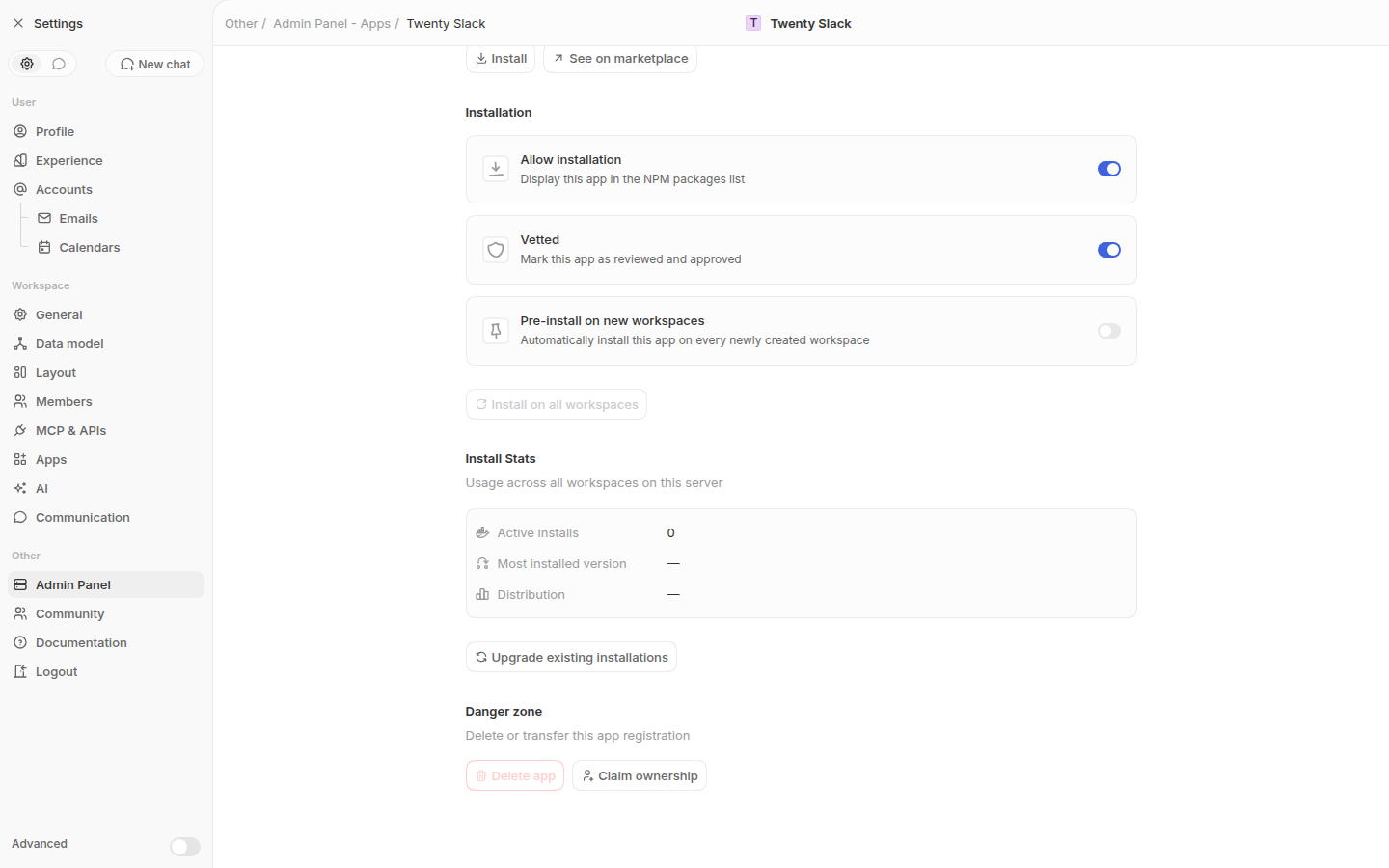
Confirmation modal with the new batch size input (defaults to 5):
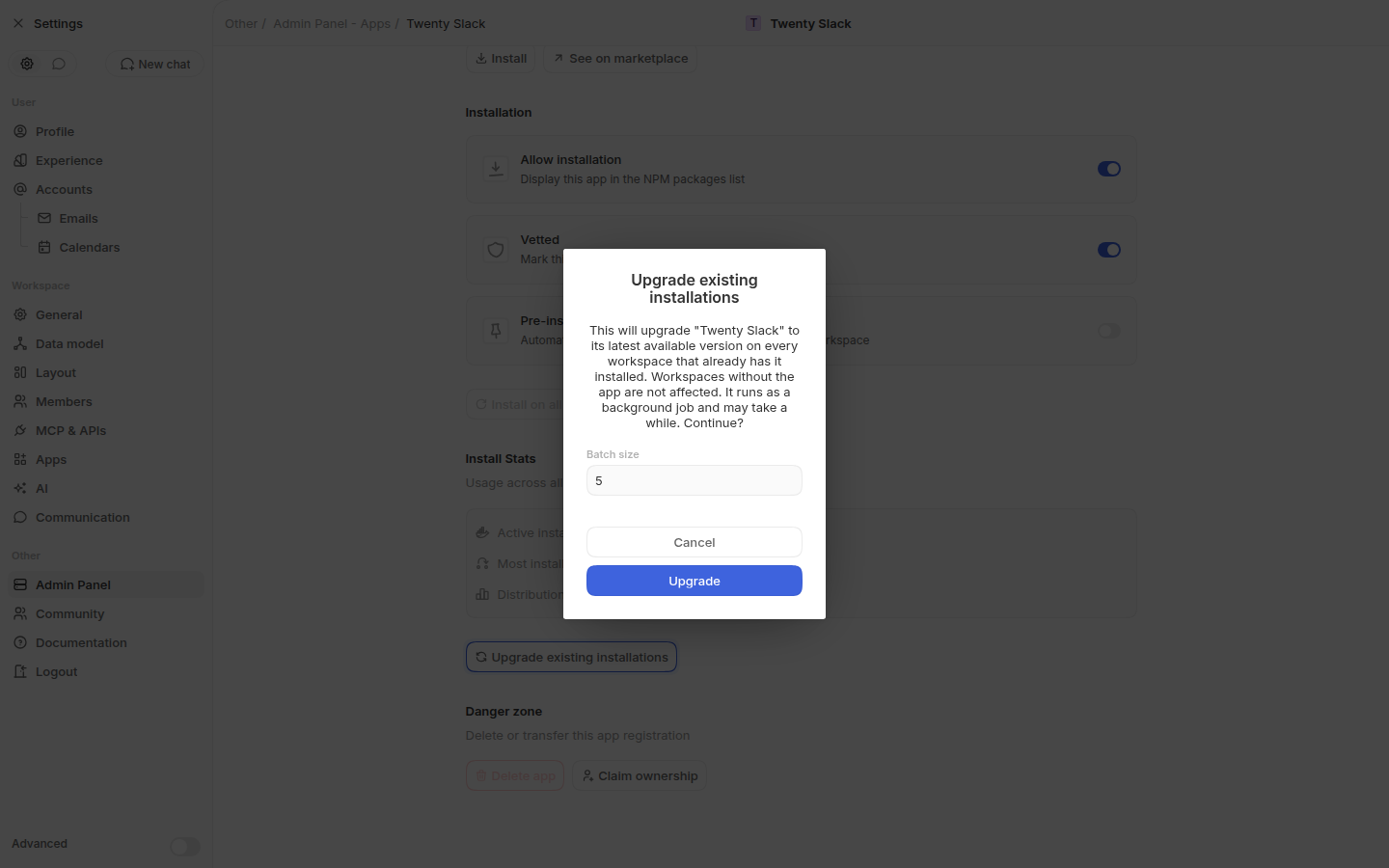
---------
Co-authored-by: Martin <martin@twenty.com>
Adds the text-editing events input-heavy front components need:
`beforeinput`, `compositionstart/update/end` and `copy/paste/cut`,
allowed on `input` and `textarea` only.

These events carry payload: `beforeinput` forwards `inputType`/`data`
through a native host listener (React synthesizes `onBeforeInput`
without them), composition events forward `data`, and paste forwards
`clipboardData.getData('text')` capped at 100k chars. Clipboard text is
read only on an explicit paste into the component's own input, never on
copy/cut, and the worker synthesizes a minimal `clipboardData` so
`onPaste` handlers work. `beforeinput` is observe-only: `preventDefault`
cannot cross the async worker boundary.

Allow-listing these events makes the host bind them, so the
`buildHostReactPropsFromRemoteProps` test that pinned them as rejected
now pins events that are still unmapped.

<!-- This is an auto-generated description by cubic. -->
<a
href="https://cubic.dev/pr/twentyhq/twenty/pull/22630?utm_source=github"
target="_blank" rel="noopener noreferrer"
data-no-image-dialog="true"><picture><source
media="(prefers-color-scheme: dark)"
srcset="https://www.cubic.dev/buttons/review-in-cubic-dark.svg"><source
media="(prefers-color-scheme: light)"
srcset="https://www.cubic.dev/buttons/review-in-cubic-light.svg"><img
alt="Review in cubic"
src="https://www.cubic.dev/buttons/review-in-cubic-dark.svg"></picture></a>
<!-- End of auto-generated description by cubic. -->
The in-memory `isMatchingMultiSelectFilter` evaluated the `containsAny`
operand with `Array.every`, which requires a record to hold **all**
selected options. But `containsAny` means "any overlap": the server
evaluates it as a Postgres array-overlap (`field::text[] &&
ARRAY[...]`), and the "Contains" UI operand for a MULTI_SELECT field
builds exactly this operand — both match on **at least one** shared
option.

So the matcher disagreed with the server. In a "Tags contains any of [A,
B]" view, an optimistic create/update of a record whose tags are just
`[A]` was treated as not matching, so it failed to appear (or was
wrongly dropped) until a refetch; `DOES_NOT_CONTAIN` (built as `not {
containsAny }`) inverted the same way. The same helper backs the
row-level-permission predicate matcher.

Switched to `Array.some` to match the OR semantics, and updated the
tests (partial-overlap, single-overlap, no-overlap, empty-array). The
sibling `isMatching*Filter` helpers were checked — this is the only
affected one.


<!-- This is an auto-generated description by cubic. -->
<a
href="https://cubic.dev/pr/twentyhq/twenty/pull/23010?utm_source=github"
target="_blank" rel="noopener noreferrer"
data-no-image-dialog="true"><picture><source
media="(prefers-color-scheme: dark)"
srcset="https://www.cubic.dev/buttons/review-in-cubic-dark.svg"><source
media="(prefers-color-scheme: light)"
srcset="https://www.cubic.dev/buttons/review-in-cubic-light.svg"><img
alt="Review in cubic"
src="https://www.cubic.dev/buttons/review-in-cubic-dark.svg"></picture></a>
<!-- End of auto-generated description by cubic. -->
 github-actions[bot]



