153e41e0366314cbb7ec00c253c32dcab71a9b6a
12947 Commits
| Author | SHA1 | Message | Date | |
|---|---|---|---|---|
 Charles Bochet Charles Bochet
|
153e41e036 |
ci: block bot contributors from PR commit history (#21926)
## What Adds a CI check (`Blocked Contributors Check`) that runs on every PR and **fails** if any commit is attributed to a known bot — via the commit author, committer, or a `Co-Authored-By:` trailer. Goal: keep automated agents (Claude, Cursor, Copilot, …) out of Twenty's contributor history. ## How - On `pull_request` (`opened`, `synchronize`, `reopened`) it fetches all PR commits via the GitHub API and matches author/committer name+email and the full commit message (for trailers) against an editable blocklist. - Patterns target **bot identities** (emails / `[bot]` handles), **not** bare first names — so a human contributor named "Claude" is *not* flagged. - On failure it emits `::error::` annotations naming the offending SHA + what matched, plus remediation guidance (rebase with `--reset-author`, strip trailers, force-push). Current blocklist: ``` noreply@anthropic.com @anthropic.com cursoragent@cursor.com copilot-swe-agent[bot] ``` Add a line to block another bot — no logic changes needed. ## Notes - This workflow only *reports* a failed status. To actually block merges, add **Blocked Contributors Check** as a required status check in branch-protection rules for `main` (repo Settings → Branches). - `@anthropic.com` also blocks any Anthropic-domain identity; narrow to just `noreply@anthropic.com` if real Anthropic employees may contribute under their work email. <!-- This is an auto-generated description by cubic. --> <a href="https://cubic.dev/pr/twentyhq/twenty/pull/21926?utm_source=github" target="_blank" rel="noopener noreferrer" data-no-image-dialog="true"><picture><source media="(prefers-color-scheme: dark)" srcset="https://www.cubic.dev/buttons/review-in-cubic-dark.svg"><source media="(prefers-color-scheme: light)" srcset="https://www.cubic.dev/buttons/review-in-cubic-light.svg"><img alt="Review in cubic" src="https://www.cubic.dev/buttons/review-in-cubic-dark.svg"></picture></a> <!-- End of auto-generated description by cubic. --> |
||
|
Abdul Rahman
|
1b7dc0367e |
fix(ai): gemini not working in ask ai (#21898)
Upstream issue: https://github.com/vercel/ai/issues/14369 Gemini 400s whenever a tool result contains JSON Schema `$ref`/`$defs` (it reads `$ref` as a function declaration name and finds no match). We hit this because `learn_tools` returns tool input schemas, and our recursive filter schema emits `$ref`/`$defs`. Other providers accept it fine, so this only blocks Gemini. Adds a Google-only `wrapLanguageModel` middleware that serializes ref-bearing tool results to text before they reach Gemini, so the pointers travel as a string instead of structured keys. The model still reads the full schema (same as the MCP path). Guarded so normal tool results pass through untouched. <!-- This is an auto-generated description by cubic. --> <a href="https://cubic.dev/pr/twentyhq/twenty/pull/21898?utm_source=github" target="_blank" rel="noopener noreferrer" data-no-image-dialog="true"><picture><source media="(prefers-color-scheme: dark)" srcset="https://www.cubic.dev/buttons/review-in-cubic-dark.svg"><source media="(prefers-color-scheme: light)" srcset="https://www.cubic.dev/buttons/review-in-cubic-light.svg"><img alt="Review in cubic" src="https://www.cubic.dev/buttons/review-in-cubic-dark.svg"></picture></a> <!-- End of auto-generated description by cubic. --> --------- Co-authored-by: Charles Bochet <charles@twenty.com> |
||
|
Mani bharadwaj
|
3ad5259106 |
fix(twenty-server): remove uuid format from openapi pageInfo cursors (#21920)
## Summary The OpenAPI schema for list responses declared `pageInfo.startCursor` and `pageInfo.endCursor` with `format: 'uuid'`, but the API actually returns base64-encoded cursor strings. This makes the documented schema inconsistent with the real response and breaks client generators that trust the `uuid` format. Closes #20003 ## Changes - Removed `format: 'uuid'` from `startCursor` and `endCursor` in `getFindManyResponse200`. - Removed `format: 'uuid'` from `startCursor` and `endCursor` in `getFindDuplicatesResponse200`. ## Verification - `npx nx lint:diff-with-main twenty-server` passed. - `npx oxlint` on the modified file passed with 0 warnings/errors. - `npx nx jest twenty-server --testPathPattern=open-api/utils` passed (11 tests, 4 snapshots). Note: `npx nx typecheck twenty-server` and the default `nx test` target hit pre-existing build errors in `twenty-ui` (unrelated Tabler icon/type mismatches), so I used the project`s `jest` target for focused verification. <!-- This is an auto-generated description by cubic. --> <a href="https://cubic.dev/pr/twentyhq/twenty/pull/21920?utm_source=github" target="_blank" rel="noopener noreferrer" data-no-image-dialog="true"><picture><source media="(prefers-color-scheme: dark)" srcset="https://www.cubic.dev/buttons/review-in-cubic-dark.svg"><source media="(prefers-color-scheme: light)" srcset="https://www.cubic.dev/buttons/review-in-cubic-light.svg"><img alt="Review in cubic" src="https://www.cubic.dev/buttons/review-in-cubic-dark.svg"></picture></a> <!-- End of auto-generated description by cubic. --> Co-authored-by: Claude <noreply@anthropic.com> |
||
|
Félix Malfait
|
2abf9c2930 |
feat(workflow): Pick Record load balanced strategy (3/3) (#21902)
## Overview Final PR in the Pick Record stack. Adds the **Load Balanced** strategy: pick the candidate that currently has the *fewest related records*. This is the "fair assignment" mode — e.g. assign a new company to the account owner who currently owns the fewest companies, or route a lead to the rep with the fewest open opportunities. **Stacked on #21900** (which is stacked on #21899) — merge in order. This PR's diff against `main` includes PRs 1 & 2 until they merge. ## What changed - Widened the `strategy` enum to add `LOAD_BALANCED`, and added an optional `loadBalance: { objectNameSingular, fieldName }` to the action input. - Editor: selecting **Load balanced** reveals a **Balance by** object picker and a **Count by** field picker (the related object's many-to-one relation fields). - Executor: for each candidate, counts records of the chosen related object whose chosen relation points at that candidate, then selects the least-loaded one. ## How it works Given pool = workspace members and config `{ objectNameSingular: "opportunity", fieldName: "pointOfContact" }`, the executor counts, per member, the opportunities whose `pointOfContact` is that member, and picks the member with the lowest count. ## Design decisions & tradeoffs 1. **No persistent state — computed live each run.** Unlike round robin, load balancing reads current data, so there's no cursor to store. Correct by construction even under concurrency (each run recomputes counts); the only caveat is two simultaneous runs can both see the same "least loaded" candidate before either assignment lands (a small, self-correcting skew), which is inherent to load-balancing and acceptable. 2. **Count via per-candidate queries.** One filtered count per candidate (`{ [relationField]: { id: { eq: candidateId } } }`), run in parallel. For the realistic pool sizes this targets (a team), this is simple and clear. A single `group_by` aggregate would scale better for very large pools — noted as a future optimization, deliberately not done to keep the logic obvious. 3. **Deterministic tie-break.** Candidates are pre-sorted by id (shared with round robin), and the first minimum wins — so equal-load ties resolve deterministically rather than arbitrarily. 4. **`Count by` lists all many-to-one relations of the chosen object** (not filtered to those targeting the pool object). Keeps the editor simple; picking an unrelated field just yields zero counts, which is visibly wrong. Filtering options to relations that target the pool object is a nice follow-up. 5. **Filter on the counted set** (e.g. only *open* opportunities) is intentionally out of scope for this first cut — documented as a follow-up. ## Testing Added `pick-record-load-balanced-workflow.integration-spec.ts`: creates two fresh companies (0 related opportunities each), attaches one opportunity to the second, configures `LOAD_BALANCED` counting opportunities by `company`, and asserts the step picks the **first** company (0 < 1). Passes locally alongside the random and round-robin tests (3 suites / 4 tests). `typecheck` + `lint:diff-with-main` green for shared/server/front. ## The full stack 1. #21899 — Random (the action + the whole scaffold) 2. #21900 — Round robin (atomic Redis cursor) 3. this — Load balanced Together these enable round-robin / load-balanced / random **assignment workflows** in Twenty, composed via the standard variable picker (assign the chosen record downstream with `{{step.<id>.id}}`). https://claude.ai/code/session_01MuPWZsqf2bmQSevk6fRbX8 --- _Generated by [Claude Code](https://claude.ai/code/session_01MuPWZsqf2bmQSevk6fRbX8)_ <!-- This is an auto-generated description by cubic. --> <a href="https://cubic.dev/pr/twentyhq/twenty/pull/21902?utm_source=github" target="_blank" rel="noopener noreferrer" data-no-image-dialog="true"><picture><source media="(prefers-color-scheme: dark)" srcset="https://www.cubic.dev/buttons/review-in-cubic-dark.svg"><source media="(prefers-color-scheme: light)" srcset="https://www.cubic.dev/buttons/review-in-cubic-light.svg"><img alt="Review in cubic" src="https://www.cubic.dev/buttons/review-in-cubic-dark.svg"></picture></a> <!-- End of auto-generated description by cubic. --> |
||
|
github-actions[bot]
|
82f6597dc3 |
i18n - docs translations (#21923)
Created by Github action <!-- This is an auto-generated description by cubic. --> <a href="https://cubic.dev/pr/twentyhq/twenty/pull/21923?utm_source=github" target="_blank" rel="noopener noreferrer" data-no-image-dialog="true"><picture><source media="(prefers-color-scheme: dark)" srcset="https://www.cubic.dev/buttons/review-in-cubic-dark.svg"><source media="(prefers-color-scheme: light)" srcset="https://www.cubic.dev/buttons/review-in-cubic-light.svg"><img alt="Review in cubic" src="https://www.cubic.dev/buttons/review-in-cubic-dark.svg"></picture></a> <!-- End of auto-generated description by cubic. --> Co-authored-by: github-actions <github-actions@twenty.com> |
||
|
Félix Malfait
|
fa6d1394af |
feat(workflow): Pick Record round robin strategy (2/3) (#21900)
## Overview Second PR in the Pick Record stack. Adds a **Round Robin** selection strategy alongside Random, so an assignment workflow can distribute records *evenly* across a candidate pool (e.g. rotate company ownership across a set of workspace members) rather than just randomly. **Stacked on #21899** — review/merge that one first. This PR's diff against `main` includes PR 1's commits until #21899 merges. ## What changed - Widened the `strategy` enum (`RANDOM` → `RANDOM | ROUND_ROBIN`) in the shared schema and the server input type. - Editor now shows a **Strategy** selector (Random / Round robin). The candidate-pool label changed from "Pick at random from" to the neutral "Pick from" since random is no longer the only mode. - Executor implements round robin. ## Design decisions & tradeoffs 1. **State store: Redis `incrBy` (atomic), keyed `pick-record:round-robin:{workspaceId}:{stepId}`.** Round robin needs a persistent cursor, and workflow runs are **not** serialized — two runs can execute the same step concurrently — so the increment must be atomic. `CacheStorageService.incrBy` (workflow cache namespace) is a single atomic Redis op, needs no schema change, and is already injectable. Index = `(cursor - 1) % poolSize`. **Tradeoff — durability:** a Redis flush/eviction resets the cursor, which restarts the cycle from an offset. That causes a one-time *fairness drift*, never a *correctness* bug (no double-assignment, since each increment is atomic). If strict durability is ever required, the cursor can move to a Postgres counter table with `INSERT … ON CONFLICT … DO UPDATE SET cursor = cursor + 1 RETURNING cursor` (atomic + durable) — deliberately **not** done here to avoid a migration for what is, in practice, an acceptable reset. 2. **Deterministic pool ordering.** The resolved pool is sorted by `id` before the cursor is applied, so position→record mapping is stable run-to-run regardless of fetch order. Without this, round robin wouldn't reliably cycle. 3. **Cursor key uses `stepId`.** Stable across runs of a published version. Republishing a version may mint new step ids, which resets the cursor — acceptable and documented here. 4. **Slot-on-increment.** The cursor increments when the step runs (reserving a position); if a later step in the run fails, that position is effectively skipped. Minor, acceptable unfairness — flagged rather than adding cross-step compensation. ## Testing Added `pick-record-round-robin-workflow.integration-spec.ts`: builds a workflow with a 3-record pool and `ROUND_ROBIN`, runs it 4 times sequentially, and asserts the picks are exactly `[p0, p1, p2, p0]` (full cycle + wraparound) against the deterministically-ordered pool. Passes locally alongside PR 1's random test (2 suites / 3 tests). `typecheck` + `lint:diff-with-main` green for shared/server/front. ## Follow-up - PR 3: `LOAD_BALANCED` (fewest related records wins). https://claude.ai/code/session_01MuPWZsqf2bmQSevk6fRbX8 --- _Generated by [Claude Code](https://claude.ai/code/session_01MuPWZsqf2bmQSevk6fRbX8)_ <!-- This is an auto-generated description by cubic. --> <a href="https://cubic.dev/pr/twentyhq/twenty/pull/21900?utm_source=github" target="_blank" rel="noopener noreferrer" data-no-image-dialog="true"><picture><source media="(prefers-color-scheme: dark)" srcset="https://www.cubic.dev/buttons/review-in-cubic-dark.svg"><source media="(prefers-color-scheme: light)" srcset="https://www.cubic.dev/buttons/review-in-cubic-light.svg"><img alt="Review in cubic" src="https://www.cubic.dev/buttons/review-in-cubic-dark.svg"></picture></a> <!-- End of auto-generated description by cubic. --> |
||
|
Félix Malfait
|
a682c8fa62 |
feat(sdk): declare row-level permission predicates in the role manifest (#21919)
## Why Apps can declare object and field permissions on a role via `defineRole`, but **not row-level security**. The RLS engine and the metadata-sync machinery already support predicates fully — they're first-class universal flat entities, the `FlatRole` already carries `rowLevelPermissionPredicateUniversalIdentifiers`, and the workspace-migration layer has builders/validators/handlers for them. The only gap was the **manifest layer**: `RoleManifest` had no field for predicates, so the sync converter always left them empty. As a result, the only way to ship RLS with an app was a post-install script that pushed predicates through the `upsertRowLevelPermissionPredicates` mutation. That mutation assigns predicates to the workspace's **generic custom application**, not the app that owns the role — so a single role's definition ends up split across two applications and drifts on every upgrade (you have to remember to re-run the script). The Partner app does exactly this today via `configure-partner-rls.ts`. ## What Adds `rowLevelPermissionPredicates` and `rowLevelPermissionPredicateGroups` to `RoleManifest` / `RoleConfig`, mirroring how `objectPermissions` / `fieldPermissions` already flow end-to-end: - **twenty-shared** — predicate + predicate-group manifest types on `RoleManifest` (referencing objects/fields by `universalIdentifier`, operand/logical-operator from the existing GraphQL enums). - **twenty-sdk** — `defineRole` accepts and validates them; the build derives deterministic predicate `universalIdentifier`s (groups keep an explicit one so predicates can reference them). - **twenty-server** — two converters turn manifest predicates/groups into universal flat entities during application-manifest sync, so they are created/updated/deleted together with the role and **owned by the app that ships it**. ### Bug fix found along the way The migration build order ran the `rowLevelPermissionPredicate(Group)` builders **before** the `role` builder, so a predicate declared alongside a brand-new role failed validation with `ROLE_NOT_FOUND`. They now run **after** the role builder, exactly like object/field permissions. ## Partner app (second commit) Converts `partner.role.ts` to declare its five predicates inline and **deletes `configure-partner-rls.ts`** + the `rls:configure` scripts — the workaround this PR is meant to retire. The predicates are byte-for-byte the same semantics as the script produced. > Live-deployment note: the existing script-created predicates are owned by the *custom* application, so the Partner app sync won't touch them. Clear them once (e.g. an empty upsert on the Partner role) around deploy to avoid duplicates. Kept as a **separate commit** so it can be split out if reviewers prefer. ## Testing - **Integration (full app):** new `successful-manifest-sync-row-level-permission-predicate.integration-spec.ts` — installs an app whose role declares a predicate and asserts the predicate row is created (and **owned by the app**, not the custom app), updated in place on re-sync, removed when dropped from the manifest, and removed on uninstall. Ran locally against a seeded test DB ✅. - Re-ran the existing cross-app permission + view-field manifest suites to confirm the build-order change doesn't regress object/field-permission sync (13/13 ✅). - **Unit (utils only):** `defineRole` validation and `fromRoleConfigToRoleManifest` deterministic-id derivation. - Docs: new "Row-level security" section in `apps/config/roles.mdx`. ## Scope notes / possible follow-ups - Surfacing RLS in the app-install permission summary UI was intentionally left out (predicates *restrict* rather than grant, and typically live on a non-default role) — easy follow-up if wanted. - The `upsertRowLevelPermissionPredicates` mutation still homes out-of-band predicates on the custom app for app-owned roles; making that consistent (or rejecting it, like field permissions already do) is a sensible follow-up. https://claude.ai/code/session_01MipAis9z9okd4oCm9HCKEf --- _Generated by [Claude Code](https://claude.ai/code/session_01MipAis9z9okd4oCm9HCKEf)_ <!-- This is an auto-generated description by cubic. --> <a href="https://cubic.dev/pr/twentyhq/twenty/pull/21919?utm_source=github" target="_blank" rel="noopener noreferrer" data-no-image-dialog="true"><picture><source media="(prefers-color-scheme: dark)" srcset="https://www.cubic.dev/buttons/review-in-cubic-dark.svg"><source media="(prefers-color-scheme: light)" srcset="https://www.cubic.dev/buttons/review-in-cubic-light.svg"><img alt="Review in cubic" src="https://www.cubic.dev/buttons/review-in-cubic-dark.svg"></picture></a> <!-- End of auto-generated description by cubic. --> |
||
|
Félix Malfait
|
573fd00ea7 |
feat(workflow): add Pick Record action (1/3 — random selection) (#21899)
## Overview

Adds a new workflow action, **Pick Record**, that selects **one** record
from a configured candidate pool and exposes the chosen record as the
step's output. Downstream steps can then reference it through the normal
variable picker — e.g. assign an owner in an _Update Record_ step by
setting **Account Owner = `{{step.<pickRecordId>.id}}`**.

This is the foundation for building **assignment workflows**
(round-robin / load-balanced owner assignment, reviewer rotation, etc.)
in Twenty.

## This is PR 1 of a 3-PR stack

| PR | Strategy | Adds |
|----|----------|------|
| **1 (this one)** | `RANDOM` | The whole `PICK_RECORD` action,
end-to-end, stateless |
| 2 | `ROUND_ROBIN` | A persistent, atomically-incremented per-step
cursor + the strategy selector UI |
| 3 | `LOAD_BALANCED` | "fewest related records wins" via an aggregate
count |

Each PR widens the `strategy` enum (a backward-compatible change), so no
data migration is needed between them.

## How it works

- **Editor**: pick an Object, then pick the candidate records (a
multi-record selector). A random record is selected from that pool at
run time.
- **Output**: a single record of the chosen object — the same output
shape as `CREATE_RECORD`/`UPDATE_RECORD` — so it drills into
`{{step.x.id}}`, `{{step.x.name}}`, … in the variable picker.
- **Execution**: reuses `FindRecordsService` to fetch the pool (`id IN
(recordIds)`, which also transparently drops any deleted candidates),
then returns one at random.

## Design decisions & tradeoffs

1. **Standalone step that outputs a variable, not an inline "random"
mode on the relation field.** This mirrors Attio's round-robin block.
The decisive reason is composition: the chosen record is almost always
reused (assign owner **and** create a follow-up task for them **and**
email them). A variable is chosen once and reused everywhere; an inline
per-field value would re-roll independently in each place. It also keeps
the (stateful) round-robin/load-balanced logic out of the field inputs.
Tradeoff: one extra step to wire up vs. an inline control — accepted for
the composability win. An inline "Assign automatically" entry point can
still be layered on later as sugar that inserts this step.

2. **Co-located in the `record-crud` action module and reuses
`FindRecordsService`.** Avoids duplicating module wiring (auth context,
permissions, object-metadata resolution) and the data-access path.
Tradeoff: "Pick" is a selection rather than a CRUD op, so the folder
name is slightly broad; chose reuse + low risk over a separate module.
Can be extracted if the family grows.

3. **`strategy` exists in the schema (defaulted `RANDOM`) but the
selector is hidden in this PR.** A dropdown with a single option would
be UX slop, and adding the field only in PR 2 would force a data
backfill for any `PICK_RECORD` steps created in between. Keeping the
field now (hidden) avoids both. PR 2 introduces the selector once
there's a real choice.

4. **Pool is an explicit static list (`recordIds`) for v1.** Matches the
most common assignment case ("rotate among these N people") and reuses
the existing `FormMultiRecordPicker`. A filter-based pool (reusing the
Find Records filter UI) and a list-from-a-previous-step pool are natural
follow-ups, intentionally out of scope here to keep the stack focused on
the three strategies.

5. **Output schema is computed on the frontend** (like `CREATE_RECORD`),
derived from `input.objectName` — so it is **not** added to
`PERSISTED_OUTPUT_SCHEMA_TYPES` and needs no server-side schema
computation.

6. **Validation**: `PICK_RECORD` is added to object-name metadata
validation (so a deleted/invalid target object is flagged) via a
dedicated `OBJECT_TARGETING_ACTION_TYPES` set — deliberately **not** to
`VARIABLE_CONSUMING_ACTION_TYPES`, because a static pool legitimately
references no upstream variable and would otherwise raise a spurious "no
variable reference" warning.

7. **Empty pool → step error** at run time (respecting the step's
error-handling options) rather than a silent no-op, since an empty pool
is a misconfiguration or fully-deleted set.

8. **`Math.random`** is used for selection — no cryptographic guarantee
is needed for assignment fairness.

## Testing

Per our testing convention (integration test over service/`.spec`
tests): added `pick-record-workflow.integration-spec.ts`, which builds a
workflow with a manual trigger + a `PICK_RECORD` step, configures a
known two-record pool, runs it, and asserts the run completes and the
picked record is **always** within the configured pool (verifying the
pool filter) across repeated runs.

Local verification (typecheck + lint for shared/server/front) is green;
running the integration suite and attaching editor screenshots in a
follow-up comment.

## Follow-ups

- PR 2: `ROUND_ROBIN` + persistent atomic cursor (Redis `incrBy` vs. a
Postgres counter table — tradeoff to be documented on that PR) +
strategy selector.
- PR 3: `LOAD_BALANCED`.
- Later (not in this stack): filter-based / variable-list pools, an
inline "Assign automatically" entry point on relation fields, OOO-skip /
weighting.

https://claude.ai/code/session_01MuPWZsqf2bmQSevk6fRbX8

---
_Generated by [Claude
Code](https://claude.ai/code/session_01MuPWZsqf2bmQSevk6fRbX8)_

<!-- This is an auto-generated description by cubic. -->
<a
href="https://cubic.dev/pr/twentyhq/twenty/pull/21899?utm_source=github"
target="_blank" rel="noopener noreferrer"
data-no-image-dialog="true"><picture><source
media="(prefers-color-scheme: dark)"
srcset="https://www.cubic.dev/buttons/review-in-cubic-dark.svg"><source
media="(prefers-color-scheme: light)"
srcset="https://www.cubic.dev/buttons/review-in-cubic-light.svg"><img
alt="Review in cubic"
src="https://www.cubic.dev/buttons/review-in-cubic-dark.svg"></picture></a>
<!-- End of auto-generated description by cubic. -->
|
||
|
Charles Bochet
|
f4219449db |
fix(front): prevent AI agent output field error message from overlapping the Type field (#21921)
## Problem Follow-up to #21834, found during QA. That PR added an inline validation error on the AI Agent **Output → Variable Name** field. The error is rendered with `InputErrorHelper`, which is `position: absolute`. When the message wraps to two lines (which it does at the side-panel width), it is taken out of the layout flow and **overlaps the "Type" selector** directly below it: ``` Variable Name [ sdlfkj sdlkj ] Use only letters, numbers, underscores, dots or hyphens (max 64 Type <-- overlapped by the error message [ Text ▾ ] ``` ## Fix Render the error with `InputHint danger` instead of `InputErrorHelper`, matching how the sibling `FormNumberFieldInput` already shows its errors. `InputHint` flows in the column (`margin-top`, not absolute), so the error reserves its own space and pushes the following fields down instead of overlapping them. This is a one-line behaviour change in `FormTextFieldInput`; no new component or styling is introduced. ## After The `Type` field is pushed below the wrapped error message with correct spacing: 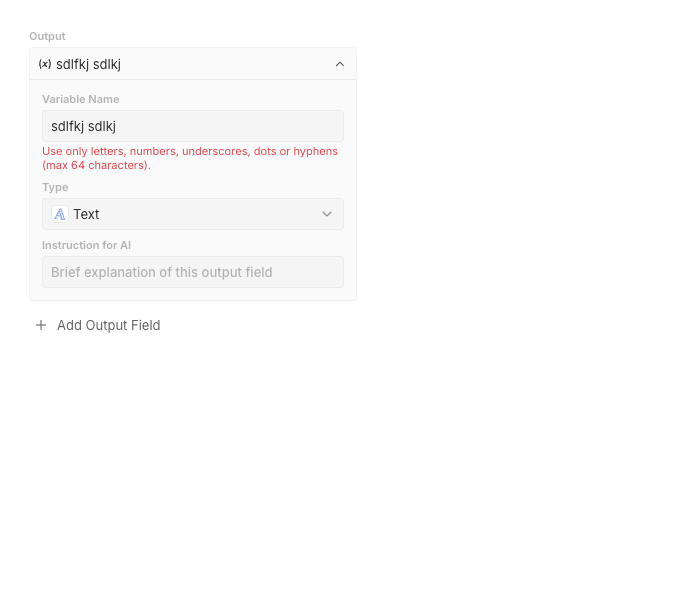 ## Tests - Added a `WithError` story to `FormTextFieldInput` (mirrors the existing `FormNumberFieldInput` `WithError` story) asserting the error message is visible. ## QA Reproduced and verified in Storybook against the real `WorkflowOutputSchemaBuilder` (throwaway story, not committed): before the fix the error overlapped `Type`; after the fix the `Type` field is pushed below the wrapped message with correct spacing. |
||
|
Charles Bochet
|
334e962ab5 |
fix: cannot create record from table view — empty morph to-many relation returns null (#21846)
## Problem

Creating a record from the table view (reproduced on **People**) crashes
the client even though the `createOne…` mutation succeeds server-side,
so the record never appears:

```
Cannot read properties of null (reading 'map')
  getRecordConnectionFromRecords → getRecordNodeFromRecord → optimistic cache effect → createOneRecord
```

## Root cause

An empty **morph** to-many relation comes back as `null`, while every
other to-many relation comes back as `{ edges: [] }`. The frontend then
runs `null.map` while building the optimistic cache node; the error
escapes the mutation `update`, the rollback evicts the record, and it
never lands in the table.

## Fix

**Server** — plain to-many relations are hydrated to `[]` and formatted
to `{ edges: [] }` by `ObjectRecordsToGraphqlConnectionHelper`; an empty
morph to-many was left undefined and the field was skipped (→ `null`).
Default an unset to-many value to `[]` so it goes through the **same
connection path as plain to-many relations**.

**Frontend** — defensive guard in `getRecordNodeFromRecord`: a to-many
relation whose value isn't an array is skipped instead of crashing,
mirroring the existing guard in `extractTargetRecordsFromRelation`.
Needed regardless, since cached data / SSE / older servers still send
`null`.

## Tests

- Unit: `getRecordNodeFromRecord` skips a null to-many (reproduces the
exact crash without the guard).
- Integration: an empty morph `ONE_TO_MANY` read returns `{ edges: []
}`, not null.
|
||
|
Félix Malfait
|
a0689d1577 |
feat(workflow): condition filter on database-event triggers (#21868)
## Problem

Connecting a mailbox bulk-creates contacts via the email/calendar sync,
and each `person.upserted` fires the seeded **"Create company when
adding a new person"** workflow. The trigger enqueues one run per record
(no batching) and each run bills several `WORKFLOW_NODE_RUN` events — so
a single mailbox connect can rack up tens of thousands of runs and
exhaust credits on a brand-new workspace. The workflow is also redundant
on that path: the sync already creates the company from the email domain
and links the person to it.

## What this does

Adds an optional, user-defined **filter** to database-event (listener)
triggers, evaluated in the listener **before a run is enqueued**.
Non-matching events never create a run, so they consume zero execution
credits. This is the Filter node's capability, lifted to the trigger
level, and available for all event types (created / updated / upserted /
deleted).

The seeded "Create company when adding a new person" workflow now
carries a visible trigger filter — `Created by → Source is not Email`
**and** `is not Calendar` — so it no longer runs for sync-created
contacts, while still running for manually / API / CSV-added people.

## How (reuse)

- **Backend:** extracted `evaluateStepFilters()`, shared by the Filter
action and the trigger listener's new `eventMatchesRecordFilter` gate.
The record is exposed under the `trigger` key so filters reference it
exactly like steps do (`{{trigger.properties.after.…}}`).
- **Shared:** one optional `filter` added to the database-event trigger
zod schema; the front-end type derives from it (settings stay JSON — no
codegen).
- **Frontend:** extracted `WorkflowStepFilterBuilder` from the Filter
action's body; both the Filter action and the trigger editor render it.
The field picker needed no changes — at the trigger it already resolves
to the record's own fields via `TRIGGER_STEP_ID`.

## Scope / decisions

- **No migration for existing workspaces** (by request) — only newly
created workspaces get the filtered default; already-created workspaces
keep the always-on workflow.
- Deliberately did **not** add relation-enrichment to the upsert path
(it would add a DB lookup to the very bulk-sync path we're relieving).
Trigger filters work on the record's own scalar/composite fields (e.g.
`createdBy.source`); relation-based filters work on created/updated
where enrichment already runs.

## Verification

- Typecheck: `twenty-shared`, `twenty-server`, `twenty-front` all green.
- Lint (diff, autofix): 0 warnings / 0 errors across all three.
- Unit tests: a new `evaluate-step-filters` spec exercising the exact
`createdBy.source IS_NOT` seed mechanism, plus new listener specs
proving non-matching events are not enqueued. All backend
filter/listener suites pass.
- Not run here: integration tests (need a DB) and Storybook.

https://claude.ai/code/session_013k36vfekDppwRCgM6Ha7De

---
_Generated by [Claude
Code](https://claude.ai/code/session_013k36vfekDppwRCgM6Ha7De)_

<!-- This is an auto-generated description by cubic. -->
<a
href="https://cubic.dev/pr/twentyhq/twenty/pull/21868?utm_source=github"
target="_blank" rel="noopener noreferrer"
data-no-image-dialog="true"><picture><source
media="(prefers-color-scheme: dark)"
srcset="https://www.cubic.dev/buttons/review-in-cubic-dark.svg"><source
media="(prefers-color-scheme: light)"
srcset="https://www.cubic.dev/buttons/review-in-cubic-light.svg"><img
alt="Review in cubic"
src="https://www.cubic.dev/buttons/review-in-cubic-dark.svg"></picture></a>
<!-- End of auto-generated description by cubic. -->

---------

Co-authored-by: Claude <noreply@anthropic.com>
|
||
|
Weiko
|
f8db73598c |
Fix dangling relation fields crashing records after deleting a custom object (#21874)
Fixes https://github.com/twentyhq/twenty/issues/21706 ## Context Deleting a custom object that has relation/junction fields pointing to it (e.g. a junction object linked from Person and Company) crashes record pages with `Target object metadata item not found for <field>`. The backend cascade correctly deletes the related relation fields, view fields and page-layout widgets, but the frontend metadata store only removed the deleted object itself, leaving dangling relation fields (and stale UI-layer references) behind. ## Fix After a successful deletion, `useDeleteOneObjectMetadataItem` now calls `invalidateMetadataStore()`, triggering the existing reconcile path that refetches objects, fields, indexes, views, view fields and page-layout widgets. This removes the dangling relations and cleans up the UI layers in one consistent pass (also replacing the previous manual command-menu refetch). <!-- This is an auto-generated description by cubic. --> <a href="https://cubic.dev/pr/twentyhq/twenty/pull/21874?utm_source=github" target="_blank" rel="noopener noreferrer" data-no-image-dialog="true"><picture><source media="(prefers-color-scheme: dark)" srcset="https://www.cubic.dev/buttons/review-in-cubic-dark.svg"><source media="(prefers-color-scheme: light)" srcset="https://www.cubic.dev/buttons/review-in-cubic-light.svg"><img alt="Review in cubic" src="https://www.cubic.dev/buttons/review-in-cubic-dark.svg"></picture></a> <!-- End of auto-generated description by cubic. --> |
||
|
Abdul Rahman
|
544c89119c |
fix: hide restricted objects and views nested in navigation folders (#21914)
Closes #20141 <!-- This is an auto-generated description by cubic. --> <a href="https://cubic.dev/pr/twentyhq/twenty/pull/21914?utm_source=github" target="_blank" rel="noopener noreferrer" data-no-image-dialog="true"><picture><source media="(prefers-color-scheme: dark)" srcset="https://www.cubic.dev/buttons/review-in-cubic-dark.svg"><source media="(prefers-color-scheme: light)" srcset="https://www.cubic.dev/buttons/review-in-cubic-light.svg"><img alt="Review in cubic" src="https://www.cubic.dev/buttons/review-in-cubic-dark.svg"></picture></a> <!-- End of auto-generated description by cubic. --> |
||
|
Abdullah.
|
602acf7a16 |
fix(twenty-website): fill feature-card visual frame on wide viewports (#21876)
## Problem On the home feature cards, the visual frame is capped at `max-width: 411px` (the scene's design width) and centered. Below ~411px-wide cards this is invisible, but once a card grows past 411px (wider viewports) the dark scene stops filling and the **card's light background shows on both sides** of the visual. At 1200px everything looks correct because the cards are narrower than 411px and the cap is never engaged; the issue only appears as the viewport widens. ## Fix `FeatureCard.tsx`, one file: - **Remove the `max-width: 411px` cap** (and the now-dead `margin: 0 auto`) from `CardImageFrame` so the frame fills the card width at every breakpoint. `useScaleToFit` then scales the 411×508 scene up to match — it's a CSS transform on DOM, so it stays crisp; no raster upscaling. - **Even out the card gutter** — `CardImage` padding `8px → 16px` (top + sides) so the visual's inset matches the content's 16px inset instead of stepping in. Bottom stays `0` (the content block's 16px provides the bottom gutter). The visual scenes themselves are untouched — this is purely the frame/container. ## Before <img width="1477" height="681" alt="image" src="https://github.com/user-attachments/assets/731f1ef7-e761-468e-b7aa-a5a06f8ac790" /> ## After <img width="1473" height="705" alt="image" src="https://github.com/user-attachments/assets/99d036a6-d3ad-4682-99c8-f283b5b95171" /> |
||
|
Abdullah.
|
a99d380175 |
feat(website): spotlight visual on top and uniform tile background (#21906)
Two tweaks to the product-feature tiles section: - **Spotlight visual moved to the top** — the spotlight tile now renders its visual above its content, matching the layout of the regular grid cells. - **Uniform tile background** — every tile now uses the same neutral gray background; removed the per-tile `TILE_MUTED` alternating toggle. |
||
|
Abdullah.
|
e90fb4b55c |
fix(security): bump dompurify to 3.4.11 (config/hook pollution) (#21905)
## fix(security): bump dompurify to 3.4.11 (config/hook pollution) Resolves [Dependabot Alert #1520](https://github.com/twentyhq/twenty/security/dependabot/1520) and [#1509](https://github.com/twentyhq/twenty/security/dependabot/1509). ### What `dompurify` is affected by: - **Permanent `ALLOWED_ATTR` pollution via `setConfig()`** ([#1520](https://github.com/twentyhq/twenty/security/dependabot/1520), Moderate, `<= 3.4.10`) - **Trusted Types policy survives `clearConfig()`** ([#1509](https://github.com/twentyhq/twenty/security/dependabot/1509), Low, `< 3.4.9`) Both patched in `3.4.11`. Bumps the direct `twenty-server` dep `^3.4.0 -> ^3.4.11`. ### Compatibility Both advisories are about config/hook state pollution via `setConfig`/`clearConfig`/hooks. All four of our call sites use plain `DOMPurify(window).sanitize(...)` with **default config** — no `setConfig`, `clearConfig`, `addHook`, `ALLOWED_ATTR`, or `RETURN_TRUSTED_TYPE` — so we are not on the affected path, and the fix does not change default-`sanitize` behavior. Verification: `typecheck twenty-server` passes; the `prepare-file-for-storage`, `create-html-to-text-converter`, and `email-composer` suites pass (28 tests). ### Verification - `dompurify` resolves to `3.4.11` (no `<= 3.4.10` remains). - Lockfile + single package.json pin change; `yarn install --immutable` passes. |
||
|
Abdullah.
|
d74b6aeadf |
fix(security): bump nodemailer to 9.0.1 (raw-option SSRF / file read) (#21903)
## fix(security): bump nodemailer to 9.0.1 (raw-option SSRF / file read) Resolves [Dependabot Alert #1518](https://github.com/twentyhq/twenty/security/dependabot/1518) and [#1519](https://github.com/twentyhq/twenty/security/dependabot/1519). ### What `nodemailer` `<= 9.0.0` lets the message-level `raw` option bypass `disableFileAccess`/`disableUrlAccess`, enabling **arbitrary file read** and **full-response SSRF** in the delivered message ([GHSA advisory](https://github.com/twentyhq/twenty/security/dependabot/1518), High). Patched in `9.0.1`. ### How — direct bump, no resolution - **twenty-server:** `nodemailer ^8.0.5 -> ^9.0.1` (major bump). - **seed-dependencies:** the application-package template `nodemailer ^8.0.5 -> ^9.0.1`; both `DEFAULT_PACKAGE_JSON_CHECKSUM` and `DEFAULT_YARN_LOCK_CHECKSUM` regenerated to match the recomputed seed files (the deps-layer cache key). ### Compatibility — verified nothing breaks It is a major upgrade, so the 9.0 breaking change was checked against the current tree. The only behavior change is **stricter TLS validation when nodemailer fetches remote content** (attachment `href`/`path` URLs, built-in OAuth2 token endpoints, HTTP/HTTPS proxy `CONNECT`). None of those paths are reachable here: - Attachments are passed as **content buffers**, never `path`/`href`. - Gmail OAuth uses **googleapis**, not nodemailer's built-in OAuth2. - No proxy on any transport. - The SMTP socket TLS is governed separately (unchanged). Verification: `typecheck twenty-server` passes (with `@types/nodemailer ^7.0.3`), and the `email-sender`, `gmail-message-outbound`, and `imap-smtp-caldav-connection` suites pass (10 tests). ### Not covered (follow-up) Root alert **#1521** will stay open: `imapflow@1.3.6` exact-pins `nodemailer@8.0.10`. The clean fix is `imapflow 1.4.2` (which pins nodemailer `9.0.1`), but it published 2026-06-19 and is **age-gated until ~2026-06-22** — it will land then as a parent-bump (no resolution). ### Verification - `nodemailer` resolves to `9.0.1` for twenty-server; seed lockfile has `9.0.1`; both seed checksums match the canonical recompute. - `yarn install --immutable` passes. |
||
|
Félix Malfait
|
7eafbd91c6 |
test(server): make timeline integration test self-seed its data (#21896)
## Problem

`timeline-from-object-record.integration-spec.ts` is flaky depending on
Jest shard composition. Its `beforeAll` scans the dev-seeded people for
one with message threads and one with calendar events, and throws when
none is found:

```
Expected the seeded workspace to contain a person with message threads and calendar events
```

This was observed as a deterministic failure of `server-integration-test
(2)` (failed on re-run too), while the other 15 shards were green.

## Root cause

The suite depends on **mutable shared fixture state** under two fragile
assumptions:

1. **That no sibling suite wiped the seeded people.**
`deleteAllRecords('person')` is a common pattern across the REST/GraphQL
suites — `rest-api-core-find-many`, `rest-api-core-find-one`,
`all-people-resolvers`, `search-resolver`, etc. — each hard-deletes
every person (`DELETE FROM "...".person`) and leaves only its own
handful behind, without restoring the seed. Within a shard, Jest runs
files serially (`maxWorkers: 1`) ordered by file size descending (no
timing cache in CI). `rest-api-core-find-many` (~16 KB, runs 2nd)
executes **before** `timeline-from-object-record` (~12 KB, runs 5th), so
by the time the timeline `beforeAll` runs, only 4 company-linked test
people remain — none with threads or events.
2. **That the seeder's `Math.random` participant assignment** happened
to land a thread and an event on a company-linked person within the
first 100 results — itself non-deterministic across DB resets.

It surfaced now because an unrelated PR added a new integration test
file, which changed the total file set and therefore Jest's shard
distribution, moving `timeline-from-object-record` and
`rest-api-core-find-many` into the **same shard** for the first time. It
is a latent test-isolation issue, not a product regression.

### Reproduced locally

Against a DB where `rest-api-core-find-many` had already run (person
count = 4), the timeline suite fails with the exact CI error; on a
freshly seeded DB it passes. So the failure is purely order/seed
dependent.

## Fix

Make the suite self-contained: in `beforeAll` it now provisions its own
graph via the GraphQL API and tears it down in `afterAll`:

```
company → person → messageThread → message → messageParticipant(personId)
                 ↘ calendarEvent → calendarEventParticipant(personId)
```

The timeline resolvers count threads via `messageThread → messages →
messageParticipants.personId` and events via `calendarEvent →
calendarEventParticipants.personId`, so this graph is sufficient and
minimal. The suite no longer reads any ambient seeded data, making it
independent of execution order and seeding randomness.

## Validation

- Self-seeding suite passes against the **polluted** DB (4 people, no
seeded threads/events) — the exact CI failure condition.
- Idempotent across repeated runs and leaves **no residue** (all
fixtures destroyed in `afterAll`).
- Full `--shard=2/16` run green except a pre-existing environmental
failure (`successful-save-imap-smtp-caldav-account`, fails locally with
no mail server, identical before/after this change).

https://claude.ai/code/session_013k36vfekDppwRCgM6Ha7De

---
_Generated by [Claude
Code](https://claude.ai/code/session_013k36vfekDppwRCgM6Ha7De)_

<!-- This is an auto-generated description by cubic. -->
<a
href="https://cubic.dev/pr/twentyhq/twenty/pull/21896?utm_source=github"
target="_blank" rel="noopener noreferrer"
data-no-image-dialog="true"><picture><source
media="(prefers-color-scheme: dark)"
srcset="https://www.cubic.dev/buttons/review-in-cubic-dark.svg"><source
media="(prefers-color-scheme: light)"
srcset="https://www.cubic.dev/buttons/review-in-cubic-light.svg"><img
alt="Review in cubic"
src="https://www.cubic.dev/buttons/review-in-cubic-dark.svg"></picture></a>
<!-- End of auto-generated description by cubic. -->
|
||
|
Félix Malfait
|
b8ea742a88 |
fix(front): respect user number format for counts and aggregates (#21894)
## Problem

Several user-facing numbers were rendered raw (e.g. `153909`) instead of
honoring the workspace member's **Number format** preference (e.g. `153
909` with `Spaces and comma`). The formatting utilities already existed
(`formatNumber` / `useNumberFormat`) but were not applied on these
surfaces.

## Root cause

`transformAggregateRawValueIntoAggregateDisplayValue` — the shared
helper behind every table/board/chart aggregate — returned the `COUNT`
branch as a raw string and never threaded the user's locale format into
`formatNumber` for the other branches (so they silently fell back to
`COMMAS_AND_DOT`).

Its existing `numberFormat` param actually held the chart `SHORT`/`FULL`
abbreviation setting, so it is renamed to `chartNumberFormat`, and a new
`numberFormat: NumberFormat` now carries the locale separators.

## Surfaces fixed

- Record table footer aggregates, including the raw **"Count all"**
total
- Record board column / group-section aggregates
- Aggregate chart and pie-chart center metric (including their raw
`COUNT` early-returns)
- View picker `<view> · <count>` total
- Record show breadcrumb pagination `(x/y)`
- Record index header and side panel `N selected` counts

The board-column header needs no change — it now receives an
already-formatted string from the transform.

## Out of scope (intentionally left raw)

The editable `SettingsCounter` input (formatting would break parsing),
the advanced-filter pill, the `+N` overflow badge, and the AI routing
debug display.

## Testing

- New + existing unit tests pass
(`transformAggregateRawValueIntoAggregateDisplayValue`, `formatNumber`,
`useNumberFormat`), with added locale-aware coverage (`SPACES_AND_COMMA`
→ `153 909`, `DOTS_AND_COMMA` → `153.909`).
- `nx typecheck twenty-front`, oxlint and oxfmt on the diff all pass.

> Note: two i18n strings change placeholder shape (`{count} selected` →
`{0} selected`); a `lingui:extract` will refresh the catalogs (runtime
falls back to source text meanwhile).

https://claude.ai/code/session_013XNL2Xa11Bw7fsnPFQgsGX

---
_Generated by [Claude
Code](https://claude.ai/code/session_013XNL2Xa11Bw7fsnPFQgsGX)_

<!-- This is an auto-generated description by cubic. -->
<a
href="https://cubic.dev/pr/twentyhq/twenty/pull/21894?utm_source=github"
target="_blank" rel="noopener noreferrer"
data-no-image-dialog="true"><picture><source
media="(prefers-color-scheme: dark)"
srcset="https://www.cubic.dev/buttons/review-in-cubic-dark.svg"><source
media="(prefers-color-scheme: light)"
srcset="https://www.cubic.dev/buttons/review-in-cubic-light.svg"><img
alt="Review in cubic"
src="https://www.cubic.dev/buttons/review-in-cubic-dark.svg"></picture></a>
<!-- End of auto-generated description by cubic. -->
|
||
|
github-actions[bot]
|
2e1da86535 |
i18n - docs translations (#21884)
Created by Github action <!-- This is an auto-generated description by cubic. --> <a href="https://cubic.dev/pr/twentyhq/twenty/pull/21884?utm_source=github" target="_blank" rel="noopener noreferrer" data-no-image-dialog="true"><picture><source media="(prefers-color-scheme: dark)" srcset="https://www.cubic.dev/buttons/review-in-cubic-dark.svg"><source media="(prefers-color-scheme: light)" srcset="https://www.cubic.dev/buttons/review-in-cubic-light.svg"><img alt="Review in cubic" src="https://www.cubic.dev/buttons/review-in-cubic-dark.svg"></picture></a> <!-- End of auto-generated description by cubic. --> Co-authored-by: github-actions <github-actions@twenty.com> |
||
|
martmull
|
6423c4cd3c |
Add recall io webhook endpoint (#21879)
## Context

Bot-recording integrations (e.g. the Recall.ai meeting bot) receive
webhooks from a third-party provider that delivers **every
tenant's events to a single URL**. Our existing `route-trigger` (`/s/…`)
resolves the workspace from the request host, which can't
work for one shared multi-tenant webhook URL. We need an instance-scoped
ingress that identifies the target workspace from the payload
  instead.

  ## Strategy

Add a new **`ingress-trigger`** logic-function trigger, mirroring
`route-trigger`:

  - A public endpoint keyed by the app's identifiers: `POST

/webhooks/ingress/:applicationRegistrationUniversalIdentifier/:logicFunctionUniversalIdentifier`.
- The logic function declares an `ingressTriggerSettings` block in its
manifest describing how to find the workspace in the payload
  (`workspaceId: { source: 'body' | 'query' | 'header', path }`).
- Core only **resolves the workspace** (declarative, fail-closed,
prototype-safe path getter), verifies the app is installed in that
workspace, then runs the function **synchronously** so the provider sees
the response (status codes / retries).
- **Signature verification stays in the logic function** (it gets
`rawBody` + forwarded headers), keeping core provider-agnostic.
- Shared execution logic (`build event → execute → map response`)
extracted into `LogicFunctionTriggerService`, now reused by both
  `route-trigger` and `ingress-trigger`.

  ## Major changes

- **twenty-shared**: new `ingressTriggerSettings` on
`LogicFunctionManifest` (`IngressTriggerSettings` type).
- **twenty-server**: new `ingress-trigger` module (controller, service,
exception + filter, workspace-id resolver util).
- **twenty-server**: extracted `LogicFunctionTriggerService` +
`route-trigger-response.util` (response builder + sender); refactored
  `RouteTriggerService` and both controllers to reuse them.
- **twenty-docs**: documented the ingress trigger (endpoint, workspace
resolution, signature responsibility, provider HMAC examples).
  - Unit tests for the resolver and the ingress service.
|
||
|
nitin
|
dd6fbbe854 |
Rename meeting bot app variables from RECALL_BOT_* to MEETING_BOT_* (#21878)
sorry recall :) <!-- This is an auto-generated description by cubic. --> <a href="https://cubic.dev/pr/twentyhq/twenty/pull/21878?utm_source=github" target="_blank" rel="noopener noreferrer" data-no-image-dialog="true"><picture><source media="(prefers-color-scheme: dark)" srcset="https://www.cubic.dev/buttons/review-in-cubic-dark.svg"><source media="(prefers-color-scheme: light)" srcset="https://www.cubic.dev/buttons/review-in-cubic-light.svg"><img alt="Review in cubic" src="https://www.cubic.dev/buttons/review-in-cubic-dark.svg"></picture></a> <!-- End of auto-generated description by cubic. --> |
||
|
nitin
|
c2e3296d85 |
Add transcript tab to calendar record page (#21792)
Adds a read-only "Transcript" tab to the CalendarEvent record page, contributed by the Twenty Meeting Bot app. Renders the diarized transcript stored on `CallRecording.transcript`, with placeholder states for pending and failed transcription. Front-end only — the transcription pipeline (request/download/reconcile + PENDING/FAILED markers) already landed on main. Deferred: live-mount verification via `yarn twenty dev`. <!-- This is an auto-generated description by cubic. --> <a href="https://cubic.dev/pr/twentyhq/twenty/pull/21792?utm_source=github" target="_blank" rel="noopener noreferrer" data-no-image-dialog="true"><picture><source media="(prefers-color-scheme: dark)" srcset="https://www.cubic.dev/buttons/review-in-cubic-dark.svg"><source media="(prefers-color-scheme: light)" srcset="https://www.cubic.dev/buttons/review-in-cubic-light.svg"><img alt="Review in cubic" src="https://www.cubic.dev/buttons/review-in-cubic-dark.svg"></picture></a> <!-- End of auto-generated description by cubic. --> |
||
|
Raphaël Bosi
|
f9084fd208 | Clear stale parent-view filters on front-component cross-object navigation (#21869) | ||
|
Abdullah.
|
a658a8dbb4 | fix(security): bump socks to clear vulnerable ip-address (XSS) (#21872) | ||
|
Abdullah.
|
8899360ebe | fix(security): refresh undici across lockfiles (6.x → 6.27.0, 7.x → 7.28.0) (#21870) | ||
|
github-actions[bot]
|
1578cc2562 |
i18n - docs translations (#21873)
Created by Github action Co-authored-by: github-actions <github-actions@twenty.com> |
||
|
Abdullah.
|
bf2ff5899e |
fix(security): drop vulnerable serialize-javascript via terser-webpack-plugin bump (#21871)
## fix(security): drop vulnerable serialize-javascript via terser-webpack-plugin bump Resolves [Dependabot Alert #548](https://github.com/twentyhq/twenty/security/dependabot/548) and [#1290](https://github.com/twentyhq/twenty/security/dependabot/1290). ### What `serialize-javascript` `< 7.0.5` is affected by: - **RCE via `RegExp.flags` / `Date.prototype.toISOString`** ([#548](https://github.com/twentyhq/twenty/security/dependabot/548), High) - **CPU-exhaustion DoS via crafted array-like objects** ([#1290](https://github.com/twentyhq/twenty/security/dependabot/1290), Moderate) ### How — parent-bump, no resolution The only consumer of the vulnerable `serialize-javascript@^6.0.2` in the tree was `terser-webpack-plugin`, which **removed the `serialize-javascript` dependency in 5.4.0**. This bumps `terser-webpack-plugin` `5.3.16 -> 5.6.1` within its existing `^5.3.16` range — an in-range parent-bump that drops `serialize-javascript` from the tree **entirely** (preferred over a `resolutions` override). ### Verification - `serialize-javascript` no longer resolves anywhere in the tree (both the vulnerable `6.0.2` and the prior `7.0.5` copies are gone). - `terser-webpack-plugin` is dev/build tooling (webpack minification), not imported in our source. - Lockfile-only change (net −22 lines); `yarn install --immutable` passes. |
||
|
Raphaël Bosi
|
fecf699bc5 |
Fix broken CSV import grid layout (#21867)
## What Import `react-data-grid/lib/styles.css` in `SpreadsheetImportTable`, the single component that renders the import grid (used by the Validate Data and Select Header steps). ## Why The React 19 migration (#21531) bumped `react-data-grid` from `7.0.0-beta.13` to `7.0.0-beta.59`. The old beta auto-injected its layout CSS; beta.59 ships it as a separate `react-data-grid/lib/styles.css` export that must be imported manually. It was never imported, so the grid lost its base layout (grid template, row heights, cell positioning): rows stacked at full height and columns no longer aligned. The library scopes its styles under `@layer rdg`, so the existing Linaria theme overrides still take precedence. <!-- This is an auto-generated description by cubic. --> <a href="https://cubic.dev/pr/twentyhq/twenty/pull/21867?utm_source=github" target="_blank" rel="noopener noreferrer" data-no-image-dialog="true"><picture><source media="(prefers-color-scheme: dark)" srcset="https://www.cubic.dev/buttons/review-in-cubic-dark.svg"><source media="(prefers-color-scheme: light)" srcset="https://www.cubic.dev/buttons/review-in-cubic-light.svg"><img alt="Review in cubic" src="https://www.cubic.dev/buttons/review-in-cubic-dark.svg"></picture></a> <!-- End of auto-generated description by cubic. --> ## Before <img width="2540" height="1448" alt="CleanShot 2026-06-19 at 17 43 58@2x" src="https://github.com/user-attachments/assets/a208b518-9088-4988-8245-4fdc4f8bc8de" /> ## After <img width="2454" height="1392" alt="CleanShot 2026-06-19 at 18 02 36@2x" src="https://github.com/user-attachments/assets/e0b30d71-8244-4363-86aa-60b12a2dfdd9" /> |
||
|
Paul Rastoin
|
ee5b3a65f4 |
Workspace migration post transaction commit side effect (#21845)
# Introduction Avoid side effect in transaction to reduce lock duration As discussed we're going to introduce in migration runner side effect later through jobs and metadata boolean state tracker in db <!-- This is an auto-generated description by cubic. --> <a href="https://cubic.dev/pr/twentyhq/twenty/pull/21845?utm_source=github" target="_blank" rel="noopener noreferrer" data-no-image-dialog="true"><picture><source media="(prefers-color-scheme: dark)" srcset="https://www.cubic.dev/buttons/review-in-cubic-dark.svg"><source media="(prefers-color-scheme: light)" srcset="https://www.cubic.dev/buttons/review-in-cubic-light.svg"><img alt="Review in cubic" src="https://www.cubic.dev/buttons/review-in-cubic-dark.svg"></picture></a> <!-- End of auto-generated description by cubic. --> |
||
|
github-actions[bot]
|
a98e3a6df9 |
i18n - website translations (#21866)
Created by Github action <!-- This is an auto-generated description by cubic. --> <a href="https://cubic.dev/pr/twentyhq/twenty/pull/21866?utm_source=github" target="_blank" rel="noopener noreferrer" data-no-image-dialog="true"><picture><source media="(prefers-color-scheme: dark)" srcset="https://www.cubic.dev/buttons/review-in-cubic-dark.svg"><source media="(prefers-color-scheme: light)" srcset="https://www.cubic.dev/buttons/review-in-cubic-light.svg"><img alt="Review in cubic" src="https://www.cubic.dev/buttons/review-in-cubic-dark.svg"></picture></a> <!-- End of auto-generated description by cubic. --> Co-authored-by: github-actions <github-actions@twenty.com> |
||
|
github-actions[bot]
|
4e64a38e1e |
i18n - docs translations (#21865)
Created by Github action Co-authored-by: github-actions <github-actions@twenty.com> |
||
|
github-actions[bot]
|
9695d77252 |
i18n - website translations (#21864)
Created by Github action <!-- This is an auto-generated description by cubic. --> <a href="https://cubic.dev/pr/twentyhq/twenty/pull/21864?utm_source=github" target="_blank" rel="noopener noreferrer" data-no-image-dialog="true"><picture><source media="(prefers-color-scheme: dark)" srcset="https://www.cubic.dev/buttons/review-in-cubic-dark.svg"><source media="(prefers-color-scheme: light)" srcset="https://www.cubic.dev/buttons/review-in-cubic-light.svg"><img alt="Review in cubic" src="https://www.cubic.dev/buttons/review-in-cubic-dark.svg"></picture></a> <!-- End of auto-generated description by cubic. --> Co-authored-by: github-actions <github-actions@twenty.com> |
||
|
martmull
|
a870e034a6 |
Add twenty slack to internal application ci (#21849)
- adds `twenty-slack` to internal application ci - unify config with twenty-last-contact app - add base oxlint config to show error twenty-shared is used in internal app <!-- This is an auto-generated description by cubic. --> <a href="https://cubic.dev/pr/twentyhq/twenty/pull/21849?utm_source=github" target="_blank" rel="noopener noreferrer" data-no-image-dialog="true"><picture><source media="(prefers-color-scheme: dark)" srcset="https://www.cubic.dev/buttons/review-in-cubic-dark.svg"><source media="(prefers-color-scheme: light)" srcset="https://www.cubic.dev/buttons/review-in-cubic-light.svg"><img alt="Review in cubic" src="https://www.cubic.dev/buttons/review-in-cubic-dark.svg"></picture></a> <!-- End of auto-generated description by cubic. --> |
||
|
Thomas Trompette
|
15fd236ad0 |
fix(workflow): add tooltip explaining why the variable picker is disabled (#21862)
## Context Closes #21773 <img width="448" height="301" alt="Capture d’écran 2026-06-19 à 16 33 56" src="https://github.com/user-attachments/assets/4efc637e-3361-4108-86b6-92ffc2e84252" /> When a workflow's variable picker (the `+` button next to a field) is disabled — e.g. on a step whose only trigger is a global manual trigger that produces no record variables — the button just shows a `not-allowed` cursor with no explanation of *why*. ## Change Add an `AppTooltip` to the disabled state of `WorkflowVariablesDropdown` explaining the reason: > No variables are available yet. Variables come from the workflow trigger and previous steps. The disabled state is reached via `disabled === true || noAvailableVariables`. In practice the callers hide the picker entirely in read-only mode (it's rendered only when `!disabled`/`!readonly`), so the meaningful trigger is **no available variables** — hence a single message rather than separate copy per reason. The tooltip is anchored with a `data-*` attribute selector instead of an `#id`, because the picker's `instanceId` comes from React's `useId()` (values like `:r1:`) which are invalid in a CSS `#id` selector that `AppTooltip` runs through `querySelectorAll`. ## Testing - `nx lint:diff-with-main twenty-front` — passes (lint + format). - Verified the component resolves/renders on a local instance running this branch. <!-- This is an auto-generated description by cubic. --> <a href="https://cubic.dev/pr/twentyhq/twenty/pull/21862?utm_source=github" target="_blank" rel="noopener noreferrer" data-no-image-dialog="true"><picture><source media="(prefers-color-scheme: dark)" srcset="https://www.cubic.dev/buttons/review-in-cubic-dark.svg"><source media="(prefers-color-scheme: light)" srcset="https://www.cubic.dev/buttons/review-in-cubic-light.svg"><img alt="Review in cubic" src="https://www.cubic.dev/buttons/review-in-cubic-dark.svg"></picture></a> <!-- End of auto-generated description by cubic. --> |
||
|
nitin
|
973b35989e |
Add standard record page layout for calendar events (#21857)
Moves calendar event details from the bespoke side-panel page to the standard record page layout system. - Adds standard calendar event record page metadata, fields view, widgets, tests, snapshots, and upgrade command for existing workspaces. - Opens calendar events through the generic ViewRecord side-panel path. - Adds participants and call recordings as standard field widgets. - Removes the old custom calendar event side-panel page and related side-panel enum/config entry. <!-- This is an auto-generated description by cubic. --> <a href="https://cubic.dev/pr/twentyhq/twenty/pull/21857?utm_source=github" target="_blank" rel="noopener noreferrer" data-no-image-dialog="true"><picture><source media="(prefers-color-scheme: dark)" srcset="https://www.cubic.dev/buttons/review-in-cubic-dark.svg"><source media="(prefers-color-scheme: light)" srcset="https://www.cubic.dev/buttons/review-in-cubic-light.svg"><img alt="Review in cubic" src="https://www.cubic.dev/buttons/review-in-cubic-dark.svg"></picture></a> <!-- End of auto-generated description by cubic. --> https://github.com/user-attachments/assets/c1f88cac-1615-478c-a3dd-87d0c61ab9a8 <img width="3024" height="1658" alt="CleanShot 2026-06-19 at 19 01 27@2x" src="https://github.com/user-attachments/assets/c3df5705-ff08-446e-ac3c-6ccb11cf21ec" /> <img width="3024" height="1658" alt="CleanShot 2026-06-19 at 19 01 19@2x" src="https://github.com/user-attachments/assets/633525db-310c-4462-8458-a72068cc1432" /> |
||
|
Raphaël Bosi
|
0b80e3e018 |
Fix record table footer hidden when an information banner is visible (#21860)
Fixes #21765. When a page-level information banner (e.g. the mailbox sync-lost banner) is visible, the record index content was rendered with `height: 100%` while sharing a flex column with the banner. It demanded the full parent height regardless of the banner above it, overflowing the card bottom (clipped by `overflow: hidden`). This hid the table footer and pushed the scroll wrapper's real bottom below the viewport, so drag-select autoscroll could never reach its trigger zone. The fix makes `StyledIndexContainer` reserve only the remaining space after the banner (`flex: 1; min-height: 0`), matching the convention already used by the body content and the Kanban/Calendar wrappers. It's layout-only, banner-agnostic, and applies to all view types. <!-- This is an auto-generated description by cubic. --> <a href="https://cubic.dev/pr/twentyhq/twenty/pull/21860?utm_source=github" target="_blank" rel="noopener noreferrer" data-no-image-dialog="true"><picture><source media="(prefers-color-scheme: dark)" srcset="https://www.cubic.dev/buttons/review-in-cubic-dark.svg"><source media="(prefers-color-scheme: light)" srcset="https://www.cubic.dev/buttons/review-in-cubic-light.svg"><img alt="Review in cubic" src="https://www.cubic.dev/buttons/review-in-cubic-dark.svg"></picture></a> <!-- End of auto-generated description by cubic. --> |
||
|
Félix Malfait
|
23f5ba9ebf |
feat: add resizable kanban column width (#21828)
## What & why Lets users resize the columns of a Kanban (record board) view. Requested by a user; the design avoids the "ragged board" problem by making the width a **single shared value**. ## Behaviour - A drag handle appears on the right edge of every column header. - Because all columns read **one** width value, dragging any handle resizes **every** column together — they can never end up mismatched. - Width is clamped between **150px** and **400px** (default **200px**). - The width is **persisted per view** and restored on reload. ## Approach **Backend** — a new nullable `View.kanbanColumnWidth` field, threaded through the existing view-level setting pattern (the same one `kanbanAggregateOperation` / `shouldHideEmptyGroups` use), so it gets create/update/manifest/override support for free: - entity column + `ViewOverrides` + `@WasIntroducedInUpgrade` - `CreateViewInput` / `UpdateViewInput` (`Int`, `@Min(150)`/`@Max(400)`) + `ViewDTO` - flat-view editable properties, entity-properties config, compare-type, standard-view + manifest converters - a fast instance command adding the `core.view` column **Frontend** — the value hydrates into a view-scoped atom and drives a single CSS variable set on the board container, which both column headers and bodies read. Live dragging only writes that CSS variable (no per-move React re-render); the final width is committed to the atom and persisted via `updateView` on pointer-up. ## Nullability / defaults `kanbanColumnWidth` is nullable — `null` means "never resized" and the UI falls back to the 200px default, so existing rows need no backfill. ## Validation - `nx typecheck twenty-server` ✅ and `nx typecheck twenty-front` ✅ - `nx lint:diff-with-main twenty-server` ✅; frontend lint fixes applied (split constants to one-per-file, removed `useRef`-for-state in favour of `useState`). - Draft pending a final green CI run (the dev container reclaimed `node_modules` mid-session; re-running locally). ## Test plan - [ ] Drag a kanban column edge → all columns resize together, clamped 150–400px - [ ] Reload → width persists for that view; other views unaffected - [ ] A view that was never resized still renders at 200px https://claude.ai/code/session_016Qe6oDBkhVbrq2QkXBJ5nE --- _Generated by [Claude Code](https://claude.ai/code/session_016Qe6oDBkhVbrq2QkXBJ5nE)_ <!-- This is an auto-generated description by cubic. --> <a href="https://cubic.dev/pr/twentyhq/twenty/pull/21828?utm_source=github" target="_blank" rel="noopener noreferrer" data-no-image-dialog="true"><picture><source media="(prefers-color-scheme: dark)" srcset="https://www.cubic.dev/buttons/review-in-cubic-dark.svg"><source media="(prefers-color-scheme: light)" srcset="https://www.cubic.dev/buttons/review-in-cubic-light.svg"><img alt="Review in cubic" src="https://www.cubic.dev/buttons/review-in-cubic-dark.svg"></picture></a> <!-- End of auto-generated description by cubic. --> --------- Co-authored-by: Claude <noreply@anthropic.com> |
||
|
Raphaël Bosi
|
1f6c2b89fd |
Accessibility guardrails and component hardening for twenty-ui (#21848)
Builds on twenty-ui's existing runtime axe gate by adding a static
enforcement layer and fixing accessibility gaps in shared components.
Color contrast is intentionally out of scope (still deferred via
`A11Y_DEFER_COLOR_CONTRAST`).

## What changed
- **Static guardrails:** enabled oxlint's `jsx-a11y` plugin
(keyboard-operability rules at `error`), and added a custom
`twenty/no-storybook-a11y-disable` rule that blocks `a11y: { test: 'off'
| 'todo' }` so the axe gate can't be silently disabled again.
- **Focus visibility:** wired the existing `focus-ring` mixin into all
buttons for real `:focus-visible` rings (was `outline: none`).
- **Decorative icons:** `aria-hidden` on icons inside labeled buttons
(added to `IconComponentProps` + render sites).
- **Inputs:** accessible-name support on `SearchInput` and `Checkbox`.
- **Interactive components:** `Tag` renders a real `<button>` when
clickable; the non-semantic clickable `div`s (`Avatar`, `Status`,
`ColorSchemeCard`, `NavigationBarItem`, etc.) are now keyboard-operable
via a shared `handleClickableElementKeyDown` helper, role and accessible
name.

## Notes for reviewers
- Two `oxlint-disable` lines remain on genuine non-interactive capture
wrappers (`CodeEditor`, `OverflowingTextWithTooltip`).
- 8 lint warnings remain by design: conditional-interactivity
`no-static-element-interactions` and legitimate `autoFocus` on
`SearchInput`.
- `NavigationBarItem` gained a required `ariaLabel`; its only consumer
(`MobileNavigationBar`) is updated with translated labels.

## Follow-ups (separate PRs)
- Enforced accessible names on icon-only buttons
(`IconButton`/`LightIconButton`) — breaking, ~128 call sites.
- `aria-activedescendant` wiring for the dropdown/listbox keyboard
layer.

<!-- This is an auto-generated description by cubic. -->
<a
href="https://cubic.dev/pr/twentyhq/twenty/pull/21848?utm_source=github"
target="_blank" rel="noopener noreferrer"
data-no-image-dialog="true"><picture><source
media="(prefers-color-scheme: dark)"
srcset="https://www.cubic.dev/buttons/review-in-cubic-dark.svg"><source
media="(prefers-color-scheme: light)"
srcset="https://www.cubic.dev/buttons/review-in-cubic-light.svg"><img
alt="Review in cubic"
src="https://www.cubic.dev/buttons/review-in-cubic-dark.svg"></picture></a>
<!-- End of auto-generated description by cubic. -->
|
||
|
Abdullah.
|
3473410d64 |
fix(website): restore deploymentId, security headers and redirects in next config (#21851)
The rebuilt-site cutover dropped several `next.config.ts` blocks the previous twenty-website had: - **`deploymentId`** — required by `open-next.config` skew protection; deploys were failing with *"Deployment ID should be set in the Next config when skew protection is enabled"*. - **Security headers** (HSTS, CSP `frame-ancestors`, X-Frame-Options, …) + immutable asset `Cache-Control`. - **Redirects** — www→apex canonicalization and content redirects (docs, legal, case-studies, partners, why-twenty). Legacy raw locale-code redirects were intentionally not restored (the site only serves en/fr/es; those URLs never existed for other locales). Pairs with twentyhq/twenty-infra#741, which builds twenty-ui before the worker build. |
||
|
github-actions[bot]
|
8712ae754d |
i18n - docs translations (#21859)
Created by Github action <!-- This is an auto-generated description by cubic. --> <a href="https://cubic.dev/pr/twentyhq/twenty/pull/21859?utm_source=github" target="_blank" rel="noopener noreferrer" data-no-image-dialog="true"><picture><source media="(prefers-color-scheme: dark)" srcset="https://www.cubic.dev/buttons/review-in-cubic-dark.svg"><source media="(prefers-color-scheme: light)" srcset="https://www.cubic.dev/buttons/review-in-cubic-light.svg"><img alt="Review in cubic" src="https://www.cubic.dev/buttons/review-in-cubic-dark.svg"></picture></a> <!-- End of auto-generated description by cubic. --> Co-authored-by: github-actions <github-actions@twenty.com> |
||
|
Thomas Trompette
|
34a2037b65 |
fix(front): keep record table footer visible below information banner (#21852)
## Context Fixes #21765. <img width="1439" height="961" alt="Capture d’écran 2026-06-19 à 15 03 46" src="https://github.com/user-attachments/assets/07104099-19de-45f9-9cca-eaaacbc326af" /> When a page-level information banner is visible on a record table (e.g. the mailbox **"Sync lost with mailbox … Please reconnect"** banner), the table footer / bottom edge was hidden behind the card boundary. As a side effect, drag-select **auto-scroll never triggered** near the bottom, because the cursor could not reach the scroll wrapper's real bottom edge. ## Root cause In `PageCardLayout`, the `InformationBannerWrapper` and the page children are siblings in a flex column. The record index child (`StyledIndexContainer`) used `height: 100%`, so it demanded the **full** body height regardless of the banner. With a banner present, banner height + 100% exceeded the card, and since the container's content (the table) has a large min-content height it would not shrink — so the bottom (the footer) was pushed past `StyledCard`'s `overflow: hidden` and clipped. `useDragSelectWithAutoScroll` only scrolls when the cursor is within `AUTO_SCROLL_EDGE_THRESHOLD_PX` (20px) of `containerRect.bottom`. With the bottom edge clipped off-screen, that zone was unreachable, so auto-scroll appeared broken. ## Fix Replace `height: 100%` with `flex: 1; min-height: 0;` so the container takes the space **remaining** after the banner — the same flex idiom its parent `StyledBodyContent` already uses. When no banner is shown, the banner wrapper collapses to `height: 0`, so the table fills the full height exactly as before (no behaviour change in the common case). ## Testing - Verified locally: with the mailbox reconnect banner forced visible on the Companies table, the footer (aggregate row) stays visible and drag-select auto-scroll reaches the bottom. - No change when no banner is present. This is a layout fix, not a drag-select threshold change — as suggested in the issue, raising the threshold would only mask the layout problem. <!-- This is an auto-generated description by cubic. --> <a href="https://cubic.dev/pr/twentyhq/twenty/pull/21852?utm_source=github" target="_blank" rel="noopener noreferrer" data-no-image-dialog="true"><picture><source media="(prefers-color-scheme: dark)" srcset="https://www.cubic.dev/buttons/review-in-cubic-dark.svg"><source media="(prefers-color-scheme: light)" srcset="https://www.cubic.dev/buttons/review-in-cubic-light.svg"><img alt="Review in cubic" src="https://www.cubic.dev/buttons/review-in-cubic-dark.svg"></picture></a> <!-- End of auto-generated description by cubic. --> |
||
|
Abdul Rahman
|
0758a4fcef |
reset filter search input on field select (#21850)
### Before https://github.com/user-attachments/assets/3e5d2193-c638-4898-a11b-a9a1b9607206 ### After https://github.com/user-attachments/assets/99eab3e2-8475-46dd-915b-0324ada53e5a <!-- This is an auto-generated description by cubic. --> <a href="https://cubic.dev/pr/twentyhq/twenty/pull/21850?utm_source=github" target="_blank" rel="noopener noreferrer" data-no-image-dialog="true"><picture><source media="(prefers-color-scheme: dark)" srcset="https://www.cubic.dev/buttons/review-in-cubic-dark.svg"><source media="(prefers-color-scheme: light)" srcset="https://www.cubic.dev/buttons/review-in-cubic-light.svg"><img alt="Review in cubic" src="https://www.cubic.dev/buttons/review-in-cubic-dark.svg"></picture></a> <!-- End of auto-generated description by cubic. --> |
||
|
Paul Rastoin
|
98c35ea804 |
App uninstall lambda, layers cleanup (#21749)
# Introduction On a logic function deletion also remove the driver entry On a app uninstall also remove the sdk layer ( keeps the dep one as it can be shared across several lambda ) | Resource | Scope | Before this PR | After | |---|---|---|---| | DB metadata (functions, objects, fields…) | per-app | deleted | deleted | | Source folder (`FileFolder.Source`) | per-function | deleted | deleted | | Built handler file (`FileFolder.BuiltLogicFunction`) | per-function | deleted | deleted | | **Lambda function** | per-function | **leaked** | **deleted** (driver `delete`) | | **SDK layer** `sdk-<wsId>-<appId>` (all versions) | per-app | **leaked** | **deleted** (driver `deleteApplicationResources` → `deleteSdkLayer`) | | Deps layer `deps-<checksum>` | shared across apps/workspaces | not deleted | **intentionally not deleted** (content-addressed, GC'd) | ## What I don't like about all that Right now there's some non reversible side effect inside the workspace migration transaction - If the transaction fails we're facing data loss - It also slows down everything I'm about to create a new PR that allow population post transaction commit side effect / cleanup to be run later <!-- This is an auto-generated description by cubic. --> <a href="https://cubic.dev/pr/twentyhq/twenty/pull/21749?utm_source=github" target="_blank" rel="noopener noreferrer" data-no-image-dialog="true"><picture><source media="(prefers-color-scheme: dark)" srcset="https://www.cubic.dev/buttons/review-in-cubic-dark.svg"><source media="(prefers-color-scheme: light)" srcset="https://www.cubic.dev/buttons/review-in-cubic-light.svg"><img alt="Review in cubic" src="https://www.cubic.dev/buttons/review-in-cubic-dark.svg"></picture></a> <!-- End of auto-generated description by cubic. --> |
||
|
Thomas Trompette
|
a59ed80422 |
fix(front): allow null subfields in Phones default value so Save enables (#21847)
## Problem Closes #21780. When editing a **Phones** field in Settings → Data Model, changing the **Default Country Code** does not enable the Save button — the form becomes dirty but never valid, so the change can't be saved. ## Root cause The settings form validates `defaultValue` with the record-value `phonesFieldValueSchema`, which requires non-null strings: ```ts primaryPhoneNumber: z.string(), primaryPhoneCountryCode: z.string(), ``` But a Phones default value can legitimately have **null** subfields — a default country code with no default number. The backend normalizes empty subfields to `null` (`nullify-empty-phones-default-value.util.ts`), and the shared contract `FieldMetadataDefaultValuePhones` is `string | null`. So an existing field whose stored default has `primaryPhoneNumber: null` makes the form **permanently invalid**: changing the country code preserves the null number → `isValid` stays `false` → `canSave = isDirty && isValid` keeps Save disabled. The sibling **address** field doesn't have this bug because `addressFieldValueSchema` already makes every subfield `.nullable()`. Phones was simply inconsistent. ## Fix Add a dedicated `phonesFieldDefaultValueSchema` with nullable subfields (mirroring the address pattern and matching `FieldMetadataDefaultValuePhones`) and use it in the Phones settings form. The stricter record-value `phonesFieldValueSchema` is left untouched, so record input/persistence/empty-checks are unaffected. ## Test plan - [x] Unit test covering the partial-null default value (and asserting the record-value schema still rejects it) - [x] `nx typecheck twenty-front` clean - [x] `nx lint:diff-with-main twenty-front` clean - Manual: open a Phones field, set a Default Country Code and save, re-open, change the country code → Save now enables. 🤖 Generated with [Claude Code](https://claude.com/claude-code) <!-- This is an auto-generated description by cubic. --> <a href="https://cubic.dev/pr/twentyhq/twenty/pull/21847?utm_source=github" target="_blank" rel="noopener noreferrer" data-no-image-dialog="true"><picture><source media="(prefers-color-scheme: dark)" srcset="https://www.cubic.dev/buttons/review-in-cubic-dark.svg"><source media="(prefers-color-scheme: light)" srcset="https://www.cubic.dev/buttons/review-in-cubic-light.svg"><img alt="Review in cubic" src="https://www.cubic.dev/buttons/review-in-cubic-dark.svg"></picture></a> <!-- End of auto-generated description by cubic. --> Co-authored-by: Claude Opus 4.8 <noreply@anthropic.com> |
||
|
Félix Malfait
|
705caab2b0 |
fix(onboarding): refresh stale workspace in currentWorkspace field resolver (#21839)
## What & why

After sign-up, users are redirected to `/sync/emails` and the page loads
forever; a full refresh fixes it. This blocks production deploy.

**Root cause** — a GraphQL field resolver returns an unrefreshed (stale)
workspace:

- `@AuthWorkspace()` (`request.workspace`) is read from the per-instance
core entity cache and can still be `PENDING_CREATION` /
`ONGOING_CREATION` right after `activateWorkspace`.
- The `currentUser` query resolver and the `onboardingStatus` field
already guard against this by calling
`refreshWorkspaceIfPendingOrOngoingCreation(...)`.
- But the `currentWorkspace` `@ResolveField` returned the raw
`@AuthWorkspace()` workspace. Because a field resolver takes precedence
over any value the query resolver attaches to its returned object, the
client receives that stale workspace.

So right after activation the client got an inconsistent payload:
- `onboardingStatus: SYNC_EMAIL` (fresh — computed from a direct DB
read)
- `currentWorkspace.activationStatus: ONGOING/PENDING_CREATION` (stale)

On the frontend, metadata loading is gated on
`isWorkspaceActiveOrSuspended(currentWorkspace)`, and
`MinimalMetadataGater` does **not** exclude `/sync/emails`. So the
workspace looked inactive → metadata never loaded (no metadata GraphQL
request was even issued) → the gater's loader showed indefinitely. A
full refresh worked because the cache had since refreshed to `ACTIVE`.

## Why it surfaces on staging but isn't caught by tests

The stale window only opens on a real fresh sign-up followed by
immediate activation, against a workspace cache that hasn't refreshed
yet (multi-instance / cache TTL). Single-instance local dev and the
existing `successful-user-and-workspace-creation` integration test
exercise `activateWorkspace` + `getCurrentUser` against one consistent
cache, so `currentWorkspace` already looks `ACTIVE` and they pass —
which is why this reproduces on staging/production but not locally, and
why a manual refresh recovers.

## How

Refresh the workspace in the `currentWorkspace` field resolver too, so
it is consistent with `onboardingStatus`. For active workspaces this is
a no-op (no extra DB read).

```ts
async currentWorkspace(@AuthWorkspace({ allowUndefined: true }) workspace) {
  if (!isDefined(workspace)) return workspace;
  return this.userService.refreshWorkspaceIfPendingOrOngoingCreation(workspace);
}
```

This is preferred over the frontend alternative (excluding
`/sync/emails` from `MinimalMetadataGater`), which would only hide the
symptom while every other consumer still received a wrong
`activationStatus`.

## Verification
- `nx typecheck twenty-server` and `nx lint:diff-with-main
twenty-server` (oxlint + oxfmt) are green.

https://claude.ai/code/session_018c1X6CwDgttMXA5tB797yS

---------

Co-authored-by: Claude <noreply@anthropic.com>
|
||
|
Raphaël Bosi
|
88967a6e47 |
Add Update fields select to People Data Labs enrichment functions (#21801)
## What The People Data Labs enrichment logic functions (`enrich-person`, `enrich-company`, `enrich-people`, `enrich-companies`) now expose an **`Update fields`** select instead of the `overrideExistingValues` boolean, and always return the enriched data in their output. `Update fields` options: - **Yes and overwrite**: persist, overwriting existing standard fields - **Yes and don't overwrite** (default): persist, filling standard fields only when empty - **No**: write nothing to the record (no CRM fields, no PDL metadata, no company creation) ## Why The functions previously only persisted data. With `No`, they can now fetch from PDL and return the result without modifying the record, so downstream workflow steps can consume it. Every matched result now carries a `data` object with the mapped record fields (standard + `pdl*` values), and the bulk functions also declare their `results[]` array in the output schema. Billing is unchanged: a successful PDL match is still charged in all modes, since the API cost is incurred regardless of persistence. ## Notes - Default behavior is preserved (unset input means fill-empty + persist). - Typecheck, lint, and the full unit suite (368 tests) pass. |
||
|
Abdul Rahman
|
d19b7f8485 |
Enable getting started translations (#21842)
## Summary The Getting Started pages on the docs site (docs.twenty.com) were only ever available in English, never translated into the other supported languages. **Root cause:** The Getting Started section (added in #19728) was never added to the Crowdin source config (`crowdin-docs.yml`), so its `.mdx` files were never uploaded for translation. Only `user-guide`, `developers`, and `twenty-ui` were configured. This also surfaced a related bug: because the pages had no translations, the navigation generator fell back to the English page path for every language, duplicating paths like `getting-started/introduction` across all 14 language navs. Mintlify treats duplicate cross-language paths as undefined behavior, which broke the language switcher (it always redirected to `/getting-started/introduction`). ## Changes - `.github/crowdin-docs.yml` — add `getting-started/**/*.mdx` as a translation source so the pages get sent to Crowdin. - `packages/twenty-docs/scripts/fix-translated-links.sh` — add `getting-started` link-rewriting rules to match the other sections. - `packages/twenty-docs/scripts/generate-docs-json.ts` — only include a page in a non-default language when its translated file exists; drop empty groups/tabs (removes the duplicate cross-language paths that broke the switcher). - `packages/twenty-docs/docs.json` — regenerated. <!-- This is an auto-generated description by cubic. --> <a href="https://cubic.dev/pr/twentyhq/twenty/pull/21842?utm_source=github" target="_blank" rel="noopener noreferrer" data-no-image-dialog="true"><picture><source media="(prefers-color-scheme: dark)" srcset="https://www.cubic.dev/buttons/review-in-cubic-dark.svg"><source media="(prefers-color-scheme: light)" srcset="https://www.cubic.dev/buttons/review-in-cubic-light.svg"><img alt="Review in cubic" src="https://www.cubic.dev/buttons/review-in-cubic-dark.svg"></picture></a> <!-- End of auto-generated description by cubic. --> --------- Co-authored-by: Cursor <cursoragent@cursor.com> |
||
|
github-actions[bot]
|
f61522b56a |
i18n - docs translations (#21841)
Created by Github action <!-- This is an auto-generated description by cubic. --> <a href="https://cubic.dev/pr/twentyhq/twenty/pull/21841?utm_source=github" target="_blank" rel="noopener noreferrer" data-no-image-dialog="true"><picture><source media="(prefers-color-scheme: dark)" srcset="https://www.cubic.dev/buttons/review-in-cubic-dark.svg"><source media="(prefers-color-scheme: light)" srcset="https://www.cubic.dev/buttons/review-in-cubic-light.svg"><img alt="Review in cubic" src="https://www.cubic.dev/buttons/review-in-cubic-dark.svg"></picture></a> <!-- End of auto-generated description by cubic. --> Co-authored-by: github-actions <github-actions@twenty.com> |
||
|
Charles Bochet
|
0064ff6741 |
fix(ai): validate AI agent output field names against schema-key constraint (#21834)
## Problem

On a self-hosted instance, an AI Agent workflow action fails at run time
with an opaque model error:

```
The model returned the following errors: tools.0.custom.input_schema.properties:
Property keys should match pattern '^[a-zA-Z0-9_.-]{1,64}$'
```

This is Anthropic's validation on tool `input_schema` **property keys**.
An AI Agent's structured **Output** fields are turned into a JSON schema
and passed to the model as a tool; each output **variable name** becomes
a property key. Anthropic rejects any key that does not match
`^[a-zA-Z0-9_.-]{1,64}$` — most commonly a name containing a **space**
(e.g. `meetings brief`), but also names over 64 characters or with other
symbols.

Until now nothing validated this: `fieldsToSchema` writes
`properties[field.name]` verbatim, so a bad name only failed once the
workflow executed, with an error that gives the user no idea what to
fix. It doesn't reproduce on every instance — it depends purely on how
the workflow's output variables happen to be named.

## Fix

Introduce a single shared check,
`isValidAgentResponseSchemaPropertyKey`, and enforce it in two places:

- **Backend** — `validateAgentResponseFormat` now rejects invalid output
field names at agent **save time** with a clear `userFriendlyMessage`,
instead of letting the broken schema reach the model. This also gates
agents created via the API and re-saves of existing bad data.
- **Frontend** — the output schema builder shows an inline error on the
Variable Name field as soon as an invalid name is entered.

## Tests

- Unit test for the shared validity check (valid + invalid cases:
spaces, leading space, empty, > 64 chars, symbols, unicode).
- Unit test for `validateAgentResponseFormat` covering text/json
formats, valid names, a space in a name, an over-length name, and
reporting multiple invalid names at once.

## Notes for the reporter

The immediate unblock for an affected workflow is to rename the output
variable to remove the space (e.g. `meetings brief` → `meetings_brief`)
and retry the run. With this change the bad name is caught up front with
an explanation rather than failing mid-run.


<!-- This is an auto-generated description by cubic. -->
<a
href="https://cubic.dev/pr/twentyhq/twenty/pull/21834?utm_source=github"
target="_blank" rel="noopener noreferrer"
data-no-image-dialog="true"><picture><source
media="(prefers-color-scheme: dark)"
srcset="https://www.cubic.dev/buttons/review-in-cubic-dark.svg"><source
media="(prefers-color-scheme: light)"
srcset="https://www.cubic.dev/buttons/review-in-cubic-light.svg"><img
alt="Review in cubic"
src="https://www.cubic.dev/buttons/review-in-cubic-dark.svg"></picture></a>
<!-- End of auto-generated description by cubic. -->
|


