4d09c400a45241b58d9349d8cf7db7d80b739bae
6487 Commits
| Author | SHA1 | Message | Date | |
|---|---|---|---|---|
 Félix Malfait Félix Malfait
|
65d399c70d |
feat(page-layout): drag widgets across tabs on record pages (#23023)
## What When editing a record page layout, you can now drag a widget out of one tab and into another. The most common case works: drag from the left column (the pinned first tab, in full mode) into the tab you're currently viewing. Ways to move a widget across tabs: - **Into the visible tab's content** — drop it into another vertical-list tab's list to place it at a precise index. A blue line shows exactly where it will land. - **Onto a tab button** — drop a widget onto another tab's button to move it to that tab; the button highlights while hovered. - **Into an empty tab / the end of a tab** — an end-of-list drop zone (wrapping the add-widget area) accepts the widget, so an empty tab is a valid drop target and widgets can be appended to the end of a populated one. Within-tab reordering keeps working as before, now with the same blue drop-line indicator. ## How The record-page widget list is migrated from `@hello-pangea/dnd` to `@dnd-kit/react` (already used elsewhere in the app, e.g. navigation-menu-item and record-board). A single `DragDropProvider` spans the left column, the tab bar, and the active tab content, which is what makes cross-list drag possible — Pangea scopes each list to its own context, so cross-tab drag wasn't expressible there. - Widgets are dnd-kit sortables grouped by `tabId`; dropping into a different group is a cross-tab move. - The drop line uses `useSortable().isDropTarget` on the targeted widget, plus an end-of-list droppable for append/empty-tab. - Each record-page tab button is a `useDroppable` target for widgets, opt-in per vertical-list tab so canvas/grid tabs keep their native placement. - The drag lifecycle lives in one router hook (`usePageLayoutWidgetDragAndDrop`) that routes to two pure, unit-tested draft utils (`moveWidgetWithinTabInDraft`, `moveWidgetToTabInDraft`). The side-panel "Move to tab" action shares the same `moveWidgetToTabInDraft` util, so drag and menu paths converge on one mutation. - Drop resolution reuses the shared module #23071 landed: `getDestinationIndex` compensates same-tab downward moves for the source-removal shift so the drop line and the landing slot agree, and the shared `preventNativeDragStart` guard stops links/images inside widget content from starting a native URL drag. ## Scope Deliberately staged to the record-page widget list. Not included (follow-ups): - Tab reordering and the field-config editors still use `@hello-pangea/dnd`; finishing the full page-layout removal of Pangea is separate. - Grid/dashboard cross-tab drag (the source there is `react-grid-layout`, which needs a cross-system bridge). - #23071 has merged and this branch sits on it; the remaining convergence is a follow-up: fold `PageLayoutWidgetSortableItem`/`PageLayoutWidgetDropLine` into the shared `DragDropItem*` cells, export a generic drag-event-type helper to delete the 7 copied `Parameters<...>` extractions, replace `useMovePageLayoutWidgetUp/Down` with `moveWidgetWithinTabInDraft`, and migrate the remaining page-layout test suites onto `pageLayoutDraftFixtures`. ## Testing - Unit tests for `moveWidgetToTabInDraft` and `moveWidgetWithinTabInDraft` (incl. the non-vertical destination guard); the three suites now share one fixture module (`page-layout/testing/pageLayoutDraftFixtures`). - The downward off-by-one is covered by the shared `getDestinationIndex` unit tests from #23071. - Full `page-layout` suite green (161 files / 1055 tests), plus typecheck, lint, and format. - The drag interaction itself (drop precision incl. downward same-tab drops, line/highlight, clone feedback) still needs a manual pass in the running app. |
||
|
github-actions[bot]
|
d20e5378fd |
i18n - translations (#23200)
Created by Github action --------- Co-authored-by: github-actions <github-actions@twenty.com> |
||
|
Raphaël Bosi
|
f5a9adcb76 |
Add post-onboarding AI chat setup behind a feature flag (#23120)
https://github.com/user-attachments/assets/fec7076f-4e46-4c39-84d7-68e4340244ac After finishing onboarding, users now land in a full-screen AI chat that helps them set up their workspace, instead of going straight to their default view. The welcome overlay's title flies into the chat's first message so the handoff reads as one continuous motion: the slide plays alone, the title swaps in place pixel-exactly (a regular-weight clone of the target line is crossfaded in mid-flight to morph the font weight), then the rest of the text fades in. All of it sits behind `IS_ONBOARDING_AI_CHAT_ENABLED` (default off, not registered as a public flag). With the flag off, onboarding behaves exactly as it does today — the welcome overlay still plays and the user lands on their home view. Layout follows the Figma: the nav drawer stays visible and the chat renders in a panel-styled container with an "Onboarding" header, matching the expanded side panel. Also fixes two pre-existing bugs the feature surfaced: - On billing instances the completion redirect raced the lazy `PaymentSuccess` page, which silently skipped the welcome animation on the no-card trial path. The redirect now defers while a checkout is pending, and `PaymentSuccess` always confirms through `useLoadCurrentUser` so freshly served feature flags are respected. - `useDefaultHomePagePath` could conclude its `/settings/profile` empty-workspace fallback from a transiently empty metadata store and strand the user there; it now waits for both object metadata and navigation menu items before deciding. Reviewer notes: - `AgentChatRuntimeEffects` no longer keys off side-panel state, so `modules/ai` stops importing `modules/side-panel`. The two visibility-scoped effects moved into `AiChatTab`. - `/workspace-setup` is deliberately URL-addressable rather than onboarding-only: the collapse control in the header is a general expand/collapse toggle (paired with a new expand button in the side panel top bar), and gating the route would break refresh and browser-back. It is still authenticated-only. - The design's second, LLM-authored paragraph is not implemented — starting an assistant turn with no user message needs server-side work. <!-- This is an auto-generated description by cubic. --> <a href="https://cubic.dev/pr/twentyhq/twenty/pull/23120?utm_source=github" target="_blank" rel="noopener noreferrer" data-no-image-dialog="true"><picture><source media="(prefers-color-scheme: dark)" srcset="https://www.cubic.dev/buttons/review-in-cubic-dark.svg"><source media="(prefers-color-scheme: light)" srcset="https://www.cubic.dev/buttons/review-in-cubic-light.svg"><img alt="Review in cubic" src="https://www.cubic.dev/buttons/review-in-cubic-dark.svg"></picture></a> <!-- End of auto-generated description by cubic. --> |
||
|
Weiko
|
e15b9efc2d |
Deprecate workspace metadataVersion and stop consuming it in the frontend (#23189)
## Context Follow-up to #23164. Now that the metadata GraphQL response cache and the workspace SDL cache are keyed on flat-map hashes, `workspace.metadataVersion` no longer drives any cache invalidation. This PR is the next stage of retiring it: the frontend stops consuming the field entirely, and the public GraphQL field is marked deprecated so external API consumers get a migration signal. ## What changed **Frontend stops consuming `metadataVersion`:** - `userQueryFragment.ts` no longer selects the field. - `currentWorkspaceState.ts` drops it from the workspace `Pick`. - `apollo.factory.ts` no longer attaches the `X-Schema-Version` request header. Dropping the header retires the "your workspace has been updated, please refresh the page" error rewrite on the server (it only fired when the header was present, and only on requests that had already failed validation). Metadata staleness detection is unaffected: the frontend has been running on collection hashes plus SSE since the minimal-metadata work, so that path stays intact. Stale clients now surface a raw validation error instead of the friendly message, which we consider an acceptable trade for deleting the mechanism. **Server marks the field deprecated:** - `workspace.entity.ts`: `@Field({ deprecationReason: 'No longer used for metadata cache invalidation, will be removed' })`. **Regenerated (CI-enforced surfaces):** `twenty-front/src/generated-metadata`, and `twenty-client-sdk`'s generated schema, which now carries `@deprecated(reason: ...)`. The `admin` codegen config produced no changes. `packages/twenty-sdk/generated` is intentionally untouched: no in-repo command produces it, CI does not drift-check it, and its committed snapshot lags the live schema, so regenerating it here would pull unrelated schema drift into this PR; it will pick up the directive on its next routine refresh. ## Deployment notes - No ordering constraint with #23164: removing a field selection and a request header is backward compatible against any server, and old frontend bundles keep working during the rollout because the field still exists and the server-side header check is still in place. Same release is fine. - The follow-up server cleanup (removing the `X-Schema-Version` check in `use-graphql-error-handler.hook.ts`, the per-request `metadataVersion` reads and seed in `middleware.service.ts`/`jwt-auth.guard.ts`, and the REST heal block) must wait until the release containing this PR has shipped, since a deployed frontend still selecting the field would break `GetCurrentUser` if the field were removed first. After that cleanup, the only remaining `metadataVersion` consumers are the five pinned upgrade commands (2.8 through 2.20), which hold the column and `WorkspaceMetadataVersionService` until that upgrade window closes; the physical column drop then follows the two-phase pattern used for `gridPosition`. ## Validation - Server and frontend typecheck, lint, and format pass; the apollo factory test suite passes unchanged (it fixtures the field but never asserted the header). - Live introspection against a server running this branch returns `isDeprecated: true` with the reason on `Workspace.metadataVersion`. - CI's pending-codegen check covers the regenerated surfaces (`data`/`metadata`/`admin` configs and `twenty-client-sdk:generate-metadata-client`). <!-- This is an auto-generated description by cubic. --> <a href="https://cubic.dev/pr/twentyhq/twenty/pull/23189?utm_source=github" target="_blank" rel="noopener noreferrer" data-no-image-dialog="true"><picture><source media="(prefers-color-scheme: dark)" srcset="https://www.cubic.dev/buttons/review-in-cubic-dark.svg"><source media="(prefers-color-scheme: light)" srcset="https://www.cubic.dev/buttons/review-in-cubic-light.svg"><img alt="Review in cubic" src="https://www.cubic.dev/buttons/review-in-cubic-dark.svg"></picture></a> <!-- End of auto-generated description by cubic. --> |
||
|
Scarab Systems
|
d1c70ab0bf |
Fix dashboard record table widget aggregate persistence (#23008)
## Summary - Update dashboard record-table widget aggregate changes to write into the widget draft while page layout edit mode is active. - Include `aggregateOperation` when saving record-table widget view fields through `upsertViewWidget`. - Persist aggregate operations server-side for widget view-field create, update, and clear flows. - Add frontend utility tests and backend integration coverage for widget aggregate create/update/clear behavior. Fixes #22934. ## Why Dashboard record-table widgets use their own draft view state while a page layout is being edited. The aggregate footer path was resolving fields through the normal current-view flow and then trying to persist immediately, which can miss widget draft fields and fail before the save flow runs. This change keeps aggregate edits in the widget draft during page layout editing, then saves the aggregate operation with the rest of the widget view configuration. ## Validation - `npx nx lint twenty-front` - `npx nx typecheck twenty-front` - `npx nx test twenty-front --configuration=ci` - `npx nx build twenty-front` - `npx nx build twenty-server` - `npx nx lint twenty-server --configuration=ci` - `npx nx typecheck twenty-server` - `npx nx test twenty-server --configuration=ci` - `npx nx jest --config ./jest-integration.config.ts --logHeapUsage --runTestsByPath test/integration/metadata/suites/view/upsert-view-widget.integration-spec.ts` - `git diff --check` Disclosure: I used AI-assisted coding tools while preparing this PR. I reviewed the changes myself, tested them, and take responsibility for the implementation and any follow-up revisions needed. <!-- This is an auto-generated description by cubic. --> <a href="https://cubic.dev/pr/twentyhq/twenty/pull/23008?utm_source=github" target="_blank" rel="noopener noreferrer" data-no-image-dialog="true"><picture><source media="(prefers-color-scheme: dark)" srcset="https://www.cubic.dev/buttons/review-in-cubic-dark.svg"><source media="(prefers-color-scheme: light)" srcset="https://www.cubic.dev/buttons/review-in-cubic-light.svg"><img alt="Review in cubic" src="https://www.cubic.dev/buttons/review-in-cubic-dark.svg"></picture></a> <!-- End of auto-generated description by cubic. --> |
||
|
github-actions[bot]
|
3ae09cd581 |
i18n - translations (#23187)
Created by Github action Co-authored-by: github-actions <github-actions@twenty.com> |
||
|
Paul Rastoin
|
987995636f |
Sync metadata store after view child entity mutations server response (#23150)
## Summary - View persist hooks (`usePerformView(Sort|Field|Filter|Group|FieldGroup|FilterGroup|)APIPersist`) now write successful mutation results back to the metadata store (`addToDraft` / `updateInDraft` / `removeFromDraft` + `applyChanges`), following the existing pattern from `usePerformViewAPIUpdate`. - Previously the store only updated via SSE, so until that landed, save flows diffed against stale view data and re-sent creates with the same id — failing server-side with a duplicate key error. Fixes TWENTY-SERVER-HQM |
||
|
Raphaël Bosi
|
eddb56d26e |
Fix uneven padding in the onboarding trust badge (#23174)
The "+10k" trust badge on the onboarding import contacts step had 2px left padding vs 10px right, so the PwC logo hugged the left edge. The badge now has equal padding on both sides so its content is centered. <img width="347" height="168" alt="image" src="https://github.com/user-attachments/assets/05e18541-827e-4ace-99ce-7e8c4201cd1b" /> |
||
|
Thomas Trompette
|
de3889e04a |
fix: use aria-current instead of aria-selected on navigation drawer items (#23160)
## Fixes Closes #23129 ## Problem Navigation drawer items render an `<a>` (or React Router `Link`) with `aria-selected="true"`. `aria-selected` is only valid on roles such as `option`, `tab`, `row`, or `gridcell`, not on links, so axe flags WCAG 4.1.2 (aria-allowed-attr): "ARIA attribute is not allowed: aria-selected=true". ## Fix Use `aria-current="page"` instead. It is the WAI-ARIA recommended way to mark the current item in a navigation, it is a global attribute valid on any role (link, button, or div), and it correctly communicates the active page to screen readers. `packages/twenty-front/src/modules/ui/navigation/navigation-drawer/components/NavigationDrawerItem.tsx`: - aria-selected={active} + aria-current={active ? 'page' : undefined} <!-- This is an auto-generated description by cubic. --> <a href="https://cubic.dev/pr/twentyhq/twenty/pull/23160?utm_source=github" target="_blank" rel="noopener noreferrer" data-no-image-dialog="true"><picture><source media="(prefers-color-scheme: dark)" srcset="https://www.cubic.dev/buttons/review-in-cubic-dark.svg"><source media="(prefers-color-scheme: light)" srcset="https://www.cubic.dev/buttons/review-in-cubic-light.svg"><img alt="Review in cubic" src="https://www.cubic.dev/buttons/review-in-cubic-dark.svg"></picture></a> <!-- End of auto-generated description by cubic. --> |
||
|
github-actions[bot]
|
271f9f833b |
i18n - translations (#23171)
Created by Github action <!-- This is an auto-generated description by cubic. --> <a href="https://cubic.dev/pr/twentyhq/twenty/pull/23171?utm_source=github" target="_blank" rel="noopener noreferrer" data-no-image-dialog="true"><picture><source media="(prefers-color-scheme: dark)" srcset="https://www.cubic.dev/buttons/review-in-cubic-dark.svg"><source media="(prefers-color-scheme: light)" srcset="https://www.cubic.dev/buttons/review-in-cubic-light.svg"><img alt="Review in cubic" src="https://www.cubic.dev/buttons/review-in-cubic-dark.svg"></picture></a> <!-- End of auto-generated description by cubic. --> --------- Co-authored-by: github-actions <github-actions@twenty.com> |
||
|
Raphaël Bosi
|
0c964aee10 |
Fix blank pages and add error recovery in onboarding (#23069)
Onboarding showed a blank page in two places: before the plan/payment step, and briefly after the welcome animation. `ChooseYourPlan` returned `null` while its `ListPlans` query loaded, leaving the step empty during the crossfade. It now renders the step loader, and the plans query is warmed from an earlier onboarding step so the content is usually already there. The post-completion redirect lands transiently on `/`, whose route element was `<></>`, so the welcome animation could reveal an empty page. It now renders a skeleton, and the `null` Suspense fallbacks on payment-success and book-call are replaced too. A failed `ListPlans` query was worse than a blank frame: `PLAN_REQUIRED` redirects every route back to itself, so the user was locked out of the product with no way to retry. That step and the billing settings page now show a retryable error state. One related fix found on the way: `BlankLayout` had no error boundary, so a render-time throw anywhere in sign-in or onboarding took down the whole app. `DefaultLayout` already had one. <!-- This is an auto-generated description by cubic. --> <a href="https://cubic.dev/pr/twentyhq/twenty/pull/23069?utm_source=github" target="_blank" rel="noopener noreferrer" data-no-image-dialog="true"><picture><source media="(prefers-color-scheme: dark)" srcset="https://www.cubic.dev/buttons/review-in-cubic-dark.svg"><source media="(prefers-color-scheme: light)" srcset="https://www.cubic.dev/buttons/review-in-cubic-light.svg"><img alt="Review in cubic" src="https://www.cubic.dev/buttons/review-in-cubic-dark.svg"></picture></a> <!-- End of auto-generated description by cubic. --> |
||
|
github-actions[bot]
|
ec859faa6a |
i18n - translations (#23170)
Created by Github action <!-- This is an auto-generated description by cubic. --> <a href="https://cubic.dev/pr/twentyhq/twenty/pull/23170?utm_source=github" target="_blank" rel="noopener noreferrer" data-no-image-dialog="true"><picture><source media="(prefers-color-scheme: dark)" srcset="https://www.cubic.dev/buttons/review-in-cubic-dark.svg"><source media="(prefers-color-scheme: light)" srcset="https://www.cubic.dev/buttons/review-in-cubic-light.svg"><img alt="Review in cubic" src="https://www.cubic.dev/buttons/review-in-cubic-dark.svg"></picture></a> <!-- End of auto-generated description by cubic. --> --------- Co-authored-by: github-actions <github-actions@twenty.com> |
||
|
Thomas Trompette
|
f5ab8a236c |
fix: add aria-label to record table selection checkboxes (#23147)
## Fixes Closes #23130 ## Problem On record tables, the select-all header checkbox and each row's selection checkbox render as `role="checkbox"` with no accessible name, failing WCAG 4.1.2 (aria-toggle-field-name). Screen-reader users cannot tell what the checkbox selects. ## Fix The shared `Checkbox` component already accepts and forwards `aria-label`, but the record-table callers weren't passing one. Added translated labels: - Row checkbox: `aria-label={t\`Select row\`}` in `RecordTableCellCheckbox.tsx` - Header checkbox: `aria-label={t\`Select all rows\`}` in `RecordTableHeaderCheckboxColumn.tsx` Both use `const { t } = useLingui()` from `@lingui/react/macro`, following the existing i18n convention in this module. <!-- This is an auto-generated description by cubic. --> <a href="https://cubic.dev/pr/twentyhq/twenty/pull/23147?utm_source=github" target="_blank" rel="noopener noreferrer" data-no-image-dialog="true"><picture><source media="(prefers-color-scheme: dark)" srcset="https://www.cubic.dev/buttons/review-in-cubic-dark.svg"><source media="(prefers-color-scheme: light)" srcset="https://www.cubic.dev/buttons/review-in-cubic-light.svg"><img alt="Review in cubic" src="https://www.cubic.dev/buttons/review-in-cubic-dark.svg"></picture></a> <!-- End of auto-generated description by cubic. --> |
||
|
Priyanshu Bartwal
|
b4aa323889 |
Record Board & Record Calendar Drag Drop dnd-kit rewrite. (#23071)
Closes: #23070 Record Board: https://github.com/user-attachments/assets/26df63e2-fbbd-4339-88b3-eed73af283b4 Record Calendar: https://github.com/user-attachments/assets/cb209545-695e-44a1-8dfb-a92b3c8650a6 ### Technical Inputs - Each column is a `Droppable`. This differs from other implementations (Record table header and Record board header), where only the gap between headers is `Droppable`. - Individual cards are `Sortable`. - Uses `DragOverlay` to display a cloned version of the dragged card along with a `+N` chip when dragging multiple cards. - Updated `DragDropColumnDropTarget` to handle `vertical` and `horizontal` orientation of drop target. - File name changes: - `DragDropColumnDropTarget` → `DragDropItemDropTarget` - `DragDropColumnDroppableSlot` → `DragDropItemDroppableSlot` - `DragDropColumnSortableCell` → `DragDropItemSortableCell` - `DragDropColumnSortableHandle` → `DragDropItemSortableHandle` - `DragDropColumnDndContext` → `DragDropItemDndContext` - `DragDropColumnData` → `DragDropItemData` <!-- This is an auto-generated description by cubic. --> <a href="https://cubic.dev/pr/twentyhq/twenty/pull/23071?utm_source=github" target="_blank" rel="noopener noreferrer" data-no-image-dialog="true"><picture><source media="(prefers-color-scheme: dark)" srcset="https://www.cubic.dev/buttons/review-in-cubic-dark.svg"><source media="(prefers-color-scheme: light)" srcset="https://www.cubic.dev/buttons/review-in-cubic-light.svg"><img alt="Review in cubic" src="https://www.cubic.dev/buttons/review-in-cubic-dark.svg"></picture></a> <!-- End of auto-generated description by cubic. --> --------- Co-authored-by: Félix Malfait <felix.malfait@gmail.com> |
||
|
Etienne
|
3223e3c58f |
fix - fix light overscroll flash in dark mode (#23153)
Before https://github.com/user-attachments/assets/7dc35369-0c1e-4ca8-9d30-12738c7e7d5b After https://github.com/user-attachments/assets/b8dd49c2-9ad3-49d0-a107-6ddfdf1ba531 <!-- This is an auto-generated description by cubic. --> <a href="https://cubic.dev/pr/twentyhq/twenty/pull/23153?utm_source=github" target="_blank" rel="noopener noreferrer" data-no-image-dialog="true"><picture><source media="(prefers-color-scheme: dark)" srcset="https://www.cubic.dev/buttons/review-in-cubic-dark.svg"><source media="(prefers-color-scheme: light)" srcset="https://www.cubic.dev/buttons/review-in-cubic-light.svg"><img alt="Review in cubic" src="https://www.cubic.dev/buttons/review-in-cubic-dark.svg"></picture></a> <!-- End of auto-generated description by cubic. --> |
||
|
Abdul Rahman
|
4c4a154d31 |
key-value storage for applications (#23089)
## What

Key-value storage for applications, as proposed in
twentyhq/core-team-issues#2391 — built on the existing `keyValuePair`
entity:

- Nullable `applicationId` relation on `keyValuePair` + a new
`APPLICATION_VARIABLE` type (fast instance command included)
- GraphQL CRUD on the metadata schema (`appKeyValue`, `setAppKeyValue`,
`deleteAppKeyValue`), requiring an `APPLICATION_ACCESS` token —
`applicationId` always comes from the token, never from arguments, so
apps can't touch each other's entries
- `kv.get` / `kv.set` / `kv.delete` helpers in
`twenty-sdk/logic-function`

## Scopes

- **`INSTALL`** (default): entries are private to one workspace install;
arbitrary JSON values
- **`GLOBAL`**: entries are shared across every install of the app, with
claim semantics — the value is always the claiming `workspaceId` and
only that workspace can overwrite or delete the key (guarded writes,
race-safe via insert-if-absent)

Since `applicationId` identifies an install (one row per workspace),
GLOBAL entries are stored under the registration owner workspace's
install so all installs of the same app share one namespace.

The GLOBAL scope is what enables cross-workspace webhook routing: e.g.
the Slack app's `serverRoute` resolver (running in the owner workspace)
can resolve `kv.get('slack:team:' + team_id, { scope: 'GLOBAL' })` to
find the workspace that connected that Slack team — without a workspace
being able to hijack another's mapping.

## Follow-ups

- Wire the Slack assistant PR (#22984) to write the claim at connect
time and read it in the events resolver
- `kv.*` access from front components

<!-- This is an auto-generated description by cubic. -->
<a
href="https://cubic.dev/pr/twentyhq/twenty/pull/23089?utm_source=github"
target="_blank" rel="noopener noreferrer"
data-no-image-dialog="true"><picture><source
media="(prefers-color-scheme: dark)"
srcset="https://www.cubic.dev/buttons/review-in-cubic-dark.svg"><source
media="(prefers-color-scheme: light)"
srcset="https://www.cubic.dev/buttons/review-in-cubic-light.svg"><img
alt="Review in cubic"
src="https://www.cubic.dev/buttons/review-in-cubic-dark.svg"></picture></a>
<!-- End of auto-generated description by cubic. -->
|
||
|
github-actions[bot]
|
0ce90d5c82 |
i18n - translations (#23116)
Created by Github action <!-- This is an auto-generated description by cubic. --> <a href="https://cubic.dev/pr/twentyhq/twenty/pull/23116?utm_source=github" target="_blank" rel="noopener noreferrer" data-no-image-dialog="true"><picture><source media="(prefers-color-scheme: dark)" srcset="https://www.cubic.dev/buttons/review-in-cubic-dark.svg"><source media="(prefers-color-scheme: light)" srcset="https://www.cubic.dev/buttons/review-in-cubic-light.svg"><img alt="Review in cubic" src="https://www.cubic.dev/buttons/review-in-cubic-dark.svg"></picture></a> <!-- End of auto-generated description by cubic. --> --------- Co-authored-by: github-actions <github-actions@twenty.com> |
||
|
Paul Rastoin
|
71a1ff7ac8 |
Cache twenty-client-sdk modules host-side via content-addressed URLs (#22981)
## Context Front component sources are fetched host-side and integrity-verified by the SHA-256 checksum embedded in their URL, cached in Cache Storage — a layer that exists specifically because their download URLs are presigned and rotate. The `twenty-client-sdk` modules (`core` and `metadata`) were re-fetched on every render and could not be cached safely: their URLs carried no checksum and the server exposed no freshness signal. This PR makes the SDK module URLs **content-addressed** and relies on the **browser HTTP cache** for immutability, and it keys the checksums on their real owners: the **application** for `core`, the **instance** for `metadata`. The checksum does double duty: cache invalidation (regeneration changes the checksum → the URL changes → guaranteed cache miss) and a server-side cacheability guard (the server only grants `immutable` when the checksum in the URL matches the authoritative checksum it knows for that module — persisted at generation time for `core`, hashed once at bootstrap for `metadata` — so no per-request hashing of the served bytes). Note this is **not** an end-to-end integrity guarantee: there is no client-side hash verification, and on a fingerprint mismatch the server still serves the current bytes with `no-store` (self-healing for stale URLs) rather than failing. <img width="2412" height="926" alt="image" src="https://github.com/user-attachments/assets/d97935d2-0fdb-4c44-89ac-596b7ca8ca64" /> Closes twentyhq/core-team-issues#2688. ## Routes | Module | URL | Scope | | --- | --- | --- | | `core` | `/rest/sdk-client/{applicationId}/core[/{checksum}]` | Per application (generated bundle) | | `metadata` | `/rest/sdk-client/metadata[/{checksum}]` | **Instance-wide**: no application segment, so every application converges on one URL and the browser downloads the module once per release instead of once per application | The previous application-scoped metadata path (`/rest/sdk-client/{applicationId}/metadata[/{checksum}]`) is **kept for backward compatibility**, new clients just stop generating those URLs. The instance-wide route is declared before the parameterized route so `metadata/{checksum}` is not swallowed as `:applicationId/:moduleName`. ## Caching model | Request | `Cache-Control` | Effect | | --- | --- | --- | | Fingerprinted URL, checksum matches the known module checksum | `immutable` | Cached indefinitely by the browser HTTP cache; a new checksum is a new URL | | Fingerprinted URL, checksum does not match | `no-store` | Current bytes served uncached (self-healing for stale URLs) | | Bare URL (pre-generation fallback, `core` only in practice) | `no-store` | Never cached | - Both responses also set `X-Content-Type-Options: nosniff` and `Content-Type: application/javascript`. - SDK modules are intentionally **not** placed in Cache Storage. That layer stays reserved for the presigned/rotating component-source URLs; SDK modules are served directly and authenticated, so the browser HTTP cache (keyed by the content-addressed URL) is their single cache layer. ## Checksum provenance - **core** — per **application**, persisted on `application.sdkClientCoreChecksum` at generation time and read back from `flatApplicationMaps` (never re-hashed per request). - **metadata** — **instance-wide**, hashed once from the installed `twenty-client-sdk/dist/metadata.mjs` package (warmed at bootstrap, memoized per process) and served straight from that package, so it is fresh from the first request after a release with no archive dependency. ## Server (twenty-server) - Hash `dist/core.mjs` at SDK generation and persist `sdkClientCoreChecksum` via `applicationRepository.update`. Adds the nullable text column to `application.entity.ts` (mirroring `packageJsonChecksum`) plus a fast instance command with up/down; `FlatApplication` picks it up automatically. - New **application-scoped** query `applicationSdkClientChecksums(applicationId: UUID!): SdkClientChecksums` on `ApplicationResolver` (metadata schema, `WorkspaceAuthGuard` + `NoPermissionGuard`). `SdkClientChecksums.core` is **nullable** and stays `null` until the SDK has been generated at least once; `metadata` is **always present** (bootstrap-warmed), so the metadata module is cacheable from the very first render of any app. The query itself returns `null` only for unknown applications. - `SdkClientChecksumsDTO` now lives in the shared `core-modules/sdk-client/dtos/`. `FrontComponentDTO` and the `frontComponent` resolver no longer carry checksums (decoupled from the front-component row). - `sdk-client` controller: instance-wide `metadata[/:checksum]` route (no workspace-cache or application lookup, serves the memoized installed module) + application-scoped `:applicationId/:moduleName[/:checksum]` route (serves `core` from the per-application archive, `metadata` kept for back-compat). Cacheability compares the URL checksum against the **known** checksum — persisted `sdkClientCoreChecksum` for `core`, memoized package hash for `metadata` — instead of hashing the served bytes on every request: `immutable` on match, `no-store` otherwise (bare URL or stale fingerprint), plus `nosniff`. A persisted checksum out of sync with the archive only downgrades to `no-store` until the next regeneration. ## Front (twenty-front) - New metadata query `GetApplicationSdkClientChecksums`, keyed by `applicationId`; removed the `sdkClientChecksums` selection from `FindOneFrontComponent`. - `getSdkClientUrls` builds the two module URLs independently: `/sdk-client/{applicationId}/core/{checksum}` and the **instance-wide** `/sdk-client/metadata/{checksum}` (no application segment → one shared browser cache entry per release across all applications). Each falls back to its bare URL when its checksum is absent — since `core` is nullable, a never-generated app still gets a content-addressed metadata URL and only `core` falls back. The checksum type is sourced from the codegen `SdkClientChecksums` type rather than a hand-maintained duplicate. - `FrontComponentRenderer` is split into a gating outer component (runs `FindOneFrontComponent`, renders nothing while loading) and a content component that receives a guaranteed-non-null `frontComponent`. Following project conventions, the side effects live in dedicated effect components: `FrontComponentLoadErrorSnackBarEffect` (query error → snackbar) and `FrontComponentApplicationTokenPairEffect` (mirrors the query-derived token pair into component state unconditionally, `null` included, so revoked credentials can never be retained or refreshed). The content component fetches checksums via the application-keyed query and **gates the mount of SDK-using components on that query**, so the very first module fetch is always the content-addressed (`immutable`) URL instead of the bare `no-store` one. Non-SDK components skip the query and are never blocked. - **Live invalidation without reload:** SDK regeneration updates the application row, and the server broadcasts an `application` metadata event carrying the new core checksum. `useOnApplicationSdkClientChecksumsUpdated` / `useUpdateSdkClientChecksumsApolloCache` patch the application-keyed checksum query cache (core only; the instance-wide metadata is preserved), so every mounted component of that application picks up the new URL at once. This replaces the previous frontComponent-derived field and closes the earlier "known gap" (a mounted component staying on a session-old checksum until a full reload). The cache-patching callback is memoized (`useCallback`) so the window listener is registered once per application, and the listener is **skipped entirely** for non-SDK components (`useListenToMetadataOperationBrowserEvent` gained a `skip` option) — they register no listener and never refetch a query they don't consume. ## Renderer (twenty-front-component-renderer) - SDK sources are fetched through a dedicated plain authenticated fetch, `fetchJavaScriptModuleSourceText` (Bearer header, `credentials: 'omit'`), instead of the Cache Storage `fetchComponentSource` path; `fetchSdkClientSources` uses it. Execution stays exclusively in the opaque-origin worker via blob URLs; the host only fetches and forwards source strings (no hashing host-side). Staleness self-resolves through the checksum: new checksum → new URL → cache miss. <!-- This is an auto-generated description by cubic. --> <a href="https://cubic.dev/pr/twentyhq/twenty/pull/22981?utm_source=github" target="_blank" rel="noopener noreferrer" data-no-image-dialog="true"><picture><source media="(prefers-color-scheme: dark)" srcset="https://www.cubic.dev/buttons/review-in-cubic-dark.svg"><source media="(prefers-color-scheme: light)" srcset="https://www.cubic.dev/buttons/review-in-cubic-light.svg"><img alt="Review in cubic" src="https://www.cubic.dev/buttons/review-in-cubic-dark.svg"></picture></a> <!-- End of auto-generated description by cubic. --> |
||
|
Etienne
|
8f704e87e3 |
fix(ai-chat) - fix AI record references when display names contain markdown characters (#23113)
<img width="516" height="86" alt="Screenshot 2026-07-21 at 16 41 16" src="https://github.com/user-attachments/assets/6e14b933-b48e-49ab-856b-400efdeba53a" /> ## Summary - Switch record references from `[[record:object:id:label]]` to `[[record:object:id:label[[/record]]` so labels can include `]`, backticks, brackets, and other markdown-significant characters - Parse references with an explicit close tag (still accepting legacy `]]`), escape labels before markdown lexing, and serialize mentions through a shared formatter - Update the AI chat system prompt so the model emits the new format ## Test plan - [ ] Ask AI about a record whose name contains `` ` ``, `[`, `]`, or `]]` and confirm it renders as a chip, not broken markdown - [ ] Confirm legacy `[[record:...]]` references still chip correctly - [ ] Mention a record in the chat editor and verify serialized text uses `[[/record]]` - [ ] Run: - `npx jest src/modules/ai/utils/__tests__/findRecordReferences.test.ts src/modules/ai/utils/__tests__/formatRecordReference.test.ts src/modules/ai/utils/__tests__/protectRecordReferencesForMarkdown.test.ts src/modules/ai/components/__tests__/TextWithRecordLinks.test.tsx --config=packages/twenty-front/jest.config.mjs` - mention extension tests for `MentionTag` / `MentionSuggestion` <!-- This is an auto-generated description by cubic. --> <a href="https://cubic.dev/pr/twentyhq/twenty/pull/23113?utm_source=github" target="_blank" rel="noopener noreferrer" data-no-image-dialog="true"><picture><source media="(prefers-color-scheme: dark)" srcset="https://www.cubic.dev/buttons/review-in-cubic-dark.svg"><source media="(prefers-color-scheme: light)" srcset="https://www.cubic.dev/buttons/review-in-cubic-light.svg"><img alt="Review in cubic" src="https://www.cubic.dev/buttons/review-in-cubic-dark.svg"></picture></a> <!-- End of auto-generated description by cubic. --> |
||
|
github-actions[bot]
|
d1087d5fc7 |
i18n - translations (#23114)
Created by Github action <!-- This is an auto-generated description by cubic. --> <a href="https://cubic.dev/pr/twentyhq/twenty/pull/23114?utm_source=github" target="_blank" rel="noopener noreferrer" data-no-image-dialog="true"><picture><source media="(prefers-color-scheme: dark)" srcset="https://www.cubic.dev/buttons/review-in-cubic-dark.svg"><source media="(prefers-color-scheme: light)" srcset="https://www.cubic.dev/buttons/review-in-cubic-light.svg"><img alt="Review in cubic" src="https://www.cubic.dev/buttons/review-in-cubic-dark.svg"></picture></a> <!-- End of auto-generated description by cubic. --> --------- Co-authored-by: github-actions <github-actions@twenty.com> |
||
|
martmull
|
e14c32015f |
Make upgrade applications batch size a job parameter defaulting to 5 (#23101)
Makes the batch size used when upgrading applications a parameter instead of a hardcoded constant, defaulting to 5, and lets admins set it from the upgrade confirmation modal. Backend: - `UpgradeApplicationsJobData` gains an optional `batchSize` field, passed through by `UpgradeApplicationsJob` to the service. - `ApplicationUpgradeService.upgradeAllApplications` accepts an optional `batchSize` parameter, defaulting to `UPGRADE_APPLICATIONS_DEFAULT_BATCH_SIZE = 5` (previously a fixed batch size of 20). The value is sanitized to a positive integer to avoid an infinite batching loop. - The `upgradeRegistrationApplications` admin mutation accepts an optional `batchSize: Int` argument and forwards it to the job. Frontend (admin panel): - The "Upgrade existing installations" confirmation modal now includes a "Batch size" number input, defaulting to 5, sent with the mutation. - Updated the admin GraphQL document and generated types. ## Screenshots Upgrade section on the admin app registration page: 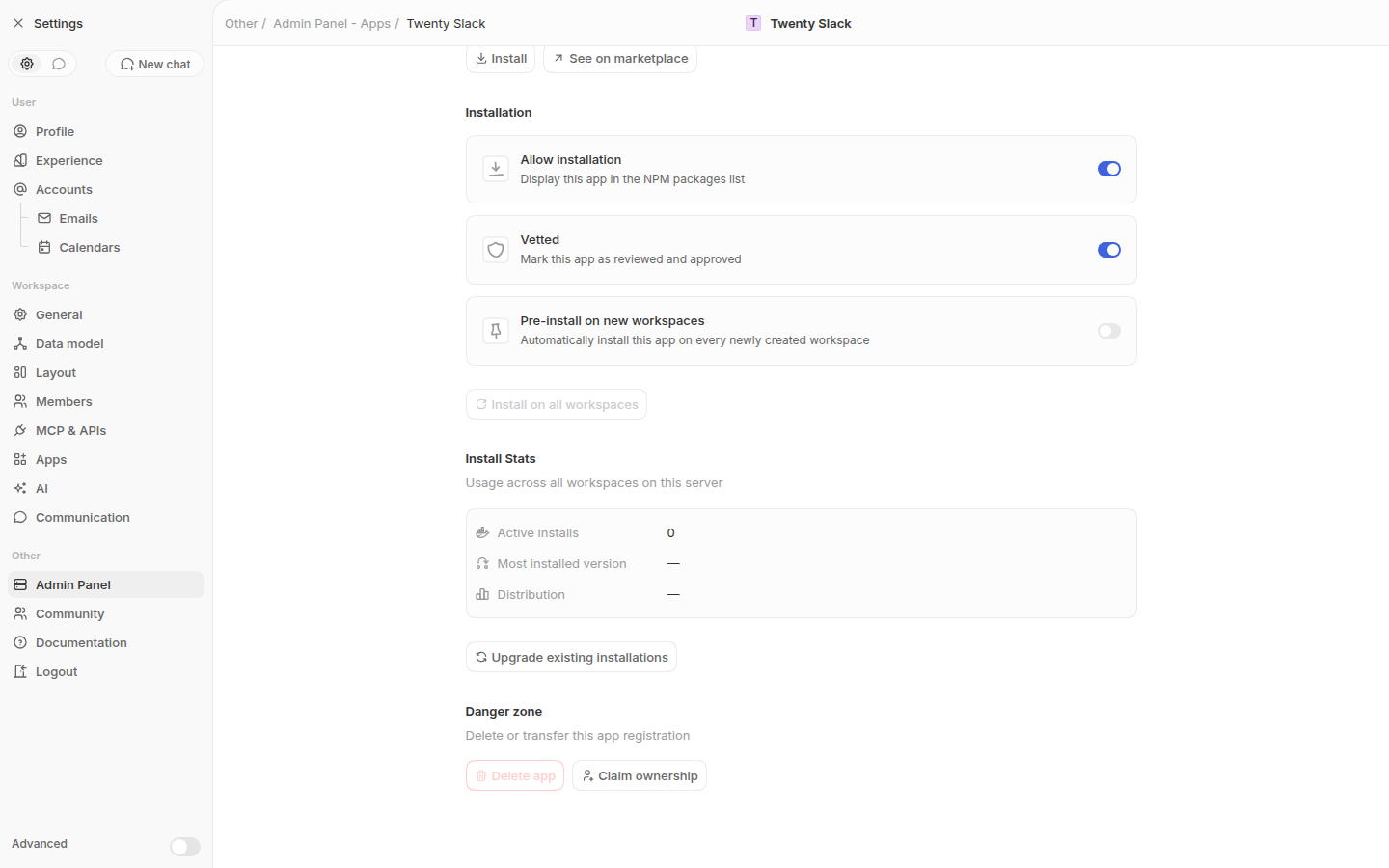 Confirmation modal with the new batch size input (defaults to 5): 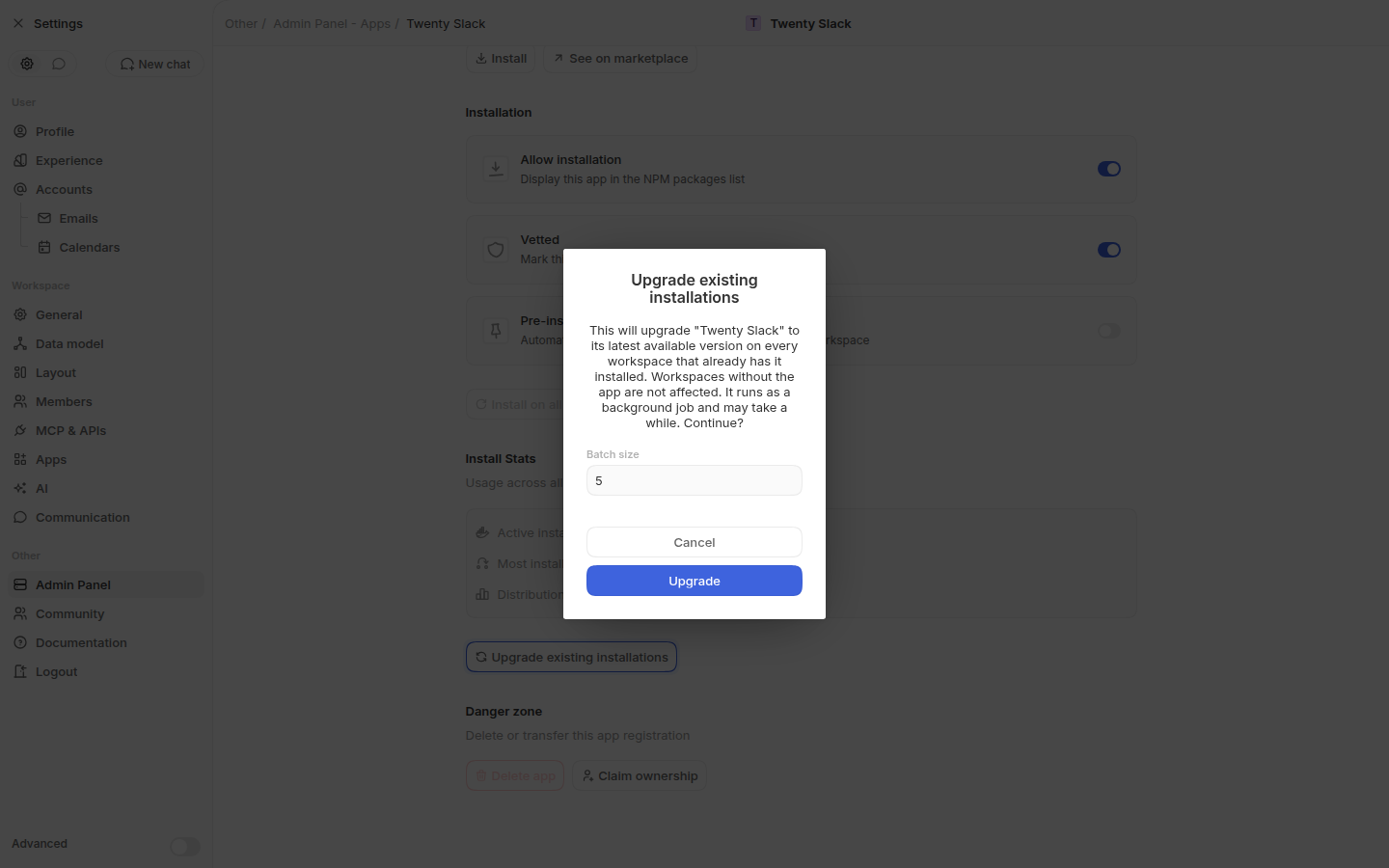 --------- Co-authored-by: Martin <martin@twenty.com> |
||
|
github-actions[bot]
|
64891c561d |
i18n - translations (#23108)
Created by Github action <!-- This is an auto-generated description by cubic. --> <a href="https://cubic.dev/pr/twentyhq/twenty/pull/23108?utm_source=github" target="_blank" rel="noopener noreferrer" data-no-image-dialog="true"><picture><source media="(prefers-color-scheme: dark)" srcset="https://www.cubic.dev/buttons/review-in-cubic-dark.svg"><source media="(prefers-color-scheme: light)" srcset="https://www.cubic.dev/buttons/review-in-cubic-light.svg"><img alt="Review in cubic" src="https://www.cubic.dev/buttons/review-in-cubic-dark.svg"></picture></a> <!-- End of auto-generated description by cubic. --> --------- Co-authored-by: github-actions <github-actions@twenty.com> |
||
|
Félix Malfait
|
3ad3e8bd1a |
feat: kanban, calendar and group-by table layouts for dashboard view widgets (#22963)
## Context Dashboard view widgets previously only rendered flat tables. This PR ships the full feature: **Table with group-by**, **Kanban**, and **Calendar** layouts for dashboard view widgets — server API + frontend, end-to-end. (Originally staged as a 4-PR stack — #22966, #22967, #22968 — consolidated here per review.) ## Server / API - **View typing.** Adds `KANBAN_WIDGET` and `CALENDAR_WIDGET` to `ViewType` (following the `TABLE_WIDGET` precedent) so widget-backing views keep their layout in `view.type` while staying excluded from record-index pickers. Shared `getViewLayoutFromViewType()` maps widget types to their base layout; `isWidgetViewType()` centralizes the exclusions that were previously hardcoded per-site. - **Migrations.** Two fast instance commands (**2.23**): `ALTER TYPE core.view_type_enum ADD VALUE` for both values, and a widened `CHK_VIEW_CALENDAR_INTEGRITY` constraint covering `CALENDAR_WIDGET` (entity `@Check` updated for fresh installs). - **Validation.** `FlatViewValidatorService` keys kanban/calendar validation on the mapped layout, so widget views get the same invariants as index views (kanban needs a groupable group-by field; calendar needs a date field + layout). Calendar widget views default to month; a non-month (DAY/WEEK) layout is rejected at the API level **unless** the `IS_CALENDAR_WEEK_VIEW_ENABLED` feature flag is enabled for the workspace — the same flag that gates day/week on index calendars. - **API.** `upsertViewWidget` (LAYOUTS permission) accepts a nested `view` settings input (`type`, `mainGroupByFieldMetadataId`, `shouldHideEmptyGroups`, kanban aggregate/column-width, calendar layout/fields). Routes through the standard update path, so `viewGroups` auto-generate from SELECT options exactly like index views. Only widget view types accepted; only `RECORD_TABLE` widgets can change view settings. - **AI tools.** `create-complete-dashboard` + `create_view` now use/allow the `*_WIDGET` types (previously they created plain `TABLE` views that leak into index pickers). ## Frontend **Settings panel.** The **Source** (object) row comes first, since which layouts are available depends on it. The **Layout** row below is a working dropdown (Table / Kanban / Calendar); layouts the source object can't support are **disabled with a hint** ("Needs a Select field" / "Needs a Date field") rather than hidden. Group-by row (select fields; searchable) with a **Hide empty groups** toggle while grouped; **Date field** row replaces Group by while Calendar is active, and — when the `IS_CALENDAR_WEEK_VIEW_ENABLED` flag is on — a **Calendar view** row (Day / Week / Month) appears beside it; **Limit** row hidden while grouped (only the flat virtualized loader enforces it). Kanban keeps its group-by locked (no `None` option). **Instant edit-mode preview.** Draft snapshots carry `viewGroups`; picking a group-by synthesizes them client-side (`buildDraftViewGroupsForFieldMetadataItem`, mirroring the server's generation), so grouped tables/boards preview immediately before dashboard save. On save, `upsertViewWidget` responses hand back the server-generated groups, which replace the client-generated ones in the persisted snapshot. **Renderers.** `RecordTableWidgetRendererContent` branches on the backing view's layout: `RecordBoardWidget` (wraps the standard `RecordBoardContainer`) and `RecordCalendarWidget` (mounts the existing `RecordCalendar`, which renders month / day / week) inside the same per-widget provider sandbox the table uses. **Read-only semantics.** Two flags with distinct scopes, each documented on its state: - `isRecordBoardViewSettingsReadOnlyComponentState` — locks the board chrome that edits view settings (add group, column reorder/resize/menu, aggregates); **card drag still updates records** under object permissions. - `isRecordCalendarReadOnlyComponentState` — widget calendars are read-only by default (no drag, no add-new, no in-calendar layout switch); cards open the side panel. The one exception, behind `IS_CALENDAR_WEEK_VIEW_ENABLED`: a **live (non edit-mode) day/week** widget calendar allows drag-to-reschedule and record creation under object permissions. Month calendars and edit-mode previews stay read-only. **Calendar state componentization.** The calendar module's three settings move from global atoms to component states keyed on `RecordCalendarComponentInstanceContext` (same pattern as record-board), so several calendar widgets and an index-page calendar can coexist without leaking state. All readers resolve the ambient instance; calendar unit tests updated. **Multi-instance fixes that also fix index pages:** record drag states were written against a different instance than every reader resolves (now use the ambient instance); the board sticky-header DOM id is namespaced per board; dragged board cards portal to `document.body` while dragging so react-grid-layout's transforms can't offset the clone from the pointer. ## Scope (v1) - Widget calendars are month-only and read-only by default. With `IS_CALENDAR_WEEK_VIEW_ENABLED` enabled, day/week layouts become selectable (UI + API) and live day/week widget calendars support drag-to-reschedule and record creation under object permissions. - Widget group-by offers SELECT fields only (server auto-generates groups from options; widgets have no per-record add-group flow). ## Tests - Integration: `upsert-view-widget-view-settings.integration-spec.ts` (9 tests — group auto-creation, invalid type/field rejections, non-month calendar widget rejected while the week/day flag is off and accepted once it's enabled, combined settings+fields call); pre-existing `upsert-view-widget` suite (20) green. - Front: new suites for draft view-group generation and snapshot clone/build utils; calendar suites componentized; full `twenty-front` jest, typecheck, oxlint green; `twenty-server` typecheck + lint green. - Browser-verified end-to-end (real dev server + seeded workspace): configure → live edit-mode preview → save → reload for all three layouts; measured drag with pointer inside the card; index-page calendar re-verified (with the week/day flag enabled). https://claude.ai/code/session_01E5N87kwwZWhDtEQaP72cMf |
||
|
Marie
|
bc3112a999 |
Fix: allow API key creation without Roles permission (#23102)
## Problem A user with the **API keys & webhooks** permission but **without** the **Roles** setting permission cannot create an API key through the UI. The role selector relies on the `getRoles` query, which is guarded by the `ROLES` permission, so the roles list comes back empty, `SettingsDevelopersRoleSelector` early-returns, and no role can be selected — leaving the form unsavable. <img width="1058" height="408" alt="Screenshot 2026-07-21 at 13 38 34" src="https://github.com/user-attachments/assets/fe97ba78-e116-458d-af10-11c5969c4636" /> ## Fix Expose the assignable roles through the API-key permission scope so users can **pick** a role to assign to an API key without being able to **edit** roles. - **Backend**: add `getApiKeyRoles` query on `ApiKeyResolver` (already guarded by `API_KEYS_AND_WEBHOOKS`), backed by `ApiKeyRoleService.getApiKeyAssignableRoles` which returns roles where `canBeAssignedToApiKeys = true`. - **Frontend**: add a `GetApiKeyRoles` query and use it in the API key create and detail pages instead of `getRoles`. The role selector prop type is narrowed to the fields it actually uses. <img width="1025" height="455" alt="Screenshot 2026-07-21 at 13 45 01" src="https://github.com/user-attachments/assets/f1be8f97-5a30-4afc-9eee-c928f4607471" /> |
||
|
Etienne
|
6d38b14520 |
fix(ai-chat) - fix record chips in AI ask-questions card (#23106)
## Summary - Ask-questions cards rendered question text and option labels as plain strings, so `[[record:...]]` showed up raw instead of as chips - Extracted `TextWithRecordLinks` from `LazyMarkdownRenderer` and reuse it in `AiChatQuestionCard` for question text and option labels - Added unit coverage for plain text, single, and multiple record references <img width="532" height="242" alt="Screenshot 2026-07-21 at 14 37 43" src="https://github.com/user-attachments/assets/a4bbd386-7757-4f09-a74d-c7eb3d0f74b9" /> ## Test plan - [ ] Open an AI chat ask-questions card whose question/options include `[[record:...]]` mentions - [ ] Confirm mentions render as record chips (not raw markup) - [ ] Confirm normal assistant text replies still chip mentions as before - [ ] Run `npx jest packages/twenty-front/src/modules/ai/components/__tests__/TextWithRecordLinks.test.tsx --config=packages/twenty-front/jest.config.mjs` fixes: https://discord.com/channels/1130383047699738754/1526887613867360347 <!-- This is an auto-generated description by cubic. --> <a href="https://cubic.dev/pr/twentyhq/twenty/pull/23106?utm_source=github" target="_blank" rel="noopener noreferrer" data-no-image-dialog="true"><picture><source media="(prefers-color-scheme: dark)" srcset="https://www.cubic.dev/buttons/review-in-cubic-dark.svg"><source media="(prefers-color-scheme: light)" srcset="https://www.cubic.dev/buttons/review-in-cubic-light.svg"><img alt="Review in cubic" src="https://www.cubic.dev/buttons/review-in-cubic-dark.svg"></picture></a> <!-- End of auto-generated description by cubic. --> |
||
|
github-actions[bot]
|
ea5f908cb2 |
i18n - translations (#23085)
Created by Github action <!-- This is an auto-generated description by cubic. --> <a href="https://cubic.dev/pr/twentyhq/twenty/pull/23085?utm_source=github" target="_blank" rel="noopener noreferrer" data-no-image-dialog="true"><picture><source media="(prefers-color-scheme: dark)" srcset="https://www.cubic.dev/buttons/review-in-cubic-dark.svg"><source media="(prefers-color-scheme: light)" srcset="https://www.cubic.dev/buttons/review-in-cubic-light.svg"><img alt="Review in cubic" src="https://www.cubic.dev/buttons/review-in-cubic-dark.svg"></picture></a> <!-- End of auto-generated description by cubic. --> --------- Co-authored-by: github-actions <github-actions@twenty.com> |
||
|
Etienne
|
9abf76f5f2 |
fix(ai): show answered ask_questions as a card in chat history (#23075)
## Context Feedback on the `ask_questions` (Ask AI) tool: - When answering a select prompt with a free-form message, the answer wasn't surfaced as expected in the conversation history. - The selected value also looked dropped once picked. Root cause: answered `ask_questions` parts were caught by the thinking-steps grouping and rendered as a generic collapsible "Ran ask_questions" tool step (JSON output), so the dedicated renderer was never reached. ## Changes - **Render answered questions as a card** (`AiChatQuestionStatusRenderer`): an "Answers" card that shows each full question with the chosen option label(s) or the free-text answer beneath it, instead of the faint inline `header: value` line. - **Free-text keyboard navigation** (`AiChatQuestionCard`): pressing Enter in the free-text area now advances to the next question, or submits when on the last question (mirroring the option-select flow). Shift+Enter still inserts a newline. ## Notes - No schema/GraphQL changes; display + interaction only. - Existing `thinkingStepsDisplayState` grouping test is unaffected (only `web_search`/`create_task`/`code_interpreter` are used there). <img width="421" height="301" alt="Screenshot 2026-07-20 at 17 48 04" src="https://github.com/user-attachments/assets/3845055d-7061-40c0-b263-aa1c670329cd" /> <!-- This is an auto-generated description by cubic. --> <a href="https://cubic.dev/pr/twentyhq/twenty/pull/23075?utm_source=github" target="_blank" rel="noopener noreferrer" data-no-image-dialog="true"><picture><source media="(prefers-color-scheme: dark)" srcset="https://www.cubic.dev/buttons/review-in-cubic-dark.svg"><source media="(prefers-color-scheme: light)" srcset="https://www.cubic.dev/buttons/review-in-cubic-light.svg"><img alt="Review in cubic" src="https://www.cubic.dev/buttons/review-in-cubic-dark.svg"></picture></a> <!-- End of auto-generated description by cubic. --> fixes https://discord.com/channels/1130383047699738754/1526871110300209282 |
||
|
Thomas Trompette
|
05132d262b |
fix(workflow): show account select in Send Email node when no account is connected (#23066)
# Why In the workflow **Send Email** (and Draft Email) node, when the workspace has no eligible connected account, the **Account** field disappears entirely — only the variable picker icon remains. The "Add account" call-to-action is unreachable, so there is no way to connect an account from the node. ## Root cause Regression from #21075. `FormSelectFieldInput` used to always pass a default empty option ("No Account") to `<Select>`; since #21075 it only prepends it when `isNullable` is set, and the email account field doesn't set it. With zero connected accounts, `<Select>` then has no option to resolve a selected option from and bails out rendering an empty fragment — even though a `callToActionButton` is configured: ```tsx // Select.tsx if (!isDefined(controlSelectedOption)) { return <></>; } ``` # What changed `FormSelectFieldInput` now prepends the empty option whenever the field is nullable **or there are no options at all**. A populated non-nullable select still offers no clearing choice (the #21075 behavior is preserved); an empty one renders its "No X" state so the control — and its call-to-action — stay visible and clickable. # Test plan - New story `FormSelectFieldInput > NoOptionsWithCallToAction`: zero options + CTA renders the "No Work Policy" control, the dropdown opens, and the CTA is clickable. - New story `WorkflowEditActionEmailBase > NoConnectedAccounts`: with `MyConnectedAccounts` mocked to `[]`, the Account field renders "No Account" instead of vanishing. The meta's msw handlers move to the keyed-object form so the story can override a single query (story-level handler arrays get concatenated after the meta's, and msw's first match wins), and the story evicts the module-singleton Apollo client's cached accounts so it actually hits the empty mock. - `npx nx typecheck twenty-front` and `npx nx lint:diff-with-main twenty-front` pass; both story files pass under the storybook vitest project (13 stories total). <!-- This is an auto-generated description by cubic. --> <a href="https://cubic.dev/pr/twentyhq/twenty/pull/23066?utm_source=github" target="_blank" rel="noopener noreferrer" data-no-image-dialog="true"><picture><source media="(prefers-color-scheme: dark)" srcset="https://www.cubic.dev/buttons/review-in-cubic-dark.svg"><source media="(prefers-color-scheme: light)" srcset="https://www.cubic.dev/buttons/review-in-cubic-light.svg"><img alt="Review in cubic" src="https://www.cubic.dev/buttons/review-in-cubic-dark.svg"></picture></a> <!-- End of auto-generated description by cubic. --> |
||
|
Paul Rastoin
|
1be5a0e54a |
System side effect relations (#22882)
Closes twentyhq/core-team-issues#2667 ## What Default relations to the standard relation objects (`timelineActivities`, `attachments`, `noteTargets`, `taskTargets`) are now fully owned by the **metadata side-effect engine**. Neither the API transpilers nor the SDK manifest builder provision them anymore: any object creation, rename or deletion — regardless of the caller — goes through the same engine handlers. ## Why - Provisioning was duplicated across the API path and the SDK manifest builder, with diverging behavior. - Universal identifiers of relation fields were derived from object **names**, so renaming an object mutated them and forced lossy delete+create cycles on manifest sync. ## How ### Engine-owned lifecycle (side-effect handlers) - `objectSystemRelationsOnCreate`: provisions the 8 forward/reverse relation fields (+ join column indexes) when an object is created. - `objectSystemRelationsOnUpdate`: renames the reverse morph fields (`target<ObjectName>`) when their host object is renamed — a lossless `fieldMetadata.update`. - `objectSystemSideEffectsOnDelete`: cascades deletion of engine-owned fields/indexes when the object is deleted. - The API transpilers and the SDK `buildManifest` no longer inject these fields; `isSystemSideEffect: true` marks engine-owned entities, guarded by a granular property allowlist (only `isActive` is user-editable) and excluded from manifest deletion inference. ### Name-free deterministic universal identifiers New `getSystemRelationFieldUniversalIdentifier({ applicationUniversalIdentifier, objectUniversalIdentifier, relationTargetObjectUniversalIdentifier })` in `twenty-shared`, exported from `twenty-sdk/define`. The identifier is keyed on the two **object** identifiers instead of field names (direction encoded by argument order), so object renames never mutate relation field identifiers. It cannot collide with the name-based `getFieldUniversalIdentifier` derivation (field names cannot contain `:`). ### twenty-standard re-owned All 48 forward/reverse system relation field declarations in `STANDARD_OBJECTS` now pin the derived name-free identifiers (computed inline via the shared util) and carry `isSystemSideEffect: true`, with labels/icons declared explicitly (translated via `msg`). `twenty-standard` is projected as if the engine had generated these fields itself. ### 2.23 upgrade commands - `reconcile-system-relation-field-universal-identifier`: structurally matches existing default relation fields per workspace and backfills the derived universal identifiers, `isSystemSideEffect` flags, and standard labels/icons. - `upgrade-people-data-labs-application`: upgrades installed PDL apps to `1.0.7` right after the backfill to close the desync window (its views reference the re-derived identifiers). ### Misc - `people-data-labs` `1.0.7`: views temporarily pin the new derived identifiers (TODO: import from the next released `twenty-sdk`). - `UpgradeStatusModule` split out of `UpgradeModule` so the application module cluster can consume upgrade status/migration services without importing the versioned command bundles (fixes a require cycle that crashed boot). - Docs: `system-fields.mdx` documents the system relation fields and their resolver; `sync-and-recovery.mdx` plan example no longer shows auto-injected relations. ## Known red CI `people-data-labs (dockerhub-latest)` fails by design until the 2.23 server image is published: the app pins the new identifiers which only exist on a 2.23 server. The `local` leg (server built from this branch) is green. ## System fields are no longer manifest-authorable (accepted regression) The manifest converter no longer derives `isSystem` / `isSystemSideEffect` from field names. Reserved-system-named manifest fields (`id`, `createdAt`, `updatedAt`, `deletedAt`, `createdBy`, `updatedBy`, `position`, `searchVector`) are now skipped at conversion time when they carry the exact derived universal identifier (keeps manifests built with older SDKs installable), and rejected with `INVALID_INPUT` when they pin any other identifier. System fields are therefore fully engine-canonical: nothing a manifest carries can produce a system-flagged entity anymore. **Accepted regression**: a manifest can no longer influence system field properties at all. Previously a (legacy) re-declaration could shape them at creation — which actually produced broken system fields, e.g. a nullable, non-unique `id` — and could still toggle the allowlisted `isActive` / `universalSettings` afterwards. We consider this acceptable for now: per-app granularity over system fields will be reintroduced later through the **override framework**, which will also settle update semantics by forbidding direct updates over `isSystemSideEffect: true` entities and expressing divergence as overrides. `isSystemSideEffect`-only entities (the default relation fields provisioned by this PR) still have no engine-level update guard (see Follow-up below); that part is unchanged and also lands with the overrides refactor. ## Follow-up `isSystemSideEffect` field update/delete guards intentionally live at the API layer (`sanitize-raw-update-field-input.ts`, `from-delete-field-input-...util.ts`) rather than in the engine-level `FlatFieldMetadataValidatorService`. Moving them into the validator requires threading operation-origin (direct field mutation vs engine cascade) through the migration matrix, otherwise legitimate object rename/delete cascades (which carry `isSystemBuild=false`) would be rejected. Tracked in twentyhq/core-team-issues#2671. <!-- This is an auto-generated description by cubic. --> <a href="https://cubic.dev/pr/twentyhq/twenty/pull/22882?utm_source=github" target="_blank" rel="noopener noreferrer" data-no-image-dialog="true"><picture><source media="(prefers-color-scheme: dark)" srcset="https://www.cubic.dev/buttons/review-in-cubic-dark.svg"><source media="(prefers-color-scheme: light)" srcset="https://www.cubic.dev/buttons/review-in-cubic-light.svg"><img alt="Review in cubic" src="https://www.cubic.dev/buttons/review-in-cubic-dark.svg"></picture></a> <!-- End of auto-generated description by cubic. --> |
||
|
github-actions[bot]
|
4ebdecfdf0 |
i18n - translations (#23077)
Created by Github action Co-authored-by: github-actions <github-actions@twenty.com> |
||
|
Gautam pandit
|
3e14dcbb05 |
Fix record board column header action accessibility (#22496)
## Summary - Keep Record Board column header actions mounted instead of rendering them only on mouse hover - Show actions on hover and focus-within so keyboard users can reach them - Avoid header layout shifts when actions appear ## Context This is a small follow-up found while reviewing #22323. It does not duplicate the Kanban column drag-and-drop implementation. ## Testing - git diff --check - Not run: package lint/typecheck because this checkout still has no node_modules and Yarn is not available on PATH <!-- This is an auto-generated description by cubic. --> <a href="https://cubic.dev/pr/twentyhq/twenty/pull/22496?utm_source=github" target="_blank" rel="noopener noreferrer" data-no-image-dialog="true"><picture><source media="(prefers-color-scheme: dark)" srcset="https://www.cubic.dev/buttons/review-in-cubic-dark.svg"><source media="(prefers-color-scheme: light)" srcset="https://www.cubic.dev/buttons/review-in-cubic-light.svg"><img alt="Review in cubic" src="https://www.cubic.dev/buttons/review-in-cubic-dark.svg"></picture></a> <!-- End of auto-generated description by cubic. --> --------- Co-authored-by: bosiraphael <raphael.bosi@gmail.com> |
||
|
github-actions[bot]
|
8a35f78d70 |
i18n - translations (#23076)
Created by Github action --------- Co-authored-by: github-actions <github-actions@twenty.com> |
||
|
martmull
|
8d84a0b9f3 |
feat(app): allow non-admin developers to claim and list marketplace apps (#22621)
## Context Follow-up to #22609. Lets a non-admin developer claim ownership of a public Twenty app they published to npm, then request a marketplace listing that a server admin reviews. Marketplace state is per-instance for now. ## Claiming - Developer tab gets a **Claim an application** section: look up an unclaimed npm app by package name or universal identifier. - Ownership is proven with GitHub OAuth against the package's npm provenance (trusted publishing): the connected account must own the GitHub account or organization the package was published from. - Errors from the GitHub callback come back as a code and are shown inline with a link to the relevant documentation. - The old one-click claim stays admin-only. - A **Sync catalog** button triggers a catalog refresh instead of waiting for the hourly cron. - Gated behind the `IS_APP_CLAIMING_ENABLED` feature flag. ## Listing requests - Catalog-synced apps are created **unlisted**; a data migration unlists previously auto-listed unclaimed npm apps (owned or vetted rows are left untouched). - Owners request a listing from the Distribution tab (logo + description required); a server admin approves or rejects it from a **Listing requests** section in the Admin Panel. ## Screenshots <img width="1512" height="829" alt="image" src="https://github.com/user-attachments/assets/788d4362-97c4-4e42-810c-ef1f11517bec"/> <img width="1512" height="829" alt="image" src="https://github.com/user-attachments/assets/d6246190-c82a-4f64-87be-3bb668527645"/> <img width="1512" height="828" alt="image" src="https://github.com/user-attachments/assets/21a8dad4-610b-4d1f-8948-b9acab40d373"/> <img width="1512" height="829" alt="image" src="https://github.com/user-attachments/assets/58246130-41f7-451e-ae7f-57bd21d04bb6"/> --------- Co-authored-by: cubic-dev-ai[bot] <191113872+cubic-dev-ai[bot]@users.noreply.github.com> |
||
|
Raphaël Bosi
|
240e185323 |
Show connect emails step to invited users without granting credits (#23058)
Invited users never saw the connect-emails onboarding step, so they could not connect their inbox while onboarding. Now they do, but only the first user (the workspace creator) earns the import-contacts reward for it. The credit is gated on the workspace having a single member, reusing the same "first user" signal the frontend already uses to gate the invite-team step. The connect-account step is still claimed for everyone so invited users' onboarding advances normally. The frontend hides the "free credits" tag and the header counter bump for invited users, so we do not promise credits they will not receive. <!-- This is an auto-generated description by cubic. --> <a href="https://cubic.dev/pr/twentyhq/twenty/pull/23058?utm_source=github" target="_blank" rel="noopener noreferrer" data-no-image-dialog="true"><picture><source media="(prefers-color-scheme: dark)" srcset="https://www.cubic.dev/buttons/review-in-cubic-dark.svg"><source media="(prefers-color-scheme: light)" srcset="https://www.cubic.dev/buttons/review-in-cubic-light.svg"><img alt="Review in cubic" src="https://www.cubic.dev/buttons/review-in-cubic-dark.svg"></picture></a> <!-- End of auto-generated description by cubic. --> |
||
|
martmull
|
45b319ef2d |
Add autofocus to 2FA OTP inputs (#23067)
as title <img width="854" height="533" alt="image" src="https://github.com/user-attachments/assets/777c2d83-8318-4337-865d-67aebc9186c2" /> |
||
|
github-actions[bot]
|
fd5afd00de |
i18n - translations (#23068)
Created by Github action --------- Co-authored-by: github-actions <github-actions@twenty.com> |
||
|
martmull
|
baa84bb2e0 |
Add auto-upgrade-in-apps (#23001)
We need to auto upgrade application, lets add this column in application entity, and add an admin button to autoupgrade all applications to latest app registrration version manually <img width="1131" height="372" alt="image" src="https://github.com/user-attachments/assets/4e755abc-38ad-4895-a2e8-d55ee1948ac2" /> <img width="906" height="533" alt="image" src="https://github.com/user-attachments/assets/ce002057-0341-4581-bf9a-66ac2bd84a9b" /> |
||
|
Raphaël Bosi
|
dd57842187 |
Show the onboarding welcome animation on sign-up only (#23057)
The welcome overlay replayed for existing users signing in, because it had no signal for "this user just signed up" and inferred it from a coincidence: a COMPLETED user standing on an onboarding URL while being redirected away. This drops that inference and triggers explicitly at the only two places onboarding reaches COMPLETED: `useSetNextOnboardingStatus` and the Stripe return. |
||
|
github-actions[bot]
|
dcd6683cac |
i18n - translations (#23007)
Created by Github action <!-- This is an auto-generated description by cubic. --> <a href="https://cubic.dev/pr/twentyhq/twenty/pull/23007?utm_source=github" target="_blank" rel="noopener noreferrer" data-no-image-dialog="true"><picture><source media="(prefers-color-scheme: dark)" srcset="https://www.cubic.dev/buttons/review-in-cubic-dark.svg"><source media="(prefers-color-scheme: light)" srcset="https://www.cubic.dev/buttons/review-in-cubic-light.svg"><img alt="Review in cubic" src="https://www.cubic.dev/buttons/review-in-cubic-dark.svg"></picture></a> <!-- End of auto-generated description by cubic. --> --------- Co-authored-by: github-actions <github-actions@twenty.com> |
||
|
neo773
|
5bedd5b8cc |
feat(email-group): communications UX, per-record DNS status (#23002)
- Rename Communications label to singular, remove docs-home banner - Provision unsubscribe Cloudflare records at domain creation and surface per-record status badges; skip Cloudflare when not configured - Move sending-domain status into the section header and only show the records table when a record is unverified - Reply to the original recipients when replying to your own message - Fix DNS records table column/badge alignment; emit synthetic records in the log driver for local testing <img width="1496" height="849" alt="Screenshot 2026-07-17 at 7 47 24 PM" src="https://github.com/user-attachments/assets/a5a59adb-2df4-4154-98b2-acf87a8008da" /> |
||
|
Félix Malfait
|
7e133a4930 |
Converge email recipient fields on existing patterns: shared parser/formatter, search-index members, one display-name rule (#22997)
# Why Follow-up to #22668, addressing @charlesBochet's five post-merge review comments. They all point the same direction: the recipient fields rebuilt things the codebase already had. This PR converges on the existing patterns where that holds up, and answers on the threads where it deliberately does not. # What changed, per comment **Parser duplication ([comment](https://github.com/twentyhq/twenty/pull/22668#discussion_r3553064242))**: `parseEmailAddressList` now lives in twenty-shared (addressparser, group flattening, try/catch). The server's `safeParseEmailAddresses` delegates to it, the front wrapper keeps only paste normalization (newlines to commas) and invalid-token preservation for red chips. The `addressparser` dependency moves from twenty-front to twenty-shared. Side effect worth knowing: RFC 5322 group members in inbound To/Cc headers were previously dropped entirely (group entries have no top-level address, so the filter removed them); flattening now imports those participants. Covered by a new regression test. **Formatter duplication ([comment](https://github.com/twentyhq/twenty/pull/22668#discussion_r3553064243))**: `formatEmailAddress` (quote only when specials require it) lives in twenty-shared. The composer chips and the server's `formatMessageFromHeader` both delegate to it. The Gmail From header output is byte-identical: the name is mime-encoded first and encoded words never contain characters that trigger quoting. CodeQL then caught that the quoting (ported from the original front util) escaped quotes but not backslashes, letting a crafted name close the quoted string early; escaping now covers both as RFC 5322 quoted-pairs, with a containment test proving a hostile name cannot split into extra recipients on reparse. **Member search divergence ([comment](https://github.com/twentyhq/twenty/pull/22668#discussion_r3553064231))**: suggestions now search WorkspaceMember through the search index in the same `useObjectRecordSearchRecords` call as Person (one ranked query), and enrich hits from `currentWorkspaceMembersState`, exactly like `SettingsRoleAssignmentWorkspaceMemberPickerDropdown`. The client-side `filterBySearchQuery` pass is gone. The hook is now what the comment described: the merge of context people, searched people, and members into one ranked list, rendered with the same `SelectableList`/`MenuItemAvatar` primitives the pickers use. Also fixed while in there: searched person ids are sliced to the suggestion limit before hydration, so top-ranked people can no longer be crowded out of the hydration page. **Chip resolution duplication ([comment](https://github.com/twentyhq/twenty/pull/22668#discussion_r3553064236))**: the display-name preference is now one rule, `getEmailIdentityDisplayName`, used by both `getDisplayNameFromParticipant` (threads) and the composer chip/menu, so the same address renders identically everywhere. The order is workspace member, then person, then display name, then handle: when an address belongs to both a teammate and a Person record, the internal identity wins (product call from Felix). `BaseChip.maxLabelWidth` is renamed `maxWidth` to match the twenty-ui `Chip` API. `ParticipantChip` itself is not used inside the field: it renders a navigating `RecordChip` when a person is linked, and navigation from the composer destroys the draft (no draft persistence yet), plus the field chips need remove/selected/danger/edit affordances it does not have. **Rebuilding on MultiItemFieldInput ([comment](https://github.com/twentyhq/twenty/pull/22668#discussion_r3553064221))**: answered on the thread rather than in code, deliberately. `MultiItemFieldInput` is a dropdown-panel list editor (vertical rows, one input at a time, bound to record-field contexts and `FieldMetadataType`), and its own TODO says the API should be refactored into a hook before growing. The inline wrapping chip row commits batches (paste), dedupes with a flash, and keeps a persistent inline input with suggestions; layering that through `renderItem`/`renderInput` would strain both components. On the menu overlap: after comparing side by side, the shared surface between `MultiItemFieldMenuItem`'s dropdown and the chip menu is three `MenuItem` rows with different copy, order, and neighbors; `MenuItem` is already the shared primitive, and a config-driven fragment would be indirection without deduplication. If deeper convergence is wanted, the honest path is the existing TODO (extract the multi-item state machine into a hook, rebase both editors on it); that touches the Links/Phones/Emails/Array/Files cell editors and deserves its own PR. # Verification - New twenty-shared suites for the parser and formatter (16 tests), including parse/format round-trips, the encoded-word case, and the backslash-escaping containment case. - Server messaging util specs all pass (70 tests), including new group-flattening regression tests; From-header spec output unchanged. - Front email module suites all pass (59 tests) with the slimmed wrappers. - Typecheck and lint green on twenty-shared, twenty-front, twenty-server; oxfmt clean on all three. - Playwright smoke against the seeded dev stack passes end to end: context suggestions on the Google company, typed search showing people and the workspace member row (now served by the search index), Enter picking the top suggestion, duplicate merge, keyboard delete, chip menu with clipboard copy, Ctrl+Enter committing the buffer then triggering send. |
||
|
Félix Malfait
|
dc0bb7760f |
fix(front): only sign out when token renewal is rejected by the server (#22983)
## Context Users are frequently signed out when coming back to Twenty. The console shows `Failed to renew token after retries, triggering unauthenticated error`: the access token has expired and the `renewToken` call fails. Today any renewal failure wipes the stored token pair and redirects to sign-in, even when the refresh token is still valid, for example when the renewal request hits a transient network failure (laptop waking up, VPN reconnecting) or a server restart during a deploy. Since the token pair state is synced across tabs, one failing tab signs out every tab. ## What this does - Only triggers the unauthenticated flow when the server definitively rejects the refresh token. The `renewToken` mutation maps those cases to `UNAUTHENTICATED` (expired or invalid JWT), `FORBIDDEN` (revoked) and `BAD_USER_INPUT` (unknown or malformed token). - Keeps the session on any other renewal failure (network errors after retries, server errors): the token pair stays in place and the next request triggers a fresh renewal attempt, so the session recovers once the server is reachable again. - Signs out immediately when the stored pair has no refresh token instead of attempting a renewal that cannot succeed. - Logs the renewal error, which was previously swallowed and made this class of logouts hard to diagnose. ## Tests - renews and replays the operation after an access token rejection - signs out when the server rejects the refresh token - keeps the session on a network error (asserts all retry attempts ran) and on a server error - signs out without attempting renewal when the stored pair has no refresh token Test mocks now reset between tests so per-test overrides cannot leak into other tests. [[Review in cubic](https://www.cubic.dev/buttons/review-in-cubic-dark.svg)](https://cubic.dev/pr/twentyhq/twenty/pull/22983?utm_source=github) |
||
|
github-actions[bot]
|
c8f0b86316 |
i18n - translations (#22988)
Created by Github action <!-- This is an auto-generated description by cubic. --> <a href="https://cubic.dev/pr/twentyhq/twenty/pull/22988?utm_source=github" target="_blank" rel="noopener noreferrer" data-no-image-dialog="true"><picture><source media="(prefers-color-scheme: dark)" srcset="https://www.cubic.dev/buttons/review-in-cubic-dark.svg"><source media="(prefers-color-scheme: light)" srcset="https://www.cubic.dev/buttons/review-in-cubic-light.svg"><img alt="Review in cubic" src="https://www.cubic.dev/buttons/review-in-cubic-dark.svg"></picture></a> <!-- End of auto-generated description by cubic. --> --------- Co-authored-by: github-actions <github-actions@twenty.com> |
||
|
Félix Malfait
|
5e27e04c0a |
Add mostly-empty field hints to data model settings (#22962)
## What

Fields that are empty in almost all records now show a subtle `Mostly
empty` hint next to their name in the object's Fields settings table
(same visual treatment as `Deactivated`), with a tooltip explaining the
signal and a matching **Mostly empty** toggle in the search filter
dropdown. The goal is to nudge admins to clean up and deactivate fields
nobody uses, while keeping the page untouched when the data model is
healthy.

## How

**No table scans.** Emptiness is read from Postgres planner statistics,
so the cost is a catalog lookup regardless of table size:

- `pg_class.reltuples` gates the feature on an approximate row count (≥
100 records; never-analyzed tables mean no hints). Reuses the shared
helper extracted from `ObjectRecordCountService`.
- `pg_stats.null_frac` plus the sampled frequency of the column type's
empty sentinel (`''` for text columns, `'{}'` for arrays, `'{}'`/`'[]'`
for json — matched per physical column type) gives a per-column empty
fraction. A value dominating ≥ 95% of a column is guaranteed to appear
in the most-common-values list, so the approximation is reliable exactly
at the threshold we care about.

**Decision rules** (pure util, unit-tested):

- Flag when every relevant column is ≥ 95% empty and the object has ≥
100 records.
- Skip system fields, the label identifier, relations, booleans, and
actor fields (exhaustive switch — a new `FieldMetadataType` fails to
compile until classified).
- Composite fields must have all their columns empty, with column sets
derived from `compositeTypeDefinitions`; only default-bearing code
columns (`currencyCode`, phone country/calling codes) are excluded so
stamped defaults don't mask emptiness.
- Anything unknown (missing stats, new column since last ANALYZE)
degrades to silence — no hint is ever shown on missing data.

**API:** one `mostlyEmptyFieldMetadataIds(objectMetadataId)` query on
the metadata schema, guarded by the `DATA_MODEL` settings permission,
fetched lazily when the fields page opens.

**UI:** exception-based — no new columns, no persistent controls. The
badge and the filter toggle only materialize when at least one field
qualifies, and disappear once things are cleaned up.

## Test

- Unit tests for the decision util (threshold,
system/label-identifier/inactive exclusion, missing statistics,
composite all-columns rule, links label/secondary data, currency
narrowing, excluded types).
- Catalog SQL validated against Postgres 16 with a table mimicking
Twenty's column shapes (text `''` defaults, enums, arrays, jsonb,
currency pairs), including the type-aware sentinel matching (a text
column full of literal `"{}"` strings does not count as empty).
- End-to-end on a seeded dev instance: 899 companies with a mix of
filled/empty fields — the API returned exactly the five fields predicted
by the raw statistics (`annualRevenue`, `employees`, `introVideo`,
`tagline`, `workPolicy`) and correctly excluded `address` (city 33%
filled), actor/system fields, and the label identifier.
- UI driven with Playwright: badge, tooltip copy, filter toggle, and
filtered table all verified visually.
- `lint:diff-with-main`, `typecheck` (server + front), and all three
`graphql:generate` configurations + SDK metadata client regenerated and
committed.
|
||
|
martmull
|
6360599943 |
Unify application version gate, registration writes and upgrade paths across sources (#22931)
Continues the source-unification arc after #22921. Three related consolidations, one commit each. ## 1. Single semver version gate (`793f4849`) The "incoming version must move forward" rule was hand-rolled twice: workspace installs (validate semver, reject equal as `APP_ALREADY_INSTALLED`, lower as `CANNOT_DOWNGRADE_APPLICATION`) and tarball deploys (reject `lte` as `VERSION_ALREADY_EXISTS`). `ApplicationVersionValidationService.validateVersionProgression` now owns the comparison rules and messages; new maps in `version-reason-to-exception-code.constant.ts` translate failure reasons to each caller's existing exception codes, so error contracts observed by the frontend/CLI are unchanged. A non-semver current version never blocks, matching both previous behaviors. ## 2. One registration-metadata writer (`13eb5f91`) Tarball upload and marketplace catalog sync wrote registration metadata with their own repository calls, duplicating the gallery-image fileId preservation and variable-schema sync, and bypassing the per-registration lock and transaction that `updateFromManifest` provides. Both now delegate to `updateFromManifest` (new `additionalFields` allowlist for their extra columns: `tarballFileId`, `isListed`, `isVetted`, `ownerWorkspaceId`, `sourcePackage`, `name`), so every manifest-bearing registration write serializes on the same lock and applies the same rules. The shared gallery fileId preservation moved to a `buildRegistrationManifestUpdateFields` util. Tarball uploads can no longer race installs on the registration row. Behavior notes: a tarball re-upload whose manifest lacks `application.displayName` now keeps the existing registration name instead of resetting it to "Unknown App", and a re-upload without a `package.json` version keeps the stored `latestAvailableVersion` instead of nulling it — both strictly less destructive. ## 3. TARBALL upgrades (`b20aaba9`) `upgradeApplication` only supported NPM; TARBALL apps had no update path for installing workspaces. It now accepts TARBALL registrations and re-installs the stored tarball, whose contents define the target version — the install flow already gates same-version and downgrade installs. The settings UI shows the latest-version row and the Upgrade button for both NPM and TARBALL apps via a shared `isUpgradableApplicationSourceType` util. LOCAL (dev-sync updates) and OAUTH_ONLY (no code artifacts) stay rejected with a clearer message. ## Validation - New tests: `validateVersionProgression` matrix in `application-version-validation.service.spec.ts`, `buildRegistrationManifestUpdateFields` gallery-preservation spec - All 27 application suites (148 tests) pass; typecheck and lint green on twenty-server and twenty-front |
||
|
Weiko
|
c6f0380070 |
Reuse onboarding container width for workspace selection (#22974)
Fix in https://github.com/twentyhq/twenty/pull/22965 was wrong, 440px wide is the new intended width for both signup forms. This PR reverts + does the correct fix. See figma as source of truth https://www.figma.com/design/xt8O9mFeLl46C5InWwoMrN/Twenty?node-id=1633-94880&p=f&m=dev ## Before <img width="431" height="450" alt="Screenshot 2026-07-16 at 18 14 26" src="https://github.com/user-attachments/assets/3f8788e1-3764-4326-867a-973a98e48007" /> ## After <img width="1030" height="898" alt="Screenshot 2026-07-17 at 08 24 38" src="https://github.com/user-attachments/assets/42e03215-f32c-4f61-8f2d-1b8ff966d31c" /> <img width="1028" height="900" alt="Screenshot 2026-07-17 at 08 24 25" src="https://github.com/user-attachments/assets/3a49142a-dc52-4097-96d2-05a4e641f574" /> |
||
|
Weiko
|
6a1de47a17 |
Fix signup visual regression in workspace selection layout (#22965)
## Summary - Split the sign-in/up onboarding container styles so workspace selection can keep its wider layout without affecting the other auth states. - Reuse the base onboarding container for the non-selection flow to restore the intended visual structure. https://github.com/twentyhq/twenty/commit/566c3b662954de932677a3fefe69735a45fe55ae commit accidentally reused the 440px workspace-selection container for the global credential form ## Before <img width="643" height="496" alt="Screenshot 2026-07-16 at 18 14 35" src="https://github.com/user-attachments/assets/abff0779-a236-424f-9503-9182dab5fa3f" /> ## After <img width="510" height="509" alt="Screenshot 2026-07-16 at 18 11 58" src="https://github.com/user-attachments/assets/8c4693b2-827f-4bc8-a9ce-10171bbb7d0b" /> <!-- This is an auto-generated description by cubic. --> <a href="https://cubic.dev/pr/twentyhq/twenty/pull/22965?utm_source=github" target="_blank" rel="noopener noreferrer" data-no-image-dialog="true"><picture><source media="(prefers-color-scheme: dark)" srcset="https://www.cubic.dev/buttons/review-in-cubic-dark.svg"><source media="(prefers-color-scheme: light)" srcset="https://www.cubic.dev/buttons/review-in-cubic-light.svg"><img alt="Review in cubic" src="https://www.cubic.dev/buttons/review-in-cubic-dark.svg"></picture></a> <!-- End of auto-generated description by cubic. --> |
||
|
Thomas Trompette
|
2a94736ece |
fix(metadata): resync metadata store via collection hashes on SSE reconnect (#22956)
## Context Follow-up to #22562 (merged), which fixed the SSE-gap durability hole from #22504 by calling `invalidateMetadataStore()` on SSE reconnect. In review, @Weiko and a second reviewer flagged a performance concern: firing a full invalidation on every reconnect can spam the backend, and reconnect frequency is unbounded (`retryAttempts: Infinity`). The steer was to lean on the per-collection hashes that `FindMinimalMetadata` already returns and refetch only what actually changed. ## Problem `invalidateMetadataStore()` sets `currentCollectionHash: undefined` for every entity key. The staleness check in `useLoadMinimalMetadata` is `entry.currentCollectionHash !== hash`, so nulling the hash makes **every** collection compare as stale. Result: each reconnect forces a full refetch of every metadata collection (objects, fields, views, ...), even when nothing changed during the gap. That defeats the collection-hash mechanism built to avoid exactly this. ## Change Add `useResyncMetadataStore`, which only bumps `metadataLoadedVersionState` without clearing collection hashes. `MinimalMetadataLoadEffect` already re-runs on a version change, so this triggers one `FindMinimalMetadata` query; the existing hash comparison then marks only genuinely-changed collections stale. `SSEClientEffect` now calls `resyncMetadataStore()` instead of `invalidateMetadataStore()` on reconnect. Net: same durability guarantee (changes missed during a disconnect are caught on reconnect), but cost per reconnect drops from "refetch everything" to "one lightweight hash query + refetch only what changed." ## Testing 1. Open a record page in a workspace. 2. Create a field / page-layout tab via the metadata API while the SSE stream is dropped (background the tab, kill the network briefly, or restart the server). 3. On reconnect the new metadata appears without a manual reload. 4. Reconnect with no metadata change triggers only a `FindMinimalMetadata` query and no collection refetch. <!-- This is an auto-generated description by cubic. --> <a href="https://cubic.dev/pr/twentyhq/twenty/pull/22956?utm_source=github" target="_blank" rel="noopener noreferrer" data-no-image-dialog="true"><picture><source media="(prefers-color-scheme: dark)" srcset="https://www.cubic.dev/buttons/review-in-cubic-dark.svg"><source media="(prefers-color-scheme: light)" srcset="https://www.cubic.dev/buttons/review-in-cubic-light.svg"><img alt="Review in cubic" src="https://www.cubic.dev/buttons/review-in-cubic-dark.svg"></picture></a> <!-- End of auto-generated description by cubic. --> |
||
|
Weiko
|
8e3ec5b43d |
Propagate record card background to inline hover content (#22957)
## Summary - Introduce a shared `--record-card-background-color` CSS variable on record cards - Reuse that variable for hovered inline cell content so the hover portal matches the card background state - Preserve selected, focused, and active background transitions without duplicating background logic ### Before <img width="196" height="337" alt="Screenshot 2026-07-16 at 16 03 40" src="https://github.com/user-attachments/assets/b74bfb24-0144-4a8c-b8a4-b56768e84d66" /> <img width="219" height="357" alt="Screenshot 2026-07-16 at 16 03 25" src="https://github.com/user-attachments/assets/19d052cb-8c8c-49c9-b3af-0178c53c0c0a" /> ### After <img width="189" height="372" alt="Screenshot 2026-07-16 at 16 03 52" src="https://github.com/user-attachments/assets/289e4186-d418-44dc-93d4-70fa47e50cf2" /> <img width="180" height="333" alt="Screenshot 2026-07-16 at 16 03 00" src="https://github.com/user-attachments/assets/b874e0c4-5840-4b7e-918c-d441c50fa487" /> <!-- This is an auto-generated description by cubic. --> <a href="https://cubic.dev/pr/twentyhq/twenty/pull/22957?utm_source=github" target="_blank" rel="noopener noreferrer" data-no-image-dialog="true"><picture><source media="(prefers-color-scheme: dark)" srcset="https://www.cubic.dev/buttons/review-in-cubic-dark.svg"><source media="(prefers-color-scheme: light)" srcset="https://www.cubic.dev/buttons/review-in-cubic-light.svg"><img alt="Review in cubic" src="https://www.cubic.dev/buttons/review-in-cubic-dark.svg"></picture></a> <!-- End of auto-generated description by cubic. --> |
||
|
Charles Bochet
|
5588ddf829 |
Fix delete/destroy/restore record commands on pages without a record index (#22952)
## Bug On a standalone page (`/page/:pageLayoutId` — a custom app page or standalone page layout), opening a record in the side panel and running **Delete** from the Options menu fails with an error toast: > Record index ID and object metadata are required to delete records The record is not deleted. The same guard breaks **Destroy** and **Restore**. ## Root cause `buildHeadlessCommandContextApi` only derives `recordIndexId` when the context store holds a `currentViewId`. On standalone pages there is no view, and `useOpenRecordInSidePanel` copies that null view id into the side panel context, so the delete/destroy/restore commands throw at mount — before executing anything. The throw is caught by `CommandMenuItemErrorBoundary` and surfaces as the toast (also reported to Sentry). The commands only use `recordIndexId` to reset table row selection and remove records from the record board — cleanup that is meaningless when no record index is on screen. The mutation itself only needs `objectMetadataItem` and the graphql filter, which are both available. ## Fix - Keep throwing when `objectMetadataItem` is missing (genuinely required). - Make `recordIndexId` optional: pass the existing `PLACEHOLDER_RECORD_INDEX_ID` to the selection hooks (they must be called unconditionally) and skip the selection cleanup at execute time when there is no record index — same pattern `useResetRecordIndexSelection` already uses. The constant is extracted to a shared file. ## Verified - **Bug path**: on a standalone page, opened a record in the side panel via search, ran Delete Task from the Options menu → record soft-deleted (checked `deletedAt` in DB), side panel closed, no error toast, no console error. - **Regression**: on the tasks index table, selected a row and ran Delete Task from the command menu → record deleted, row removed, table selection reset, no errors. <!-- This is an auto-generated description by cubic. --> <a href="https://cubic.dev/pr/twentyhq/twenty/pull/22952?utm_source=github" target="_blank" rel="noopener noreferrer" data-no-image-dialog="true"><picture><source media="(prefers-color-scheme: dark)" srcset="https://www.cubic.dev/buttons/review-in-cubic-dark.svg"><source media="(prefers-color-scheme: light)" srcset="https://www.cubic.dev/buttons/review-in-cubic-light.svg"><img alt="Review in cubic" src="https://www.cubic.dev/buttons/review-in-cubic-dark.svg"></picture></a> <!-- End of auto-generated description by cubic. --> |



