 Charles Bochet
c0cc0689d6
Charles Bochet
c0cc0689d6
## Add API client generation to SDK dev mode and refactor orchestrator
into step-based pipeline

### Why

The SDK dev mode lacked typed API client generation, forcing developers
to work without auto-generated GraphQL types when building applications.
Additionally, the orchestrator was a monolithic class that mixed watcher
management, token handling, and sync logic — making it difficult to
extend with new steps like client generation.

### How

- **Refactored the orchestrator** into a step-based pipeline with
dedicated classes: `CheckServer`, `EnsureValidTokens`,
`ResolveApplication`, `BuildManifest`, `UploadFiles`,
`GenerateApiClient`, `SyncApplication`, and `StartWatchers`. Each step
has typed input/output/status, managed by a new `OrchestratorState`
class.
- **Added `GenerateApiClientOrchestratorStep`** that detects
object/field schema changes and regenerates a typed GraphQL client (via
`@genql/cli`) into `node_modules/twenty-sdk/generated` for seamless
imports.
- **Replaced `checkApplicationExist`** with `findOneApplication` on both
server resolver and SDK API service, returning the entity data instead
of a boolean.
- **Added application token pair mutations**
(`generateApplicationToken`, `renewApplicationToken`) to the API
service, with the server now returning `ApplicationTokenPairDTO`
containing both access and refresh tokens.
- **Restructured the dev UI** into `dev/ui/components/` with dedicated
panel, section, and event log components.
- **Simplified `AppDevCommand`** from ~180 lines of watcher management
down to ~40 lines that delegate entirely to the orchestrator.

The #1 Open-Source CRM
🌐 Website · 📚 Documentation ·  Roadmap ·
  Discord ·
  Figma
Figma
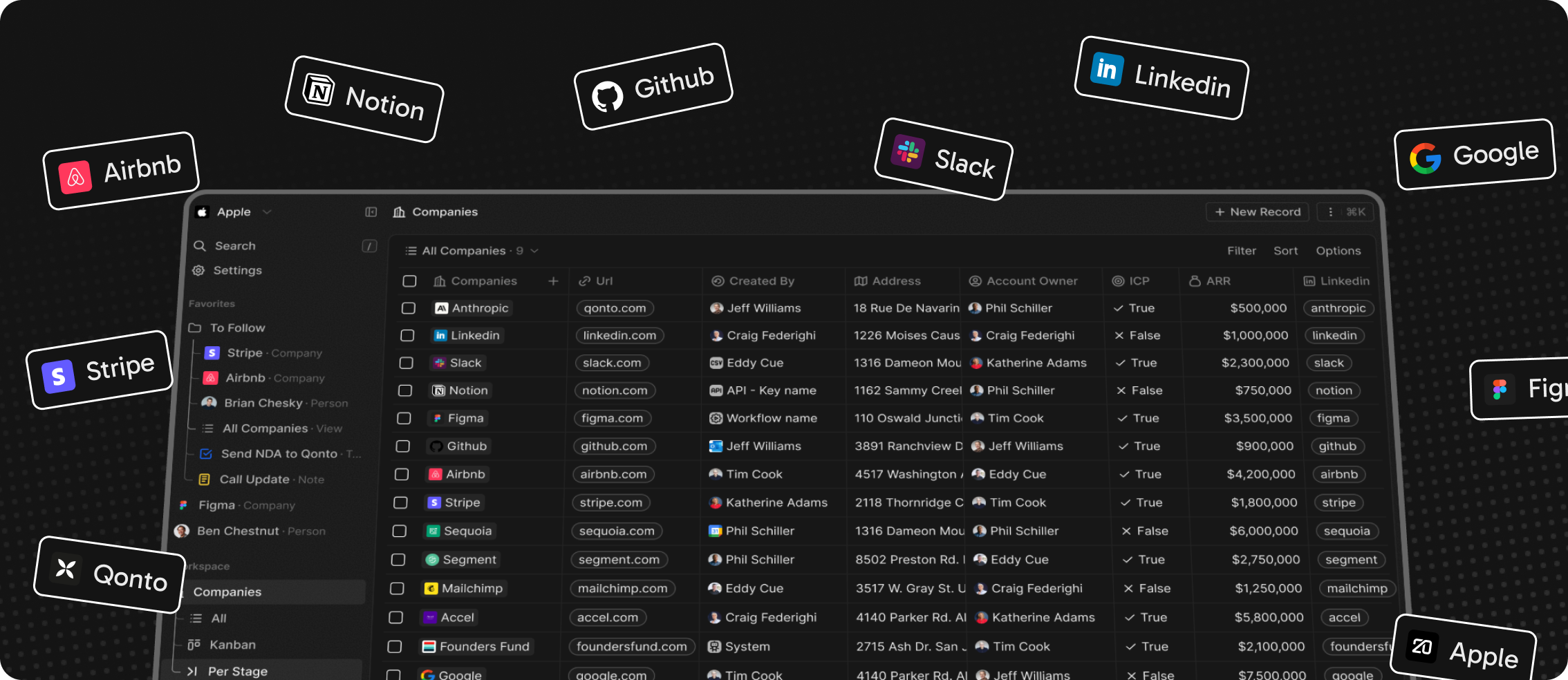
Installation
See: 🚀 Self-hosting 🖥️ Local Setup
Does the world need another CRM?
We built Twenty for three reasons:
CRMs are too expensive, and users are trapped. Companies use locked-in customer data to hike prices. It shouldn't be that way.
A fresh start is required to build a better experience. We can learn from past mistakes and craft a cohesive experience inspired by new UX patterns from tools like Notion, Airtable or Linear.
We believe in Open-source and community. Hundreds of developers are already building Twenty together. Once we have plugin capabilities, a whole ecosystem will grow around it.
What You Can Do With Twenty
Please feel free to flag any specific needs you have by creating an issue.
Below are a few features we have implemented to date:
- Personalize layouts with filters, sort, group by, kanban and table views
- Customize your objects and fields
- Create and manage permissions with custom roles
- Automate workflow with triggers and actions
- Emails, calendar events, files, and more
Personalize layouts with filters, sort, group by, kanban and table views

Customize your objects and fields

Create and manage permissions with custom roles

Automate workflow with triggers and actions

Emails, calendar events, files, and more

Stack
- TypeScript
- Nx
- NestJS, with BullMQ, PostgreSQL, Redis
- React, with Recoil, Emotion and Lingui
Thanks


Thanks to these amazing services that we use and recommend for UI testing (Chromatic), code review (Greptile), catching bugs (Sentry) and translating (Crowdin).
Join the Community
- Star the repo
- Subscribe to releases (watch -> custom -> releases)
- Follow us on Twitter or LinkedIn
- Join our Discord
- Improve translations on Crowdin
- Contributions are, of course, most welcome!