 Paul Rastoin
bd9688421f
Paul Rastoin
bd9688421f
# Introduction
Important note: This PR officially deprecates the `standardId`, about to
drop col and entity property after this has been merged

Important note2: Haven't updated the optimistic tool to also update the
universal identifier aggregators only the ids one, they should not be
consumed in the runner context -> need to improve typing or either the
optimistic tooling

In this PR we're introducing all the devxp allowing future metadata
incremental universal migration -> this has an impact on all existing
metadata actions handler ( explaining its size )
This PR also introduce workspace agnostic create update actions runner
for both field and object metadata in order to battle test the described
above devxp

Noting that these two metadata are the most complex to handle

Notes:
- A workspace migration is now highly bind to a
`applicationUniversalIdentifier`. Though we don't strictly validate
application scope for the moment

## Next
Migrate both object and field builder to universal comparison

## Universal Actions vs Flat Actions Architecture

### Concept

The migration system uses a two-phase action model:

1. **Universal Actions** - Actions defined using `universalIdentifier`
(stable, portable identifiers like `standardId` + `applicationId`)
2. **Flat Actions** - Actions defined using database `entityId` (UUIDs
specific to a workspace)

### Why This Separation?

- **Universal actions are portable**: They can be serialized, stored,
and replayed across different workspaces
- **Flat actions are executable**: They contain the actual database IDs
needed to perform operations
- **Decoupling**: The builder produces universal actions; the runner
transpiles them to flat actions at execution time

### Transpiler Pattern

Each action handler must implement
`transpileUniversalActionToFlatAction()`:

```typescript
@Injectable()
export class CreateFieldActionHandlerService extends WorkspaceMigrationRunnerActionHandler(
  'create',
  'fieldMetadata',
) {
  override async transpileUniversalActionToFlatAction(
    context: WorkspaceMigrationActionRunnerArgs<UniversalCreateFieldAction>,
  ): Promise<FlatCreateFieldAction> {
    // Resolve universal identifiers to database IDs
    const flatObjectMetadata = findFlatEntityByUniversalIdentifierOrThrow({
      flatEntityMaps: allFlatEntityMaps.flatObjectMetadataMaps,
      universalIdentifier: action.objectMetadataUniversalIdentifier,
    });

    return {
      type: action.type,
      metadataName: action.metadataName,
      objectMetadataId: flatObjectMetadata.id, // Resolved ID
      flatFieldMetadatas: /* ... transpiled entities ... */,
    };
  }
}
```

### Action Handler Base Class

`BaseWorkspaceMigrationRunnerActionHandlerService<TActionType,
TMetadataName>` provides:

- **`transpileUniversalActionToFlatAction()`** - Abstract method each
handler must implement
- **`transpileUniversalDeleteActionToFlatDeleteAction()`** - Shared
helper for delete actions

## FlatEntityMaps custom properties
Introduced a `TWithCustomMapsProperties` generic parameter to control
whether custom indexing structures are included:

- **`false` (default)**: Returns `FlatEntityMaps<MetadataFlatEntity<T>>`
- used in builder/runner contexts
- **`true`**: Returns the full maps type with custom properties (e.g.,
`byUserWorkspaceIdAndFolderId`) - used in cache contexts

## Create Field Actions Refactor

Refactored create-field actions to support relation field pairs
bundling.

**Problem:** Relation fields (e.g., `Attachment.targetTask` ↔
`Task.attachments`) couldn't resolve each other's IDs during
transpilation because they were in separate actions with independent
`fieldIdByUniversalIdentifier` maps.

**Solution:**
- Removed `objectMetadataUniversalIdentifier` from
`UniversalCreateFieldAction` and `objectMetadataId` from
`FlatCreateFieldAction` - each field now carries its own
- Runner groups fields by object internally and processes each table
separately
- Split aggregator into two focused utilities:
- `aggregateNonRelationFieldsIntoObjectActions` - merges non-relation
fields into object actions
- `aggregateRelationFieldPairs` - bundles relation pairs with shared
`fieldIdByUniversalIdentifier`

The #1 Open-Source CRM
🌐 Website · 📚 Documentation ·  Roadmap ·
  Discord ·
  Figma
Figma
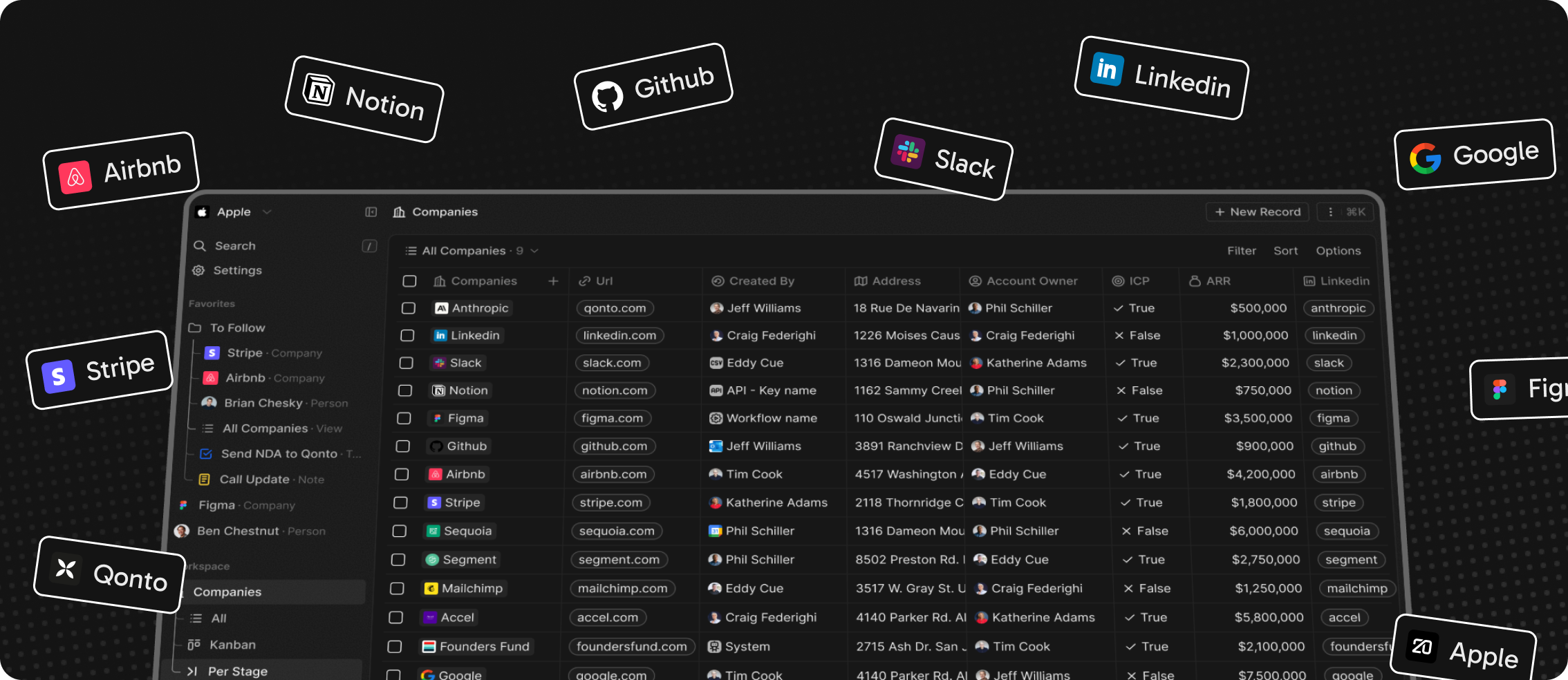
Installation
See: 🚀 Self-hosting 🖥️ Local Setup
Does the world need another CRM?
We built Twenty for three reasons:
CRMs are too expensive, and users are trapped. Companies use locked-in customer data to hike prices. It shouldn't be that way.
A fresh start is required to build a better experience. We can learn from past mistakes and craft a cohesive experience inspired by new UX patterns from tools like Notion, Airtable or Linear.
We believe in Open-source and community. Hundreds of developers are already building Twenty together. Once we have plugin capabilities, a whole ecosystem will grow around it.
What You Can Do With Twenty
Please feel free to flag any specific needs you have by creating an issue.
Below are a few features we have implemented to date:
- Personalize layouts with filters, sort, group by, kanban and table views
- Customize your objects and fields
- Create and manage permissions with custom roles
- Automate workflow with triggers and actions
- Emails, calendar events, files, and more
Personalize layouts with filters, sort, group by, kanban and table views

Customize your objects and fields

Create and manage permissions with custom roles

Automate workflow with triggers and actions

Emails, calendar events, files, and more

Stack
- TypeScript
- Nx
- NestJS, with BullMQ, PostgreSQL, Redis
- React, with Recoil, Emotion and Lingui
Thanks


Thanks to these amazing services that we use and recommend for UI testing (Chromatic), code review (Greptile), catching bugs (Sentry) and translating (Crowdin).
Join the Community
- Star the repo
- Subscribe to releases (watch -> custom -> releases)
- Follow us on Twitter or LinkedIn
- Join our Discord
- Improve translations on Crowdin
- Contributions are, of course, most welcome!