 Charles Bochet
b456f79167
Charles Bochet
b456f79167
## Reduce type leakage between GraphQL schemas

### Why

Twenty runs two separate GraphQL schemas: **core** and **metadata**.
NestJS's `@nestjs/graphql` uses a global `TypeMetadataStorage` that
accumulates all decorated types across all modules. When each schema is
built, every registered type leaks into both schemas regardless of which
module it belongs to.

This means the core schema's generated TypeScript
(`generated/graphql.ts`) contained ~2,700 lines of types that only
belong to the metadata schema (and vice versa). This creates confusion
about type ownership, inflates generated code, and makes it harder to
reason about which API surface each schema actually exposes.

### How

**1. Patch `@nestjs/graphql` to support schema-scoped type resolution**

- **(Already done)** Added a `resolverSchemaScope` option to
`GqlModuleOptions`, allowing each schema to declare a scope (e.g.
`'metadata'`)
- `ResolversExplorerService` now filters resolvers by a
`RESOLVER_SCHEMA_SCOPE` metadata key, so each schema only sees its own
resolvers
- `GraphQLSchemaFactory` now performs a **reachability walk**
(`computeReachableTypes`) starting from scoped resolver return types and
arguments, only including types that are transitively referenced —
handling unions, interfaces, and prototype chains
- Type definition storage and orphaned reference registry are cleared
between schema builds to prevent cross-contamination

**2. Register `ClientConfig` as orphaned type in metadata schema**

Since `ClientConfig` is needed in the metadata schema but not directly
returned by a resolver, it's explicitly declared via
`buildSchemaOptions.orphanedTypes`.

**3. Regenerate frontend types and fix imports**

- `generated/graphql.ts` shrank by ~2,700 lines (types moved to where
they belong)
- `generated-metadata/graphql.ts` gained types like `ClientConfig` that
were previously missing
- ~500 frontend files updated to import from the correct generated file

The #1 Open-Source CRM
🌐 Website · 📚 Documentation ·  Roadmap ·
  Discord ·
  Figma
Figma
Installation
See: 🚀 Self-hosting 🖥️ Local Setup
Does the world need another CRM?
We built Twenty for three reasons:
CRMs are too expensive, and users are trapped. Companies use locked-in customer data to hike prices. It shouldn't be that way.
A fresh start is required to build a better experience. We can learn from past mistakes and craft a cohesive experience inspired by new UX patterns from tools like Notion, Airtable or Linear.
We believe in Open-source and community. Hundreds of developers are already building Twenty together. Once we have plugin capabilities, a whole ecosystem will grow around it.
What You Can Do With Twenty
Please feel free to flag any specific needs you have by creating an issue.
Below are a few features we have implemented to date:
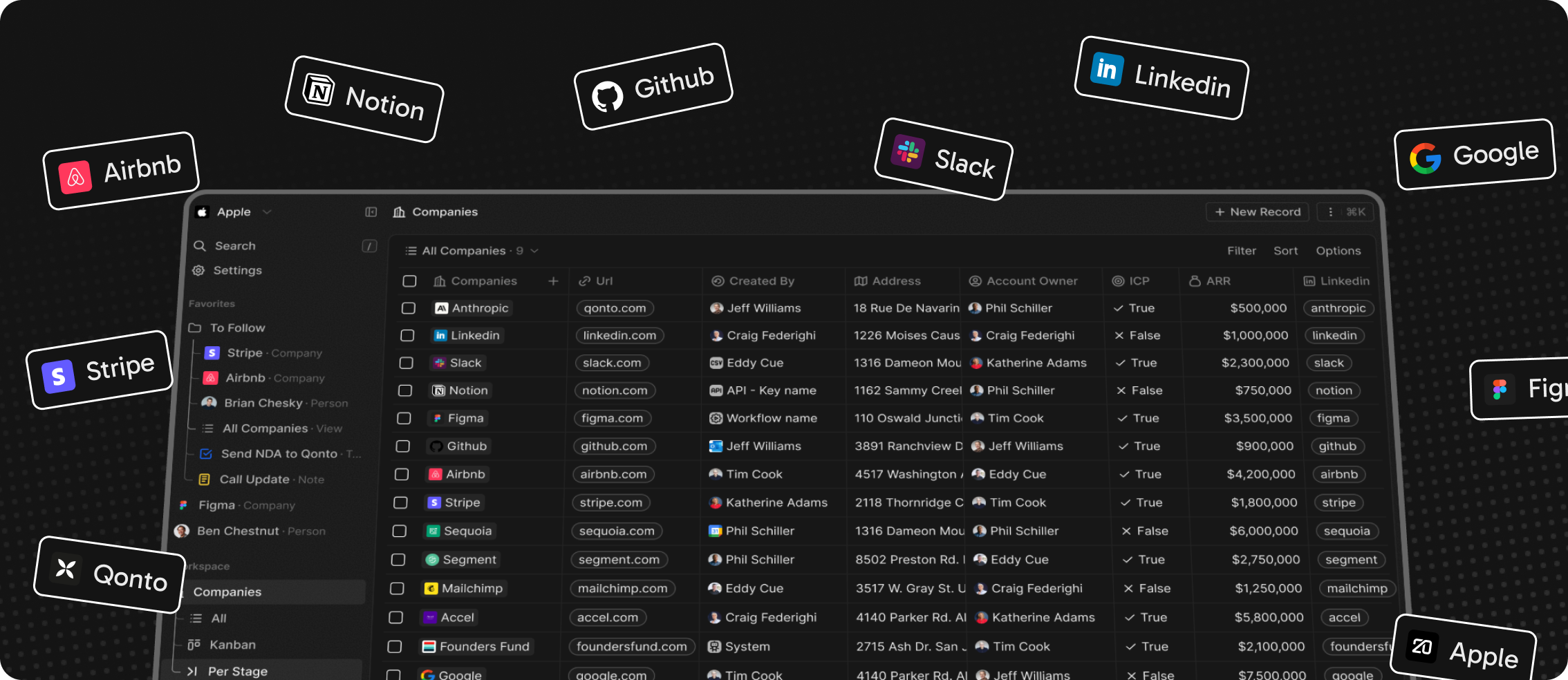
- Personalize layouts with filters, sort, group by, kanban and table views
- Customize your objects and fields
- Create and manage permissions with custom roles
- Automate workflow with triggers and actions
- Emails, calendar events, files, and more
Personalize layouts with filters, sort, group by, kanban and table views

Customize your objects and fields

Create and manage permissions with custom roles

Automate workflow with triggers and actions

Emails, calendar events, files, and more

Stack
- TypeScript
- Nx
- NestJS, with BullMQ, PostgreSQL, Redis
- React, with Recoil, Emotion and Lingui
Thanks


Thanks to these amazing services that we use and recommend for UI testing (Chromatic), code review (Greptile), catching bugs (Sentry) and translating (Crowdin).
Join the Community
- Star the repo
- Subscribe to releases (watch -> custom -> releases)
- Follow us on Twitter or LinkedIn
- Join our Discord
- Improve translations on Crowdin
- Contributions are, of course, most welcome!