 Félix Malfait
b292a93376
Félix Malfait
b292a93376
## The bug

Pasting `https://<workspace>.twenty.com/mcp` into an MCP client (Claude
connector, etc.) fails discovery. Curl shows why:

```bash
$ curl -si https://twentyfortwenty.twenty.com/.well-known/oauth-protected-resource
HTTP/2 200
...
{
  \"resource\": \"http://{workspace}.twenty.com/mcp\",
  \"authorization_servers\": [\"http://twentyfortwenty.twenty.com\"],
  ...
}
```

The response advertises `http://` even though the request came in on
`https://`. RFC 9728 / RFC 8707 require the client to validate that the
advertised `resource` matches the URL it connected to, so strict MCP
clients reject the mismatch and OAuth never starts.

## Why request.protocol returns \"http\"

Per [Express docs](https://expressjs.com/en/guide/behind-proxies.html),
`request.protocol` returns the socket-level protocol unless
`app.set('trust proxy', ...)` is configured. In our deployment:

```
client -- https --> Cloudflare -- https --> ingress-nginx -- http --> NestJS pod
```

TLS is terminated at the edge. The upstream TCP connection into the pod
is plain HTTP, and nginx sets `X-Forwarded-Proto: https` for the pod to
read. Without a `trust proxy` setting, Express ignores
`X-Forwarded-Proto` and `request.protocol === 'http'`.

`main.ts` currently has no `app.set('trust proxy', ...)` call anywhere.

## Why this only surfaced now

`grep -rn request.protocol` finds three pre-existing call sites —
`RestApiMetadataService`, `OpenApiService`, `RouteTriggerService`. All
three wrap it in `getServerUrl({ serverUrlEnv: SERVER_URL,
serverUrlFallback: \`${request.protocol}://${request.get('host')}\` })`,
which returns `SERVER_URL` whenever it's non-empty. In production
`SERVER_URL` is always set (e.g. \`api.twenty.com\`), so the
\`request.protocol\` branch is effectively dead code there.

#19755 introduced the first call site that uses `request.protocol`
unconditionally — the OAuth discovery controller has to echo the request
host, because the whole point is supporting multiple paste-able origins
(workspace subdomains, custom domains, etc.). That's why this is the
first \"wrong protocol\" bug anyone has seen in our app.

## The fix

One line in `main.ts`:

```ts
app.set('trust proxy', twentyConfigService.get('TRUST_PROXY'));
```

Backed by a new `TRUST_PROXY` env var with a default. `request.protocol`
then honors `X-Forwarded-Proto`, `request.ip` honors `X-Forwarded-For`,
etc. OAuth discovery URLs come out on the right scheme, and any future
`request.protocol` callers Just Work.

## Why this needs to be configurable (not hardcoded)

Twenty is open-source and deployed in at least three distinct
topologies:

1. **Kubernetes with ingress** (us, enterprise self-hosters) — TLS
terminated upstream, needs `trust proxy` **on**.
2. **Self-host behind a user-supplied reverse proxy** (Caddy, Traefik,
nginx — our [recommended
setup](https://twenty.com/developers/section/self-hosting)) — same as
above, needs `trust proxy` **on**.
3. **Self-host with NestJS exposed directly to the internet** — no
upstream proxy, needs `trust proxy` **off** (otherwise any curl with
`X-Forwarded-For: 1.2.3.4` spoofs `request.ip`, poisoning rate-limiters
and audit logs).

There is no single static value that's correct for all three. Express
makes this a setting for exactly this reason — we follow suit.

## Why the default is `'loopback, linklocal, uniquelocal'`

Shorthand for loopback (127/8, ::1), link-local (169.254/16, fe80::/10),
and unique-local (10/8, 172.16/12, 192.168/16, fc00::/7). In practical
terms: **trust peers coming from private networks; don't trust the
public internet**.

This default is correct for shapes 1 and 2 (cloud, proxied self-host)
because the ingress/proxy peer is always a private-network IP in every
sane deployment.

For shape 3 (directly exposed), the default is still safe because public
clients have public IPs, which are not in any of those ranges — so
`X-Forwarded-For` from an attacker on the internet is ignored. The only
way to be bitten is the exotic case where a public client reaches NestJS
through a private-network hop that isn't a proxy (e.g. a NAT appliance
that forwards to the pod on a private IP and blindly appends headers).
Narrow attack surface, and an operator running that kind of setup is
expected to configure `TRUST_PROXY=false` explicitly.

\"Safer than the naïve `true`, more useful than `false`\" — this matches
what Rails, Django, and many other frameworks recommend for
Kubernetes-style deployments.

## Why an env var instead of hardcoded

- Rejecting hardcoded `true`: would expose shape-3 self-hosters to IP
spoofing without a way to opt out.
- Rejecting hardcoded `false`: would leave cloud + shape-2 self-hosters
broken, same bug as today.
- Accepting string-typed env (not boolean): Express's `trust proxy`
accepts booleans, hop counts (`1`, `2`), IP ranges (`'10.0.0.0/8'`), and
named CIDRs (`'loopback'`). A boolean would hide that flexibility;
operators occasionally need the richer values. The string maps 1:1 onto
what Express accepts.

## Deployment matrix

| Deployment | Default works? | Override needed? |
|---|---|---|
| Cloud (us, K8s + nginx ingress + Cloudflare) | ✓ | — |
| Self-host behind reverse proxy (recommended) | ✓ | — |
| Self-host exposed directly on public IP | ✓ (public IPs not in private
ranges) | Optional: `TRUST_PROXY=false` for strictness |
| Local dev (direct, no proxy) | ✓ (no `X-Forwarded-*` headers arrive) |
— |
| Exotic: multi-hop through non-sanitizing private-network middlebox |
Risky | `TRUST_PROXY=false` |

## Related

- Blocks MCP connector OAuth on `<ws>.twenty.com` / custom domains.
After deploy: `curl -s
https://<ws>.twenty.com/.well-known/oauth-protected-resource | jq
.resource` should return `https://...` (not `http://...`).
- Fixes latent issue in `RestApiMetadataService`, `OpenApiService`,
`RouteTriggerService` fallback paths (pre-existing but dead in
production because `SERVER_URL` is always set — no behavior change
there).

## Test plan

- [x] `tsc --noEmit` clean
- [ ] After deploy: `curl -s
https://twentyfortwenty.twenty.com/.well-known/oauth-protected-resource`
returns `https://` URLs
- [ ] After deploy: MCP connector in Claude successfully completes OAuth
against `https://<ws>.twenty.com/mcp`
- [ ] No change in `request.ip` logging behavior on cloud (nginx-ingress
peer is already private-network, was already being trusted implicitly by
every framework layer that wasn't `request.protocol`)

🤖 Generated with [Claude Code](https://claude.com/claude-code)

---------

Co-authored-by: Claude Opus 4.6 <noreply@anthropic.com>

The #1 Open-Source CRM
🌐 Website · 📚 Documentation ·  Roadmap ·
  Discord ·
  Figma
Figma
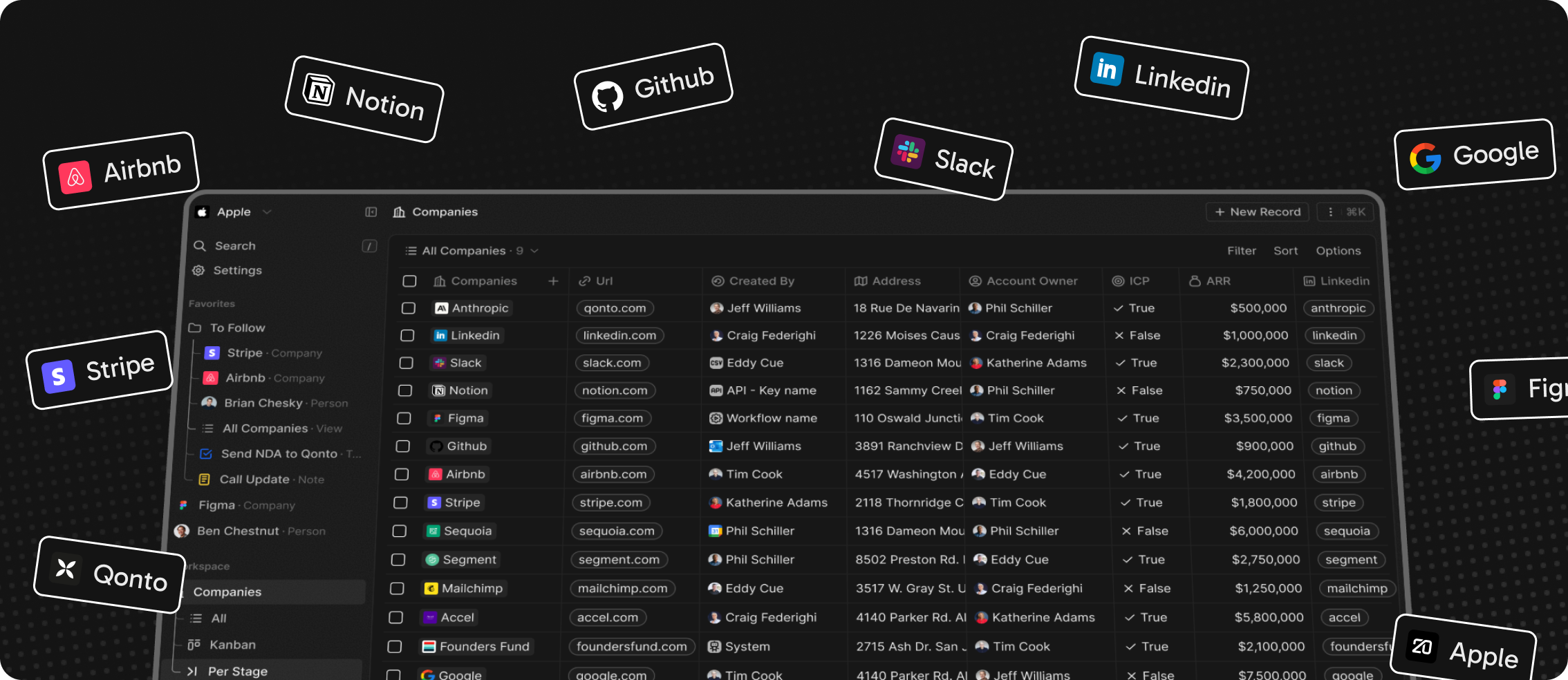
Installation
See: 🚀 Self-hosting 🖥️ Local Setup
Why Twenty
We built Twenty for three reasons:
CRMs are too expensive, and users are trapped. Companies use locked-in customer data to hike prices. It shouldn't be that way.
A fresh start is required to build a better experience. We can learn from past mistakes and craft a cohesive experience inspired by new UX patterns from tools like Notion, Airtable or Linear.
We believe in open-source and community. Hundreds of developers are already building Twenty together. Once we have plugin capabilities, a whole ecosystem will grow around it.
What You Can Do With Twenty
Please feel free to flag any specific needs you have by creating an issue.
Below are a few features we have implemented to date:
- Personalize layouts with filters, sort, group by, kanban and table views
- Customize your objects and fields
- Create and manage permissions with custom roles
- Automate workflow with triggers and actions
- Emails, calendar events, files, and more
Personalize layouts with filters, sort, group by, kanban and table views

Customize your objects and fields

Create and manage permissions with custom roles

Automate workflow with triggers and actions

Emails, calendar events, files, and more

Stack
- TypeScript
- Nx
- NestJS, with BullMQ, PostgreSQL, Redis
- React, with Jotai, Linaria and Lingui
Thanks


Thanks to these amazing services that we use and recommend for UI testing (Chromatic), code review (Greptile), catching bugs (Sentry) and translating (Crowdin).
Join the Community
- Star the repo
- Subscribe to releases (watch -> custom -> releases)
- Follow us on Twitter or LinkedIn
- Join our Discord
- Improve translations on Crowdin
- Contributions are, of course, most welcome!