 martmull
942755d0dd
martmull
942755d0dd
## Problem

After installing an app, its icon is missing across the UI, while
application *registration* icons render fine.

`Application.logo` holds the manifest path (`public/logo.svg`), which is
package-relative and not displayable. The server exposes a `logoUrl`
resolve field that turns it into
`/public-assets/{workspaceId}/{applicationId}/{logo}`, but on the front
end:

- `APPLICATION_FRAGMENT` and `FIND_MANY_APPLICATIONS` never selected
`Application.logoUrl`.
- So the only source of a usable logo url was
`currentWorkspace.installedApplications`, which is fetched by
`GetCurrentUser` at bootstrap. Nothing refreshed it after
`installApplication`, so a freshly installed app was absent from that
list.
- `useApplicationChipData` then fell through to
`fallbackApplicationData`, which callers populated with the raw `logo`
path. `getAbsoluteImageUrl('public/logo.svg')` yields
`{serverUrl}/public/logo.svg`, which 404s, so the avatar rendered as a
letter placeholder.

## Before / After

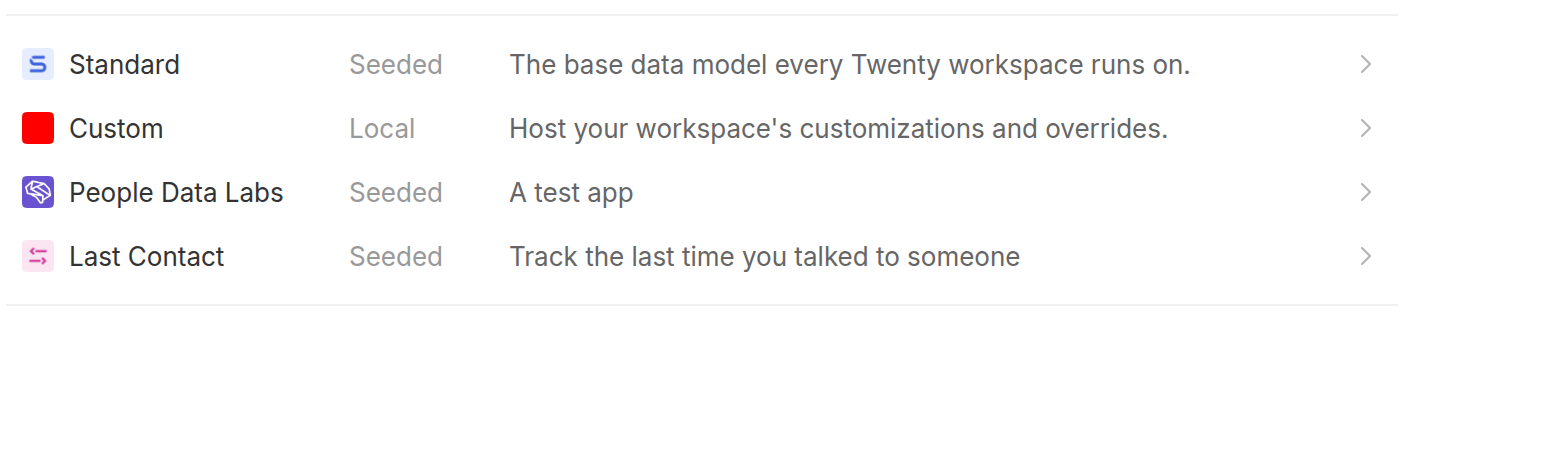
An app installed while the applications page is open, so the workspace
snapshot loaded at bootstrap does not know about it yet:

| Before | After |
|---|---|
| <img
src="https://raw.githubusercontent.com/twentyhq/twenty/e27a817fd95c5e44c1fbb64fd4fd68525daeee61/.pr-assets/app-icon-before.png"
width="480"> | <img
src="https://raw.githubusercontent.com/twentyhq/twenty/e27a817fd95c5e44c1fbb64fd4fd68525daeee61/.pr-assets/app-icon-after.png"
width="480"> |

## Changes

- Select `logoUrl` on `Application` in `APPLICATION_FRAGMENT` and
`FIND_MANY_APPLICATIONS`.
- Drop `logo` from `ApplicationDisplayData` and from the `AppChip` /
subtable fallback props, so a package-relative path can no longer reach
an `img` src. Call sites that already passed a url under `logo` now pass
`logoUrl`.
- `SettingsApplicationDetails` and `SettingsApplicationsTable` pass the
application's own `logoUrl`.
- On install, add the returned application to
`currentWorkspace.installedApplications` instead of reloading the
current user, so the chips that resolve by `applicationId` only (nav
menu items, object/field tables, tool rows, workflow nodes) pick it up.
- Stop exposing `logo` on the `Application` GraphQL type: nothing
selects it anymore, and having both `logo` (package-relative path) and
`logoUrl` (display url) was the source of the bug. The column is still
read server-side to build `logoUrl`.
- Regenerated `generated-metadata/graphql.ts`.

## Verification

Ran the stack locally against a seeded workspace with an installed app
whose logo lives at `public/logo.png`:

- `findManyApplications` returns a `logoUrl` under `/public-assets/...`,
and that url serves `200 image/png`.
- Reproduced the bug and the fix in the browser with the scenario shown
above (screenshots taken on the base commit and on this branch).
- `npx nx typecheck twenty-front`, `npx nx typecheck twenty-server`,
`npx nx lint:diff-with-main` on both, and the application settings jest
suites pass.

---
_Generated by [Claude
Code](https://claude.ai/code/session_01N8r4z2dZ553nAnCNe7GxMH)_

[Review in
cubic](https://cubic.dev/pr/twentyhq/twenty/pull/23411?utm_source=github)

The #1 Open-Source CRM
 Website ·
  Documentation ·
  Roadmap ·
  Discord ·
  Figma
Figma

Why Twenty
Twenty gives technical teams the building blocks for a custom CRM that meets complex business needs and quickly adapts as the business evolves. Twenty is the CRM you build, ship, and version like the rest of your stack.
 Learn more about why we built Twenty
Installation
Cloud

The fastest way to get started. Sign up at twenty.com and spin up a workspace in under a minute, with no infrastructure to manage and always up to date.
Build an app

Scaffold a new app with the Twenty CLI:
npx create-twenty-app my-app
Define objects, fields, and views as code:
import { defineObject, FieldType } from 'twenty-sdk/define';

export default defineObject({
  nameSingular: 'deal',
  namePlural: 'deals',
  labelSingular: 'Deal',
  labelPlural: 'Deals',
  fields: [
    { name: 'name', label: 'Name', type: FieldType.TEXT },
    { name: 'amount', label: 'Amount', type: FieldType.CURRENCY },
    { name: 'closeDate', label: 'Close Date', type: FieldType.DATE_TIME },
  ],
});
Then ship it to your workspace:
npx twenty app:publish --private
See the app development guide for objects, views, agents, and logic functions.
 Self-hosting

Run Twenty on your own infrastructure with Docker Compose, or contribute locally via the local setup guide.
Everything you need
Twenty gives you the building blocks of a modern CRM (objects, views, workflows, and agents) and lets you extend them as code. Here's a tour of what's in the box.
Want to go deeper? Read the  User Guide for product walkthroughs, or the Documentation for developer reference.

|

|

|

|

|

|
 Learn more about version control in doc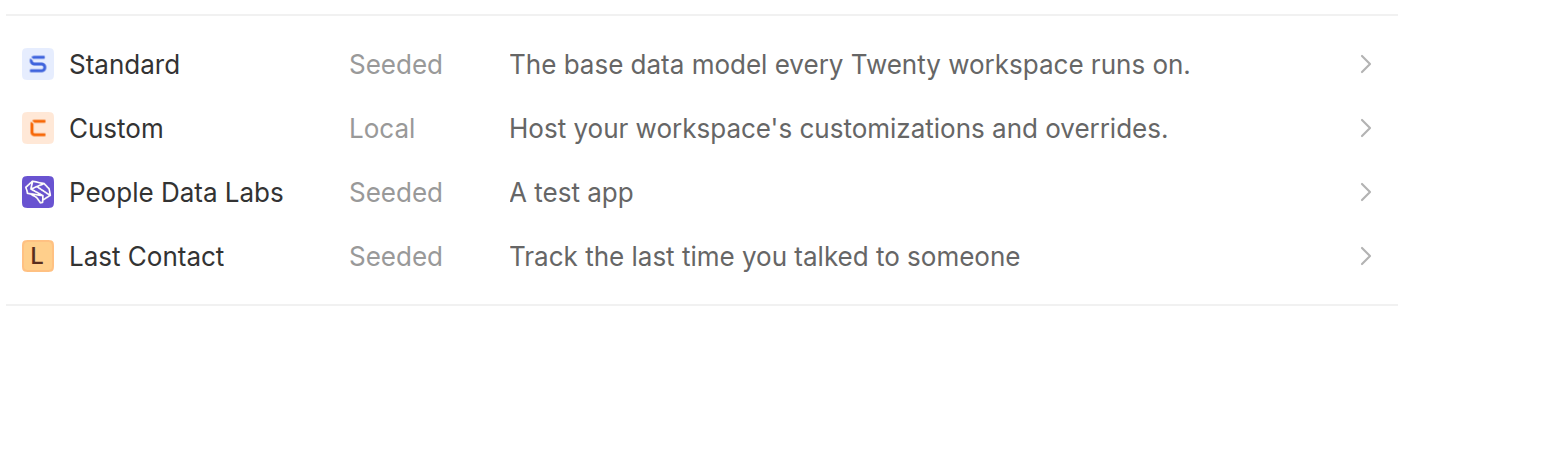
Stack
 TypeScript
 Nx
Nx NestJS, with BullMQ,
  PostgreSQL,
  Redis
Redis React, with Jotai, Linaria and Lingui
Thanks


Thanks to these amazing services that we use and recommend for code review (Greptile), catching bugs (Sentry) and translating (Crowdin).
Join the Community
Star the repo · Discord ·  Feature requests · Releases ·
  X ·
X ·  LinkedIn ·
  Crowdin ·
  Contribute