 Félix Malfait
53d22a3b70
Félix Malfait
53d22a3b70
## Summary

OAuth 2.1 and the MCP authorization spec mandate PKCE (S256) for public
clients — clients registered with \`token_endpoint_auth_method=none\`
(no client secret). We advertise \`code_challenge_methods_supported:
[\"S256\"]\` in \`/.well-known/oauth-authorization-server\` but our
\`/authorize\` flow accepted requests from public clients without
\`code_challenge\`.

## Why this was a soft failure today

\`oauth.service.ts:178\` already rejects token exchange when a client
presents neither \`client_secret\` nor \`code_verifier\`:

\`\`\`ts
if (!clientSecret && !storedCodeChallenge) {
return this.errorResponse('invalid_request', 'Either client_secret or
code_verifier (PKCE) is required');
}
\`\`\`

So a public client attempting to bypass PKCE would **eventually** fail —
but only after:
1. Getting a valid authorization code issued at \`/authorize\`
2. Round-tripping the user through consent
3. Trying to exchange the code at \`/token\` and finally getting
rejected

That's a wasted user interaction and a fuzzy spec boundary. This PR
rejects at \`/authorize\` instead, matching the spec's \"MUST require
PKCE for public clients\" expectation.

## Fix

Single check in \`AuthService.generateAuthorizationCode\`:

\`\`\`ts
const isPublicClient = !applicationRegistration.oAuthClientSecretHash;

if (isPublicClient && !codeChallenge) {
  throw new AuthException(
\`code_challenge is required for public clients (PKCE S256, per OAuth
2.1)\`,
    AuthExceptionCode.FORBIDDEN_EXCEPTION,
  );
}
\`\`\`

### Why \`!oAuthClientSecretHash\` is the right \"public\" predicate

- Dynamic registration (\`POST /oauth/register\`) hardcodes
\`oAuthClientSecretHash: null\` and rejects any
\`token_endpoint_auth_method != \"none\"\`
(oauth-registration.controller.ts:120-130).
- Confidential clients registered via the workspace settings UI have a
non-null bcrypt hash.
- The same field is already used as the public/confidential gate in
\`validateClient\` and \`validateClientSecret\`.

## Scope

- ✅ Dynamic-registration clients (Claude, other MCP connectors) — MUST
now supply code_challenge. They already do; no behavior change for
conformant clients.
- ✅ The seeded twenty-cli registration — public client, already uses
PKCE. No change.
- ➖ Confidential clients (workspace-admin-registered OAuth apps with a
client_secret) — unaffected, they authenticate at the token endpoint.

## Related

- #19836 — CORS exposes \`WWW-Authenticate\` / \`MCP-Protocol-Version\`
- #19838 — RFC 9728 PRM split + RFC 9207 iss param + \`scope\` in
WWW-Authenticate challenge

## Test plan

- [x] \`tsc --noEmit\` clean on modified file (pre-existing
\`twenty-shared\` dist errors unrelated)
- [ ] Integration-level smoke test after deploy:
  \`\`\`bash
  # Register a dynamic client (public)
  CLIENT_ID=$(curl -s -X POST -H 'Content-Type: application/json' \\
-d
'{\"client_name\":\"pkce-test\",\"redirect_uris\":[\"http://localhost/cb\"]}'
\\
    https://<host>/oauth/register | jq -r .client_id)

# Without code_challenge → should now 4xx at /authorize (cannot easily
test outside the React UI,
  # but the GraphQL authorizeApp mutation will throw AuthException)
  \`\`\`
- [ ] Claude MCP connector still completes OAuth end-to-end (it always
sends code_challenge, so no-op)

🤖 Generated with [Claude Code](https://claude.com/claude-code)

Co-authored-by: Claude Opus 4.6 <noreply@anthropic.com>

The #1 Open-Source CRM
🌐 Website · 📚 Documentation ·  Roadmap ·
  Discord ·
  Figma
Figma
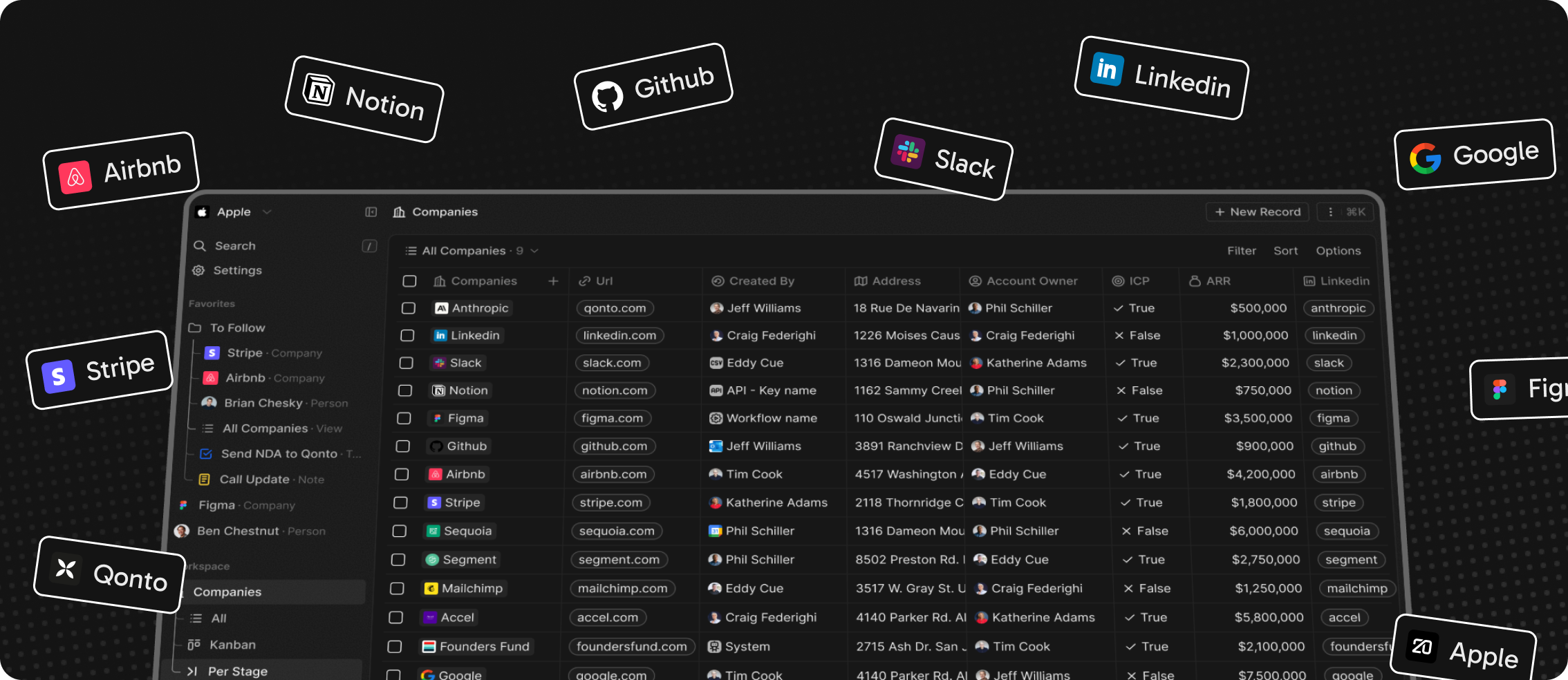
Installation
See: 🚀 Self-hosting 🖥️ Local Setup
Why Twenty
We built Twenty for three reasons:
CRMs are too expensive, and users are trapped. Companies use locked-in customer data to hike prices. It shouldn't be that way.
A fresh start is required to build a better experience. We can learn from past mistakes and craft a cohesive experience inspired by new UX patterns from tools like Notion, Airtable or Linear.
We believe in open-source and community. Hundreds of developers are already building Twenty together. Once we have plugin capabilities, a whole ecosystem will grow around it.
What You Can Do With Twenty
Please feel free to flag any specific needs you have by creating an issue.
Below are a few features we have implemented to date:
- Personalize layouts with filters, sort, group by, kanban and table views
- Customize your objects and fields
- Create and manage permissions with custom roles
- Automate workflow with triggers and actions
- Emails, calendar events, files, and more
Personalize layouts with filters, sort, group by, kanban and table views

Customize your objects and fields

Create and manage permissions with custom roles

Automate workflow with triggers and actions

Emails, calendar events, files, and more

Stack
- TypeScript
- Nx
- NestJS, with BullMQ, PostgreSQL, Redis
- React, with Jotai, Linaria and Lingui
Thanks


Thanks to these amazing services that we use and recommend for UI testing (Chromatic), code review (Greptile), catching bugs (Sentry) and translating (Crowdin).
Join the Community
- Star the repo
- Subscribe to releases (watch -> custom -> releases)
- Follow us on Twitter or LinkedIn
- Join our Discord
- Improve translations on Crowdin
- Contributions are, of course, most welcome!