 Félix Malfait
3ed67b825e
Félix Malfait
3ed67b825e
## Overview

This PR implements **generic many-to-many relation support** through
junction tables (also known as associative entities or join tables).
This replaces the need for hardcoded taskTarget/noteTarget logic and
provides a flexible foundation for modeling complex entity
relationships.

## Architecture

### Data Model

Many-to-many relationships are implemented using a **junction object
pattern**:

```
┌─────────┐       ┌──────────────────┐       ┌─────────┐
│  Pet    │──────>│   PetRocket      │<──────│ Rocket  │
│         │ 1:N   │  (junction)      │  N:1  │         │
│ rockets ├───────┤ pet    : Pet     ├───────┤         │
└─────────┘       │ rocket : Rocket  │       └─────────┘
                  └──────────────────┘
```

The junction object (PetRocket) has:
- A `MANY_TO_ONE` relation to **Pet** (the source)
- A `MANY_TO_ONE` relation to **Rocket** (the target)

The source object (Pet) has a `ONE_TO_MANY` relation pointing to the
junction, with **field settings** that specify which target field to
follow.

### Field Settings Schema

Junction configuration is stored in `FieldMetadataRelationSettings`:

```typescript
{
  relationType: "ONE_TO_MANY",
  // Points to the target field on the junction object
  junctionTargetFieldId?: string;      // For regular relations
  junctionTargetMorphId?: string;      // For polymorphic relations
}
```

**Two configuration modes:**
1. **`junctionTargetFieldId`** - References a specific `RELATION` field
on the junction
2. **`junctionTargetMorphId`** - References a `morphId` group for
polymorphic targets (e.g., link to Person OR Company)

### GraphQL Query Generation

When a junction relation is detected, the GraphQL fields are generated
to fetch the nested target:

```graphql
query GetPetWithRockets {
  pet(id: "...") {
    rockets {           # ONE_TO_MANY to junction
      id
      rocket {          # Target field on junction
        id
        name
        __typename
      }
    }
  }
}
```

For polymorphic junction targets:
```graphql
caretakerPerson { id, name }
caretakerCompany { id, name }
```

## Frontend Architecture

### Display Flow

1. **Detection**: `hasJunctionConfig()` checks if field has junction
settings
2. **Config Resolution**: `getJunctionConfig()` resolves junction object
metadata and target fields
3. **Record Extraction**: `extractTargetRecordsFromJunction()` extracts
target records from junction records
4. **Rendering**: Target records displayed as chips (not junction
records)

### Edit Flow

1. **Picker Opening**: Initializes the multi-record picker with:
   - Searchable object types (derived from junction target fields)
   - Pre-selected items (extracted from existing junction records)

2. **Selection Handling**: Manages create/delete of junction records:
   - **Select**: Creates new junction record with source + target IDs
   - **Deselect**: Finds and deletes the junction record
- **Optimistic Updates**: Manually updates Recoil store before API call

### Key Trade-offs

| Decision | Trade-off |
|----------|-----------|
| Junction records managed manually | More control over optimistic
updates, but requires manual cache management |
| Settings stored per-field | Flexible (same junction can power
different views), but requires UI to configure |
| Polymorphic via morphId groups | Supports N target types, but adds
query complexity |
| Feature flag gated | Safe rollout, but requires flag management |

## Backend Changes

- **Validation**: Junction target field must exist and be a valid
`MANY_TO_ONE` relation
- **Settings**: Extended `FieldMetadataRelationSettings` type with
junction fields
- **Dev Seeder**: Added sample junction objects (PetRocket,
EmploymentHistory, PetCareAgreement) for testing

## How to Test

1. Enable the `IS_JUNCTION_RELATIONS_ENABLED` feature flag
2. Create objects with junction pattern (Pet → PetRocket → Rocket)
3. Configure the junction target in field settings (advanced mode)
4. Verify:
- Display shows target objects (Rockets), not junction records
(PetRockets)
   - Picker allows selecting/deselecting targets
   - Changes persist correctly


https://github.com/user-attachments/assets/d04f057a-228c-4de8-af48-76bb2d72cac1

---------

Co-authored-by: Charles Bochet <charles@twenty.com>

The #1 Open-Source CRM
🌐 Website · 📚 Documentation ·  Roadmap ·
  Discord ·
  Figma
Figma
Installation
See: 🚀 Self-hosting 🖥️ Local Setup
Does the world need another CRM?
We built Twenty for three reasons:
CRMs are too expensive, and users are trapped. Companies use locked-in customer data to hike prices. It shouldn't be that way.
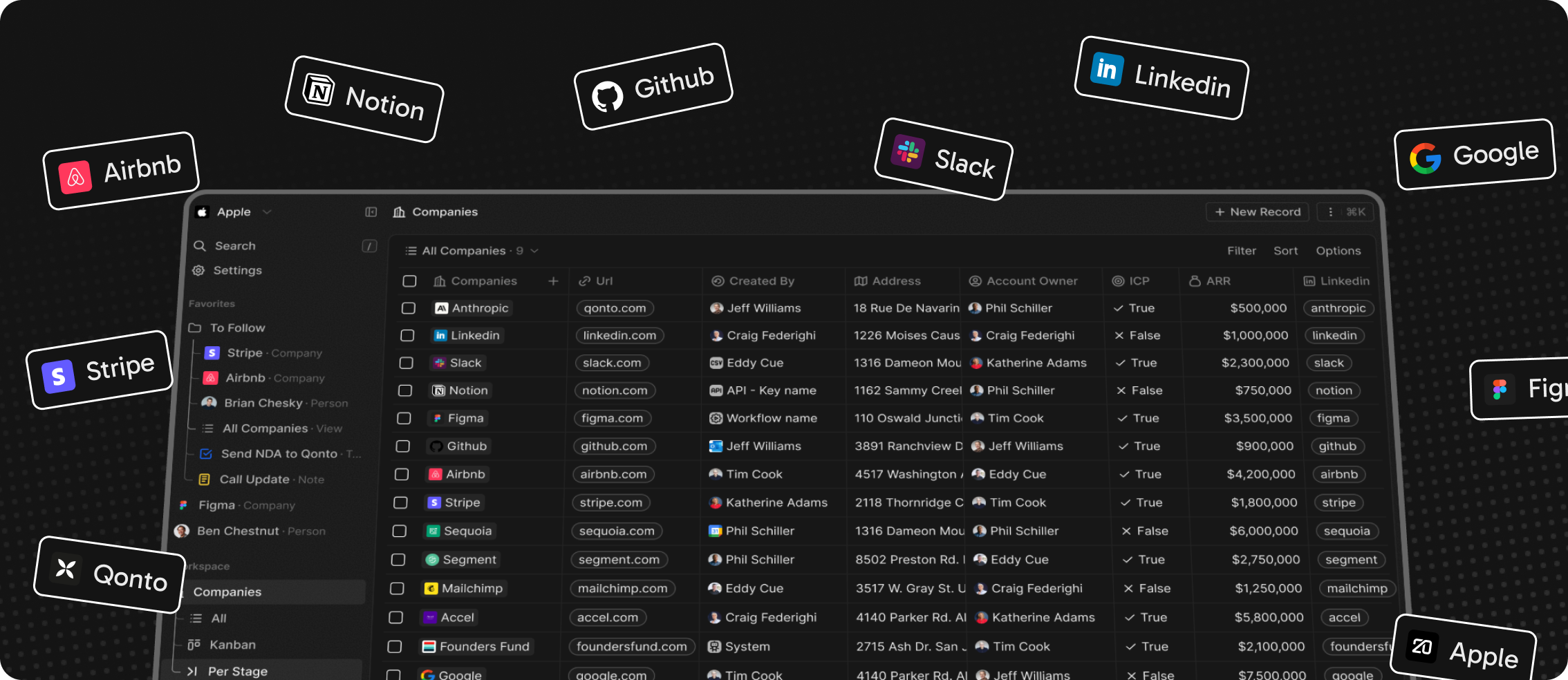
A fresh start is required to build a better experience. We can learn from past mistakes and craft a cohesive experience inspired by new UX patterns from tools like Notion, Airtable or Linear.
We believe in Open-source and community. Hundreds of developers are already building Twenty together. Once we have plugin capabilities, a whole ecosystem will grow around it.
What You Can Do With Twenty
Please feel free to flag any specific needs you have by creating an issue.
Below are a few features we have implemented to date:
- Personalize layouts with filters, sort, group by, kanban and table views
- Customize your objects and fields
- Create and manage permissions with custom roles
- Automate workflow with triggers and actions
- Emails, calendar events, files, and more
Personalize layouts with filters, sort, group by, kanban and table views

Customize your objects and fields

Create and manage permissions with custom roles

Automate workflow with triggers and actions

Emails, calendar events, files, and more

Stack
- TypeScript
- Nx
- NestJS, with BullMQ, PostgreSQL, Redis
- React, with Recoil, Emotion and Lingui
Thanks


Thanks to these amazing services that we use and recommend for UI testing (Chromatic), code review (Greptile), catching bugs (Sentry) and translating (Crowdin).
Join the Community
- Star the repo
- Subscribe to releases (watch -> custom -> releases)
- Follow us on Twitter or LinkedIn
- Join our Discord
- Improve translations on Crowdin
- Contributions are, of course, most welcome!