 Félix Malfait
1f3defa7b3
Félix Malfait
1f3defa7b3
## The bug

Claude's MCP connector fails with \"Couldn't reach the MCP server\" on
every URL (\`api.twenty.com/mcp\`, \`app.twenty.com/mcp\`,
\`<workspace>.twenty.com/mcp\`, custom domains). The failure happens
**before** any OAuth flow starts — the client never even reaches the
consent screen.

## Root cause

\`POST /mcp\` unauthenticated returns:

\`\`\`
HTTP/2 401
access-control-allow-origin: *
www-authenticate: Bearer
resource_metadata=\"https://…/.well-known/oauth-protected-resource\"
content-type: application/json; charset=utf-8
(no access-control-expose-headers)
\`\`\`

The [Fetch/CORS
spec](https://fetch.spec.whatwg.org/#cors-safelisted-response-header-name)
defines only six response headers as safelisted — \`Cache-Control\`,
\`Content-Language\`, \`Content-Type\`, \`Expires\`, \`Last-Modified\`,
\`Pragma\`. Every other header is withheld from cross-origin JS unless
the server opts it in via \`Access-Control-Expose-Headers\`.

Result: Claude's browser-side MCP client receives the 401 but
\`response.headers.get('WWW-Authenticate')\` returns \`null\`. No
\`resource_metadata\` URL, no discovery, no OAuth — the client gives up
with the generic \"can't reach server\" error.

The [MCP authorization
spec](https://modelcontextprotocol.io/specification/draft/basic/authorization)
explicitly requires this header to be exposed.

## Fix

One config change in \`main.ts\`:

\`\`\`ts
-    cors: true,
+ // Expose WWW-Authenticate so browser-based MCP clients can read the
+ // resource_metadata pointer on 401. Required by MCP authorization
spec.
+    cors: { exposedHeaders: ['WWW-Authenticate'] },
\`\`\`

NestJS's default \`cors: true\` uses the \`cors\` package defaults,
which don't set \`exposedHeaders\`. Moving to an explicit config keeps
all other defaults (origin \`*\`, standard methods) and adds the single
required expose.

## Why it's safe and generally beneficial

- \`Access-Control-Expose-Headers: WWW-Authenticate\` is sent on every
response but only has an effect when \`WWW-Authenticate\` is actually
present (i.e. 401s). It's an opt-in permission, not a header-setter.
- \`WWW-Authenticate\` itself is still only set by \`McpAuthGuard\` on
401 — this PR doesn't change where or when the header is emitted.
- Covers the entire app, not just \`/mcp\` — any future 401-returning
endpoint will behave correctly for browser clients automatically.
- No change to origin handling, methods, or credentials. All existing
API / GraphQL / REST traffic is unaffected.

## Verification

After deploy:
\`\`\`bash
curl -sI -X POST -H \"Origin: https://claude.ai\"
https://api.twenty.com/mcp \\
  | grep -iE 'access-control-expose|www-authenticate'
# Expect:
#   access-control-expose-headers: WWW-Authenticate
#   www-authenticate: Bearer resource_metadata=\"…\"
\`\`\`

Then re-try adding the MCP connector in Claude — if this was the only
blocker, OAuth should now complete.

## Related

- #19755, #19766, #19824 — prior fixes in the MCP/OAuth discovery chain
(host-aware metadata, path-aware well-known, \`TRUST_PROXY\` for
\`request.protocol\`). This PR completes the CORS side of that work.

🤖 Generated with [Claude Code](https://claude.com/claude-code)

Co-authored-by: Claude Opus 4.6 <noreply@anthropic.com>

The #1 Open-Source CRM
🌐 Website · 📚 Documentation ·  Roadmap ·
  Discord ·
  Figma
Figma
Installation
See: 🚀 Self-hosting 🖥️ Local Setup
Why Twenty
We built Twenty for three reasons:
CRMs are too expensive, and users are trapped. Companies use locked-in customer data to hike prices. It shouldn't be that way.
A fresh start is required to build a better experience. We can learn from past mistakes and craft a cohesive experience inspired by new UX patterns from tools like Notion, Airtable or Linear.
We believe in open-source and community. Hundreds of developers are already building Twenty together. Once we have plugin capabilities, a whole ecosystem will grow around it.
What You Can Do With Twenty
Please feel free to flag any specific needs you have by creating an issue.
Below are a few features we have implemented to date:
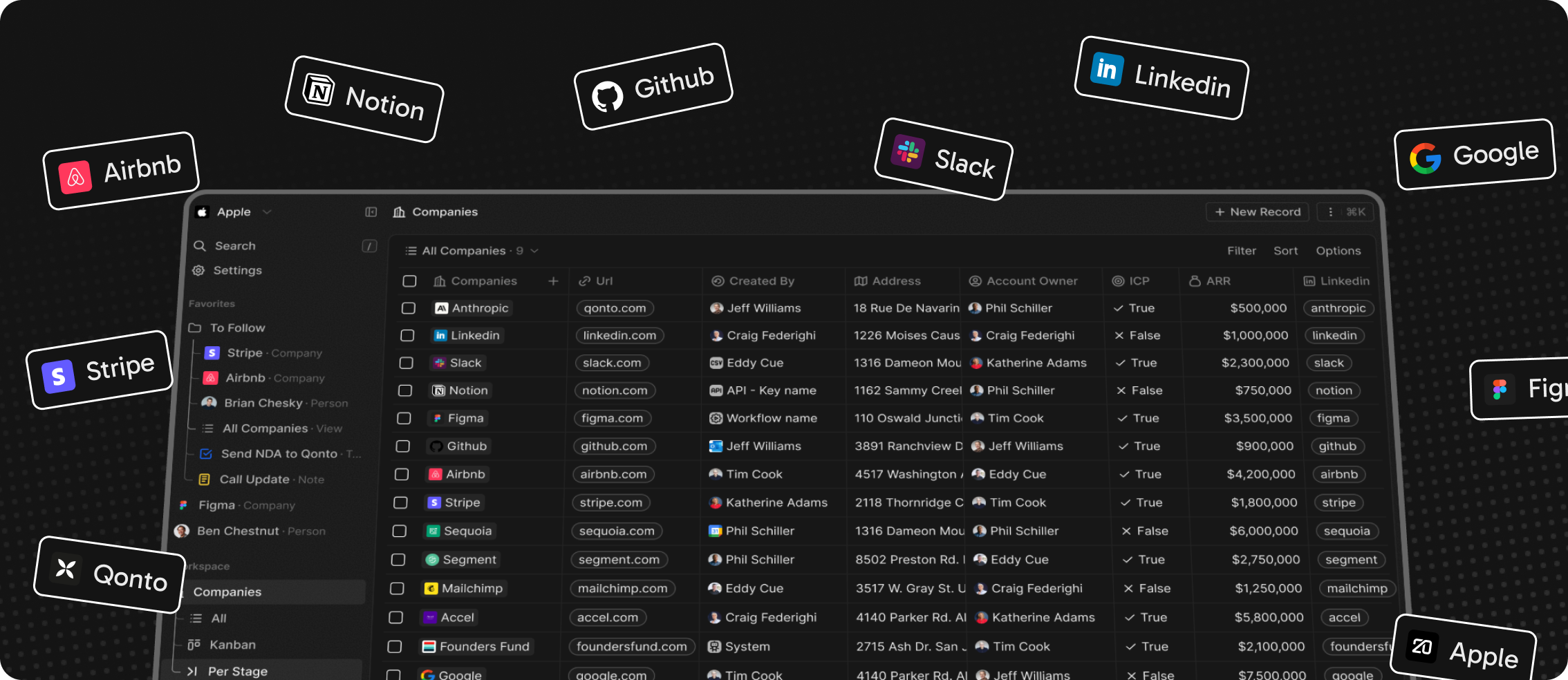
- Personalize layouts with filters, sort, group by, kanban and table views
- Customize your objects and fields
- Create and manage permissions with custom roles
- Automate workflow with triggers and actions
- Emails, calendar events, files, and more
Personalize layouts with filters, sort, group by, kanban and table views

Customize your objects and fields

Create and manage permissions with custom roles

Automate workflow with triggers and actions

Emails, calendar events, files, and more

Stack
- TypeScript
- Nx
- NestJS, with BullMQ, PostgreSQL, Redis
- React, with Jotai, Linaria and Lingui
Thanks


Thanks to these amazing services that we use and recommend for UI testing (Chromatic), code review (Greptile), catching bugs (Sentry) and translating (Crowdin).
Join the Community
- Star the repo
- Subscribe to releases (watch -> custom -> releases)
- Follow us on Twitter or LinkedIn
- Join our Discord
- Improve translations on Crowdin
- Contributions are, of course, most welcome!