 Weiko
02fda92a93
Weiko
02fda92a93
## Context
This PR introduces a Global Workspace DataSource that consolidates
workspace-specific database access through a single TypeORM DataSource
instance with AsyncLocalStorage-based context management instead of N
workspace datasources.

- Created GlobalWorkspaceDataSource extending TypeORM's DataSource to
manage multiple workspaces with entity metadata caching (1-hour TTL)
- Implemented AsyncLocalStorage for workspace context propagation
(WorkspaceContextForStorage) containing workspace ID, metadata,
permissions, and feature flags
- Modified query execution flow to wrap operations in workspace context
via GlobalWorkspaceOrmManager.executeInWorkspaceContext()
- Added schema name to entity schemas for proper multi-tenant database
separation

Next:
- use the new global workspace datasource everywhere and deprecate
workspace datasource factory
- improve metadata caching using a short TTL to avoid multiple calls to
redis
- Leverage the new WorkspaceContextALS and put it higher in the request
hierarchy to have access to permission, metadata and featureflag
everywhere --- build it manually for commands --- find a way to
propagate it in jobs?
- Remove PG_POOL patch once we have a unique datasource and increase
global datasource pool size

## Implementation
Why ALS:

1. Automatic Per-Request Isolation

With schema-based multi-tenancy, each workspace has its own PostgreSQL
schema
(e.g. workspace_20202020-1c25-4d02-bf25-6aeccf7ea419).
The critical challenge is ensuring that concurrent requests from
different tenants don't interfere with each other.
```typescript
// Request A (Workspace 1) and Request B (Workspace 2) executing concurrently

// Without ALS: Race condition — they'd share the same global state!
// With ALS: Each request has isolated context ✓
```
ALS automatically isolates context per async execution chain, so:
- Request from Tenant A → ALS stores workspaceId: "tenant-a" → Queries
hit workspace_tenant_a schema
- Request from Tenant B → ALS stores workspaceId: "tenant-b" → Queries
hit workspace_tenant_b schema

✅ No interference, even when executing simultaneously on the same
Node.js event loop.

2. No Manual Context Passing

Before ALS, you'd need to pass workspaceId through every function call:
```typescript
// ❌ Without ALS - Context threading nightmare
getRepository(workspaceId, entity)
  → createEntityManager(workspaceId)
    → getMetadata(workspaceId, target)
      → findInCache(workspaceId, cacheKey)
```
With ALS:
```typescript
// ✅ With ALS - Clean, implicit context
getRepository(entity)          // Reads workspaceId from ALS
  → createEntityManager()      // Reads workspaceId from ALS
    → getMetadata(target)      // Reads workspaceId from ALS
      → findInCache(cacheKey)  // Reads workspaceId from ALS
```
example
```typescript
override findMetadata(target: EntityTarget<ObjectLiteral>): EntityMetadata | undefined {
  const context = getWorkspaceContext(); // 👈 Automatically gets the right workspace!
  const { workspaceId, metadataVersion } = context;
  const cacheKey = `${workspaceId}-${metadataVersion}`;
  // ... returns metadata for THIS workspace's schema
}
```

3. Async Chain Propagation

Node.js operations are heavily async. ALS automatically propagates
context through:

- async/await chains
- Promise chains
- Callbacks

```typescript
executeInWorkspaceContext(workspaceId, async () => {
  await prepareContext();           // Has context ✓
  const results = await run();      // Has context ✓
  await enrichResults();            // Has context ✓

  // Even nested async operations maintain context!
  await Promise.all([
    saveToCache(),   // Has context ✓
    emitEvent(),     // Has context ✓
    logMetrics(),    // Has context ✓
  ]);
});
```
5. Schema-Specific Metadata Caching

The implementation caches entity metadata per workspace + version:
```typescript
// Cache key format: "workspaceId-metadataVersion"
const cacheKey = `${workspaceId}-${metadataVersion}`;
```
Why this matters with schemas:

- Each workspace has different table structures (custom fields, objects)
- EntitySchema includes schema: "workspace_xxx" property
- Each cached metadata points to the correct schema

ALS ensures getWorkspaceContext() returns the right workspaceId,
so you always get the correct schema's metadata from cache.

6. Single DataSource for All Tenants

The key change here:
```typescript
// ❌ Old approach: One DataSource per tenant
const dataSourceTenantA = new DataSource({ schema: 'workspace_a' });
const dataSourceTenantB = new DataSource({ schema: 'workspace_b' });
// Problem: Hundreds of DB connection pools!
```
```typescript
// ✅ New approach: One shared DataSource + ALS context
const globalDataSource = new GlobalWorkspaceDataSource();

// ALS determines which schema to use at runtime
```
When you call:
```typescript
globalDataSource.getRepository('person');
```
It internally does:
```typescript
const context = getWorkspaceContext();  // Gets current tenant from ALS
const metadata = this.findMetadata('person'); // Finds metadata for THIS tenant's schema
// EntityMetadata includes: schema: "workspace_20202020-1c25..."
// TypeORM automatically queries: SELECT * FROM "workspace_20202020-1c25...".person
```
7. Request Lifecycle Example

```typescript
// 1. GraphQL request arrives: "query people { ... }"
// 2. Middleware extracts authContext.workspace.id = "tenant-a"
// 3. Query runner wraps execution in ALS:
executeInWorkspaceContext("tenant-a", async () => {
  // 4. Everything inside has access to workspace context:
  const repo = getRepository('person');      // ALS → tenant-a
  const metadata = getMetadata('person');    // ALS → tenant-a → cache["tenant-a-v5"]

  // 5. TypeORM builds query with correct schema:
  // SELECT * FROM "workspace_tenant_a"."person" WHERE ...

  // 6. Even nested calls work:
  await saveAuditLog();  // ALS → tenant-a → correct audit schema
  await emitWebhook();   // ALS → tenant-a → correct tenant webhook
});
// 7. Request completes, ALS context automatically cleaned up
```

8. Safety & Error Prevention

```typescript
// If you forget to set context:
const context = getWorkspaceContext();
// ❌ Throws: "Workspace context not set..."
// Fails fast rather than querying wrong schema!

// Can't accidentally query wrong tenant:
// Context is immutable within execution scope
```

The #1 Open-Source CRM
🌐 Website · 📚 Documentation ·  Roadmap ·
  Discord ·
  Figma
Figma
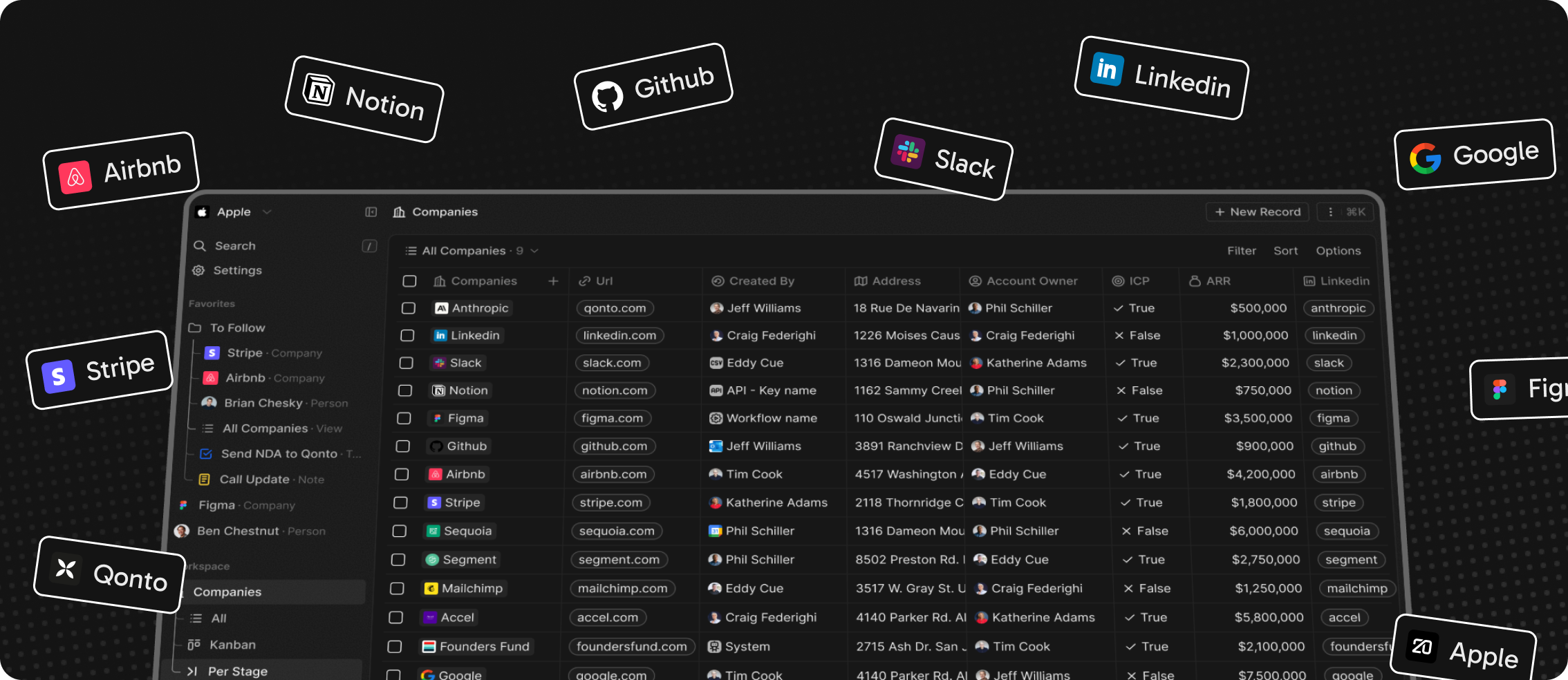
Installation
See: 🚀 Self-hosting 🖥️ Local Setup
Does the world need another CRM?
We built Twenty for three reasons:
CRMs are too expensive, and users are trapped. Companies use locked-in customer data to hike prices. It shouldn't be that way.
A fresh start is required to build a better experience. We can learn from past mistakes and craft a cohesive experience inspired by new UX patterns from tools like Notion, Airtable or Linear.
We believe in Open-source and community. Hundreds of developers are already building Twenty together. Once we have plugin capabilities, a whole ecosystem will grow around it.
What You Can Do With Twenty
Please feel free to flag any specific needs you have by creating an issue.
Below are a few features we have implemented to date:
- Personalize layouts with filters, sort, group by, kanban and table views
- Customize your objects and fields
- Create and manage permissions with custom roles
- Automate workflow with triggers and actions
- Emails, calendar events, files, and more
Personalize layouts with filters, sort, group by, kanban and table views

Customize your objects and fields

Create and manage permissions with custom roles

Automate workflow with triggers and actions

Emails, calendar events, files, and more

Stack
- TypeScript
- Nx
- NestJS, with BullMQ, PostgreSQL, Redis
- React, with Recoil, Emotion and Lingui
Thanks


Thanks to these amazing services that we use and recommend for UI testing (Chromatic), code review (Greptile), catching bugs (Sentry) and translating (Crowdin).
Join the Community
- Star the repo
- Subscribe to releases (watch -> custom -> releases)
- Follow us on Twitter or LinkedIn
- Join our Discord
- Improve translations on Crowdin
- Contributions are, of course, most welcome!