ea7863dc4e20c91ae69bb3eca3ce67a17e0220ea
768 Commits
| Author | SHA1 | Message | Date | |
|---|---|---|---|---|
 Thomas Trompette Thomas Trompette
|
9dd9709e97 |
test(workflow): cover the workflow core mirror end to end (#23434)
## What Adds the integration coverage `core.workflow` mirroring never had: create, rename, delete, restore and destroy, asserting the core row appears, follows the rename, disappears and comes back. No production code changes. The async `WorkflowCoreDualWriteListener` stays as the mirror for the workflow entity. ## Why this PR changed shape It originally replaced the listener with query hooks, to remove the last async best-effort write path. That was the wrong call, for three reasons found while reviewing it: 1. **It would have introduced drift, not removed it.** `workflow-trigger.workspace-service.ts` updates `lastPublishedVersionId` via `workflowRepository.update(...)` when a version is activated. That is a repository write, not an API mutation, so query hooks never fire for it and `core.workflow.lastPublishedVersionId` would have gone stale on **every workflow activation**. The consistency cron compares that field, so it would surface as `fieldMismatch` drift. The listener catches it because events are emitted at the ORM layer. 2. **Hooks are no more atomic than the listener here.** Workflow CRUD goes through the generic API, so there is no dedicated mutation to wrap and the generic runner holds no transaction: it commits, then runs post-hooks. Both approaches are post-commit, with the same drift guarantees. 3. **Events carry the full record; hook payloads do not.** `workspace-insert-query-builder` passes the full formatted result to the event while the client response is filtered by `returning`. That partial payload is what forced the re-fetches, the `coreWorkflowId` pre-hook injection, and the destroy pre-commit special case. All three were workarounds for a problem the listener does not have. The principle we settled on: **use the transaction where one exists, use the listener where there isn't one.** Post-hooks were the worst of both here. Version *content* writes keep their transactional mirror, since those go through dedicated mutations that own a transaction. ## Note on the test The mirror is asynchronous, so the assertions poll (20 attempts, 250ms) rather than reading core immediately after the mutation returns. Without that it would be racy. ## Verification - `nx typecheck twenty-server` green - `oxfmt` + `oxlint --type-aware` green |
||
|
Paul Rastoin
|
25d20731ac |
Include root cause errors in workspace migration runner exception message (#23416)
closes https://github.com/twentyhq/core-team-issues/issues/2733 ```diff - "message": "Migration action 'create' for 'index' (universalIdentifier: 67c6811e-...) failed" + "message": "Migration action 'create' for 'index' (universalIdentifier: 67c6811e-...) failed: [workspaceSchema] could not create unique index "IDX_UNIQUE_85951922a2..." (pg code: 23505, detail: Key ("externalId")=(DUPLICATED-VALUE) is duplicated.)" ``` ## Problem When a workspace migration action fails, the `EXECUTION_FAILED` exception message only states which action failed: ``` Migration action 'create' for 'index' (universalIdentifier: 9e20a0f6-7a18-51c5-a422-5dc4dbd1d972) failed ``` The underlying errors (`metadata`, `workspaceSchema`, `actionTranspilation`) are attached to the exception instance but dropped by most surfaces: the SDK CLI only prints `errors[0].message`, server logs only log `error.message`, and the REST/GraphQL paths lose the postgres driver details. Debugging a failed app install (like the stale index universalIdentifier case in the issue) requires guessing. ## Change - New `formatWorkspaceMigrationRunnerExecutionErrors` util that builds a compact one-line summary of the underlying execution errors, including the postgres error code and `detail` for `QueryFailedError`, capped at 1500 chars. - The `EXECUTION_FAILED` exception message now appends that summary: ``` Migration action 'create' for 'index' (universalIdentifier: 9e20a0f6-...) failed: [workspaceSchema] relation "IDX_..." already exists (pg code: 42P07) ``` Since every surface (CLI, server logs, Sentry, REST, GraphQL) shows `error.message`, the root cause now propagates everywhere without touching those surfaces. - Since actions run inside a single transaction, when one branch fails with `25P02 current transaction is aborted` (collateral of the other branch's statement aborting the transaction), the summary keeps only the real root cause. A lone 25P02 error is still shown. ## Notes - The SDK's `getSyncErrorRecoveryHint` matching (`/migration action .* failed/`) still works with the suffixed format. - Commit-time failures from `DEFERRABLE INITIALLY DEFERRED` FK constraints still bypass this path (wrapped as `INTERNAL_SERVER_ERROR` with no action attribution) and are left as a follow-up. ## Tests - New spec for the formatter util (labels, pg code/detail, 25P02 demotion, truncation). - Extended `workspace-migration-runner.exception.spec.ts` with a root-cause message assertion. - Updated `format-upgrade-error-for-storage` snapshots (first line now carries the enriched message). --- _Generated by [Claude Code](https://claude.ai/code/session_01Mu8t74X14oYVkLrFBZHs2o)_ <!-- This is an auto-generated description by cubic. --> <a href="https://cubic.dev/pr/twentyhq/twenty/pull/23416?utm_source=github" target="_blank" rel="noopener noreferrer" data-no-image-dialog="true"><picture><source media="(prefers-color-scheme: dark)" srcset="https://www.cubic.dev/buttons/review-in-cubic-dark.svg"><source media="(prefers-color-scheme: light)" srcset="https://www.cubic.dev/buttons/review-in-cubic-light.svg"><img alt="Review in cubic" src="https://www.cubic.dev/buttons/review-in-cubic-dark.svg"></picture></a> <!-- End of auto-generated description by cubic. --> |
||
|
martmull
|
942755d0dd |
fix(applications): display the installed application icon (#23411)
## Problem

After installing an app, its icon is missing across the UI, while
application *registration* icons render fine.

`Application.logo` holds the manifest path (`public/logo.svg`), which is
package-relative and not displayable. The server exposes a `logoUrl`
resolve field that turns it into
`/public-assets/{workspaceId}/{applicationId}/{logo}`, but on the front
end:

- `APPLICATION_FRAGMENT` and `FIND_MANY_APPLICATIONS` never selected
`Application.logoUrl`.
- So the only source of a usable logo url was
`currentWorkspace.installedApplications`, which is fetched by
`GetCurrentUser` at bootstrap. Nothing refreshed it after
`installApplication`, so a freshly installed app was absent from that
list.
- `useApplicationChipData` then fell through to
`fallbackApplicationData`, which callers populated with the raw `logo`
path. `getAbsoluteImageUrl('public/logo.svg')` yields
`{serverUrl}/public/logo.svg`, which 404s, so the avatar rendered as a
letter placeholder.

## Before / After

An app installed while the applications page is open, so the workspace
snapshot loaded at bootstrap does not know about it yet:

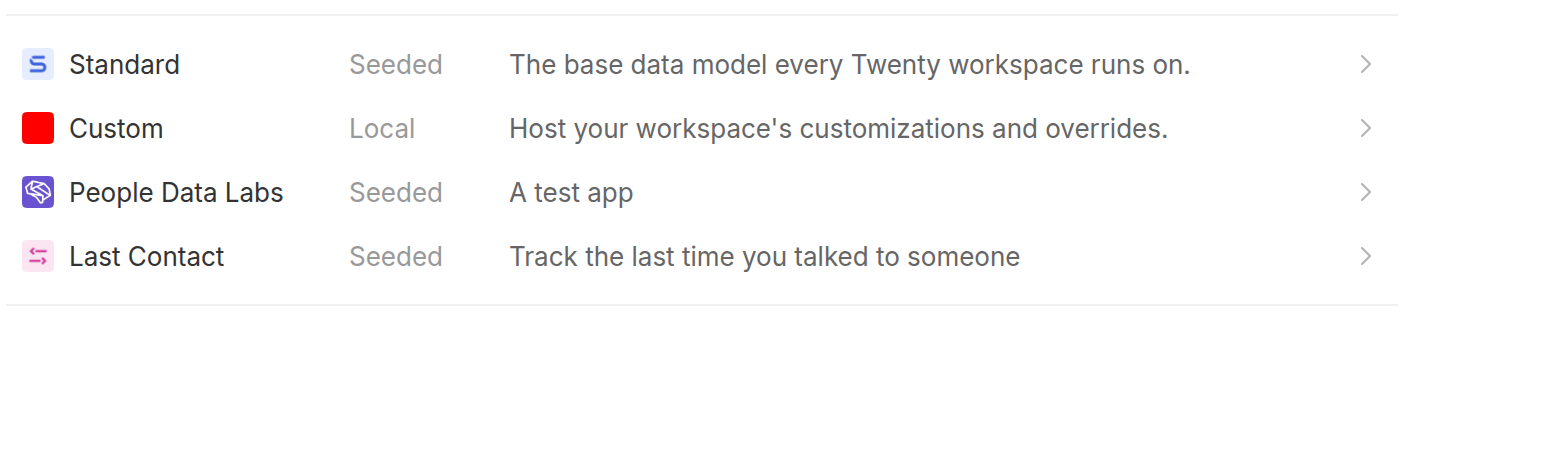
| Before | After |
|---|---|
| <img
src="https://raw.githubusercontent.com/twentyhq/twenty/e27a817fd95c5e44c1fbb64fd4fd68525daeee61/.pr-assets/app-icon-before.png"
width="480"> | <img
src="https://raw.githubusercontent.com/twentyhq/twenty/e27a817fd95c5e44c1fbb64fd4fd68525daeee61/.pr-assets/app-icon-after.png"
width="480"> |

## Changes

- Select `logoUrl` on `Application` in `APPLICATION_FRAGMENT` and
`FIND_MANY_APPLICATIONS`.
- Drop `logo` from `ApplicationDisplayData` and from the `AppChip` /
subtable fallback props, so a package-relative path can no longer reach
an `img` src. Call sites that already passed a url under `logo` now pass
`logoUrl`.
- `SettingsApplicationDetails` and `SettingsApplicationsTable` pass the
application's own `logoUrl`.
- On install, add the returned application to
`currentWorkspace.installedApplications` instead of reloading the
current user, so the chips that resolve by `applicationId` only (nav
menu items, object/field tables, tool rows, workflow nodes) pick it up.
- Stop exposing `logo` on the `Application` GraphQL type: nothing
selects it anymore, and having both `logo` (package-relative path) and
`logoUrl` (display url) was the source of the bug. The column is still
read server-side to build `logoUrl`.
- Regenerated `generated-metadata/graphql.ts`.

## Verification

Ran the stack locally against a seeded workspace with an installed app
whose logo lives at `public/logo.png`:

- `findManyApplications` returns a `logoUrl` under `/public-assets/...`,
and that url serves `200 image/png`.
- Reproduced the bug and the fix in the browser with the scenario shown
above (screenshots taken on the base commit and on this branch).
- `npx nx typecheck twenty-front`, `npx nx typecheck twenty-server`,
`npx nx lint:diff-with-main` on both, and the application settings jest
suites pass.

---
_Generated by [Claude
Code](https://claude.ai/code/session_01N8r4z2dZ553nAnCNe7GxMH)_

[Review in
cubic](https://cubic.dev/pr/twentyhq/twenty/pull/23411?utm_source=github)
|
||
|
Etienne
|
902bc6db63 |
fix(ai-node) - scope AI agent node database tools to explicitly granted objects (#23400)
## Context An AI agent node scoped to a single object was still loading CRUD tools for the whole workspace, inflating every run's prompt to ~200k tokens (~110k on a standard seed workspace: 146 tools across 19 objects, 18 of them system objects). Two mechanisms caused this: the roles permissions cache force-grants every system object to every role (`isSystem ? true`), and blanket role flags (`canReadAllObjectRecords`, ...) grant all remaining objects. The per-object rows written by the agent Permissions tab were additive on top of that, so scoping an agent had almost no effect on its tool payload. ## What **Backend: explicit grants only for the agent node** - New opt-in flag `requireExplicitObjectGrants` on `ToolProviderContext`, set only by the workflow agent executor. - With the flag, `DatabaseToolProvider` generates CRUD tools exclusively from the role's explicit `objectPermission` rows: no row means no tools, and each verb gate reads the row directly (`canReadObjectRecords` for find tools, `canUpdateObjectRecords` for create/update/upsert, `canSoftDeleteObjectRecords` for delete). A verb left null is not granted; composed defaults and the system force-grant can no longer leak through. Composed permissions are still used for `restrictedFields`. - Explicit rows are read from the `flatObjectPermissionMaps` workspace cache key, fetched in the same `getOrRecompute` call as `rolesPermissions`: no extra query. - Without the flag (chat, MCP, tool index, workspace stats), behavior is unchanged: composed permissions, verified live (`getToolIndex` for an Admin returns the same 245 CRUD tools as before). - Removed the `CANNOT_ADD_OBJECT_PERMISSION_ON_SYSTEM_OBJECT` guard on `upsertObjectPermissions` so system objects can be granted explicitly. **Frontend: grant system objects from the agent Permissions tab** - The objects picker in the workflow agent side panel ends with a new "System objects" submenu listing all active system objects; picking one opens the same CRUD grant flow as regular objects. - Permissions granted on system objects now resolve their labels in the existing permission list and can be deleted (both previously looked up non-system objects only, which would have hidden such grants). Result: an agent granted one object ships ~10 tools instead of 146, cutting the prompt from ~110k tokens to a few thousand and the per-run cost accordingly. ## Notes - Removing the system-object guard affects the whole upsert path: user roles can also receive explicit system object rows via the API. A `canRead: false` row on a system object now takes effect at the query layer for that role. - The agent role is resolved as the first role of the permission config, matching `getObjectsPermissionsFromRolePermissionConfig` (multi-role is not supported yet). ## Tests - `database-tool.provider.spec.ts`: three new cases for the flag (object without a row emits nothing, partial row emits only granted verbs, absent flag keeps composed behavior even with zero rows, which guards the chat regression). - `object-permission.service.spec.ts`: the system-object case now asserts a successful upsert. - Integration: dropped the failing "system object" upsert case and its snapshot, added a successful system object upsert case. Both suites pass against a live server. <!-- This is an auto-generated description by cubic. --> <a href="https://cubic.dev/pr/twentyhq/twenty/pull/23400?utm_source=github" target="_blank" rel="noopener noreferrer" data-no-image-dialog="true"><picture><source media="(prefers-color-scheme: dark)" srcset="https://www.cubic.dev/buttons/review-in-cubic-dark.svg"><source media="(prefers-color-scheme: light)" srcset="https://www.cubic.dev/buttons/review-in-cubic-light.svg"><img alt="Review in cubic" src="https://www.cubic.dev/buttons/review-in-cubic-dark.svg"></picture></a> <!-- End of auto-generated description by cubic. --> |
||
|
Paul Rastoin
|
49e2272fb9 |
fix(workspace-migration): stop leaking workspace ids in delete action payloads (#23377)
Closes https://github.com/twentyhq/core-team-issues/issues/2732 ## Problem Workspace migration delete actions embedded the raw workspace-cache flat entity as their `flatEntity` payload, leaking: - `id`, `workspaceId`, `applicationId` - raw many-to-one join columns (`objectMetadataId`, `relationTargetFieldMetadataId`, ...) - raw FK aggregators (`viewFieldIds`, ...) - raw jsonb properties containing serialized relations (`settings`, `overrides`, `configuration`) Create actions already expose universal identifiers only. The asymmetry made identical migrations non-portable across workspaces (payloads embed random workspace primary keys) and caused snapshot flakiness in integration suites. ## Fix - Add `deleteFlatEntityForeignKeyAggregators` (raw-side counterpart of `deleteUniversalFlatEntityForeignKeyAggregators`, following the `flatEntityForeignKeyAggregator` / `universalFlatEntityForeignKeyAggregator` naming of `ALL_ONE_TO_MANY_METADATA_RELATIONS`). It strips base workspace-scoped properties, every property registered with a `universalProperty` counterpart in `ALL_ENTITY_PROPERTIES_CONFIGURATION_BY_METADATA_NAME` (covers raw join columns and serialized jsonb, including cases not modeled as many-to-one relations like `labelIdentifierFieldMetadataId`), and raw one-to-many `...Ids` aggregators. Its scope is disjoint from the universal-side util. - Apply it in the delete branch of `WorkspaceEntityMigrationBuilderService` — the single point where delete-action `flatEntity` is attached — so the payload matches its `MetadataUniversalFlatEntity<T>` type at runtime. Universal `...UniversalIdentifiers` aggregators are kept (they are portable), so `BaseUniversalDeleteWorkspaceMigrationAction` needs no type change. - Regenerate the affected `successful-sync-application-workspace-migration` snapshot: the delete payload now only carries universal identifiers. Safe downstream: the runner resolves delete targets via `universalIdentifier` lookups in current maps and metadata events fetch the deleted entity from maps by `entityId`; no consumer reads the stripped properties (only create handlers consume `action.flatEntity`). Note: the `normalizeIdCollections` mitigation flag mentioned in the issue does not exist on `main`, so there was nothing to remove. ## Tests - New snapshot-based unit spec for the strip util (objectMetadata and fieldMetadata shapes, plus input immutability). - Full twenty-server unit suite: 6922 passed. - Integration with live DB: full `metadata/suites/application` (50 suites), object/field/index/agent metadata suites, all 26 `graphql/suites/view` suites, `failing-agent-deletion`, `object-identifier-update-side-effect-on-view-field` — all green, no other snapshot changes. |
||
|
Thomas Trompette
|
2c49c4169c |
feat(workflow): remove async workflowVersion core dual-write listener (#23374)
## What Removes `WorkflowVersionCoreDualWriteListener` (and its now-empty module), replacing the last async best-effort core writes for workflow versions with synchronous mirrors. Adds one missing synchronous funnel so nothing is left uncovered. ## Why After #23356, the listener's `handleRestored` / `handleDeleted` / `handleDestroyed` handlers are redundant with the synchronous lifecycle mirror, so the async path (which can silently drift on failure) can go. While removing it I found one path the listener was **not** redundant on: **direct `deleteOneWorkflowVersion` (discard draft)** is an allowed operation (discard a DRAFT version that isn't the only version, via the `DISCARD_DRAFT_WORKFLOW` command) and had **no** synchronous post-hook. The async listener was the sole thing deleting its core row. Removing the listener without a replacement would have drifted on every draft discard. So this PR also adds a `workflowVersion.deleteOne` post-hook that mirrors the deletion to core. ## Coverage after this change | version lifecycle path | synchronous coverage | | --- | --- | | `deleteOneWorkflowVersion` (discard draft) | **new** `workflowVersion.deleteOne` post-hook | | delete via workflow cascade | `handleWorkflowSubEntities` -> `deleteCoreVersionsByWorkflowIds` (#23356) | | restore via workflow cascade | `handleWorkflowSubEntities` -> `recreateCoreVersionsByWorkflowId` (#23356) | | destroy via workflow | `workflow.destroy*` post-hooks (#23356) | | `deleteMany` / `destroyOne|Many` / `restoreOne|Many` version | blocked by pre-hooks ("Method not allowed") | ## Notes - The new post-hook re-fetches the version (`withDeleted`) to resolve its `coreWorkflowVersionId`, because the delete post-hook payload only carries the columns the client selected (the delete `RETURNING` set is built from `selectedFieldsResult.select`), so `coreWorkflowVersionId` is not reliably present. - `deleteCoreVersionsByWorkspaceVersionIds` deletes precisely by `coreWorkflowVersionId` (not by `workflowId`), so discarding one draft does not touch the core rows of the workflow's other versions. - The workflow-side `WorkflowCoreSyncModule` listener is intentionally left in place (separate migration track). ## Verification - `nx typecheck twenty-server` green - `nx lint:diff-with-main twenty-server` green - Added integration test `workflow-version-discard-draft-core-mirror`: activate v1, create a draft, discard it, assert only the draft's core row is removed and the active version's core row remains. - Live run on a dev instance still pending. ## Merge gate Per the migration plan, removing the async backstop should land only after the drift cron reports zero drift over a soak period. <!-- This is an auto-generated description by cubic. --> <a href="https://cubic.dev/pr/twentyhq/twenty/pull/23374?utm_source=github" target="_blank" rel="noopener noreferrer" data-no-image-dialog="true"><picture><source media="(prefers-color-scheme: dark)" srcset="https://www.cubic.dev/buttons/review-in-cubic-dark.svg"><source media="(prefers-color-scheme: light)" srcset="https://www.cubic.dev/buttons/review-in-cubic-light.svg"><img alt="Review in cubic" src="https://www.cubic.dev/buttons/review-in-cubic-dark.svg"></picture></a> <!-- End of auto-generated description by cubic. --> |
||
|
Thomas Trompette
|
79bf20515d |
feat(workflow): mirror version delete/restore/destroy to core transactionally (#23356)
Next step in the workflowVersion -> core soft-ref migration. The transactional mirror (#23243) made **content** writes (create/update) drift-free. This does the same for the **lifecycle** events (delete / restore / destroy), which were still handled only by the async best-effort listener. It's the prerequisite for dropping that listener. ## What changed `delete` and `restore` already soft-delete / restore the workflow's versions inside `handleWorkflowSubEntities` (twenty doesn't cascade soft-deletes, so it does each sub-entity explicitly). So the core delete/recreate just sits next to the existing version write: - **delete** — after `workflowVersionRepository.softDelete({ workflowId })`, `deleteCoreVersionsByWorkflowIds` removes the `core.workflowVersion` rows (`workflowId IN (...)`). (`deactivateVersionOnDelete` no longer re-mirrors the deactivated version — that was recreating the core row it just deleted; it only flips the workspace status to `DEACTIVATED` so a restore comes back deactivated.) - **restore** — after `workflowVersionRepository.restore({ workflowId })`, `recreateCoreVersionsByWorkflowId` re-reads the restored versions and reuses the existing `upsertToCore` (which reuses the stored `coreWorkflowVersionId` soft-ref, so rows come back with their original ids and current status). - **destroy** — version destroy isn't done in `handleWorkflowSubEntities` (it happens via the generic cascade), so there's no existing place to hang the core delete. New `workflow.destroyOne`/`destroyMany` **post**-hooks call `deleteCoreVersionsByWorkflowIds` (batched `IN`) only after the destroy commits, so a rejected destroy can't remove core rows while the workspace versions survive. No new transactional wrappers or raw SQL — the delete/recreate reuse the existing `WorkflowVersionCoreSyncService` methods (`deleteFromCore`-style delete, `upsertToCore`). The async listener stays as an idempotent backstop until the cron soaks zero drift. ## Async listener kept as backstop `handleRestored` / `handleDeleted` / `handleDestroyed` stay for now. Both paths are idempotent (delete-of-deleted is a no-op; upsert converges), so they don't conflict. Those handlers come out in a follow-up once the consistency cron soaks zero drift - which this PR unblocks. ## Verification Lifecycle integration test — creates a workflow, **activates** the version (the active path is where the delete re-mirror bug bit), then asserts the core row: present -> gone after delete -> back after restore (as `DEACTIVATED`, same id) -> gone after destroy. Plus the existing `workflow-resolver` delete/restore suite (regression, since `handleWorkflowSubEntities` is shared). Also verified **live** on a running instance against the real DB: the full active-version lifecycle above, plus a batched `destroyWorkflows` on two workflows removing both core rows in one `IN` delete. `nx typecheck` + oxlint + oxfmt clean. <!-- This is an auto-generated description by cubic. --> <a href="https://cubic.dev/pr/twentyhq/twenty/pull/23356?utm_source=github" target="_blank" rel="noopener noreferrer" data-no-image-dialog="true"><picture><source media="(prefers-color-scheme: dark)" srcset="https://www.cubic.dev/buttons/review-in-cubic-dark.svg"><source media="(prefers-color-scheme: light)" srcset="https://www.cubic.dev/buttons/review-in-cubic-light.svg"><img alt="Review in cubic" src="https://www.cubic.dev/buttons/review-in-cubic-dark.svg"></picture></a> <!-- End of auto-generated description by cubic. --> |
||
|
Raphaël Bosi
|
56245a35af |
Stop leaking the refresh token in the social SSO redirect URL (#23061)
The Google/Microsoft callback for a sign-in with no target workspace
redirected to `/sign-in-up?tokenPair={...}`, putting a 60-day refresh
token in a query string. Those persist in browser history, `Referer`
headers and access logs.

It now carries a single-use, 5-minute opaque token in the URL fragment,
which the frontend exchanges over POST. Browsers never send the fragment
on the wire, so the token stays out of access logs, proxies and
`Referer` headers entirely. Redemption claims the row with a `DELETE`
guarded on `revokedAt`/`deletedAt` being null, so concurrent requests
cannot each mint a refresh token and a revoked token cannot redeem.
Enterprise SSO (OIDC/SAML) already used a POST exchange and is
unchanged.

```mermaid
sequenceDiagram
  participant Browser
  participant Server
  participant DB

  Note over Browser,Server: before, the redirect carried access + 60-day refresh in ?tokenPair
  Browser->>Server: GET /auth/google/redirect
  Server->>DB: store sha256(token), expires in 5 min
  Server-->>Browser: 302 /sign-in-up#ssoExchangeToken=opaque
  Note over Browser: fragment never sent back to any server
  Browser->>Server: POST getAuthTokensFromSSOExchangeToken
  Server->>DB: guarded DELETE, single-use claim
  Server-->>Browser: access + refresh token, in the response body
```

Since the token is single-use, the refresh token is minted at redemption
instead of at callback, so an abandoned redirect leaves an inert expired
hash rather than a live credential.

Redemption lives in its own `SignInUpSSOExchangeTokenEffect` +
`useRedeemSSOExchangeToken`, mirroring the existing
`VerifyLoginTokenEffect` + `useVerifyLogin` pair, so
`SignInUpGlobalScopeFormEffect` only loses the vulnerable branch. Like
`useVerifyLogin`, the hook clears any stale token pair before
exchanging. The effect reads `window.location.hash` live and strips it
synchronously, which doubles as the StrictMode double-invocation latch.

Remaining exposure is the browser itself (history until the synchronous
strip, client-side scripts), same as any fragment-based OAuth response.
`loginToken` on the workspace-targeted branch still travels as
`/verify?loginToken=` and is replayable for 15 minutes; moving it to the
fragment too is a separate change.

A fast instance command adds a unique partial index on `("type",
"value")` for live SSO exchange tokens, so redemption is an index lookup
instead of a full scan of the shared token table and at most one row can
ever match.
|
||
|
Weiko
|
cdd78462b9 |
fix: block route triggers for suspended workspaces (#23347)
## Problem Logic function route triggers (app HTTP endpoints served under `/s/*` and public domains) kept serving traffic for suspended workspaces. A workspace suspended for non-payment (`activationStatus = SUSPENDED`) still served its route triggers for the entire suspension window until soft-deletion removed it from domain lookup. Every other trigger path gates on activation status — cron triggers only process `ACTIVE` workspaces — but the route trigger path had no check at all. ## Fix `RouteTriggerService.getLogicFunctionWithPathParamsOrFail` now rejects requests when the resolved workspace has `activationStatus = SUSPENDED`, throwing a `RouteTriggerException` with a new `WORKSPACE_SUSPENDED` code mapped to `403 Forbidden` in the REST exception filter. Scope is intentionally limited to `SUSPENDED`; other non-active statuses and the DB event trigger path are untouched. <!-- This is an auto-generated description by cubic. --> <a href="https://cubic.dev/pr/twentyhq/twenty/pull/23347?utm_source=github" target="_blank" rel="noopener noreferrer" data-no-image-dialog="true"><picture><source media="(prefers-color-scheme: dark)" srcset="https://www.cubic.dev/buttons/review-in-cubic-dark.svg"><source media="(prefers-color-scheme: light)" srcset="https://www.cubic.dev/buttons/review-in-cubic-light.svg"><img alt="Review in cubic" src="https://www.cubic.dev/buttons/review-in-cubic-dark.svg"></picture></a> <!-- End of auto-generated description by cubic. --> --------- Co-authored-by: Copilot Autofix powered by AI <62310815+github-advanced-security[bot]@users.noreply.github.com> |
||
|
Thomas Trompette
|
46a3a83866 |
feat(workflow): mirror all workflowVersion writes to core in-transaction, drop async create/update dual-write (#23243)
Switches the workflowVersion -> core dual-write from the async,
best-effort listener to a **transactional mirror**, wires every
content-write funnel through it, and drops the async create/update
handlers. Core can no longer drift from the workspace on any covered
path: the core copy commits or rolls back atomically with the workspace
write.

## Helper (`WorkflowVersionCoreSyncService`)
Two entry points, both writing `core.workflowVersion` and stamping the
`coreWorkflowVersionId` soft-ref on the **caller's transaction
manager**:

- `writeWorkflowVersionAndMirror(workspaceId, write)` - for funnels that
don't own a transaction. Opens a workspace queryRunner, runs the
caller's workspace write on that manager, re-reads the row, mirrors to
core in the same tx, commits, then invalidates the trigger-map cache
post-commit.
- `mirrorWorkflowVersionWrite({ workspaceId, entityManager,
workflowVersion })` - for funnels that already own a queryRunner tx
(activation / deactivation / delete-cascade); they just gain this one
call on their existing manager before commit.

`invalidateAutomatedTriggerMaps` is public so tx-owning callers run it
post-commit.

## Funnels wired (all content writes now mirror in-transaction)
- `updateWorkflowVersionStepsAndTrigger` (central builder step/trigger
edit)
- edge create/delete (4 trigger/step writes)
- `createDraftFromWorkflowVersion` (update + insert),
`duplicateWorkflow` (content update), `updateWorkflowVersionPositions`
- iterator / if-else empty-node step writes
- `workflow.createOne` / `createMany` post-hooks (v1 draft insert)
- AI `create_complete_workflow` tool (v1 insert)
- activation / deactivation status writes (ACTIVE / ARCHIVED /
DEACTIVATED) on their existing tx
- `deactivateVersionOnDelete` cascade (ACTIVE -> DEACTIVATED) on its
existing tx

Direct `workflowVersion.createOne/createMany` is forbidden by a
pre-hook, so there is no un-funneled create path.

## Async listener trimmed
`handleCreated` and `handleUpdated` are removed: every create/update now
mirrors in-transaction, so the post-commit handlers were redundant and
were the source of the rollback-drift (an edit that rolls back still
emitted an `UPDATED` event carrying the uncommitted payload, which the
async listener wrote to core).

`handleRestored`, `handleDeleted`, `handleDestroyed` are **kept**.
Soft-delete/restore go through the generic ORM (not a funnel):
`handleDeleted` drops the core row on soft-delete, and `handleRestored`
recreates it on restore (the restore path just calls
`workflowVersionRepository.restore()`). Removing the restore handler
would leave restored versions with no core row, so the delete/restore
pair stays async.

## Why the core write is raw SQL
`core.workflowVersion` is on the core DataSource, not the workspace
DataSource, so a repository can't be pointed at it from the workspace
queryRunner's manager. But both schemas are one Postgres DB and a
queryRunner is a single connection, so a schema-qualified `INSERT INTO
core."workflowVersion" ... ON CONFLICT` on that manager participates in
the workspace transaction (the prefill util's pattern). The workspace
write and soft-ref write-back go through the ORM's
`repository.update(criteria, data, undefined, queryRunner.manager)`, so
the source-of-truth workspace write keeps its ORM machinery (actor
stamping, search vector, events); only the dumb core mirror is raw,
confined to the helper.

**jsonb:** the raw insert has no entity transformer, so
`triggers`/`steps` are passed as JSON strings (Postgres parses them) -
the inverse of the prefill core insert (the #23204 double-encode trap),
covered by the test. `universalIdentifier` is minted only for a new
link; on conflict only `triggers`/`steps`/`status` are updated.

## Test
In-process integration test: opens a workspace queryRunner, calls the
helper, asserts the core row is visible inside the tx with correct
native jsonb, rolls back, asserts the core row is gone - empirically
confirming one workspace queryRunner writes `core.*` in the same tx.

## Review feedback addressed
- **Duplicate atomicity:** `duplicateWorkflow` now inserts the draft
version with its final steps/trigger inside
`writeWorkflowVersionAndMirror`, so a mirror failure rolls back the
whole version instead of leaving an unmirrored empty draft.
- **Delete cascade:** `deactivateVersionOnDelete` moved its command-menu
cleanup after commit, so a rolled-back deactivation can no longer strip
the menu item from a still-active version.
- **Rollback drift / unlinked rows:** resolved structurally by the
in-transaction mirror + removal of the async CREATED/UPDATED handlers,
and by the soft-ref-field guard that skips mirroring (returns null) on
workspaces without `coreWorkflowVersionId`.
- **Unit suites:** the step-helpers, step-operations and edge suites now
provide a `WorkflowVersionCoreSyncService` mock whose
`writeWorkflowVersionAndMirror` runs the write callback against the test
repo; all three pass (35 tests).

## Verification
Rebased onto `origin/main`. `nx typecheck twenty-server` is green, the
three affected unit suites pass (35 tests), and every changed file
passes type-aware oxlint + oxfmt. Integration suites were failing only
on behind-main DB-init drift (`core.keyValuePair` / data-migration),
which the rebase resolves. Live end-to-end test on a running instance
still pending.
|
||
|
Thomas Trompette
|
cbcfba0de2 |
feat(workflow): dedicated updateWorkflowVersionTrigger mutation + close version CRUD holes (#23207)
Prerequisite for the workflow-core soft-ref migration: every
`workflowVersion` content write must go through a dedicated,
draft-guarded server mutation so it can later be wrapped in a
transactional core mirror. This closes the generic-CRUD holes that let
writes bypass that path.

## Part A - dedicated `updateWorkflowVersionTrigger` mutation
The builder saved a version's trigger through generic
`updateOneWorkflowVersion` - the only content write not going through a
dedicated mutation. Added:
- Server: `updateWorkflowVersionTrigger(input: { workflowVersionId,
trigger })` resolver +
`WorkflowVersionStepWorkspaceService.updateWorkflowVersionTrigger`,
draft-guarded via `getValidatedDraftWorkflowVersion` then
`updateWorkflowVersionStepsAndTrigger` (reuses existing write logic).
- Front: `useUpdateWorkflowVersionTrigger` now calls the dedicated
mutation instead of `useUpdateOneRecord`.

## Part B - restrict generic `updateOneWorkflowVersion`
`validateWorkflowVersionForUpdateOne` previously allowed writing
`trigger`, `position`, `workflowId` (re-parenting),
`coreWorkflowVersionId`, and let `steps: null` slip through on a draft.
It now rejects any update that sets `steps`, `trigger`, `status`,
`workflowId`, or `coreWorkflowVersionId`, or that clears the `name`,
while still allowing a plain rename. (A name-only allowlist was tried
first but blocked legitimate renames - at the pre-hook the generic
update payload is not single-key - so it was replaced by this denylist,
verified live.)

## Part C - close the destroy/restore hole
`workflowVersion` had no `destroyOne/destroyMany/restoreOne/restoreMany`
query hooks, so a caller with object permission could hard-destroy any
version (including active) or resurrect one with no validation. Added
pre-hooks that forbid all four via the API ("Method not allowed"),
matching the existing forbidden generic mutations (`createOne`,
`deleteMany`, ...). Rationale: there is no legitimate API use for
standalone version destroy/restore - retention purging happens through
the trash-cleanup cron (internal, not hook-gated) and restore happens
through the workflow-restore cascade or create-draft-from-version.

## Tests
Integration specs that set a trigger through the generic mutation were
migrated to the new `updateWorkflowVersionTrigger` mutation (new
`update-workflow-version-trigger.util.ts`). Unit test for the front hook
updated.

## Verification
- `twenty-server` + `twenty-front` typecheck: clean.
- oxlint + oxfmt on all changed files: clean.
- `graphql.ts` regenerated for the new mutation; its types match the
server DTOs exactly. Local `graphql:generate` introspects a running
server, so it only succeeds against a server built from this branch - CI
regenerates against the PR server and verifies.


<!-- This is an auto-generated description by cubic. -->
<a
href="https://cubic.dev/pr/twentyhq/twenty/pull/23207?utm_source=github"
target="_blank" rel="noopener noreferrer"
data-no-image-dialog="true"><picture><source
media="(prefers-color-scheme: dark)"
srcset="https://www.cubic.dev/buttons/review-in-cubic-dark.svg"><source
media="(prefers-color-scheme: light)"
srcset="https://www.cubic.dev/buttons/review-in-cubic-light.svg"><img
alt="Review in cubic"
src="https://www.cubic.dev/buttons/review-in-cubic-dark.svg"></picture></a>
<!-- End of auto-generated description by cubic. -->

---------

Co-authored-by: prastoin <paul@twenty.com>
|
||
|
Raphaël Bosi
|
d1c6b8ee72 |
Show relation record labels instead of UUIDs in dashboard charts (#23163)
https://github.com/user-attachments/assets/d012a013-2c90-49a1-a27e-b8e4b684a84f Charts grouped by a relation without a sub-field rendered raw FK UUIDs on axis ticks, legends and tooltips. The server now batch-resolves the grouped record ids to their label identifier through a permission-scoped query and formats every bucket with the record's display name. Unresolvable records (deleted or not readable) render as Unknown and their ids are stripped from the response payload. Same-named records get an ordinal suffix so their buckets don't merge. Covers bar, line and pie, plain and morph relations. ```mermaid flowchart TD A["Dashboard widget load"] --> B["Chart data service<br/>(bar / line / pie)"] B --> C["executeGroupByQuery:<br/>group by relation FK id,<br/>ORDER BY target label identifier,<br/>scoped to source object permissions"] C --> D["filterOutEmptyChartBuckets"] D --> E{"Bare relation axis?<br/>(no sub-field)"} subgraph RL["ChartRelationLabelService.resolveRelationLabels"] direction TB G1["Collect distinct record ids<br/>per target object"] --> G2["Batch SELECT label identifier columns,<br/>scoped to TARGET object permissions"] G2 --> G3["buildRawLabelByRecordId:<br/>display name per record"] G3 --> G4["buildUniqueRelationLabels:<br/>suffix duplicates, Unknown for unresolved"] end E -- No --> H["formatDimensionValue per bucket"] E -- Yes --> G1 G4 --> H H --> I["Strip unresolved ids from<br/>formattedToRawLookup"] I --> J["Chart DTO to frontend"] ``` The chart settings sub-field dropdown gains a Record option to group by the related record itself, and now only offers sub-fields the backend accepts (system fields like a workspace member's updatedBy were selectable but rejected at query time). Chart-data errors are now logged server-side. Also fixes two latent bugs on this path: sorting a bare-relation chart by field threw `Cannot orderBy unknown field: agentId`, and the pie chart truncated slices before sorting. The AI dashboard tool guidance and the seeded dashboards no longer force the sub-field workaround. The group-by query orders buckets by the related record's label identifier at the database level (the engine now accepts ordering by a target field when grouping by its id), so with more than 100 distinct related records the surviving buckets match the label order. |
||
|
Félix Malfait
|
1fdb5605f1 |
feat: kanban, calendar and grouped-table layouts for relation field widgets (#23112)
## Context A relation field widget on a record page can already embed a record-scoped view rendered as a **table** (`FieldDisplayMode.TABLE`) — e.g. a Company's Opportunities. This brings **kanban, calendar and grouped-table** to that same embedded view, so the board/calendar stays scoped to *this* record's related records (not a standalone all-records widget — that was the earlier #23003 approach, closed). Builds directly on the merged dashboard widget layouts (#22963), reusing its renderer, draft/save pipeline, and settings dropdowns. ## Approach — extend the existing "Table" display mode The relation field widget already stores a `viewId` and renders it through the layout-agnostic `RecordTableWidgetRendererContent` (which branches on the embedded view's `type`), scoped to the current record via `RecordFilterValueDependenciesContext`. So rendering + persistence already work for any widget view type — only the authoring UI and one server gate were missing. **No new `FieldDisplayMode`, no data migration.** ## Server - `view-widget-upsert.service.ts`: a field widget in table display mode (`isFieldTableWidget`) could already persist viewFields/filters/sorts through this path, but was **blocked from updating view settings** (`type` / group-by / calendar), pinning its embedded view to a table. The widget-type guard earlier in the method already rejects every widget kind other than record-table and field-table, so the now-redundant record-table-only guard on the view-settings branch is dropped. The allowed-widget-view-types check and the downstream group-by / calendar-field validations still apply equally. ## Frontend - **One merged Layout picker.** The field widget's Layout dropdown lists **Field / Card / Table / Kanban / Calendar** in a single flat list — you pick Kanban directly, instead of "Display as: Table" first and a separate embedded-view layout second. Picking a view layout selects the `TABLE` display mode under the hood, seeds the record-scoped embedded view on first use (with a default group-by / date field), and applies the layout in the same click. Kanban/Calendar are disabled with a hint ("Needs a Select field" / "Needs a Date field") when the relation target can't support them — same gating as the dashboard picker. The row's icon and description reflect the effective selection (e.g. Kanban), and the dropdown mounts the draft-init effect so switching straight from Field/Card to Kanban works before the table renderer has ever mounted. - **Contextual rows** (Group by / Date field / Calendar view / Hide empty groups) extracted from the dashboard panel into a reusable `WidgetViewLayoutSettingsRows` (source object passed in — fixed to the relation target; no Source / Limit rows) and surfaced under the picker while a view layout is active. Its standalone layout row is hidden here (`isLayoutRowHidden`) since layout lives in the merged picker. - Reuses the dashboard draft snapshot + `upsertViewWidget` save pipeline and the group-by/calendar dropdown components unchanged. ## Scope - **One-to-many relations only** (matches the existing `getFieldWidgetAvailableDisplayModes` gate; junction / many-to-many stay table-only — a pre-existing inconsistency left untouched here). - Field-widget **calendars inherit the dashboard's behavior** (month read-only by default; day/week + drag-to-reschedule only behind `IS_CALENDAR_WEEK_VIEW_ENABLED`), since it's literally the same renderer. ## Tests - Server integration (`upsert-view-widget-view-settings.integration-spec.ts`): a FIELD + TABLE widget can switch its embedded view to `KANBAN_WIDGET` (with group-by) and `CALENDAR_WIDGET` (with date field), and the kanban group-by validation still applies through the newly-opened path. - Front unit: `getWidgetViewLayoutSettingsItemIds` (keyboard-nav row ids per layout/flag/group state). ## Follow-ups (intentionally not in this PR) - Migrate the dashboard settings panel onto the shared `WidgetViewLayoutSettingsRows` (kept out to avoid churning the just-merged #22963 file; behavior-preserving refactor). https://claude.ai/code/session_01E5N87kwwZWhDtEQaP72cMf |
||
|
martmull
|
fdb8865933 |
test: cover uninstall logic function hook execution (#23249)
Follow-up to #23227 ([review comment](https://github.com/twentyhq/twenty/pull/23227#pullrequestreview-4771629391)): adds integration coverage for the `defineUninstallLogicFunction` hook execution on uninstall. ## What New integration suite `successful-uninstall-application-logic-function-hook.integration-spec.ts` that drives the real `syncApplication` / `uninstallApplication` GraphQL flow and asserts on the executor wiring: - When the synced manifest declares an `uninstallLogicFunction`, uninstalling the application resolves the hook and calls `LogicFunctionExecutorService.execute` exactly once, before deletion, with the `{ version }` payload. - When the manifest declares no uninstall hook, uninstalling the application does not call the executor. The executor is spied via the running app container (`getAppProviderByClassName`) and stubbed to a success result, so the test verifies the server-side resolution/trigger path deterministically without depending on the local function runtime. ## Test plan - `npx jest --config ./jest-integration.config.ts successful-uninstall-application-logic-function-hook` passes (2/2). - Typecheck green for twenty-server; oxlint and oxfmt clean on the new file. --- _Generated by [Claude Code](https://claude.ai/code/session_016zJPggkVEw1V7SqnPSiUQx)_ <!-- This is an auto-generated description by cubic. --> <a href="https://cubic.dev/pr/twentyhq/twenty/pull/23249?utm_source=github" target="_blank" rel="noopener noreferrer" data-no-image-dialog="true"><picture><source media="(prefers-color-scheme: dark)" srcset="https://www.cubic.dev/buttons/review-in-cubic-dark.svg"><source media="(prefers-color-scheme: light)" srcset="https://www.cubic.dev/buttons/review-in-cubic-light.svg"><img alt="Review in cubic" src="https://www.cubic.dev/buttons/review-in-cubic-dark.svg"></picture></a> <!-- End of auto-generated description by cubic. --> --------- Co-authored-by: martmull <martin@twenty.com> |
||
|
Abdul Rahman
|
148dc6dfaa |
Let server route resolvers answer the caller synchronously (#23233)
## Problem

A server route resolver can only return a dispatch target (`{
workspaceId, targetLogicFunctionUniversalIdentifier, payload }`), and
`ServerRouteTriggerService` always acks `202 {queued:true}`. The target
function runs off the queue, after the response has been sent, so its
return value can never reach the caller.

That makes it impossible to integrate a provider whose webhook URL has
to be proven with a handshake on the same response. Slack's Events API
is the case that surfaced it: `url_verification` sends `{ type,
challenge }` and will not accept the Request URL unless the challenge
comes back on that POST.

## Change

A resolver may now return a `Response` (the existing
`LogicFunctionHttpResponse`) instead of a dispatch target. The route
sends it as-is via `buildRouteTriggerResponse` and enqueues nothing.

- Reuses the marker and builder that HTTP route triggers already use, so
there is no new response shape.
- Dispatch results behave exactly as before; the resolver error path is
unchanged, just hoisted out of `parseResolverResult` so it runs before
the branch.
- SDK: `ServerRouteResolverResult` becomes `ServerRouteDispatchResult |
LogicFunctionHttpResponse`.

Additive: a resolver that returns a dispatch target sees no behavior
change. Previously, returning this shape threw
`RESOLVER_INVALID_RESULT`.

## Testing

`server-route-trigger.service.spec.ts` gains a case asserting the
resolver's response is sent verbatim and nothing is enqueued. 15/15
pass.

## Context

Split out of #22984 (Slack conversational assistant), which needs this
to complete the Slack Events URL verification. That PR depends on this
one merging first.

<!-- This is an auto-generated description by cubic. -->
<a
href="https://cubic.dev/pr/twentyhq/twenty/pull/23233?utm_source=github"
target="_blank" rel="noopener noreferrer"
data-no-image-dialog="true"><picture><source
media="(prefers-color-scheme: dark)"
srcset="https://www.cubic.dev/buttons/review-in-cubic-dark.svg"><source
media="(prefers-color-scheme: light)"
srcset="https://www.cubic.dev/buttons/review-in-cubic-light.svg"><img
alt="Review in cubic"
src="https://www.cubic.dev/buttons/review-in-cubic-dark.svg"></picture></a>
<!-- End of auto-generated description by cubic. -->
|
||
|
Abdul Rahman
|
2c79093b74 |
feat: agent roleUniversalIdentifier for manifest-driven role assignment (#23206)
## Summary - Adds optional `roleUniversalIdentifier` on `AgentManifest` / `defineAgent` so apps can declaratively assign a role to an agent (same config shape as `defaultRoleUniversalIdentifier`). - Wires `agentUniversalIdentifier` as a sync many-to-one FK on `roleTarget`, and emits a deterministic `roleTarget` from the agent during app sync (create / update / delete). - Enables app agents (e.g. Slack assistant) to get a role on install without postInstall hooks or manual admin assignment. <!-- This is an auto-generated description by cubic. --> <a href="https://cubic.dev/pr/twentyhq/twenty/pull/23206?utm_source=github" target="_blank" rel="noopener noreferrer" data-no-image-dialog="true"><picture><source media="(prefers-color-scheme: dark)" srcset="https://www.cubic.dev/buttons/review-in-cubic-dark.svg"><source media="(prefers-color-scheme: light)" srcset="https://www.cubic.dev/buttons/review-in-cubic-light.svg"><img alt="Review in cubic" src="https://www.cubic.dev/buttons/review-in-cubic-dark.svg"></picture></a> <!-- End of auto-generated description by cubic. --> |
||
|
Scarab Systems
|
d1c70ab0bf |
Fix dashboard record table widget aggregate persistence (#23008)
## Summary - Update dashboard record-table widget aggregate changes to write into the widget draft while page layout edit mode is active. - Include `aggregateOperation` when saving record-table widget view fields through `upsertViewWidget`. - Persist aggregate operations server-side for widget view-field create, update, and clear flows. - Add frontend utility tests and backend integration coverage for widget aggregate create/update/clear behavior. Fixes #22934. ## Why Dashboard record-table widgets use their own draft view state while a page layout is being edited. The aggregate footer path was resolving fields through the normal current-view flow and then trying to persist immediately, which can miss widget draft fields and fail before the save flow runs. This change keeps aggregate edits in the widget draft during page layout editing, then saves the aggregate operation with the rest of the widget view configuration. ## Validation - `npx nx lint twenty-front` - `npx nx typecheck twenty-front` - `npx nx test twenty-front --configuration=ci` - `npx nx build twenty-front` - `npx nx build twenty-server` - `npx nx lint twenty-server --configuration=ci` - `npx nx typecheck twenty-server` - `npx nx test twenty-server --configuration=ci` - `npx nx jest --config ./jest-integration.config.ts --logHeapUsage --runTestsByPath test/integration/metadata/suites/view/upsert-view-widget.integration-spec.ts` - `git diff --check` Disclosure: I used AI-assisted coding tools while preparing this PR. I reviewed the changes myself, tested them, and take responsibility for the implementation and any follow-up revisions needed. <!-- This is an auto-generated description by cubic. --> <a href="https://cubic.dev/pr/twentyhq/twenty/pull/23008?utm_source=github" target="_blank" rel="noopener noreferrer" data-no-image-dialog="true"><picture><source media="(prefers-color-scheme: dark)" srcset="https://www.cubic.dev/buttons/review-in-cubic-dark.svg"><source media="(prefers-color-scheme: light)" srcset="https://www.cubic.dev/buttons/review-in-cubic-light.svg"><img alt="Review in cubic" src="https://www.cubic.dev/buttons/review-in-cubic-dark.svg"></picture></a> <!-- End of auto-generated description by cubic. --> |
||
|
Weiko
|
0108a34765 |
Rekey metadata caches when flat map hashes change (#23164)
## Context

The `/metadata` GraphQL response cache (`ObjectMetadataItems`,
`FindAllViews`) and the workspace SDL cache were keyed on
`workspace.metadataVersion`, an integer bumped on every object/field
migration. That mechanism is legacy (the migration runner literally
calls it `getLegacyCacheInvalidationPromises`): the data plane already
moved to `WorkspaceCacheService`, which versions each flat entity map
with its own hash minted on invalidation.

Version keying had two concrete costs: the version bump was the only
proactive invalidation for `ObjectMetadataItems`, and keeping
`FindAllViews` fresh required `flushGraphQLOperation`, a full Redis
keyspace SCAN on every relevant migration. It is also the main blocker
for deprecating `metadataVersion` entirely.

This PR re-keys both caches on the flat-map hashes instead.

## What changed

**Response cache** (`use-cached-metadata.ts`): the key is now
`{operation}:{workspaceId}:{combinedDependencyHash}[:{userWorkspaceId}]:{locale}:{queryHash}`.
Each cached operation declares which flat maps its resolvers read
(`metadata-graphql-operations-to-cache.constant.ts`) plus a scope:
`ObjectMetadataItems` stays workspace-shared, `FindAllViews` is per-user
because unlisted-view visibility depends on the caller. When any
declared map changes, its hash rotates and the key rotates with it; no
flush needed. The key is resolved once per request and reused in
`onResponse`, so a rotation mid-request can never cache a response under
a fresher key than the data it was built from. If hash resolution fails,
the request is served uncached (Sentry-captured).

This also fixes three pre-existing key soundness gaps: `FindAllViews`
ignored locale although view names are translated server-side, the query
hash ignored GraphQL variables (`$viewTypes`), and mid-request version
rotation could re-key between request and response.

**SDL cache** (`workspace-graphql-schema-sdl.service.ts`): keyed on the
combined hash of the four maps the schema is generated from, taken from
the same `getOrRecomputeWithHashes` call that returns the data, so key
and content cannot skew. The `metadataVersion` read/seed block there is
gone; the Redis seed moved to `middleware.service.ts` so the
`X-Schema-Version` "refresh the page" check keeps working after the
Redis key's TTL expires.

**`WorkspaceCacheService`**: the internal pipeline now threads `{data,
hashes}` through every stage (local hit, hash validation, Redis fetch,
recompute) and the memoizer stores the pair, so returned hashes are
always consistent with returned data. New public
`getOrRecomputeWithHashes` and `getOrRecomputeCombinedHash`
(hashes-first: one MGET of the small `:hash` keys, full pipeline only
for missing ones, so cold pods never pull map payloads just to build a
key).

**Atomic pair writes** (`cache-storage.service.ts`): `mset` on the Redis
driver now delegates to the store's own `mset` (a MULTI of `SET ... PX`,
or native `MSET`), grouped by TTL. Previously it was a `Promise.all` of
independent SETs, so two concurrent recomputes could interleave and
leave one recompute's `:data` next to the other's `:hash`; with
hash-keyed caches that torn pair could persist a stale response under a
live key. `CoreEntityCacheService` writes through the same method and is
fixed for free.

**Cleanup**: `flush()` lost its `metadataVersion` parameter (always
pattern-flush per key on workspace deletion),
`METADATA_VERSIONED_WORKSPACE_CACHE_KEY` became
`HASH_KEYED_WORKSPACE_CACHE_KEYS` with the `MetadataVersion` key
relocated to `WORKSPACE_CACHE_KEYS` and the dead `ORMEntitySchemas`
entry removed.

## Deliberately unchanged

- `incrementMetadataVersion` and all its callers stay: the version still
feeds the `X-Schema-Version` check and the pinned upgrade commands.
Deprecating the column is a later stage.
- The runner's `FindAllViews` pattern-flush is kept for exactly one
release: view-only migrations never bump `metadataVersion`, so old pods
in a rolling deploy have no other invalidation signal for their
version-keyed entries. It gets deleted next release, which removes the
SCAN entirely.
- Old-shape cache entries are not migrated; they expire via the 7-day
TTL.

## Known limitations (follow-ups, not regressions)

- The plugin reads dependency hashes Redis-fresh while resolvers can
serve up to 10s-old memoized data, so a request landing right after a
migration can cache a pre-rotation response under the new key. Same
shape existed under `metadataVersion`; closing it needs request-scoped
snapshot plumbing.
- Concurrent recomputes are last-writer-wins (lost update). Fencing with
a conditional write is a follow-up.

## Validation

- Unit: response-cache plugin behavior (scope, key stash, serve-uncached
on failure, prototype-name guard), atomic `mset` batching, existing
`WorkspaceCacheService` spec passing unchanged.
- Integration: a new drift-guard spec runs the real
`ObjectMetadataItems`/`FindAllViews` operations with full frontend
selection sets against the in-process app, spies on
`WorkspaceCacheService`, and fails if resolvers read a flat map missing
from the declared dependency lists, so the constant cannot silently
drift.
- Manual against a live server: creating a field rotates the field-map
hash and the very next `ObjectMetadataItems` response contains it (hash
rotation is now its only invalidation path); warm hits are ~5ms; SDL
entries appear under hash-shaped keys via introspection.

## Suggested reading order

1. `workspace-cache.service.ts`, `workspace-cache-key.type.ts`,
`combine-cache-hashes.util.ts` (the `{data, hashes}` pipeline)
2. `use-cached-metadata.ts`,
`metadata-graphql-operations-to-cache.constant.ts`,
`metadata.module-factory.ts` (response cache)
3. `workspace-graphql-schema-sdl.service.ts`,
`workspace-cache-storage.service.ts` (SDL cache and renames)
4. `middleware.service.ts` (metadata version seed relocation)
5. `cache-storage.service.ts` (atomic writes)
6. Tests
|
||
|
Abdul Rahman
|
04d1c2035c |
feat(connections): run a logic function on connection provider connect (#23167)
## What Adds an optional `onConnectLogicFunctionUniversalIdentifier` field to the connection provider manifest. When set, the referenced logic function is dispatched right after an OAuth connection is successfully established for that provider. This gives apps a first-class "on connect" hook — e.g. the Slack app can resolve the workspace's `team_id` via `auth.test` and claim the `team_id -> workspaceId` mapping in the SERVER key-value store immediately on connect, instead of racing against later events. Follow-up to the app key-value store PR (#23089). ## How - **twenty-shared**: add `onConnectLogicFunctionUniversalIdentifier` to `ConnectionProviderManifest`. - **twenty-sdk**: expose the field in `defineConnectionProvider` and validate it is a UUID `universalIdentifier`. - **twenty-server**: - add a nullable `onConnectLogicFunctionUniversalIdentifier` column to `ConnectionProviderEntity` (+ fast instance command / migration). - map the field through the <!-- This is an auto-generated description by cubic. --> <a href="https://cubic.dev/pr/twentyhq/twenty/pull/23167?utm_source=github" target="_blank" rel="noopener noreferrer" data-no-image-dialog="true"><picture><source media="(prefers-color-scheme: dark)" srcset="https://www.cubic.dev/buttons/review-in-cubic-dark.svg"><source media="(prefers-color-scheme: light)" srcset="https://www.cubic.dev/buttons/review-in-cubic-light.svg"><img alt="Review in cubic" src="https://www.cubic.dev/buttons/review-in-cubic-dark.svg"></picture></a> <!-- End of auto-generated description by cubic. --> |
||
|
martmull
|
f59bda1dbf |
feat(server): queued-only server-route dispatch (#23134)
## Context

Follow-up to the incident where 500s and latency spiked around 6pm until
the Recall webhook was disabled. Server routes
(`/webhooks/server/:resolverUid`) ran the resolver **and** the target
logic function synchronously inside the API request, so any handler
throw became a 500 and any slowdown past Svix's delivery timeout marked
the delivery failed — Svix redelivered, feeding load back into the API
in a self-sustaining storm.

## What changed

- Every server-route request acks with **202 `{ queued: true }`** as
soon as the resolver returns; the target runs on `logicFunctionQueue`.
Signature verification stays synchronous in the resolver and still
rejects with a non-2xx. External senders never observe target latency or
failures.
- The resolver contract is unchanged from main: `{ workspaceId,
targetLogicFunctionUniversalIdentifier, payload? }`.
- The target lookup still happens synchronously before enqueueing,
scoped to the resolver's application registration, so unknown targets
404 as before.
- Endpoints whose caller must read the response body (challenge
handshakes, Slack commands) should use `httpRouteTriggerSettings`
routes.

Final diff is 4 files: the server-route service, its spec, the
integration spec, and the docs page. Trigger jobs, fan-out, message
queue, shared types, and SDK are all untouched.

## Tests

- `server-route-trigger.service.spec.ts`: 202 ack + enqueue,
unknown-target 404 without enqueue, resolver auth/contract/error
mapping.
- Integration: `server-route-trigger-authorization.integration-spec.ts`
asserts the 202 queued ack (run locally against a seeded DB, green).
- `typecheck` + `lint:diff-with-main` + `oxfmt` clean.

## Notes

- **Breaking for existing server-route resolvers**: responses are always
202; the target's return value no longer reaches the caller. Existing
resolvers returning response bodies must move those endpoints to
`httpRouteTriggerSettings`.
- A queued target's handler failure is recorded in execution logs but
not retried (same as other queue-executed functions today); retry
semantics are deliberately out of scope here.
- Follow-up candidates: retry-on-failure semantics for queued
executions, `addBulk` for single-round-trip fan-out, declarative
signature verification to take resolver code out of the request path,
moving the call-recorder 250s artifacts import off the API request path.
- Companion PR #23135 (call-recorder): no app change needed for dispatch
— queued dispatch applies by default.
|
||
|
Thomas Trompette
|
25f28ee299 |
Fix TWENTY-SERVER-60Y: register permissions exception filter globally (#23104)
## Context Sentry [TWENTY-SERVER-60Y](https://twenty-v7.sentry.io/issues/6633503406) ("Permission Denied: Entity performing the request does not have permission") has ~12.9k occurrences / 151 users. It groups by the shared throw site `settings-permission.guard.ts:57`, so it's a **catch-all bucket** for settings-permission denials across many resolvers, not a single operation. Sampled events include `findOneApplication` (app runtimes reading their own `applicationVariables`), `uploadFilesFieldFileByUniversalIdentifier`, `UpdatePageLayoutWithTabsAndWidgets`, `CreateFileUpload`, etc. ## Root cause Settings-permission denials are only converted to a client-appropriate `FORBIDDEN` when a resolver manually attaches `PermissionsGraphqlApiExceptionFilter`. **28** GraphQL resolvers do; **~35** guarded resolvers do not. On those, the guard-thrown `PermissionsException` (a `CustomException`, not a `BaseGraphQLError`) falls through to the Yoga error hook, is serialized as `INTERNAL_SERVER_ERROR`, and `shouldCaptureException` reports it to Sentry as a 500-class error. REST is not affected: every `SettingsPermissionGuard` controller already carries `PermissionsRestApiExceptionFilter` (15/15). ## Fix Register `PermissionsGraphqlApiExceptionFilter` globally via `APP_FILTER` in the core and metadata engine modules, mirroring the existing global GraphQL filters `BillingGraphqlApiExceptionFilter` and `FlatEntityMapsGraphqlApiExceptionFilter`. The filter is guarded on the GraphQL context (`host.getType()`), so REST keeps its existing per-controller filter untouched and no request-scoped dependency is pulled into a global provider. Every settings-guarded resolver now returns `FORBIDDEN` for denials, which is both the correct client error code and excluded from Sentry. Existing per-resolver `@UseFilters(PermissionsGraphqlApiExceptionFilter)` entries remain valid (handler-scoped takes precedence, identical result); collapsing them into the global registration is a possible follow-up. ## Test Added a case to `granular-settings-permissions.integration-spec.ts`: a member without the `APPLICATIONS` flag calling `findOneApplication{applicationVariables{key value}}` (the exact Sentry query, and a resolver with **no** resolver-scoped filter) must receive `FORBIDDEN`, exercising the global filter. Verified against the local test DB: - With the global filter: passes (`FORBIDDEN`). - Without it: fails with `INTERNAL_SERVER_ERROR`, reproducing the leak. - The existing roles / workspace-members / api-keys denial tests (per-resolver filters) still pass, confirming no precedence conflict and no boot issue from dual `APP_FILTER` registration. Fixes TWENTY-SERVER-60Y |
||
|
Abdul Rahman
|
4c4a154d31 |
key-value storage for applications (#23089)
## What

Key-value storage for applications, as proposed in
twentyhq/core-team-issues#2391 — built on the existing `keyValuePair`
entity:

- Nullable `applicationId` relation on `keyValuePair` + a new
`APPLICATION_VARIABLE` type (fast instance command included)
- GraphQL CRUD on the metadata schema (`appKeyValue`, `setAppKeyValue`,
`deleteAppKeyValue`), requiring an `APPLICATION_ACCESS` token —
`applicationId` always comes from the token, never from arguments, so
apps can't touch each other's entries
- `kv.get` / `kv.set` / `kv.delete` helpers in
`twenty-sdk/logic-function`

## Scopes

- **`INSTALL`** (default): entries are private to one workspace install;
arbitrary JSON values
- **`GLOBAL`**: entries are shared across every install of the app, with
claim semantics — the value is always the claiming `workspaceId` and
only that workspace can overwrite or delete the key (guarded writes,
race-safe via insert-if-absent)

Since `applicationId` identifies an install (one row per workspace),
GLOBAL entries are stored under the registration owner workspace's
install so all installs of the same app share one namespace.

The GLOBAL scope is what enables cross-workspace webhook routing: e.g.
the Slack app's `serverRoute` resolver (running in the owner workspace)
can resolve `kv.get('slack:team:' + team_id, { scope: 'GLOBAL' })` to
find the workspace that connected that Slack team — without a workspace
being able to hijack another's mapping.

## Follow-ups

- Wire the Slack assistant PR (#22984) to write the claim at connect
time and read it in the events resolver
- `kv.*` access from front components

<!-- This is an auto-generated description by cubic. -->
<a
href="https://cubic.dev/pr/twentyhq/twenty/pull/23089?utm_source=github"
target="_blank" rel="noopener noreferrer"
data-no-image-dialog="true"><picture><source
media="(prefers-color-scheme: dark)"
srcset="https://www.cubic.dev/buttons/review-in-cubic-dark.svg"><source
media="(prefers-color-scheme: light)"
srcset="https://www.cubic.dev/buttons/review-in-cubic-light.svg"><img
alt="Review in cubic"
src="https://www.cubic.dev/buttons/review-in-cubic-dark.svg"></picture></a>
<!-- End of auto-generated description by cubic. -->
|
||
|
Félix Malfait
|
3ad3e8bd1a |
feat: kanban, calendar and group-by table layouts for dashboard view widgets (#22963)
## Context Dashboard view widgets previously only rendered flat tables. This PR ships the full feature: **Table with group-by**, **Kanban**, and **Calendar** layouts for dashboard view widgets — server API + frontend, end-to-end. (Originally staged as a 4-PR stack — #22966, #22967, #22968 — consolidated here per review.) ## Server / API - **View typing.** Adds `KANBAN_WIDGET` and `CALENDAR_WIDGET` to `ViewType` (following the `TABLE_WIDGET` precedent) so widget-backing views keep their layout in `view.type` while staying excluded from record-index pickers. Shared `getViewLayoutFromViewType()` maps widget types to their base layout; `isWidgetViewType()` centralizes the exclusions that were previously hardcoded per-site. - **Migrations.** Two fast instance commands (**2.23**): `ALTER TYPE core.view_type_enum ADD VALUE` for both values, and a widened `CHK_VIEW_CALENDAR_INTEGRITY` constraint covering `CALENDAR_WIDGET` (entity `@Check` updated for fresh installs). - **Validation.** `FlatViewValidatorService` keys kanban/calendar validation on the mapped layout, so widget views get the same invariants as index views (kanban needs a groupable group-by field; calendar needs a date field + layout). Calendar widget views default to month; a non-month (DAY/WEEK) layout is rejected at the API level **unless** the `IS_CALENDAR_WEEK_VIEW_ENABLED` feature flag is enabled for the workspace — the same flag that gates day/week on index calendars. - **API.** `upsertViewWidget` (LAYOUTS permission) accepts a nested `view` settings input (`type`, `mainGroupByFieldMetadataId`, `shouldHideEmptyGroups`, kanban aggregate/column-width, calendar layout/fields). Routes through the standard update path, so `viewGroups` auto-generate from SELECT options exactly like index views. Only widget view types accepted; only `RECORD_TABLE` widgets can change view settings. - **AI tools.** `create-complete-dashboard` + `create_view` now use/allow the `*_WIDGET` types (previously they created plain `TABLE` views that leak into index pickers). ## Frontend **Settings panel.** The **Source** (object) row comes first, since which layouts are available depends on it. The **Layout** row below is a working dropdown (Table / Kanban / Calendar); layouts the source object can't support are **disabled with a hint** ("Needs a Select field" / "Needs a Date field") rather than hidden. Group-by row (select fields; searchable) with a **Hide empty groups** toggle while grouped; **Date field** row replaces Group by while Calendar is active, and — when the `IS_CALENDAR_WEEK_VIEW_ENABLED` flag is on — a **Calendar view** row (Day / Week / Month) appears beside it; **Limit** row hidden while grouped (only the flat virtualized loader enforces it). Kanban keeps its group-by locked (no `None` option). **Instant edit-mode preview.** Draft snapshots carry `viewGroups`; picking a group-by synthesizes them client-side (`buildDraftViewGroupsForFieldMetadataItem`, mirroring the server's generation), so grouped tables/boards preview immediately before dashboard save. On save, `upsertViewWidget` responses hand back the server-generated groups, which replace the client-generated ones in the persisted snapshot. **Renderers.** `RecordTableWidgetRendererContent` branches on the backing view's layout: `RecordBoardWidget` (wraps the standard `RecordBoardContainer`) and `RecordCalendarWidget` (mounts the existing `RecordCalendar`, which renders month / day / week) inside the same per-widget provider sandbox the table uses. **Read-only semantics.** Two flags with distinct scopes, each documented on its state: - `isRecordBoardViewSettingsReadOnlyComponentState` — locks the board chrome that edits view settings (add group, column reorder/resize/menu, aggregates); **card drag still updates records** under object permissions. - `isRecordCalendarReadOnlyComponentState` — widget calendars are read-only by default (no drag, no add-new, no in-calendar layout switch); cards open the side panel. The one exception, behind `IS_CALENDAR_WEEK_VIEW_ENABLED`: a **live (non edit-mode) day/week** widget calendar allows drag-to-reschedule and record creation under object permissions. Month calendars and edit-mode previews stay read-only. **Calendar state componentization.** The calendar module's three settings move from global atoms to component states keyed on `RecordCalendarComponentInstanceContext` (same pattern as record-board), so several calendar widgets and an index-page calendar can coexist without leaking state. All readers resolve the ambient instance; calendar unit tests updated. **Multi-instance fixes that also fix index pages:** record drag states were written against a different instance than every reader resolves (now use the ambient instance); the board sticky-header DOM id is namespaced per board; dragged board cards portal to `document.body` while dragging so react-grid-layout's transforms can't offset the clone from the pointer. ## Scope (v1) - Widget calendars are month-only and read-only by default. With `IS_CALENDAR_WEEK_VIEW_ENABLED` enabled, day/week layouts become selectable (UI + API) and live day/week widget calendars support drag-to-reschedule and record creation under object permissions. - Widget group-by offers SELECT fields only (server auto-generates groups from options; widgets have no per-record add-group flow). ## Tests - Integration: `upsert-view-widget-view-settings.integration-spec.ts` (9 tests — group auto-creation, invalid type/field rejections, non-month calendar widget rejected while the week/day flag is off and accepted once it's enabled, combined settings+fields call); pre-existing `upsert-view-widget` suite (20) green. - Front: new suites for draft view-group generation and snapshot clone/build utils; calendar suites componentized; full `twenty-front` jest, typecheck, oxlint green; `twenty-server` typecheck + lint green. - Browser-verified end-to-end (real dev server + seeded workspace): configure → live edit-mode preview → save → reload for all three layouts; measured drag with pointer inside the card; index-page calendar re-verified (with the week/day flag enabled). https://claude.ai/code/session_01E5N87kwwZWhDtEQaP72cMf |
||
|
Paul Rastoin
|
1be5a0e54a |
System side effect relations (#22882)
Closes twentyhq/core-team-issues#2667 ## What Default relations to the standard relation objects (`timelineActivities`, `attachments`, `noteTargets`, `taskTargets`) are now fully owned by the **metadata side-effect engine**. Neither the API transpilers nor the SDK manifest builder provision them anymore: any object creation, rename or deletion — regardless of the caller — goes through the same engine handlers. ## Why - Provisioning was duplicated across the API path and the SDK manifest builder, with diverging behavior. - Universal identifiers of relation fields were derived from object **names**, so renaming an object mutated them and forced lossy delete+create cycles on manifest sync. ## How ### Engine-owned lifecycle (side-effect handlers) - `objectSystemRelationsOnCreate`: provisions the 8 forward/reverse relation fields (+ join column indexes) when an object is created. - `objectSystemRelationsOnUpdate`: renames the reverse morph fields (`target<ObjectName>`) when their host object is renamed — a lossless `fieldMetadata.update`. - `objectSystemSideEffectsOnDelete`: cascades deletion of engine-owned fields/indexes when the object is deleted. - The API transpilers and the SDK `buildManifest` no longer inject these fields; `isSystemSideEffect: true` marks engine-owned entities, guarded by a granular property allowlist (only `isActive` is user-editable) and excluded from manifest deletion inference. ### Name-free deterministic universal identifiers New `getSystemRelationFieldUniversalIdentifier({ applicationUniversalIdentifier, objectUniversalIdentifier, relationTargetObjectUniversalIdentifier })` in `twenty-shared`, exported from `twenty-sdk/define`. The identifier is keyed on the two **object** identifiers instead of field names (direction encoded by argument order), so object renames never mutate relation field identifiers. It cannot collide with the name-based `getFieldUniversalIdentifier` derivation (field names cannot contain `:`). ### twenty-standard re-owned All 48 forward/reverse system relation field declarations in `STANDARD_OBJECTS` now pin the derived name-free identifiers (computed inline via the shared util) and carry `isSystemSideEffect: true`, with labels/icons declared explicitly (translated via `msg`). `twenty-standard` is projected as if the engine had generated these fields itself. ### 2.23 upgrade commands - `reconcile-system-relation-field-universal-identifier`: structurally matches existing default relation fields per workspace and backfills the derived universal identifiers, `isSystemSideEffect` flags, and standard labels/icons. - `upgrade-people-data-labs-application`: upgrades installed PDL apps to `1.0.7` right after the backfill to close the desync window (its views reference the re-derived identifiers). ### Misc - `people-data-labs` `1.0.7`: views temporarily pin the new derived identifiers (TODO: import from the next released `twenty-sdk`). - `UpgradeStatusModule` split out of `UpgradeModule` so the application module cluster can consume upgrade status/migration services without importing the versioned command bundles (fixes a require cycle that crashed boot). - Docs: `system-fields.mdx` documents the system relation fields and their resolver; `sync-and-recovery.mdx` plan example no longer shows auto-injected relations. ## Known red CI `people-data-labs (dockerhub-latest)` fails by design until the 2.23 server image is published: the app pins the new identifiers which only exist on a 2.23 server. The `local` leg (server built from this branch) is green. ## System fields are no longer manifest-authorable (accepted regression) The manifest converter no longer derives `isSystem` / `isSystemSideEffect` from field names. Reserved-system-named manifest fields (`id`, `createdAt`, `updatedAt`, `deletedAt`, `createdBy`, `updatedBy`, `position`, `searchVector`) are now skipped at conversion time when they carry the exact derived universal identifier (keeps manifests built with older SDKs installable), and rejected with `INVALID_INPUT` when they pin any other identifier. System fields are therefore fully engine-canonical: nothing a manifest carries can produce a system-flagged entity anymore. **Accepted regression**: a manifest can no longer influence system field properties at all. Previously a (legacy) re-declaration could shape them at creation — which actually produced broken system fields, e.g. a nullable, non-unique `id` — and could still toggle the allowlisted `isActive` / `universalSettings` afterwards. We consider this acceptable for now: per-app granularity over system fields will be reintroduced later through the **override framework**, which will also settle update semantics by forbidding direct updates over `isSystemSideEffect: true` entities and expressing divergence as overrides. `isSystemSideEffect`-only entities (the default relation fields provisioned by this PR) still have no engine-level update guard (see Follow-up below); that part is unchanged and also lands with the overrides refactor. ## Follow-up `isSystemSideEffect` field update/delete guards intentionally live at the API layer (`sanitize-raw-update-field-input.ts`, `from-delete-field-input-...util.ts`) rather than in the engine-level `FlatFieldMetadataValidatorService`. Moving them into the validator requires threading operation-origin (direct field mutation vs engine cascade) through the migration matrix, otherwise legitimate object rename/delete cascades (which carry `isSystemBuild=false`) would be rejected. Tracked in twentyhq/core-team-issues#2671. <!-- This is an auto-generated description by cubic. --> <a href="https://cubic.dev/pr/twentyhq/twenty/pull/22882?utm_source=github" target="_blank" rel="noopener noreferrer" data-no-image-dialog="true"><picture><source media="(prefers-color-scheme: dark)" srcset="https://www.cubic.dev/buttons/review-in-cubic-dark.svg"><source media="(prefers-color-scheme: light)" srcset="https://www.cubic.dev/buttons/review-in-cubic-light.svg"><img alt="Review in cubic" src="https://www.cubic.dev/buttons/review-in-cubic-dark.svg"></picture></a> <!-- End of auto-generated description by cubic. --> |
||
|
Raphaël Bosi
|
240e185323 |
Show connect emails step to invited users without granting credits (#23058)
Invited users never saw the connect-emails onboarding step, so they could not connect their inbox while onboarding. Now they do, but only the first user (the workspace creator) earns the import-contacts reward for it. The credit is gated on the workspace having a single member, reusing the same "first user" signal the frontend already uses to gate the invite-team step. The connect-account step is still claimed for everyone so invited users' onboarding advances normally. The frontend hides the "free credits" tag and the header counter bump for invited users, so we do not promise credits they will not receive. <!-- This is an auto-generated description by cubic. --> <a href="https://cubic.dev/pr/twentyhq/twenty/pull/23058?utm_source=github" target="_blank" rel="noopener noreferrer" data-no-image-dialog="true"><picture><source media="(prefers-color-scheme: dark)" srcset="https://www.cubic.dev/buttons/review-in-cubic-dark.svg"><source media="(prefers-color-scheme: light)" srcset="https://www.cubic.dev/buttons/review-in-cubic-light.svg"><img alt="Review in cubic" src="https://www.cubic.dev/buttons/review-in-cubic-dark.svg"></picture></a> <!-- End of auto-generated description by cubic. --> |
||
|
Charles Bochet
|
39082cf787 |
Only show the install-apps onboarding step to workspace creators (#22990)
New users joining an existing workspace through an invite link were routed through the "Install your first apps" onboarding step, which is meant for workspace creation only. #22347 set `ONBOARDING_INSTALL_APPS_PENDING` inside `activateOnboardingForUser`, which is shared by both sign-up paths. Gate it per path like the connect-account step: `true` on `signUpOnNewWorkspace`, `false` on `signInUpOnExistingWorkspace`. Verified locally: invited users now go straight from create-profile into the workspace, and workspace creators still get the install-apps step. Covered by a unit test on the invite path and integration tests asserting the onboarding status per sign-up path (invite → `PROFILE_CREATION`; workspace creation → `SYNC_EMAIL` then `APPS_INSTALLATION`). |
||
|
Félix Malfait
|
5e27e04c0a |
Add mostly-empty field hints to data model settings (#22962)
## What

Fields that are empty in almost all records now show a subtle `Mostly
empty` hint next to their name in the object's Fields settings table
(same visual treatment as `Deactivated`), with a tooltip explaining the
signal and a matching **Mostly empty** toggle in the search filter
dropdown. The goal is to nudge admins to clean up and deactivate fields
nobody uses, while keeping the page untouched when the data model is
healthy.

## How

**No table scans.** Emptiness is read from Postgres planner statistics,
so the cost is a catalog lookup regardless of table size:

- `pg_class.reltuples` gates the feature on an approximate row count (≥
100 records; never-analyzed tables mean no hints). Reuses the shared
helper extracted from `ObjectRecordCountService`.
- `pg_stats.null_frac` plus the sampled frequency of the column type's
empty sentinel (`''` for text columns, `'{}'` for arrays, `'{}'`/`'[]'`
for json — matched per physical column type) gives a per-column empty
fraction. A value dominating ≥ 95% of a column is guaranteed to appear
in the most-common-values list, so the approximation is reliable exactly
at the threshold we care about.

**Decision rules** (pure util, unit-tested):

- Flag when every relevant column is ≥ 95% empty and the object has ≥
100 records.
- Skip system fields, the label identifier, relations, booleans, and
actor fields (exhaustive switch — a new `FieldMetadataType` fails to
compile until classified).
- Composite fields must have all their columns empty, with column sets
derived from `compositeTypeDefinitions`; only default-bearing code
columns (`currencyCode`, phone country/calling codes) are excluded so
stamped defaults don't mask emptiness.
- Anything unknown (missing stats, new column since last ANALYZE)
degrades to silence — no hint is ever shown on missing data.

**API:** one `mostlyEmptyFieldMetadataIds(objectMetadataId)` query on
the metadata schema, guarded by the `DATA_MODEL` settings permission,
fetched lazily when the fields page opens.

**UI:** exception-based — no new columns, no persistent controls. The
badge and the filter toggle only materialize when at least one field
qualifies, and disappear once things are cleaned up.

## Test

- Unit tests for the decision util (threshold,
system/label-identifier/inactive exclusion, missing statistics,
composite all-columns rule, links label/secondary data, currency
narrowing, excluded types).
- Catalog SQL validated against Postgres 16 with a table mimicking
Twenty's column shapes (text `''` defaults, enums, arrays, jsonb,
currency pairs), including the type-aware sentinel matching (a text
column full of literal `"{}"` strings does not count as empty).
- End-to-end on a seeded dev instance: 899 companies with a mix of
filled/empty fields — the API returned exactly the five fields predicted
by the raw statistics (`annualRevenue`, `employees`, `introVideo`,
`tagline`, `workPolicy`) and correctly excluded `address` (city 33%
filled), actor/system fields, and the label identifier.
- UI driven with Playwright: badge, tooltip copy, filter toggle, and
filtered table all verified visually.
- `lint:diff-with-main`, `typecheck` (server + front), and all three
`graphql:generate` configurations + SDK metadata client regenerated and
committed.
|
||
|
martmull
|
6360599943 |
Unify application version gate, registration writes and upgrade paths across sources (#22931)
Continues the source-unification arc after #22921. Three related consolidations, one commit each. ## 1. Single semver version gate (`793f4849`) The "incoming version must move forward" rule was hand-rolled twice: workspace installs (validate semver, reject equal as `APP_ALREADY_INSTALLED`, lower as `CANNOT_DOWNGRADE_APPLICATION`) and tarball deploys (reject `lte` as `VERSION_ALREADY_EXISTS`). `ApplicationVersionValidationService.validateVersionProgression` now owns the comparison rules and messages; new maps in `version-reason-to-exception-code.constant.ts` translate failure reasons to each caller's existing exception codes, so error contracts observed by the frontend/CLI are unchanged. A non-semver current version never blocks, matching both previous behaviors. ## 2. One registration-metadata writer (`13eb5f91`) Tarball upload and marketplace catalog sync wrote registration metadata with their own repository calls, duplicating the gallery-image fileId preservation and variable-schema sync, and bypassing the per-registration lock and transaction that `updateFromManifest` provides. Both now delegate to `updateFromManifest` (new `additionalFields` allowlist for their extra columns: `tarballFileId`, `isListed`, `isVetted`, `ownerWorkspaceId`, `sourcePackage`, `name`), so every manifest-bearing registration write serializes on the same lock and applies the same rules. The shared gallery fileId preservation moved to a `buildRegistrationManifestUpdateFields` util. Tarball uploads can no longer race installs on the registration row. Behavior notes: a tarball re-upload whose manifest lacks `application.displayName` now keeps the existing registration name instead of resetting it to "Unknown App", and a re-upload without a `package.json` version keeps the stored `latestAvailableVersion` instead of nulling it — both strictly less destructive. ## 3. TARBALL upgrades (`b20aaba9`) `upgradeApplication` only supported NPM; TARBALL apps had no update path for installing workspaces. It now accepts TARBALL registrations and re-installs the stored tarball, whose contents define the target version — the install flow already gates same-version and downgrade installs. The settings UI shows the latest-version row and the Upgrade button for both NPM and TARBALL apps via a shared `isUpgradableApplicationSourceType` util. LOCAL (dev-sync updates) and OAUTH_ONLY (no code artifacts) stay rejected with a clearer message. ## Validation - New tests: `validateVersionProgression` matrix in `application-version-validation.service.spec.ts`, `buildRegistrationManifestUpdateFields` gallery-preservation spec - All 27 application suites (148 tests) pass; typecheck and lint green on twenty-server and twenty-front |
||
|
Weiko
|
a5108d512f |
Block filters on restricted fields (#22873)
## Summary
- Reject filter conditions that target fields without read access,
including relation traversals
- Add unit and integration coverage for denied field filter access

The issue is an information leak through filtering: a user who cannot
read a field can still infer its values from totalCount

### Manual reproduction
- Create or use a non-admin role.
- Give it read access to People records.
- Disable read access to the Person jobTitle field.
- Assign a test member to that role.
- Authenticate as that member.

Run:
```gql
query People($filter: PersonFilterInput) {
  people(filter: $filter, first: 0) {
    totalCount
  }
}
Variables:
{
  "filter": {
    "jobTitle": {
      "like": "Par%"
    }
  }
}
```
Ensure at least one Person has a matching jobTitle.
Before the fix, the request succeeds:
```gql
{
  "data": {
    "people": {
      "totalCount": 1
    }
  }
}
```
The caller can probe restricted values using different filters.
After the fix, it returns a permission error:
```gql
{
  "errors": [
    {
      "message": "Permission denied"
    }
  ]
}
```
The same should happen through a relation filter, for example filtering
Companies by a restricted Person field:
```gql
query Companies($filter: CompanyFilterInput) {
  companies(filter: $filter, first: 0) {
    totalCount
  }
}
{
  "filter": {
    "people": {
      "jobTitle": {
        "like": "Par%"
      }
    }
  }
}
```
|
||
|
Weiko
|
fdb78b35d0 |
Handle scalar select filter values when recomputing view filters (#22930)
## Summary Fixing `Internal Server Error: Unexpected invalid view filter value for filter` Updating a select field’s options failed with an INTERNAL_SERVER_ERROR when the field had an associated IS_NOT_EMPTY view filter. The affected filter stored an empty string as its value: ``` operand: IS_NOT_EMPTY value: "" ``` ### Root cause The option-update side effect treated every associated select filter value as an option array. It attempted to parse the empty string and then rejected the result because it was not an array. However, IS_NOT_EMPTY is a value-less operand, so its empty value is valid and should not participate in option recomputation. ### Fix Skip option-value recomputation for operands that do not expect a value, including IS_NOT_EMPTY. Normalize legacy scalar select-filter values using the same logic as filter validation. Leave subfield filters unchanged. Preserve compatibility with legacy filter-value representations until they are migrated to the canonical JSON format. |
||
|
Charles Bochet
|
8e03921372 |
Add CREATED workspace activation status (read path + enum migration) (#22904)
## Context Since v2 onboarding (#22303), workspaces are activated **before** the billing plan step (now the last onboarding step). Users abandoning at the plan step leave ACTIVE workspaces with a Stripe customer but no subscription (~60–110/day on cloud, 935+ so far), and no cleanup mechanism ever touches them: billing webhooks never fire (no subscription), the suspended-workspaces cron only handles SUSPENDED, the onboarding cron only handles PENDING_CREATION/ONGOING_CREATION. Target lifecycle (across two PRs): `PENDING_CREATION → ONGOING_CREATION → CREATED → ACTIVE → SUSPENDED → deleted`. **`CREATED`** = the workspace schema is provisioned but onboarding is not complete — no billing subscription yet. It is **not** considered active: | Concern | CREATED behavior | |---|---| | Sign-in / invited teammates joining | allowed (invite-team step precedes the plan step) | | Member + metadata loading (app shell) | allowed (user must finish onboarding) | | Permissions | real permission checks (no PENDING-style bypass) | | Version upgrades / workspace migrations | **included** (schema must not drift) | | Messaging/calendar/workflow/etc. crons | **excluded** — no background processing until a plan is chosen | | PLAN_REQUIRED onboarding lock | unchanged (still derived from subscription existence) | ## What this PR does (read path only) The enum addition ships as a **slow** instance command, which can run after deploy — so nothing in this PR ever **writes** `CREATED`. The write path (setting it at activation, the cleanup sweep, the backfill of the existing zombie cohort) is a follow-up PR that ships once this migration has run everywhere. - **twenty-shared**: `CREATED` enum value; `PROVISIONED_WORKSPACE_ACTIVATION_STATUSES` + `isWorkspaceProvisioned` ("schema exists": CREATED | ACTIVE | SUSPENDED), replacing `isWorkspaceActiveOrSuspended` — all call sites (server member loading, access-token workspace-member lookup, front metadata-store gates) meant "has schema/members". - **Slow instance command** (2.22.0): swaps `core.workspace_activationStatus_enum` using the rename→recreate→alter-column idiom. The CHECK constraints on `core.workspace` embed casts to the enum type and would break the swap — the command captures them from `pg_constraint`, drops them, swaps the type, and restores them. - **Pre-migration-safe queries**: Postgres rejects `IN ('CREATED', ...)` when the enum value does not exist yet — even for reads, and the instance-command runner itself queries provisioned workspaces before migrating (a fresh database could never initialize). All provisioned-status filters go through a new `activationStatusIn` util comparing on `"activationStatus"::text`, valid before and after the migration. - **Upgrade path**: workspace iterator, command runner, upgrade-status and workspace-version services iterate CREATED workspaces. Since they now cover more than ACTIVE/SUSPENDED, the stale names were renamed to `ProvisionedWorkspaceCommandRunner`, `hasProvisionedWorkspaces`, `getProvisionedWorkspaceIds`, `loadProvisionedWorkspaces` (the mechanical import rename in old version-command dirs is why this PR carries the `ci:allow-previous-version-upgrade-mutation` label). - **Sign-in**: `throwIfWorkspaceIsNotReadyForSignInUp` accepts CREATED so invited members can join during onboarding (join authorization itself is unchanged — enforced upstream in `checkAccessForSignIn`); `activateWorkspace` idempotent-retry accepts CREATED as a terminal state. - **Transitions out of CREATED** (only write ACTIVE — safe to ship now, dead until the write path lands): the Stripe webhook reactivation branch also promotes CREATED, and `syncSubscriptionToDatabase` promotes synchronously; both gated on `WORKSPACE_ACTIVATING_SUBSCRIPTION_STATUSES` (Active/Trialing — extracted from `shouldReactivateWorkspace`, behavior-preserving) so an `incomplete` subscription created by the payment-intent flow before payment never promotes the workspace. - Deliberately untouched: all background crons, permission guards, JWT strategy, PLAN_REQUIRED logic, admin panel (renders the raw status string). ## Follow-up PR (after this migration has run) 1. `activateWorkspace` sets `hasWorkspaceAnySubscription ? ACTIVE : CREATED` (billing disabled → always ACTIVE, self-hosted unchanged). 2. Cleanup: suspend CREATED workspaces older than N days (config var), handing them to the existing suspended pipeline (warn → soft-delete → destroy). 3. Backfill: cloud-only slow command moving ACTIVE workspaces with no billingSubscription row (created since Jul 1) to CREATED. ## Verification - Migration exercised against a real database via the command class: up → down → up; `enum_range` and `pg_get_constraintdef` checked after each step (constraints restored against the new type, `DEFAULT 'INACTIVE'` preserved). - Pre-migration safety exercised for real: with the migration rolled back (enum without CREATED), `run-instance-commands` — the exact fresh-database CI path that failed before the `::text` fix — completes cleanly. - End-to-end with a workspace manually set to CREATED and the branch server+front running: sign-in issues tokens, `currentUser` loads workspaceMember(s), the full app loads with no console errors; GraphQL returns `activationStatus: CREATED`. - Workspace creation ran end-to-end locally in **both billing modes** on this branch: - billing disabled: signup → workspace creation → ACTIVE immediately → onboarding completes with no plan step → app loads (unchanged behavior); - billing enabled (Stripe test mode): signup creates the Stripe customer eagerly → activation ends ACTIVE → subscription-less workspace is pinned to the plan-required page → no-card trial checkout creates a `trialing` subscription via `createDirectSubscription`/`syncSubscriptionToDatabase` → app loads. - `twenty-shared` unit tests, server specs on touched services, `lint:diff-with-main` and `typecheck` for shared/server/front all green; full CI green. |
||
|
Weiko
|
25bd2897a3 |
Add weekly layout to record calendar (#22819)
## Summary - Add a week layout to record calendar views and persist the selected layout. - Render `DATE` calendars as an all-day week and `DATE_TIME` calendars as an hourly week. - Add an optional end date field across calendar configuration, metadata, persistence, and complete-view upserts. - Use configured end values for ranged and multi-day events, with a one-hour fallback when a `DATE_TIME` end is absent or invalid. - Keep calendar cards consistent with the existing compact view, including checkbox selection and whole-card record opening. - Gate the weekly layout and end-date behavior behind the public Labs `IS_CALENDAR_WEEK_VIEW_ENABLED` workspace feature flag. ## Week interactions - Show overlapping timed events side by side and cap the visible records at two per day. - Display start and end times on timed cards, enforce a readable 30-minute minimum height, and keep today’s text contrast stronger. - Drag timed events between days and times with 30-minute snapping while preserving their duration, including zero-duration events. - Show a create button when hovering a 30-minute slot; keyboard users can focus a day, move the slot with the arrow keys, and reach the same contextual action. - Initialize new records with the selected slot time and a compatible writable end value one hour later. - Show the workspace time zone and current-time indicator in timed weeks; date-only weeks keep the all-day section without an hourly grid. ## Configuration and data loading - Only allow end fields that match the start field type, and prevent selecting the same field for both boundaries. - Load records whose ranges overlap the visible period so month and week layouts display the same relevant records. - Resolve and persist calendar end fields when updating existing views through `upsert_complete_view`. - Fall back to Month and ignore the configured end field while the flag is disabled, without overwriting either persisted setting, so re-enabling restores the previous configuration. - Expose the flag in Labs and keep it default-off for workspaces without a stored value; enable it in the development seeder. <img width="1285" height="808" alt="Screenshot 2026-07-15 at 15 50 17" src="https://github.com/user-attachments/assets/b7e3f7f1-ca77-492f-8cce-cca186ebca0b" /> |
||
|
Abdul Rahman
|
f4ff234db8 |
feat: make record avatar/icon resolution data-driven via a configurable image identifier field (#22644)
## Summary Today the avatar/icon shown for a record is hardcoded per object — Company pulls a favicon from its domain link, Person uses `avatarUrl`, etc. This PR replaces that hardcoding with a generic, data-driven abstraction based on a configurable **image identifier field** on each object's metadata (mirroring the existing **label identifier** concept). An object's image identifier can point to: - a **`FILES`** field → the uploaded image is used directly (rounded avatar), or - a **`LINKS`** field → a favicon is derived from the primary URL via the Twenty icons service (squared avatar), gated by `ALLOW_REQUESTS_TO_TWENTY_ICONS`. This lets any object type (Opportunity, a custom "Listing", etc.) define its own avatar/icon without code changes, and makes the field configurable/overridable for standard objects. ## ❓ Open question: also allow `TEXT` → direct image URL? Right now the image identifier is restricted to `FILES` (uploaded file) and `LINKS` (favicon). We deliberately left out `TEXT` → **direct image URL** (e.g. an imported/synced photo URL stored in a text field). There's precedent for it — Person's avatar was originally a `TEXT` `avatarUrl`, and WorkspaceMember still is — and it's unambiguous (a `TEXT` field has no favicon-vs-image ambiguity, and selecting it as the image identifier is itself the declaration of intent). It's a small, clean extension: - add `TEXT` to the allowed image-identifier types, - add an explicit `TEXT → raw URL` case - `getAvatarType`: `TEXT → rounded`. Caveats: it relies on admin assertion that the text values are image URLs (no data-level guarantee), and external image URLs load third-party content in the browser (IP-leak/hotlinking, same as favicons — a proxy/cache would be the more robust long-term answer). ### ✅ Resolution Decision: **we will not support `TEXT` as an image identifier.** Image identifiers stay restricted to `FILES` and `LINKS`, and any other type fails closed (returns no avatar) on both the frontend and backend. Instead, the legacy items that still rely on a `TEXT` avatar — Person's deprecated `avatarUrl` and WorkspaceMember's `avatarUrl` — will be migrated to `FILE` fields in a follow-up PR. Until then, WorkspaceMember remains an exception (its `avatarUrl` still resolves through the existing CorePicture path), and legacy Person `avatarUrl` values that haven't been migrated will show initials placeholders. <!-- This is an auto-generated description by cubic. --> <a href="https://cubic.dev/pr/twentyhq/twenty/pull/22644?utm_source=github" target="_blank" rel="noopener noreferrer" data-no-image-dialog="true"><picture><source media="(prefers-color-scheme: dark)" srcset="https://www.cubic.dev/buttons/review-in-cubic-dark.svg"><source media="(prefers-color-scheme: light)" srcset="https://www.cubic.dev/buttons/review-in-cubic-light.svg"><img alt="Review in cubic" src="https://www.cubic.dev/buttons/review-in-cubic-dark.svg"></picture></a> <!-- End of auto-generated description by cubic. --> |
||
|
Paul Rastoin
|
14dacd8d35 |
[Slow db query] Resolve applicationId from cache in FileStorageService (#22870)
## Context Sentry flagged a recurring slow DB query (TWENTY-SERVER-HZJ): `SELECT ... FROM core.application WHERE workspaceId = $1 AND universalIdentifier = $2 AND deletedAt IS NULL LIMIT 1`, emitted on every file write under `POST /graphql` (record avatar/file fields) and `POST /metadata`. `FileStorageService` re-resolved the owning application row from `core.application` by `(workspaceId, universalIdentifier)` on every file write, uncached and synchronously in the request path. The row was only used to recover `application.id`. The workspace cache already exposes this mapping via `flatApplicationMaps.idByUniversalIdentifier`. Closes twentyhq/core-team-issues#2668. ## Changes - Injected `WorkspaceCacheService` into `FileStorageService` in place of the `ApplicationEntity` repository. - Added `resolveApplicationIdOrThrow`: resolves `applicationId` from `flatApplicationMaps.idByUniversalIdentifier` on the normal (already-committed) path, throwing `FileStorageException(FILE_NOT_FOUND)` on a cache miss. When a `queryRunner` is provided (application-creating transactions, where the freshly created row is not yet in cache), it keeps the DB read through `queryRunner.manager` so it can see uncommitted rows. - Added `resolveApplicationUniversalIdentifierOrThrow` for the by-id lookup in `deleteByFileId`, resolved from `flatApplicationMaps.byId`. - Applied the cache path to `writeFile`, `createPendingFile`, `deleteFile`, `deleteFolder`, and `deleteByFileId`. Only `writeFile` carries a `queryRunner`; the others never do. - Updated `FileStorageModule` to import `WorkspaceCacheModule` and drop the now-unused `ApplicationEntity` repository registration. No migration needed: a partial unique composite index on `(universalIdentifier, workspaceId) WHERE deletedAt IS NULL AND universalIdentifier IS NOT NULL` already exists on `ApplicationEntity` and covers the query. ## Tests Extended `file-storage.service.spec.ts`: - cache hit resolves `applicationId` without a DB call, - cache miss throws `FILE_NOT_FOUND`, - the `queryRunner` path still reads from the DB and skips the cache. All 95 file-storage unit tests pass; typecheck, oxlint, and oxfmt are clean on the touched files. --- _Generated by [Claude Code](https://claude.ai/code/session_018GUrJ26xvZpjtrGGev9jsk)_ <!-- This is an auto-generated description by cubic. --> <a href="https://cubic.dev/pr/twentyhq/twenty/pull/22870?utm_source=github" target="_blank" rel="noopener noreferrer" data-no-image-dialog="true"><picture><source media="(prefers-color-scheme: dark)" srcset="https://www.cubic.dev/buttons/review-in-cubic-dark.svg"><source media="(prefers-color-scheme: light)" srcset="https://www.cubic.dev/buttons/review-in-cubic-light.svg"><img alt="Review in cubic" src="https://www.cubic.dev/buttons/review-in-cubic-dark.svg"></picture></a> <!-- End of auto-generated description by cubic. --> |
||
|
martmull
|
7381038452 |
Paginate admin panel app registrations list (#22734)
## Context The `findAllApplicationRegistrations` query on the admin panel Apps page (`/settings/admin-panel#apps`) loaded every application registration at once, with search and filtering done client-side. ## Changes **Server** - `findAllApplicationRegistrations` now takes `limit` / `offset` / `searchTerm` / `isPreInstalledOnly` args and returns a `PaginatedApplicationRegistrations` object (`registrations`, `totalCount`, `hasMore`), following the same pattern as `getQueueJobs`. - `ApplicationRegistrationService.findAll` uses `findAndCount` with `take`/`skip`, and moves the search (name, source package, universal identifier via `ILIKE`) and the pre-installed filter into the SQL query, mirroring how `getInstalledWorkspacesGlobal` filters installed workspaces. **Frontend** - `SettingsAdminApps` passes the page, the debounced search term (300ms, like the installed workspaces table), and the pre-installed toggle as query variables instead of filtering client-side. - Adds a Previous / Next pagination footer (25 per page) matching the queue jobs table, shown only when there is more than one page. - The "unconfigured first" ordering is kept within each page (`isConfigured` is a dataloader-resolved field, so it can't be sorted in SQL). ## Notes - Regenerated `generated-admin/graphql.ts` follows in a subsequent commit. --- _Generated by [Claude Code](https://claude.ai/code/session_015erumgPozkbNA3zPeKrrFW)_ <!-- This is an auto-generated description by cubic. --> <a href="https://cubic.dev/pr/twentyhq/twenty/pull/22734?utm_source=github" target="_blank" rel="noopener noreferrer" data-no-image-dialog="true"><picture><source media="(prefers-color-scheme: dark)" srcset="https://www.cubic.dev/buttons/review-in-cubic-dark.svg"><source media="(prefers-color-scheme: light)" srcset="https://www.cubic.dev/buttons/review-in-cubic-light.svg"><img alt="Review in cubic" src="https://www.cubic.dev/buttons/review-in-cubic-dark.svg"></picture></a> <!-- End of auto-generated description by cubic. --> --------- Co-authored-by: Weiko <corentin@twenty.com> |
||
|
Paul Rastoin
|
b94e38c2d9 |
fix(server): stabilize flaky app-install workspace-version gate test (#22851)
## What The integration test `failing-app-installation-workspace-version.integration-spec.ts` is flaky depending on the shape of the upgrade sequence, especially right after a version bump. It intermittently fails at upload time with: ``` App requires Twenty server >=2.21.0 but this server is 2.20.0. (SERVER_VERSION_INCOMPATIBLE) ``` ## Why The test mixed two different version sources: - The upload-time check (`validateServerCompatibility`) compares the app's required version against the **instance** inferred version, i.e. the last attempted instance command (`workspaceId IS NULL`, via `getInferredVersion`). - The test's `beforeAll` instead derived the required version from the **workspace** cursor. These agree most of the time but diverge right after a version bump whose newest upgrade segment ends in workspace-scoped commands and adds no new instance command. In that state the seeded workspace cursor sits at the new version while the instance is still at the previous one. The test then uploads an app requiring `>=newVersion`, which fails the instance gate at upload time before the workspace gate under test is ever reached. ## How Derive the gate version in `beforeAll` from the last attempted instance command, mirroring exactly what `getInferredVersion()` uses. The required version is then always `>=` the instance's own version, so the upload passes; injecting that same command as a failed workspace attempt drops the workspace to the previous completed version, so the install reliably hits the workspace gate and returns `WORKSPACE_VERSION_INCOMPATIBLE` as the snapshot expects. This holds regardless of whether the newest version's segment ends in an instance or workspace command. No production code changed; the fix is confined to test setup logic. --- _Generated by [Claude Code](https://claude.ai/code/session_01UtEpU7fF4q6pydGRaawfve)_ <!-- This is an auto-generated description by cubic. --> <a href="https://cubic.dev/pr/twentyhq/twenty/pull/22851?utm_source=github" target="_blank" rel="noopener noreferrer" data-no-image-dialog="true"><picture><source media="(prefers-color-scheme: dark)" srcset="https://www.cubic.dev/buttons/review-in-cubic-dark.svg"><source media="(prefers-color-scheme: light)" srcset="https://www.cubic.dev/buttons/review-in-cubic-light.svg"><img alt="Review in cubic" src="https://www.cubic.dev/buttons/review-in-cubic-dark.svg"></picture></a> <!-- End of auto-generated description by cubic. --> |
||
|
Paul Rastoin
|
3614183200 |
fix(server): stabilize app install version-gate integration test (#22826)
## Why The `failing-app-installation-workspace-version` integration suite fails on CI (e.g. [this run](https://github.com/twentyhq/twenty/actions/runs/29105697459/job/86405891168)): ``` App requires Twenty server >=2.21.0 but this server is 2.20.0. subCode: SERVER_VERSION_INCOMPATIBLE ``` The test uploads an app requiring `>=${TWENTY_CURRENT_VERSION}` and expects the install to be rejected by the **workspace** version gate. But after the `2.21.0` version bump, `TWENTY_CURRENT_VERSION` (`2.21.0`) moved ahead of the latest instance upgrade command (`2-20`, so `getInferredVersion()` returns `2.20.0`). The tarball upload runs the **instance** server-compat check first, which rejects `>=2.21.0` against a `2.20.0` server before the workspace gate under test is ever reached. The sibling sync test is unaffected because sync only validates workspace compatibility, not the upload-time instance check. ## What Derive the required version range from the version the instance actually reached (the workspace upgrade cursor via `extractVersionFromCommandName`) instead of the drifting `TWENTY_CURRENT_VERSION` constant. This way: - The upload passes the instance server-compat check (server satisfies `>=<current version>`). - The workspace, which resolves one version behind after the injected failed cursor, still fails the workspace gate, producing the expected `WORKSPACE_VERSION_INCOMPATIBLE` error. The error assertion keeps using the normalized snapshot (`scrubSemverVersions`), so the concrete version numbers do not leak into the snapshot and future version bumps won't churn it. --- _Generated by [Claude Code](https://claude.ai/code/session_01XqhqQ8VGJZWBuznR8nRviX)_ <!-- This is an auto-generated description by cubic. --> <a href="https://cubic.dev/pr/twentyhq/twenty/pull/22826?utm_source=github" target="_blank" rel="noopener noreferrer" data-no-image-dialog="true"><picture><source media="(prefers-color-scheme: dark)" srcset="https://www.cubic.dev/buttons/review-in-cubic-dark.svg"><source media="(prefers-color-scheme: light)" srcset="https://www.cubic.dev/buttons/review-in-cubic-light.svg"><img alt="Review in cubic" src="https://www.cubic.dev/buttons/review-in-cubic-dark.svg"></picture></a> <!-- End of auto-generated description by cubic. --> |
||
|
Thomas Trompette
|
cb2e325c4b |
fix(workflow): make prefilled workflow ids unique per workspace (#22800)
## Problem \`prefillWorkflows\` (run for every workspace on \`activateWorkspace\`) inserts workflows and versions with **hardcoded ids** (\`QUICK_LEAD_WORKFLOW_ID = 8b213cac...\`, etc.). So every workspace carries the same workflow/version record ids. Within a workspace schema that's harmless, but it means workspace record ids are **not unique across workspaces**, which: - breaks the workflowVersion backfill on the shared core table (surfaced as the \`IDX_WORKFLOW_VERSION_ONE_ACTIVE_PER_WORKFLOW\` duplicate-key error, since multiple workspaces claim the same active \`workflowId\`), and - collides on \`core.workflow\`/\`core.workflowVersion\` PKs once workflows migrate to core (the core row reuses the workspace record id), causing cross-workspace clobbering. ## Fix Derive the prefill ids **deterministically per workspace**: \`getWorkflowPrefillIds(workspaceId)\` returns \`v5(label:workspaceId, namespace)\` for each of the workflow/version/trigger ids. Deterministic (stable across the idempotent \`orIgnore\` re-runs) but unique per workspace. The command-menu-item prefill uses the same helper so its \`workflowVersionId\` reference stays consistent. Only affects **new** workspaces; existing workspaces keep their current ids (prefill is skipped on re-activation). ## Test Reset seeds two workspaces; both now get a Quick Lead workflow with a **distinct** v5-derived id (not the old \`8b213cac\`), and internal references stay consistent (\`version.workflowId == workflow.id\`, \`lastPublishedVersionId == version.id\`). Typecheck + lint clean. Companion to #22795 (which scopes the active index to workspace). Together they fix the backfill duplicate-id failures. <!-- This is an auto-generated description by cubic. --> <a href="https://cubic.dev/pr/twentyhq/twenty/pull/22800?utm_source=github" target="_blank" rel="noopener noreferrer" data-no-image-dialog="true"><picture><source media="(prefers-color-scheme: dark)" srcset="https://www.cubic.dev/buttons/review-in-cubic-dark.svg"><source media="(prefers-color-scheme: light)" srcset="https://www.cubic.dev/buttons/review-in-cubic-light.svg"><img alt="Review in cubic" src="https://www.cubic.dev/buttons/review-in-cubic-dark.svg"></picture></a> <!-- End of auto-generated description by cubic. --> |
||
|
Abdul Rahman
|
ffdda50afc |
remove nestjs-query auto-resolver from index-metadata (#22775)
## Summary

Removes the `NestjsQueryGraphQLModule.forFeature` block from
`IndexMetadataModule`, continuing the incremental migration off
`@ptc-org/nestjs-query`.

- Drops the dead auto-generated read surface: `index` and
`indexMetadatas` queries, the `IndexConnection` /
`IndexObjectMetadataConnection` types, and the `Index.objectMetadata`
field. No client consumes these — the frontend reads indexes via
`ObjectMetadata.indexMetadatas`.
- Keeps `IndexMetadataDTO` nestjs-query-compatible (`@Authorize`,
`@FilterableField`, `@QueryOptions`, `@IDField`) because
`ObjectMetadataDTO` still references it via
`@CursorConnection('indexMetadatas')` until object-metadata is migrated.
- Hand-written `createOneIndex` / `deleteOneIndex` mutations and the
`indexFieldMetadataList` resolve-field are unchanged.
- Deletes the now-obsolete `index-metadatas` integration test and
regenerates the GraphQL schema artifacts (frontend + client-sdk).

## Breaking change

This is an intentional GraphQL schema breaking change
(`api-breaking-changes` CI will flag it)

<!-- This is an auto-generated description by cubic. -->
<a
href="https://cubic.dev/pr/twentyhq/twenty/pull/22775?utm_source=github"
target="_blank" rel="noopener noreferrer"
data-no-image-dialog="true"><picture><source
media="(prefers-color-scheme: dark)"
srcset="https://www.cubic.dev/buttons/review-in-cubic-dark.svg"><source
media="(prefers-color-scheme: light)"
srcset="https://www.cubic.dev/buttons/review-in-cubic-light.svg"><img
alt="Review in cubic"
src="https://www.cubic.dev/buttons/review-in-cubic-dark.svg"></picture></a>
<!-- End of auto-generated description by cubic. -->
|
||
|
martmull
|
1c8b8970fd | Allow CLI dev mode on catalog-synced apps without mutating the shared registration (#22756) | ||
|
neo773
|
4cce9b1544 | Fix integration test hang on unmocked requests + de-flake object metadata suite (#22758) | ||
|
martmull
|
d430e38a9a |
Fix shard 12 integration test failure: regenerate stale object metadata snapshot from #22594 (#22768)
# Context Since #22594 merged (July 9, 16:59 CET), `server-integration-test (12)` fails deterministically on every main-based branch. The failure is easy to misread as flakiness because nx truncates the failed task's replayed output before jest's `FAIL`/summary lines reach the CI log; the visible `timelineActivity` FK-violation errors are pre-existing noise also present in green runs. Note: the flakiness PRs merged yesterday morning (#22699, #22701, #22702) are not the cause. The failure window starts with #22594. # Root cause #22594 moved `searchVector` provisioning out of the reserved-system-fields path into its own side-effect handler, registered after `ObjectSystemFieldsOnCreateSideEffectHandlerService` in `metadata-side-effect-handlers.module.ts`. The `searchVector` field entry therefore now appears after `updatedAt`/`updatedBy` in the create-object validation report. The snapshot for `failing-create-one-object-metadata-v2.integration-spec.ts` was rewritten in #22594 but kept the old `position -> searchVector -> updatedAt` ordering, so 15 of the 19 tests fail on a snapshot mismatch. Reproduced locally on latest main: 15/19 fail, diff is exactly the three reordered name lines. # Fix Regenerated the snapshot with `jest -u` against a freshly reset database. Suite is 19/19 green afterwards. The sibling snapshot suites in the same directory (`failing-update-one-object-metadata`, `failing-update-one-standard-object-metadata`, `successful-update-one-standard-object-metadata`) were re-run and pass unchanged. Pure block move: only the `searchVector`/`updatedAt`/`updatedBy` name lines relocate, 15 occurrences each (45+/45-), one file, no product code. # Related - #22757 is an earlier draft with the same snapshot regeneration. - #22758 fixes the same suite by replacing the snapshot with per-case contract assertions (plus an msw catch-all). If that one merges first, this PR becomes unnecessary. --- _Generated by [Claude Code](https://claude.ai/code/session_01NPSkHDBHNQw4c1iJzFTxoA)_ <!-- This is an auto-generated description by cubic. --> <a href="https://cubic.dev/pr/twentyhq/twenty/pull/22768?utm_source=github" target="_blank" rel="noopener noreferrer" data-no-image-dialog="true"><picture><source media="(prefers-color-scheme: dark)" srcset="https://www.cubic.dev/buttons/review-in-cubic-dark.svg"><source media="(prefers-color-scheme: light)" srcset="https://www.cubic.dev/buttons/review-in-cubic-light.svg"><img alt="Review in cubic" src="https://www.cubic.dev/buttons/review-in-cubic-dark.svg"></picture></a> <!-- End of auto-generated description by cubic. --> Co-authored-by: Martin <martin@twenty.com> |
||
|
Paul Rastoin
|
e9a030f762 |
fix(server): allow relabelling onto a field introduced in the same manifest sync (#22727)
## Context Closes twentyhq/core-team-issues#2655. `computeOrderedMigrationActions` runs `objectMetadata.update` **before** `fieldMetadata.create`. In a single manifest sync that both introduces a new field and relabels the object's `labelIdentifierFieldMetadataUniversalIdentifier` onto that field, the object update handler resolved the label identifier's universal identifier against the persisted `flatFieldMetadataMaps` only. Since the field's `fieldMetadata.create` runs later in the same migration, the field isn't in the maps yet and the sync failed with `ENTITY_NOT_FOUND`. The API metadata path is unaffected because create-field and update-object are separate requests (separate transactions), so the field is already persisted by the time the object update resolves. ## What this does `update-object-action-handler.service.ts` now resolves `labelIdentifierFieldMetadataId` and `imageIdentifierFieldMetadataId` against the deterministically preallocated field ids first, then falls back to the persisted flat maps for fields that already exist. The preallocated ids (`preallocatedIdByUniversalIdentifierByMetadataName`) are built from every create action before the migration loop starts (`buildPreallocatedIdByUniversalIdentifierFromActions`) and are the same ids `create-field-action-handler` persists the fields with. This is the same "preallocated-first, then flat maps" resolution that `resolveUniversalRelationIdentifiersToIds` already uses for modeled many-to-one relations, so no ordering change or new machinery is needed, and the single sync stays one atomic transaction. This does not touch the underlying action ordering or the hand-rolled label/image identifier handling flagged by the `#2172` TODO; generalizing those into the relation config remains the follow-up. ## Test Adds `relabel-onto-new-field-manifest-sync.integration-spec.ts` (used as the TDD reproduction, now green): - introducing a field and relabelling onto it in a single sync succeeds, and the object's `labelIdentifierFieldMetadataId` points at the new field; - the split path (introduce in one sync, relabel in the next) still succeeds and exposes the enriched `labelIdentifierFieldMetadataId` through the metadata API. Both cases pass against the fix. `oxlint`, `oxfmt`, and `typecheck` are clean. --- _Generated by [Claude Code](https://claude.ai/code/session_01KJewXMuWYUyrX3YJh2JBDE)_ <!-- This is an auto-generated description by cubic. --> <a href="https://cubic.dev/pr/twentyhq/twenty/pull/22727?utm_source=github" target="_blank" rel="noopener noreferrer" data-no-image-dialog="true"><picture><source media="(prefers-color-scheme: dark)" srcset="https://www.cubic.dev/buttons/review-in-cubic-dark.svg"><source media="(prefers-color-scheme: light)" srcset="https://www.cubic.dev/buttons/review-in-cubic-light.svg"><img alt="Review in cubic" src="https://www.cubic.dev/buttons/review-in-cubic-dark.svg"></picture></a> <!-- End of auto-generated description by cubic. --> |
||
|
Paul Rastoin
|
60fd322b49 |
Centralize system field side effects + search field metadata (#22594)
## Introduction Closes twentyhq/core-team-issues#2635 and twentyhq/core-team-issues#2642 and twentyhq/core-team-issues#2589 Object system fields (`searchVector` + its GIN index + `searchFieldMetadata`, the reserved system fields, default relations) were provisioned through several scattered, path-specific code paths. As a result the **app-manifest sync path** authored objects with an empty/`NULL` `searchVector` and **zero `searchFieldMetadata`**, so app-owned objects shipped a broken generated search column (see #22657). The generation logic also lived partly in imperative services rather than in the metadata side-effect engine, and relied on non-deterministic (`v4`) universal identifiers that `twenty apply` could not converge, destroying manually backfilled rows. This PR centralizes every object-creation system side effect into the **metadata side-effect engine**, extends the engine to keep search metadata consistent on field delete and object relabel, makes the standard app's search identifiers deterministic, and ships upgrade commands to reconcile existing workspaces. ## What changed ### Side effects moved into the metadata side-effect engine New dedicated, self-contained handlers — so every write path (API and app manifest) gets identical results, and side effects never trigger other side effects. **Object create / delete** (`handlers/object-metadata`) * **`objectSystemFieldsOnCreate`** — generates the 7 reserved system fields (`id`, `createdAt`, `updatedAt`, `deletedAt`, `createdBy`, `updatedBy`, `position`). * **`objectSearchVectorOnCreate`** — provisions the full-text search surface as one unit: the `searchVector` `TS_VECTOR` field, its backing GIN index, and the `searchFieldMetadata` row (for searchable objects whose label identifier is a searchable field) that keeps `searchVector` populated instead of `NULL`. * **`objectSystemSideEffectsOnDelete`** — tears the above down on object deletion. **Search-metadata consistency on relabel / field delete** (new — these are what close the manifest-path gaps) * **`objectSearchVectorOnUpdate`** (`handlers/object-metadata`) — when a searchable object is relabeled onto a new searchable field, provisions the `searchFieldMetadata` row that indexes it. Relabeling is **additive**: existing rows (e.g. the provisioned `name` row) are preserved, so the previous label identifier stays searchable. Mirrors the API update path so a manifest re-sync that changes the label identifier reaches search parity. No-ops for junction objects (`id` label identifier) and non-searchable field types. * **`fieldSearchFieldMetadataOnDelete`** (`handlers/field-metadata`) — when a field is deleted, cascade-deletes every `searchFieldMetadata` row that indexes it. `searchFieldMetadata` is excluded from manifest deletion inference, so this explicit cascade is what covers **both the API and manifest paths** (the object-scoped DB cascade only fires on object deletion). Uses the `searchFieldMetadataUniversalIdentifiers` aggregator on the flat field for an O(k) lookup instead of scanning all rows. The **default `name` field and default relations are now caller-provided default fields** (SDK autocomplete on the manifest path, input transpiler on the API path) rather than system side effects — removing duplicate name generation, the imperative `build-default-*-for-custom-object` utilities, and the ad-hoc system-field integrity validator. ### Deterministic identifiers for the standard app The twenty-standard search GIN index and `searchFieldMetadata` now derive deterministic universal identifiers (`getIndexUniversalIdentifier` / `getSearchFieldUniversalIdentifier`) instead of `v4`, so `twenty apply` converges instead of recreating. ### Upgrade commands (`2-20`) to reconcile existing workspaces **Instance commands** (run once per instance; ordered fast → slow → workspace): 1. **`AddIsSystemSideEffectToSearchFieldMetadata`** (fast) — adds the `isSystemSideEffect` column to `core.searchFieldMetadata`. Defaults to `true`, which also correctly backfills every existing row since `searchFieldMetadata` is always system-derived (never user-authored). 2. **`BackfillNameFieldIsSystemSideEffect`** (slow) — re-flags existing `name` fields from `isSystemSideEffect: true` → `false`, since the default `name` field is now a caller-provided default like any other user-owned field (it was provisioned as `true` in 2.15 → 2.19). This is a pure data backfill, so the bulk `UPDATE` lives in `runDataMigration()` rather than `up()` — keeping it out of the fast schema transaction avoids holding an `ACCESS EXCLUSIVE` lock that could stall reads during the deploy. Slow instance commands still run before every workspace command of the version, so the fresh value is in place before the search-reconcile workspace commands recompute the `fieldMetadata` flat-entity cache. Scoping by name alone is safe (no engine-owned field is named `name`); `down()` is best-effort (pre-2.15 `false` rows are indistinguishable from flipped ones). **Workspace commands** (idempotent, dry-run supported): 1. **`reconcile-search-vector-gin-index-universal-identifier`** — re-owns every searchVector GIN index UID to its deterministic value (all applications), then backfills the missing GIN index for installed-app objects. 2. **`reconcile-search-field-metadata`** — re-owns every `searchFieldMetadata` UID (all applications), then backfills the missing rows for installed-app searchable objects. 3. **`rebuild-installed-app-search-vectors`** — rebuilds the `searchVector` column of every installed-app `TS_VECTOR` field, once the index and rows exist. Design notes: * **Re-own is global** (twenty-standard, workspace-custom, installed) — a UID convergence keyed on each row's own application. * **Backfill is installed-app only** — standard/custom objects already have these rows via the manifest funnel. * Re-own runs **before** backfill and is transaction-guarded; a failure aborts that workspace to avoid a unique-identifier collision. ## Tests * Integration: app manifest sync now asserts system fields + searchable objects (searchVector, GIN index, searchFieldMetadata) are created; a new relabel suite drives three manifest syncs and asserts records stay searchable through the old + new label identifiers and lose searchability when a field is removed; removed the obsolete system-fields-integrity suite/snapshots. * Unit: per-handler side-effect specs (including the new `objectSearchVectorOnUpdate` and `fieldSearchFieldMetadataOnDelete` handlers), and per-util specs for the re-own / backfill operation builders and the GIN-index classifier. ## Upgrade / migration notes * Existing workspaces converge on the next upgrade run via the `2-20` instance + workspace commands (idempotent, dry-run supported). * Backfill and rebuild go through the workspace-migration runner (automatic cache invalidation); the re-own step invalidates only the affected flat-entity maps directly. * The cross-version upgrade CI now flushes the cache before running the upgrade, so the new version recomputes every flat-entity map from the database instead of reading blobs the old version serialized in an older shape. ## Follow-up * `object-metadata.service.ts` still carries a `TODO: remove once default view fields move to the metadata side effect engine` — default view fields are the next candidate to move into the engine. * A single manifest sync cannot yet both create a field and relabel the object onto it, because `objectMetadata.update` is ordered before `fieldMetadata.create` in the migration runner. Tracked in twentyhq/core-team-issues#2655; to be fixed in a follow-up. |
||
|
martmull
|
67fa0cc93c |
Fix flaky webhook delivery integration test (fixed sleep -> poll) (#22699)
# Context Part of a CI flakiness sweep. `webhooks.integration-spec.ts` › "should deliver webhook successfully when safe mode is disabled" intermittently fails with `expect(receiver.receivedPayloads.length).toBe(1) ... Received: 0` on unrelated PRs (example: run 28959576750, shard 3). # Root cause The test asserted delivery after a fixed 100ms sleep. Delivery actually crosses: a fire-and-forget `EventEmitter2.emit` (the GraphQL response returns before the job is even enqueued) → BullMQ hop 1 (`CallWebhookJobsJob`, which also recomputes the just-invalidated `flatWebhookMaps` cache) → BullMQ hop 2 (`CallWebhookJob`) → HTTP POST to the in-test receiver. Two Redis round trips plus a cache rebuild routinely exceed 100ms on loaded CI runners. The global `waitForAllJobsToFinish` only runs in `afterEach`, after the assertion. # Fix - Poll the receiver with the existing `expectEventually` helper (30s deadline, 100ms interval) instead of sleeping, and give the test an explicit 60s timeout (suite default is 20s). Worst case the test fails slower; it can no longer fail while delivery is merely in flight. - Bonus bug found during adversarial review of this fix: the `finally` cleanup deleted config key `HTTP_TOOL_SAFE_MODE_ENABLED` while the test creates `OUTBOUND_HTTP_SAFE_MODE_ENABLED`, silently leaving outbound safe mode disabled in the DB for every suite that runs after this one. Fixed the key. Duplicate-delivery risk was checked: `CallWebhookJob.handle` never throws (errors swallowed), so `retryLimit: 3` can't produce a second payload that would break `toBe(1)`. Test-only change, 1 file, +15/-9. --- _Generated by [Claude Code](https://claude.ai/code/session_01AtD2wWm3EthV6t3Hs31QyB)_ <!-- This is an auto-generated description by cubic. --> <a href="https://cubic.dev/pr/twentyhq/twenty/pull/22699?utm_source=github" target="_blank" rel="noopener noreferrer" data-no-image-dialog="true"><picture><source media="(prefers-color-scheme: dark)" srcset="https://www.cubic.dev/buttons/review-in-cubic-dark.svg"><source media="(prefers-color-scheme: light)" srcset="https://www.cubic.dev/buttons/review-in-cubic-light.svg"><img alt="Review in cubic" src="https://www.cubic.dev/buttons/review-in-cubic-dark.svg"></picture></a> <!-- End of auto-generated description by cubic. --> |
||
|
martmull
|
0ea0c23556 |
refactor(app-marketplace): rename featured to vetted (#22674)
## What Renames the application-registration "featured" flag to "vetted" across the backend, frontend, GraphQL schema/DTOs, and the marketplace UI. "Vetted" better describes what the flag actually does today: it marks an app as reviewed and approved by the Twenty team (a trust signal), rather than "featured" which reads as spotlighting/promotion. The admin toggle description was already "Mark this app as reviewed and approved". ## How - Renamed `isFeatured` -> `isVetted` on the `ApplicationRegistration` entity, DTOs (`MarketplaceApp`, `MarketplaceAppDetail`, `UpdateApplicationRegistrationPayload`), services, GraphQL fragments, and the settings/admin UI (labels: "Featured" -> "Vetted", "Featured only" -> "Vetted only", etc.). - Renamed the `MARKETPLACE_FEATURED_APPLICATIONS` constant/file to `MARKETPLACE_VETTED_APPLICATIONS`. - Regenerated GraphQL client artifacts (`generated-metadata`, `generated-admin`, `twenty-client-sdk`). ### Database The `isFeatured` column is renamed in place to `isVetted` via a single 2.20 fast instance command (`ALTER TABLE ... RENAME COLUMN`). No new column, no data-copy backfill. - Since all 2.19 commands (including the existing `isFeatured` backfill) complete before any 2.20 command runs, the rename carries over the values that backfill set. - The entity uses `@WasRenamedInUpgrade` so the upgrade-aware layer queries the old column name until the rename step runs during an upgrade. ## Testing - `nx typecheck` and `nx lint:diff-with-main` pass for twenty-server and twenty-front. - Ran `database:reset` on a fresh dev DB: the 2.19 `isFeatured` backfill runs first, then the 2.20 rename; the column ends up as `isVetted` (and `isFeatured` no longer exists), values preserved. - Booted the server: the `@WasRenamedInUpgrade` decorator validates against the upgrade sequence, and GraphQL introspection confirms all four types expose `isVetted` and none expose `isFeatured`. - Ran the three `graphql:generate` configs and the SDK metadata client generator so the committed generated files match the generator output (field ordering included). ## Notes - The `api-breaking-changes` check flags the removal of the `isFeatured` GraphQL field — that is expected and inherent to this rename. - Translation catalogs (`locales/`) are intentionally not touched here since they are managed via Crowdin; new English strings render via Lingui's default-message fallback until translated. |
||
|
Paul Rastoin
|
163c96c2e5 |
Validate range version app dev sync (#22625)
# Introduction Also now validating the workspace version when running a sync manifest <!-- This is an auto-generated description by cubic. --> <a href="https://cubic.dev/pr/twentyhq/twenty/pull/22625?utm_source=github" target="_blank" rel="noopener noreferrer" data-no-image-dialog="true"><picture><source media="(prefers-color-scheme: dark)" srcset="https://www.cubic.dev/buttons/review-in-cubic-dark.svg"><source media="(prefers-color-scheme: light)" srcset="https://www.cubic.dev/buttons/review-in-cubic-light.svg"><img alt="Review in cubic" src="https://www.cubic.dev/buttons/review-in-cubic-dark.svg"></picture></a> <!-- End of auto-generated description by cubic. --> |
||
|
martmull
|
b733a79821 |
feat(server): support server-scoped files via nullable workspaceId on file table (#22587)
Part of the app settings architecture cleanup (twentyhq/core-team-issues#2456) — PR 1 of the server-level documents plan, reworked after the revert of #22560 (#22579). Same capability, different shape: **no new entity** — server-level documents live in the existing `file` table with a nullable `workspaceId`. ## Problem All file storage is workspace-scoped (`FileEntity.workspaceId NOT NULL`, `{workspaceId}/{app}/…` storage keys). Server-level data like application-registration manifests and tarballs for ownerless catalog registrations has no first-class home, forcing raw-driver bypasses (`DefaultAiCatalogService`, prototype #22556). ## Changes (core storage layer only — no HTTP serving, no GraphQL exposure) **`FileEntity` gains server scope** (mirrors `KeyValuePairEntity`, which already supports both instance-level and per-workspace rows): - `workspaceId` uuid becomes **nullable** — NULL means server-scoped; the entity no longer extends `WorkspaceRelatedEntity` and declares its columns directly - `applicationRegistrationId` nullable FK (`onDelete: CASCADE`) — registration-owned documents follow their registration - ownership checks: `workspaceId IS NOT NULL OR applicationRegistrationId IS NOT NULL` and `workspaceId IS NULL OR applicationRegistrationId IS NULL` — every row has exactly one owner - `IDX_FILE_APPLICATION_REGISTRATION_ID_PATH_UNIQUE` UNIQUE (`applicationRegistrationId`, `path`) — mirrors the workspace unique-constraint pattern; workspace rows are exempt via their NULL `applicationRegistrationId` **New `ServerFileStorageService`** (`file-storage/services/`, exported from the global `FileStorageModule`; `FileStorageService` moved alongside it): - storage keys `server/{fileFolder}/{applicationRegistrationId}/{resourcePath}` — the registration segment is injected by the service itself, so paths cannot collide across registrations; scope-validation util mirroring `validateStoragePathIsWithinWorkspaceOrThrow`; new `ServerFileFolder` enum in twenty-shared - `writeServerFile` (upsert on (`applicationRegistrationId`, `path`) + driver write; throws on failure), `readServerFile`/`readServerFileById` (missing row or bytes surfaces `FILE_NOT_FOUND`), `checkServerFileExists`, `deleteServerFile`/`deleteByServerFileId` (bytes best-effort, row authoritative), `deleteByApplicationRegistrationId` - rows are accessed through a plain repository pinned to `workspaceId: IsNull()` on every query; workspace-file code paths still go through `WorkspaceScopedRepository`, which never sees NULL rows **Null-safety ripples** (workspaceId is now `string | null`): - `WorkspaceScopedEntity` bound widened to `workspaceId: string | null` (the wrapper always filters with a concrete id) - `list-and-delete-orphaned-workspace-entities` now skips `workspaceId IS NULL` rows — previously `NOT EXISTS` would have flagged server rows as orphans and deleted them - `PendingFileCleanupService` sweeps only `workspaceId IS NOT NULL` rows; `application-package-fetcher` pins its tarball lookup to workspace rows (tarball migration to server scope is a follow-up PR) **Migration**: `allow-server-scoped-file` ships as a **2-20 fast instance command** (2.20.0 is current since #22639; re-slotted from 2-19 per review). Command runs are tracked by name, so instances that already executed the 2-20 `standardOverrides` drop command still pick this one up. Its realistic timestamp sorts before that drop command's fabricated `1825000000000`, which the `ci:allow-upgrade-command-timestamp-exception` label covers. ## Next PRs in the plan - PR 2: HTTP serving + token type for server files - PR 3: application-registration manifests stored as versioned server files (rework of draft #22556) - PR 4 (optional): registration tarballs migrate to server scope ## Verification - New spec `server-file-storage.service.spec.ts` (traversal table, upsert conflict semantics, row-before-bytes reads, best-effort byte deletion, registration cascade) + scope-validation util spec; affected suites all green - Typecheck (server + shared), `lint:diff-with-main`, full `oxfmt --check src/` on both packages clean - Fresh `database:reset` on the re-slotted branch: the 2-20 command executes, generator then reports **no schema drift**; both ownership checks and the composite unique verified live (dual-owner insert and duplicate registration+path both rejected) |
||
|
neo773
|
d99e6db93d |
test(messaging): messaging and calendar sync integration suites (#22567)
13 integration suites driving the real sync pipeline end to end — OAuth connect via the actual `/auth/google-apis/get-access-token` / `microsoft-apis` callbacks (transient token + mocked provider token exchange), real queue workers, provider APIs mocked at the HTTP layer with msw. **Messaging (8):** Gmail list fetch + import, Gmail folder discovery, Microsoft folder discovery, history-based incremental sync, stale-sync recovery, sync failure lifecycle (429 throttle → exhaustion → relaunch; declined refresh token → insufficient permissions), token refresh, connected-account cleanup cascade. **Calendar (5):** Google events import (full + sync-token incremental), Microsoft events import (delta fetch + import), stale-sync recovery, failure lifecycle, cleanup cascade. <!-- This is an auto-generated description by cubic. --> <a href="https://cubic.dev/pr/twentyhq/twenty/pull/22567?utm_source=github" target="_blank" rel="noopener noreferrer" data-no-image-dialog="true"><picture><source media="(prefers-color-scheme: dark)" srcset="https://www.cubic.dev/buttons/review-in-cubic-dark.svg"><source media="(prefers-color-scheme: light)" srcset="https://www.cubic.dev/buttons/review-in-cubic-light.svg"><img alt="Review in cubic" src="https://www.cubic.dev/buttons/review-in-cubic-dark.svg"></picture></a> <!-- End of auto-generated description by cubic. --> |
||
|
Etienne
|
54aa52d11c |
feat(index): support composite unique indexes in create-many upsert conflict resolution (#22604)
## Context

The `createMany` upsert path resolved conflicts by scanning individual
field
metadata and only treating a field as a conflict target when it was
flagged
`isUnique` (plus the primary `id`). This ignored **composite unique
indexes**
(multi-column unique constraints), so upserting against a multi-field
unique
key never matched an existing row and could either insert a duplicate or
fail.

## What changed

- **Conflict groups are now derived from unique indexes**, not from
per-field
`isUnique` flags. `getConflictingFields` reads the object's index
metadata
(`flatIndexMaps`) and builds one `ConflictingFieldGroup` per unique
index
  (the primary `id` remains its own group).
- Each index group correctly expands its fields into DB columns,
handling:
- **Composite field types** — expands to the sub-columns included in the
unique constraint (or a specific sub-field when the index targets one).
- **`MANY_TO_ONE` relation fields** — resolves to the join column name.
  - **Scalar fields** — used directly.
- `ConflictingFieldGroup.baseField: string` → **`baseFields:
string[]`**, since
  a composite index spans multiple fields.
- **Clearer multi-match error message**: conflicting values are now
grouped per
index (`baseFields (fullPath: value, ...)`, groups joined by `;`) so
it's
  obvious which unique key caused the ambiguity when a payload matches
  different rows across different indexes.
- `CommonCreateManyQueryRunnerService` now fetches `flatIndexMaps` via
  `WorkspaceManyOrAllFlatEntityMapsCacheService` and passes them into
`getConflictingFields`; the cache module is wired into
`CoreCommonApiModule`.

## Tests

- New integration suite
`composite-unique-index-upsert.integration-spec.ts`:
- single composite unique index — insert, update-on-match, and
insert-when-key-differs
- **two independent composite unique indexes** — happy path (single row
matches
both) and failure path (payload matches different rows across the two
indexes → `Multiple records found with the same unique field values` /
    `BAD_USER_INPUT`).
- Updated unit specs for `get-conflicting-fields`,
`get-matching-record-id`,
  `build-where-conditions`, and `categorize-records` to reflect the
  index-driven grouping and the `baseFields[]` shape.

## Test plan

- [ ] `npx nx run twenty-server:test:integration:with-db-reset --
composite-unique-index-upsert`
- [ ] `npx nx test twenty-server -- get-conflicting-fields
get-matching-record-id build-where-conditions categorize-records`
- [ ] Manual: upsert against a composite unique index updates the
matching row instead of inserting a duplicate.

fixes
https://github.com/twentyhq/twenty/issues/22580#issuecomment-4894266699

<!-- This is an auto-generated description by cubic. -->
<a
href="https://cubic.dev/pr/twentyhq/twenty/pull/22604?utm_source=github"
target="_blank" rel="noopener noreferrer"
data-no-image-dialog="true"><picture><source
media="(prefers-color-scheme: dark)"
srcset="https://www.cubic.dev/buttons/review-in-cubic-dark.svg"><source
media="(prefers-color-scheme: light)"
srcset="https://www.cubic.dev/buttons/review-in-cubic-light.svg"><img
alt="Review in cubic"
src="https://www.cubic.dev/buttons/review-in-cubic-dark.svg"></picture></a>
<!-- End of auto-generated description by cubic. -->
|