e38d58760283e1e5453a2bfc4035af65143201bc
1233 Commits
| Author | SHA1 | Message | Date | |
|---|---|---|---|---|
 martmull martmull
|
0ea0c23556 |
refactor(app-marketplace): rename featured to vetted (#22674)
## What Renames the application-registration "featured" flag to "vetted" across the backend, frontend, GraphQL schema/DTOs, and the marketplace UI. "Vetted" better describes what the flag actually does today: it marks an app as reviewed and approved by the Twenty team (a trust signal), rather than "featured" which reads as spotlighting/promotion. The admin toggle description was already "Mark this app as reviewed and approved". ## How - Renamed `isFeatured` -> `isVetted` on the `ApplicationRegistration` entity, DTOs (`MarketplaceApp`, `MarketplaceAppDetail`, `UpdateApplicationRegistrationPayload`), services, GraphQL fragments, and the settings/admin UI (labels: "Featured" -> "Vetted", "Featured only" -> "Vetted only", etc.). - Renamed the `MARKETPLACE_FEATURED_APPLICATIONS` constant/file to `MARKETPLACE_VETTED_APPLICATIONS`. - Regenerated GraphQL client artifacts (`generated-metadata`, `generated-admin`, `twenty-client-sdk`). ### Database The `isFeatured` column is renamed in place to `isVetted` via a single 2.20 fast instance command (`ALTER TABLE ... RENAME COLUMN`). No new column, no data-copy backfill. - Since all 2.19 commands (including the existing `isFeatured` backfill) complete before any 2.20 command runs, the rename carries over the values that backfill set. - The entity uses `@WasRenamedInUpgrade` so the upgrade-aware layer queries the old column name until the rename step runs during an upgrade. ## Testing - `nx typecheck` and `nx lint:diff-with-main` pass for twenty-server and twenty-front. - Ran `database:reset` on a fresh dev DB: the 2.19 `isFeatured` backfill runs first, then the 2.20 rename; the column ends up as `isVetted` (and `isFeatured` no longer exists), values preserved. - Booted the server: the `@WasRenamedInUpgrade` decorator validates against the upgrade sequence, and GraphQL introspection confirms all four types expose `isVetted` and none expose `isFeatured`. - Ran the three `graphql:generate` configs and the SDK metadata client generator so the committed generated files match the generator output (field ordering included). ## Notes - The `api-breaking-changes` check flags the removal of the `isFeatured` GraphQL field — that is expected and inherent to this rename. - Translation catalogs (`locales/`) are intentionally not touched here since they are managed via Crowdin; new English strings render via Lingui's default-message fallback until translated. |
||
|
Pratik Mahajan
|
72d728ea8e |
fix(messaging): add sender name to IMAP/SMTP From headers (#22603)
Manual IMAP/SMTP outbound emails were being composed with a bare email address in the From header, so recipients did not see the sender's display name. Gmail already built a proper sender header from Google profile data, but manually configured IMAP/SMTP accounts had no equivalent path and fell back to the raw address only. Fix this by storing the optional sender display name in the IMAP/SMTP/CALDAV connection parameters, exposing it through the settings flow and metadata API, and reusing a shared From-header formatter when composing outbound messages. The formatter now builds a properly encoded sender header when a name is available and falls back to the bare email address when it is not, keeping the behavior safe for blank or missing names. Gmail keeps using its existing Google-derived display name source; this change only brings manual accounts up to the same header formatting standard and removes duplicated formatting logic between outbound drivers. After this change, manual SMTP sends and IMAP draft creation include the configured sender name in the From header, while blank names are normalized away instead of producing malformed headers. Existing manual account names are preserved when updates omit the field, and edited accounts can still explicitly clear it through the settings flow. Add focused utility coverage for the shared From-header formatter. Fixes: #22608 <!-- This is an auto-generated description by cubic. --> <a href="https://cubic.dev/pr/twentyhq/twenty/pull/22603?utm_source=github" target="_blank" rel="noopener noreferrer" data-no-image-dialog="true"><picture><source media="(prefers-color-scheme: dark)" srcset="https://www.cubic.dev/buttons/review-in-cubic-dark.svg"><source media="(prefers-color-scheme: light)" srcset="https://www.cubic.dev/buttons/review-in-cubic-light.svg"><img alt="Review in cubic" src="https://www.cubic.dev/buttons/review-in-cubic-dark.svg"></picture></a> <!-- End of auto-generated description by cubic. --> --------- Co-authored-by: neo773 <neo773@protonmail.com> |
||
|
Félix Malfait
|
b5b6e110b0 |
Merge app Public URL and Public Domains settings into one App URL section (#22666)
## Context

The app settings tab showed two sections for the same concept: a "Public
URL" block with a very technical description (Permissions-Policy, COOP,
COEP), a blue info banner about the legacy `/s/` endpoint, and a
separate "Public Domains" block. Confusing, and scary-sounding for apps
whose routes are not really "public".

## Changes

**One merged "App URL" section** (still only rendered for apps that
actually expose HTTP-triggered functions):
- Title renamed to the neutral "App URL" with a one-line description:
"This app's routes are served from this URL. Add a custom domain to use
your own."
- Read-only copyable base URL input, custom domain list card right below
it.
- Removed the info banner and all header/CORS jargon.

**Always show the real URL**: `getFunctionsBaseUrl` now takes
`serverBaseUrl` and falls back to `${serverBaseUrl}/s` instead of
returning `undefined`, so self-hosted instances (no dedicated function
domain) see their actual base URL instead of nothing. This centralizes
the fallback previously duplicated in `FrontComponentRenderer` and
`getLogicFunctionHttpUrl`.

**"Public Domain" renamed to "Custom Domain"** in all user-facing
strings (add card, footer button, detail page, snackbars). Internal
identifiers, GraphQL types and routes keep the `PublicDomain` name to
match the backend entity.

**Polish**:
- Domain rows and the add card use a world icon instead of the mail
icon.
- Row description shows "Added x days ago" instead of a raw ISO
timestamp, via a new shared `useGetAddedRelativeDateDescription` hook
also adopted by the approved access domains card that had the same
inline helper.
- `FrontComponentRenderer` consumes `functionsBaseUrl` from
`useGetLogicFunctionHttpUrl` instead of re-deriving it from the same
atoms.
- User docs updated accordingly.

## Testing

- Ran the app locally (Postgres/Redis + server + front), synced a
fixture app with an HTTP-triggered logic function, and verified the
merged section renders correctly with the copyable URL and Add Custom
Domain card, no banner, no duplicate section.
- `getLogicFunctionHttpUrl` unit tests updated and passing (7/7), `npx
nx typecheck twenty-front` and `lint:diff-with-main` green.
- Locale catalogs are untouched; Crowdin sync regenerates them from the
new source strings.

---
_Generated by [Claude
Code](https://claude.ai/code/session_01NyEWoybMBq62cSNfAFdJAT)_

<!-- This is an auto-generated description by cubic. -->
<a
href="https://cubic.dev/pr/twentyhq/twenty/pull/22666?utm_source=github"
target="_blank" rel="noopener noreferrer"
data-no-image-dialog="true"><picture><source
media="(prefers-color-scheme: dark)"
srcset="https://www.cubic.dev/buttons/review-in-cubic-dark.svg"><source
media="(prefers-color-scheme: light)"
srcset="https://www.cubic.dev/buttons/review-in-cubic-light.svg"><img
alt="Review in cubic"
src="https://www.cubic.dev/buttons/review-in-cubic-dark.svg"></picture></a>
<!-- End of auto-generated description by cubic. -->
|
||
|
martmull
|
2a495c3477 |
feat(app): allow claiming ownership of unclaimed app registrations (#22609)
## After <img width="653" height="703" alt="image" src="https://github.com/user-attachments/assets/ebe800da-b00b-4239-99a9-e157f7bfd7a0" /> <img width="634" height="711" alt="image" src="https://github.com/user-attachments/assets/00a048bf-36b1-489f-a080-1ed2d069e625" /> ## Context App registrations track their owner via `ownerWorkspaceId`. Curated / catalog / CLI apps are seeded **unclaimed** (`ownerWorkspaceId: null`). Until now there was no way to take ownership of an unclaimed app from the UI — the only ownership action was **Transfer ownership**, which requires the caller to already be the owner, so it can't act on a null-owner app. This PR adds a way to **claim** an unclaimed app registration, and makes the owner always visible on the detail page. ## Behaviour Admin panel → app registration detail → General tab: - The **Owner** row is now always shown — an **Unclaimed** tag when there's no owner workspace (previously the row was hidden). - Danger zone buttons are ownership-aware: - **Unclaimed** app → **Delete app** + **Claim ownership** (claims it for the current workspace). - **Owned** app → **Delete app** + **Transfer ownership** (unchanged). Transfer is hidden for unclaimed apps because transferring requires the caller to already own the registration. ## Changes **Backend** - New `claimOwnership` service method: looks the registration up globally, rejects it if it already has an owner, otherwise assigns `ownerWorkspaceId` to the caller's workspace. - New `claimApplicationRegistrationOwnership` mutation, guarded by `WorkspaceAuthGuard` + `SettingsPermissionGuard(APPLICATIONS)` (same guards as transfer). - New `ClaimApplicationRegistrationOwnershipInput` DTO (`applicationRegistrationId`). **Frontend** - **Claim ownership** button (shown only when the registration has no owner workspace); opens a confirmation modal and calls the new mutation. - **Transfer ownership** button now renders only for owned registrations. - The **Owner** row in the general info card is always displayed, with an `Unclaimed` tag when there is no owner. **Generated** - Regenerated the checked-in GraphQL artifacts (`twenty-front` metadata, `twenty-client-sdk` schema/types) against the live server so codegen output matches. ## Verification - `nx typecheck twenty-front` and `nx typecheck twenty-server` pass. - `oxlint` + `oxfmt` pass on all changed source files. - Codegen is idempotent — re-running the three `graphql:generate` configs + `generate-metadata-client` produces no diff. - Verified end-to-end on the running app against the seeded unclaimed `Twenty CLI` registration (Owner shows `Unclaimed`; Danger zone shows Delete + Claim ownership). https://claude.ai/code/session_01U7rbxhBSUQRWBbdP5TmAgZ |
||
|
Marie
|
8a4bcd1445 |
(Billing for self hosts) Tie enterprise key to server (#22464)
# Enterprise key: bind to a server, free dev instances, self-serve transfer, shorter license ## Summary Enterprise keys were being reused across multiple instances (e.g. one prod + one dev, or several environments), which broke seat accounting and made licensing ambiguous. This PR ties each enterprise key to a **single server**, while giving customers a legitimate, self-serve way to run a **free development instance** and to **move their key** when they replace a server. ## Product behavior ### 1. Enterprise key is bound to one server - The first server to validate an enterprise key **claims** it (claim-on-first-use). From then on, that key is bound to that one server (until unbound - see 3.). - Any other instance that presents the **same key from a different server is hard-rejected**: it does not receive a license, so enterprise features stay off there. - Each instance has a stable server identifier. If one isn't set, the instance generates and persists one automatically on first validation (in keyValuePair table), so existing customers generally don't need to do anything (unless they have disabled config variables in db then they should add it to .env). ### 2. Free development instance - Every enterprise subscription gets **one free, non-billable development instance** in addition to its production instance. - An instance registers as development by declaring its instance type as `development` (done by default when validating the enterprise key, then can be toggled from UI or by updating value in keyValuePair table). - The free dev slot is only granted while there is an **active production instance** on the same subscription (so it's a perk for paying customers, not a way to run for free). - Only **one** dev instance can be active at a time per subscription, and it is **not counted as a billable seat**. ### 3. Self-serve unbind / rebind (transfer) - Admins can **release** the binding from the enterprise settings, which frees the key so it can be **claimed by a new server**. - This is the intended path when **sunsetting an instance and standing up a new one** (migration, re-hosting, disaster recovery): release on the old/dead box, then the new box claims it on its next validation. - To prevent abuse, releases are **rate-limited (10 per rolling 30 days)**; hitting the limit shows a clear message. ### 4. Automatic release of dead servers - If a bound server stops checking in for **14 days**, its binding is considered stale and is **auto-released**, so a replacement can claim the key without any manual step. This covers the case where the old server is already gone and can't release itself. ### 5. Shorter license validity (30 → 7 days) - The license (validity token) now expires after **7 days** instead of 30. The daily background refresh keeps healthy instances licensed transparently. - This limits the value of copying a license from one instance to another, since a copied license now stops working within a week. ### 6. License issuance is rate-limited - Issuing a new license is capped at **twice per 24h, independently for production and for development**. This tolerates the normal daily refresh (including small drift between runs) while blocking bursts of license minting for cloned instances. - Hitting this limit never revokes an existing, still-valid license — the current one keeps working until it expires; the manual "refresh" button just reports that the daily limit was reached. ## What changes for existing self-hosted customers **If you run a single production instance with one enterprise key:** nothing to do. On the next validation your instance reports its server identifier, claims the binding, and keeps working. **If you reuse one key across several instances (e.g. prod + dev, or multiple environments):** only the **first** instance to validate keeps its license. The others will **lose enterprise features**. To migrate: - Keep your production instance as-is (it claims the binding). - For a secondary/testing box, mark it as a **development instance** (set the instance type to `development`) to use the free dev slot — no extra cost. - If you genuinely need multiple production instances, you'll need **separate subscriptions/keys** for each. **If you're replacing a server (decommissioning + rebuilding):** - **Release** the binding from enterprise settings on the old instance, then start the new one — it will claim the key automatically. - If the old server is already gone, just wait for the **14-day auto-release**, or contact support. **Legacy instances that can't persist a server identifier automatically:** set the server identifier explicitly in your environment configuration (the instance logs a message telling you to do so). **Offline instances:** because licenses now last 7 days, an instance that can't reach our licensing endpoint for more than a week will lose enterprise features until it can check in again. > A migration email will be sent to affected customers separately. ## Technical implementation (brief) - Binding state lives in the **subscription's billing metadata** (bound server id + last-seen timestamps for prod and dev, release timestamps, and license-issuance timestamps). No new database is introduced on the licensing side; the billing provider's subscription metadata is the source of truth. <img width="976" height="413" alt="metadata_3" src="https://github.com/user-attachments/assets/ccc64822-e177-4223-a65a-4a4602aedf0e" /> - On each validation, a pure **binding resolver** takes the reported server id + instance type + current metadata and returns `allowed` (with the metadata to persist and whether the seat is billable) or `rejected`. It handles claim-on-first-use, staleness/auto-release, the dev-requires-active-prod rule, and the single-dev-slot rule. - **Rate limits** (release + license issuance) use a shared sliding-window helper stored as pruned timestamp lists in the same metadata, so the metadata self-cleans and never grows unbounded. License issuance uses **separate windows per instance type**. - The self-hosted instance **generates and persists a server identifier** if none is configured, and sends it (plus instance type) as instance metadata on validation. - A rejected binding returns a specific error code; the instance **revokes its stored license** on that code. A license-issuance rate-limit instead **throws a typed exception that surfaces to the manual refresh** while leaving the existing license untouched; the daily refresh job swallows it. - License lifetime is a configurable duration (defaulted from 30 to **7 days**), clamped to the subscription's cancellation date when sooner. |
||
|
neo773
|
904957ea1e |
message campaign redesign (#22508)
<!-- This is an auto-generated description by cubic. --> <a href="https://cubic.dev/pr/twentyhq/twenty/pull/22508?utm_source=github" target="_blank" rel="noopener noreferrer" data-no-image-dialog="true"><picture><source media="(prefers-color-scheme: dark)" srcset="https://www.cubic.dev/buttons/review-in-cubic-dark.svg"><source media="(prefers-color-scheme: light)" srcset="https://www.cubic.dev/buttons/review-in-cubic-light.svg"><img alt="Review in cubic" src="https://www.cubic.dev/buttons/review-in-cubic-dark.svg"></picture></a> <!-- End of auto-generated description by cubic. --> |
||
|
Thomas des Francs
|
59c16ef46f |
Polish settings billing and MCP UI (#22554)
## Summary - Polish Billing credits progress rounding and secondary action styling. - Update MCP setup logos, card spacing, grouping, and badge color. ## Before/After MCP & APIs <img width="2258" height="2010" alt="MCP & APIs settings visual" src="https://github.com/user-attachments/assets/915c8b50-5b98-4ba9-8e5c-a33f36440f6e" /> Billing <img width="2240" height="1644" alt="Billing settings visual" src="https://github.com/user-attachments/assets/9e3eb332-5792-4a4a-80b0-1b984e574008" /> |
||
|
Thomas des Francs
|
1a60d4eaa3 |
Add MCP setup screen (#22468)
## Summary - Add a first-tab MCP setup experience under MCP & APIs with quick install cards, manual configuration, client logos, and HTTPS gating for Claude install links. - Rename API/Webhooks settings surfaces to MCP & APIs and update related icons, permissions, breadcrumbs, and command menu entries. - Add the Tabler sparkle-2 icon wrapper and MCP setup visual assets. ## Screenshots | Before | After | | --- | --- | |  | <img alt="image" src="https://github.com/user-attachments/assets/a6ae2ae6-322b-4370-b9b6-0a3d73ff7fa7" /> | <!-- This is an auto-generated description by cubic. --> <a href="https://cubic.dev/pr/twentyhq/twenty/pull/22468?utm_source=github" target="_blank" rel="noopener noreferrer" data-no-image-dialog="true"><picture><source media="(prefers-color-scheme: dark)" srcset="https://www.cubic.dev/buttons/review-in-cubic-dark.svg"><source media="(prefers-color-scheme: light)" srcset="https://www.cubic.dev/buttons/review-in-cubic-light.svg"><img alt="Review in cubic" src="https://www.cubic.dev/buttons/review-in-cubic-dark.svg"></picture></a> <!-- End of auto-generated description by cubic. --> --------- Co-authored-by: Charles Bochet <charles@twenty.com> |
||
|
Thomas des Francs
|
e609320666 | Squirclesssss 🟦🔵 (#22535) | ||
|
Raphaël Bosi
|
566c3b6629 |
Remove v1 onboarding and rely only on v2 (#22398)
https://github.com/user-attachments/assets/a6bfaac3-6c79-4fd5-999a-e6a70cff8ac8 Removes the old (v1) signup and onboarding flow now that v2 is the only path, and drops the `isOnboardingV2` flag entirely. The surviving (formerly-v2) pages reclaim the canonical `AppPath` members and clean URLs (`/welcome`, `/verify`, `/workspace-activation`, `/create/profile`, `/sync/emails`, `/install-apps`, `/invite-team`, `/plan-required`). - Deletes the v1 pages, the v1 workspace-creation form, the `isOnboardingV2State` flag + `onboardingV2` URL-param plumbing, and `InstallAppsAutoSkipEffect`. - Collapses the router and page-change navigation matrix to a single set of paths, and renames the v2 components/stories to drop the `V2` suffix. Follow-up fixes so the single flow behaves correctly on every deployment: - Restore the captcha-token, query-param and pageview effects on the default (root) domain, and serve `/authorize` there so OAuth login keeps working. - Gate the invite-team → `/plan-required` interception on billing so billing-disabled instances aren't trapped on the upgrade page. - On a cold boot to an auth/onboarding path, show the onboarding loader instead of the CRM skeleton, and add `/verify-email` and `/plan-required/payment-success` to that loader path list. - Add a retry to PaymentSuccess after the confirmation timeout, fix the InstallApps icon crossfade, restyle the book-call pages for the full-page layout, and delete code orphaned by the v1 removal. - Extract the pageview/captcha/query-param logic out of `PageChangeEffect` into standalone Effect components shared by the root and workspace app trees. <!-- This is an auto-generated description by cubic. --> <a href="https://cubic.dev/pr/twentyhq/twenty/pull/22398?utm_source=github" target="_blank" rel="noopener noreferrer" data-no-image-dialog="true"><picture><source media="(prefers-color-scheme: dark)" srcset="https://www.cubic.dev/buttons/review-in-cubic-dark.svg"><source media="(prefers-color-scheme: light)" srcset="https://www.cubic.dev/buttons/review-in-cubic-light.svg"><img alt="Review in cubic" src="https://www.cubic.dev/buttons/review-in-cubic-dark.svg"></picture></a> <!-- End of auto-generated description by cubic. --> --------- Co-authored-by: Félix Malfait <felix.malfait@gmail.com> |
||
|
Thomas des Francs
|
1db9b0c657 |
Fix webhook entity dropdown layout (#22497)
## Summary - Reuse the shared `SelectControl` for the webhook entity selector. - Update webhook entity menu icons and object ordering. - Fix dropdown section labels and separators so headers span full width while menu items keep the expected inset and 4px header spacing. - Keep the webhook filter row responsive and the remove-filter button at icon-button width. ## Before/After <img width="3454" height="2000" alt="image" src="https://github.com/user-attachments/assets/bfe0cc39-ad66-4cae-98be-1eddc66f12f3" />  ## Tests - `git diff --check` - `npx nx typecheck twenty-front` <!-- This is an auto-generated description by cubic. --> <a href="https://cubic.dev/pr/twentyhq/twenty/pull/22497?utm_source=github" target="_blank" rel="noopener noreferrer" data-no-image-dialog="true"><picture><source media="(prefers-color-scheme: dark)" srcset="https://www.cubic.dev/buttons/review-in-cubic-dark.svg"><source media="(prefers-color-scheme: light)" srcset="https://www.cubic.dev/buttons/review-in-cubic-light.svg"><img alt="Review in cubic" src="https://www.cubic.dev/buttons/review-in-cubic-dark.svg"></picture></a> <!-- End of auto-generated description by cubic. --> |
||
|
martmull
|
25fe66565c |
feat(applications): add type and options to application variables (#22157)
## Before <img width="1452" height="709" alt="image" src="https://github.com/user-attachments/assets/cd384ffa-cbe6-49d5-a807-ca8d580f55a9" /> <img width="1074" height="452" alt="image" src="https://github.com/user-attachments/assets/720d38db-3495-4032-8831-17d24ec6a7e7" /> ## After <img width="1421" height="865" alt="image" src="https://github.com/user-attachments/assets/2275c996-c895-4800-8324-2aa2ddfddd43" /> <img width="1348" height="870" alt="image" src="https://github.com/user-attachments/assets/3e1a891d-6db0-4cbd-870a-2a5bbde4929d" /> ## Summary Adds typed application variables with optional select **options**. This is the other half of #22059, split out from the custom-settings-tab removal. ## Changes - **Shared types**: `ApplicationVariable` / `ServerVariables` gain an optional `type` (a `FieldMetadataType` subset — `TEXT`, `BOOLEAN`, `NUMBER`, `DATE`, `SELECT`, `MULTI_SELECT`, `RAW_JSON`, `RICH_TEXT`, `ARRAY`, …) and select `options`. New `serializeApplicationVariableValue` / `deserializeApplicationVariableValue` helpers convert typed values to/from the encrypted string storage. - **Server**: `type`/`options` columns on `applicationVariable` and `applicationRegistrationVariable` (entities + DTOs), a fast `2-17` instance command, manifest processing via the serialization helpers, and a `QueryDeepPartialEntity` cast where the manifest JSON column is persisted. - **Frontend**: a polymorphic `SettingsApplicationVariableInput` that renders the native `Form*` field component for each type (boolean, number, date/date-time, select, multi-select, array, raw JSON, rich text, text); fragment/query updates to fetch `type`/`options`. - **SDK**: `defineApplication` validates that `SELECT`/`MULTI_SELECT` variables declare non-empty `options` at build time (since `options` is kept structurally optional for TypeORM/SDK compatibility). Variables default to `TEXT` when no type is given, so existing manifests are unaffected. ## Notes The generated GraphQL artifacts (`type`/`options` on the variable types) are regenerated by codegen; that change accompanies this PR. https://claude.ai/code/session_013Z7UB35V2mvUozh55QHG23 --- _Generated by [Claude Code](https://claude.ai/code/session_013Z7UB35V2mvUozh55QHG23)_ <!-- This is an auto-generated description by cubic. --> <a href="https://cubic.dev/pr/twentyhq/twenty/pull/22157?utm_source=github" target="_blank" rel="noopener noreferrer" data-no-image-dialog="true"><picture><source media="(prefers-color-scheme: dark)" srcset="https://www.cubic.dev/buttons/review-in-cubic-dark.svg"><source media="(prefers-color-scheme: light)" srcset="https://www.cubic.dev/buttons/review-in-cubic-light.svg"><img alt="Review in cubic" src="https://www.cubic.dev/buttons/review-in-cubic-dark.svg"></picture></a> <!-- End of auto-generated description by cubic. --> |
||
|
Charles Bochet
|
caa282f5da |
fix(front): gate SSO and audit logs on enterprise validity token (#22459)
## Problem The Security settings UI gates the **SSO** card and **audit logs** on `currentWorkspace.hasValidSignedEnterpriseKey`, but the backend enforces enterprise features through `EnterprisePlanService.isValid()`, which returns `hasValidEnterpriseValidityToken()`. These check different things: - **`hasValidSignedEnterpriseKey`** — the `ENTERPRISE_KEY` config var is present and is a correctly-signed JWT (signature check only, no expiry). It's the credential the operator installs. - **`hasValidEnterpriseValidityToken`** — a validity token (fetched from the licensing API, stored as an `AppToken`, refreshed by cron) that is present and not expired. This is the runtime "is enterprise active right now" check, and it's the one every backend gate uses (`EnterpriseFeaturesEnabledGuard`, SSO sign-in, event-log retention, billing, row-level permissions, signing-key rotation). As a result, a workspace with a valid unexpired validity token but no locally-signed key (e.g. the `ENTERPRISE_KEY` env var isn't set on a given replica, or an "orphaned validity token" state) shows SSO **disabled** in the UI while the server would actually authorize SSO operations. ## Change Gate the SSO card and audit-logs section on `hasValidEnterpriseValidityToken` so the UI matches backend enforcement. The Enterprise management page (`SettingsEnterprise.tsx`) deliberately keeps the key/token distinction — it needs the signed key for subscription status, the customer portal, and the orphaned-validity-token warning — so it is left unchanged. ## Files - `SettingsSSOIdentitiesProvidersListCard.tsx` — skip/disable now driven by the validity token - `SettingsSecuritySettings.tsx` — `hasEnterpriseAccess` now driven by the validity token ## Notes - The SSO `skip` condition changed from `=== false` to `!== true`, so an undefined workspace (still loading) now skips the query rather than firing it — consistent with the `disabled` checks below it. ## Test - `nx lint:diff-with-main twenty-front` passes. - Not manually verifiable in local dev without an enterprise license setup (requires a workspace in the token-valid / key-absent state). <!-- This is an auto-generated description by cubic. --> <a href="https://cubic.dev/pr/twentyhq/twenty/pull/22459?utm_source=github" target="_blank" rel="noopener noreferrer" data-no-image-dialog="true"><picture><source media="(prefers-color-scheme: dark)" srcset="https://www.cubic.dev/buttons/review-in-cubic-dark.svg"><source media="(prefers-color-scheme: light)" srcset="https://www.cubic.dev/buttons/review-in-cubic-light.svg"><img alt="Review in cubic" src="https://www.cubic.dev/buttons/review-in-cubic-dark.svg"></picture></a> <!-- End of auto-generated description by cubic. --> |
||
|
Thomas des Francs
|
416f4cf90e |
Add billing plans comparison page (#22424)
## What changed - Added a Billing > Plans tab with a Pro vs Organization comparison table. - Updated subscription card CTAs so Compare plans routes to the new Plans tab, while upgrade/downgrade actions stay inside the comparison page. - Added a reusable segmented control and used it for the billing period toggle and navigation drawer tabs. - Hid billing pages/navigation when billing is disabled, including self-hosted environments. <img width="1417" height="882" alt="file-f98283057b5a700f275cde2a38831ac3" src="https://github.com/user-attachments/assets/182a7ff4-51fa-492e-8c75-51f9dc35b59e" /> <!-- This is an auto-generated description by cubic. --> <a href="https://cubic.dev/pr/twentyhq/twenty/pull/22424?utm_source=github" target="_blank" rel="noopener noreferrer" data-no-image-dialog="true"><picture><source media="(prefers-color-scheme: dark)" srcset="https://www.cubic.dev/buttons/review-in-cubic-dark.svg"><source media="(prefers-color-scheme: light)" srcset="https://www.cubic.dev/buttons/review-in-cubic-light.svg"><img alt="Review in cubic" src="https://www.cubic.dev/buttons/review-in-cubic-dark.svg"></picture></a> <!-- End of auto-generated description by cubic. --> --------- Co-authored-by: Etienne <45695613+etiennejouan@users.noreply.github.com> |
||
|
Félix Malfait
|
86e4685781 |
fix: format numbers according to user preferences in settings views (#22501)
## Context Record and field counts in several settings views were rendered as raw numbers (e.g. `158355`), ignoring the workspace member's number format preference. This PR routes them through the existing `useNumberFormat` hook (which wraps `formatNumber` with the user's `numberFormat` preference), so they render as `158,355` / `158 355` / `158.355` / `158'355` depending on the preference. ## Changes Starting point (from the screenshot): the Settings → Data model objects table. - **`SettingsObjectItemTableRow`** — Fields and Records columns in Settings → Data model - **`SettingsAvailableStandardObjectItemTableRow`** — Fields column in Settings → Data model → New object - **`SettingsDataModelOverviewObject`** — record count next to the object name in the data model graph overview (guards against `undefined` while the count query loads) - **`SettingsLogs`** — "X of Y" record counts above the event logs table - **`SettingsAdminGeneral`** — Users column in the admin panel top workspaces table - **`SettingsAdminWorkspaceContent`** — Members value in the admin panel workspace info card - **`NoteList`** — total notes count in the record page Notes tab ## Test coverage - `npx nx lint:diff-with-main twenty-front` (oxlint + oxfmt) passes - `npx nx typecheck twenty-front` passes - No behavioral change beyond formatting; `formatNumber` defaults to 0 decimals so integer counts stay integers https://claude.ai/code/session_019pXXZSaza8TXPYK8NefQiS --- _Generated by [Claude Code](https://claude.ai/code/session_019pXXZSaza8TXPYK8NefQiS)_ <!-- This is an auto-generated description by cubic. --> <a href="https://cubic.dev/pr/twentyhq/twenty/pull/22501?utm_source=github" target="_blank" rel="noopener noreferrer" data-no-image-dialog="true"><picture><source media="(prefers-color-scheme: dark)" srcset="https://www.cubic.dev/buttons/review-in-cubic-dark.svg"><source media="(prefers-color-scheme: light)" srcset="https://www.cubic.dev/buttons/review-in-cubic-light.svg"><img alt="Review in cubic" src="https://www.cubic.dev/buttons/review-in-cubic-dark.svg"></picture></a> <!-- End of auto-generated description by cubic. --> |
||
|
Félix Malfait
|
a28887bba6 |
feat(server): workspace opt-out of root-domain directory listing (#22423)
## What Lets a workspace opt out of being surfaced in the multi-workspace root-domain (app.twenty.com) picker via **email-domain discovery**. Adds `isDirectoryListingEnabled` (default `true`) on the workspace. When `false`, the workspace is filtered out of the approved-access-domain branch of `findAvailableWorkspacesByEmail`, so a user whose email domain matches an approved access domain no longer sees the workspace in the sign-up picker. ## Scope of the opt-out (deliberately narrow) The filter is applied **only** to the approved-access-domain discovery source: - **Members** (`availableWorkspacesForSignIn`) — never filtered; they keep access. - **Explicit invitations** — never filtered; the intent is one-to-one. - **Approved-access-domain discovery** — the only "listing" source, gated by the flag. A hidden workspace stays fully reachable by members and invited users via the direct workspace subdomain; it just isn't advertised in the global picker. > Open question for review: do we also want a stronger mode that hides the workspace from the root-domain picker even for existing members (forcing them to use the subdomain directly)? That would additionally filter the member/invitation sources and is a larger behavior change — not included here. ## Changes **Backend** - `workspace.entity.ts` — new `isDirectoryListingEnabled` column (`@Field`, default `true`). - `user-workspace.service.ts` — filter the approved-access-domain branch on the flag. - `update-workspace-input.ts` — expose the field on `updateWorkspace`. - `workspace.service.ts` — `PermissionFlagType.SECURITY` (same as the other discovery/security toggles). - Fast instance command adding the column (default `true`, so no existing workspace is hidden). **Frontend** - Settings > Security: a **"List in workspace directory"** toggle (shown only in multi-workspace mode) that flips the flag via `updateWorkspace`, mirroring the existing `isInternalMessagesImportEnabled` toggle. - Threaded the field through the current-user fragment, `CurrentWorkspace` type, and mock data. - Regenerated the metadata + client-sdk GraphQL types (`generated-metadata`, `twenty-client-sdk/.../generated`) — generated against a server booted from this branch. ## Verification - `tsgo` typecheck: 0 errors. `oxlint`: 0/0. `oxfmt`: clean. - Codegen diff verified to contain **only** the new field (no unrelated drift). - Tests not run locally; CI covers unit/integration + the codegen/migration freshness checks. --------- Co-authored-by: claude[bot] <41898282+claude[bot]@users.noreply.github.com> |
||
|
martmull
|
4f44131901 |
perf(front): query only rendered fields in application settings pages (#22454)
Part of the application settings architecture work: https://github.com/twentyhq/core-team-issues/issues/2456 Application settings pages pulled far more data than they render: - **`FindOneApplicationByUniversalIdentifier`** fetched the full `ApplicationFields` fragment (all nested agents, objects, logicFunctions, frontComponents, commandMenuItems) just so `SettingsAvailableApplicationDetails` could check whether an app is installed. Slimmed to `id, universalIdentifier, name, version` (its only caller; every field usage audited). - **`FindManyApplicationRegistrations`** (developer tab list) fetched the 17-field registration fragment including `isConfigured`, which triggers a per-row DataLoader resolve. The list renders only `id, name, universalIdentifier, sourceType` — new lean `ApplicationRegistrationListItem` fragment. The detail page and admin list, which actually render `isConfigured`, keep the full fragment. - **`SidePanelEditOwnerSection`** pulled the full `FindOneApplication` payload to render a name — new `FindOneApplicationName` (`id, name`) query. Regenerated `generated-metadata/graphql.ts` (document-level changes only, zero schema drift; data/admin outputs byte-identical). Deliberately untouched: the installed-app detail page query (renders its nested collections across tabs), the sub-detail pages that share its cache entry, and the marketplace manifest usage (needs backend fields — later PR). Verified: typecheck, oxlint/oxfmt on touched files, jest (applications 19/19, navigation-menu-item 86/86). 🤖 Generated with [Claude Code](https://claude.com/claude-code) https://claude.ai/code/session_011sST4rPLU1Koi2oVGi84ei --- _Generated by [Claude Code](https://claude.ai/code/session_011sST4rPLU1Koi2oVGi84ei)_ <!-- This is an auto-generated description by cubic. --> <a href="https://cubic.dev/pr/twentyhq/twenty/pull/22454?utm_source=github" target="_blank" rel="noopener noreferrer" data-no-image-dialog="true"><picture><source media="(prefers-color-scheme: dark)" srcset="https://www.cubic.dev/buttons/review-in-cubic-dark.svg"><source media="(prefers-color-scheme: light)" srcset="https://www.cubic.dev/buttons/review-in-cubic-light.svg"><img alt="Review in cubic" src="https://www.cubic.dev/buttons/review-in-cubic-dark.svg"></picture></a> <!-- End of auto-generated description by cubic. --> |
||
|
Thomas des Francs
|
d8cc81cb91 |
Improve billing settings UI (#22377)
## Summary - Refresh the settings billing subscription and credits cards with clearer status, usage, and action states. - Add the credit-package picker flow and route past-due/cancellation actions to billing management instead of credit modals. - Clean up related billing UI helpers and formatting. ## Screens ### regular <img width="1007" height="781" alt="image" src="https://github.com/user-attachments/assets/dc9c0c59-8cda-422a-a0d3-56292421a744" /> ### downgrading <img width="1049" height="818" alt="image" src="https://github.com/user-attachments/assets/0dc3dea8-5b55-4cf2-bc92-997cf6e9bebc" /> <img width="1048" height="901" alt="image" src="https://github.com/user-attachments/assets/fba805ad-f523-444b-93a0-2011b6b43443" /> ### Trialing without card <img width="1008" height="903" alt="image" src="https://github.com/user-attachments/assets/d5dd11b6-4c92-4102-ac22-ad1ad4e9fbfb" /> with card <img width="1008" height="806" alt="image" src="https://github.com/user-attachments/assets/0dbeb00e-890e-4448-94fe-0cc0ef411e8d" /> ### Past due & Unpaid <img width="1052" height="860" alt="Past due" src="https://github.com/user-attachments/assets/25ba53ef-6e74-4b4c-bfe1-d6c74e165917" /> <img width="1138" height="860" alt="Unpaid" src="https://github.com/user-attachments/assets/bb16fe65-84e4-40a7-8951-90b01030aded" /> --------- Co-authored-by: Etienne <45695613+etiennejouan@users.noreply.github.com> |
||
|
martmull
|
27dea0ed0b |
Add installed workspaces view to application registration (#22359)
## After <img width="895" height="344" alt="image" src="https://github.com/user-attachments/assets/33591753-f248-45ce-b32d-cc1112f50579" /> <img width="889" height="425" alt="image" src="https://github.com/user-attachments/assets/469ee228-9abb-486f-b2ec-9efb490bb2c8" /> <img width="766" height="343" alt="image" src="https://github.com/user-attachments/assets/2d88444a-6d98-4f97-8e5d-109197cfad27" /> ## Summary Add a new "Installed workspaces" section to the application registration settings page that displays all workspaces that have installed a given application, with pagination support. ## Key Changes - **Backend Service**: Added `getInstalledWorkspaces()` method to `ApplicationRegistrationService` that queries installed applications across workspaces with pagination support - **Backend DTO**: Created `ApplicationRegistrationInstalledWorkspacesDTO` and `InstalledWorkspaceDTO` to structure the response with workspace details (id, displayName, logo, version), total count, and hasMore flag - **GraphQL Resolver**: Added `findApplicationRegistrationInstalledWorkspaces` query resolver with pagination (page parameter, default page size of 10) and proper authorization guards - **Frontend Component**: Created `SettingsApplicationRegistrationInstalledWorkspaces` component that: - Displays installed workspaces in a table with workspace logo, name, and version - Shows initial 3 workspaces with "Show all" button to expand - Implements pagination with "Show more" button to load additional pages - Handles empty state (returns null if no workspaces installed) - **GraphQL Query**: Added `FindApplicationRegistrationInstalledWorkspaces` query document for frontend data fetching - **Integration**: Integrated the new component into `SettingsApplicationRegistrationGeneralTab` ## Implementation Details - Pagination uses offset-based approach with configurable page size (10 workspaces per page) - Query results are ordered by workspace displayName and id for consistent ordering - Soft-deleted applications and workspaces are excluded from the list and counts - Apollo Client's `fetchMore` with `updateQuery` merges paginated results into the cache - Component respects existing authorization (API_KEYS_AND_WEBHOOKS permission required) - Uses existing UI components (Table, Card, Avatar, Button) from twenty-ui library - Supports internationalization with Lingui ## Screenshots The new "Installed workspaces" section on the app registration General tab (admin app detail page), captured against a local instance with a demo app installed in 14 workspaces. The three PNGs are committed under `.github/assets/screenshots/installed-workspaces/` and render inline in the **Files changed** tab of this PR: - `1-first-3-show-all.png` — Collapsed: the first 3 installed workspaces (avatar + name + installed version) with a "Show all" button. - `2-expanded-show-more.png` — "Show all": the first page of 10 workspaces, with a "Show more" button (more remain). - `3-all-paginated.png` — "Show more": all 14 workspaces loaded, button gone. Review in cubic: https://cubic.dev/pr/twentyhq/twenty/pull/22359?utm_source=github https://claude.ai/code/session_012nWtviSBdfFeHEASTtwvJ7 |
||
|
Paul Rastoin
|
b0d7516951 |
Deprecate asExpression from field metadata search_vector (#22287)
## Summary Fully deprecates the cached `asExpression` / `generatedType` settings on `TS_VECTOR` (searchVector) fields. Previously the generated-column expression was stored in `FieldMetadataSettings` and kept in sync via imperative recompute side-effects. It is now **derived at DDL time** from the `searchFieldMetadata` rows that describe which fields feed the search vector, making `searchFieldMetadata` the single source of truth and removing a whole class of cache-drift bugs. This is delivered across the milestones tracked in #2587 and coordinates with the frontend migration (#1428). ## Why - The searchVector expression lived in two places (stored `settings.asExpression` + the actual generated column), kept consistent by bespoke side-effects (`recompute-search-vector-on-field-rename`, label-identifier recompute, etc.). - The frontend reconstructed the searchable-fields list by **regex-parsing** the stored `asExpression`. - Both are brittle. Deriving the expression from `searchFieldMetadata` rows at build/run time removes the cache and the parsing. ## What changed ### Server - data model & derivation - Introduce the `tsVectorFieldMetadata` relation on `searchFieldMetadata` (`tsVectorFieldMetadataId` / universal identifier) linking each searchable-field row to its target `TS_VECTOR` field. - New runtime derivation `deriveSearchVectorAsExpressionForTsVectorField` (`flat-search-field-metadata/utils/...`) used by the create-object and update-field handlers to generate the column expression from `searchFieldMetadata` rows. - Remove `asExpression` / `generatedType` from stored settings: `FieldMetadataSettings.TS_VECTOR` is now `null`; the column builder (`generate-column-definitions.util.ts`) hardcodes `generatedType: 'STORED'` and requires the derived expression. - Delete the imperative recompute side-effects and the `compute-search-vector-universal-settings-from-object-manifest` path; drop the `settings` block from all 28 standard `compute-*-standard-flat-field-metadata` utils. ### Server - migration runner - New `rebuildSearchVector` marker on `update-field` actions: the orchestrator synthesizes targeted column rebuilds (`compute-search-vector-rebuild-target-universal-identifiers.util.ts` + the deprioritize aggregator) only when a searchFieldMetadata change or indexed-field rename actually requires it - instead of rebuilding on every settings touch. - Deferrable FKs + in-flight ID resolution so a `searchFieldMetadata` row and its `TS_VECTOR` field can be created in the same transaction (deterministic UUIDs). ### Frontend (contract change, #1428) - New `SearchFieldMetadataDTO` + dataloader exposing `searchFieldMetadataList` on object metadata. - `SettingsObjectSearchSection` now reads `objectMetadataItem.searchFieldMetadatas` instead of parsing `asExpression`; new `SearchFieldMetadataItem` type, fragment, and mapping updates. ### Upgrade commands (2.18) - `2-18-instance-command-fast-...-add-ts-vector-field-metadata-id-to-search-field-metadata` - `2-18-instance-command-fast-...-make-search-field-metadata-fks-deferrable` - `2-18-instance-command-slow-...-backfill-ts-vector-field-metadata-id-on-search-field-metadata` (These were relocated from 2.16 to 2.18 and re-timestamped into an ordered block - add column -> make FK deferrable -> backfill data - since 2.16/2.17 are released.) ### Tests - Updated search-vector side-effect integration specs to assert behavior (search works) rather than the now-removed `asExpression`; removed the obsolete expression-validation specs; refreshed the application-sync snapshot (`universalSettings: null`). ## Upgrade / compatibility notes - Existing workspaces keep their stored `settings` until a later cleanup; nothing reads it anymore. The new derivation drives all DDL going forward. - Schema changes are gated behind the 2.18 instance commands above. ## Known follow-up (separate PR) https://github.com/twentyhq/core-team-issues/issues/2620 - The column rebuild (`DROP`/`ADD` of the `searchVector` STORED column) cascade-drops its GIN index and does not recreate it - a pre-existing regression on `main` inherited here. A follow-up PR will fix the rebuild handler to recreate the GIN index and add a 2.18 workspace command to recompute every search vector + strip the deprecated settings. (Planned.) ## Test plan - [ ] `npx nx typecheck twenty-server` / `twenty-front` - [ ] `npx nx lint:diff-with-main twenty-server` / `twenty-front` - [ ] Server integration: create/update/delete field, rename indexed field, update object - search returns expected records - [ ] Run the 2.18 instance commands on a seeded DB; verify `tsVectorFieldMetadataId` backfilled and FKs deferrable - [ ] Frontend: object Search settings tab lists the correct searchable fields (no `asExpression` parsing) close https://github.com/twentyhq/core-team-issues/issues/2587 <!-- This is an auto-generated description by cubic. --> <a href="https://cubic.dev/pr/twentyhq/twenty/pull/22287?utm_source=github" target="_blank" rel="noopener noreferrer" data-no-image-dialog="true"><picture><source media="(prefers-color-scheme: dark)" srcset="https://www.cubic.dev/buttons/review-in-cubic-dark.svg"><source media="(prefers-color-scheme: light)" srcset="https://www.cubic.dev/buttons/review-in-cubic-light.svg"><img alt="Review in cubic" src="https://www.cubic.dev/buttons/review-in-cubic-dark.svg"></picture></a> <!-- End of auto-generated description by cubic. --> |
||
|
Raphaël Bosi
|
facdbb5ba8 |
v2 onboarding: dedicated verify step and upgrade-free-trial as the last step (#22303)
https://github.com/user-attachments/assets/b1ee4f77-c6d7-4638-b9f1-dd801d1cc0db Completes the onboarding-v2 flow: a dedicated verify step, the reordering that makes the plan step come last, and the upgrade-free-trial page itself. ## Verify step (`/verify-v2`) After the cross-domain token exchange, v2 sign-ups land on a clean `BlankLayout` "Verifying your email" screen (fading Twenty logo) instead of the v1 `AuthModal` flashing over the background mock. The redirect target is chosen from `isOnboardingV2` (read from the Jotai store at redirect time). The pulsing logo is extracted into a shared `OnboardingPulsingLogo`, reused by the workspace-activation loader. `/verify-v2` joins the same exempt lists as `/verify` (ongoing-creation guard, metadata gater, apollo unauthenticated handler, captcha, page title) — intentionally not `useShowAuthModal`, which is what drops the modal. ## Plan step is now last `getOnboardingStatus` checks `PLAN_REQUIRED` after invite-team instead of first, so onboarding runs workspace activation → email → profile → invite → plan. This is what lets the upgrade step be reached as the final step instead of gating right after sign-up. Applies to both v1 and v2 (same order). ## Upgrade free trial page (`PlanRequiredV2` → `ChooseYourPlanV2` / `UpgradeFreeTrial`) The final step, full-screen under `BlankLayout` via `OnboardingV2Layout`, matching the Figma (billing card with the Stripe form, the "Basic / without credit card" option, trial + credits pills). Reuses the v1 `ChooseYourPlanContent` billing logic (`SubscriptionPaymentForm`, `useHandleCheckoutSession`). The "+N free credits" reward comes from `clientConfig.onboarding.upgradeCreditsReward` (sourced from `BILLING_FREE_WORKFLOW_CREDITS_FOR_TRIAL_PERIOD_WITH_CREDIT_CARD`). ## Also Fixes a latent staleness in the Apollo `onUnauthenticatedError` handler — it captured `location` from the memoized client, now read via a ref — so auth-path exemptions are correct after navigation. Note: the onboarding step order change affects v1 too (plan becomes its last step as well). |
||
|
Thomas des Francs
|
2bb7fb2e9b |
Polish settings page titles and admin tables (#22305)
## Summary - Reuse the shared settings title presentation for read-only and editable settings page titles. - Polish settings AI/app icons, breadcrumb cropping, and admin detail title icons. - Align admin panel table/card typography and spacing with existing settings tables. ## Before/After <img width="1524" height="2214" alt="Settings pages before and after" src="https://github.com/user-attachments/assets/91037b25-b442-4eb2-b244-1d8280ce2cd9" /> <img width="2200" height="3268" alt="Additional settings UI before and after" src="https://github.com/user-attachments/assets/f10d7283-7031-4958-8539-649c3067cd31" /> <!-- This is an auto-generated description by cubic. --> <a href="https://cubic.dev/pr/twentyhq/twenty/pull/22305?utm_source=github" target="_blank" rel="noopener noreferrer" data-no-image-dialog="true"><picture><source media="(prefers-color-scheme: dark)" srcset="https://www.cubic.dev/buttons/review-in-cubic-dark.svg"><source media="(prefers-color-scheme: light)" srcset="https://www.cubic.dev/buttons/review-in-cubic-light.svg"><img alt="Review in cubic" src="https://www.cubic.dev/buttons/review-in-cubic-dark.svg"></picture></a> <!-- End of auto-generated description by cubic. --> |
||
|
martmull
|
d1854bc7e9 |
Add marketplace catalog synchronization to admin panel (#22260)
## After <img width="1476" height="658" alt="image" src="https://github.com/user-attachments/assets/25a042dd-eabf-4b71-9872-d3b627104634" /> ## Summary This PR adds the ability for admins to manually synchronize the marketplace application catalog from the admin panel. It introduces a new mutation endpoint and UI controls to trigger catalog synchronization with user feedback via snackbar notifications. ## Key Changes - **Frontend (SettingsAdminApps component)**: - Added `useSnackBar` hook for user feedback on sync success/failure - Imported `useMutation` from Apollo Client to handle the sync operation - Added `IconRefresh` and `Button` imports for the sync UI control - Created `handleSyncCatalog` function that triggers the mutation, refetches app registrations, and displays appropriate snackbar messages - Added a new "General" section with a "Synchronize catalog" button above the existing app registrations table - Button shows loading state and is disabled while sync is in progress - **Backend (AdminPanelResolver)**: - Added `syncMarketplaceCatalog` mutation that queues a `MarketplaceCatalogSyncCronJob` via the message queue - Uses `@InjectMessageQueue` decorator to inject the cron queue service - Includes job deduplication via `id: 'marketplace-catalog-sync'` to prevent multiple pending sync jobs - Protected with `@UseGuards(AdminPanelGuard)` for admin-only access - **GraphQL Schema**: - Added `SyncMarketplaceCatalog` mutation type definition - Generated corresponding TypeScript types and mutation document - **New Files**: - Created `syncMarketplaceCatalog.ts` GraphQL mutation document <!-- This is an auto-generated description by cubic. --> <a href="https://cubic.dev/pr/twentyhq/twenty/pull/22260?utm_source=github" target="_blank" rel="noopener noreferrer" data-no-image-dialog="true"><picture><source media="(prefers-color-scheme: dark)" srcset="https://www.cubic.dev/buttons/review-in-cubic-dark.svg"><source media="(prefers-color-scheme: light)" srcset="https://www.cubic.dev/buttons/review-in-cubic-light.svg"><img alt="Review in cubic" src="https://www.cubic.dev/buttons/review-in-cubic-dark.svg"></picture></a> <!-- End of auto-generated description by cubic. --> |
||
|
Félix Malfait
|
538b180824 |
feat(dpa): self-serve Data Processing Agreement generator (#22243)
## What

A single, region-aware DPA that serves all customers, generated
automatically from the customer's deployment. Two layers:

1. **Click-through DPA** — recorded at signup (acceptance = execution),
resolving merge fields from the deployment region. Cloud only.
2. **In-app signed-PDF generator** — Settings → Legal → Generate DPA:
preview the agreement, enter legal entity + authorized signatory,
download a PDF pre-signed by Twenty, and store the executed copy against
the workspace with its template version + timestamp. Deep-linkable at
`/dpa` (login-gated) for `twenty.com/dpa`.

## How it resolves

A typed variable matrix (`dpa-region-config.constant.ts`) maps the
deployment region to the contracting Processor entity and terms:

- **EU (default)** → Twenty.com SAS, hosting EU/Frankfurt, governing law
France, SCC section dormant.
- **US (custom)** → Twenty, Inc., hosting US, SCC section active.

Region is a deployment-wide setting (`DPA_DEPLOYMENT_REGION`, default
EU) behind a `DpaRegionService` seam so it can later become
per-workspace without touching callers. The legal text is verbatim from
the template (generated into `dpa-template.constant.ts` directly from
the source `.docx`); only the 6 merge fields are filled and the SCC
sections (7.2–7.5) stay in the document for every region per the spec —
only field values branch. Sub-processors are deferred to
trust.twenty.com (not enumerated). Billing stays decoupled (Twenty, Inc.
remains merchant of record regardless of Processor).

## UI

Standard list + create-page pattern (mirrors API keys / webhooks): a
list of executed copies (with re-download) — or the agreement preview
when none exists — and a top-right blue **Generate DPA** CTA opening a
standard create page. The "Legal" item is intentionally **not** in the
settings menu; the page is reached via the `/dpa` deep link.

## Notable implementation details

- **PDF** is rendered server-side with `@react-pdf/renderer`. The
built-in standard-14 fonts only encode ASCII and crash on the template's
curly quotes / em–en dashes / accented Latin, so Liberation Sans (OFL)
is **subset to a Latin glyph set and embedded as base64 data: URLs** —
no font files to ship or resolve at runtime (works in dev, prod-Docker
and CI).
- New `core.dpaAgreement` table via a fast instance command (FK hash
reproduced to match TypeORM).
- Self-hosted deployments (billing disabled) skip click-through
recording and stamp a prominent "not a valid agreement" banner on the
preview and PDF.

## Tests

- Unit: resolver (per-region entity/law/SCC state, EU default, no
unresolved `{{ }}`, SCC sections present in both regions, self-hosted
notice) and HTML renderer.
- Integration (`test/integration/graphql/suites/dpa`): preview has no
unresolved fields; `generateSignedDpa` renders + persists + returns a
downloadable PDF (asserted with accented input to guard the font
regression); list re-download.

## ⚠ Needs legal input before go-live (marked `TODO_CONFIRM` in
`dpa-region-config.constant.ts`)

- Registered-office addresses for Twenty.com SAS and Twenty, Inc.
- US deployment governing law (the template only specifies France).
- DPO name and the Twenty pre-signed authorized signatory name/title.

## Out of scope (flagged per spec)

Intra-group legal agreement and any Stripe/billing-entity changes. A
future e-sign provider would plug in at `DpaService.generateSignedDpa` +
the signatory input.

> Draft until the integration test passes in CI and the legal
`TODO_CONFIRM` values are supplied.

https://claude.ai/code/session_01Ahjydxx6J1souz1s1NeA9a

---
_Generated by [Claude
Code](https://claude.ai/code/session_01Ahjydxx6J1souz1s1NeA9a)_

<!-- This is an auto-generated description by cubic. -->
<a
href="https://cubic.dev/pr/twentyhq/twenty/pull/22243?utm_source=github"
target="_blank" rel="noopener noreferrer"
data-no-image-dialog="true"><picture><source
media="(prefers-color-scheme: dark)"
srcset="https://www.cubic.dev/buttons/review-in-cubic-dark.svg"><source
media="(prefers-color-scheme: light)"
srcset="https://www.cubic.dev/buttons/review-in-cubic-light.svg"><img
alt="Review in cubic"
src="https://www.cubic.dev/buttons/review-in-cubic-dark.svg"></picture></a>
<!-- End of auto-generated description by cubic. -->
|
||
|
Félix Malfait
|
0e22ae0521 |
feat: create calendar events on Google and Microsoft accounts (#22231)
## Context Twenty can import calendar events and send emails, but cannot create calendar events. This adds calendar event creation on connected **Google** and **Microsoft** accounts, mirroring the existing email-send architecture (`message-outbound-manager`). ## What it adds The capability is exposed three ways, all backed by the same composer → driver → persist pipeline: - **GraphQL mutation** `createCalendarEvent` (metadata API) - **AI agent tool** `create_calendar_event` (flows to MCP automatically), gated by a new `CREATE_CALENDAR_EVENT_TOOL` permission flag - **Workflow builder node** "Create Calendar Event" in the **Core** section, with a full settings form (variable interpolation supported) CalDAV/IMAP is intentionally out of scope for now (different long pole). ## Design notes - **Reuse over reinvention** — the created event is run through the existing inbound formatters (`formatGoogleCalendarEvents` / `formatMicrosoftCalendarEvents`) and persisted immediately via the existing `CalendarSaveEventsService`, so it appears in Twenty right away and is reconciled by the next provider sync (dedup on external id). Persistence is best-effort. - **OAuth scopes** — Google already requests `calendar.events` (read+write), so no change there. Microsoft moves `Calendars.Read` → `Calendars.ReadWrite`; existing Microsoft accounts must re-consent (surfaced as a clear "reconnect" error via a missing-scope check). - **Deliberate invitation semantics** — `sendInvitations` is off by default. When off, the event is created with **no attendees** on either provider, so creating an event never silently emails external people. When on, attendees are attached and notified (Google `sendUpdates: all`, Microsoft's default). This sidesteps Microsoft Graph having no per-request suppression. - **Timezone correctness** — Microsoft Graph interprets `dateTime` as wall-clock in the supplied `timeZone` and ignores the offset, so the absolute instant is converted to its wall-clock form before sending (Google honors the offset directly). Both providers end up scheduling the same instant. - **Conferencing** — optional Google Meet (`conferenceData.createRequest`, with a follow-up `events.get` to resolve the async link) / Microsoft Teams (`isOnlineMeeting`). - Attendees are a comma-separated string everywhere (tool input, GraphQL DTO, workflow input), consistent with `send_email` recipients; the composer parses to its internal list. ## Test plan - **Unit**: 45 tests covering the composer (validation, all-day boundaries, offset enforcement, timezone, scope checks, default-account resolution), both provider drivers, the dispatcher, and the workflow step-log builder. - **Integration**: `createCalendarEvent` on the `/metadata` API fails closed with a structured error for a non-existent account (the auth/ownership/validation path that doesn't require provider mocking). - **Manual**: verified the workflow node appears in the Core section, the settings form renders and round-trips (edit → autosave → reload), and the live mutation returns a structured failure for a bogus account. ## Open question for reviewers The metadata mutation `createCalendarEvent` shares a name with the core schema's auto-generated `createCalendarEvent(data:)` CRUD mutation for the CalendarEvent object — they live on different endpoints (`/metadata` vs `/graphql`) so there's no runtime conflict, but it's a potential point of confusion for API consumers. Happy to rename (e.g. `createCalendarEventOnConnectedAccount`) if preferred. ## Out of scope / follow-ups - CalDAV/IMAP support - Event update/delete and recurrence - Existing Microsoft accounts need re-consent for the widened scope <!-- This is an auto-generated description by cubic. --> <a href="https://cubic.dev/pr/twentyhq/twenty/pull/22231?utm_source=github" target="_blank" rel="noopener noreferrer" data-no-image-dialog="true"><picture><source media="(prefers-color-scheme: dark)" srcset="https://www.cubic.dev/buttons/review-in-cubic-dark.svg"><source media="(prefers-color-scheme: light)" srcset="https://www.cubic.dev/buttons/review-in-cubic-light.svg"><img alt="Review in cubic" src="https://www.cubic.dev/buttons/review-in-cubic-dark.svg"></picture></a> <!-- End of auto-generated description by cubic. --> --------- Co-authored-by: neo773 <neo773@protonmail.com> |
||
|
martmull
|
e747bc3e42 |
Add backfill installation feature for pre-installed apps (#22199)
## After <img width="1070" height="514" alt="image" src="https://github.com/user-attachments/assets/9cbd2ff5-1678-4c2f-84da-074568f37c51" /> ## Summary Adds the ability to backfill application installations across all existing workspaces. This allows admins to retroactively install a pre-registered application on every active and suspended workspace through a background job, making the feature idempotent and non-blocking. ## Key Changes - **Backend Service**: Added `backfillApplicationOnAllWorkspaces()` method to `PreInstalledAppsService` that: - Validates the application registration exists - Iterates through all workspaces using `WorkspaceIteratorService` - Installs the app on each workspace - Swallows `APP_ALREADY_INSTALLED` errors for idempotency - Logs success/failure counts - **Background Job**: Created `BackfillApplicationInstallationJob` to process backfill requests asynchronously via the message queue - **GraphQL Mutation**: Added `backfillApplicationInstallation` mutation to `AdminPanelResolver` that: - Validates the application registration exists - Enqueues the background job - Returns immediately without blocking the request - **UI Components**: Enhanced `SettingsAdminApplicationRegistrationGeneralToggles` with: - New "Pre-install on new workspaces" toggle for the `isPreInstalled` flag - "Backfill on all workspaces" button with confirmation modal - Loading state and success/error snack bar feedback - **Data Model**: Added `isPreInstalled` field to `UpdateApplicationRegistrationPayload` input type - **Tests**: Added comprehensive unit tests for `PreInstalledAppsService.backfillApplicationOnAllWorkspaces()` covering: - Missing registration validation - Successful multi-workspace installation - Idempotent handling of already-installed errors - Proper error propagation for unexpected failures ## Implementation Details The backfill operation is designed to be: - **Idempotent**: Already-installed apps are skipped without error - **Non-blocking**: Runs as a background job via message queue - **Resilient**: Per-workspace failures don't block other installations - **Observable**: Logs aggregated success/failure counts for monitoring <!-- This is an auto-generated description by cubic. --> <a href="https://cubic.dev/pr/twentyhq/twenty/pull/22199?utm_source=github" target="_blank" rel="noopener noreferrer" data-no-image-dialog="true"><picture><source media="(prefers-color-scheme: dark)" srcset="https://www.cubic.dev/buttons/review-in-cubic-dark.svg"><source media="(prefers-color-scheme: light)" srcset="https://www.cubic.dev/buttons/review-in-cubic-light.svg"><img alt="Review in cubic" src="https://www.cubic.dev/buttons/review-in-cubic-dark.svg"></picture></a> <!-- End of auto-generated description by cubic. --> --------- Co-authored-by: cubic-dev-ai[bot] <191113872+cubic-dev-ai[bot]@users.noreply.github.com> |
||
|
Raphaël Bosi
|
c891258f34 |
Add v2 onboarding create profile page (#22221)
<img width="3024" height="1498" alt="CleanShot 2026-06-26 at 15 30 23@2x" src="https://github.com/user-attachments/assets/8b4863a9-66ed-4da1-851b-473cedf71511" /> <img width="3022" height="1500" alt="CleanShot 2026-06-26 at 15 29 43@2x" src="https://github.com/user-attachments/assets/22fc0e94-f670-4638-975c-f06b2b2e25e8" /> Adds the v2 onboarding **Create profile** page, shown right after the import-contacts step (`PROFILE_CREATION`) for the onboarding-v2 cohort. It renders full-screen under `BlankLayout` via the shared `OnboardingV2Layout`, matching the Figma (340px column, inline round avatar uploader + First/Last row, Job Title, dark Continue). The v1 modal flow is untouched and still used for non-v2 users. Job Title is wired end-to-end: it adds a real `jobTitle` field to the `WorkspaceMember` standard object (shared metadata constant + flat field metadata + entity property) and a `2-17` workspace upgrade command to backfill the field on existing workspaces. Continue persists name + jobTitle through the existing `updateWorkspaceMemberSettings` mutation, whose allow-list picks up the new standard field automatically. Routing mirrors `SyncEmailsV2`: new `AppPath.CreateProfileV2`, lazy route, and an `isOnboardingV2`-gated branch in `usePageChangeEffectNavigateLocation` (+ tests and a Storybook story). Reviewer notes: - `jobTitle` is **write-only** for now (no read-back path: core DTO/transpiler/fragment unchanged), and the field is `isSystem`/non-UI-editable to match its siblings. Easy to surface later if wanted. - New `OnboardingProfilePictureUploader` is a compact round avatar uploader reusing the same upload mutation flow as `WorkspaceMemberPictureUploader`. <!-- This is an auto-generated description by cubic. --> <a href="https://cubic.dev/pr/twentyhq/twenty/pull/22221?utm_source=github" target="_blank" rel="noopener noreferrer" data-no-image-dialog="true"><picture><source media="(prefers-color-scheme: dark)" srcset="https://www.cubic.dev/buttons/review-in-cubic-dark.svg"><source media="(prefers-color-scheme: light)" srcset="https://www.cubic.dev/buttons/review-in-cubic-light.svg"><img alt="Review in cubic" src="https://www.cubic.dev/buttons/review-in-cubic-dark.svg"></picture></a> <!-- End of auto-generated description by cubic. --> |
||
|
Félix Malfait
|
b841b92cb5 |
fix(billing): widen embedded add-card modal and align its buttons (#22141)
## Context Follow-up to #22125. The embedded "Add your credit card" modal had two visual issues: 1. **Too narrow** — it used `narrowWidth` (~368px), which capped the Stripe Payment Element too tightly (cramped card fields, country dropdown, and the Google Pay / Cash App / bank-account accordions). 2. **Mismatched buttons** — the submit used `MainButton` (onboarding's filled CTA) while Cancel used `Button` (the settings/`ConfirmationModal` outlined style), so the two never matched. No new components or behavior — purely prop/component swaps within existing primitives. ## Changes - **`AddCreditCardModal`**: drop `narrowWidth`, use `size="medium"` so the Payment Element has room. - **`AddPaymentMethodForm`**: replace `MainButton` with `Button` (`variant="secondary"`, `accent="blue"`, `fullWidth`), using `Button`'s built-in `isLoading` spinner. Both buttons are now full-width outlined `Button`s, matching the sibling `StartSubscriptionConfirmationModal` (which renders `ConfirmationModal`'s blue-accented confirm + plain cancel). Removed the now-unused `MainButton`/`Loader` imports and `StyledButtonContainer`. ## Notes - Frontend-only; no GraphQL/schema/codegen impact. https://claude.ai/code/session_01VU7SfrSgaYWr2AhVL8DMfu --- _Generated by [Claude Code](https://claude.ai/code/session_01VU7SfrSgaYWr2AhVL8DMfu)_ <!-- This is an auto-generated description by cubic. --> <a href="https://cubic.dev/pr/twentyhq/twenty/pull/22141?utm_source=github" target="_blank" rel="noopener noreferrer" data-no-image-dialog="true"><picture><source media="(prefers-color-scheme: dark)" srcset="https://www.cubic.dev/buttons/review-in-cubic-dark.svg"><source media="(prefers-color-scheme: light)" srcset="https://www.cubic.dev/buttons/review-in-cubic-light.svg"><img alt="Review in cubic" src="https://www.cubic.dev/buttons/review-in-cubic-dark.svg"></picture></a> <!-- End of auto-generated description by cubic. --> |
||
|
Félix Malfait
|
94dbcc27a9 |
feat(billing): embed credit card form in the add-card trial-end modal (#22125)
## Context

When a trialing workspace (trial without a credit card) clicks **Add
Credit Card** from the "End trial period" banner or the AI-chat
usage-limit banner, the modal currently redirects the browser to
Stripe's hosted billing portal to collect the card. Since we already
embed the Stripe Payment Element in onboarding, this brings the same
in-app experience to the trial-end modal so the whole flow stays inside
Twenty.

## Why the onboarding flow couldn't be reused as-is

The onboarding embed (`createSubscriptionPaymentIntent` /
`SubscriptionPaymentForm`) **creates a new subscription** with
`payment_behavior: 'default_incomplete'`. In the trial-end case the
customer **already has a trialing subscription**, so that path throws
`BILLING_SUBSCRIPTION_INVALID`. The correct primitive here is a
**SetupIntent** against the existing customer: collect + save the card,
then end the trial.

A standalone SetupIntent attaches the card to the customer but does
**not** make it the default (the Stripe portal used to do that for us),
so the trial-end invoice would have no payment method. The backend now
backfills the customer default before charging.

## Changes

**Backend**
- `StripeCustomerService`: `createSetupIntent()` for an existing
customer, and `ensureDefaultPaymentMethod()` which sets the customer
default only when none is already set (won't clobber a portal-chosen
default).
- `BillingPortalWorkspaceService.createPaymentMethodSetupIntent()`:
returns a SetupIntent client secret for the current non-canceled
subscription's customer.
- `BillingSubscriptionService.endTrialPeriod()`: ensures a default
payment method before `trial_end: 'now'`.
- New `createBillingPaymentMethodSetupIntent` mutation +
`BillingSetupIntent` DTO; SDK schema snapshot synced.

**Frontend**
- `AddPaymentMethodForm`: Stripe Elements (`mode: 'setup'`), confirms
with `redirect: 'if_required'` so the common card case stays in-app; 3DS
still redirects and is finished by the existing
`EndTrialAfterPaymentMethodEffect`.
- `AddCreditCardModal`: hosts the embedded form.
- Both trial-end banners (`InformationBannerEndTrialPeriod`,
`AIChatNoMoreBillingCreditsBanner`) open the embedded modal instead of
redirecting when no card is on file; the AI-chat path preserves its
thread context in the 3DS return URL.

## Flow

1. User clicks **Add Credit Card** → embedded modal opens.
2. Card entered → `createBillingPaymentMethodSetupIntent` →
`confirmSetup({ redirect: 'if_required' })`.
3. Non-3DS: confirms inline → `endSubscriptionTrialPeriod` →
subscription active, no redirect.
4. 3DS: redirects to `?startSubscriptionAfterPaymentMethod=true` →
existing effect finishes activation.
5. Self-hosted instances without a Stripe publishable key fall back to
the existing portal redirect (the form renders an unavailable state).

## Notes for reviewers
- The metadata GraphQL types were regenerated by hand (codegen needs a
live `/metadata` server, which wasn't available in the authoring
environment); a `graphql:generate --configuration=metadata` run against
a live backend should be a no-op.
- Local `typecheck`/`lint` could not be run in the authoring environment
(dependency install was blocked); relying on CI to validate.
- Scope is intentionally limited to the two trial-end banner modals. The
Settings → Billing "update payment method" link still uses the Stripe
portal.

https://claude.ai/code/session_01VU7SfrSgaYWr2AhVL8DMfu

---
_Generated by [Claude
Code](https://claude.ai/code/session_01VU7SfrSgaYWr2AhVL8DMfu)_

<!-- This is an auto-generated description by cubic. -->
<a
href="https://cubic.dev/pr/twentyhq/twenty/pull/22125?utm_source=github"
target="_blank" rel="noopener noreferrer"
data-no-image-dialog="true"><picture><source
media="(prefers-color-scheme: dark)"
srcset="https://www.cubic.dev/buttons/review-in-cubic-dark.svg"><source
media="(prefers-color-scheme: light)"
srcset="https://www.cubic.dev/buttons/review-in-cubic-light.svg"><img
alt="Review in cubic"
src="https://www.cubic.dev/buttons/review-in-cubic-dark.svg"></picture></a>
<!-- End of auto-generated description by cubic. -->
|
||
|
Félix Malfait
|
179ab2f066 |
feat(billing): clarify subscription, credits, and add-credits sections (#22126)
## What & why Redesigns the **content** of the workspace billing settings page so the numbers that matter are surfaced clearly. Strictly reuses existing design-system components — no new UI primitives, no color/font changes, same section structure. All pricing values are pulled from the pricing config (nothing hardcoded). ## Changes **Subscription card** (`SettingsBillingSubscriptionInfo.tsx`) - **Seats** row shows per-seat pricing inline, e.g. `16 × $25 / seat / mo` (interval-aware unit). - **"Credits by period" → "Monthly credits"** (interval-aware: "Yearly credits" on yearly plans). - New **"Total per month"** row (→ "Total per year" on yearly) with a helper line via the existing `Label`: `$400 seats + $2,000 credits · next charge <date>`. The total is computed at the billing interval, so it equals the actual next charge. - **"Switch to Yearly · save 20%"** — discount computed from real monthly vs. yearly config prices (only appended when > 0). **Credit usage card** (`SettingsBillingCreditsSection.tsx`) - Denominator stays total available (allocation + rollover); figures shown in full (`3,856`, not `3.86k`). - "Base Credits" → **"This month's credits"** + a **"Rolled over"** row rendered as `+1,856`. - Adds a blue `Info` note stating the rollover rule: *"Unused credits roll over, up to 2× your plan's credits (max 4,000)."* — verified against the backend cap (`billing-credit-rollover.service.ts`: `rolloverAmount = min(unused, tierQuantity)`). **Add-credits section** (`ResourceCreditPriceSelector.tsx`) - "Resource credits" → **"Add monthly credits"** with a description clarifying it stacks on the plan and adjusts the bill. - On selection, shows the resulting **new total** and **new rollover cap** (2× the new allocation). **Shared logic** - New `useBillingSubscriptionCost` hook centralizes the seats/credits/total math so the subscription card and the add-credits selector stay consistent. - Yearly-discount calculation lives in `useBillingWording` (`getYearlyDiscountPercent`) next to the existing price logic. All new figures degrade gracefully — the Total row and the add-credits summary only render when fully computable, so trial/edge states never show partial numbers. ## Testing ⚠️ `nx typecheck` / `lint` could **not** be run in the authoring environment (dependency install couldn't complete due to flaky network). The changes were reviewed manually against the generated GraphQL types (`BillingPlanKey` = `{ENTERPRISE, PRO}`, `unitAmount: number`, `creditAmount: Maybe<number>`, nullable `interval`/`currentPeriodEnd`/`quantity` — all guarded) and a 4-angle cleanup pass (reuse/simplify/efficiency/altitude). **Please let CI run typecheck + lint to confirm.** https://claude.ai/code/session_01GNhCHPfD1SRzAiBACXGCf7 --- _Generated by [Claude Code](https://claude.ai/code/session_01GNhCHPfD1SRzAiBACXGCf7)_ <!-- This is an auto-generated description by cubic. --> <a href="https://cubic.dev/pr/twentyhq/twenty/pull/22126?utm_source=github" target="_blank" rel="noopener noreferrer" data-no-image-dialog="true"><picture><source media="(prefers-color-scheme: dark)" srcset="https://www.cubic.dev/buttons/review-in-cubic-dark.svg"><source media="(prefers-color-scheme: light)" srcset="https://www.cubic.dev/buttons/review-in-cubic-light.svg"><img alt="Review in cubic" src="https://www.cubic.dev/buttons/review-in-cubic-dark.svg"></picture></a> <!-- End of auto-generated description by cubic. --> |
||
|
Thomas des Francs
|
9ed0d85954 |
Update workspace domain card layout (#22108)
## What changed - Render the Workspace domain cards side by side instead of stacked. - Keep both domain cards full width within the row. - Rename the section title from `Workspace Domain` to `Workspace domain`. - Use the `www` globe icon for Subdomain while keeping the standard globe for Custom Domain. - Export `IconWorldWww` from `twenty-ui/icon` for front-end consumers. <img width="1029" height="220" alt="image" src="https://github.com/user-attachments/assets/83ad8a29-d63c-42bb-9233-7754d1e7adf7" /> ## Why This matches the updated settings design for the Workspace domain section and makes the Subdomain and Custom Domain options scan as sibling actions. ## Validation - Ran focused `oxlint` and `oxfmt` checks on edited files. - Built `twenty-ui` successfully. - Ran `twenty-front` typecheck successfully. <!-- This is an auto-generated description by cubic. --> <a href="https://cubic.dev/pr/twentyhq/twenty/pull/22108?utm_source=github" target="_blank" rel="noopener noreferrer" data-no-image-dialog="true"><picture><source media="(prefers-color-scheme: dark)" srcset="https://www.cubic.dev/buttons/review-in-cubic-dark.svg"><source media="(prefers-color-scheme: light)" srcset="https://www.cubic.dev/buttons/review-in-cubic-light.svg"><img alt="Review in cubic" src="https://www.cubic.dev/buttons/review-in-cubic-dark.svg"></picture></a> <!-- End of auto-generated description by cubic. --> |
||
|
Raphaël Bosi
|
dd9ad876a4 |
Reduce published twenty-ui npm package size (#22087)
The published `twenty-ui@1.0.0-alpha.0` tarball was ~181 MB unpacked (27 MB compressed, 2,701 files). This was a build-config issue, so a clean CI build would reproduce the same size. Main fix: externalize `@tabler/icons-react` instead of bundling it. It was forced into the bundle and aliased to the full icon barrel, inlining the entire icon set into every entry point in both ESM and CJS (~81% of the package). It stays a `dependency`, so consumers still get it; the dynamic `<Icon name>` registry still resolves icons at runtime. Also: - Stop emitting/shipping declaration maps (`declarationMap: false`). - Exclude the internal `dist/individual` build and `*.map` from the tarball via `files` (it still builds locally for `twenty-front-component-renderer`). - Clean up the stale `files` / `project.json` build outputs at their source, `scripts/generateBarrels.ts`. - Add a `pack-size` CI guard (30 MB unpacked budget) and wire `size` + `pack-size` into `ci-ui.yaml`. Result: ~181 MB to ~2.3 MB unpacked (0.40 MB tarball, 400 files). All export subpaths, types, and icon rendering verified intact in both module formats. <!-- This is an auto-generated description by cubic. --> <a href="https://cubic.dev/pr/twentyhq/twenty/pull/22087?utm_source=github" target="_blank" rel="noopener noreferrer" data-no-image-dialog="true"><picture><source media="(prefers-color-scheme: dark)" srcset="https://www.cubic.dev/buttons/review-in-cubic-dark.svg"><source media="(prefers-color-scheme: light)" srcset="https://www.cubic.dev/buttons/review-in-cubic-light.svg"><img alt="Review in cubic" src="https://www.cubic.dev/buttons/review-in-cubic-dark.svg"></picture></a> <!-- End of auto-generated description by cubic. --> |
||
|
RISHAV DEWAN
|
1cdede89de |
fix(email-settings): enable independent message folder and subfolder selection (#21853)
## Summary Fixes #21840 Currently, selecting a root folder in **Settings → Accounts → Emails → Folders** automatically selects all of its subfolders, and selecting a subfolder automatically selects all of its ancestor folders. Users have no granular control over individual folder sync. This PR replaces the cascade selection logic with fully independent per-node selection, matching standard tree-select UX patterns used in file explorers and permission trees. ## Changes ### Bug Fix - **`computeFolderIdsForSyncToggle.ts`**: Removed `collectChildren` and `collectParents` cascade helpers. The function now returns only the toggled folder's ID, enabling fully independent selection. - **`SettingsAccountsMessageFoldersCard.tsx`**: Updated call site to match simplified function signature (removed unused `allFolders` and `isSynced` args). ### Tests - **`computeFolderIdsForSyncToggle.test.ts`**: Rewrote tests to reflect new per-node behavior. Removed tests asserting old cascade behavior; replaced with tests verifying only the toggled folder is affected. - **`isFolderTreePartiallySelected.test.ts`** *(new)*: Added 9 tests for `isFolderTreePartiallySelected`, which is now the primary mechanism driving the indeterminate checkbox state on parent folders. ## Behavior Before / After | Action | Before | After | |--------|--------|-------| | Check a root folder | Checks root + all subfolders | Checks root only | | Check a subfolder | Checks subfolder + all ancestors | Checks subfolder only | | Uncheck a root folder | Unchecks root + all subfolders | Unchecks root only | | Parent with partial children | No indeterminate state (broken) | Shows `–` indeterminate correctly | ## What Was Already Correct The indeterminate checkbox UI was already fully implemented: - `isFolderTreePartiallySelected` correctly detects mixed sync states in subtrees - `SettingsMessageFoldersTreeItem` already passes `indeterminate` to the `Checkbox` component - The `Checkbox` component in `twenty-ui` already supports the `indeterminate` prop Only the toggle cascade logic needed fixing. ## Testing ```bash # Unit tests cd packages/twenty-front && yarn jest --testPathPattern="computeFolderIdsForSyncToggle|isFolderTreePartiallySelected" # Lint npx nx lint:diff-with-main twenty-front # Type check npx nx typecheck twenty-front <!-- This is an auto-generated description by cubic. --> <a href="https://cubic.dev/pr/twentyhq/twenty/pull/21853?utm_source=github" target="_blank" rel="noopener noreferrer" data-no-image-dialog="true"><picture><source media="(prefers-color-scheme: dark)" srcset="https://www.cubic.dev/buttons/review-in-cubic-dark.svg"><source media="(prefers-color-scheme: light)" srcset="https://www.cubic.dev/buttons/review-in-cubic-light.svg"><img alt="Review in cubic" src="https://www.cubic.dev/buttons/review-in-cubic-dark.svg"></picture></a> <!-- End of auto-generated description by cubic. --> --------- Co-authored-by: Charles Bochet <charles@twenty.com> Co-authored-by: neo773 <62795688+neo773@users.noreply.github.com> Co-authored-by: neo773 <neo773@protonmail.com> |
||
|
Félix Malfait
|
614bc7b7e6 |
feat: serve HTTP logic functions on isolated *.withtwenty.com domain (#22045)
## Summary Implements [core-team-issues#2473](https://github.com/twentyhq/core-team-issues/issues/2473): serve HTTP-triggered logic functions from a dedicated, **cookieless** public domain (`{workspaceSubdomain}.withtwenty.com`) instead of the same-site `/s/` route, so functions can safely return **arbitrary headers** — custom headers, `Permissions-Policy` (camera/mic/geolocation), `Cross-Origin-Opener-Policy: same-origin`, `Cross-Origin-Embedder-Policy: require-corp`, `Set-Cookie`, etc. The `/s/` route stays the strict, same-site path it is today. **Self-hosting is unchanged** — everything new is gated on `PUBLIC_DOMAIN_URL` being set. ### Why Today user-authored function responses are served same-site with the Twenty app, so the response-header allow-list is restricted to 5 safe headers and request headers are limited to a per-function allow-list. Serving from an origin that shares nothing with `*.twenty.com` removes that constraint safely — the same "user content domain" pattern as GitHub (`*.githubusercontent.com`) and CodeSandbox (`*.csb.app`). ## What's in here **Routing** - The **root-path → `/s` rewrite happens at the nginx ingress**, not in app code. The existing `api-ingress.yaml` already rewrites root paths onto `/s` (host-agnostically) when the edge sets `X-Twenty-Public-Domain: true`, so `*.withtwenty.com` and registered custom public domains are handled by the same mechanism. (An earlier in-app middleware was removed as a redundant, wrong-layer duplicate.) - `WorkspaceDomainsService.resolveWorkspaceAndPublicDomain` recognizes `*.` subdomains, resolves the workspace by subdomain, and returns `isIsolatedOrigin`. Explicitly registered public-domain rows still take precedence and keep their application scoping. The ingress preserves the `Host` header, so this resolution still fires. **Headers (server)** - Isolated origin → all response headers pass through and all request headers are forwarded. Same-site `/s/` keeps the strict allow-lists. (Global CORS already handles preflight/ACAO.) **`/s/` deprecation for new routes (cloud only)** - New `LOGIC_FUNCTION_LEGACY_ROUTE_CUTOFF` config var (ISO date, optional). When `PUBLIC_DOMAIN_URL` is set, functions created on/after the cutoff return **410 Gone** on `/s/` with the new URL. Existing routes and self-hosted instances are untouched. **Frontend education** - `publicFunctionDomain` added to `ClientConfig` (from `PUBLIC_DOMAIN_URL`). - The logic-function **Live URL** now resolves to `https://{workspaceSubdomain}.{publicFunctionDomain}{path}` on cloud, falling back to `/s/` for self-hosting. - Front components call their functions through the SDK (`RestApiClient`), which now targets the isolated domain via the injected `TWENTY_FUNCTIONS_URL`. - New **"Public URL"** section on the application **Settings** tab explaining the isolated domain (shown when the app exposes HTTP-triggered functions). **Docs**: note the `withtwenty.com` domain for external callers in the apps guide. ## Infra prerequisites (not code — needs dashboard work) - Wildcard DNS `*.withtwenty.com` (proxied) + wildcard TLS in the public-domain Cloudflare zone. - Edge (Cloudflare) sets `X-Twenty-Public-Domain: true` for `*.withtwenty.com` requests, so the existing nginx ingress rewrites them onto `/s` (same header the custom-domain flow already relies on). - Set `PUBLIC_DOMAIN_URL=https://withtwenty.com` on cloud. - Submit `withtwenty.com` to the **Public Suffix List** (required for cross-tenant cookie isolation before relying on `Set-Cookie`). ## Test plan - [x] `nx typecheck twenty-server`, `nx typecheck twenty-front` - [x] `lint:diff-with-main` + oxfmt clean (server + front) - [x] `npx jest route-trigger public-function-domain domain-server-config workspace-domains build-logic-function-event client-config` → server unit tests passing (resolution tiers, header passthrough vs allow-list, `/s/` cutoff 410) - [x] `npx jest getLogicFunctionHttpUrl` (front) and `nx test twenty-client-sdk` (RestApiClient routing) passing - [x] CI green (server, front, sdk, renderer, ui, zapier, example apps) - [ ] Manual: hit `{subdomain}.withtwenty.com/` end-to-end once infra is provisioned <a href="https://cubic.dev/pr/twentyhq/twenty/pull/22045?utm_source=github" rel="nofollow noreferrer noopener" target="_blank">``<img alt="Review in cubic" src="https://www.cubic.dev/buttons/review-in-cubic-dark.svg">``</a> |
||
|
Thomas des Francs
|
9e57ec3153 |
Update data model object settings labels (#22070)
## Summary - Update Data Model object list copy: rename the section to **Objects** and the count column to **Records**. - Improve relation rows by showing the related object name with the field name as a secondary label, including morph relation-specific labels/icons. - Hide relations to system objects unless Advanced mode is enabled, and default the System objects filter to on while Advanced mode is on. - Reuse a shared secondary-label component for the light subtitle/deactivated text treatment. ## Screenshots ### Before Mix of field name & object name. Not all relations are navigable <img width="1642" height="950" alt="image" src="https://github.com/user-attachments/assets/e04fb710-e333-4dd7-a29f-82c226202e77" /> ### After <img width="1690" height="1112" alt="image" src="https://github.com/user-attachments/assets/f7d75974-a5cc-401b-bbd2-ab82a2006cf9" /> |
||
|
Félix Malfait
|
2e099c91e1 |
fix(domains): show custom domain DNS records and activation status without a page reload (#22037)
## Problem

Setting up a custom domain had two confusing UX issues, both caused by
local state not being refreshed after the relevant mutation:

1. **DNS records didn't appear after saving.** After hitting save you
got the green "Custom domain updated" snackbar, but the "Domain Setup"
section (the Cloudflare/DNS records to configure) stayed empty. You had
to leave the page and come back for the records to show up.
2. **The "Custom Domain" card stayed "Inactive"** even after the DNS
records validated as "Success". Only a full page reload flipped it to
"Active".

## Root cause

**Issue 1 — stale closure.** In `useSettingsCustomDomain.handleSave`,
the `updateWorkspace` `onCompleted` callback called
`setCurrentWorkspace({ ...currentWorkspace, customDomain })` and then
`checkCustomDomainRecords()`. But `checkCustomDomainRecords` guarded on
the closed-over `currentWorkspace.customDomain`, which was still `null`
at that render. The `setCurrentWorkspace` call doesn't synchronously
update that captured value, so the guard returned early and the records
were never fetched. Remounting the page (navigate away/back) ran the
on-mount effect with a fresh workspace, which is why the trip "fixed"
it.

**Issue 2 — `isCustomDomainEnabled` never refreshed locally.** The
Active/Inactive badge is driven by
`currentWorkspace.isCustomDomainEnabled`. The backend flips this flag
inside `checkCustomDomainValidRecords`
(`custom-domain-manager.service.ts`), but the mutation didn't return it,
so the local `currentWorkspaceState` stayed stale until a full reload
re-ran the bootstrap query. The green "Success" DNS rows read from a
different source (`record.status`), which is why the rows and the badge
disagreed.

## Changes

**Issue 1**
- `checkCustomDomainRecords` now accepts the domain explicitly
(defaulting to the workspace value), so the freshly-saved domain can be
passed straight from `handleSave` instead of relying on the stale
closure. No new `useEffect` introduced.
- Fixed the Reload button so it no longer passes its click event as the
domain argument.

**Issue 2**
- Added a nullable `isCustomDomainEnabled` field to the
`DomainValidRecords` GraphQL type, populated only by the custom-domain
check (the shared public-domain flow leaves it null, so it's backward
compatible).
- The frontend now writes that value back into `currentWorkspaceState`
when the check completes, using a **functional** Jotai update so a
concurrent `customDomain` update is never clobbered. The badge flips to
"Active" as soon as validation passes — on mount, on Reload, and right
after save.

I deliberately kept this targeted rather than introducing real-time
workspace sync: `isCustomDomainEnabled` only changes server-side during
the on-demand DNS check (mount/Reload/cron), so returning it from that
mutation is sufficient and far lower risk.

## Notes
- `packages/twenty-front/src/generated-metadata/graphql.ts` was updated
to match what `graphql:generate` produces for the new schema field
(codegen requires a running backend, which isn't available in this
environment). Worth re-running codegen in CI to confirm it's
byte-identical.
- No existing unit or integration tests reference these paths.

## Test plan
- [ ] Set a custom domain → DNS records appear immediately (no
navigation needed).
- [ ] Once DNS validates, the "Custom Domain" card flips to "Active"
without a reload.
- [ ] Reload button still refreshes records.
- [ ] Public domain validation flow is unaffected.

https://claude.ai/code/session_01BB6C6bpPZMUbMzKSCydEaj

---
_Generated by [Claude
Code](https://claude.ai/code/session_01BB6C6bpPZMUbMzKSCydEaj)_

<!-- This is an auto-generated description by cubic. -->
<a
href="https://cubic.dev/pr/twentyhq/twenty/pull/22037?utm_source=github"
target="_blank" rel="noopener noreferrer"
data-no-image-dialog="true"><picture><source
media="(prefers-color-scheme: dark)"
srcset="https://www.cubic.dev/buttons/review-in-cubic-dark.svg"><source
media="(prefers-color-scheme: light)"
srcset="https://www.cubic.dev/buttons/review-in-cubic-light.svg"><img
alt="Review in cubic"
src="https://www.cubic.dev/buttons/review-in-cubic-dark.svg"></picture></a>
<!-- End of auto-generated description by cubic. -->
|
||
|
Parship Chowdhury
|
c18787350f |
fix: month and year dropdowns in settings logs date picker (#21529)
### Summary - Fixes #21514 and Issue 2 - **Issue 1**: when opening the calendar and choosing a month or year, those lists could appear underneath the calendar, making them impossible to see and use. (Issue #21514) - **Issue 2**: after opening the calendar icon menu, clicking the month or year controls don't work, so you couldn’t actually change the month or year. Before: <img width="355" height="434" alt="607363028-0d3a302e-9dba-4d9a-b354-ad7cbcd1fba5" src="https://github.com/user-attachments/assets/b1c357d1-a7cf-4572-8737-721cf4e2597a" /> After: https://github.com/user-attachments/assets/ffc26447-ff34-4f11-a3b4-4c329e446ec4 <!-- This is an auto-generated description by cubic. --> <a href="https://cubic.dev/pr/twentyhq/twenty/pull/21529?utm_source=github" target="_blank" rel="noopener noreferrer" data-no-image-dialog="true"><picture><source media="(prefers-color-scheme: dark)" srcset="https://www.cubic.dev/buttons/review-in-cubic-dark.svg"><source media="(prefers-color-scheme: light)" srcset="https://www.cubic.dev/buttons/review-in-cubic-light.svg"><img alt="Review in cubic" src="https://www.cubic.dev/buttons/review-in-cubic-dark.svg"></picture></a> <!-- End of auto-generated description by cubic. --> --------- Signed-off-by: Parship Chowdhury <parshipchowdhury@gmail.com> Co-authored-by: Charles Bochet <charles@twenty.com> |
||
|
Raphaël Bosi
|
5f22908588 |
Decouple twenty-ui Avatar from app server-URL config (#21968)
Makes `twenty-ui`'s `Avatar` render the `avatarUrl` it receives instead of building it from `window._env_`/`window.location` at module load, so the library no longer depends on the app environment. URL resolution moves to `twenty-front` via a `getAbsoluteImageUrl` helper applied at the call sites. Part of making twenty-ui a standalone library. |
||
|
Thomas Trompette
|
a59ed80422 |
fix(front): allow null subfields in Phones default value so Save enables (#21847)
## Problem Closes #21780. When editing a **Phones** field in Settings → Data Model, changing the **Default Country Code** does not enable the Save button — the form becomes dirty but never valid, so the change can't be saved. ## Root cause The settings form validates `defaultValue` with the record-value `phonesFieldValueSchema`, which requires non-null strings: ```ts primaryPhoneNumber: z.string(), primaryPhoneCountryCode: z.string(), ``` But a Phones default value can legitimately have **null** subfields — a default country code with no default number. The backend normalizes empty subfields to `null` (`nullify-empty-phones-default-value.util.ts`), and the shared contract `FieldMetadataDefaultValuePhones` is `string | null`. So an existing field whose stored default has `primaryPhoneNumber: null` makes the form **permanently invalid**: changing the country code preserves the null number → `isValid` stays `false` → `canSave = isDirty && isValid` keeps Save disabled. The sibling **address** field doesn't have this bug because `addressFieldValueSchema` already makes every subfield `.nullable()`. Phones was simply inconsistent. ## Fix Add a dedicated `phonesFieldDefaultValueSchema` with nullable subfields (mirroring the address pattern and matching `FieldMetadataDefaultValuePhones`) and use it in the Phones settings form. The stricter record-value `phonesFieldValueSchema` is left untouched, so record input/persistence/empty-checks are unaffected. ## Test plan - [x] Unit test covering the partial-null default value (and asserting the record-value schema still rejects it) - [x] `nx typecheck twenty-front` clean - [x] `nx lint:diff-with-main twenty-front` clean - Manual: open a Phones field, set a Default Country Code and save, re-open, change the country code → Save now enables. 🤖 Generated with [Claude Code](https://claude.com/claude-code) <!-- This is an auto-generated description by cubic. --> <a href="https://cubic.dev/pr/twentyhq/twenty/pull/21847?utm_source=github" target="_blank" rel="noopener noreferrer" data-no-image-dialog="true"><picture><source media="(prefers-color-scheme: dark)" srcset="https://www.cubic.dev/buttons/review-in-cubic-dark.svg"><source media="(prefers-color-scheme: light)" srcset="https://www.cubic.dev/buttons/review-in-cubic-light.svg"><img alt="Review in cubic" src="https://www.cubic.dev/buttons/review-in-cubic-dark.svg"></picture></a> <!-- End of auto-generated description by cubic. --> Co-authored-by: Claude Opus 4.8 <noreply@anthropic.com> |
||
|
Félix Malfait
|
adf6eb572b |
feat(billing): embed Stripe Payment Element in onboarding (#21759)
## What & why Replaces the hosted Stripe Checkout redirect on the onboarding "Choose your plan" step (credit-card trial) with an inline Stripe **Payment Element**, so users never leave the app to enter card details. ## How it works - **Frontend:** a deferred `<Elements mode="setup">` renders the Payment Element, themed via the Appearance API. On Continue: `elements.submit()` → `checkoutSession` mutation creates the trialing subscription server-side and returns its pending SetupIntent `clientSecret` → `stripe.confirmSetup()` confirms the card (handling 3DS) → redirect to the existing `/plan-required/payment-success`. - **Backend:** new `BILLING_STRIPE_PUBLISHABLE_KEY` config var exposed via `/client-config`; the card path creates the subscription with `payment_behavior: default_incomplete` + a free trial (so Stripe attaches a `pending_setup_intent`) and returns its client secret. The hosted-Checkout code path is removed. - The **no-credit-card** trial path is unchanged. - Billing address collection is **disabled** in the Payment Element to reduce friction; `automatic_tax` is correspondingly disabled (tax needs an address — collect it later, e.g. at conversion / via the billing portal). ## Required before this works 1. Set `BILLING_STRIPE_PUBLISHABLE_KEY` (`pk_…`) on the server (infra change pending). 2. Run `nx run twenty-front:graphql:generate --configuration=metadata` against a server exposing the updated schema (see inline note on the hand-authored document). 3. Verify in Stripe test mode: happy path, 3DS (`4000 0025 0000 3155`), a decline. ## Verified typecheck (front + server), oxlint + oxfmt clean, `client-config.service.spec` passing. Not run here: the app end-to-end / Stripe test mode and `graphql:generate` (no server/DB in the dev container). I've left self-review comments inline flagging cleanup opportunities plus a couple of architectural/tech-debt items. 🤖 Generated with [Claude Code](https://claude.com/claude-code) https://claude.ai/code/session_01TxCfinXq7abSrbF7aTw2cA --- _Generated by [Claude Code](https://claude.ai/code/session_01TxCfinXq7abSrbF7aTw2cA)_ <!-- This is an auto-generated description by cubic. --> <a href="https://cubic.dev/pr/twentyhq/twenty/pull/21759?utm_source=github" target="_blank" rel="noopener noreferrer" data-no-image-dialog="true"><picture><source media="(prefers-color-scheme: dark)" srcset="https://www.cubic.dev/buttons/review-in-cubic-dark.svg"><source media="(prefers-color-scheme: light)" srcset="https://www.cubic.dev/buttons/review-in-cubic-light.svg"><img alt="Review in cubic" src="https://www.cubic.dev/buttons/review-in-cubic-dark.svg"></picture></a> <!-- End of auto-generated description by cubic. --> --------- Co-authored-by: Claude <noreply@anthropic.com> |
||
|
Etienne
|
99f4084a05 |
fix(front): pass auth headers to GraphiQL fetcher for introspection (#21821)
## Summary https://discord.com/channels/1130383047699738754/1517429151328374896 - The GraphiQL playground's automatic introspection query was firing without an `Authorization` header, causing "GraphQL introspection has been disabled" errors in production - `defaultHeaders` only pre-fills the GraphiQL headers editor UI — it does not inject headers into actual fetch requests - Added `headers` to the `createGraphiQLFetcher` config so all requests (including auto-introspection on load) are authenticated ## Test plan - [x] Open Settings > API & Webhooks, select Core schema + GraphQL, click Launch - [x] Verify the introspection query in the network tab now includes the `Authorization: Bearer ...` header - [x] Confirm the schema explorer loads successfully in a production environment (or with `NODE_ENV=production`) <!-- This is an auto-generated description by cubic. --> <a href="https://cubic.dev/pr/twentyhq/twenty/pull/21821?utm_source=github" target="_blank" rel="noopener noreferrer" data-no-image-dialog="true"><picture><source media="(prefers-color-scheme: dark)" srcset="https://www.cubic.dev/buttons/review-in-cubic-dark.svg"><source media="(prefers-color-scheme: light)" srcset="https://www.cubic.dev/buttons/review-in-cubic-light.svg"><img alt="Review in cubic" src="https://www.cubic.dev/buttons/review-in-cubic-dark.svg"></picture></a> <!-- End of auto-generated description by cubic. --> |
||
|
neo773
|
616d58bc7e |
messaging: gmail folder backfill (#21753)
demo https://github.com/user-attachments/assets/a157cee1-a8fa-4050-af1b-c31a83fb75da /closes #17095 <!-- This is an auto-generated description by cubic. --> <a href="https://cubic.dev/pr/twentyhq/twenty/pull/21753?utm_source=github" target="_blank" rel="noopener noreferrer" data-no-image-dialog="true"><picture><source media="(prefers-color-scheme: dark)" srcset="https://www.cubic.dev/buttons/review-in-cubic-dark.svg"><source media="(prefers-color-scheme: light)" srcset="https://www.cubic.dev/buttons/review-in-cubic-light.svg"><img alt="Review in cubic" src="https://www.cubic.dev/buttons/review-in-cubic-dark.svg"></picture></a> <!-- End of auto-generated description by cubic. --> |
||
|
Thomas des Francs
|
de9af38a67 |
Fix view type label casing (#21772)
## Summary Fix the view type label shown in the object Options menu by introducing a shared `ViewType` label map instead of formatting raw enum values at each call site. I chose to fix the root cause instead of only patching the symptom: the menu was displaying the generated enum value `TABLE`, and `capitalize()` only uppercased the first character without lowercasing the rest. The new mapping gives each view type an explicit translated UI label, so the parent Options menu, the Layout submenu, the view picker, and application content rows all use the same casing source. ## Before / After | Before | After | | --- | --- | | The Options menu showed `TABLE` in uppercase. | The Options menu now shows `Table`, and the Layout submenu still shows `Table`, `Calendar`, and `Kanban`. | | 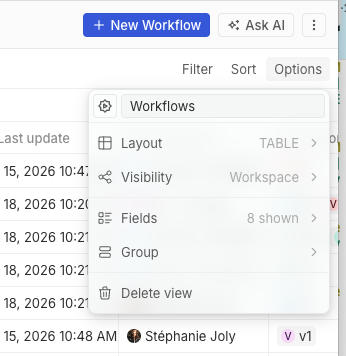 | 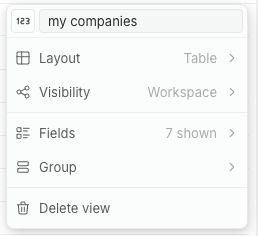 | ## Tests - `git diff --check` - Browser smoke test on `http://apple.localhost:3001/objects/companies` - default view Options menu still opens - custom view Options menu shows `Layout` contextual text as `Table`, not `TABLE` - Layout submenu still shows `Table`, `Calendar`, and `Kanban` - no browser console errors Not run: package lint/test commands, because this checkout has no `node_modules` installed. |
||
|
Weiko
|
9f30915f6f |
fix(metadata): remove deprecated isCustom from Objects and Fields (#21799)
## Context Follow-up to #21228, which deprecated `isCustom` on object/field metadata but kept it exposed because the frontend still relied on it. This removes it from the GraphQL API and the frontend entirely. ## Implementation ### Server - Remove `isCustom` `@Field` from the `Object`, `Field`, and `MinimalObjectMetadata` GraphQL types - Remove the `isCustom` `@ResolveField` resolvers and the `isCustomLoader` dataloader (+ payload/interface) - Remove `isCustom` as an internal `@HideField()` on the Object/Field DTOs used by the i18n standard-override gate > Use an explicit isStandard instead (which is the correct gating) ### Frontend - Add `getIsMetadataItemCustom` helper + `useGetIsMetadataItemCustom` hook: an item is custom when `applicationId === currentWorkspace.workspaceCustomApplication.id` - Migrate all consumers off `objectMetadataItem.isCustom` / `fieldMetadataItem.isCustom`; `isRecordFieldReadOnly` now takes a precomputed `isFieldCustom` - Drop `isCustom` from the metadata fragment/mutations/minimal query, FE types, zod schemas, and mock generators; regenerate GraphQL types ## Notes - Breaking change on the (already-deprecated) `Object.isCustom` / `Field.isCustom` GraphQL fields and the `isCustom` filter - FE semantic is "belongs to the workspace custom app" (third-party-app objects/fields are treated as non-custom) - `isCustom` on IndexMetadata / View / Skill / Agent is a separate column and is untouched - Breaking changes on REST metadata API |
||
|
Thomas des Francs
|
454758471f |
Fix side panel command menu header controls (#21747)
## Summary Tested the 3 behaviors of the issue locally. Animation is not perfect on the closing but I think this is a great v1 - Move the side-panel close action to the right side of the top bar while keeping back navigation on the left. - Keep the nav side-panel button as the command-menu entry point for direct side-panel pages and hide it while command-menu pages/history are active. - Reset command-menu search/filter state when opening the root command menu from the nav button. Fixes twentyhq/core-team-issues#2504 ## Videos ### Before https://github.com/user-attachments/assets/08c1b6b3-5fbd-4154-a85d-5072a3b7690e ### After https://github.com/user-attachments/assets/11682dea-f21c-47b5-91a8-869f30b09d96 <!-- This is an auto-generated description by cubic. --> <a href="https://cubic.dev/pr/twentyhq/twenty/pull/21747?utm_source=github" target="_blank" rel="noopener noreferrer" data-no-image-dialog="true"><picture><source media="(prefers-color-scheme: dark)" srcset="https://www.cubic.dev/buttons/review-in-cubic-dark.svg"><source media="(prefers-color-scheme: light)" srcset="https://www.cubic.dev/buttons/review-in-cubic-light.svg"><img alt="Review in cubic" src="https://www.cubic.dev/buttons/review-in-cubic-dark.svg"></picture></a> <!-- End of auto-generated description by cubic. --> |
||
|
Raphaël Bosi
|
8034c7725f |
Reorganize twenty-ui into best-practice component domains and per-component folders (#21745)
Reorganizes `twenty-ui`'s component organization to follow how the best
UI libraries (MUI, Mantine, Base UI, Polaris) structure their source,
now that the package has stabilized.

**Taxonomy** — dissolves the meaningless `components/` junk-drawer and
the 107-file `display/` mega-category. New domains/subpaths:
`data-display`, `typography`, `icon`, `surfaces`; `feedback` and
`layout` absorb the rest (banners/callout/info + placeholders →
feedback; modal/card → surfaces; motion + separators → layout).

**Per-component layout** — every component is now
`<domain>/<ComponentName>/<ComponentName>.tsx` with colocated
styles/stories/types, `internal/` for private helpers and `parts/` for
re-exported compound sub-parts. The redundant inner `/components/` is
gone. `icon` and `json-visualizer` are kept as cohesive subsystems.

**Also:** adds a tree-shakeable root barrel (`import { Button } from
'twenty-ui'`), the generator now owns `individual-entry.ts`, and a real
barrel-leak bug is fixed (private `internals/` parts were leaking into
the public API).

Consumer imports (~1.2k files) and the `twenty-sdk` UI aggregator were
updated by codemod. The change is **export-neutral** except 16
intentionally-removed private internals symbols (all verified
unconsumed). Gates green: typecheck, lint, build, size-limit, storybook.


<!-- This is an auto-generated description by cubic. -->
<a
href="https://cubic.dev/pr/twentyhq/twenty/pull/21745?utm_source=github"
target="_blank" rel="noopener noreferrer"
data-no-image-dialog="true"><picture><source
media="(prefers-color-scheme: dark)"
srcset="https://www.cubic.dev/buttons/review-in-cubic-dark.svg"><source
media="(prefers-color-scheme: light)"
srcset="https://www.cubic.dev/buttons/review-in-cubic-light.svg"><img
alt="Review in cubic"
src="https://www.cubic.dev/buttons/review-in-cubic-dark.svg"></picture></a>
<!-- End of auto-generated description by cubic. -->
|
||
|
Etienne
|
d99e479be8 |
feat(billing) - facilitate top up in ai chat (#21645)
Today, when a trialing user hits their AI usage cap inside the Ask AI chat, ending the trial bounces them to the Stripe billing portal (and, for card-less users, loses their place in the conversation). This PR makes activating a paid plan / topping up credits feel seamless from within the chat: Trial users with a card on file activate their subscription in place, without leaving the app. Trial users without a card are sent to the Stripe payment-method portal and, on return, the trial is ended automatically and they're dropped back into the exact Ask AI thread they came from. Credit-exhaustion and trial banners now reflect whether a payment method exists (Add Credit Card vs Subscribe Now / End Trial Period) and upgrade inline via a confirmation modal instead of redirecting to Settings. Uploading Screen Recording 2026-06-16 at 07.51.12.mov… https://github.com/user-attachments/assets/4ea77273-da63-4b32-b6f1-5ac9e9560651 <!-- This is an auto-generated description by cubic. --> <a href="https://cubic.dev/pr/twentyhq/twenty/pull/21645?utm_source=github" target="_blank" rel="noopener noreferrer" data-no-image-dialog="true"><picture><source media="(prefers-color-scheme: dark)" srcset="https://www.cubic.dev/buttons/review-in-cubic-dark.svg"><source media="(prefers-color-scheme: light)" srcset="https://www.cubic.dev/buttons/review-in-cubic-light.svg"><img alt="Review in cubic" src="https://www.cubic.dev/buttons/review-in-cubic-dark.svg"></picture></a> <!-- End of auto-generated description by cubic. --> |
||
|
nitin
|
177afde866 |
[BREAKING CHANGE] fix chart cache collisions with key-based data plumbing (#21743)
closes https://discord.com/channels/1130383047699738754/1514946035317997709 This fixes Apollo cache collisions for pie slices and line series by keeping chart bucket identity as key end-to-end, matching how bar chart already works. What changed -- - Renamed pie/line chart response identity from id to key in the chart data path. - Kept key through frontend chart hooks, types, stories, and tooltip/drilldown logic. - Only adapt key to id at actual external boundaries like Nivo and GraphWidgetLegend. - Added/updated tests covering cache normalization and chart data behavior. before - <img width="2600" height="844" alt="CleanShot 2026-06-17 at 20 17 14@2x" src="https://github.com/user-attachments/assets/b9ee83e9-db4b-423e-8668-a7beb4c4c62e" /> after - <img width="2614" height="800" alt="CleanShot 2026-06-17 at 20 16 17@2x" src="https://github.com/user-attachments/assets/674a5417-ffc2-441d-9484-e1126438254c" /> <!-- This is an auto-generated description by cubic. --> <a href="https://cubic.dev/pr/twentyhq/twenty/pull/21743?utm_source=github" target="_blank" rel="noopener noreferrer" data-no-image-dialog="true"><picture><source media="(prefers-color-scheme: dark)" srcset="https://www.cubic.dev/buttons/review-in-cubic-dark.svg"><source media="(prefers-color-scheme: light)" srcset="https://www.cubic.dev/buttons/review-in-cubic-light.svg"><img alt="Review in cubic" src="https://www.cubic.dev/buttons/review-in-cubic-dark.svg"></picture></a> <!-- End of auto-generated description by cubic. --> |
||
|
Raphaël Bosi
|
9c9c34fccf |
Remove twenty-ui-deprecated and migrate frontend to twenty-ui (#21596)
Migrates `twenty-front`, `twenty-sdk`, and `twenty-front-component-renderer` from `twenty-ui-deprecated` to `twenty-ui` (mechanical import swap — the packages have API parity) and deletes the deprecated package along with its workspace/CI/config wiring. Also adds `@linaria/react`/`@linaria/core` as direct deps of `twenty-front` (it used them transitively via the deprecated package). Note: move the required status check from `ci-ui-status-check` to `ci-new-ui-status-check`. Argos: the Storybook box-model/button-reset baseline shift (the bulk of the visual diffs) is isolated in #21665 — Storybook now loads twenty-ui's global `reset.scss`, which the production app already ships. Once #21665 merges and this branch is rebased, the remaining Argos diffs are component-level visual-parity items only. |
||
|
Raphaël Bosi
|
d4c1fc86e3 |
Stabilize flaky Argos stories in twenty-front storybook (#21691)
Three twenty-front stories rendered non-deterministically and intermittently tripped Argos as false positives (flaky on `main`, not caused by any recent change). Each is now deterministic: - **SettingsDataModelFieldSettingsFormCard › WithRelationForm**: the relation preview was screenshotted mid-settle — it briefly shows the fallback object/record before the form default and the sample record load. Added a `play` that waits for the settled state so Argos captures it consistently. - **MultiSelectInput › SingleSelection**: the final deselect click left a transient hover/tooltip. The play now moves the pointer off the option and waits for the tooltip to disappear. - **Breadcrumb › Default**: ambiguous intrinsic width made the last crumb flip between "New" and "N…". Gave the story a fixed container width. Verified the three stories pass in the Storybook vitest runner across repeated runs. <!-- This is an auto-generated description by cubic. --> <a href="https://cubic.dev/pr/twentyhq/twenty/pull/21691?utm_source=github" target="_blank" rel="noopener noreferrer" data-no-image-dialog="true"><picture><source media="(prefers-color-scheme: dark)" srcset="https://www.cubic.dev/buttons/review-in-cubic-dark.svg"><source media="(prefers-color-scheme: light)" srcset="https://www.cubic.dev/buttons/review-in-cubic-light.svg"><img alt="Review in cubic" src="https://www.cubic.dev/buttons/review-in-cubic-dark.svg"></picture></a> <!-- End of auto-generated description by cubic. --> |



