a3beea893dd0340be85429e515615e9c6cb18031
2056 Commits
| Author | SHA1 | Message | Date | |
|---|---|---|---|---|
 nitin nitin
|
079e9b8e56 |
feat(dashboard): extend number format option to bar, line and pie charts (#23505)
https://discord.com/channels/1130383047699738754/1509604545381142649 Extends the Format option (Short/Full) added for the Number widget in #21521 to bar, line and pie charts. Format controls the numbers printed on the chart face: data labels and the pie center metric. Axis ticks stay abbreviated and tooltips always show the full value. Defaults to Short, so existing charts render unchanged. Server: nullable `numberFormat` on the bar/line/pie configuration DTOs, exposed in the dashboard AI tool schema. No migration, configuration is jsonb. Deferred: - The Format row has no visible effect while data labels are off, since tooltips are always full. - Number widget format defaults differ by field type (CURRENCY defaults to Short, NUMBER to Full). Pre-existing, untouched here. https://github.com/user-attachments/assets/0778f08a-6681-4e7a-8716-fb3026d1e01f <!-- This is an auto-generated description by cubic. --> <a href="https://cubic.dev/pr/twentyhq/twenty/pull/23505?utm_source=github" target="_blank" rel="noopener noreferrer" data-no-image-dialog="true"><picture><source media="(prefers-color-scheme: dark)" srcset="https://www.cubic.dev/buttons/review-in-cubic-dark.svg"><source media="(prefers-color-scheme: light)" srcset="https://www.cubic.dev/buttons/review-in-cubic-light.svg"><img alt="Review in cubic" src="https://www.cubic.dev/buttons/review-in-cubic-dark.svg"></picture></a> <!-- End of auto-generated description by cubic. --> |
||
|
Weiko
|
e2e2142998 |
Add calendar date field submenu with grouped field options (#23445)
## Summary - Add a submenu for selecting calendar date fields as it was not clear enough that you could pick 2 date fields. - Group date and datetime fields with non-selectable headers ### Before <img width="240" height="252" alt="Screenshot 2026-07-29 at 11 32 54" src="https://github.com/user-attachments/assets/169bd965-676f-4ef9-8ba6-9ecac80547c6" /> ### After <img width="260" height="246" alt="Screenshot 2026-07-29 at 11 31 58" src="https://github.com/user-attachments/assets/a4471bb0-5c1f-4f5e-bddb-165a5c9da4c7" /> |
||
|
Thomas Trompette
|
a0281f635b |
Restore soft-deleted junction record when re-adding a junction relation (#23371)
Fixes #23305. Removing a junction relation soft-deletes the intermediate junction record. Re-adding the same relation created a brand new record, which the composite unique index on the junction object (e.g. `personId` + `companyId`) rejected with "This record already exists". `useUpdateJunctionRelationFromCell` now creates the junction record through `useCreateManyRecords` with `upsert: true`. The server matches on the unique index with `withDeleted()` and clears `deletedAt` on the matched row instead of inserting. ## This revives, it does not create Worth being explicit, because it is a deliberate trade and not obvious from the diff. When a soft-deleted row exists for the pair, the user gets that row back. Same id, same `createdAt`, same `createdBy`, and anything attached to it (notes, files, and any fields the app added to the junction object). Verified on a dev instance: after re-adding a link through the picker, the row still reported a creation date from days earlier. That is fine for a pure link. It is a lie for a junction that carries data, for instance a `PersonCompanyRelationship` with a role and dates. The alternative designs are hard-deleting on detach (needs `canDestroyObjectRecords` on the junction object, which most roles do not grant) and partial unique indexes (needs `indexWhereClause` exposed to app-declared indexes, which the SDK does not support today). Both are larger changes. This one unblocks affected apps without requiring anything from them. Note that upsert conflict detection ignores `indexWhereClause`, so shipping partial indexes later would not change this behaviour on its own. ## Why the id handling changed The hook no longer sends a client-generated id. Under upsert the server decides which row you get, so the id in the input would be discarded. The optimistic store entry still uses a local id so the chip appears immediately, then adopts the persisted id once the mutation resolves. Without that, a revive left an id in the store that exists nowhere on the server, and the next removal failed with "This record does not exist or has been deleted". Supersedes #23365, which took the same approach but added `$upsert` to the shared `createOne` mutation. That capability already exists per call on `createMany`, and widening the shared document broke the `useCreateOneRecordMutation` and `useCreateOneRecord` tests. ## Testing Verified end to end on a dev instance with a junction object carrying a non-partial composite unique index, since the dev seed does not create one and the bug cannot reproduce without it: - before: re-adding after a removal fails with "This record already exists" - after: the original row is restored, `deletedAt` cleared, one row throughout, and removing again in the same session works, with no GraphQL errors Added an integration test for the path this depends on: a soft-deleted record matched on its unique fields alone, with no id in the input. The existing coverage only exercised upsert by explicit id. ## Known gaps, deliberately not addressed here **Toggling a link off while its creation is still in flight.** The store id is provisional until the mutation returns, so a removal issued inside that window deletes an id the server never received. Reproduced by stalling the create and clicking remove during it: `CombinedGraphQLErrors: Record not found`, and the link stays active despite the user removing it. The window is one mutation round trip. Left for a follow-up; the likely fix is a per-record operation queue so adds and removes on a field run in click order. **Junction objects with no unique index.** Remove then re-add still creates a duplicate row there, on this branch as on main, because conflict detection is driven by unique indexes. --------- Co-authored-by: Shinu Cherian <129690295+Shinu-Cherian@users.noreply.github.com> |
||
|
Félix Malfait
|
b602294f1d |
Hide the command menu button while the mobile side panel is open (#23471)
On mobile the side panel covers the page, but the page header stays mounted underneath. Its command menu button (`⌘K`, the `⋮` icon) sits at the same coordinates as the panel's own close button, so the two icons render on top of each other. Measured on a 390x844 viewport with the AI chat open: - `Command Menu` button at `x=346, y=8, 32x32` - `Close side panel` button at `x=358, y=14, 24x24` `SidePanelToggleButton` already hid itself for the command menu and search pages, but the AI chat pages (`AskAI`, `ViewPreviousAiChats`) are not in `COMMAND_MENU_SIDE_PANEL_PAGES`, so the button stayed and overlapped. ## Change Hide the button on mobile whenever the side panel is open, rather than enumerating pages — the header is not reachable behind a full-screen panel either way. Layout customization mode is the exception and keeps it: `alignWithSidePanelTopBar` deliberately repositions the button into the side panel top bar there, so that path is preserved. Desktop is unaffected. ## Testing Three cases added to `SidePanelToggleButton.test.tsx` (hidden on mobile with the panel open, kept on mobile in layout customization mode, kept on desktop with the AI chat open); the `useIsMobile` mock is now switchable per test. All 10 tests pass. Verified in the browser at 390x844: with the AI chat open only `Close side panel` remains in the top bar, and the button reappears once the panel is closed. --- _Generated by [Claude Code](https://claude.ai/code/session_018gcsCQbuTMsyFWv874p25Q)_ <!-- This is an auto-generated description by cubic. --> <a href="https://cubic.dev/pr/twentyhq/twenty/pull/23471?utm_source=github" target="_blank" rel="noopener noreferrer" data-no-image-dialog="true"><picture><source media="(prefers-color-scheme: dark)" srcset="https://www.cubic.dev/buttons/review-in-cubic-dark.svg"><source media="(prefers-color-scheme: light)" srcset="https://www.cubic.dev/buttons/review-in-cubic-light.svg"><img alt="Review in cubic" src="https://www.cubic.dev/buttons/review-in-cubic-dark.svg"></picture></a> <!-- End of auto-generated description by cubic. --> |
||
|
Félix Malfait
|
840c6d0129 |
Take openRecordIn from the view in scope instead of a global atom (#23422)
Stacked on #23424 (mobile chip navigation). Review that one first; the diff shown here is only the delta. ## Problem `recordIndexOpenRecordInState` was a global atom mirroring `view.openRecordIn`. It was written whenever any index view loaded and never reset, so a record chip behaved according to whichever view had been browsed last: - Companies view set to "record page". Open a Company, tap a related Opportunity chip. The Opportunities view says "side panel", but the chip reads the leftover Companies setting and opens a full page. - Visit the Opportunities index first, then the same Company page, and that same chip now opens a side panel. The setting is per view in the database, but the frontend kept it in one slot as though it were a user preference. ## Approach The value already lives on the view, so the mirror is deleted rather than scoped: - `useResolveOpenRecordIn` reads the current view of the surrounding context store. On a record index that is the view being displayed. On a record show page `MainContextStoreProvider` resolves a view for the object in the URL — the last visited view for that object, falling back to its index view — so chips there follow a view belonging to the object they sit on, rather than whatever was loaded last. - Where no context store is mounted at all (a mention inside a note, for instance) there is no view to take a setting from, so the hook falls back to `DEFAULT_VIEW_OPEN_RECORD_IN`. The instance lookup is non-throwing on purpose: `RecordChip` renders in a lot of places, and an existing test caught this crashing when the read was strict. - The options dropdown now reads and writes `currentView.openRecordIn` directly, the same way `isCompact` beside it already works, so `setAndPersistOpenRecordIn` only has to persist. - `useGetOpenRecordIn` is gone; every call site had the object name available at render, so the reactive hook covers all of them. ## Behaviour change A chip whose behaviour previously came from an unrelated view now follows the view in scope. That is the point of the change, but it does mean some chips will open somewhere different from before, always in the direction of "what this list is configured to do" rather than "what the last list was configured to do". ## Testing - New `useResolveOpenRecordIn` tests: falls back to the default with no context store, follows the context store's view when there is one. - Full frontend suite: 951 suites, 5598 tests passing. Typecheck and lint clean. - Not exercised in a running app: no database in this environment. The dropdown's optimistic behaviour in particular relies on the same view store refresh that `isCompact` already depends on, so it is worth a click-through before merge. |
||
|
Félix Malfait
|
8990334cad |
Make record chips open records natively on touch devices (#23424)
Two mobile problems in the record table: tapping a chip in the first column takes two taps, and chips in every other column open a side panel where a full page is wanted. #23422 is stacked on this branch. ## Two taps to open a record The table's interactive layer lives in a hover portal mounted from `onMouseMove` on the table wrapper. Touch has no hover, so the browser fakes one, and the synthesised `mousemove` arrives *before* the `mousedown`. React commits the portal in the microtask between them, so the whole tap is hit-tested against a subtree that did not exist when the user aimed. Confirmed in Chromium with real touch input (`page.tap`, Pixel 5 emulation), mounting an overlay from the mousemove handler: ``` mousemove target=chip >>> overlay mounted <- the hover portal mousedown target=portalChip <- a node that did not exist when the finger went down mouseup target=portalChip click target=portalChip ``` The same test also ruled out `preventDefault` on the compat `mousedown` as a cause, and showed a `setTimeout`-deferred mount does *not* retarget — it is specifically React's sync flush timing that does. So hover state is now only tracked on hover-capable pointers. `useMoveHoverToCurrentCell` becomes the single writer and absorbs the deduplication `RecordTableContent` was duplicating inline. The interaction/layout split matters here: `useIsMobile` is a 768px width query, which answers "how much room is there to lay out", not "how does this person point". The new `useIsTouchDevice` uses `(hover: none) and (pointer: coarse)`. Layout keeps using width; interaction uses capability. ## Side panel on mobile "Where does a record open" was computed independently in six places and only `useOpenRecordFromIndexView` knew about mobile. `RecordChip` — every chip outside the first column, plus board cards and relation fields — had its own copy without that check. On mobile the side panel animates to `fullScreen`, so it is a full-page view with no URL and no back button. That decision now lives in one `resolveOpenRecordIn`: the view setting is an intent, and the side panel is only a real destination when there is room for it and the object supports it. Also here: `MOUSE_DOWN` navigation downgrades to `CLICK` on touch. It only buys a frame on a real pointer, since a tap synthesises its mouse events after the finger is already gone. ## Hover styling Separate layer, same root cause. A tap leaves CSS `:hover` applied until the next tap lands elsewhere, so a row you came back from keeps reading as selected. Nine `:hover` blocks across the record table, `Chip` and `Avatar` are now fenced behind `(hover: hover)` — the same media feature `useIsTouchDevice` branches on, via a new `hover-capable` SCSS mixin on the twenty-ui side and inline media queries in the Linaria components. Desktop rendering is unchanged, since Chrome matches `hover: hover`. Verified the built CSS emits the wrapper correctly, and checked the nested form through stylis directly for the Linaria side. ## Testing - New unit tests for `resolveOpenRecordIn` and for hover not being tracked on touch devices. - Full frontend suite: 951 suites, 5598 tests passing. Typecheck and lint clean. - Not observed end to end in a running app: no database in this environment, and the `RecordIndexPage` story renders an empty table under its msw mocks. The browser-level mechanism is verified and the fix removes the mid-gesture DOM change, but it is worth one pass on a real device before merge. ## Follow-ups not in this PR - The whole first cell navigates but only the chip-sized part of it gives tap feedback, and `isRecordTableRowActive` is only set on the side panel path — setting it on the navigate path too would keep the row lit while the page loads. - Rows are 32px against a 44px minimum touch target. - Giving the side panel a URL would make "panel vs page" a rendering decision on the same location, rather than something each call site has to branch on. --- _Generated by [Claude Code](https://claude.ai/code/session_019cDWPgWESbdRUhGxGb66j8)_ <!-- This is an auto-generated description by cubic. --> <a href="https://cubic.dev/pr/twentyhq/twenty/pull/23424?utm_source=github" target="_blank" rel="noopener noreferrer" data-no-image-dialog="true"><picture><source media="(prefers-color-scheme: dark)" srcset="https://www.cubic.dev/buttons/review-in-cubic-dark.svg"><source media="(prefers-color-scheme: light)" srcset="https://www.cubic.dev/buttons/review-in-cubic-light.svg"><img alt="Review in cubic" src="https://www.cubic.dev/buttons/review-in-cubic-dark.svg"></picture></a> <!-- End of auto-generated description by cubic. --> |
||
|
Félix Malfait
|
4f31265927 |
Fix 1px gap above the record table header (#23441)
## Problem A transparent 1px slit shows up between the view bar and the table header row, letting the scrolled records show through above the column names. The record table header is `position: sticky; top: 0` inside the table's scroll container. On fractional device pixel ratios (scaled displays, browser zoom) the compositor can land the sticky header half a device pixel below the top edge of the scroll container, so its topmost device pixel row is painted with the scrolled content behind it instead of the header background. ## Repro Reproduced locally on `/objects/companies` with `deviceScaleFactor` 1.25, 1.75 and 2.25 — the slit appears at specific vertical scroll offsets (e.g. `scrollTop` 47 at DPR 1.75), and never at integer ratios. Before (DPR 1.75, `scrollTop` 47) — the row underneath bleeds through above "Name": <img width="960" alt="before" src="https://github.com/user-attachments/assets/00000000-0000-0000-0000-000000000000"> ## Fix Extend the header background 1px upwards with a `box-shadow` on the sticky container, so whatever half-pixel the compositor exposes is always covered. The shadow is painted as part of the sticky layer, so it follows the header wherever it lands. Nothing changes visually otherwise: when the table is scrolled to the top the shadow sits above the scroll container's padding box and is clipped away. ## Verification Scripted pixel scan of the top device-pixel row of the header, over scroll offsets 1-60 at DPR 1.25 / 1.5 / 1.75 / 2.25 / 2.5: | | before | after | |---|---|---| | DPR 1.25 | 3 offsets with a visible slit | 0 | | DPR 1.5 | 0 | 0 | | DPR 1.75 | 2 | 0 | | DPR 2.25 | 3 | 0 | | DPR 2.5 | 0 | 0 | Also checked at rest (`scrollTop` 0) and while scrolled at DPR 1 and 2 that no extra line appears above the header. `oxlint`, `oxfmt` and `nx typecheck twenty-front` pass. --- _Generated by [Claude Code](https://claude.ai/code/session_014gaDhmeDSNjdBeRRepKPAr)_ <!-- This is an auto-generated description by cubic. --> <a href="https://cubic.dev/pr/twentyhq/twenty/pull/23441?utm_source=github" target="_blank" rel="noopener noreferrer" data-no-image-dialog="true"><picture><source media="(prefers-color-scheme: dark)" srcset="https://www.cubic.dev/buttons/review-in-cubic-dark.svg"><source media="(prefers-color-scheme: light)" srcset="https://www.cubic.dev/buttons/review-in-cubic-light.svg"><img alt="Review in cubic" src="https://www.cubic.dev/buttons/review-in-cubic-dark.svg"></picture></a> <!-- End of auto-generated description by cubic. --> |
||
|
Thomas Trompette
|
11447bd96f |
fix: make add-select-option work on record detail pages (#23420)
Fixes #23339 Follow-up to #23410, which fixed the neighbouring issue (#23341) for users *without* the `DATA_MODEL` permission. ## Problem In #23339 the reporter added a multiselect field to Person and then found the inline "create option" prompt unresponsive. They clearly have `DATA_MODEL` permission, since they just created the field, so the permission check isn't what's blocking them. The blocker is the *other* precondition. Both hooks read the object name from the router: ```ts const { objectNamePlural } = useParams(); ``` `objectNamePlural` only exists on record index routes (`/objects/:objectNamePlural`). Record **detail** pages are `/object/:objectNameSingular/:objectRecordId`, so on a record page the param is `undefined` and: - `useCanAddSelectOption` returns false via `isNonEmptyString(objectNamePlural)` - `useAddSelectOption` bails out at `if (!fieldName || !objectNamePlural) return;` So the action was dead on record pages for **every** user, admins included, and the navigation target it needed was never reachable from there. ## Fix Resolve the field and its object from `fieldMetadataId`, which `FieldDefinition` already carries, instead of reading the object name off the URL: ```ts const { fieldMetadataItem, objectMetadataItem } = useFieldMetadataItemById(fieldMetadataId); ``` This drops the route dependency entirely, so the action behaves the same wherever the field is rendered, and `canAddSelectOption` now reflects only the real permission check. It also lets both hooks take a single `fieldMetadataId` argument: `fieldMetadataItem.name` is the same value the callers were previously passing as `fieldName`, so that parameter is no longer needed. Resolving both values from one id means the guard and the action can't disagree about which field they're describing. `useFieldMetadataItemById` is used rather than `useFieldMetadataItemByIdOrThrow` because a lookup miss should disable the prompt, not crash the field input. ## Reproduction On the code the reporter was running (immediately before #23410), as an **admin** with full `DATA_MODEL`, on a company record page, typing a value matching no option: - `Add "…" to options` renders - clicking it does nothing — URL unchanged, no navigation - pressing <kbd>Enter</kbd> does nothing either which matches #23339 exactly, including the note about the Enter keypress. After #23410 the same root cause shows up differently: the prompt is no longer rendered at all on record pages, since the guard it's now gated on is false there. Still broken, just silent. ## Testing Verified manually on a local instance, swapping only these files between three states and re-running the identical steps on the same cell. | code state | user | route | result | |---|---|---|---| | before #23410 | Admin | `/object/company/:id` | prompt shown, click and Enter both do nothing | | current main | Admin | `/object/company/:id` | prompt not shown, action unreachable | | **this PR** | Admin | `/object/company/:id` | prompt shown, navigates to `/settings/objects/companies/workPolicy?newOption=…` | | **this PR** | Admin | `/objects/tasks` (`Status`, single select) | still works, navigates to `/settings/objects/tasks/status?newOption=…` | | **this PR** | Member (no `DATA_MODEL`) | `/object/company/:id` | prompt not shown | The settings form opens with the typed value prefilled alongside the existing options, so the end-to-end flow works from a record page for the first time. The Member row confirms #23341 stays fixed: dropping the route dependency doesn't weaken the permission gate. The single-select row covers `SelectFieldInput`, which takes the same change. `nx lint:diff-with-main twenty-front` and `nx typecheck twenty-front` both pass. |
||
|
Thomas Trompette
|
38e9d231bc |
fix: hide add-select-option prompt for users without data model permission (#23410)
Fixes #23341 ## Problem A user whose role lacks the `DATA_MODEL` permission flag still saw the `Add "…" to options` prompt when typing a value that matched no option in a multiselect. Clicking it did nothing. `MultiSelectInput` renders `AddSelectOptionMenuItem` based purely on whether the callback exists: ```tsx {onAddSelectOption && searchFilter && filteredOptionsInDropDown.length === 0 && ( ``` `MultiSelectFieldInput` always passed a callback, and did the permission check *inside* it: ```tsx const handleAddSelectOption = (optionName: string) => { if (!canAddSelectOption) { return; } addSelectOption(optionName); }; ``` So the guard suppressed the click but not the render, which is exactly the reported symptom: the prompt is visible and inert. ## Fix Gate at the prop instead of inside the handler, so the menu item is never rendered when the action is unavailable: ```tsx onAddSelectOption={canAddSelectOption ? addSelectOption : undefined} ``` The wrapper is now redundant and removed; `addSelectOption` already has the matching `(optionName: string) => void` signature. `SelectFieldInput` had the byte-identical bug (`SelectInput` gates on `onAddSelectOption &&` the same way), so it gets the same change. ## Note on scope `useCanAddSelectOption` requires `objectNamePlural` from the route in addition to the permission flag: ```ts const canAddSelectOption = userHasPermissionToEditDataModel && isNonEmptyString(fieldName) && isNonEmptyString(objectNamePlural); ``` Record *detail* pages (`/object/:objectNameSingular/:recordId`) have no `objectNamePlural`, so the prompt was dead there for **every** user, admins included. This change hides it in that case too, which is the correct behavior since the click could never have worked. ## Testing Verified manually against a local instance, toggling the patch in and out on the same cell so before/after is directly comparable. Company `Work Policy` (multiselect) in the Companies table view, typing a string that matches no option: | user | route | before | after | |---|---|---|---| | Member (no `DATA_MODEL`) | `/objects/companies` | prompt shown, click does nothing | prompt hidden | | Admin | `/objects/companies` | prompt shown, click works | prompt shown, click works (navigates to `/settings/objects/companies/workPolicy?newOption=…`) | | Admin | `/object/company/:id` | prompt shown, click does nothing | prompt hidden | `nx lint:diff-with-main twenty-front` and `nx typecheck twenty-front` both pass. <!-- This is an auto-generated description by cubic. --> <a href="https://cubic.dev/pr/twentyhq/twenty/pull/23410?utm_source=github" target="_blank" rel="noopener noreferrer" data-no-image-dialog="true"><picture><source media="(prefers-color-scheme: dark)" srcset="https://www.cubic.dev/buttons/review-in-cubic-dark.svg"><source media="(prefers-color-scheme: light)" srcset="https://www.cubic.dev/buttons/review-in-cubic-light.svg"><img alt="Review in cubic" src="https://www.cubic.dev/buttons/review-in-cubic-dark.svg"></picture></a> <!-- End of auto-generated description by cubic. --> |
||
|
neo773
|
1e58c3073c |
Feat/email composer improvements (#23188)
- Move composer to dedicated page - Add test email option - Auto saved as draft can be revisited from `objects/messageCampaigns` later - Campaign stats component https://github.com/user-attachments/assets/9e523116-e79b-496d-9c9d-3887e0c9213f <!-- This is an auto-generated description by cubic. --> <a href="https://cubic.dev/pr/twentyhq/twenty/pull/23188?utm_source=github" target="_blank" rel="noopener noreferrer" data-no-image-dialog="true"><picture><source media="(prefers-color-scheme: dark)" srcset="https://www.cubic.dev/buttons/review-in-cubic-dark.svg"><source media="(prefers-color-scheme: light)" srcset="https://www.cubic.dev/buttons/review-in-cubic-light.svg"><img alt="Review in cubic" src="https://www.cubic.dev/buttons/review-in-cubic-dark.svg"></picture></a> <!-- End of auto-generated description by cubic. --> --------- Co-authored-by: Félix Malfait <felix.malfait@gmail.com> |
||
|
Thomas Trompette
|
48f4c1661b |
fix(sse): resync records on reconnect and recover from silent query listener errors (#23357)
## Context

Live updates stop working in prod in a way that only a page refresh
fixes. Two independent holes in the SSE self-healing path, both silent.

## 1. Reconnecting restored the stream but never the data

Events emitted while the stream was down are not replayed, so any record
change during the gap stayed missing from the UI indefinitely. On
reconnect `SSEClientEffect` called `resyncMetadataStore()` and
dispatched `SSE_CLIENT_RECONNECTED_EVENT_NAME`, but the only listeners
were `AgentChatMessagesFetchEffect` and
`AgentChatStreamKeepAliveEffect`. No record surface listened. Metadata
self-healed, records did not.

This fires on every deploy, laptop sleep and network blip, and the
reconnect backoff is a uniform random draw up to 2 minutes, so the gap
is routinely long.

The event was also incomplete. It was dispatched on graphql-sse
transport reconnects only. When the keep-alive watchdog or an error set
`shouldDestroyEventStream` and `SSEEventStreamEffect` built a
replacement stream, nothing was dispatched at all.
`useTriggerEventStreamCreation` now dispatches it from the creation path
too, for every stream that replaces an earlier one in the tab.

Each surface is wired to the resync path it already uses, through an
optional `onSseReconnected` on `useListenToEventsForQuery`. That hook is
the single funnel every SSE subscriber already goes through, so the tab
reloads exactly what it declared an interest in and nothing else:

- Record table: reset virtualization, plus
`useRefetchAggregateQueriesForObjectMetadataItem` for the header count,
which is served by a separate aggregate query that the row reset does
not touch.
- Record board: `triggerRecordBoardInitialQuery({ shouldResetScroll:
false })`. Scroll position preserved.
- Workflow versions: `shouldWorkflowRefetchRequest`.

These are the same resets each component already runs on every record
event, so the only new thing is the trigger. `SSEClientEffect` keeps the
metadata store resync, which is genuinely global; that also fixes the
matching gap on the metadata side, since `resyncMetadataStore()` used to
be called straight from the graphql-sse `connected` callback and so
never ran for a watchdog- or error-driven stream re-creation.

**Known gap:** the record show page and workflow run detail are not
covered. Both read through `useFindOneRecord`, but their subscription
lives in a sibling component with no access to `refetch`. Wiring them
needs either `refetch` exposed from `RecordShowEffect` /
`useWorkflowRun`, or the subscription moved into the data owner — the
latter changes subscription lifetime, and `useListenToEventsForQuery`
unregisters by `queryId` on unmount regardless of other consumers. Left
out pending a decision.

## 2. A network error on `addQueryToEventStream` silently unsubscribed a
view forever

`handleError` in `SSEQuerySubscribeEffect` only reacted to
`CombinedGraphQLErrors`. On Apollo Client v4 a network failure or a 5xx
from a rolling pod surfaces as `ServerError` or a plain `Error`, so the
handler was a complete no-op: no Sentry capture, no stream teardown, and
`syncAdditions` returned before recording the listener as active.

Since neither `requiredQueryListeners` nor `activeQueryListeners`
changed, the driving effect never re-ran. That query stayed unregistered
server-side for the rest of the session while the stream looked healthy
and every other view kept updating live. Recovery required remounting
the component or refreshing.

The recovery now runs for every error type.
`getGraphqlErrorExtensionsFromError` is called unconditionally: it
accepts `unknown` and reads `extensions` off any object-shaped error, so
an error carrying a gracefully-handled `code` is still recognised as one
whether or not it is a `CombinedGraphQLErrors`.

Note: errors without extensions now reach Sentry, since
`isGracefullyHandledEventStreamError` returns false for them. That is
new noise during outages, but this failure class is currently completely
invisible.

## Testing

- `nx typecheck twenty-front` and oxlint `--type-aware` + oxfmt pass.
- Verified on a local instance with an A/B/A run. A row inserted
straight into Postgres emits no SSE event, which is exactly the state
after a disconnect; restarting the server then forces a reconnect. With
the fix the row appears and the count updates with no page reload;
reverted to `main` it stays invisible indefinitely. Redis confirmed the
stream had reconnected and re-registered its queries in the negative
run, so that result is the missing resync rather than a dead stream.
- Fix 2 is **not** exercised at runtime — it needs a network-level
failure on the `addQueryToEventStream` mutation specifically. Reasoned
about only.
- There are no existing tests for the `sse-db-event` module.

## Known gap

A tab's very first stream is not treated as a reconnection, since
`isRecreatedEventStream` is derived from
`lastSseEventReceivedTimestampState` already being set. If that first
stream connects but never receives its first message and is then
replaced, no resync is dispatched. That is the separate issue of
`SSEKeepAliveEffect` being gated on `sseEventStreamReady`, which is
itself only set by the first message: a stream that never becomes ready
is never watched and never torn down. Not addressed here.


<!-- This is an auto-generated description by cubic. -->
<a
href="https://cubic.dev/pr/twentyhq/twenty/pull/23357?utm_source=github"
target="_blank" rel="noopener noreferrer"
data-no-image-dialog="true"><picture><source
media="(prefers-color-scheme: dark)"
srcset="https://www.cubic.dev/buttons/review-in-cubic-dark.svg"><source
media="(prefers-color-scheme: light)"
srcset="https://www.cubic.dev/buttons/review-in-cubic-light.svg"><img
alt="Review in cubic"
src="https://www.cubic.dev/buttons/review-in-cubic-dark.svg"></picture></a>
<!-- End of auto-generated description by cubic. -->
|
||
|
Raphaël Bosi
|
590ae069e8 |
Support workspace member Me filter for relation fields in dashboards (#23282)
<img width="3024" height="1484" alt="CleanShot 2026-07-27 at 15 04 22@2x" src="https://github.com/user-attachments/assets/a57797b7-dbe9-4748-aeff-18667f1f69bb" /> Fixes #20225 Workspace member "Me" filters worked for standard actor fields (Created by / Updated by) in dashboard widgets but not for relation fields pointing to a workspace member (e.g. "Account owner"). In the advanced-filter UI, picking such a relation forced a relation traversal and never produced a filter you could set to "Me". For a many-to-one relation targeting workspaceMember, the relation-target sub-menu now offers a "filter by record" entry that creates a direct relation filter with the same "Me" multi-select picker used by view filters. Traversal (e.g. "Account owner -> Name") is preserved. No backend change is needed: the stored value matches view filters and is already resolved server-side. <!-- This is an auto-generated description by cubic. --> <a href="https://cubic.dev/pr/twentyhq/twenty/pull/23282?utm_source=github" target="_blank" rel="noopener noreferrer" data-no-image-dialog="true"><picture><source media="(prefers-color-scheme: dark)" srcset="https://www.cubic.dev/buttons/review-in-cubic-dark.svg"><source media="(prefers-color-scheme: light)" srcset="https://www.cubic.dev/buttons/review-in-cubic-light.svg"><img alt="Review in cubic" src="https://www.cubic.dev/buttons/review-in-cubic-dark.svg"></picture></a> <!-- End of auto-generated description by cubic. --> |
||
|
Félix Malfait
|
3a8f086d15 |
Converge drag and drop on shared dnd-kit primitives, remove @hello-pangea/dnd (#23211)
Follow-ups recorded in #23023, done in one pass. ## Shared primitives - Folded `PageLayoutWidgetSortableItem` and `PageLayoutWidgetDropLine` into the shared `DragDropItemSortableCell` / new `DragDropItemDropLine` (new `data`, `dropLine`, `highlightWhileDragging`, `hasTransition` props). - Added generic `DragDropProviderDragStartEvent` (and DragMove/DragOver/DragEnd/DropTarget) helpers and deleted the 7 copied `Parameters<...>` extractions across the dnd hooks. - Replaced the `useMovePageLayoutWidgetUp/Down` implementations (~140 lines) with `moveWidgetWithinTabInDraft`. - Migrated the remaining page-layout test suites onto `pageLayoutDraftFixtures`. ## Tab reordering off Pangea - Tabs are sortable cells on the same provider as widget drags, segregated by dnd type, so widget drops on tab buttons keep working while tabs reorder. - Reordering is ID based (`reorderTabInDraft`: insert before the hovered tab), which keeps the pinned first tab in place without index arithmetic. - Preserved overflow behaviors: the dropdown stays open while a tab drag is in flight, dropping a tab on the "+N More" button appends it and opens the dropdown, and both the visible strip and the overflow list have end drop zones. ## Fields configuration editors off Pangea - Group reorder, field reorder and cross-group field moves now run on the shared cells (same drop line and end-zone patterns). ## DraggableList off Pangea - `DraggableList` / `DraggableItem` keep their consumer-facing API — the ~9 consumers now type their handlers with a local `DraggableListDropResult` instead of pangea's `DropResult` — but run on the shared sortable cells; each list's uuid group doubles as its dnd type so nested lists stay isolated from page-level providers. - Items register their index in a list-scoped registry so the end drop zone can resolve the append index at drop time (with insert-before semantics an item could otherwise never reach the last position). - Deleted three dead files that only existed for pangea plumbing (the side panel navigation placeholder, `getCssCompatibleDraggableProps`, the orphaned `recordGroupPendingDragEndReorderState`). ## Record table row drag off Pangea - Rows register through `useSortable` directly on the row element — no wrapper div, so row CSS, sticky cells and virtualization stay untouched — with the grip cell wired as the drag handle via the shared sortable handle ref context. - Both table modes (virtualized flat list and record groups) share a `DragOverlay` clone that replaces pangea's virtual-mode `renderClone`, and end drop zones per record group (and after the virtualized list) allow dropping after the last row or into an empty group. - The drop handlers keep their pangea-shaped result object, retyped as a local `RecordDragDropResult`, so the position computation logic is untouched. ## Pangea removed `@hello-pangea/dnd` is gone from `package.json` and the lockfile, along with its orphaned transitive entries (`css-box-model`, `raf-schd`, `react-redux`, `redux`). Nothing in the repo imports it anymore. ## Dashboards: cross-tab widget drag for grids react-grid-layout drags never enter dnd-kit, so the bridge hit-tests the pointer against the tab buttons' `data-page-layout-tab-drop-target-id` rects during grid drags, highlights the hovered tab through state, and on drop moves the widget to the destination grid below its existing content (`moveWidgetToGridTabInDraft`, `buildTabWidgetLayouts`). The grid's own post-drag layout commit is suppressed once so it does not overwrite the cross-tab move. ## Fixes found while testing - With `feedback: 'clone'`, the drag source is its own initial drop target and its placeholder is a DOM clone taken at drag start, so the drop line rendered into the source got baked into the placeholder and stuck there for the whole drag. The line is now hidden on the source cell, leaving a single indicator at the actual target. - Reorderable tabs collapsed to text height and sat top-aligned next to "+ New Tab" because the sortable cell wrapper defaults to `display: block; height: auto`, breaking the tab height chain — the tab list now uses the cell's `fill` mode so tabs stretch to the strip height again. ## Testing Playwright against the dev app: - Record page: widget reorder up and down in the pinned column (single blue drop line at the target), drag to another tab via its tab button (highlight + move), drag back into content at a specific position, chained cross-tab moves, tab reorder with vertical drop line, new tab creation. - Overflow (narrow viewport): drop a tab on "+N More" (appends last, dropdown opens), reorder inside the dropdown (stays open), drag a tab from the dropdown back to the visible strip. - Dashboard: grid drag within a tab, cross-tab drag onto a tab button (hover highlight, widget lands below destination content, remaining widgets keep their positions), save and reload persistence in both directions. - Fields editor: field reorder, group reorder, field move across groups, plus the Move Up / Move Down widget actions. Since the pangea-removal commits: - Typecheck, oxlint and oxfmt green over the full front source; unit suites green including the migrated `useStartRecordDrag` test (jest needed a scoped transform exemption for `@preact/signals-core` once dnd-kit reached the side-panel suites). - Storybook visual regression unchanged across ~700 stories — expected, since the migrated surfaces render identical DOM at rest (drop lines and drag overlays only exist mid-drag). - The tab strip fix reverses the exact regression mechanism: the sortable cell wrapper defaulted to `display: block; height: auto`, collapsing the tab height chain next to the full-height "+ New Tab" button; `fill` restores the stretch. --- _Generated by [Claude Code](https://claude.ai/code/session_01XKRCzzu8oGyocXZtFp7VEG)_ <a href="https://cubic.dev/pr/twentyhq/twenty/pull/23211?utm_source=github" rel="nofollow noreferrer noopener" target="_blank">``<img alt="Review in cubic" src="https://www.cubic.dev/buttons/review-in-cubic-dark.svg">``</a> |
||
|
neo773
|
97d2b52a71 |
fix(front): duplicate junction chip after Add New in relation picker (#23185)
Clicking Add New in a junction relation picker rendered the newly created target twice until a page reload. The handler appended the created junction to the source record's store field after awaiting the mutation, but useCreateOneRecord's post-optimistic effect had already attached it, so the same junction id ended up in the field array twice (single row in DB). Removes the redundant manual append in both to-many picker flows. <!-- This is an auto-generated description by cubic. --> <a href="https://cubic.dev/pr/twentyhq/twenty/pull/23185?utm_source=github" target="_blank" rel="noopener noreferrer" data-no-image-dialog="true"><picture><source media="(prefers-color-scheme: dark)" srcset="https://www.cubic.dev/buttons/review-in-cubic-dark.svg"><source media="(prefers-color-scheme: light)" srcset="https://www.cubic.dev/buttons/review-in-cubic-light.svg"><img alt="Review in cubic" src="https://www.cubic.dev/buttons/review-in-cubic-dark.svg"></picture></a> <!-- End of auto-generated description by cubic. --> |
||
|
Scarab Systems
|
d1c70ab0bf |
Fix dashboard record table widget aggregate persistence (#23008)
## Summary - Update dashboard record-table widget aggregate changes to write into the widget draft while page layout edit mode is active. - Include `aggregateOperation` when saving record-table widget view fields through `upsertViewWidget`. - Persist aggregate operations server-side for widget view-field create, update, and clear flows. - Add frontend utility tests and backend integration coverage for widget aggregate create/update/clear behavior. Fixes #22934. ## Why Dashboard record-table widgets use their own draft view state while a page layout is being edited. The aggregate footer path was resolving fields through the normal current-view flow and then trying to persist immediately, which can miss widget draft fields and fail before the save flow runs. This change keeps aggregate edits in the widget draft during page layout editing, then saves the aggregate operation with the rest of the widget view configuration. ## Validation - `npx nx lint twenty-front` - `npx nx typecheck twenty-front` - `npx nx test twenty-front --configuration=ci` - `npx nx build twenty-front` - `npx nx build twenty-server` - `npx nx lint twenty-server --configuration=ci` - `npx nx typecheck twenty-server` - `npx nx test twenty-server --configuration=ci` - `npx nx jest --config ./jest-integration.config.ts --logHeapUsage --runTestsByPath test/integration/metadata/suites/view/upsert-view-widget.integration-spec.ts` - `git diff --check` Disclosure: I used AI-assisted coding tools while preparing this PR. I reviewed the changes myself, tested them, and take responsibility for the implementation and any follow-up revisions needed. <!-- This is an auto-generated description by cubic. --> <a href="https://cubic.dev/pr/twentyhq/twenty/pull/23008?utm_source=github" target="_blank" rel="noopener noreferrer" data-no-image-dialog="true"><picture><source media="(prefers-color-scheme: dark)" srcset="https://www.cubic.dev/buttons/review-in-cubic-dark.svg"><source media="(prefers-color-scheme: light)" srcset="https://www.cubic.dev/buttons/review-in-cubic-light.svg"><img alt="Review in cubic" src="https://www.cubic.dev/buttons/review-in-cubic-dark.svg"></picture></a> <!-- End of auto-generated description by cubic. --> |
||
|
Thomas Trompette
|
f5ab8a236c |
fix: add aria-label to record table selection checkboxes (#23147)
## Fixes Closes #23130 ## Problem On record tables, the select-all header checkbox and each row's selection checkbox render as `role="checkbox"` with no accessible name, failing WCAG 4.1.2 (aria-toggle-field-name). Screen-reader users cannot tell what the checkbox selects. ## Fix The shared `Checkbox` component already accepts and forwards `aria-label`, but the record-table callers weren't passing one. Added translated labels: - Row checkbox: `aria-label={t\`Select row\`}` in `RecordTableCellCheckbox.tsx` - Header checkbox: `aria-label={t\`Select all rows\`}` in `RecordTableHeaderCheckboxColumn.tsx` Both use `const { t } = useLingui()` from `@lingui/react/macro`, following the existing i18n convention in this module. <!-- This is an auto-generated description by cubic. --> <a href="https://cubic.dev/pr/twentyhq/twenty/pull/23147?utm_source=github" target="_blank" rel="noopener noreferrer" data-no-image-dialog="true"><picture><source media="(prefers-color-scheme: dark)" srcset="https://www.cubic.dev/buttons/review-in-cubic-dark.svg"><source media="(prefers-color-scheme: light)" srcset="https://www.cubic.dev/buttons/review-in-cubic-light.svg"><img alt="Review in cubic" src="https://www.cubic.dev/buttons/review-in-cubic-dark.svg"></picture></a> <!-- End of auto-generated description by cubic. --> |
||
|
Priyanshu Bartwal
|
b4aa323889 |
Record Board & Record Calendar Drag Drop dnd-kit rewrite. (#23071)
Closes: #23070 Record Board: https://github.com/user-attachments/assets/26df63e2-fbbd-4339-88b3-eed73af283b4 Record Calendar: https://github.com/user-attachments/assets/cb209545-695e-44a1-8dfb-a92b3c8650a6 ### Technical Inputs - Each column is a `Droppable`. This differs from other implementations (Record table header and Record board header), where only the gap between headers is `Droppable`. - Individual cards are `Sortable`. - Uses `DragOverlay` to display a cloned version of the dragged card along with a `+N` chip when dragging multiple cards. - Updated `DragDropColumnDropTarget` to handle `vertical` and `horizontal` orientation of drop target. - File name changes: - `DragDropColumnDropTarget` → `DragDropItemDropTarget` - `DragDropColumnDroppableSlot` → `DragDropItemDroppableSlot` - `DragDropColumnSortableCell` → `DragDropItemSortableCell` - `DragDropColumnSortableHandle` → `DragDropItemSortableHandle` - `DragDropColumnDndContext` → `DragDropItemDndContext` - `DragDropColumnData` → `DragDropItemData` <!-- This is an auto-generated description by cubic. --> <a href="https://cubic.dev/pr/twentyhq/twenty/pull/23071?utm_source=github" target="_blank" rel="noopener noreferrer" data-no-image-dialog="true"><picture><source media="(prefers-color-scheme: dark)" srcset="https://www.cubic.dev/buttons/review-in-cubic-dark.svg"><source media="(prefers-color-scheme: light)" srcset="https://www.cubic.dev/buttons/review-in-cubic-light.svg"><img alt="Review in cubic" src="https://www.cubic.dev/buttons/review-in-cubic-dark.svg"></picture></a> <!-- End of auto-generated description by cubic. --> --------- Co-authored-by: Félix Malfait <felix.malfait@gmail.com> |
||
|
Félix Malfait
|
3ad3e8bd1a |
feat: kanban, calendar and group-by table layouts for dashboard view widgets (#22963)
## Context Dashboard view widgets previously only rendered flat tables. This PR ships the full feature: **Table with group-by**, **Kanban**, and **Calendar** layouts for dashboard view widgets — server API + frontend, end-to-end. (Originally staged as a 4-PR stack — #22966, #22967, #22968 — consolidated here per review.) ## Server / API - **View typing.** Adds `KANBAN_WIDGET` and `CALENDAR_WIDGET` to `ViewType` (following the `TABLE_WIDGET` precedent) so widget-backing views keep their layout in `view.type` while staying excluded from record-index pickers. Shared `getViewLayoutFromViewType()` maps widget types to their base layout; `isWidgetViewType()` centralizes the exclusions that were previously hardcoded per-site. - **Migrations.** Two fast instance commands (**2.23**): `ALTER TYPE core.view_type_enum ADD VALUE` for both values, and a widened `CHK_VIEW_CALENDAR_INTEGRITY` constraint covering `CALENDAR_WIDGET` (entity `@Check` updated for fresh installs). - **Validation.** `FlatViewValidatorService` keys kanban/calendar validation on the mapped layout, so widget views get the same invariants as index views (kanban needs a groupable group-by field; calendar needs a date field + layout). Calendar widget views default to month; a non-month (DAY/WEEK) layout is rejected at the API level **unless** the `IS_CALENDAR_WEEK_VIEW_ENABLED` feature flag is enabled for the workspace — the same flag that gates day/week on index calendars. - **API.** `upsertViewWidget` (LAYOUTS permission) accepts a nested `view` settings input (`type`, `mainGroupByFieldMetadataId`, `shouldHideEmptyGroups`, kanban aggregate/column-width, calendar layout/fields). Routes through the standard update path, so `viewGroups` auto-generate from SELECT options exactly like index views. Only widget view types accepted; only `RECORD_TABLE` widgets can change view settings. - **AI tools.** `create-complete-dashboard` + `create_view` now use/allow the `*_WIDGET` types (previously they created plain `TABLE` views that leak into index pickers). ## Frontend **Settings panel.** The **Source** (object) row comes first, since which layouts are available depends on it. The **Layout** row below is a working dropdown (Table / Kanban / Calendar); layouts the source object can't support are **disabled with a hint** ("Needs a Select field" / "Needs a Date field") rather than hidden. Group-by row (select fields; searchable) with a **Hide empty groups** toggle while grouped; **Date field** row replaces Group by while Calendar is active, and — when the `IS_CALENDAR_WEEK_VIEW_ENABLED` flag is on — a **Calendar view** row (Day / Week / Month) appears beside it; **Limit** row hidden while grouped (only the flat virtualized loader enforces it). Kanban keeps its group-by locked (no `None` option). **Instant edit-mode preview.** Draft snapshots carry `viewGroups`; picking a group-by synthesizes them client-side (`buildDraftViewGroupsForFieldMetadataItem`, mirroring the server's generation), so grouped tables/boards preview immediately before dashboard save. On save, `upsertViewWidget` responses hand back the server-generated groups, which replace the client-generated ones in the persisted snapshot. **Renderers.** `RecordTableWidgetRendererContent` branches on the backing view's layout: `RecordBoardWidget` (wraps the standard `RecordBoardContainer`) and `RecordCalendarWidget` (mounts the existing `RecordCalendar`, which renders month / day / week) inside the same per-widget provider sandbox the table uses. **Read-only semantics.** Two flags with distinct scopes, each documented on its state: - `isRecordBoardViewSettingsReadOnlyComponentState` — locks the board chrome that edits view settings (add group, column reorder/resize/menu, aggregates); **card drag still updates records** under object permissions. - `isRecordCalendarReadOnlyComponentState` — widget calendars are read-only by default (no drag, no add-new, no in-calendar layout switch); cards open the side panel. The one exception, behind `IS_CALENDAR_WEEK_VIEW_ENABLED`: a **live (non edit-mode) day/week** widget calendar allows drag-to-reschedule and record creation under object permissions. Month calendars and edit-mode previews stay read-only. **Calendar state componentization.** The calendar module's three settings move from global atoms to component states keyed on `RecordCalendarComponentInstanceContext` (same pattern as record-board), so several calendar widgets and an index-page calendar can coexist without leaking state. All readers resolve the ambient instance; calendar unit tests updated. **Multi-instance fixes that also fix index pages:** record drag states were written against a different instance than every reader resolves (now use the ambient instance); the board sticky-header DOM id is namespaced per board; dragged board cards portal to `document.body` while dragging so react-grid-layout's transforms can't offset the clone from the pointer. ## Scope (v1) - Widget calendars are month-only and read-only by default. With `IS_CALENDAR_WEEK_VIEW_ENABLED` enabled, day/week layouts become selectable (UI + API) and live day/week widget calendars support drag-to-reschedule and record creation under object permissions. - Widget group-by offers SELECT fields only (server auto-generates groups from options; widgets have no per-record add-group flow). ## Tests - Integration: `upsert-view-widget-view-settings.integration-spec.ts` (9 tests — group auto-creation, invalid type/field rejections, non-month calendar widget rejected while the week/day flag is off and accepted once it's enabled, combined settings+fields call); pre-existing `upsert-view-widget` suite (20) green. - Front: new suites for draft view-group generation and snapshot clone/build utils; calendar suites componentized; full `twenty-front` jest, typecheck, oxlint green; `twenty-server` typecheck + lint green. - Browser-verified end-to-end (real dev server + seeded workspace): configure → live edit-mode preview → save → reload for all three layouts; measured drag with pointer inside the card; index-page calendar re-verified (with the week/day flag enabled). https://claude.ai/code/session_01E5N87kwwZWhDtEQaP72cMf |
||
|
Thomas Trompette
|
05132d262b |
fix(workflow): show account select in Send Email node when no account is connected (#23066)
# Why In the workflow **Send Email** (and Draft Email) node, when the workspace has no eligible connected account, the **Account** field disappears entirely — only the variable picker icon remains. The "Add account" call-to-action is unreachable, so there is no way to connect an account from the node. ## Root cause Regression from #21075. `FormSelectFieldInput` used to always pass a default empty option ("No Account") to `<Select>`; since #21075 it only prepends it when `isNullable` is set, and the email account field doesn't set it. With zero connected accounts, `<Select>` then has no option to resolve a selected option from and bails out rendering an empty fragment — even though a `callToActionButton` is configured: ```tsx // Select.tsx if (!isDefined(controlSelectedOption)) { return <></>; } ``` # What changed `FormSelectFieldInput` now prepends the empty option whenever the field is nullable **or there are no options at all**. A populated non-nullable select still offers no clearing choice (the #21075 behavior is preserved); an empty one renders its "No X" state so the control — and its call-to-action — stay visible and clickable. # Test plan - New story `FormSelectFieldInput > NoOptionsWithCallToAction`: zero options + CTA renders the "No Work Policy" control, the dropdown opens, and the CTA is clickable. - New story `WorkflowEditActionEmailBase > NoConnectedAccounts`: with `MyConnectedAccounts` mocked to `[]`, the Account field renders "No Account" instead of vanishing. The meta's msw handlers move to the keyed-object form so the story can override a single query (story-level handler arrays get concatenated after the meta's, and msw's first match wins), and the story evicts the module-singleton Apollo client's cached accounts so it actually hits the empty mock. - `npx nx typecheck twenty-front` and `npx nx lint:diff-with-main twenty-front` pass; both story files pass under the storybook vitest project (13 stories total). <!-- This is an auto-generated description by cubic. --> <a href="https://cubic.dev/pr/twentyhq/twenty/pull/23066?utm_source=github" target="_blank" rel="noopener noreferrer" data-no-image-dialog="true"><picture><source media="(prefers-color-scheme: dark)" srcset="https://www.cubic.dev/buttons/review-in-cubic-dark.svg"><source media="(prefers-color-scheme: light)" srcset="https://www.cubic.dev/buttons/review-in-cubic-light.svg"><img alt="Review in cubic" src="https://www.cubic.dev/buttons/review-in-cubic-dark.svg"></picture></a> <!-- End of auto-generated description by cubic. --> |
||
|
Gautam pandit
|
3e14dcbb05 |
Fix record board column header action accessibility (#22496)
## Summary - Keep Record Board column header actions mounted instead of rendering them only on mouse hover - Show actions on hover and focus-within so keyboard users can reach them - Avoid header layout shifts when actions appear ## Context This is a small follow-up found while reviewing #22323. It does not duplicate the Kanban column drag-and-drop implementation. ## Testing - git diff --check - Not run: package lint/typecheck because this checkout still has no node_modules and Yarn is not available on PATH <!-- This is an auto-generated description by cubic. --> <a href="https://cubic.dev/pr/twentyhq/twenty/pull/22496?utm_source=github" target="_blank" rel="noopener noreferrer" data-no-image-dialog="true"><picture><source media="(prefers-color-scheme: dark)" srcset="https://www.cubic.dev/buttons/review-in-cubic-dark.svg"><source media="(prefers-color-scheme: light)" srcset="https://www.cubic.dev/buttons/review-in-cubic-light.svg"><img alt="Review in cubic" src="https://www.cubic.dev/buttons/review-in-cubic-dark.svg"></picture></a> <!-- End of auto-generated description by cubic. --> --------- Co-authored-by: bosiraphael <raphael.bosi@gmail.com> |
||
|
Félix Malfait
|
7e133a4930 |
Converge email recipient fields on existing patterns: shared parser/formatter, search-index members, one display-name rule (#22997)
# Why Follow-up to #22668, addressing @charlesBochet's five post-merge review comments. They all point the same direction: the recipient fields rebuilt things the codebase already had. This PR converges on the existing patterns where that holds up, and answers on the threads where it deliberately does not. # What changed, per comment **Parser duplication ([comment](https://github.com/twentyhq/twenty/pull/22668#discussion_r3553064242))**: `parseEmailAddressList` now lives in twenty-shared (addressparser, group flattening, try/catch). The server's `safeParseEmailAddresses` delegates to it, the front wrapper keeps only paste normalization (newlines to commas) and invalid-token preservation for red chips. The `addressparser` dependency moves from twenty-front to twenty-shared. Side effect worth knowing: RFC 5322 group members in inbound To/Cc headers were previously dropped entirely (group entries have no top-level address, so the filter removed them); flattening now imports those participants. Covered by a new regression test. **Formatter duplication ([comment](https://github.com/twentyhq/twenty/pull/22668#discussion_r3553064243))**: `formatEmailAddress` (quote only when specials require it) lives in twenty-shared. The composer chips and the server's `formatMessageFromHeader` both delegate to it. The Gmail From header output is byte-identical: the name is mime-encoded first and encoded words never contain characters that trigger quoting. CodeQL then caught that the quoting (ported from the original front util) escaped quotes but not backslashes, letting a crafted name close the quoted string early; escaping now covers both as RFC 5322 quoted-pairs, with a containment test proving a hostile name cannot split into extra recipients on reparse. **Member search divergence ([comment](https://github.com/twentyhq/twenty/pull/22668#discussion_r3553064231))**: suggestions now search WorkspaceMember through the search index in the same `useObjectRecordSearchRecords` call as Person (one ranked query), and enrich hits from `currentWorkspaceMembersState`, exactly like `SettingsRoleAssignmentWorkspaceMemberPickerDropdown`. The client-side `filterBySearchQuery` pass is gone. The hook is now what the comment described: the merge of context people, searched people, and members into one ranked list, rendered with the same `SelectableList`/`MenuItemAvatar` primitives the pickers use. Also fixed while in there: searched person ids are sliced to the suggestion limit before hydration, so top-ranked people can no longer be crowded out of the hydration page. **Chip resolution duplication ([comment](https://github.com/twentyhq/twenty/pull/22668#discussion_r3553064236))**: the display-name preference is now one rule, `getEmailIdentityDisplayName`, used by both `getDisplayNameFromParticipant` (threads) and the composer chip/menu, so the same address renders identically everywhere. The order is workspace member, then person, then display name, then handle: when an address belongs to both a teammate and a Person record, the internal identity wins (product call from Felix). `BaseChip.maxLabelWidth` is renamed `maxWidth` to match the twenty-ui `Chip` API. `ParticipantChip` itself is not used inside the field: it renders a navigating `RecordChip` when a person is linked, and navigation from the composer destroys the draft (no draft persistence yet), plus the field chips need remove/selected/danger/edit affordances it does not have. **Rebuilding on MultiItemFieldInput ([comment](https://github.com/twentyhq/twenty/pull/22668#discussion_r3553064221))**: answered on the thread rather than in code, deliberately. `MultiItemFieldInput` is a dropdown-panel list editor (vertical rows, one input at a time, bound to record-field contexts and `FieldMetadataType`), and its own TODO says the API should be refactored into a hook before growing. The inline wrapping chip row commits batches (paste), dedupes with a flash, and keeps a persistent inline input with suggestions; layering that through `renderItem`/`renderInput` would strain both components. On the menu overlap: after comparing side by side, the shared surface between `MultiItemFieldMenuItem`'s dropdown and the chip menu is three `MenuItem` rows with different copy, order, and neighbors; `MenuItem` is already the shared primitive, and a config-driven fragment would be indirection without deduplication. If deeper convergence is wanted, the honest path is the existing TODO (extract the multi-item state machine into a hook, rebase both editors on it); that touches the Links/Phones/Emails/Array/Files cell editors and deserves its own PR. # Verification - New twenty-shared suites for the parser and formatter (16 tests), including parse/format round-trips, the encoded-word case, and the backslash-escaping containment case. - Server messaging util specs all pass (70 tests), including new group-flattening regression tests; From-header spec output unchanged. - Front email module suites all pass (59 tests) with the slimmed wrappers. - Typecheck and lint green on twenty-shared, twenty-front, twenty-server; oxfmt clean on all three. - Playwright smoke against the seeded dev stack passes end to end: context suggestions on the Google company, typed search showing people and the workspace member row (now served by the search index), Enter picking the top suggestion, duplicate merge, keyboard delete, chip menu with clipboard copy, Ctrl+Enter committing the buffer then triggering send. |
||
|
Weiko
|
8e3ec5b43d |
Propagate record card background to inline hover content (#22957)
## Summary - Introduce a shared `--record-card-background-color` CSS variable on record cards - Reuse that variable for hovered inline cell content so the hover portal matches the card background state - Preserve selected, focused, and active background transitions without duplicating background logic ### Before <img width="196" height="337" alt="Screenshot 2026-07-16 at 16 03 40" src="https://github.com/user-attachments/assets/b74bfb24-0144-4a8c-b8a4-b56768e84d66" /> <img width="219" height="357" alt="Screenshot 2026-07-16 at 16 03 25" src="https://github.com/user-attachments/assets/19d052cb-8c8c-49c9-b3af-0178c53c0c0a" /> ### After <img width="189" height="372" alt="Screenshot 2026-07-16 at 16 03 52" src="https://github.com/user-attachments/assets/289e4186-d418-44dc-93d4-70fa47e50cf2" /> <img width="180" height="333" alt="Screenshot 2026-07-16 at 16 03 00" src="https://github.com/user-attachments/assets/b874e0c4-5840-4b7e-918c-d441c50fa487" /> <!-- This is an auto-generated description by cubic. --> <a href="https://cubic.dev/pr/twentyhq/twenty/pull/22957?utm_source=github" target="_blank" rel="noopener noreferrer" data-no-image-dialog="true"><picture><source media="(prefers-color-scheme: dark)" srcset="https://www.cubic.dev/buttons/review-in-cubic-dark.svg"><source media="(prefers-color-scheme: light)" srcset="https://www.cubic.dev/buttons/review-in-cubic-light.svg"><img alt="Review in cubic" src="https://www.cubic.dev/buttons/review-in-cubic-dark.svg"></picture></a> <!-- End of auto-generated description by cubic. --> |
||
|
Charles Bochet
|
5588ddf829 |
Fix delete/destroy/restore record commands on pages without a record index (#22952)
## Bug On a standalone page (`/page/:pageLayoutId` — a custom app page or standalone page layout), opening a record in the side panel and running **Delete** from the Options menu fails with an error toast: > Record index ID and object metadata are required to delete records The record is not deleted. The same guard breaks **Destroy** and **Restore**. ## Root cause `buildHeadlessCommandContextApi` only derives `recordIndexId` when the context store holds a `currentViewId`. On standalone pages there is no view, and `useOpenRecordInSidePanel` copies that null view id into the side panel context, so the delete/destroy/restore commands throw at mount — before executing anything. The throw is caught by `CommandMenuItemErrorBoundary` and surfaces as the toast (also reported to Sentry). The commands only use `recordIndexId` to reset table row selection and remove records from the record board — cleanup that is meaningless when no record index is on screen. The mutation itself only needs `objectMetadataItem` and the graphql filter, which are both available. ## Fix - Keep throwing when `objectMetadataItem` is missing (genuinely required). - Make `recordIndexId` optional: pass the existing `PLACEHOLDER_RECORD_INDEX_ID` to the selection hooks (they must be called unconditionally) and skip the selection cleanup at execute time when there is no record index — same pattern `useResetRecordIndexSelection` already uses. The constant is extracted to a shared file. ## Verified - **Bug path**: on a standalone page, opened a record in the side panel via search, ran Delete Task from the Options menu → record soft-deleted (checked `deletedAt` in DB), side panel closed, no error toast, no console error. - **Regression**: on the tasks index table, selected a row and ran Delete Task from the command menu → record deleted, row removed, table selection reset, no errors. <!-- This is an auto-generated description by cubic. --> <a href="https://cubic.dev/pr/twentyhq/twenty/pull/22952?utm_source=github" target="_blank" rel="noopener noreferrer" data-no-image-dialog="true"><picture><source media="(prefers-color-scheme: dark)" srcset="https://www.cubic.dev/buttons/review-in-cubic-dark.svg"><source media="(prefers-color-scheme: light)" srcset="https://www.cubic.dev/buttons/review-in-cubic-light.svg"><img alt="Review in cubic" src="https://www.cubic.dev/buttons/review-in-cubic-dark.svg"></picture></a> <!-- End of auto-generated description by cubic. --> |
||
|
Weiko
|
a7de3ce3a5 |
Allow non-compact all-day calendar cards to show full content (#22953)
## Summary - Render all-day calendar items as full `RecordCalendarCard` content in non-compact views, while keeping compact cards clickable as a whole. - Rework the all-day time grid layout so the label and day cells align cleanly in a dedicated grid row. - Add coverage for the new card behavior and for filtering out `DATE_TIME` records from the all-day lane. ### Week (compact) <img width="1308" height="812" alt="Screenshot 2026-07-16 at 15 30 02" src="https://github.com/user-attachments/assets/24f74f22-86c1-4326-8c65-92ee2c3e8c92" /> ### Week (non compact) **NEW** <img width="1311" height="789" alt="Screenshot 2026-07-16 at 15 29 52" src="https://github.com/user-attachments/assets/8445c8c5-c952-47e9-ba24-c21d63352e79" /> ### Month <img width="1310" height="822" alt="Screenshot 2026-07-16 at 15 29 41" src="https://github.com/user-attachments/assets/aa33cf48-c602-49e6-bfb1-b9ab1c798bcb" /> <!-- This is an auto-generated description by cubic. --> <a href="https://cubic.dev/pr/twentyhq/twenty/pull/22953?utm_source=github" target="_blank" rel="noopener noreferrer" data-no-image-dialog="true"><picture><source media="(prefers-color-scheme: dark)" srcset="https://www.cubic.dev/buttons/review-in-cubic-dark.svg"><source media="(prefers-color-scheme: light)" srcset="https://www.cubic.dev/buttons/review-in-cubic-light.svg"><img alt="Review in cubic" src="https://www.cubic.dev/buttons/review-in-cubic-dark.svg"></picture></a> <!-- End of auto-generated description by cubic. --> |
||
|
Weiko
|
8cf462d5f7 |
Add day view support to record calendar (#22922)
## Summary - Add a calendar day view and wire it into the record calendar layout selection - Update the top bar, time grid, and week/day drag and drop handling to support the new view - Extend supported layout logic and public feature flags for calendar day view access - Add coverage for calendar view content, calendar container behavior, top bar behavior, day view rendering, supported layout resolution, and week event drop handling <img width="1276" height="852" alt="Screenshot 2026-07-15 at 17 48 33" src="https://github.com/user-attachments/assets/b1d9d255-2d64-4adb-82b9-3e500cb0d561" /> <!-- This is an auto-generated description by cubic. --> <a href="https://cubic.dev/pr/twentyhq/twenty/pull/22922?utm_source=github" target="_blank" rel="noopener noreferrer" data-no-image-dialog="true"><picture><source media="(prefers-color-scheme: dark)" srcset="https://www.cubic.dev/buttons/review-in-cubic-dark.svg"><source media="(prefers-color-scheme: light)" srcset="https://www.cubic.dev/buttons/review-in-cubic-light.svg"><img alt="Review in cubic" src="https://www.cubic.dev/buttons/review-in-cubic-dark.svg"></picture></a> <!-- End of auto-generated description by cubic. --> |
||
|
Weiko
|
25bd2897a3 |
Add weekly layout to record calendar (#22819)
## Summary - Add a week layout to record calendar views and persist the selected layout. - Render `DATE` calendars as an all-day week and `DATE_TIME` calendars as an hourly week. - Add an optional end date field across calendar configuration, metadata, persistence, and complete-view upserts. - Use configured end values for ranged and multi-day events, with a one-hour fallback when a `DATE_TIME` end is absent or invalid. - Keep calendar cards consistent with the existing compact view, including checkbox selection and whole-card record opening. - Gate the weekly layout and end-date behavior behind the public Labs `IS_CALENDAR_WEEK_VIEW_ENABLED` workspace feature flag. ## Week interactions - Show overlapping timed events side by side and cap the visible records at two per day. - Display start and end times on timed cards, enforce a readable 30-minute minimum height, and keep today’s text contrast stronger. - Drag timed events between days and times with 30-minute snapping while preserving their duration, including zero-duration events. - Show a create button when hovering a 30-minute slot; keyboard users can focus a day, move the slot with the arrow keys, and reach the same contextual action. - Initialize new records with the selected slot time and a compatible writable end value one hour later. - Show the workspace time zone and current-time indicator in timed weeks; date-only weeks keep the all-day section without an hourly grid. ## Configuration and data loading - Only allow end fields that match the start field type, and prevent selecting the same field for both boundaries. - Load records whose ranges overlap the visible period so month and week layouts display the same relevant records. - Resolve and persist calendar end fields when updating existing views through `upsert_complete_view`. - Fall back to Month and ignore the configured end field while the flag is disabled, without overwriting either persisted setting, so re-enabling restores the previous configuration. - Expose the flag in Labs and keep it default-off for workspaces without a stored value; enable it in the development seeder. <img width="1285" height="808" alt="Screenshot 2026-07-15 at 15 50 17" src="https://github.com/user-attachments/assets/b7e3f7f1-ca77-492f-8cce-cca186ebca0b" /> |
||
|
Abdul Rahman
|
f4ff234db8 |
feat: make record avatar/icon resolution data-driven via a configurable image identifier field (#22644)
## Summary Today the avatar/icon shown for a record is hardcoded per object — Company pulls a favicon from its domain link, Person uses `avatarUrl`, etc. This PR replaces that hardcoding with a generic, data-driven abstraction based on a configurable **image identifier field** on each object's metadata (mirroring the existing **label identifier** concept). An object's image identifier can point to: - a **`FILES`** field → the uploaded image is used directly (rounded avatar), or - a **`LINKS`** field → a favicon is derived from the primary URL via the Twenty icons service (squared avatar), gated by `ALLOW_REQUESTS_TO_TWENTY_ICONS`. This lets any object type (Opportunity, a custom "Listing", etc.) define its own avatar/icon without code changes, and makes the field configurable/overridable for standard objects. ## ❓ Open question: also allow `TEXT` → direct image URL? Right now the image identifier is restricted to `FILES` (uploaded file) and `LINKS` (favicon). We deliberately left out `TEXT` → **direct image URL** (e.g. an imported/synced photo URL stored in a text field). There's precedent for it — Person's avatar was originally a `TEXT` `avatarUrl`, and WorkspaceMember still is — and it's unambiguous (a `TEXT` field has no favicon-vs-image ambiguity, and selecting it as the image identifier is itself the declaration of intent). It's a small, clean extension: - add `TEXT` to the allowed image-identifier types, - add an explicit `TEXT → raw URL` case - `getAvatarType`: `TEXT → rounded`. Caveats: it relies on admin assertion that the text values are image URLs (no data-level guarantee), and external image URLs load third-party content in the browser (IP-leak/hotlinking, same as favicons — a proxy/cache would be the more robust long-term answer). ### ✅ Resolution Decision: **we will not support `TEXT` as an image identifier.** Image identifiers stay restricted to `FILES` and `LINKS`, and any other type fails closed (returns no avatar) on both the frontend and backend. Instead, the legacy items that still rely on a `TEXT` avatar — Person's deprecated `avatarUrl` and WorkspaceMember's `avatarUrl` — will be migrated to `FILE` fields in a follow-up PR. Until then, WorkspaceMember remains an exception (its `avatarUrl` still resolves through the existing CorePicture path), and legacy Person `avatarUrl` values that haven't been migrated will show initials placeholders. <!-- This is an auto-generated description by cubic. --> <a href="https://cubic.dev/pr/twentyhq/twenty/pull/22644?utm_source=github" target="_blank" rel="noopener noreferrer" data-no-image-dialog="true"><picture><source media="(prefers-color-scheme: dark)" srcset="https://www.cubic.dev/buttons/review-in-cubic-dark.svg"><source media="(prefers-color-scheme: light)" srcset="https://www.cubic.dev/buttons/review-in-cubic-light.svg"><img alt="Review in cubic" src="https://www.cubic.dev/buttons/review-in-cubic-dark.svg"></picture></a> <!-- End of auto-generated description by cubic. --> |
||
|
Weiko
|
8e022d3c49 |
Fix stale relation table in field widget when switching records in side panel (#22829)
The relation table rendered by a FIELD widget in TABLE display mode kept its jotai component states (loaded rows, virtualization maps, loading guards, query identifiers) in instances keyed only by widget id and view id. Since the side panel record pages share those instances across records, switching to another record kept rendering the previous record's related rows until an asynchronous catch-up reload landed, and any race or error in that catch-up left the previous record's data on screen permanently. Scope the record-table widget's context store instance and record index instance by target record id (and side panel surface), the same way FieldsWidget already scopes its field list instances. Each record now gets its own table state, so a record's rows can never appear under another record, and loads that land after a record switch write into their own instance instead of the visible one. loadRecordIndexStates and setRecordGroupsFromViewGroups accept an optional recordIndexId override so the widget view load effect can populate the record-scoped instance instead of deriving the shared one from object name and view id. <!-- This is an auto-generated description by cubic. --> <a href="https://cubic.dev/pr/twentyhq/twenty/pull/22829?utm_source=github" target="_blank" rel="noopener noreferrer" data-no-image-dialog="true"><picture><source media="(prefers-color-scheme: dark)" srcset="https://www.cubic.dev/buttons/review-in-cubic-dark.svg"><source media="(prefers-color-scheme: light)" srcset="https://www.cubic.dev/buttons/review-in-cubic-light.svg"><img alt="Review in cubic" src="https://www.cubic.dev/buttons/review-in-cubic-dark.svg"></picture></a> <!-- End of auto-generated description by cubic. --> |
||
|
Priyanshu Bartwal
|
7babc049f5 |
[Twenty-Front]: Record board column drag and drop functionality (#22323)
Closes #22321 - Used `@dnd-kit` library for core drag and drop logic. - Tried to keep as much similar to #21304 as possible. https://github.com/user-attachments/assets/bff100cf-d727-4281-a5fa-b010a373f189 <!-- This is an auto-generated description by cubic. --> <a href="https://cubic.dev/pr/twentyhq/twenty/pull/22323?utm_source=github" target="_blank" rel="noopener noreferrer" data-no-image-dialog="true"><picture><source media="(prefers-color-scheme: dark)" srcset="https://www.cubic.dev/buttons/review-in-cubic-dark.svg"><source media="(prefers-color-scheme: light)" srcset="https://www.cubic.dev/buttons/review-in-cubic-light.svg"><img alt="Review in cubic" src="https://www.cubic.dev/buttons/review-in-cubic-dark.svg"></picture></a> <!-- End of auto-generated description by cubic. --> --------- Co-authored-by: Charles Bochet <charles@twenty.com> Co-authored-by: Raphaël Bosi <71827178+bosiraphael@users.noreply.github.com> Co-authored-by: bosiraphael <raphael.bosi@gmail.com> |
||
|
Thomas Trompette
|
b682162f31 |
fix(front): render +N button for right-edge-clipped chips in expandable list (#22748)
## Problem Fixes #22383. Overflowing relation & multi-select chip cells didn't show the "+N" overflow button, so hidden records/values were unreachable. There were several distinct causes behind this, addressed below. Before <img width="263" height="34" alt="Capture d’écran 2026-07-10 à 11 43 13" src="https://github.com/user-attachments/assets/1001d47b-0f54-4fbd-a5cb-83a5c32c35ac" /> After <img width="263" height="34" alt="Capture d’écran 2026-07-10 à 11 41 54" src="https://github.com/user-attachments/assets/d4f5cf2f-fda4-422e-b72d-2df3fc81a06f" /> ## Changes **1. Overflow detection missed right-edge-clipped chips** `isFirstOverflowingChildElement` used `childElement.offsetLeft > containerElement.clientWidth` (left edge past the container), which is false when a chip is only right-edge clipped. Switched to a right-edge check: `childElement.offsetLeft + childElement.offsetWidth > containerElement.clientWidth`. **2. Multi-select never used the overflow list when unfocused** `MultiSelectFieldDisplay` rendered a plain clipped `MultiSelectDisplay` when not focused, and only used `ExpandableList` on focus. That non-focused fallback painted over the focused "+N" and hid it. It now always renders through `ExpandableList` with `isChipCountDisplayed={isFocused}`, matching `RelationFromManyFieldDisplay`, so the count shows on focus only (not idle). **3. The hover portal was never actually focused** `FieldFocusContextProvider` silently ignored its `isFocused` prop (`({ children }: any)` + hard-coded `useState(false)`), so `RecordInlineCellAnchoredPortal`'s `<FieldFocusContextProvider isFocused={true}>` had no effect and the hovered cell's display always saw `isFocused=false`. That's why "+N" never appeared on hover for any multi-value field. The portal now uses the existing `FieldFocusStaticFocusedProvider`, fulfilling the intent — so relations, multi-select, emails and phones all surface their "+N" on hover. **4. "+N" was hard to read on multi-select** The "+N" chip has a transparent background (shared component), and the hover portal let the base layer's colored option chips bleed through it. Gave the hover portal content an opaque `background.primary` so nothing bleeds through; the "+N" component itself is untouched, so relations/emails/phones keep their existing look. ## Test plan - Hover a relation or multi-select field whose values overflow the cell: the "+N" button appears (and is readable), and clicking it lists the hidden records. When not hovered, no "+N" shows. - Verify fully-overflowing rows still show the correct "+N" count. |
||
|
Félix Malfait
|
6897fff632 |
Rebuild email composer recipient fields as a structured chip input with person resolution and autocomplete (#22668)
# Why

The To/Cc/Bcc fields reused `FormMultiTextFieldInput`, the workflow
Tiptap tag editor, with recipients stored as a comma-separated string.
That caused every reported issue: duplicates were allowed, the field was
locked to one 32px line with a hidden horizontal scrollbar, chips did
nothing on click, `First Last <email>` could not even be typed (space
committed a tag) and was rejected by the backend when pasted, chips
could not be edited, invalid addresses only failed server-side after
pressing Send, and there was no autocomplete at all.

## The model

A recipient is `{ address, displayName? }`. Person and workspace member
are never stored in composer state; they are resolved live from the
address at render time, mirroring how `MatchParticipantService` links
`messageParticipant.handle` to `personId`/`workspaceMemberId` on the
receive side. Entities appear at the edges (autocomplete in, chip
display out); state, dedupe, validation, and send operate on addresses
only. The send path is unchanged: `SendEmailInput.to/cc/bcc` stay
comma-separated bare addresses.

# What changed

New module `activities/emails/recipients/` (the workflow editor is
untouched; its other consumers are unaffected):

- **`EmailRecipientsFieldInput`**: wrapping chip rows (up to ~3 lines,
then scroll), commit on Enter/Tab/comma/semicolon/blur, space commits
only when the buffer is already a valid email, paste parses RFC 5322
lists (names, quoted commas, semicolons, newlines), case-insensitive
dedupe with a flash on the existing chip, invalid addresses become red
chips that disable Send, double-click or keyboard editing in place with
Escape revert, Backspace select-then-delete, arrow-key chip navigation,
Ctrl/Cmd+Enter commits a pending buffer or sends when the buffer is
empty.
- **Person resolution**: chips resolve against People
(`emails.primaryEmail`, case-insensitive) and workspace members,
rendering avatar + name when known and degrading to a plain address chip
otherwise.
- **Chip menu**: person/member header, Copy email, Edit, Remove, and Add
as person for unknown addresses (creates the Person; the chip upgrades
in place).
- **Autocomplete**: blends context people (company you are composing
from, or the company behind a person/opportunity), ranked people search,
workspace members with a Team member badge, and a literal "Use this
email" row ranked first when the typed buffer is a valid address.
Suggestions exclude addresses already present in any field. Enter picks
the highlighted or top row.
- **Prefill**: replies and drafts preserve participant display names
(`getEmailDraftPrefillFromMessage`, `useReplyContext`).
- `useEmailComposerState` holds `EmailRecipient[]` per field and blocks
send on invalid recipients; the recipient-limit warning is surfaced
again in the composer.
- The Send Email engine command passes the record context so context
suggestions work from the record page action.
- `EmailsFilter` was missing from the shared `LeafFilter` union, so
nothing could filter on `emails.primaryEmail`; added (additive).
- New dependency `addressparser@1.0.1` in twenty-front, the same package
and version the server already uses to parse inbound mail headers, so
both sides parse identically. Tiny, dependency-free, browser-safe.

# Decisions and tradeoffs

- Person resolution matches on `emails.primaryEmail` only,
case-insensitively via per-address `ilike` filters (no `%` wildcards,
`%_\` escaped). `additionalEmails` is a JSONB array and not cleanly
filterable through the GraphQL filter API today; the server-side matcher
checks additional emails too, so a chip may show as a plain address even
though the send still links to the person via participant matching.
- Chip flash-on-duplicate replays its CSS animation by remounting the
chip subtree (nonce in the React key), chosen over animation-restart
hacks; the remount is invisible.
- Keyboard chip selection keeps DOM focus on the input and tracks a
virtual `selectedChipIndex` (`aria-activedescendant`) instead of roving
focus across chips: one focus point, no focus juggling, standard
combobox listbox pattern.
- `flushSync` (precedent: `Dropdown.tsx`) focuses and places the caret
after entering chip-edit mode; the alternative was a useEffect on
editing state.
- Suggestion rows `preventDefault` on mousedown so picking a suggestion
never blurs the input (blur would first commit the half-typed buffer as
a junk chip).
- Cmd/Ctrl+Enter inside a recipient field: with a non-empty buffer it
commits the buffer only; with an empty buffer it sends via an `onSubmit`
prop wired to `handleSend`. Not commit+send in one stroke: `handleSend`
holds a same-render closure over composer state, so sending in the same
event would read the pre-commit recipients. E2E also showed the side
panel's own ctrl+Enter hotkey never fires while any form field is
focused (focus-stack scoping, applies to the old composer too), which is
why the field triggers the submit itself.
- Enter with suggestions open picks the highlighted (or top) suggestion,
Gmail-style. When the typed buffer is itself a valid email, the literal
row is ranked first so Enter keeps meaning "add what I typed".
- Suggestions are disabled while editing a chip (the edit buffer holds
`Name <email>` text, a poor search query).
- Dedupe blocks within a field; across fields typed duplicates are
allowed (sometimes intentional), but suggestions exclude addresses
already present in any of To/Cc/Bcc.
- Chip menu actions never navigate: navigating the side panel (or main
view) unmounts the composer and silently destroys the draft, since
composer state is component-local with no draft persistence. "Add as
person" creates the record and shows a snackbar while the chip upgrades
in place; the person header row is informational. "Open person"
navigation should come back once drafts survive navigation.
- The reply composer gets no context record: its widget target record is
the message thread, not a person/company, and replies already prefill
participants.
- If two people share a primary email, the last fetched match wins for
chip display (no ambiguity UI).
- "Add as person" splits the display name on the first space for
firstName/lastName, the same heuristic the contact-creation manager uses
server-side.

# Deferred

- Display names on the wire (`Name <email>` in outbound headers): needs
`SendEmailInput` / `EmailComposerService.validateEmails` changes
server-side.
- Drag chips between To/Cc/Bcc; collapse-on-blur to one line with a "+N
others" summary.
- Frequency/recency ranking of suggestions from `messageParticipant`
aggregates.
- "Open person" from the chip menu, pending draft persistence across
navigation.

# Verification

Unit tests cover the parser, formatter round-trip, merge/dedupe, and the
field state machine (commit, dedupe flash, edit, cancel, keyboard
selection). Typecheck, lint, and the email module suites pass, plus the
shared and side-panel suites.

Every flow was also driven end to end with Playwright against seeded
data: prefill resolution, context and typed suggestions, keyboard
navigation and picks, dedupe flash, RFC 5322 paste, invalid chips gating
Send, wrapping, in-place editing, chip menus, clipboard copy, Add as
person with live chip upgrade, Cc/Bcc exclusions, and the Ctrl+Enter
send path (the mutation reached the server; it failed only on the seeded
account's missing refresh token, expected outside a real provider
connection).

Screenshots of each verified behavior:
https://claude.ai/code/artifact/1743f05d-422e-43d0-bbea-a34a0470c180

---
_Generated by [Claude
Code](https://claude.ai/code/session_0199wDARiw48GqVTpgWzbXWw)_

<!-- This is an auto-generated description by cubic. -->
<a
href="https://cubic.dev/pr/twentyhq/twenty/pull/22668?utm_source=github"
target="_blank" rel="noopener noreferrer"
data-no-image-dialog="true"><picture><source
media="(prefers-color-scheme: dark)"
srcset="https://www.cubic.dev/buttons/review-in-cubic-dark.svg"><source
media="(prefers-color-scheme: light)"
srcset="https://www.cubic.dev/buttons/review-in-cubic-light.svg"><img
alt="Review in cubic"
src="https://www.cubic.dev/buttons/review-in-cubic-dark.svg"></picture></a>
<!-- End of auto-generated description by cubic. -->
|
||
|
Aressand
|
14e4b5bd31 |
fix(rls): prefill RLS predicate fields when creating related records (#22620)
## What / Why Creating a record from a relation section (e.g. adding a child record from its parent's record page) fails with **"Record does not satisfy security constraints"** for any role restricted by row-level permissions. Root cause: `useAddNewRecordAndOpenSidePanel` builds the create payload with only the label field and the parent FK. Fields required by the role's RLS predicates (e.g. `owner = current workspace member`) are missing, so the server rejects the insert in `validateRLSPredicatesForRecords` with `RLS_VALIDATION_FAILED`. `useCreateNewIndexRecord` (the record table "+ New" path) already handles this via `buildRecordInputFromRLSPredicates()`. The relation-section creation path was simply never updated — same bug class, different entry point. ## How Spread `buildRecordInputFromRLSPredicates()` into the create payload in `useAddNewRecordAndOpenSidePanel`, mirroring `useCreateNewIndexRecord`. The record is then created with the RLS-required fields prefilled (e.g. owner = current member), so it passes server-side validation. No behavior change for roles without RLS predicates: `buildRecordInputFromRLSPredicates()` returns an empty object when there are none. ## Test plan Requires row-level permissions (Enterprise) enabled. 1. Create a role with an RLS predicate `owner IS current workspace member`. 2. Assign it to a non-admin user; create a parent record owned by that user. 3. As that user, open the parent record and add a child record from a relation section (the "+" on a one-to-many / many-to-one relation field). 4. **Before:** "Record does not satisfy security constraints". **After:** the child record is created, with owner prefilled to the current member. Also verified via REST against a self-hosted instance: inserting the child record without the owner field is rejected (HTTP 400, RLS_VALIDATION_FAILED); inserting it with `ownerId = current member` succeeds (HTTP 201). <!-- This is an auto-generated description by cubic. --> <a href="https://cubic.dev/pr/twentyhq/twenty/pull/22620?utm_source=github" target="_blank" rel="noopener noreferrer" data-no-image-dialog="true"><picture><source media="(prefers-color-scheme: dark)" srcset="https://www.cubic.dev/buttons/review-in-cubic-dark.svg"><source media="(prefers-color-scheme: light)" srcset="https://www.cubic.dev/buttons/review-in-cubic-light.svg"><img alt="Review in cubic" src="https://www.cubic.dev/buttons/review-in-cubic-dark.svg"></picture></a> <!-- End of auto-generated description by cubic. --> |
||
|
Paul Rastoin
|
6c40c7b91a |
Deterministic system field universal identifier (#22565)
# Introduction Close twentyhq/core-team-issues#2641 Auto-provisioned field metadata used to get its `universalIdentifier` from three unrelated sources: random `v4()` on the server when creating custom objects, hardcoded values in `STANDARD_OBJECTS`, and an ad-hoc `v5` derivation in the SDK manifest build. This PR unifies all of them behind the shared `getFieldUniversalIdentifier` derivation: ``` universalIdentifier = f(applicationUniversalIdentifier, objectUniversalIdentifier, fieldName) ``` ## Ownership model The rollout is built on an explicit split of who owns a field's universal identifier: - **The 8 system fields** (`id`, `createdAt`, `updatedAt`, `deletedAt`, `createdBy`, `updatedBy`, `position`, `searchVector`) are **server-owned**. Their universal identifiers are always the deterministic derivation, on **every** application (standard, workspace-custom, installed). Clients cannot provide custom values: a temporary check in `validateObjectMetadataSystemFieldsIntegrity` rejects any non-derived system field identifier at migration build time. This check stands in until system fields are generated exclusively server side by the metadata side-effect engine and stripped from client inputs — at which point it becomes structurally impossible to send one. - **`name` is a default field, not a system field**: it is auto-provisioned when absent (server side for custom objects, SDK side for application objects) but authors can define their own. It is only derived where it is guaranteed to be auto-provisioned. In particular, standard objects keep their **historical hardcoded** `name` identifiers: the standard app authors its `name` fields like any installed app would, and moving those identifiers would break every installed application referencing them (e.g. views on `opportunity.name`). - **User-created and author-provided fields** keep random / explicit identifiers, untouched. ## Server - `validateObjectMetadataSystemFieldsIntegrity` now validates, on top of the existing type/`isSystem` checks, that each system field's `universalIdentifier` equals the deterministic derivation. Runs for every object creation going through the migration orchestrator: app sync, custom object creation, standard provisioning - `build-default-flat-field-metadatas-for-custom-object.util.ts` derives the system field identifiers (and the auto-provisioned `name`) with `getFieldUniversalIdentifier` instead of `v4()` - `build-default-relation-flat-field-metadatas-for-custom-object.util.ts` derives both the forward and the reverse default relation field identifiers deterministically - `generateMorphOrRelationFlatFieldMetadataPair` accepts optional `sourceFieldUniversalIdentifier` / `targetFieldUniversalIdentifier` so callers can inject deterministic values; user-created relations still default to `v4()` ## twenty-shared - `STANDARD_OBJECTS` system field identifiers (the 8) are now computed at module load via `buildStandardObjectSystemFields`; `name` and every other identifier keep their hardcoded values - New snapshot test pinning **every** universal identifier of `STANDARD_OBJECTS`: any identifier change now requires an explicit snapshot update and should ship with a coordinated backfill ## SDK (breaking, pre-GA) - `generateDefaultFieldUniversalIdentifier` delegates to `getFieldUniversalIdentifier` and now requires `applicationUniversalIdentifier` - Reverse default relation field identifiers are derived from the field's real coordinates (standard object UID + actual field name, e.g. `targetRocket` on `attachment`) instead of the legacy custom-object UID + synthetic `${fieldName}Inverse` hash input. Field *names* are unchanged - The manifest build threads the application universal identifier through default field injection (two-pass over object configs) - `twenty dev:add` now resolves the application universal identifier upfront and refuses to scaffold anything until `defineApplication` declares one — no more `fill-later` placeholder for the app UID in generated files ## Upgrade A 2.19 **workspace command** backfills existing `fieldMetadata.universalIdentifier` rows to the deterministic derivation. Coverage follows the ownership model: - **The 8 system fields**: taken over for **every application**, whatever value they currently hold. This is both safe and required now that sync rejects non-derived values — leaving a row unconverged would make its application unsyncable - **`name`**: workspace-custom app → always taken over (server-generated, no author to clobber); installed applications → only rows still carrying the legacy SDK derivation are recomputed, author-provided identifiers are never touched; standard app → never touched (hardcoded in `STANDARD_OBJECTS`) - **Default relation fields**: workspace-custom app → forward fields on custom objects and reverse fields on the standard relation objects; installed applications → legacy-derivation probe only All identifiers of a workspace are updated inside a single transaction, then the command flushes the field-metadata-related workspace caches and bumps the metadata version. Stored `applicationRegistration.manifest` snapshots are intentionally **not** rewritten: installs and upgrades always sync from the `manifest.json` inside the resolved package (npm/tarball), the stored column is only used for display/marketplace purposes. ## Breaking behavior for old packages (fail closed) Packages built with an older SDK carry legacy system field identifiers in their tarball `manifest.json`. Installing or upgrading such a package now fails with an explicit `INVALID_SYSTEM_FIELD` validation error ("universal identifier is not deterministic") instead of silently mismatching against the backfilled rows and triggering a destructive delete+create. The remediation is to rebuild the package with the new SDK; the backfill has already converged the installed rows, so the rebuilt manifest syncs cleanly. ## Test plan - [x] `twenty-sdk` unit tests (526 tests) and typecheck - [x] `twenty-shared` unit tests (1635 tests) including the `STANDARD_OBJECTS` snapshot; `name` identifiers verified byte-for-byte identical to `main` - [x] Lint and typecheck clean on all touched packages - [x] Integration: create a custom object and verify system + default relation field identifiers match the deterministic derivation (`create-one-object-metadata-deterministic-field-universal-identifiers`, 13 assertions passing) - [x] Integration: `failing-sync-application-object-system-fields` extended with a non-derived system field identifier case; all identifiers in the spec pinned deterministically so snapshots embedding expected/actual values are stable across runs (verified with a double run) - [x] Integration: all application sync suites pass with the derived system field identifiers now required by the `buildDefaultObjectManifest` test helper (9 suites, 20 tests) - [x] Full test-database reset: standard app provisioning and seeded workspaces pass the new validation - [x] SDK manifest build verified on the postcard example app: all auto-generated default field identifiers match the derivation - [ ] Run `upgrade:2-19:backfill-deterministic-field-universal-identifiers` (dry-run then real) on a seeded workspace and verify identifier convergence with a rebuilt app manifest |
||
|
martmull
|
0706c7c1bc |
feat(front): upload files directly to storage for files-field, attachments and workflow (#22576)
## Context Final step of the direct-to-storage upload work (follows #22449 endpoints, #22531 reaper, #22533 content-verify). The server can now hand the client an upload URL so bytes go straight to storage instead of being buffered through the Node process (the original OOM problem). This PR switches the frontend to that flow for the three in-scope surfaces. ## What this does Adds **`useDirectFileUpload`** — the shared hook that runs the handshake: 1. `createFileUpload({ filename, size, fileFolder, fieldMetadataId? })` → `{ fileId, uploadUrl, contentType, expiresAt }` 2. `PUT` the raw file to `uploadUrl` with `Content-Type: contentType` 3. `completeFileUpload({ fileId })` → `FileWithSignedUrl` (`{ id, path, size, createdAt, url }`) Routes the three existing upload hooks through it, **keeping each hook's public signature and return shape unchanged** so no call sites change: | Hook | Folder | |---|---| | `useUploadFilesFieldFile` (FILES fields) | `FilesField` | | `useUploadAttachmentFile` (attachments — the Attachment object's `file` FILES field) | `FilesField` | | `useUploadWorkflowFile` (workflow send-email attachments) | `Workflow` | Adds the `CreateFileUpload` / `CompleteFileUpload` gql documents and regenerates `generated-metadata` types (+19 lines, scoped to the two new operations). ## Out of scope - AI-chat (`AgentChat`) and email-attachment (`EmailAttachment`) uploads keep the legacy buffered mutations — those folders aren't in the server's direct-upload allowlist (`[FilesField, Workflow]`). - Workflow serverless-function code is saved via metadata mutations, not the file path. ## Notes - The legacy `uploadFilesFieldFile` / `uploadWorkflowFile` mutations still exist server-side and remain used by the out-of-scope surfaces, so this is non-breaking. - Local storage routes the `PUT` to the token-authenticated streaming endpoint (`SERVER_URL/file-upload/:id?token=…`); S3 uses a presigned `PUT`. CORS is already enabled globally on the server and the token rides in the query string (no cookies), so the browser upload works cross-origin. ## Verification `typecheck` and `lint:diff-with-main` green on `twenty-front`; codegen ran against a live metadata schema so the generated file matches the drift check. No existing tests/stories cover these hooks. https://claude.ai/code/session_015UH8KWmsB9zdYaog8MFG1d --- _Generated by [Claude Code](https://claude.ai/code/session_015UH8KWmsB9zdYaog8MFG1d)_ <!-- This is an auto-generated description by cubic. --> <a href="https://cubic.dev/pr/twentyhq/twenty/pull/22576?utm_source=github" target="_blank" rel="noopener noreferrer" data-no-image-dialog="true"><picture><source media="(prefers-color-scheme: dark)" srcset="https://www.cubic.dev/buttons/review-in-cubic-dark.svg"><source media="(prefers-color-scheme: light)" srcset="https://www.cubic.dev/buttons/review-in-cubic-light.svg"><img alt="Review in cubic" src="https://www.cubic.dev/buttons/review-in-cubic-dark.svg"></picture></a> <!-- End of auto-generated description by cubic. --> |
||
|
avonian
|
26491ecdc6 |
fix(front): don't blank record title when the title cell is untouched (#22293)
## Problem

On a record show page, the record title (label identifier) can be
silently blanked. Repro:

1. Create a record, set its name, set a relation field (e.g. a
one-to-one/many relation).
2. Reload the page.
3. Click the **edit** affordance on the relation field.

→ The record's name clears to “Untitled”, and it persists (an
`updateOne` fires with `input: { name: "" }`).

## Root cause

`RecordTitleCellTextFieldInput` registers `onClickOutside` / `onEnter` /
`onTab` / `onShiftTab` and always forwards `draftValue ?? ''` to be
persisted. When the title cell is in edit mode but the user never typed
in it, `draftValue` is `undefined`, so the forwarded value is `""`.

Opening another field's input counts as a click-outside on the title
cell, which then persists `{ name: "" }` over the existing label
identifier.

## Fix

Skip persisting when the title draft is untouched (`draftValue ===
undefined`) by passing `skipPersist` on the blur-style events. An
unedited title can no longer overwrite the existing label identifier;
genuine edits set the draft and persist exactly as before.

## Test plan

- Repro above: name no longer clears when editing a relation after
reload.
- Creating a new record and naming it still works.
- Renaming an existing record via its title still works.

🤖 Generated with [Claude Code](https://claude.com/claude-code)

<!-- This is an auto-generated description by cubic. -->
<a
href="https://cubic.dev/pr/twentyhq/twenty/pull/22293?utm_source=github"
target="_blank" rel="noopener noreferrer"
data-no-image-dialog="true"><picture><source
media="(prefers-color-scheme: dark)"
srcset="https://www.cubic.dev/buttons/review-in-cubic-dark.svg"><source
media="(prefers-color-scheme: light)"
srcset="https://www.cubic.dev/buttons/review-in-cubic-light.svg"><img
alt="Review in cubic"
src="https://www.cubic.dev/buttons/review-in-cubic-dark.svg"></picture></a>
<!-- End of auto-generated description by cubic. -->

---------

Co-authored-by: Charles Bochet <charles@twenty.com>
|
||
|
Thomas des Francs
|
e609320666 | Squirclesssss 🟦🔵 (#22535) | ||
|
Etienne
|
1270054d35 |
feat(ai): dashboard & view building (#22411)
## Why

Building a dashboard through AI chat used to cost ~9 sequential LLM
round-trips
(~160K input tokens for a single request): the agent had to resolve
object/field UUIDs and assemble views through many granular tool calls,
each
step replaying the full cached context.

## What changed

### 1. Reference objects & fields by name (fewer round-trips)
The agent no longer needs to resolve UUIDs before acting.
- `get_object_metadata`: filter by `objectName` (singular/plural) and a
new
`includeFields` flag returning each object's fields (`{id, name, type,
label}`)
  inline — object + field IDs in one call.
- `get_field_metadata`: accepts `objectName` as an alternative to
  `objectMetadataId`.
- All three dashboard write tools (`create_complete_dashboard`,
`add_dashboard_widget`, `update_dashboard_widget`): accept `objectName`
and
`*FieldName` variants (`aggregateFieldName`,
`primaryAxisGroupByFieldName`,
`secondaryAxisGroupByFieldName`, `groupByFieldName`, ratio `fieldName`),
resolved to UUIDs server-side by `resolveWidgetFieldNamesToIds`. UUID
variants
  still win when both are given.

### 2. `upsert_complete_view` — one atomic call to build/reconfigure a
view
- New `upsert_complete_view` tool + `ViewService.upsertCompleteView`:
create or
  update a view together with its fields, filters, and sorts.
- Children are **declarative**: a provided array replaces all existing
entries of
that kind, `[]` clears them, omitting leaves them untouched. Fields are
  referenced by name or UUID; no child-row IDs needed.
- Runs as a **single workspace migration** (`view` + `viewField` +
`viewFilter` +
`viewSort` in one `validateBuildAndRunWorkspaceMigration` matrice)
instead of
chained per-entity service calls. New
`buildCompleteViewChildrenFlatOperations`
  util assembles the child create/delete operations.
- Granular tools (`create_view_filter`, `update_view_sort`, …) are
retained for
  surgical single-entry edits.

### 3. Chart filters on dashboard widgets (end-to-end)
- Added `chartFilterSchema` (`recordFilters` + optional
`recordFilterGroups` for
AND/OR logic) to the four chart configs, with field-by-name or -UUID
references
  and documented operands/value formats.
- **Relative dates supported** — e.g. `PAST_7_DAY`, `THIS_1_MONTH`,
`NEXT_3_WEEK`,
plus open-ended `IS_IN_PAST` / `IS_IN_FUTURE` / `IS_TODAY`. Filters
route
through the same read pipeline (`computeRecordGqlOperationFilter`) as
view
  filters, so they resolve and apply correctly.
- `resolveChartFilterFieldNamesToIds` resolves filter `fieldName` → id
against the
  widget object.

### 4. Re-enable AI-assisted dashboards
- Removed the "coming soon" gating (`isActive: false` on the dashboard
skill and
the "not available yet" copy in the MCP server + chat prompts) and
registered
  `DashboardToolProvider`.
- Rewrote the dashboard skill prompt: confirmation gate (present a plan,
wait for
confirmation), completion guard (once confirmed, emit the create tool
in-turn —
no "now let me…" preambles), default-and-proceed (pick sensible defaults
for
missing fields instead of stalling), and an intent gate so informational
  dashboard questions are answered directly without loading skills.

### 5. Frontend: clearer advanced-filter labels
- `useRecordFilterField` now derives the filter label from field
metadata and
appends the relation target field (e.g. `Company → Name`), so
relation/target
filters — including those set by the AI — display correctly instead of
showing
  a stale/blank stored label.

## Fixes
- **`get_object_metadata({ objectName })` crash.**
`ObjectMetadataService.findManyWithinWorkspace`
  spread an array-form (`OR`) `where` into a plain object, producing
`{ "0": {...}, "1": {...}, workspaceId }` → `Property "0" was not found
in
"ObjectMetadataEntity"`. Now injects `workspaceId` into each OR clause,
so name
  lookups work.
- **Invalid SELECT/MULTI_SELECT filter options silently produced broken
charts/views.**
Chart-configuration validation and the migration-layer
`FlatViewFilterValidator`
now reject filters that reference options that don't exist, with a clear
  `Allowed values: …` message at creation time (shared
  `getInvalidSelectFilterOptionValues` util + tests).
- **Non-atomic view assembly.** The previous multi-call view build could
leave a
half-built view on failure; `upsert_complete_view` now runs as a single
transaction (one validation pass, one cache recompute, rollback on
error).
- **Blank RECORD_TABLE widgets from UNLISTED views.** Guidance + the
upsert
ownership check steer widget-backing views to `WORKSPACE` visibility; an
  UNLISTED view created without an owner renders a blank widget.
- **Extra discovery round-trip removed.** Deleted the skill→tool bundle
mechanism
(`SKILL_TOOL_BUNDLES`, `getBundledToolNamesForSkills`, and the
`load_skills`
  schema-loading path) that forced a second `learn_tools` call.
- **Type-safety of widget resolution.** Reworked the widget resolver to
build a
properly typed `WidgetWithMetadataIds` (dedicated input/output types)
instead of
  returning an untyped, cast-heavy object.

## Notes
- Backend changes are in `twenty-server`; one small `twenty-front`
change to the
  advanced-filter label hook. No entity/schema changes, so no migration.
- Tests added: `getInvalidSelectFilterOptionValues`,
`resolveWidgetFieldNamesToIds`
(incl. filter/relative-date resolution), `update_dashboard_widget`, and
expanded
  view-tools factory specs.
- Design decisions: dedicated composite tool over code-interpreter
orchestration
(atomicity + validation + consistency with `create_complete_dashboard` /
  `create_complete_workflow`); name-or-UUID but no child-row IDs on
`upsert_complete_view`; name→id resolution kept as stateless utils, not
services.

## Test plan
- [ ] `npx nx run twenty-server:typecheck`
- [ ] `npx nx lint:diff-with-main twenty-server` and `twenty-front`
- [ ] `npx nx test twenty-server` (view tools factory,
`getInvalidSelectFilterOptionValues`,
      `resolveWidgetFieldNamesToIds`, `update_dashboard_widget`)
- [ ] AI chat: "Create a dashboard with a chart of deal value by
pipeline stage
      and a table of the top 10 open opportunities" → plans, waits for
      confirmation, then builds with fewer round-trips
- [ ] AI chat: add a chart widget filtered by a relative date (e.g.
deals created
      in `PAST_7_DAY`) and confirm the chart is actually filtered
- [ ] Filter on a non-existent SELECT option is rejected with a clear
error

<!-- This is an auto-generated description by cubic. -->
<a
href="https://cubic.dev/pr/twentyhq/twenty/pull/22411?utm_source=github"
target="_blank" rel="noopener noreferrer"
data-no-image-dialog="true"><picture><source
media="(prefers-color-scheme: dark)"
srcset="https://www.cubic.dev/buttons/review-in-cubic-dark.svg"><source
media="(prefers-color-scheme: light)"
srcset="https://www.cubic.dev/buttons/review-in-cubic-light.svg"><img
alt="Review in cubic"
src="https://www.cubic.dev/buttons/review-in-cubic-dark.svg"></picture></a>
<!-- End of auto-generated description by cubic. -->
|
||
|
martmull
|
25fe66565c |
feat(applications): add type and options to application variables (#22157)
## Before <img width="1452" height="709" alt="image" src="https://github.com/user-attachments/assets/cd384ffa-cbe6-49d5-a807-ca8d580f55a9" /> <img width="1074" height="452" alt="image" src="https://github.com/user-attachments/assets/720d38db-3495-4032-8831-17d24ec6a7e7" /> ## After <img width="1421" height="865" alt="image" src="https://github.com/user-attachments/assets/2275c996-c895-4800-8324-2aa2ddfddd43" /> <img width="1348" height="870" alt="image" src="https://github.com/user-attachments/assets/3e1a891d-6db0-4cbd-870a-2a5bbde4929d" /> ## Summary Adds typed application variables with optional select **options**. This is the other half of #22059, split out from the custom-settings-tab removal. ## Changes - **Shared types**: `ApplicationVariable` / `ServerVariables` gain an optional `type` (a `FieldMetadataType` subset — `TEXT`, `BOOLEAN`, `NUMBER`, `DATE`, `SELECT`, `MULTI_SELECT`, `RAW_JSON`, `RICH_TEXT`, `ARRAY`, …) and select `options`. New `serializeApplicationVariableValue` / `deserializeApplicationVariableValue` helpers convert typed values to/from the encrypted string storage. - **Server**: `type`/`options` columns on `applicationVariable` and `applicationRegistrationVariable` (entities + DTOs), a fast `2-17` instance command, manifest processing via the serialization helpers, and a `QueryDeepPartialEntity` cast where the manifest JSON column is persisted. - **Frontend**: a polymorphic `SettingsApplicationVariableInput` that renders the native `Form*` field component for each type (boolean, number, date/date-time, select, multi-select, array, raw JSON, rich text, text); fragment/query updates to fetch `type`/`options`. - **SDK**: `defineApplication` validates that `SELECT`/`MULTI_SELECT` variables declare non-empty `options` at build time (since `options` is kept structurally optional for TypeORM/SDK compatibility). Variables default to `TEXT` when no type is given, so existing manifests are unaffected. ## Notes The generated GraphQL artifacts (`type`/`options` on the variable types) are regenerated by codegen; that change accompanies this PR. https://claude.ai/code/session_013Z7UB35V2mvUozh55QHG23 --- _Generated by [Claude Code](https://claude.ai/code/session_013Z7UB35V2mvUozh55QHG23)_ <!-- This is an auto-generated description by cubic. --> <a href="https://cubic.dev/pr/twentyhq/twenty/pull/22157?utm_source=github" target="_blank" rel="noopener noreferrer" data-no-image-dialog="true"><picture><source media="(prefers-color-scheme: dark)" srcset="https://www.cubic.dev/buttons/review-in-cubic-dark.svg"><source media="(prefers-color-scheme: light)" srcset="https://www.cubic.dev/buttons/review-in-cubic-light.svg"><img alt="Review in cubic" src="https://www.cubic.dev/buttons/review-in-cubic-dark.svg"></picture></a> <!-- End of auto-generated description by cubic. --> |
||
|
Félix Malfait
|
3aeb2b0d5d |
Self-host Inter and DM Mono fonts (#22506)
Replaces the two Google Fonts stylesheets with self-hosted fonts via `@fontsource`, imported in the app entry (and Storybook preview), and removes the duplicate Inter that BlockNote was shipping. ## Why - **The caching argument for Google Fonts is dead.** Browsers partition the HTTP cache by top-level site (Chrome 86+, Firefox 85+, Safari even earlier), so a font cached from another website is never reused on ours. Every first-time visitor downloads the fonts either way — Google just adds a detour. - **Faster first paint.** This removes two render-blocking cross-origin stylesheets from `index.html` (DNS + TLS to `fonts.googleapis.com`, then a second connection to `fonts.gstatic.com`, with no preconnect today). The fonts now ship from our own `/assets` alongside the rest of the app, behind the same CDN and cache policy. - **Privacy.** Visitor IPs are no longer sent to Google on every page load. A German court ruled in 2022 that Google Fonts embedding violates GDPR, and privacy-conscious self-hosters currently have no way to opt out of the dependency. - **Air-gapped / offline self-hosted instances** currently render fallback system fonts; they now get the real ones. ## Font unification We were actually loading Inter from two places: the Google stylesheet, plus `@blocknote/core/fonts/inter.css` (8 weights, latin-only, woff+woff2) imported by the two rich-text editors — whichever loaded last won the cascade. Both are gone; `@fontsource` is now the single source: - Inter 400/500/600 (theme weights) + 700 (rich-text bold, previously only covered by the BlockNote copy) - DM Mono 400/500 (DM Mono has no 600 upstream; the old Google link requested one anyway) Fontsource ships the same `unicode-range` subsets as the Google CSS, so browsers still only download the subset they need (~60KB of woff2 for latin), and non-latin locales keep full coverage — which the latin-only BlockNote copy didn't provide. ## Notes - The BlockNote PDF export (`exportBlockNoteEditorToPdf.ts`) still fetches Inter TTFs from `fonts.gstatic.com` at export time — react-pdf needs TTF files, left unchanged here. <!-- This is an auto-generated description by cubic. --> <a href="https://cubic.dev/pr/twentyhq/twenty/pull/22506?utm_source=github" target="_blank" rel="noopener noreferrer" data-no-image-dialog="true"><picture><source media="(prefers-color-scheme: dark)" srcset="https://www.cubic.dev/buttons/review-in-cubic-dark.svg"><source media="(prefers-color-scheme: light)" srcset="https://www.cubic.dev/buttons/review-in-cubic-light.svg"><img alt="Review in cubic" src="https://www.cubic.dev/buttons/review-in-cubic-dark.svg"></picture></a> <!-- End of auto-generated description by cubic. --> |
||
|
Félix Malfait
|
d8ea406b80 |
fix(front): skip unknown fields in SSE optimistic updates instead of dropping the event (#22474)
## Rationale When an SSE record-update event carries a field the tab's metadata cache doesn't know (someone added a custom field after this tab loaded), `computeOptimisticRecordFromInput` throws `Should never occur, encountered unknown fields …`. The catch in `useTriggerEventStreamCreation` swallows the throw, so the **entire event is discarded** — the tab silently stops reflecting that update. **Production evidence (Sentry):** the `Error while processing SSE message` family — ~860 events / ~480 users in the last 30 days, ongoing ([TWENTY-FRONT-7PD](https://twenty-v7.sentry.io/issues/TWENTY-FRONT-7PD) et al.), with the sampled stack landing exactly on this throw. Related: [TWENTY-FRONT-633](https://twenty-v7.sentry.io/issues/TWENTY-FRONT-633) (903 users). ## Why this is the root cause, not a symptom patch The throw is an assertion that unknown fields "should never occur". That's the correct contract for the 4 local-mutation callers (`useUpdateOneRecord`, `useCreateOneRecord`, `useCreateManyRecords`, `useRunWorkflowVersion`) — there, an unknown field is a programming bug. But for the SSE caller the input comes from the **server**, which can legitimately be ahead of the tab's metadata. Schema convergence is the metadata-event pipeline's job (it flows over the same SSE channel); the record pipeline's job is to tolerate the window. So the fix moves the decision to the right caller instead of weakening the assertion for everyone: - `getUnknownRecordInputFields` — detection logic extracted, shared - mutation callers: still throw (behavior unchanged) - SSE update path: filters unknown fields and applies the rest of the event Dropping the *fields* loses nothing: the tab couldn't render them anyway without the metadata, and the metadata event that follows triggers the proper refresh. ## User impact ~480 users/month currently get silently stale tabs (list/kanban rows not reflecting teammates' updates) whenever any custom field is added while they have Twenty open. After this fix, updates keep flowing; only the not-yet-known field is skipped until metadata converges. ## Test plan - [x] Unit tests for `getUnknownRecordInputFields` (known fields, `__typename`, unknown fields, relation join columns) - [x] Existing `computeOptimisticRecordFromInput` tests cover the unchanged throw path - [ ] CI green https://claude.ai/code/session_01Lyi6zTema2FMVVh8MD6c38 --- _Generated by [Claude Code](https://claude.ai/code/session_01Lyi6zTema2FMVVh8MD6c38)_ <!-- This is an auto-generated description by cubic. --> <a href="https://cubic.dev/pr/twentyhq/twenty/pull/22474?utm_source=github" target="_blank" rel="noopener noreferrer" data-no-image-dialog="true"><picture><source media="(prefers-color-scheme: dark)" srcset="https://www.cubic.dev/buttons/review-in-cubic-dark.svg"><source media="(prefers-color-scheme: light)" srcset="https://www.cubic.dev/buttons/review-in-cubic-light.svg"><img alt="Review in cubic" src="https://www.cubic.dev/buttons/review-in-cubic-dark.svg"></picture></a> <!-- End of auto-generated description by cubic. --> |
||
|
Abdul Rahman
|
429e8c4b84 |
fix: align email validation between front and server and roll back optimistic value on failed save (#22490)
## Summary

Inline edits of EMAILS fields could leave the UI in a misleading state:
the frontend validated with Zod's default `z.email()` while the server
used the stricter `z.regexes.unicodeEmail` pattern (which caps the local
part at 64 characters). A very long email passed client validation and
was optimistically written to the UI; the server then rejected the
mutation. An error snackbar was shown, but the field kept displaying the
unsaved value until a page reload.

## Changes

- **Single source of truth for email validation**: added a shared
`emailSchema` (`z.email({ pattern: z.regexes.unicodeEmail })`) in
`twenty-shared/utils`, now used by:
- the server-side EMAILS field validator
(`validate-emails-primary-email-subfield-or-throw.util.ts`)
  - the `EmailsFieldInput` inline editor
  - spreadsheet import validation
- **Rollback on failed save**: `useUpdateOneRecord` now restores the
optimistically updated fields in the record store when the mutation
fails, mirroring the store upsert already done in the success path.
Previously the catch block only rolled back the Apollo cache — which
stopped reverting the UI after table virtualization, since the record
store (the render source of truth) is no longer synced reactively from
the cache. The error is still rethrown, so the existing global
promise-rejection handler keeps showing the error snackbar. This fixes
the stale-value-until-reload behavior for all field types and all
callers, not just EMAILS fields.
- **Regression tests**: added unit tests for the shared schema,
including the >64-character local part case.

Fixes [sonarly issue
#54034](https://sonarly.com/issue/54034?share=eyJ0aWQiOjMzMCwidHlwIjoiYnVnIiwicmlkIjo1NDAzNCwiZXhwIjoxNzgzNTI1OTQzfQ.9e7639034a677301512fceeafab764b1)

<!-- This is an auto-generated description by cubic. -->
<a
href="https://cubic.dev/pr/twentyhq/twenty/pull/22490?utm_source=github"
target="_blank" rel="noopener noreferrer"
data-no-image-dialog="true"><picture><source
media="(prefers-color-scheme: dark)"
srcset="https://www.cubic.dev/buttons/review-in-cubic-dark.svg"><source
media="(prefers-color-scheme: light)"
srcset="https://www.cubic.dev/buttons/review-in-cubic-light.svg"><img
alt="Review in cubic"
src="https://www.cubic.dev/buttons/review-in-cubic-dark.svg"></picture></a>
<!-- End of auto-generated description by cubic. -->
|
||
|
Parship Chowdhury
|
49a80c72d2 |
feat: show group-by context in record show breadcrumb (#22247)
Fixes [#837](https://github.com/twentyhq/core-team-issues/issues/837) On the record show page, extend breadcrumb pagination when the current view is grouped: (`rank/total in {viewName} -> {groupValue}`) Example: `Tasks / Schedule follow-up call (1/1,800 in By Status -> To do)` https://github.com/user-attachments/assets/7038d1f5-57e5-4e85-a3e6-09ac46c5b824 https://github.com/user-attachments/assets/88134fa4-e038-4520-a970-ce058a4444b0 <img width="1427" height="173" alt="Screenshot 2026-06-27 202807" src="https://github.com/user-attachments/assets/842d911e-b4bc-4443-afcd-4c67ed007ae0" /> <img width="1426" height="183" alt="Screenshot 2026-06-27 202851" src="https://github.com/user-attachments/assets/f8d9ee31-b1cb-46fa-9e7c-8876d4b099ff" /> <img width="1427" height="178" alt="Screenshot 2026-06-27 203423" src="https://github.com/user-attachments/assets/196ed694-0edb-4b52-934c-0938d3fd4da2" /> <!-- This is an auto-generated description by cubic. --> <a href="https://cubic.dev/pr/twentyhq/twenty/pull/22247?utm_source=github" target="_blank" rel="noopener noreferrer" data-no-image-dialog="true"><picture><source media="(prefers-color-scheme: dark)" srcset="https://www.cubic.dev/buttons/review-in-cubic-dark.svg"><source media="(prefers-color-scheme: light)" srcset="https://www.cubic.dev/buttons/review-in-cubic-light.svg"><img alt="Review in cubic" src="https://www.cubic.dev/buttons/review-in-cubic-dark.svg"></picture></a> <!-- End of auto-generated description by cubic. --> --------- Signed-off-by: Parship Chowdhury <parshipchowdhury@gmail.com> Co-authored-by: bosiraphael <raphael.bosi@gmail.com> |
||
|
nitin
|
5a5c829129 |
fix(page-layout): render relation field widgets in table display mode (#22220)
Adding a to-many relation field as a **Table** on a record page rendered an empty widget (header only) in several cases. This fixes three independent defects behind that. - **Morph inverse relations crashed the table.** The host-scoping view filter (`IS current record`) is built on the relation's inverse field. When that inverse is a `MORPH_RELATION` (attachments, notes, tasks…), `getFilterTypeFromFieldType` fell through to `TEXT` and the GraphQL builder threw `Unknown operand IS for TEXT filter`, unmounting the table via the ErrorBoundary. `MORPH_RELATION` now classifies as `RELATION`, and the relation filter resolves the correct morph join column (e.g. `targetPersonId`) from the current record's object type. - **Stale `viewId` on field change.** Changing the bound field on a Table widget kept the previous relation's draft view (wrong object/fields/filter). Field selection now regenerates the draft view for the new relation, or clears the stale `viewId` when the new field can't back a table. - **Label identifier could be hidden or reordered.** Relation-table widget views now pin the label-identifier field first and visible on view creation and save. Deferred: morph relation filters with arbitrary selected record ids (not just "current record") — needs target-object identity in the filter value schema. **Test:** open a Person → edit layout → add a Field widget → bind a to-many relation → switch Layout to Table. Previously empty for `attachments` (morph) and for any field changed on an existing Table widget; now scoped to the host record. <!-- This is an auto-generated description by cubic. --> <a href="https://cubic.dev/pr/twentyhq/twenty/pull/22220?utm_source=github" target="_blank" rel="noopener noreferrer" data-no-image-dialog="true"><picture><source media="(prefers-color-scheme: dark)" srcset="https://www.cubic.dev/buttons/review-in-cubic-dark.svg"><source media="(prefers-color-scheme: light)" srcset="https://www.cubic.dev/buttons/review-in-cubic-light.svg"><img alt="Review in cubic" src="https://www.cubic.dev/buttons/review-in-cubic-dark.svg"></picture></a> <!-- End of auto-generated description by cubic. --> |
||
|
Paul Rastoin
|
b0d7516951 |
Deprecate asExpression from field metadata search_vector (#22287)
## Summary Fully deprecates the cached `asExpression` / `generatedType` settings on `TS_VECTOR` (searchVector) fields. Previously the generated-column expression was stored in `FieldMetadataSettings` and kept in sync via imperative recompute side-effects. It is now **derived at DDL time** from the `searchFieldMetadata` rows that describe which fields feed the search vector, making `searchFieldMetadata` the single source of truth and removing a whole class of cache-drift bugs. This is delivered across the milestones tracked in #2587 and coordinates with the frontend migration (#1428). ## Why - The searchVector expression lived in two places (stored `settings.asExpression` + the actual generated column), kept consistent by bespoke side-effects (`recompute-search-vector-on-field-rename`, label-identifier recompute, etc.). - The frontend reconstructed the searchable-fields list by **regex-parsing** the stored `asExpression`. - Both are brittle. Deriving the expression from `searchFieldMetadata` rows at build/run time removes the cache and the parsing. ## What changed ### Server - data model & derivation - Introduce the `tsVectorFieldMetadata` relation on `searchFieldMetadata` (`tsVectorFieldMetadataId` / universal identifier) linking each searchable-field row to its target `TS_VECTOR` field. - New runtime derivation `deriveSearchVectorAsExpressionForTsVectorField` (`flat-search-field-metadata/utils/...`) used by the create-object and update-field handlers to generate the column expression from `searchFieldMetadata` rows. - Remove `asExpression` / `generatedType` from stored settings: `FieldMetadataSettings.TS_VECTOR` is now `null`; the column builder (`generate-column-definitions.util.ts`) hardcodes `generatedType: 'STORED'` and requires the derived expression. - Delete the imperative recompute side-effects and the `compute-search-vector-universal-settings-from-object-manifest` path; drop the `settings` block from all 28 standard `compute-*-standard-flat-field-metadata` utils. ### Server - migration runner - New `rebuildSearchVector` marker on `update-field` actions: the orchestrator synthesizes targeted column rebuilds (`compute-search-vector-rebuild-target-universal-identifiers.util.ts` + the deprioritize aggregator) only when a searchFieldMetadata change or indexed-field rename actually requires it - instead of rebuilding on every settings touch. - Deferrable FKs + in-flight ID resolution so a `searchFieldMetadata` row and its `TS_VECTOR` field can be created in the same transaction (deterministic UUIDs). ### Frontend (contract change, #1428) - New `SearchFieldMetadataDTO` + dataloader exposing `searchFieldMetadataList` on object metadata. - `SettingsObjectSearchSection` now reads `objectMetadataItem.searchFieldMetadatas` instead of parsing `asExpression`; new `SearchFieldMetadataItem` type, fragment, and mapping updates. ### Upgrade commands (2.18) - `2-18-instance-command-fast-...-add-ts-vector-field-metadata-id-to-search-field-metadata` - `2-18-instance-command-fast-...-make-search-field-metadata-fks-deferrable` - `2-18-instance-command-slow-...-backfill-ts-vector-field-metadata-id-on-search-field-metadata` (These were relocated from 2.16 to 2.18 and re-timestamped into an ordered block - add column -> make FK deferrable -> backfill data - since 2.16/2.17 are released.) ### Tests - Updated search-vector side-effect integration specs to assert behavior (search works) rather than the now-removed `asExpression`; removed the obsolete expression-validation specs; refreshed the application-sync snapshot (`universalSettings: null`). ## Upgrade / compatibility notes - Existing workspaces keep their stored `settings` until a later cleanup; nothing reads it anymore. The new derivation drives all DDL going forward. - Schema changes are gated behind the 2.18 instance commands above. ## Known follow-up (separate PR) https://github.com/twentyhq/core-team-issues/issues/2620 - The column rebuild (`DROP`/`ADD` of the `searchVector` STORED column) cascade-drops its GIN index and does not recreate it - a pre-existing regression on `main` inherited here. A follow-up PR will fix the rebuild handler to recreate the GIN index and add a 2.18 workspace command to recompute every search vector + strip the deprecated settings. (Planned.) ## Test plan - [ ] `npx nx typecheck twenty-server` / `twenty-front` - [ ] `npx nx lint:diff-with-main twenty-server` / `twenty-front` - [ ] Server integration: create/update/delete field, rename indexed field, update object - search returns expected records - [ ] Run the 2.18 instance commands on a seeded DB; verify `tsVectorFieldMetadataId` backfilled and FKs deferrable - [ ] Frontend: object Search settings tab lists the correct searchable fields (no `asExpression` parsing) close https://github.com/twentyhq/core-team-issues/issues/2587 <!-- This is an auto-generated description by cubic. --> <a href="https://cubic.dev/pr/twentyhq/twenty/pull/22287?utm_source=github" target="_blank" rel="noopener noreferrer" data-no-image-dialog="true"><picture><source media="(prefers-color-scheme: dark)" srcset="https://www.cubic.dev/buttons/review-in-cubic-dark.svg"><source media="(prefers-color-scheme: light)" srcset="https://www.cubic.dev/buttons/review-in-cubic-light.svg"><img alt="Review in cubic" src="https://www.cubic.dev/buttons/review-in-cubic-dark.svg"></picture></a> <!-- End of auto-generated description by cubic. --> |
||
|
vittolago
|
fb800e7a2d |
fix: improve native print output for dashboards and record tables (#22272)
## Summary - Adds print-specific snapshots for dashboards so native browser print/PDF captures charts and front components instead of the app shell. - Adds record-table print snapshots for object index pages so printable tables are generated from visible rows and native print avoids virtualized blank pages. - Preserves rendered chart layers by rasterizing canvas/SVG content for print. ## AI-generated disclosure This pull request was AI-generated by Hermes Agent on behalf of Vittorio Alfieri. The changes were reviewed and tested locally before submission. ## Screenshots ### Dashboard print **Before**  **After**  ### Table records print **Before**  **After**  ## Test plan - [x] `yarn nx typecheck twenty-front` - [x] `yarn nx build twenty-front` - [x] Generated dashboard PDFs from the preview build and rasterized pages to PNG for visual verification. - [x] Generated Tasks/table-record PDFs from the preview build and verified the final page contains table content instead of blank pages. <!-- This is an auto-generated description by cubic. --> <a href="https://cubic.dev/pr/twentyhq/twenty/pull/22272?utm_source=github" target="_blank" rel="noopener noreferrer" data-no-image-dialog="true"><picture><source media="(prefers-color-scheme: dark)" srcset="https://www.cubic.dev/buttons/review-in-cubic-dark.svg"><source media="(prefers-color-scheme: light)" srcset="https://www.cubic.dev/buttons/review-in-cubic-light.svg"><img alt="Review in cubic" src="https://www.cubic.dev/buttons/review-in-cubic-dark.svg"></picture></a> <!-- End of auto-generated description by cubic. --> --------- Co-authored-by: Félix Malfait <felix@twenty.com> Co-authored-by: Félix Malfait <felix.malfait@gmail.com> |
||
|
Félix Malfait
|
2a21eb46c0 |
perf: cap to-many relation records per parent and inline chips in table (#22206)
## Problem Record table views that show a to-many relation column (e.g. Workflows with a "Runs" column) get slow and janky to scroll when some records have many related records. Two root causes, found by profiling the page live: 1. **Backend over-fetch + unfairness.** Nested one-to-many relations were loaded with a single flat limit of `QUERY_MAX_RECORDS_FROM_RELATION * parentCount` shared across *all* parents in the page (`WHERE parentColumn IN (ids) LIMIT 60*N`, no per-parent cap). A single hot parent can consume the entire budget — returning thousands of rows for one cell, and potentially starving sibling parents of records they actually have. The `limit * parentCount` shape shows the original intent *was* a per-parent budget; it was just implemented as a global limit. 2. **Frontend DOM explosion.** `ExpandableList` mounts the *entire* child array inline (clipped with `overflow: hidden`) when unfocused, and mounts all children for measurement when focused. A cell with 2,000+ relation chips mounts ~14k DOM nodes — one observed page reached ~55k nodes for 43 rows, producing 100–300 ms main-thread long tasks on every scroll. ## Fix - **Backend:** load one-to-many relations with a true **per-parent** cap via a `LATERAL` join — each parent runs its own indexed, `LIMIT`-ed scan that stops after the per-parent budget. This is `O(perParentLimit × parentCount)` and never reads or sorts a parent's full relation set. The per-parent query is built through the workspace query builder (so it stays schema-qualified and keeps the soft-delete predicate) and wrapped as a `FROM` subquery; read/row-level permissions are enforced when records are hydrated by id, as elsewhere in the relation loader. Many-to-one is unchanged. - **Frontend:** add an opt-in `maxInlineCount` to `ExpandableList` so to-many relation cells mount only a small inline preview; the expand dropdown still renders the full fetched set. Fully backward compatible (no cap → identical behavior). ## Why LATERAL over a window function A windowed `ROW_NUMBER() OVER (PARTITION BY parent) <= limit` is correct and fair too, but a window function **cannot stop early within a partition** — it must read every matching row (and sort it). Measured on skewed data (one parent with ~4k children, on the existing single-column join index, PG16): | Approach | Time | Buffers | Rows read from the hot partition | |---|---|---|---| | Pre-PR (`LIMIT 60×N`) | 1.6 ms | 91 | ~180 total, early-stops, but **unfair** (starves siblings) | | Window (`ROW_NUMBER`) | 3.7 ms | 128 | **all ~4k + sort** | | **LATERAL (`per-parent LIMIT`)** | **0.5 ms** | **57** | **~60, index early-stop** | LATERAL matches the pre-PR read cost while being fair, needs no new index, and scales independently of how large any single relation is. ## Verification - Backend integration test (`nested-relation-per-parent-limit`): a parent with 65 children is capped at 60 while a sibling with 3 keeps all 3 — passes. - `EXPLAIN ANALYZE` on the generated SQL: Index Scan with the `LIMIT` pushed into the per-parent lateral (early-stop). - Frontend unit test for the `ExpandableList` cap. - Manual check on a table cell with 40 related records: exactly 10 chips mount inline (down from 40), no console errors, chips still clickable and the overflow count reflects the true total. |
||
|
Thomas des Francs
|
9b57c5dfac |
Set record card header height and calendar spacing (#22187)
## Summary Sets the shared `RecordCardHeaderContainer` height to `32px`, so board and calendar card headers use the same common header size. Updates the board fetch-more card-height estimate to use the same `32px` header value. Reduces the calendar card header/content gap by removing the body top padding while keeping the existing side and bottom padding. ## Screenshots Before: 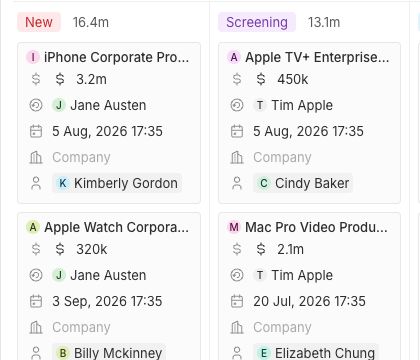 After: 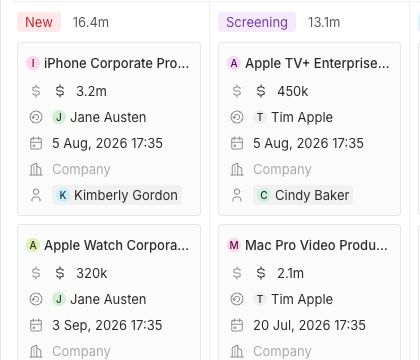 ## Validation - Browser verification on `http://apple.localhost:3001/objects/opportunities?viewId=0433d066-dda7-4b2c-89e5-04d4792d193c`: visible calendar card body padding computes to `0px 4px 4px` - Browser verification on board view: visible board card headers compute to `32px` - Browser console errors: none - `git diff --check` - `prettier --write` on changed files - `oxlint --type-aware` on changed files in the running checkout |
||
|
Mani bharadwaj
|
7e48d36c98 |
fix(twenty-front): apply object type translations to details panel relation labels (#22090)
## Problem When users customize or translate object type names (e.g. "Company" → "Unternehmen" in German), the translated/customized names do **not** appear in the details panel. The default English names still show instead. This is because the frontend's relation metadata only carried `nameSingular`/`namePlural` (internal API identifiers), not `labelSingular`/`labelPlural` (user-facing display labels). Components that display relation names had no choice but to use the internal identifiers. Fixes #19790 ## Changes ### Data layer — add labels to the pipeline - **GraphQL fragment** (`fragment.ts`): Added `labelSingular`/`labelPlural` to `sourceObjectMetadata` and `targetObjectMetadata` in both `relation` and `morphRelations` - **Type** (`FieldMetadataItemRelation.ts`): Extended the `Pick` type to include `labelSingular`/`labelPlural` - **Field metadata type** (`FieldMetadata.ts`): Added `relationObjectMetadataLabelSingular`/`LabelPlural` to `FieldRelationMetadata` - **Mapping** (`formatFieldMetadataItemAsFieldDefinition.ts`): Maps the new label fields with `label ?? name` fallback for backwards compatibility ### Display layer — use labels for user-facing text - **RecordDetailRelationRecordsListItem**: Uses `relationObjectMetadataLabelSingular` for delete confirmation dialog title, subtitle, and button text (falls back to `nameSingular`) - **RecordDetailRelationRecordsList**: Threads `objectLabelSingular` prop through - **RecordDetailRelationSection**: Passes `labelSingular ?? nameSingular` from the looked-up object metadata - **FieldWidgetRelationCard**: Passes `relationObjectMetadataLabelSingular` from field metadata - **FieldWidgetJunctionRelationCard**: Passes `labelSingular ?? nameSingular` from object metadata lookup - **FieldWidgetMorphRelationCard**: Passes label from morph relation hook result - **useGetMorphRelationRelatedRecordsWithObjectNameSingular**: Carries `labelSingular` from matched morph relation ### Test data - Updated story/mock files with `relationObjectMetadataLabelSingular`/`LabelPlural` fields - Updated `SettingsDataModelRelationFieldPreview` with label fields in morph relation objects ## Design decisions - **Backwards compatible**: All new props are optional. Every display usage uses `label ?? name` fallback, so if `labelSingular` isn't available yet (e.g. before GraphQL regeneration), it falls back to the old behavior - **Lookup vs display separation**: `nameSingular` continues to be used for lookups, routing, and GraphQL queries (it's the identifier). `labelSingular` is only used for user-facing display text - **Minimal scope**: Only changes the display paths identified in the bug report — confirmation dialogs and relation labels in the details panel ## Test plan 1. Set workspace language to a non-English locale (e.g. German) 2. Navigate to a record with relation fields 3. Verify relation section titles and labels show translated names 4. Try to delete a related record — verify the confirmation dialog uses the translated name 5. Switch language back to English — verify everything still works correctly <!-- This is an auto-generated description by cubic. --> <a href="https://cubic.dev/pr/twentyhq/twenty/pull/22090?utm_source=github" target="_blank" rel="noopener noreferrer" data-no-image-dialog="true"><picture><source media="(prefers-color-scheme: dark)" srcset="https://www.cubic.dev/buttons/review-in-cubic-dark.svg"><source media="(prefers-color-scheme: light)" srcset="https://www.cubic.dev/buttons/review-in-cubic-light.svg"><img alt="Review in cubic" src="https://www.cubic.dev/buttons/review-in-cubic-dark.svg"></picture></a> <!-- End of auto-generated description by cubic. --> --------- Co-authored-by: Charles Bochet <charles@twenty.com> |
||
|
Parship Chowdhury
|
b3e39e2198 |
fix: relative date picker calendar display (#21895)
Part of https://github.com/twentyhq/twenty/issues/19739#issuecomment-4652034526 (Bug 1-3). Maybe it feels like theses bugs are not actually bugs, but we can maybe say it as UX improvements: specially needed in case when an user will choose any past options. ### Bug 1: calendar open on wrong month With Is Relative (e.g. Past 1 Quarter), the calendar opened on today’s month instead of the range start. After the fix, it now opens on the first month of the filtered range. **Testing:** View filter → Date field → Is Relative → Past 1 Quarter. Calendar opens on January (range start), not today’s month https://github.com/user-attachments/assets/8849d00a-4d5c-4f8a-8d31-3a62535eb311 ### Bug 2: Dates not highlighted Ranges older than ~2 months (e.g. Q1 when today is June) showed no highlighted days. Highlighting now covers the full resolved range. **Testing:** Same setup: past 1 Quarter on a date when Q1 is outside the old 2‑month window. Jan 1 - Mar 31 will highlight. https://github.com/user-attachments/assets/d21e2272-c923-4493-80ff-bdf4228842b1 ### Bug 3: No month navigation Relative mode only showed Past - 1 - Quarter controls with no way to browse months. Now see the new arrows move through months without changing the filter. <img width="377" height="455" alt="Screenshot 2026-06-20 181107" src="https://github.com/user-attachments/assets/eb51feb9-af10-489a-b166-8b8d6c642e05" /> > [!NOTE] > 1. We can't do the fixes by one by one, i have to fix them within one PR because all the fixes are inter-related, like we can't test the bug 1 fix alone without implementing bug 3. > 2. Bug 4 will be done in a separate PR which is actually the issue #19739. See https://github.com/twentyhq/twenty/issues/19739#issuecomment-4652034526 for better understanding. > 3. If you see the screen recordings, they are actually done with the alignment fixes from #21881 . So without that changes you will see the alignmemt issues in the calendar grid in your local. --------- Co-authored-by: Félix Malfait <felix.malfait@gmail.com> |
||
|
Charles Bochet
|
d8cb4aa15b |
fix(filter): resolve filter-derived date defaults with Temporal (fixes create/update crash in date-filtered views) (#22124)
## Symptom

Creating or updating an Opportunity on a board view crashes with:

```
Uncaught TypeError: e.split is not a function
    at splitDateString (date-fns) → parseISO → isMatchingDateFilter
    → isRecordMatchingFilter → <group-by optimistic effect> → createOneRecord
```

`e` is a non-string (a `Date` object, shown as `{}` in the debugger).
Distinct from the `null` case fixed in #22029.

## Root cause

Reproduced on a live board filtered by **Close date — Is relative —
"This quarter"** (a `DATE_TIME` field).

When you create a record in a filtered view, `useCreateNewIndexRecord`
derives default field values from the view's filters via
`buildRecordInputFromFilter` → `buildValueFromFilter`. For a date field,
`computeValueFromFilterDate` returned a JS **`Date` object** (`new
Date()` / `new Date(value)`), assigned to the new record verbatim. The
optimistic record's `closeDate` was then a `Date`, not an ISO string,
and the group-by optimistic effect matched it via `parseISO(dateObject)`
→ `dateString.split is not a function`, crashing every create/update in
the view.

## Fix

`computeValueFromFilterDate` now returns timezone-aware **ISO strings**
via Temporal, mirroring what `turnRecordFilterIntoGqlOperationFilter`
produces for the same filters — so a record created in a date-filtered
view actually satisfies its own filter:

- **`DATE_TIME`** → an instant. Date-only filter values (a `DATE_TIME`
"is" filter stores `yyyy-MM-dd`, no time) are resolved to the start of
day in the user's time zone, matching how the filter operands are built
— `Temporal.Instant.from()` alone would `RangeError` on them.
- **`DATE`** → a plain date `yyyy-MM-dd` resolved in the **user's time
zone** (`Temporal.Now.plainDateISO(timeZone)`). A bare `new
Date().toISOString()` would use the UTC date, which near midnight is the
wrong calendar day for non-UTC users, so the new record could miss its
own `IS_TODAY`/relative filter. The time zone is threaded from
`useUserTimezone` (same source the filter side uses).
- `IS_BEFORE` subtracts 1 day for `DATE` / 1 minute for `DATE_TIME` (the
`-1 minute` special-case moved out of `buildRecordInputFromFilter`,
which now just assigns the string).

No `Date` object ever reaches `parseISO`, and the value matches the
filter operand, so the optimistic card lands in the right place.

## Tests

- `buildValueFromFilter.spec.ts`: every date operator returns an ISO
**string** (round-tripped to the expected instant); a `DATE` block
asserts date-only `yyyy-MM-dd` output and that `IS_TODAY` resolves to
the correct calendar day **per time zone** at a UTC day boundary
(`2024-03-20` UTC vs `2024-03-21` Asia/Tokyo); a date-only `DATE_TIME`
`IS` value resolves to start-of-day in the user time zone (UTC vs
America/New_York) without throwing.
- `buildRecordInputFromFilter.test.ts`: filter-derived date values are
ISO strings, not `Date` objects.

## Verified locally (Chrome)

Reproduced the exact prod scenario on the **By Stage Opportunities
Kanban board** (the group-by optimistic effect) with a **Close date — Is
relative** filter:

- Created a card in a column → **no `split is not a function` crash**;
the card got a valid Close date (`now` for the relative filter, e.g. `25
Jun 2026 13:10`). Console clean.
- Also verified a **table view + Close date — Is** filter: created
record gets a valid start-of-day value (`25 Jun 2026 00:00`).

Both `IS_RELATIVE` (→ now instant) and the date-only `IS` (→
start-of-day in the user tz) paths produce string values that the
optimistic matcher handles without throwing.
|



