942755d0dd63fbd513a6caf744bc3e290dd695f2
188 Commits
| Author | SHA1 | Message | Date | |
|---|---|---|---|---|
 Thomas des Francs Thomas des Francs
|
1a60d4eaa3 |
Add MCP setup screen (#22468)
## Summary - Add a first-tab MCP setup experience under MCP & APIs with quick install cards, manual configuration, client logos, and HTTPS gating for Claude install links. - Rename API/Webhooks settings surfaces to MCP & APIs and update related icons, permissions, breadcrumbs, and command menu entries. - Add the Tabler sparkle-2 icon wrapper and MCP setup visual assets. ## Screenshots | Before | After | | --- | --- | |  | <img alt="image" src="https://github.com/user-attachments/assets/a6ae2ae6-322b-4370-b9b6-0a3d73ff7fa7" /> | <!-- This is an auto-generated description by cubic. --> <a href="https://cubic.dev/pr/twentyhq/twenty/pull/22468?utm_source=github" target="_blank" rel="noopener noreferrer" data-no-image-dialog="true"><picture><source media="(prefers-color-scheme: dark)" srcset="https://www.cubic.dev/buttons/review-in-cubic-dark.svg"><source media="(prefers-color-scheme: light)" srcset="https://www.cubic.dev/buttons/review-in-cubic-light.svg"><img alt="Review in cubic" src="https://www.cubic.dev/buttons/review-in-cubic-dark.svg"></picture></a> <!-- End of auto-generated description by cubic. --> --------- Co-authored-by: Charles Bochet <charles@twenty.com> |
||
|
Thomas des Francs
|
416f4cf90e |
Add billing plans comparison page (#22424)
## What changed - Added a Billing > Plans tab with a Pro vs Organization comparison table. - Updated subscription card CTAs so Compare plans routes to the new Plans tab, while upgrade/downgrade actions stay inside the comparison page. - Added a reusable segmented control and used it for the billing period toggle and navigation drawer tabs. - Hid billing pages/navigation when billing is disabled, including self-hosted environments. <img width="1417" height="882" alt="file-f98283057b5a700f275cde2a38831ac3" src="https://github.com/user-attachments/assets/182a7ff4-51fa-492e-8c75-51f9dc35b59e" /> <!-- This is an auto-generated description by cubic. --> <a href="https://cubic.dev/pr/twentyhq/twenty/pull/22424?utm_source=github" target="_blank" rel="noopener noreferrer" data-no-image-dialog="true"><picture><source media="(prefers-color-scheme: dark)" srcset="https://www.cubic.dev/buttons/review-in-cubic-dark.svg"><source media="(prefers-color-scheme: light)" srcset="https://www.cubic.dev/buttons/review-in-cubic-light.svg"><img alt="Review in cubic" src="https://www.cubic.dev/buttons/review-in-cubic-dark.svg"></picture></a> <!-- End of auto-generated description by cubic. --> --------- Co-authored-by: Etienne <45695613+etiennejouan@users.noreply.github.com> |
||
|
Thomas des Francs
|
d8cc81cb91 |
Improve billing settings UI (#22377)
## Summary - Refresh the settings billing subscription and credits cards with clearer status, usage, and action states. - Add the credit-package picker flow and route past-due/cancellation actions to billing management instead of credit modals. - Clean up related billing UI helpers and formatting. ## Screens ### regular <img width="1007" height="781" alt="image" src="https://github.com/user-attachments/assets/dc9c0c59-8cda-422a-a0d3-56292421a744" /> ### downgrading <img width="1049" height="818" alt="image" src="https://github.com/user-attachments/assets/0dc3dea8-5b55-4cf2-bc92-997cf6e9bebc" /> <img width="1048" height="901" alt="image" src="https://github.com/user-attachments/assets/fba805ad-f523-444b-93a0-2011b6b43443" /> ### Trialing without card <img width="1008" height="903" alt="image" src="https://github.com/user-attachments/assets/d5dd11b6-4c92-4102-ac22-ad1ad4e9fbfb" /> with card <img width="1008" height="806" alt="image" src="https://github.com/user-attachments/assets/0dbeb00e-890e-4448-94fe-0cc0ef411e8d" /> ### Past due & Unpaid <img width="1052" height="860" alt="Past due" src="https://github.com/user-attachments/assets/25ba53ef-6e74-4b4c-bfe1-d6c74e165917" /> <img width="1138" height="860" alt="Unpaid" src="https://github.com/user-attachments/assets/bb16fe65-84e4-40a7-8951-90b01030aded" /> --------- Co-authored-by: Etienne <45695613+etiennejouan@users.noreply.github.com> |
||
|
Thomas des Francs
|
2bb7fb2e9b |
Polish settings page titles and admin tables (#22305)
## Summary - Reuse the shared settings title presentation for read-only and editable settings page titles. - Polish settings AI/app icons, breadcrumb cropping, and admin detail title icons. - Align admin panel table/card typography and spacing with existing settings tables. ## Before/After <img width="1524" height="2214" alt="Settings pages before and after" src="https://github.com/user-attachments/assets/91037b25-b442-4eb2-b244-1d8280ce2cd9" /> <img width="2200" height="3268" alt="Additional settings UI before and after" src="https://github.com/user-attachments/assets/f10d7283-7031-4958-8539-649c3067cd31" /> <!-- This is an auto-generated description by cubic. --> <a href="https://cubic.dev/pr/twentyhq/twenty/pull/22305?utm_source=github" target="_blank" rel="noopener noreferrer" data-no-image-dialog="true"><picture><source media="(prefers-color-scheme: dark)" srcset="https://www.cubic.dev/buttons/review-in-cubic-dark.svg"><source media="(prefers-color-scheme: light)" srcset="https://www.cubic.dev/buttons/review-in-cubic-light.svg"><img alt="Review in cubic" src="https://www.cubic.dev/buttons/review-in-cubic-dark.svg"></picture></a> <!-- End of auto-generated description by cubic. --> |
||
|
Félix Malfait
|
0e22ae0521 |
feat: create calendar events on Google and Microsoft accounts (#22231)
## Context Twenty can import calendar events and send emails, but cannot create calendar events. This adds calendar event creation on connected **Google** and **Microsoft** accounts, mirroring the existing email-send architecture (`message-outbound-manager`). ## What it adds The capability is exposed three ways, all backed by the same composer → driver → persist pipeline: - **GraphQL mutation** `createCalendarEvent` (metadata API) - **AI agent tool** `create_calendar_event` (flows to MCP automatically), gated by a new `CREATE_CALENDAR_EVENT_TOOL` permission flag - **Workflow builder node** "Create Calendar Event" in the **Core** section, with a full settings form (variable interpolation supported) CalDAV/IMAP is intentionally out of scope for now (different long pole). ## Design notes - **Reuse over reinvention** — the created event is run through the existing inbound formatters (`formatGoogleCalendarEvents` / `formatMicrosoftCalendarEvents`) and persisted immediately via the existing `CalendarSaveEventsService`, so it appears in Twenty right away and is reconciled by the next provider sync (dedup on external id). Persistence is best-effort. - **OAuth scopes** — Google already requests `calendar.events` (read+write), so no change there. Microsoft moves `Calendars.Read` → `Calendars.ReadWrite`; existing Microsoft accounts must re-consent (surfaced as a clear "reconnect" error via a missing-scope check). - **Deliberate invitation semantics** — `sendInvitations` is off by default. When off, the event is created with **no attendees** on either provider, so creating an event never silently emails external people. When on, attendees are attached and notified (Google `sendUpdates: all`, Microsoft's default). This sidesteps Microsoft Graph having no per-request suppression. - **Timezone correctness** — Microsoft Graph interprets `dateTime` as wall-clock in the supplied `timeZone` and ignores the offset, so the absolute instant is converted to its wall-clock form before sending (Google honors the offset directly). Both providers end up scheduling the same instant. - **Conferencing** — optional Google Meet (`conferenceData.createRequest`, with a follow-up `events.get` to resolve the async link) / Microsoft Teams (`isOnlineMeeting`). - Attendees are a comma-separated string everywhere (tool input, GraphQL DTO, workflow input), consistent with `send_email` recipients; the composer parses to its internal list. ## Test plan - **Unit**: 45 tests covering the composer (validation, all-day boundaries, offset enforcement, timezone, scope checks, default-account resolution), both provider drivers, the dispatcher, and the workflow step-log builder. - **Integration**: `createCalendarEvent` on the `/metadata` API fails closed with a structured error for a non-existent account (the auth/ownership/validation path that doesn't require provider mocking). - **Manual**: verified the workflow node appears in the Core section, the settings form renders and round-trips (edit → autosave → reload), and the live mutation returns a structured failure for a bogus account. ## Open question for reviewers The metadata mutation `createCalendarEvent` shares a name with the core schema's auto-generated `createCalendarEvent(data:)` CRUD mutation for the CalendarEvent object — they live on different endpoints (`/metadata` vs `/graphql`) so there's no runtime conflict, but it's a potential point of confusion for API consumers. Happy to rename (e.g. `createCalendarEventOnConnectedAccount`) if preferred. ## Out of scope / follow-ups - CalDAV/IMAP support - Event update/delete and recurrence - Existing Microsoft accounts need re-consent for the widened scope <!-- This is an auto-generated description by cubic. --> <a href="https://cubic.dev/pr/twentyhq/twenty/pull/22231?utm_source=github" target="_blank" rel="noopener noreferrer" data-no-image-dialog="true"><picture><source media="(prefers-color-scheme: dark)" srcset="https://www.cubic.dev/buttons/review-in-cubic-dark.svg"><source media="(prefers-color-scheme: light)" srcset="https://www.cubic.dev/buttons/review-in-cubic-light.svg"><img alt="Review in cubic" src="https://www.cubic.dev/buttons/review-in-cubic-dark.svg"></picture></a> <!-- End of auto-generated description by cubic. --> --------- Co-authored-by: neo773 <neo773@protonmail.com> |
||
|
Raphaël Bosi
|
5f22908588 |
Decouple twenty-ui Avatar from app server-URL config (#21968)
Makes `twenty-ui`'s `Avatar` render the `avatarUrl` it receives instead of building it from `window._env_`/`window.location` at module load, so the library no longer depends on the app environment. URL resolution moves to `twenty-front` via a `getAbsoluteImageUrl` helper applied at the call sites. Part of making twenty-ui a standalone library. |
||
|
Weiko
|
9f30915f6f |
fix(metadata): remove deprecated isCustom from Objects and Fields (#21799)
## Context Follow-up to #21228, which deprecated `isCustom` on object/field metadata but kept it exposed because the frontend still relied on it. This removes it from the GraphQL API and the frontend entirely. ## Implementation ### Server - Remove `isCustom` `@Field` from the `Object`, `Field`, and `MinimalObjectMetadata` GraphQL types - Remove the `isCustom` `@ResolveField` resolvers and the `isCustomLoader` dataloader (+ payload/interface) - Remove `isCustom` as an internal `@HideField()` on the Object/Field DTOs used by the i18n standard-override gate > Use an explicit isStandard instead (which is the correct gating) ### Frontend - Add `getIsMetadataItemCustom` helper + `useGetIsMetadataItemCustom` hook: an item is custom when `applicationId === currentWorkspace.workspaceCustomApplication.id` - Migrate all consumers off `objectMetadataItem.isCustom` / `fieldMetadataItem.isCustom`; `isRecordFieldReadOnly` now takes a precomputed `isFieldCustom` - Drop `isCustom` from the metadata fragment/mutations/minimal query, FE types, zod schemas, and mock generators; regenerate GraphQL types ## Notes - Breaking change on the (already-deprecated) `Object.isCustom` / `Field.isCustom` GraphQL fields and the `isCustom` filter - FE semantic is "belongs to the workspace custom app" (third-party-app objects/fields are treated as non-custom) - `isCustom` on IndexMetadata / View / Skill / Agent is a separate column and is untouched - Breaking changes on REST metadata API |
||
|
Raphaël Bosi
|
8034c7725f |
Reorganize twenty-ui into best-practice component domains and per-component folders (#21745)
Reorganizes `twenty-ui`'s component organization to follow how the best
UI libraries (MUI, Mantine, Base UI, Polaris) structure their source,
now that the package has stabilized.

**Taxonomy** — dissolves the meaningless `components/` junk-drawer and
the 107-file `display/` mega-category. New domains/subpaths:
`data-display`, `typography`, `icon`, `surfaces`; `feedback` and
`layout` absorb the rest (banners/callout/info + placeholders →
feedback; modal/card → surfaces; motion + separators → layout).

**Per-component layout** — every component is now
`<domain>/<ComponentName>/<ComponentName>.tsx` with colocated
styles/stories/types, `internal/` for private helpers and `parts/` for
re-exported compound sub-parts. The redundant inner `/components/` is
gone. `icon` and `json-visualizer` are kept as cohesive subsystems.

**Also:** adds a tree-shakeable root barrel (`import { Button } from
'twenty-ui'`), the generator now owns `individual-entry.ts`, and a real
barrel-leak bug is fixed (private `internals/` parts were leaking into
the public API).

Consumer imports (~1.2k files) and the `twenty-sdk` UI aggregator were
updated by codemod. The change is **export-neutral** except 16
intentionally-removed private internals symbols (all verified
unconsumed). Gates green: typecheck, lint, build, size-limit, storybook.


<!-- This is an auto-generated description by cubic. -->
<a
href="https://cubic.dev/pr/twentyhq/twenty/pull/21745?utm_source=github"
target="_blank" rel="noopener noreferrer"
data-no-image-dialog="true"><picture><source
media="(prefers-color-scheme: dark)"
srcset="https://www.cubic.dev/buttons/review-in-cubic-dark.svg"><source
media="(prefers-color-scheme: light)"
srcset="https://www.cubic.dev/buttons/review-in-cubic-light.svg"><img
alt="Review in cubic"
src="https://www.cubic.dev/buttons/review-in-cubic-dark.svg"></picture></a>
<!-- End of auto-generated description by cubic. -->
|
||
|
Raphaël Bosi
|
9c9c34fccf |
Remove twenty-ui-deprecated and migrate frontend to twenty-ui (#21596)
Migrates `twenty-front`, `twenty-sdk`, and `twenty-front-component-renderer` from `twenty-ui-deprecated` to `twenty-ui` (mechanical import swap — the packages have API parity) and deletes the deprecated package along with its workspace/CI/config wiring. Also adds `@linaria/react`/`@linaria/core` as direct deps of `twenty-front` (it used them transitively via the deprecated package). Note: move the required status check from `ci-ui-status-check` to `ci-new-ui-status-check`. Argos: the Storybook box-model/button-reset baseline shift (the bulk of the visual diffs) is isolated in #21665 — Storybook now loads twenty-ui's global `reset.scss`, which the production app already ships. Once #21665 merges and this branch is rebased, the remaining Argos diffs are component-level visual-parity items only. |
||
|
Thomas des Francs
|
d06e687b77 |
Fix settings UI polish pass 2 (#21540)
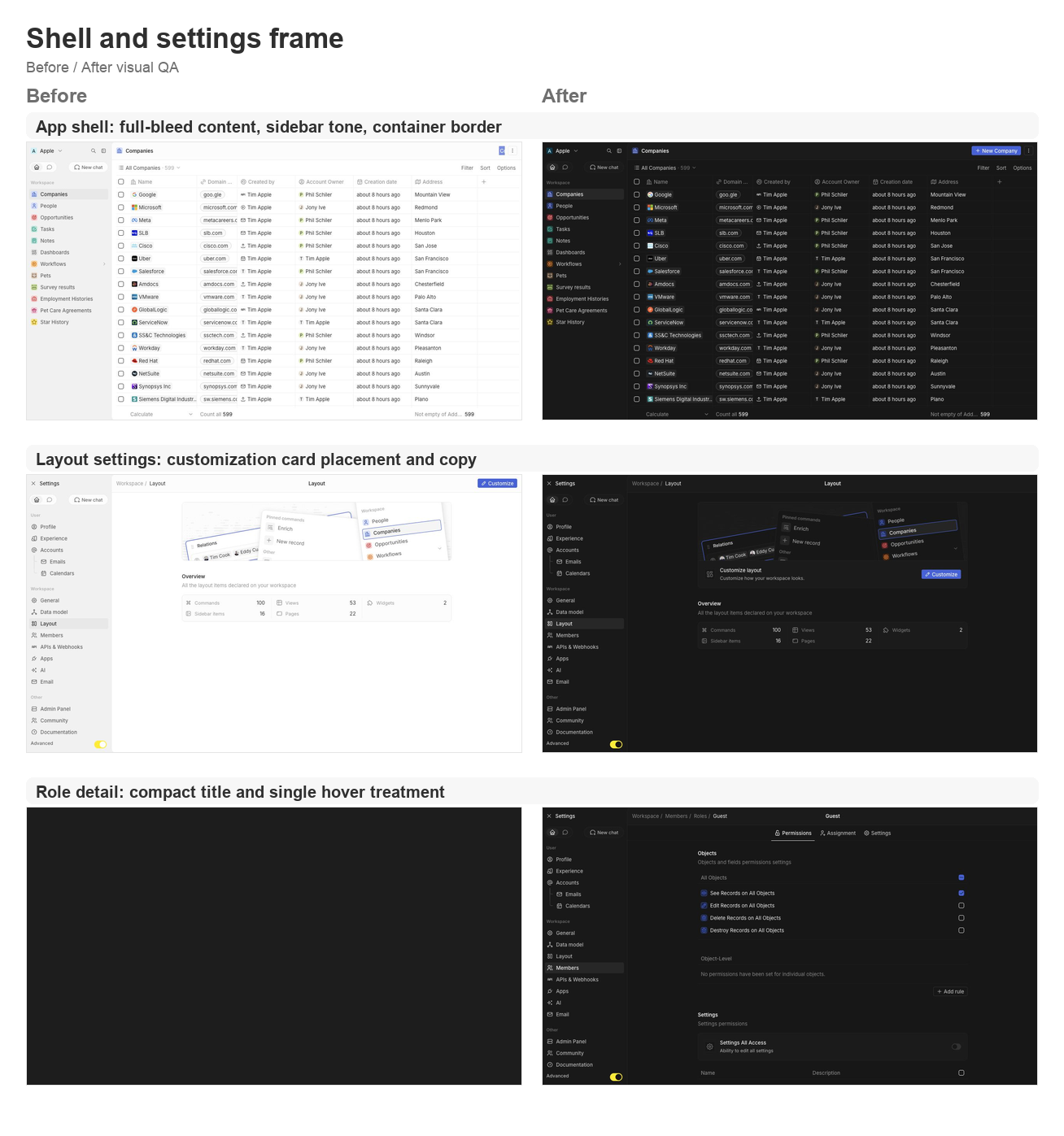
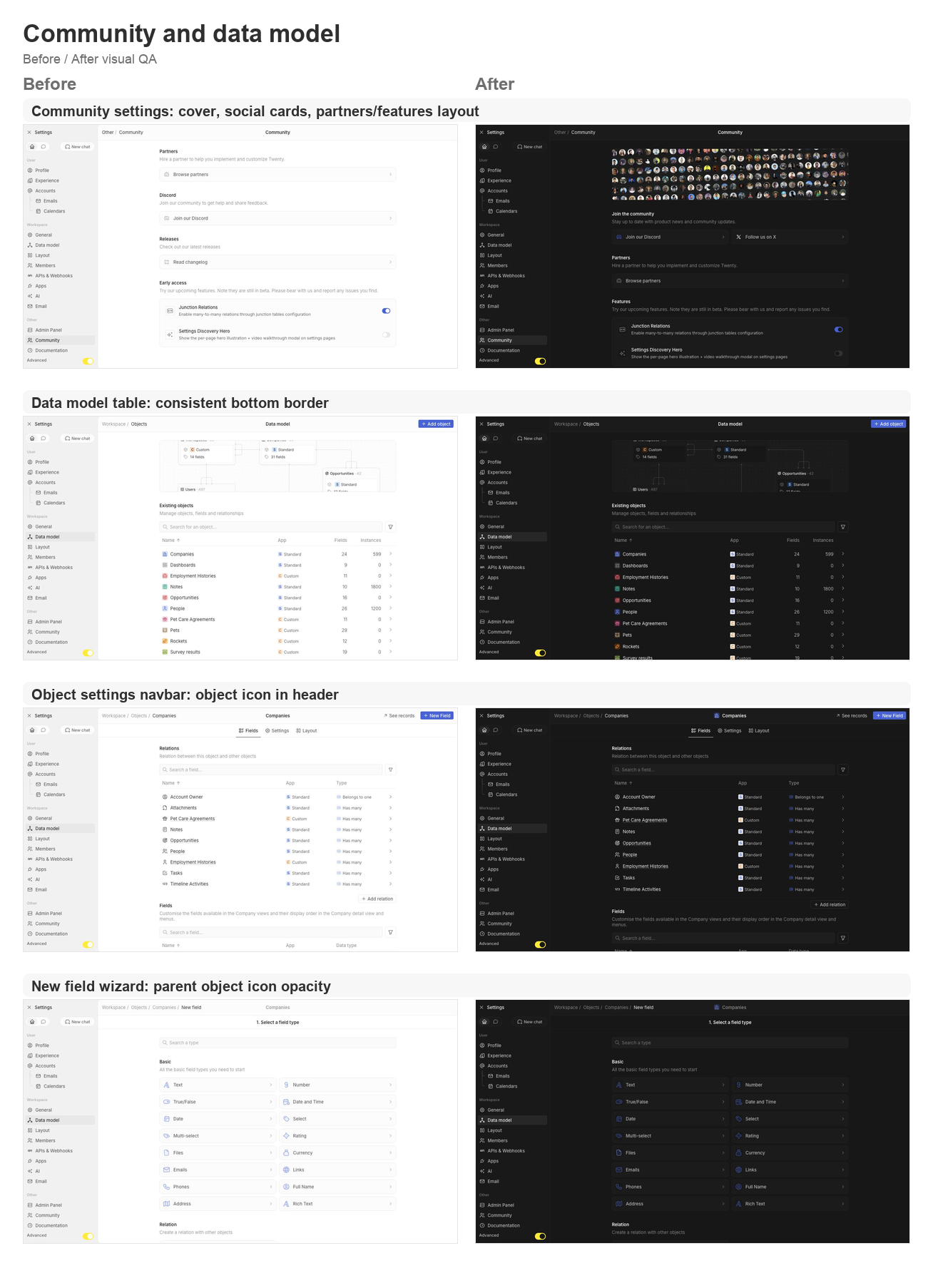
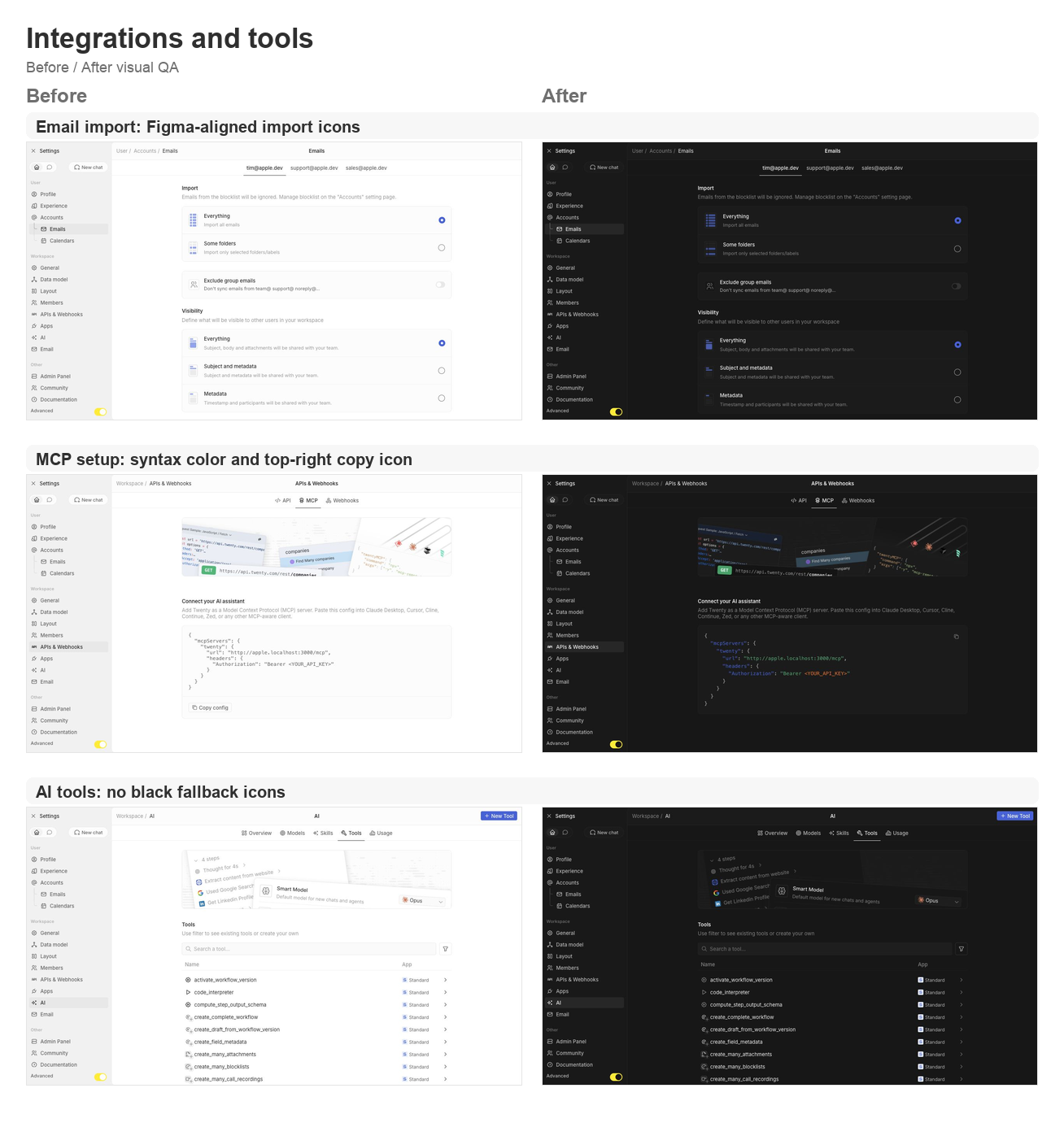
## Summary This PR groups the requested second UI polish pass across the app shell, settings pages, data model, community, AI tools, and developer setup surfaces. ### Shell and navigation polish - Lets the app content card fill the available viewport and removes the bottom-left radius on the main container. - Uses an outside-looking container border treatment so the rounded top-left edge matches the Figma frame without a double border. - Restores the separator between the AI chat side panel and the record container. - Updates navigation drawer background/skeleton tones to use gray/3 consistently. - Simplifies the full-screen backend error fallback so the white screen fills the viewport. ### Settings page polish - Moves the layout customization action from the settings navbar into a settings card under the hero. - Tightens layout page copy now that the customization surfaces are not directly manageable yet. - Aligns role detail title sizing and hover treatment with other settings headers. - Supports settings card brand icon colors, then restores Discord and X brand logos on the Community page. - Adds the Community discovery cover, moves community/social content to the top, and reorganizes Partners and Features. - Keeps setting card subtitle and separator behavior available for the updated settings cards. ### Data model and object settings polish - Adds a shared data-model table body wrapper so object, field, and relation tables all keep the expected bottom border. - Displays the object icon in the object settings navbar. - Shares the new-field wizard parent object icon wrapper and keeps the object icon at 64% opacity in wizard headers. - Updates the new-field type selector icon treatment to match the wizard header opacity behavior. ### Integrations, tools, and API polish - Reworks the MCP setup config card with light syntax coloring and a top-right copy icon button instead of the bottom copy section. - Fixes email import icons to match the Figma asset shape. - Ensures AI tool table icons and chevrons never fall back to black. ## Validation - `npx nx lint:diff-with-main twenty-front` - `npx tsc -p packages/twenty-front/tsconfig.json --noEmit` - `git diff --check` - Manual local visual pass on `apple.localhost:3001` for companies, settings/community, data model, object settings, new-field wizard, layout settings, account import, MCP setup, AI tools, and role detail pages. ## Visual QA ### Shell and settings frame <img width="1308" height="1397" alt="Shell and settings frame before/after board" src="https://raw.githubusercontent.com/twentyhq/twenty/pr-assets/ui-fixes-2/visual-qa/ui-fixes-2/shell-settings-frame.png" /> ### Community and data model <img width="1308" height="1806" alt="Community and data model before/after board" src="https://raw.githubusercontent.com/twentyhq/twenty/pr-assets/ui-fixes-2/visual-qa/ui-fixes-2/community-data-model.png" /> ### Integrations and tools <img width="1308" height="1397" alt="Integrations and tools before/after board" src="https://raw.githubusercontent.com/twentyhq/twenty/pr-assets/ui-fixes-2/visual-qa/ui-fixes-2/integrations-tools.png" /> <!-- This is an auto-generated description by cubic. --> <a href="https://cubic.dev/pr/twentyhq/twenty/pull/21540?utm_source=github" target="_blank" rel="noopener noreferrer" data-no-image-dialog="true"><picture><source media="(prefers-color-scheme: dark)" srcset="https://www.cubic.dev/buttons/review-in-cubic-dark.svg"><source media="(prefers-color-scheme: light)" srcset="https://www.cubic.dev/buttons/review-in-cubic-light.svg"><img alt="Review in cubic" src="https://www.cubic.dev/buttons/review-in-cubic-dark.svg"></picture></a> <!-- End of auto-generated description by cubic. --> |
||
|
Thomas des Francs
|
b14195428a |
Fix navigation and settings UI polish (#21523)
## Summary This PR groups the requested UI polish pass across navigation, settings, AI settings, data model, community/lab, and dashboard chips. ### Navigation and drawer polish - Smooths app/settings route switching with a 300ms content transition. - Smooths app menu/settings menu drawer swaps with a fade transition while preserving the existing drawer dimensions. - Keeps navigation and AI chat history panes mounted to avoid flicker when switching tabs. - Aligns the first app/settings section with the AI chat history section title. - Removes the main app navigation "Other" section. - Aligns the settings exit header with the workspace switcher header. - Sets the settings exit icon gap to 8px, uses the small icon stroke token, and keeps the icon color on text-secondary. - Makes the workspace switcher button 28px high inside its 32px container, moves the dropdown up so the workspace name does not jump, and keeps a 2px gap between header icon buttons. - Moves Settings below Support in the workspace switcher menu. - Pins the Advanced toggle to the bottom of the settings drawer and aligns its right padding with nav items. ### Settings surface polish - Fixes vertically cropped dropdown menu headers. - Makes wizard parent titles tertiary when a nested wizard title is visible. - Places danger-zone buttons side by side. - Uses a 32px Visualize button. - Restores 8px top/bottom padding on settings tables. - Separates AI overview counts into three columns like layout overview. - Adds separators inside setting cards, including the Smart Model / Fast Model card. - Groups lab/early-access toggles into one card with separators and full-width row backgrounds. - Replaces deprecated Enterprise adornment tags with the Organization adornment on gated AI/security/settings surfaces. - Uses the Discord brand icon in Community while keeping the standard icon component rendering pattern. - Tightens Skills/Tools search-to-table spacing so switching tabs does not shake the table top. - Fixes the small gap in nested navigation breadcrumbs between Emails and Calendars. ### Dashboard/data table polish - Fixes vertically cropped "Not shared" chips on dashboards. - Keeps table row/header spacing stable after the settings table padding restoration. ## Validation - `npx nx lint:diff-with-main twenty-front` - `npx tsc -p packages/twenty-front/tsconfig.json --noEmit` - Manual Chrome pass on `apple.localhost:3001` for profile, app navigation, workspace switcher, AI overview/models/skills/tools/usage, community/lab, data model, new-field wizard, and dashboards. ## Visual QA ### Settings surface fixes <img width="1324" height="2668" alt="Settings surface fixes before/after board" src="https://github.com/user-attachments/assets/312131fa-3922-4724-9460-46fd373754d1" /> ### Navigation drawer fixes <img width="1324" height="1816" alt="Navigation drawer fixes before/after board" src="https://github.com/user-attachments/assets/ca0b29e5-e393-46c0-81f7-e6bed2557b59" /> ### Tables, wizards, gates and chips <img width="1324" height="2242" alt="Tables, wizards, gates and chips before/after board" src="https://github.com/user-attachments/assets/5f358240-c31c-4c15-8ca8-04ed761fbf85" /> |
||
|
Félix Malfait
|
1efa3567ef |
Rename isUIReadOnly to isUIEditable, add isUICreatable, expose both to app developers (#21504)
<!-- CURSOR_AGENT_PR_BODY_BEGIN -->
# UI capability flags: `isUIEditable` + `isUICreatable`
## Per-verb capability model
This PR replaces the negative `isUIReadOnly` metadata flag with
positive, per-verb capability flags (à la Salesforce
`createable`/`updateable`):
- **`isUIEditable: boolean`, default `true`** — rename of `isUIReadOnly`
with inverted polarity, on **both** `objectMetadata` and
`fieldMetadata`. It is one concept ("can the user edit this through the
generic UI?") at two altitudes, so it carries one name at both levels.
- **`isUICreatable: boolean`, default `true`** — new, **object-level
only** (fields have no create verb). When `false`, no generic UI
affordance to create a record of this object appears anywhere (table "+"
buttons, board column add, calendar add, relation-section "Add new",
record picker "Add new", command-menu create action and its keyboard
shortcut).
Both flags are **UI-affordance flags only**: the server does not block
create/edit mutations based on them, so the system, API, and workflows
continue to mutate these records freely. They are orthogonal statements
about the object's nature with no implication rule in the data model.
Because today's inline creation UX creates a blank record the user must
then edit, the frontend create predicate currently requires both
`isUICreatable` and effective editability.
There is no CREATE permission in `ObjectPermissions`; the frontend keeps
gating creation on `canUpdateObjectRecords` as a proxy, ANDed with the
new flags.
## Unified create predicate
All generic creation entry points now flow through one predicate,
`canCreateRecordsForObjectMetadataItem` (`isUICreatable` && not
`isSystem` && not effectively read-only, where effective read-only
covers `isUIEditable`, `isRemote`, and the `canUpdateObjectRecords`
proxy via `isObjectMetadataReadOnly`). This deletes the previously
hardcoded suppression lists:
- `isRecordTableCreateDisabled.ts` and its hardcoded
`WorkflowRun`/`WorkflowVersion` list — deleted; those objects (plus
`workspaceMember`) now declare `isUICreatable: false` in the standard
application instead.
- The hardcoded `workspaceMember` guard inside
`useAddNewRecordAndOpenSidePanel.ts` — deleted.
- The `CREATE_NEW_RECORD` command menu item's availability expression
now checks `objectMetadataItem.isUICreatable`, `isUIEditable`,
`isSystem`, and `isRemote`; a workspace upgrade command re-syncs the
expression in existing workspaces.
Component-local conditions (soft-delete filter active, layout
customization mode) stay in their components.
## GraphQL compatibility and removal plan
The schema delta versus main is **purely additive plus deprecations —
zero breaking changes**:
- `isUIReadOnly` remains on both the ObjectMetadata and FieldMetadata
GraphQL output types for **one release** as a deprecated field computed
as `!isUIEditable` (`deprecationReason: 'Use isUIEditable'`). The Twenty
frontend no longer queries it.
- `isUIReadOnly` also remains on the **input side** for one release
(`CreateFieldInput`, `UpdateFieldInput`, `FieldFilter`, `ObjectFilter`),
keeping the schema shape identical to main for those members. On create
it acts as a legacy alias mapped to `!isUIReadOnly` (`isUIEditable` wins
when both are provided); on update it is ignored, exactly as on main (it
was never an editable property). Filtering on the deprecated member
keeps working until the column is dropped at upgrade time; after that it
is a deprecated no-op surface kept only for schema compatibility.
**Removal plan for next release: drop `isUIReadOnly` from the output
DTOs (and resolvers' `@ResolveField`s), from the input/filter types,
from the create-input mapping, and the `@WasRemovedInUpgrade`-retained
entity columns and decorators.**
## ⚠️ Webhook / database-event payload shape change
The `database-event-payload` type in `twenty-shared` got a clean rename
(no alias): metadata snapshots in webhook and database-event payloads
now carry `isUIEditable` (and `isUICreatable` at object level) **instead
of** `isUIReadOnly`, with inverted polarity. Consumers of these payloads
that read `isUIReadOnly` must switch to `isUIEditable`.
## New manifest properties (app-developer DX)
Application developers can now set these flags in their app manifests
(purely additive — existing manifests and older `twenty-sdk` versions
are unaffected, defaults apply when omitted):
- `objects[].isUICreatable?: boolean` (default `true`)
- `objects[].isUIEditable?: boolean` (default `true`)
- `fields[].isUIEditable?: boolean` (default `true`)
The manifest converters previously hardcoded `isUIReadOnly: false`; they
now read the manifest values with `?? true` defaults. The types are
re-exported through `twenty-sdk` from `twenty-shared`.
## Migration & backfill
- One fast instance command: adds `isUIEditable` (NOT NULL default
`true`) on `core."objectMetadata"` and `core."fieldMetadata"`, backfills
`isUIEditable = false` exactly where `isUIReadOnly = true`, drops
`isUIReadOnly`, and adds `isUICreatable` (default `true`) on
`objectMetadata`. The `down` is the exact inverse. Uses `ADD/DROP COLUMN
IF (NOT) EXISTS`, matching the 2-12 drop-`isCustom` precedent. Verified
up and down in separate transactions against a dev database with exact
backfill counts.
- **Cross-version upgrade safety (multi-version self-hosted jumps):**
the upgrade sequence interleaves per version (instance → workspace
commands), so pre-2.13 workspace commands run **before** the 2.13 rename
when an old instance jumps several versions. Following the `isCustom`
precedent: `isUIEditable`/`isUICreatable` are marked
`@WasIntroducedInUpgrade` and `isUIReadOnly` stays on both entities as
`@WasRemovedInUpgrade`, so the upgrade-aware entity metadata adapter
hides the not-yet-existing columns (and keeps the legacy column live) at
pre-2.13 cursors. **No committed upgrade command outside the 2-13
directory is modified**: the old 1-21/2-8/2-9 commands keep their
original `isUIReadOnly: true` inputs, which still compile (entity
property retained, deprecated create-input alias mapped) and still
produce the correct legacy column writes pre-rename.
- A 2-13 workspace command (`sync-standard-ui-capability-flags`)
re-syncs `isUICreatable` **and** `isUIEditable` on standard objects and
`isUIEditable` on standard fields from the standard-application
definitions. This backfills `isUICreatable: false` on
`workflowRun`/`workflowVersion`/`workspaceMember` and heals fields
created mid-cross-upgrade by pre-2.13 commands (whose hidden
`isUIEditable` value cannot reach the insert). Both 2-13 sync commands
pass `isSystemBuild: true` — the flat metadata validator otherwise
rejects direct updates to system objects (verified against a
deliberately drifted dev database; the run is idempotent).
- A second 2-13 workspace command re-syncs the create-record command
availability expression.
## Testing
- Unit tests for `canCreateRecordsForObjectMetadataItem`
(flag/permission/system combinations) and for the manifest converters
(flags set / omitted → defaults).
- Full `upgrade --dry-run` boots the sequence (107 steps) and validates
the upgrade-aware decorator references; both 2-13 sync commands verified
end to end against real drift and re-run idempotently.
- Schema verified by live introspection after the input-alias restore:
all four input/filter members match main, output deprecations intact;
frontend metadata types and `twenty-client-sdk` schema regenerated from
the running server.
- Read-only-related and touched jest suites pass on both packages;
typecheck and lint pass on `twenty-server` and `twenty-front`.
<!-- CURSOR_AGENT_PR_BODY_END -->
<div><a
href="https://cursor.com/agents/bc-0f3e04cb-b04a-40be-8330-5609c4538e8a"><picture><source
media="(prefers-color-scheme: dark)"
srcset="https://cursor.com/assets/images/open-in-web-dark.png"><source
media="(prefers-color-scheme: light)"
srcset="https://cursor.com/assets/images/open-in-web-light.png"><img
alt="Open in Web" width="114" height="28"
src="https://cursor.com/assets/images/open-in-web-dark.png"></picture></a> <a
href="https://cursor.com/background-agent?bcId=bc-0f3e04cb-b04a-40be-8330-5609c4538e8a"><picture><source
media="(prefers-color-scheme: dark)"
srcset="https://cursor.com/assets/images/open-in-cursor-dark.png"><source
media="(prefers-color-scheme: light)"
srcset="https://cursor.com/assets/images/open-in-cursor-light.png"><img
alt="Open in Cursor" width="131" height="28"
src="https://cursor.com/assets/images/open-in-cursor-dark.png"></picture></a> </div>
<!-- This is an auto-generated description by cubic. -->
<a
href="https://cubic.dev/pr/twentyhq/twenty/pull/21504?utm_source=github"
target="_blank" rel="noopener noreferrer"
data-no-image-dialog="true"><picture><source
media="(prefers-color-scheme: dark)"
srcset="https://www.cubic.dev/buttons/review-in-cubic-dark.svg"><source
media="(prefers-color-scheme: light)"
srcset="https://www.cubic.dev/buttons/review-in-cubic-light.svg"><img
alt="Review in cubic"
src="https://www.cubic.dev/buttons/review-in-cubic-dark.svg"></picture></a>
<!-- End of auto-generated description by cubic. -->
---------
Co-authored-by: Cursor Agent <cursoragent@cursor.com>
|
||
|
Raphaël Bosi
|
c596a5e342 |
Rename twenty-ui to twenty-ui-deprecated and twenty-new-ui to twenty-ui to prepare package release (#21315)
## Description Promotes the next-gen UI library (formerly `twenty-new-ui`) to the name **`twenty-ui`** (v0.1.0, publishable) and renames the old package to **`twenty-ui-deprecated`**. Rewrites ~1,730 `twenty-ui` imports → `twenty-ui-deprecated`, updates all configs/CI/Docker/deps, and migrates twenty-front's `Toggle` to the new package (first consumer) as a drop-in. ## Next steps - Wire the `ui/v*` publish dispatch (`cd-deploy-tag.yaml` + `.yarnrc.yml`), then tag `ui/v0.1.0` to publish. - Continue migrating components from `twenty-ui-deprecated` → `twenty-ui`. |
||
|
Félix Malfait
|
431f6ae98f |
feat(settings): move settings chrome into a single rounded card (#21131)
## What Replaces `SubMenuTopBarContainer` with a settings-specific `SettingsPageLayout` that puts the whole page chrome — breadcrumb, centered title, actions, an optional secondary bar (tabs or wizard step), and the 760px body — inside **one rounded card**, with `SidePanelForDesktop` as a sibling. Title, tabs and body content share one centered vertical axis at every card width. Supersedes #21122. One PR, no feature flag. ## New components (`@/settings/components/layout/`) - **SettingsPageLayout** — owns the rounded card + side-panel sibling, `useCommandMenuHotKeys`, mobile command menu - **SettingsPageHeader** — breadcrumb · centered title · actions in a symmetric `1fr auto 1fr` grid (symmetric padding throughout) - **SettingsSecondaryBar** — the secondary row, bracketed by top + bottom borders - **SettingsTabBar** — centered tabs reusing `activeTabIdComponentState` + `TabListFromUrlOptionalEffect` for URL-hash sync (does not touch the shared `TabList`) - **SettingsWizardStepBar** — back arrow · "N. Label" · optional trailing slot ## Migrations - Bulk rename across ~80 call sites (`SubMenuTopBarContainer` → `SettingsPageLayout`); old component deleted. - 5 tab pages (AI, APIs & Webhooks, Applications, Members, Role) + the Data Model object-detail page render their tabs in `secondaryBar` (object-detail keeps "See records" / "New Field" in the header actions). - The 2 role object-level steps render the wizard step bar with working back navigation. - Accounts consolidated into **General / Emails / Calendars** tabs; standalone `SettingsAccountsEmails` / `SettingsAccountsCalendars` pages + routes + stories removed. `SettingsPath.AccountsEmails` / `AccountsCalendars` now resolve to `accounts#emails` / `accounts#calendars`, so existing `getSettingsPath()` links deep-link to the right tab via the existing hash sync — no call-site changes. ## Verification - `nx typecheck twenty-front` and `nx lint twenty-front` both clean. - Browser (logged-in workspace): title / tab / body / card centers align on a single axis at multiple widths — width-invariant, so alignment holds when the AI side panel (a sibling) shrinks the card. Rounded card with even gaps on all four sides; tab row bracketed by two 1px lines; no-tab pages render header → body with no lines; wizard back navigation works; `…/accounts#emails` opens the Emails tab. The shared `PageHeader` and `TabList` are untouched. The settings side panel itself isn't wired to open yet — that's a follow-up PR. |
||
|
nitin
|
996cdaf3ff |
refactor(agents): split tool resolution into native and action rails (#20331)
## Summary

Splits AI agent tool resolution into two independent rails:

- **Native tools** — capabilities baked into the model SDK
(Anthropic/OpenAI `web_search`, xAI `web`/`x` provider options). Bound
by `NativeToolBinderService`, controlled by per-agent
`modelConfiguration` toggles. Opaque to Twenty — executed on the model
provider's servers.
- **Action tools** — registry-scoped tools from `ToolRegistryService`
(code interpreter, send email, record CRUD, etc.). Permission-gated via
the agent's role. Executed on Twenty's server.

Both rails merge into a single `ToolSet` at call time. When both
surfaces expose a search tool the model picks at runtime — coexistence
is intentional (relevant once Exa returns as an action, see below).

## Notable changes worth calling out

**Contract change: `AgentAsyncExecutorService.executeAgent` no longer
accepts `rolePermissionConfig`.** Workflow agents now scope exclusively
by the agent's own permission-tab role (`unionOf: [agentRoleId]`). The
previous role-merging path (caller role intersected with agent role) is
removed. No agent role → no registry tools (fail-closed by design).

**`NativeToolBinderService` relocated** from
`core-modules/tool-provider/native/` →
`metadata-modules/ai/ai-models/services/`. The binder needs SDK-package
knowledge, which lives in `ai-models`. Old location created a backwards
module dependency.

**`NATIVE_MODEL_TOOLS_BY_SDK_PACKAGE` is exhaustive over
`AiSdkPackage`** (`Record<>`, not `Partial<Record<>>`). Adding a new SDK
without thinking about native tools now fails the build. SDKs without
native tools (Bedrock, Google, Mistral, Azure, OpenAI-compatible) get
explicit `{}` entries.

**Discriminated union `kind: 'sdk-tool' | 'provider-option'`** lets one
registry describe both function tools (Anthropic/OpenAI) and runtime
sources (xAI). Follows the local `tool-provider` convention from #19321.

## Deferred to follow-ups

- **Exa web search is dropped from this PR** (along with its
`WEB_SEARCH_TOOL` permission flag and the Exa-specific gating). Exa
comes back as an **action/app tool** once apps can define permission
flags through the SDK — ongoing work in #20481.
- **xAI native search currently errors.** xAI deprecated its Live Search
API (the `web`/`x` provider-option sources this rail maps to), so xAI
returns `410` when native search is actually exercised. The code path
itself is clear — it's only hit if you test xAI native tools. Fixed
separately alongside the broader xAI model fixes.

## Conscious non-decisions

- **No "twenty-native" category.** `native` is reserved for
model/provider SDK features; everything Twenty-owned is just a
tool/action.
- **Coexistence over precedence.** No rule forcing an action search tool
to override native search (or vice-versa) — when both exist, it's the
user's choice in workflow agents and the model's choice in chat.

---------

Co-authored-by: Félix Malfait <felix.malfait@gmail.com>
Co-authored-by: Félix Malfait <felix@twenty.com>
|
||
|
Félix Malfait
|
8cb88cabee |
fix(role): rebind API keys + agents before deleting their role (#20935)
## Customer-reported bug

A customer hit this when using the AI chat:

```json
{
  "message": "API key 760d4822-da40-4b3f-9031-40563d7ed6c9 has no role assigned",
  "extensions": {
    "code": "INTERNAL_SERVER_ERROR",
    "userFriendlyMessage": "This API key has no role assigned."
  }
}
```

Their integration authenticates via API key. Somewhere along the way,
the role bound to that API key was deleted, leaving the API key
authenticated but role-less. Any request that hits a permission check
(`getRoleIdForApiKeyId`) blows up.

## Root cause

In `RoleService.deleteManyRoles`, the pre-deletion cleanup
(`assignDefaultRoleToMembersWithRoleToDelete`) only rebinds **user
workspaces** to the workspace default role. API keys and agents pointing
at the role are ignored. Because `RoleTargetEntity.role` declares
`onDelete: 'CASCADE'`, the FK then drops the role_target rows for those
API keys / agents — but the API keys themselves stay in `api_key`, now
orphaned in `apiKeyRoleMap`.

A previous read-side workaround
([2767ddac44](https://github.com/twentyhq/twenty/commit/2767ddac44) —
make the `role` ResolveField nullable) handled the API-key-details page,
but did not address the write paths (`getRoleIdForApiKeyId`).

## Fix

- Rename `assignDefaultRoleToMembersWithRoleToDelete` →
`rebindTargetsOfRoleToDeleteToDefaultRole` and extend it to rebind API
keys (via `ApiKeyRoleService.assignRoleToApiKey`) and agents (via
`AiAgentRoleService.assignRoleToAgent`) in the same step, before the
role is deleted.
- If the workspace default role doesn't satisfy `canBeAssignedToApiKeys`
/ `canBeAssignedToAgents`, the inner `assignRoleTo*` validation throws.
We catch that and rethrow as a `PermissionsException` with a
role-deletion-context message and two new codes —
`ROLE_CANNOT_BE_ASSIGNED_TO_API_KEYS` /
`ROLE_CANNOT_BE_ASSIGNED_TO_AGENTS` — so the admin sees a clear
"reassign these first" prompt rather than a confusing inner error.

## Scope / non-goals

- **Already-orphaned API keys are not auto-healed.** The customer still
needs to reassign a role to their existing orphan API key via the UI
(Settings > API Keys > [the key] > role). A separate cleanup command for
existing orphans is a follow-up.
- I did not investigate *why* the customer's session was authenticated
via API key in the AI chat — that may be their integration setup. Worth
confirming with them separately.

## Test plan

- [ ] Workspace with default role `Admin` (which has
`canBeAssignedToApiKeys: true`): create an API key with a custom role,
delete the custom role → API key is rebound to Admin, requests keep
working.
- [ ] Workspace with default role `Member` (default, has
`canBeAssignedToApiKeys: false`): create an API key with a custom role,
delete the custom role → role deletion fails with the new
`ROLE_CANNOT_BE_ASSIGNED_TO_API_KEYS` error explaining the admin must
reassign first. API key + custom role are both unchanged.
- [ ] Same two scenarios for agents (`canBeAssignedToAgents`).
- [ ] Existing user-workspace rebind behavior is unchanged.
- [ ] Role deletion with no dependent API keys / agents still works.
|
||
|
Thomas des Francs
|
c721fa8502 |
Add editor mode for text field widgets (#20779)
## Summary Tested ↓ <img width="3456" height="1990" alt="CleanShot 2026-05-20 at 21 14 04@2x" src="https://github.com/user-attachments/assets/b4e0d3d3-715f-4ad7-bd03-e8e1922b3c6c" /> - Enable `FieldDisplayMode.EDITOR` for plain `TEXT` field widgets while keeping `FIELD` as the default display mode. - Add a plain multiline text editor renderer for `TEXT + EDITOR` field widgets with optimistic record-store/cache updates and debounced persistence. - Reuse the shared `TextArea` component through a transparent, uncapped variant so the editor has no input chrome and lets the widget grow. - Add unit coverage for text display-mode config and a Storybook scenario for a text field widget in editor mode. ## useEffect cleanup note `FieldWidgetTextEditor` flushes the debounced persist callback in a `useEffect` cleanup: ```ts useEffect(() => () => persistTextDebounced.flush(), [persistTextDebounced]); ``` This follows the existing debounced autosave cleanup pattern already used in `WorkflowEditActionHttpRequest`. It ensures pending text changes are persisted when the widget unmounts, while `onBlur` still flushes immediately for normal editor exits. ## Validation - `npx nx test twenty-front --testPathPattern=page-layout` - `npx nx typecheck twenty-front` - `npx nx lint twenty-front` - Browser check on `http://apple.localhost:3001/object/company/20202020-a305-41e7-8c72-ba44072a4c58` for transparent textarea, no internal max-height/scroll, equal padding, and widget growth. Note: lint passes with two unrelated existing warnings in `NavigationDrawerItem.tsx` and `ConfigVariableEdit.tsx`. --------- Co-authored-by: Charles Bochet <charles@twenty.com> |
||
|
nitin
|
db0547f503 |
[1/3] Rename permissionFlag to rolePermissionFlag + add permissionFlag catalog/backfill (#20481)
Split of #20377. ## Summary This PR separates available permission flags from per-role permission flag grants. Previously, `core.permissionFlag` stored the role assignment directly: `roleId + flag`. This PR renames that legacy grant table to `core.rolePermissionFlag`, then recreates `core.permissionFlag` as the catalog of available permission flags. ## What changed - Rename the existing `core.permissionFlag` grant table to `core.rolePermissionFlag`. - Add the new syncable `core.permissionFlag` catalog entity with key, label, description, icon, permission type, relevance flags, and custom/standard metadata. - Add stable `SystemPermissionFlag` universal identifiers for the built-in `PermissionFlagType` values. - Seed the standard permission flags for every workspace under the Twenty standard application. - Backfill existing role grants: - create missing catalog rows for existing grant keys, - add `rolePermissionFlag.permissionFlagId`, - migrate grants from the old string `flag` column to the new catalog FK, - replace the old `(flag, roleId)` uniqueness with `(permissionFlagId, roleId)`. - Rewire role permission flag caches, permission checks, role DTO mapping, and `upsertPermissionFlags` to resolve through the catalog. - Keep the existing public role permission API shape: product/app surfaces still talk about `permissionFlags` and return `{ id, roleId, flag }`. - Update metadata flat-entity machinery, migration builders, validators, action handlers, snapshots, generated schemas, docs, and app fixtures for the new `permissionFlag` / `rolePermissionFlag` split. ## Behavior after this PR - Existing permission flag grants keep working. - Existing GraphQL role permission flows keep the same public naming. - Standard permission flags are represented as catalog rows. - Permission checks now compare grants through catalog universal identifiers instead of the legacy `flag` column. - Workspace deletion cleanup now verifies both `permissionFlag` and `rolePermissionFlag`. ## What is not in this PR - Public GraphQL CRUD for custom permission flags. - App manifest support for declaring new custom permission flags. - Frontend UI for creating or assigning custom permission flags beyond the existing role permission flow. --------- Co-authored-by: Weiko <corentin@twenty.com> |
||
|
Félix Malfait
|
c938fbf4d6 |
feat(twenty-front): relation traversal in filter dropdown (stacked) (#20533)
**Stacked on #20527** https://github.com/user-attachments/assets/48995655-401a-4c35-8094-e88da8408bdd ## Summary Surfaces the one-hop relation traversal added in #20527 through the existing **composite sub-field dropdown pattern**. Clicking a MANY_TO_ONE relation field in the "+ Filter" picker now opens the same second-level dropdown that composite fields (FULL_NAME, ADDRESS, CURRENCY, etc.) already use — populated with the target object's filterable fields. Picking one (e.g. `Company → Name`) builds a filter that serializes to the nested GraphQL filter the backend now accepts: `{ company: { name: { ilike: "%X%" } } }`. No new components. The whole feature reuses `AdvancedFilterSubFieldSelectMenu` + the existing `subFieldNameUsedInDropdownComponentState` + the existing `MenuItem hasSubMenu` indicator. Only the conditions that gate the sub-menu (and the sub-menu's content for relations) were broadened. ## What landed | File | Change | |---|---| | `ObjectFilterDropdownFilterSelectMenuItem` | Sub-menu chevron now shows on MANY_TO_ONE relations (`isManyToOneRelationField` util). | | `AdvancedFilterFieldSelectMenu` | Relation clicks open the sub-menu alongside composite clicks. | | `AdvancedFilterSubFieldSelectMenu` | New branch: when the sub-menu type is `'RELATION'`, render the target object's filterable fields via `useFilterableFieldMetadataItems(targetObjectMetadataId)`. Composite logic untouched. | | `objectFilterDropdownSubMenuFieldType` state | Widened to accept a `'RELATION'` sentinel. Role-permissions sub-field menu narrows it back out (it doesn't traverse relations). | | `useSelectFieldUsedInAdvancedFilterDropdown` | New optional `targetFieldMetadataItem` arg. When present, the stored RecordFilter's `type` is the target field's type so the operand picker and value input render the target's operands (`'TEXT'` operators when filtering `company.name`, etc.). | | `turnRecordFilterIntoGqlOperationFilter` (shared) | When the filter targets a `RELATION` field with a `subFieldName`, synthesize a field-metadata for the target, recurse to build the inner filter, then wrap it under the relation field's name → `{ relationName: { targetFieldName: { ...operator } } }`. | `RecordFilter.subFieldName` stays narrowly typed as `CompositeFieldSubFieldName` so the wide downstream consumers (`shouldShowFilterTextInput`, composite handlers in the serializer, etc.) don't change. The relation target field's name is stored through a narrowly-scoped cast at the dropdown's storage point — the serializer checks `filter.type === 'RELATION'` before interpreting it as a target field name, so the cast can't be mis-read by composite-only code paths. ## Test plan - [ ] Open a table view on People, click "+ Filter", click "Company" → sub-menu opens with Company's filterable fields - [ ] Pick "Name" → operand picker shows TEXT operators (Contains, Equals, …) - [ ] Type "Airbnb" → filter applies, table shows people whose company name contains "Airbnb" - [ ] Verify network tab: the GraphQL filter variable is `{ company: { name: { ilike: "%Airbnb%" } } }` - [ ] Same flow with a composite target field (e.g. `Company → annualRecurringRevenue → amountMicros`) — should work end-to-end (backend supports composite-within-relation; #20527 has an integration test covering this) - [ ] Composite fields (FULL_NAME, ADDRESS) still open their normal sub-menu and filter correctly — no regression - [ ] Role-permissions field-select sub-field menu is unaffected (it bails out early on the RELATION sentinel) ## Out of scope - ONE_TO_MANY traversal (no backend support yet) - Aggregates (`people.count > 5`) - Persisting relation-traversal filters into a saved view (ViewFilter has no `relationPath` column yet; that's a separate slice) - REST API DSL changes - AI Tools 🤖 Generated with [Claude Code](https://claude.com/claude-code) --------- Co-authored-by: Claude Opus 4.7 <noreply@anthropic.com> |
||
|
Félix Malfait
|
34b927ff23 |
feat(public-domain): bind public domains to apps + reorganize settings (#20360)
## Summary - **Public domains can now be bound to a specific app.** When a request hits an app-bound public domain, route resolution restricts logic-function matching to that app's HTTP-routed functions only — isolating each app's routes to its own domain instead of letting routes from other apps in the workspace match nondeterministically. - **Settings sidebar reorganized.** Removed the standalone Domains page. Workspace Domain → General. Approved Domains + Invitations → Members "Access" tab. Emailing Domains + Public Domains → Apps "Developer" tab. Roles → Members "Roles" tab. ## Why The use case: someone building a partner portal app or a lead-collection app declares private objects (leads, partners…) plus a few public HTTP routes. Each app needs its own domain (`partners.acme.com`, `leads.acme.com`) without those domains exposing every other app's routes in the same workspace. Today's PublicDomainEntity is workspace-scoped only, so all HTTP-routed logic functions in a workspace compete for any public domain — first match wins nondeterministically. ## Backend - Added nullable `applicationId` FK to `PublicDomainEntity` (cascade-deleted with the app); indexed for the route-trigger lookup. - New fast instance command `2-4-instance-command-fast-1798000003000-add-application-id-to-public-domain` adds the column, index, and FK constraint. - `createPublicDomain(domain, applicationId)` accepts an optional app binding; new `updatePublicDomain(domain, applicationId)` mutation rebinds/unbinds an existing domain. Both validate the application belongs to the workspace. - `WorkspaceDomainsService.resolveWorkspaceAndPublicDomain(origin)` returns both the workspace and the matched public domain in one query — replacing the old back-to-back lookups in the route-trigger hot path. `getWorkspaceByOriginOrDefaultWorkspace` is preserved as a thin wrapper. - `RouteTriggerService` filters `logicFunction` by `applicationId` when the matched public domain is app-scoped; falls back to workspace-wide when unbound. - Three sequential validation queries in `createPublicDomain` now run in parallel via `Promise.all`. ## Frontend | Old location | New location | |---|---| | Settings sidebar → Domains (standalone page) | Removed | | Domains page → Workspace Domain | General page | | Domains page → Approved Domains | Members → Access tab | | Domains page → Emailing Domains | Apps → Developer tab | | Domains page → Public Domains | Apps → Developer tab | | Settings sidebar → Roles (standalone) | Members → Roles tab | | `pages/settings/roles/` | `pages/settings/members/roles/` | - The Public Domain detail page has an Application picker that uses `Select`'s native `emptyOption` + `null` value pattern (matches `SettingsDataModelObjectIdentifiersForm`). - Members page tabs use the existing `TabListFromUrlOptionalEffect` mechanism (rendered automatically by `TabList`) for hash-based tab activation. - `/settings/members/roles` redirects to `/settings/members#roles` so role sub-pages' `navigate(SettingsPath.Roles)` lands on the Members page with the Roles tab pre-selected. - All affected breadcrumbs updated to nest under their new parents. - `SettingsPath.Roles` and friends now nest under `members/`; `Subdomain` and `CustomDomain` under `general/`; `PublicDomain` and `EmailingDomain` under `applications/`. ## Test plan - [x] `nx typecheck twenty-front` passes - [x] `nx typecheck twenty-server` passes - [x] `oxlint --type-aware` clean on all touched files - [x] `prettier --check` clean on all touched files - [x] Migration applied locally; `publicDomain.applicationId` (uuid, nullable) confirmed in DB - [x] GraphQL schema exposes `PublicDomain.applicationId`, `createPublicDomain.applicationId`, `updatePublicDomain` mutation - [x] **End-to-end route resolution scenarios verified locally:** - Domain bound to App A, function in App A → route matches ✅ - Domain bound to App B, function in App A → route does NOT match (HTTP 404 `TRIGGER_NOT_FOUND`) ✅ - Domain unbound (`applicationId = NULL`) → route matches workspace-wide ✅ - Unknown path on bound domain → returns 404 cleanly ✅ - [x] UI sanity (browser-tested at `apple.localhost:3001`): - General page shows Workspace Domain card - Members page shows Team / Access / Roles tabs - Access tab combines Invite by link + by email + Approved Domains - Roles tab embeds the role list - `/settings/members/roles` direct URL → redirects + Roles tab pre-selected - Apps Developer tab shows Emailing Domains + Public Domains sections - Public Domain detail page has Application picker dropdown listing workspace apps - Sidebar nav: "Domains" and "Roles" no longer present (now folded into General/Members) ## Notes for reviewers - Creating a public domain via the UI still requires Cloudflare credentials in the dev `.env` (`CLOUDFLARE_API_KEY`, `CLOUDFLARE_PUBLIC_DOMAIN_ZONE_ID`, `PUBLIC_DOMAIN_URL`). The DNS step is unchanged from main. - The `applicationId` column is nullable, so existing public-domain rows continue to work workspace-wide — no data backfill required. - `SettingsRolesContainer` was deleted (no longer referenced after `SettingsRoles` index page was removed). 🤖 Generated with [Claude Code](https://claude.com/claude-code) --------- Co-authored-by: Claude Opus 4.7 (1M context) <noreply@anthropic.com> |
||
|
Félix Malfait
|
30b8663a74 |
chore: remove IS_AI_ENABLED feature flag (#19916)
## Summary - AI is now GA, so the public/lab `IS_AI_ENABLED` flag is removed from `FeatureFlagKey`, the public flag catalog, and the dev seeder. - Drops every backend `@RequireFeatureFlag(IS_AI_ENABLED)` guard (agent, agent chat, chat subscription, role-to-agent assignment, workflow AI step creation) and the now-unused `FeatureFlagModule`/`FeatureFlagGuard` wiring in the AI and workflow modules. - Removes frontend gating from settings nav, role permissions/assignment/applicability, command menu hotkeys, side panel, mobile/drawer nav, and the agent chat provider so AI UI is always on. Tests and generated GraphQL/SDK schemas updated accordingly. ## Test plan - [x] `npx nx typecheck twenty-shared` - [x] `npx nx typecheck twenty-server` - [x] `npx nx typecheck twenty-front` - [x] `npx nx lint:diff-with-main twenty-server` - [x] `npx nx lint:diff-with-main twenty-front` - [x] `npx jest --config=packages/twenty-server/jest.config.mjs feature-flag` - [x] `npx jest --config=packages/twenty-server/jest.config.mjs workspace-entity-manager` - [ ] Manual smoke test: AI features still accessible without any flag row in `featureFlag` 🤖 Generated with [Claude Code](https://claude.com/claude-code) --------- Co-authored-by: Claude Opus 4.7 (1M context) <noreply@anthropic.com> |
||
|
Félix Malfait
|
6117a1d6c0 |
refactor: standardize AI acronym to Ai (PascalCase) across internal identifiers (#19837)
## Summary

The "AI" acronym was rendered inconsistently across the codebase. The
backend AI module had settled on PascalCase `Ai` (`AiAgentModule`,
`AiBillingService`, `AiChatModule`, `AiModelRegistryService`, etc.),
while frontend components, several DTOs, a few types, and shared
identifiers still used all-caps `AI` (`AIChatTab`,
`AISystemPromptPreviewDTO`, `SettingsPath.AIPrompts`, ...). CLAUDE.md
specifies PascalCase for classes; this PR normalizes everything internal
to `Ai`.

**This is a pure internal rename.** The GraphQL schema is untouched —
`@ObjectType` decorator string arguments, resolver method names (which
become Query/Mutation field names), gql template contents, and the
`generated-metadata/graphql.ts` file are preserved verbatim. The only
visible change is TypeScript identifiers and file names.

## Also folded in (adjacent cleanups)

- **`AgentModelConfigService` → `AiModelConfigService`**. Lives in
`ai-models/` and is used by multiple AI code paths, not just the Agent
entity. The "Agent" prefix was misleading.
- **`generate-text-input.dto.ts` → `generate-text.input.ts`**. The
`ai-agent/dtos/` folder already uses `<entity>.input.ts` convention for
Input classes (`create-agent.input.ts` etc.); the old path mixed
`.dto.ts` file extension with a class that has no DTO suffix. File
rename only; class stays `GenerateTextInput`.
- **Removed stale TODO** in `ai-model-config.type.ts` that asked for the
`AiModelConfig` rename that this PR performs.

## Rename methodology

Bulk rename via perl with anchored regex
`(?<!['"])(?<![A-Z.])AI([A-Z])(?=[a-z])/Ai$1/g`:

- **Lookbehind for non-uppercase** skips adjacent acronyms (`MOSAIC`,
`OIDCSSO`) and leaves `AIRBNB_ID` alone.
- **Lookbehind for non-quote** protects most string literals.
- **Lookahead for lowercase** restricts matches to PascalCase
identifiers (`AIChatTab`), leaving SCREAMING_SNAKE constants untouched.

Strict file-scope exclusions: `generated-metadata/**`, `generated/**`,
`locales/**`, `migrations/**`, `illustrations/**`, `halftone/**`, and
the two gql template files (`queries/getAISystemPromptPreview.ts`,
`mutations/uploadAIChatFile.ts`).

Post-rename reverts for identifiers where the regex was too eager:
- Backend resolver method names kept: `getAISystemPromptPreview`,
`uploadAIChatFile` (they are GraphQL field names).
- `@ObjectType('AdminAIModels')` / `('AISystemPromptPreview')` /
`('AISystemPromptSection')` kept as-is.
- Backend classes `ClientAIModelConfig` / `AdminAIModelConfig` kept
as-is (they use `@ObjectType()` with no argument, so the class name IS
the schema name).
- External-library symbols restored: `OpenAIProvider`,
`createOpenAICompatible`, `vercelAIIntegration`.

File renames use a two-step rename to work on macOS case-insensitive
filesystems: `git mv X.tsx X.tsx.tmp && git mv X.tsx.tmp renamed.tsx`.

## Diff audit

- 0 changes to migrations
- 0 changes to locale `.po` / `.ts` files
- 0 changes to `generated-metadata/graphql.ts`
- 0 changes to website illustration files (base64 blobs preserved)
- 0 renames inside user-facing translation strings (`t\`…\``,
`msg\`…\``, `<Trans>…</Trans>`)

## Test plan

- [x] `npx nx typecheck twenty-server` — PASS
- [x] `npx nx typecheck twenty-front` — PASS
- [x] `npx jest ai-model admin agent-role` — 79/79 PASS
- [x] `npx oxlint --type-aware` on 118 changed files — 0 errors
- [x] `npx prettier --check` on 118 changed files — clean
- [ ] CI
|
||
|
martmull
|
381f3ba7d9 |
Fix app design 1/2 (#19735)
comply with https://www.figma.com/design/xt8O9mFeLl46C5InWwoMrN/Twenty?node-id=96977-349627&m=dev ## After <img width="1512" height="909" alt="Capture d’écran 2026-04-16 à 09 40 37" src="https://github.com/user-attachments/assets/6d80191a-79a9-4f0f-aa4f-0e447fff4f6d" /> <img width="1512" height="909" alt="Capture d’écran 2026-04-16 à 09 40 22" src="https://github.com/user-attachments/assets/4f763272-027e-4246-b455-7d46babf7d8c" /> <img width="1512" height="909" alt="Capture d’écran 2026-04-16 à 09 39 11" src="https://github.com/user-attachments/assets/b9b35e18-8068-447e-821d-5ec28bb5bd16" /> <img width="1512" height="909" alt="Capture d’écran 2026-04-16 à 09 39 05" src="https://github.com/user-attachments/assets/57d9318a-902f-4fd7-a2a3-5795ebe0b9dc" /> <img width="1512" height="909" alt="Capture d’écran 2026-04-16 à 09 39 02" src="https://github.com/user-attachments/assets/78a33fa8-6bdd-484e-a82d-bd0f7592a623" /> <img width="1512" height="909" alt="Capture d’écran 2026-04-16 à 09 38 58" src="https://github.com/user-attachments/assets/f7987aed-c6e1-4032-a611-86817655137d" /> <img width="1512" height="909" alt="Capture d’écran 2026-04-16 à 09 38 55" src="https://github.com/user-attachments/assets/d1c451ab-1d2d-41e4-a059-cf4303ecabe7" /> <img width="1512" height="909" alt="Capture d’écran 2026-04-16 à 09 38 48" src="https://github.com/user-attachments/assets/593cae36-2320-443f-a955-93b211a6ee3f" /> <img width="1512" height="909" alt="Capture d’écran 2026-04-16 à 09 37 40" src="https://github.com/user-attachments/assets/c9f602b1-8de3-4e82-a3a6-344594a0c153" /> <img width="1512" height="909" alt="Capture d’écran 2026-04-16 à 09 37 34" src="https://github.com/user-attachments/assets/b54ddddf-5dda-46c8-ace3-cffe6015825a" /> ## before <img width="1512" height="909" alt="Capture d’écran 2026-04-16 à 09 42 18" src="https://github.com/user-attachments/assets/c0976a0a-0124-48ec-8e7c-78627cea7063" /> <img width="1512" height="909" alt="Capture d’écran 2026-04-16 à 09 42 16" src="https://github.com/user-attachments/assets/d2db926c-4040-411d-9091-8b60e7c519e6" /> <img width="1512" height="909" alt="Capture d’écran 2026-04-16 à 09 42 13" src="https://github.com/user-attachments/assets/2d69f2ff-f26e-4249-91a3-2cf3d261e840" /> <img width="1512" height="909" alt="Capture d’écran 2026-04-16 à 09 42 07" src="https://github.com/user-attachments/assets/1028aabc-77ac-4c51-a8c3-9a194faba87f" /> <img width="1512" height="909" alt="Capture d’écran 2026-04-16 à 09 42 01" src="https://github.com/user-attachments/assets/1caa9f5e-3eaa-433c-9d3b-e0f094f16e8e" /> <img width="1512" height="909" alt="Capture d’écran 2026-04-16 à 09 41 56" src="https://github.com/user-attachments/assets/f42b6976-3a8f-4591-9283-bda79bdb424b" /> <img width="1512" height="909" alt="Capture d’écran 2026-04-16 à 09 41 53" src="https://github.com/user-attachments/assets/93d00df8-0091-4dfa-9ac0-f6f376be5962" /> <img width="1512" height="909" alt="Capture d’écran 2026-04-16 à 09 41 43" src="https://github.com/user-attachments/assets/9deae7e5-39c1-4518-a463-6d79bc5bf132" /> <img width="1512" height="909" alt="Capture d’écran 2026-04-16 à 09 41 37" src="https://github.com/user-attachments/assets/3e21b521-c47d-482c-ad41-66abfe973772" /> |
||
|
Abdul Rahman
|
34a903b4fa |
Object icon visual parity (#19374)
## Summary Aligns **object metadata** icons with the **tinted tile** look everywhere we show a workspace object, and **retires** the navigation-only `NavigationMenuItemStyleIcon` wrapper in favor of **shared** UI primitives under `@/ui/display` and `@/object-metadata`. ## What changed ### Global tinted icon building blocks (`@/ui/display`) - **`TintedIconTile`** / **`StyledTintedIconTileContainer`** support optional **`size`** and **`stroke`**, and grow the tile when **`size`** is set so layouts match previous `theme.icon` usage. - Shared helpers and constants for theme color parsing and tinted backgrounds/borders/icon color (e.g. **`getTintedIconTileStyleFromColor`**, **`parseThemeColor`**, **`getColorFromTheme`**, related constants). ### Object metadata icon (`@/object-metadata`) - **`ObjectMetadataIcon`** composes **`TintedIconTile`** with **`getObjectColorWithFallback`**, forwards optional **`size`** / **`stroke`** for **visual parity** with old `getIcon` + explicit sizing. - **`getSelectOptionIconFromObjectMetadataItem`** returns an **`IconComponent`** for selects/menus that expect a component, not a React node. ### Navigation module cleanup - **Removed** **`NavigationMenuItemStyleIcon`**; call sites use **`ObjectMetadataIcon`**, **`TintedIconTile`**, and/or the shared **`getTintedIconTileStyleFromColor`** pipeline so the same treatment is **not** tied to the navigation package. - **`NavigationMenuItemIcon`**, view/link overlays, DnD handle, and sidebar editor flows updated to use the shared pattern where they render object (or tinted) icons. ### Product surfaces updated (non-exhaustive) - **Settings:** role object picker/rows, data model tables/graph/overview, object preview summary, webhooks entity list, morph relation multiselect. - **Workflows:** create/update/delete/upsert/find records, triggers, filters, variables dropdowns, AI agent object rows, object dropdowns. - **Shell:** side panel object filter / data sources / folder chrome where object icons appear. - **Records:** index header icon, show breadcrumb styling. - **Activity:** timeline event icon when linked object metadata applies. - **`NavigationDrawerItem`:** tinted branch aligned with shared **`TintedIconTile`** behavior. --------- Co-authored-by: Etienne <45695613+etiennejouan@users.noreply.github.com> |
||
|
Neil Kanakia
|
bad488494f |
Fix dark mode text color on permissions tab empty stat (#19336) (#19340)
Before: black text in dark mode <img width="1224" height="860" alt="image" src="https://github.com/user-attachments/assets/a419ef77-9358-4588-ad19-a15b57448682" /> After updated styling: the correct grey text in dark mode <img width="638" height="249" alt="Screenshot 2026-04-05 at 2 47 24 PM" src="https://github.com/user-attachments/assets/bf736464-d33c-40f1-8244-2cf5d93b7e9c" /> --------- Co-authored-by: Charles Bochet <charles@twenty.com> |
||
|
Charles Bochet
|
a3f468ef98 |
chore: remove IS_ROW_LEVEL_PERMISSION_PREDICATES_ENABLED and IS_DATE_TIME_WHOLE_DAY_FILTER_ENABLED feature flags (#19082)
## Summary - Removes `IS_ROW_LEVEL_PERMISSION_PREDICATES_ENABLED` feature flag, making row-level permission predicates always enabled. Removes early-return guards from query builders (select, update, insert) and the shared utility, the public feature flag metadata entry, and `updateFeatureFlag` calls from integration tests. - Removes `IS_DATE_TIME_WHOLE_DAY_FILTER_ENABLED` feature flag, making whole-day datetime filtering always enabled. Simplifies filter input components and hooks to always use date-only format for `IS` operand on `DATE_TIME` fields. - Cleans up enum definitions, seed data, generated schema files, and test mocks for both flags. |
||
|
Charles Bochet
|
4d74cc0a28 |
chore: remove IS_APPLICATION_ENABLED feature flag (#19081)
## Summary - Remove the `IS_APPLICATION_ENABLED` feature flag — application features are now always enabled - Remove `@RequireFeatureFlag` decorators and `FeatureFlagGuard` from 7 application resolvers (registration, development, manifest, install, upgrade, marketplace, oauth) - Remove frontend feature flag checks: settings navigation visibility, route protection wrapper, side panel widget type gating, and role permission flag filtering - Delete the integration test for disabled-flag behavior - Clean up seed data, test mocks, and generated schema files |
||
|
Harshit Singh
|
34832815e6 |
fix: update settings page for mobile viewport (#18991)
## Description - This PR fixes https://github.com/twentyhq/core-team-issues/issues/2313#issuecomment-4116380772 - Fixes Admin Panel Apps table, Data model table and Roles table - made data model table scrollable for mobile viewport keeping name column fixed. ## Visual Appearance ## Before - Roles Table <img width="636" height="1039" alt="Screenshot 2026-03-26 at 1 28 30 PM" src="https://github.com/user-attachments/assets/fa7532bd-aeb0-4c8f-a40e-08cc976cd2c2" /> - Admin Apps table <img width="610" height="998" alt="Screenshot 2026-03-26 at 1 28 12 PM" src="https://github.com/user-attachments/assets/8712473c-350f-46f8-9e68-9cb0a5fa9d80" /> - Data Model table https://github.com/user-attachments/assets/c48075c5-56dd-4b76-acd4-76330d6dab94 ## After - Roles Table <img width="761" height="1045" alt="Screenshot 2026-03-26 at 1 23 19 PM" src="https://github.com/user-attachments/assets/17099956-816a-4d41-b987-563f6931a995" /> - Admin Apps table <img width="794" height="1044" alt="Screenshot 2026-03-26 at 1 23 34 PM" src="https://github.com/user-attachments/assets/0463a087-2363-4192-9adb-7d27076f303a" /> - Data model Table https://github.com/user-attachments/assets/fd44e353-cc7c-44cf-bda0-d2f3cd531f2e --------- Co-authored-by: Charles Bochet <charles@twenty.com> Co-authored-by: Charles Bochet <charlesBochet@users.noreply.github.com> |
||
|
Thomas Trompette
|
e1374e34a7 |
Fix object permission override (#18948)
Issue: https://www.loom.com/share/dd48cd509f614e51829f6a5b58d41b6b Bug: Unsetting a revoked object permission keeps it revoked When a role has a global permission enabled (e.g. canReadAllObjectRecords: true) but an object-level override revokes it (canReadObjectRecords: false), clicking to remove that override had no effect — the permission stayed revoked after save. Root cause: Backend (object-permission.service.ts): The nullish coalescing operator (??) was used to fall back to the current DB value when the input didn't provide a value. Since ?? treats both null and undefined as nullish, sending canReadObjectRecords: null (meaning "remove override") was coalesced to the current value (false), silently discarding the reset. Fix: - Backend: Replaced ?? with explicit !== undefined checks, so null is preserved as a meaningful value (meaning "no override / inherit from global") while undefined (field not provided) still falls back to the current value. This also fixes the "Reset all permissions" flow which sends null for all permission fields. Additional frontend fix: Changed !value to value === false so that only an explicit false cascades revocation to write permissions. Setting null (reset to inherit) now only affects the read permission itself. |
||
|
Charles Bochet
|
d5a7dec117 |
refactor: rename ObjectMetadataItem to EnrichedObjectMetadataItem and clean up metadata flows (#18830)
## Summary - Renames `ObjectMetadataItem` to `EnrichedObjectMetadataItem` across the entire frontend (~440 files) to clarify that this type includes derived fields (`readableFields`, `updatableFields`, nested `fields[]`, `indexMetadatas[]`) computed at read time from the metadata store - Creates `splitObjectMetadataGqlResponse` that goes directly from a GraphQL `ObjectMetadataItemsQuery` response to flat store items (combining the old `mapPaginatedObjectMetadataItemsToObjectMetadataItems` + `splitObjectMetadataItemWithRelated` two-step flow into one call) - Removes `ObjectMetadataItemWithRelated` type and all "WithRelated" naming - Renames `generatedMockObjectMetadataItems` to `generateTestEnrichedObjectMetadataItemsMock` to make it clear this is test-only enriched data - Deletes `useLoadMockedObjectMetadataItems` hook (consolidated into `useLoadMockedMinimalMetadata`) - Ensures nothing destined for the metadata store computes `readableFields`/`updatableFields` (preventing the localStorage bloat from #18809) ## Type hierarchy (before → after) **Before:** ``` ObjectMetadataItemsQuery → mapPaginated → ObjectMetadataItemWithRelated → enrich → ObjectMetadataItem → split → FlatObjectMetadataItem (store) ``` **After:** ``` ObjectMetadataItemsQuery → splitObjectMetadataGqlResponse → FlatObjectMetadataItem (store) → mapPaginated + enrich (tests only) → EnrichedObjectMetadataItem ``` ## Test plan - [x] `npx nx typecheck twenty-front` passes - [x] `npx nx test twenty-front` passes (767 suites, 4505 tests) - [x] `npx nx lint twenty-front` passes - [ ] CI checks pass Made with [Cursor](https://cursor.com) |
||
|
oniani1
|
d69e4d7008 |
fix: prevent FIND_RECORDS from silently dropping unresolved filter variables (#18814)
## Summary Fixes #18744 — The workflow FIND_RECORDS action silently drops filter conditions when a variable resolves to null/empty, causing the query to return **all records** instead of erroring. **Root cause (three compounding layers):** 1. **`variable-resolver.ts`** — `resolveString` returns `undefined` when a variable lookup fails (e.g., `{{steps.trigger.output.userId}}` where `userId` doesn't exist in context). The return type says `string` but `evalFromContext` actually returns `undefined` at runtime. 2. **`checkIfShouldSkipFiltering.ts`** — Treats `undefined`/`null`/`""` values as "skip this filter." This is correct for the **UI filter builder** (user hasn't finished typing), but wrong for **workflow execution** (variable resolution failed = misconfigured workflow). 3. **`find-records.workflow-action.ts`** — When all filters are silently skipped, `computeRecordGqlOperationFilter` returns `{}` (match everything). The query runs with no filter, returning all records — silently succeeding with wrong results. ## Fix Added validation in `find-records.workflow-action.ts` **after** `resolveInput` but **before** `computeRecordGqlOperationFilter`. For each filter with a value-requiring operand (i.e., not IS_EMPTY, IS_NOT_EMPTY, IS_IN_PAST, IS_IN_FUTURE, IS_TODAY), if the resolved value is `undefined`, `null`, or `""`, throw `INVALID_STEP_INPUT` with a descriptive error message. **Why this approach:** - Scoped to the workflow executor — does **not** break the UI filter builder's intentional skip-on-empty behavior - Does not change shared utilities (`checkIfShouldSkipFiltering`, `resolveInput`) used across the app - Fails fast with a clear error instead of silently returning wrong data - 1 file changed, 23 lines added ## Test plan - [x] Backend typecheck passes - [x] oxlint passes (0 warnings, 0 errors) - [x] Prettier passes - [ ] Manual: Create a workflow with FIND_RECORDS using a variable that doesn't exist → should error with "Filter condition has an empty value after variable resolution" instead of returning all records - [ ] Manual: Create a workflow with FIND_RECORDS using IS_EMPTY operand (no value needed) → should still work correctly --------- Co-authored-by: Claude Opus 4.6 (1M context) <noreply@anthropic.com> Co-authored-by: Charles Bochet <charles@twenty.com> |
||
|
Charles Bochet
|
ba9aa41bba |
refactor: metadata store cleanup, SSE unification, mock metadata loading & login redirect fix (#18651)
## Summary - **SSE unification**: Replaced 11 individual SSE effect components with a single generic `MetadataStoreSSEEffect` - **Metadata store cleanup**: Merged `metadataCollectionHashesState` into `metadataStoreState` (currentCollectionHash / draftCollectionHash per entity), moved `objectMetadataItemsSelector` to `object-metadata` domain, converted `navigationMenuItemsState` to a derived selector - **Naming clarity**: Renamed `isAppMetadataReadyState` → `isMinimalMetadataReadyState`, `MetadataGater` → `MinimalMetadataGater`, `useIsLogged` → `useHasAccessTokenPair`, `patchMetadataStoreFromSSEEvent` now takes named object params - **Mock metadata loading**: Added `generate-navigation-menu-items.ts` script, rewrote `useLoadMockedMinimalMetadata` to load full objects/fields/indexes/views/navItems from generated mock data, enabling proper sign-in background rendering (table columns, view picker, navigation) - **Login/logout transitions**: `MinimalMetadataLoadEffect` manages mocked↔real metadata transitions based on auth state, `MainContextStoreProvider` computes context on auth pages for view picker support - **Login redirect fix**: `handleLoadWorkspaceAfterAuthentication` now re-enables `isAppEffectRedirectEnabled` after `loadCurrentUser()` completes, fixing the blocked post-login navigation - **Dead code removal**: Deleted `useRefreshPageLayouts`, `useApplyPageLayouts`, `useStaleMetadataEntities`, `metadataCollectionHashesState`, and all individual SSE effects ## Test plan - [x] Login from welcome page redirects to companies page - [x] Logout transitions cleanly to mocked metadata on welcome page - [x] Sign-in background shows table columns, view picker, and navigation items - [x] SSE events still update metadata store entries correctly - [x] Navigation menu items persist across page refreshes - [ ] CI: lint, typecheck, tests pass |
||
|
Félix Malfait
|
b470cb21a1 |
Upgrade Apollo Client to v4 and refactor error handling (#18584)
## Summary This PR upgrades Apollo Client from v3.10.0 to v4 and refactors error handling patterns across the codebase to use a new centralized `useSnackBarOnQueryError` hook. ## Key Changes - **Dependency Update**: Upgraded `@apollo/client` from `^3.10.0` to `^3.11.0` in root package.json - **New Hook**: Added `useSnackBarOnQueryError` hook for centralized Apollo query error handling with snack bar notifications - **Error Handling Refactor**: Updated 100+ files to use the new error handling pattern: - Removed direct `ApolloError` imports where no longer needed - Replaced manual error handling logic with `useSnackBarOnQueryError` hook - Simplified error handling in hooks and components across multiple modules - **GraphQL Codegen**: Updated codegen configuration files to work with Apollo Client v3.11.0 - **Type Definitions**: Added TypeScript declaration file for `apollo-upload-client` module - **Test Updates**: Updated test files to reflect new error handling patterns ## Notable Implementation Details - The new `useSnackBarOnQueryError` hook provides a consistent way to handle Apollo query errors with automatic snack bar notifications - Changes span across multiple feature areas: auth, object records, settings, workflows, billing, and more - All changes maintain backward compatibility while improving code maintainability and reducing duplication - Jest configuration updated to work with the new Apollo Client version https://claude.ai/code/session_019WGZ6Rd7sEHuBg9sTrXRqJ --------- Co-authored-by: Claude <noreply@anthropic.com> |
||
|
Marie
|
c1da7be6d7 |
Billing for self-hosts (#18075)
## Summary Implements enterprise licensing and per-seat billing for self-hosted environments, with Stripe as the single source of truth for subscription data. ### Components - **twenty-website** hosts the private key to sign `ENTERPRISE_KEY` and `ENTERPRISE_VALIDITY_TOKEN`. It communicates with Stripe to emit the daily `ENTERPRISE_VALIDITY_TOKEN` if the subscription is active, based on the user's Stripe subscription ID stored in `ENTERPRISE_KEY`. - **Stripe** is the single source of truth for subscription data (status, seats, billing). - **The client** (twenty-server + DB + workers) saves `ENTERPRISE_KEY` in the `keyValuePair` table (or `.env` if `IS_CONFIG_VARIABLES_IN_DB_ENABLED` is false) and the daily-renewed `ENTERPRISE_VALIDITY_TOKEN` in the `appToken` table. `ENTERPRISE_VALIDITY_TOKEN` is verified client-side using a public key to grant access to enterprise features (RLS, SSO, audit logs, etc.). ### Flow 1. When requesting an upgrade to an enterprise plan (from **Enterprise** in settings), the user is shown a modal to choose monthly/yearly billing, then redirected to Stripe to enter payment details. After checkout, they land on twenty-website where they are exposed to their `ENTERPRISE_KEY`, which they paste in the UI. It is saved in the `keyValuePair` table. On activation, a first `ENTERPRISE_VALIDITY_TOKEN` with 30-day validity is stored in the `appToken` table. 2. **Every day**, a cron job runs and does two things: - **Refreshes the validity token**: communicates with twenty-website to get a new `ENTERPRISE_VALIDITY_TOKEN` with 30-day validity if the Stripe subscription is still active. If the subscription is in cancellation, the emitted token has a validity equal to the cancellation date. If it's no longer valid, the token is not replaced. The cron only needs to run every 30 days in practice, but runs daily so it's resilient to occasional failures. - **Reports seat count**: counts active (non-soft-deleted) `UserWorkspace` entries and sends the count to twenty-website, which updates the Stripe subscription quantity with proration. Seats are also reported on first activation. If the subscription is canceled or scheduled for cancellation, the seat update is skipped. 3. `ENTERPRISE_VALIDITY_TOKEN` is verified server-side via a public key to grant access to enterprise features. ### Key concepts Three distinct checks are exposed as GraphQL fields on `Workspace`: | Field | Meaning | |---|---| | `hasValidEnterpriseKey` | Has any valid enterprise key (signed JWT **or** legacy plain string) | | `hasValidSignedEnterpriseKey` | `ENTERPRISE_KEY` is a properly signed JWT (billing portal makes sense) | | `hasValidEnterpriseValidityToken` | `ENTERPRISE_VALIDITY_TOKEN` is present and not expired (expiration depends on signed token payload, not on "expiresAt" on appToken table which is only indicative) | Feature access is gated by `isValid()` = `hasValidEnterpriseValidityToken || hasValidEnterpriseKey` (to support both new and legacy keys during transition). After transition isValid() = hasValidEnterpriseValidityToken ### Frontend states The Enterprise settings page handles multiple states: - **No key**: show "Get Enterprise" with checkout modal - **Orphaned validity token** (token valid but no signed key): prompt user to set a valid enterprise key - **Active/trialing but no validity token**: show subscription status with a "Reload validity token" action - **Active/trialing**: show full subscription info, billing portal access, cancel option - **Cancellation scheduled**: show cancellation date, billing portal - **Canceled**: show billing history link and option to start a new subscription - **Past due / Incomplete**: prompt to update payment or restart ### Temporary retro-compatibility: legacy plain-text keys Previously, enterprise features were gated by a simple check: any non-empty string in `ENTERPRISE_KEY` granted access. With this PR, we transition to a controlled system relying on signed JWTs. To avoid breaking existing self-hosted users: - **Legacy plain-text keys still grant access** to enterprise features. `hasValidEnterpriseKey` returns `true` for both signed JWTs and plain strings, and `isValid()` checks `hasValidEnterpriseKey` as a fallback when no validity token is present. - **A deprecation banner** is shown at the top of the app when `hasValidEnterpriseKey` is `true` but `hasValidSignedEnterpriseKey` is `false`, informing the user that their key format is deprecated and they should activate a new signed key. - **No billing portal or subscription management** is available for legacy keys since there is no Stripe subscription to manage. This retro-compatibility will be removed in a future version. At that point, `isValid()` will only check `hasValidEnterpriseValidityToken`. ### Edge cases - **Air-gapped / production environments**: for self-hosted clients that block external traffic (or for our own production), provide a long-lived `ENTERPRISE_VALIDITY_TOKEN` (e.g. 99 years) directly in the `appToken` table, with no `ENTERPRISE_KEY`. The daily cron will skip the refresh (no enterprise key to authenticate with), but the pre-seeded validity token will be used to grant feature access. No billing or seat reporting occurs in this mode. - **`IS_CONFIG_VARIABLES_IN_DB_ENABLED` is false**: if the user tries to activate an enterprise key but DB config writes are disabled, the backend returns a clear error asking them to add `ENTERPRISE_KEY` to their `.env` file manually. - **Canceled subscriptions**: the `/seats` endpoint skips Stripe updates for canceled or cancellation-scheduled subscriptions to avoid Stripe API errors. ### How to test - launch twenty-website on a different url (eg localhost:1002) - add ENTERPRISE_API_URL=http://localhost:3002/api/enterprise (or else) in your server .env - ask me for twenty-website's .env file content (STRIPE_SECRET_KEY; STRIPE_ENTERPRISE_MONTHLY_PRICE_ID;STRIPE_ENTERPRISE_YEARLY_PRICE_ID; ENTERPRISE_JWT_PRIVATE_KEY; ENTERPRISE_JWT_PUBLIC_KEY; NEXT_PUBLIC_WEBSITE_URL) - visit Admin panel / enterprise |
||
|
Thomas Trompette
|
2af3121c51 |
Fix dashboard creation + role permission page design (#18565)
1. **Creating a new dashboard crashes with "Tab not found"** and widgets can't be added after the crash is prevented. **Root cause:** `initializePageLayout` wrapped both the persisted and draft state updates behind an `isDeeplyEqual` guard. After navigation, `resetPageLayoutEditMode` resets the draft atom to its default but leaves the persisted atom untouched. On re-initialization, `isDeeplyEqual` returns true (persisted unchanged), so the draft is never repopulated. But edit mode is still activated. **Fix**: Move the draft store.set outside the isDeeplyEqual guard so it's always set on initialization. Also add a defensive check in `PageLayoutRendererContent` to prevent the crash when activeTabId doesn't match available tabs. https://github.com/user-attachments/assets/bcd69866-63eb-4e5e-a1bb-655e71ba6dc5 2. **Permission role page design broken** Before <img width="573" height="1130" alt="role-page-broken" src="https://github.com/user-attachments/assets/09f60fd2-ef08-4133-bb28-034b15579481" /> After <img width="573" height="266" alt="Capture d’écran 2026-03-11 à 14 25 55" src="https://github.com/user-attachments/assets/c34f9993-51e1-4108-a7e6-f434f558edfd" /> |
||
|
Thomas Trompette
|
8e003aa6cf |
Fix permission settings page (#18535)
<img width="589" height="651" alt="Capture d’écran 2026-03-10 à 15 59 37" src="https://github.com/user-attachments/assets/6c4cf5e6-a5cc-4306-a0ae-322addad340f" /> |
||
|
nitin
|
36bcc71f3d |
refactor(command-menu-item): rename Actions to CommandMenuItem (#18489)
actions are being renamed to command menu item, they will be migrated to server and will be served as headless front components --------- Co-authored-by: Raphaël Bosi <71827178+bosiraphael@users.noreply.github.com> |
||
|
Charles Bochet
|
fea47aa9f8 |
Add twenty/folder-structure custom oxlint rule (#18467)
## Summary

- Re-implements `eslint-plugin-project-structure`'s folder structure
enforcement as a custom oxlint rule (`twenty/folder-structure`),
recovering functionality lost during the ESLint → Oxlint migration
- Validates `src/modules/` structure: kebab-case module folder names,
allowed subdirectories (hooks, utils, components, states, types,
graphql, etc.), hook file naming (`use{PascalCase}.(ts|tsx)`), util file
naming (`{camelCase}.(ts|tsx)`), and module nesting depth (max 4 levels)
- Enabled as `"warn"` in twenty-front with 403 pre-existing violations
to address incrementally

## What the rule checks

| Check | Example valid | Example invalid |
|-------|-------------|-----------------|
| Module names kebab-case | `object-record/` | `graphWidgetBarChart/` |
| Allowed subdirs only | `hooks/`, `components/`, `utils/` |
`random-stuff/` |
| Hook file naming | `useMyHook.ts` | `badName.ts` |
| Util file naming | `buildQuery.ts` | `build-query.ts` |
| Max nesting depth 4 | `a/b/c/d/hooks/` | `a/b/c/d/e/hooks/` |
| Utils kebab-case subfolders | `utils/cron-to-human/` |
`utils/camelCase/` |

## Pre-existing violations (403 total)

| Category | Count | Examples |
|----------|-------|---------|
| Non-kebab-case module names | 160 | `graphWidgetBarChart`,
`AIChatThreads` |
| Module depth > 4 | 215 |
`settings/roles/role-permissions/object-level-permissions/field-permissions`
|
| Util file naming | 22 | `.util.ts` suffix, kebab-case, PascalCase
filenames |
| Misc (hooks, tests) | 6 | Non-hook files in hooks/, folders in test
dirs |
|
||
|
Charles Bochet
|
ef499b6d47 |
Re-enable disabled lint rules and right-size CI runners (#18461)
## Summary - Re-enable one lint rule that was temporarily disabled during the ESLint-to-Oxlint migration: - **`twenty/sort-css-properties-alphabetically`** in twenty-front — 578 violations auto-fixed across 390 files - Document why **`typescript/consistent-type-imports`** cannot be auto-fixed in twenty-server: NestJS relies on `emitDecoratorMetadata` for DI, so converting constructor parameter imports to `import type` erases them at compile time and breaks dependency injection at runtime - Right-size CI runners, reducing 8-core usage from 18 jobs to 3: | Change | Jobs | Rationale | |--------|------|-----------| | **Keep 8-core** | `ci-merge-queue/e2e-test`, `ci-front/front-sb-build`, `ci-front/front-build` | Heavy builds needing max CPU + memory (10GB NODE_OPTIONS, full Storybook webpack bundling) | | **8-core → 4-core** | `ci-server` (build, lint-typecheck, validation, test, integration-test), `ci-front/front-sb-test`, `ci-zapier/server-setup`, `ci-sdk/sdk-e2e-test` | Already sharded into 10-12 parallel instances, I/O-bound (DB/Redis), or moderate single builds | | **8-core → 2-core** | `ci-emails/emails-test` | Trivially lightweight (build + curl health check) | | **Removed** | `ci-front/front-chromatic-deployment` | Dead code — permanently disabled with `if: false` | - Fix merge queue CI issues: - **Concurrency**: Use `merge_group.base_ref` instead of unique merge group ref so new queue entries cancel previous runs - **Required status checks**: Add `merge_group` trigger to all 6 required CI workflows (front, server, shared, website, docker-compose, sdk) with `changed-files-check` auto-skipped for merge_group events — status check jobs auto-pass without re-running full CI - **Build caching**: Add Nx build cache restore/save to E2E test job with fallback to `main` branch cache for faster frontend and server builds ## Test plan - [ ] CI passes on this PR (verifies lint rule auto-fix works) - [ ] Verify 4-core runner jobs complete within their 30-minute timeouts - [ ] Verify merge queue status checks auto-pass (ci-front-status-check, ci-server-status-check, etc.) - [ ] Verify merge queue E2E concurrency cancels previous runs when a new PR enters the queue |
||
|
Charles Bochet
|
d37ed7e07c |
Optimize merge queue to only run E2E and integrate prettier into lint (#18459)
## Summary - **Merge queue optimization**: Created a dedicated `ci-merge-queue.yaml` workflow that only runs Playwright E2E tests on `ubuntu-latest-8-cores`. Removed `merge_group` trigger from all 7 existing CI workflows (front, server, shared, website, sdk, zapier, docker-compose). The merge queue goes from ~30+ parallel jobs to a single focused E2E job. - **Label-based merge queue simulation**: Added `run-merge-queue` label support so developers can trigger the exact merge queue E2E pipeline on any open PR before it enters the queue. - **Prettier in lint**: Chained `prettier --check` into `lint` and `prettier --write` into `lint --configuration=fix` across `nx.json` defaults, `twenty-front`, and `twenty-server`. Prettier formatting errors are now caught by `lint` and fixed by `lint:fix` / `lint:diff-with-main --configuration=fix`. ## After merge (manual repo settings) Update GitHub branch protection required status checks: 1. Remove old per-workflow merge queue checks (`ci-front-status-check`, `ci-e2e-status-check`, `ci-server-status-check`, etc.) 2. Add `ci-merge-queue-status-check` as the required check for the merge queue |
||
|
Charles Bochet
|
9d57bc39e5 |
Migrate from ESLint to OxLint (#18443)
## Summary Fully replaces ESLint with OxLint across the entire monorepo: - **Replaced all ESLint configs** (`eslint.config.mjs`) with OxLint configs (`.oxlintrc.json`) for every package: `twenty-front`, `twenty-server`, `twenty-emails`, `twenty-ui`, `twenty-shared`, `twenty-sdk`, `twenty-zapier`, `twenty-docs`, `twenty-website`, `twenty-apps/*`, `create-twenty-app` - **Migrated custom lint rules** from ESLint plugin format to OxLint JS plugin system (`@oxlint/plugins`), including `styled-components-prefixed-with-styled`, `no-hardcoded-colors`, `sort-css-properties-alphabetically`, `graphql-resolvers-should-be-guarded`, `rest-api-methods-should-be-guarded`, `max-consts-per-file`, and Jotai-related rules - **Migrated custom rule tests** from ESLint `RuleTester` + Jest to `oxlint/plugins-dev` `RuleTester` + Vitest - **Removed all ESLint dependencies** from `package.json` files and regenerated lockfiles - **Updated Nx targets** (`lint`, `lint:diff-with-main`, `fmt`) in `nx.json` and per-project `project.json` to use `oxlint` commands with proper `dependsOn` for plugin builds - **Updated CI workflows** (`.github/workflows/ci-*.yaml`) — no more ESLint executor - **Updated IDE setup**: replaced `dbaeumer.vscode-eslint` with `oxc.oxc-vscode` extension, configured `source.fixAll.oxc` and format-on-save with Prettier - **Replaced all `eslint-disable` comments** with `oxlint-disable` equivalents across the codebase - **Updated docs** (`twenty-docs`) to reference OxLint instead of ESLint - **Renamed** `twenty-eslint-rules` package to `twenty-oxlint-rules` ### Temporarily disabled rules (tracked in `OXLINT_MIGRATION_TODO.md`) | Rule | Package | Violations | Auto-fixable | |------|---------|-----------|-------------| | `twenty/sort-css-properties-alphabetically` | twenty-front | 578 | Yes | | `typescript/consistent-type-imports` | twenty-server | 3814 | Yes | | `twenty/max-consts-per-file` | twenty-server | 94 | No | ### Dropped plugins (no OxLint equivalent) `eslint-plugin-project-structure`, `lingui/*`, `@stylistic/*`, `import/order`, `prefer-arrow/prefer-arrow-functions`, `eslint-plugin-mdx`, `@next/eslint-plugin-next`, `eslint-plugin-storybook`, `eslint-plugin-react-refresh`. Partial coverage for `jsx-a11y` and `unused-imports`. ### Additional fixes (pre-existing issues exposed by merge) - Fixed `EmailThreadPreview.tsx` broken import from main rename (`useOpenEmailThreadInSidePanel`) - Restored truthiness guard in `getActivityTargetObjectRecords.ts` - Fixed `AgentTurnResolver` return types to match entity (virtual `fileMediaType`/`fileUrl` are resolved via `@ResolveField()`) ## Test plan - [x] `npx nx lint twenty-front` passes - [x] `npx nx lint twenty-server` passes - [x] `npx nx lint twenty-docs` passes - [x] Custom oxlint rules validated with Vitest: `npx nx test twenty-oxlint-rules` - [x] `npx nx typecheck twenty-front` passes - [x] `npx nx typecheck twenty-server` passes - [x] CI workflows trigger correctly with `dependsOn: ["twenty-oxlint-rules:build"]` - [x] IDE linting works with `oxc.oxc-vscode` extension |
||
|
Charles Bochet
|
c53a13417e |
Remove all styled(Component) patterns in favor of parent wrappers and props (#18430)
## Summary

Eliminates all ~350 `styled(Component)` usages across `twenty-front` and
`twenty-ui` (212 files changed). Each was replaced following these
rules:

- **Margin/layout CSS** (margin, padding, flex, align-self, width) →
wrapped in a `styled.div`/`styled.span` parent container
- **Third-party components** (Link, TextareaAutosize,
ReactPhoneNumberInput, Handle, etc.) → parent container with child CSS
selectors (`> a`, `> textarea`, `> input`, etc.)
- **Intrinsic behavior via existing props** (TableRow
`gridTemplateColumns`, TableCell `color`/`align`) → replaced
`styled(TableRow)` / `styled(TableCell)` with direct prop usage
- **Other visual overrides on twenty-ui components** (Card, Section,
TabList, Button, MenuItem, ScrollWrapper, etc.) → parent wrappers with
`> div` / `> *` child selectors
- **Extending styled.div/span** → merged all CSS into a single
`styled.div`/`styled.span`

Also adds `overflow: hidden` to parent containers wrapping
`ScrollWrapper` so scroll activates correctly with the new wrapper
structure.

### Migration patterns

| Before | After |
|--------|-------|
| `styled(Avatar)` with `margin-right` | `<StyledAvatarContainer><Avatar
/></StyledAvatarContainer>` |
| `styled(Link)` with `text-decoration: none` |
`<StyledLinkContainer><Link /></StyledLinkContainer>` with `> a { ... }`
|
| `styled(TableRow)` with `grid-template-columns` | `<TableRow
gridTemplateColumns="..." />` |
| `styled(TableCell)` with `color` / `align` | `<TableCell color={...}
align="right" />` |
| `styled(Card)` with `margin-top` | `<StyledCardContainer><Card
/></StyledCardContainer>` |
| `styled(TabList)` with `background` |
`<StyledTabListContainer><TabList /></StyledTabListContainer>` with `>
div { ... }` |
| `styled(StyledBase)` extending a `styled.div` | Single merged
`styled.div` with all styles inlined |
|
||
|
nitin
|
5853891b02 | refactor!: rename Command Menu page/navigation layer to Side Panel (#18393) | ||
|
Charles Bochet
|
647c32ff3e |
Deprecate runtime theme objects in favor of CSS variables (#18402)
## Summary

- **Eliminate `ICON_SIZES` / `ICON_STROKES` constants**: all icon
dimensions are now resolved at runtime via
`resolveThemeVariableAsNumber(themeCssVariables.icon.size.X)`, ensuring
values always come from computed CSS variables
- **No more consumer imports from `twenty-ui/theme`**: moved
`ColorSchemeContext`, `ColorSchemeProvider`, `ThemeColor`,
`MAIN_COLOR_NAMES`, `getNextThemeColor`, `AnimationDuration` to
`twenty-ui/theme-constants`
- **Remove `ThemeContext` / `ThemeContextProvider` / `ThemeProvider` /
`ThemeType`**: replaced across ~300 files with `themeCssVariables` (for
CSS contexts) or `resolveThemeVariable` / `resolveThemeVariableAsNumber`
(for JS runtime values)
- **Simplify provider chain**: only `ColorSchemeProvider` remains — it
toggles `light`/`dark` class on `document.documentElement` and provides
`colorScheme` via React context
- **Fix pre-existing test failures**: `useIcons.test.ts`
(non-configurable ES module spy) and
`turnRecordFilterGroupIntoGqlOperationFilter.test.ts`
(`Omit<RecordFilter, 'id'>` type mismatch)

### Theme access pattern (before → after)

| Context | Before | After |
|---------|--------|-------|
| CSS (Linaria) | `${({ theme }) => theme.font.color.primary}` |
`${themeCssVariables.font.color.primary}` |
| JS runtime (icon size, animation) | `theme.icon.size.md` /
`ICON_SIZES.md` |
`resolveThemeVariableAsNumber(themeCssVariables.icon.size.md)` |
| Color scheme check | `theme.name === 'dark'` |
`useContext(ColorSchemeContext).colorScheme === 'dark'` |
|
||
|
Raphaël Bosi
|
b11f77df2a |
[FRONT COMPONENTS] Introduce conditionalAvailabilityExpression to command menu items (#18319)
## PR Description - Uses `expr-eval` to enable front components (SDK plugins) to define conditional availability as declarative expressions. - Moves shared types and constants to `twenty-shared` - Introduces a `conditionalAvailabilityExpression` field on `CommandMenuItemEntity`, allowing command menu items to store an `expr-eval` compatible expression string that is evaluated against a CommandMenuContext to determine if the item should be shown. - Creates an esbuild transform plugin `conditional-availability-transform-plugin` in `twenty-sdk` that converts TypeScript conditional availability expressions into `expr-eval` compatible syntax at build time, so SDK developers can write natural TS expressions that get transformed to evaluable strings. - Removes deprecated `forceRegisteredActionsByKey` state and its usage. - Creates `useCommandMenuContext` hook that builds the full `CommandMenuContext` object from React state, which is then passed to `useCommandMenuItemFrontComponentActions` for evaluating conditional availability expressions. |
||
|
Charles Bochet
|
3b2bf39565 |
Refactor modal (#18377)
## Summary - Move Modal UI components (`Modal`, `ModalContent`, `ModalHeader`, `ModalFooter`, `ModalBackdrop`) from `twenty-front` to `twenty-ui` as stateless, reusable components - Create `ModalStatefulWrapper` in `twenty-front` that connects Jotai state (`isModalOpenedComponentState`) to the stateless `Modal` via an `isOpen` prop - Rename `modalVariant` prop to `overlay` with clearer values: `'dark'` (default), `'light'` (in-container), `'transparent'` (invisible panel). Remove unused `'medium'` overlay - Rename `modalId` to `modalInstanceId` across the entire modal zone (~30 consumer files) - Extract `ModalProps` to its own file in `twenty-ui/types/ModalProps.ts`; extract `ModalStatefulWrapperProps` to its own file using `Pick<ModalProps, ...>` for shared props - Extract `ModalBackdrop` to its own file and export from `twenty-ui`; use it in `UserOrMetadataLoader` instead of a local styled component - Use `ModalFooter` in `StepNavigationButton` and `ModalHeader` in `SpreadsheetImportStepperContainer` instead of duplicated `styled.div` definitions - Remove unused `onClose` prop from stateless `Modal`; fix `typeof document` guard in `ModalStatefulWrapper` - Split shared types into individual files: `ModalSize.ts`, `ModalPadding.ts`, `ModalOverlay.ts` - Extract wyw profiling instrumentation from `vite.config.ts` into reusable `createWywProfilingPlugin` with parametrized threshold and improved logging - Delete old `Modal.tsx`, `Modal.styles.ts`, `ModalContent.tsx`, `ModalHeader.tsx`, `ModalFooter.tsx` from `twenty-front` - Add comprehensive Storybook stories in `twenty-ui` covering Default, Confirmation, Small, ExtraLarge, Closed, and Interactive variants |
||
|
Charles Bochet
|
7a2e397ad1 |
Complete linaria migration (#18361)
## Summary

Completes the migration of the frontend styling system from **Emotion**
(`@emotion/styled`, `@emotion/react`) to **Linaria** (`@linaria/react`,
`@linaria/core`), a zero-runtime CSS-in-JS library where styles are
extracted at build time.

This is the final step of the migration — all ~494 files across
`twenty-front`, `twenty-ui`, `twenty-website`, and `twenty-sdk` are now
fully converted.

## Changes

### Styling Migration (across ~480 component files)
- Replaced all `@emotion/styled` imports with `@linaria/react`
- Converted runtime theme access patterns (`({ theme }) => theme.x.y`)
to build-time `themeCssVariables` CSS custom properties
- Replaced `useTheme()` hook (from Emotion) with
`useContext(ThemeContext)` where runtime theme values are still needed
(e.g., passing colors to non-CSS props like icon components)
- Removed `@emotion/react` `css` helper usages in favor of Linaria
template literals

### Dependency & Configuration Changes
- **Removed**: `@emotion/react`, `@emotion/styled` from root
`package.json`
- **Added**: `@wyw-in-js/babel-preset`, `next-with-linaria` (for
twenty-website SSR support)
- Updated Nx generator defaults from `@emotion/styled` to
`@linaria/react` in `nx.json`
- Simplified `vite.config.ts` (removed Emotion-specific configuration)
- Updated `twenty-website/next.config.js` to use `next-with-linaria` for
SSR Linaria support

### Storybook & Testing
- Removed `ThemeProvider` from Emotion in Storybook previews
(`twenty-front`, `twenty-sdk`)
- Now relies solely on `ThemeContextProvider` for theme injection

### Documentation
- Removed the temporary `docs/emotion-to-linaria-migration-plan.md`
(migration complete)
- Updated `CLAUDE.md` and `README.md` to reflect Linaria as the styling
stack
- Updated frontend style guide docs across all locales

## How it works

Linaria extracts styles at build time via the `@wyw-in-js/vite` plugin.
All expressions in `styled` template literals must be **statically
evaluable** — no runtime theme objects or closures over component state.

- **Static styles** use `themeCssVariables` which map to CSS custom
properties (`var(--theme-color-x)`)
- **Runtime theme access** (for non-CSS use cases like icon `color`
props) uses `useContext(ThemeContext)` instead of Emotion's `useTheme()`
|
||
|
Abdullah.
|
20a2c3836e |
feat: introduce role selector when inviting members to a workspace (#18085)
This PR adds an explicit role selector to the "Invite by email" flow,
requires a role choice before sending, and stores the selected role with
each invitation. The backend now accepts and persists `roleId` on
invitations and applies it when the invite is accepted, while keeping it
optional to avoid breaking existing clients and legacy invites.

---

### Frontend

- **Settings → Members → Invite by email**
- New **Role** dropdown (same `Select` pattern as member/API key role
selectors) between the email input and Invite button.
- Roles are loaded via `SettingsRolesQueryEffect` and
`settingsAllRolesSelector`; only roles with `canBeAssignedToUsers` are
shown.
- Role is **required**: form validates `roleId` (e.g.
`z.string().min(1)`) and the Invite button is disabled until a role is
selected and emails are valid.
- `WorkspaceInviteTeam` receives `roles` as a prop from the parent;
layout is responsive (e.g. stacked on small viewports).
- **Pending invitations table**
- New **Role** column showing the invitation’s role label (or "Unknown
role" for legacy invites without `roleId`), using the same roles source
for lookup.
- **Onboarding invite step**
- When sending invites during onboarding, the workspace **default role**
is used when available (`currentWorkspace?.defaultRole?.id`), so no role
selector is added there.
- **GraphQL**
- `sendInvitations` mutation accepts optional `roleId`;
`findWorkspaceInvitations` and resend mutation responses include
`roleId` on `WorkspaceInvitation`. Frontend types (e.g.
`WorkspaceInvitation`, hook variables) updated accordingly.

---

### Backend

- **API**
- `SendInvitationsInput` has an **optional** `roleId` (UUID, nullable).
The resolver normalises `null` to `undefined` so existing callers and
legacy flows are not broken.
- **Validation (when `roleId` is provided)**
- Role checks are centralised in **RoleValidationService**
(`RoleValidationModule`, in `metadata-modules/role-validation/`). It
validates that the role exists in the workspace and has
`canBeAssignedToUsers`, and throws a permissions-style error otherwise.
This avoids circular dependencies (e.g. `RoleModule` imports
`UserWorkspaceModule`, so invite/accept flows cannot depend on
`RoleModule`).
- **Send flow:** `WorkspaceInvitationResolver` and
`WorkspaceInvitationService.sendInvitations` both call
`RoleValidationService.validateRoleAssignableToUsersOrThrow` when
`roleId` is present (resolver before calling the service; service again
before creating tokens so that **resend** also validates the stored role
and fails fast if the role was deleted or made unassignable).
- **Accept flow:**
`UserWorkspaceService.addUserToWorkspaceIfUserNotInWorkspace` uses the
same service in `resolveRoleIdForNewMember` when an invitation provides
a `roleId`, then falls back to `workspace.defaultRoleId` when not.
Role/default is resolved and validated before any user/workspace/member
creation.
- **Persistence**
- Invitation app tokens store `roleId` in `context` next to `email`
(`context: { email, roleId? }`). `generateInvitationToken` and
`createWorkspaceInvitation` accept an optional `roleId` and only add it
to `context` when defined.
- **Resend**
- Resend passes the existing invitation’s `context.roleId` into
`sendInvitations`. The service validates that role (when present) before
creating the new token, so if the role was deleted or made unassignable,
resend fails with a clear error instead of sending a broken link.
- **Response shape**
- `SendInvitationsOutput.result` remains `WorkspaceInvitation[]`. When
`usePersonalInvitation` is false we only push full invitation records
(from `castAppTokenToWorkspaceInvitationUtil`), so the result always
matches the GraphQL type (`id`, `email`, `roleId`, `expiresAt`).
- **Modules**
- `WorkspaceInvitationModule` and `UserWorkspaceModule` import
**RoleValidationModule** (not `RoleModule`) and inject
**RoleValidationService** for validation. `RoleModule` imports
`RoleValidationModule` and `RoleService` delegates to
`RoleValidationService` for the same validation where the module graph
allows.

---

### Backward compatibility

- **Optional `roleId`**: Clients that don’t send `roleId` (or send
`null`) are unchanged; invitations are created without a role and the
accept flow uses the workspace default role.
- **Legacy invitations**: App tokens with only `context.email` still
work; `context.roleId` is optional and the UI can show e.g. "Unknown
role" for those in the pending-invitations table.
|
||
|
Baptiste Devessier
|
cfad24da48 |
Fix empty user id clickhouse (#18238)
- Fixes: - Make Workspace User select work; previously, it didn't work as we were not fetching the workspace users correctly - Send Object Events with valid record id and object id ## Audit logs demo https://github.com/user-attachments/assets/92437037-d253-4810-a138-7c709550755d |
||
|
Charles Bochet
|
86fbf69e95 |
Fix more tests (#18287)
Improve mock in front tests |