5c7915ba564cb3cc182fa34e4ea4b1ac84ec7964
45 Commits
| Author | SHA1 | Message | Date | |
|---|---|---|---|---|
 Raphaël Bosi Raphaël Bosi
|
f5a9adcb76 |
Add post-onboarding AI chat setup behind a feature flag (#23120)
https://github.com/user-attachments/assets/fec7076f-4e46-4c39-84d7-68e4340244ac After finishing onboarding, users now land in a full-screen AI chat that helps them set up their workspace, instead of going straight to their default view. The welcome overlay's title flies into the chat's first message so the handoff reads as one continuous motion: the slide plays alone, the title swaps in place pixel-exactly (a regular-weight clone of the target line is crossfaded in mid-flight to morph the font weight), then the rest of the text fades in. All of it sits behind `IS_ONBOARDING_AI_CHAT_ENABLED` (default off, not registered as a public flag). With the flag off, onboarding behaves exactly as it does today — the welcome overlay still plays and the user lands on their home view. Layout follows the Figma: the nav drawer stays visible and the chat renders in a panel-styled container with an "Onboarding" header, matching the expanded side panel. Also fixes two pre-existing bugs the feature surfaced: - On billing instances the completion redirect raced the lazy `PaymentSuccess` page, which silently skipped the welcome animation on the no-card trial path. The redirect now defers while a checkout is pending, and `PaymentSuccess` always confirms through `useLoadCurrentUser` so freshly served feature flags are respected. - `useDefaultHomePagePath` could conclude its `/settings/profile` empty-workspace fallback from a transiently empty metadata store and strand the user there; it now waits for both object metadata and navigation menu items before deciding. Reviewer notes: - `AgentChatRuntimeEffects` no longer keys off side-panel state, so `modules/ai` stops importing `modules/side-panel`. The two visibility-scoped effects moved into `AiChatTab`. - `/workspace-setup` is deliberately URL-addressable rather than onboarding-only: the collapse control in the header is a general expand/collapse toggle (paired with a new expand button in the side panel top bar), and gating the route would break refresh and browser-back. It is still authenticated-only. - The design's second, LLM-authored paragraph is not implemented — starting an assistant turn with no user message needs server-side work. <!-- This is an auto-generated description by cubic. --> <a href="https://cubic.dev/pr/twentyhq/twenty/pull/23120?utm_source=github" target="_blank" rel="noopener noreferrer" data-no-image-dialog="true"><picture><source media="(prefers-color-scheme: dark)" srcset="https://www.cubic.dev/buttons/review-in-cubic-dark.svg"><source media="(prefers-color-scheme: light)" srcset="https://www.cubic.dev/buttons/review-in-cubic-light.svg"><img alt="Review in cubic" src="https://www.cubic.dev/buttons/review-in-cubic-dark.svg"></picture></a> <!-- End of auto-generated description by cubic. --> |
||
|
martmull
|
e14c32015f |
Make upgrade applications batch size a job parameter defaulting to 5 (#23101)
Makes the batch size used when upgrading applications a parameter instead of a hardcoded constant, defaulting to 5, and lets admins set it from the upgrade confirmation modal. Backend: - `UpgradeApplicationsJobData` gains an optional `batchSize` field, passed through by `UpgradeApplicationsJob` to the service. - `ApplicationUpgradeService.upgradeAllApplications` accepts an optional `batchSize` parameter, defaulting to `UPGRADE_APPLICATIONS_DEFAULT_BATCH_SIZE = 5` (previously a fixed batch size of 20). The value is sanitized to a positive integer to avoid an infinite batching loop. - The `upgradeRegistrationApplications` admin mutation accepts an optional `batchSize: Int` argument and forwards it to the job. Frontend (admin panel): - The "Upgrade existing installations" confirmation modal now includes a "Batch size" number input, defaulting to 5, sent with the mutation. - Updated the admin GraphQL document and generated types. ## Screenshots Upgrade section on the admin app registration page: 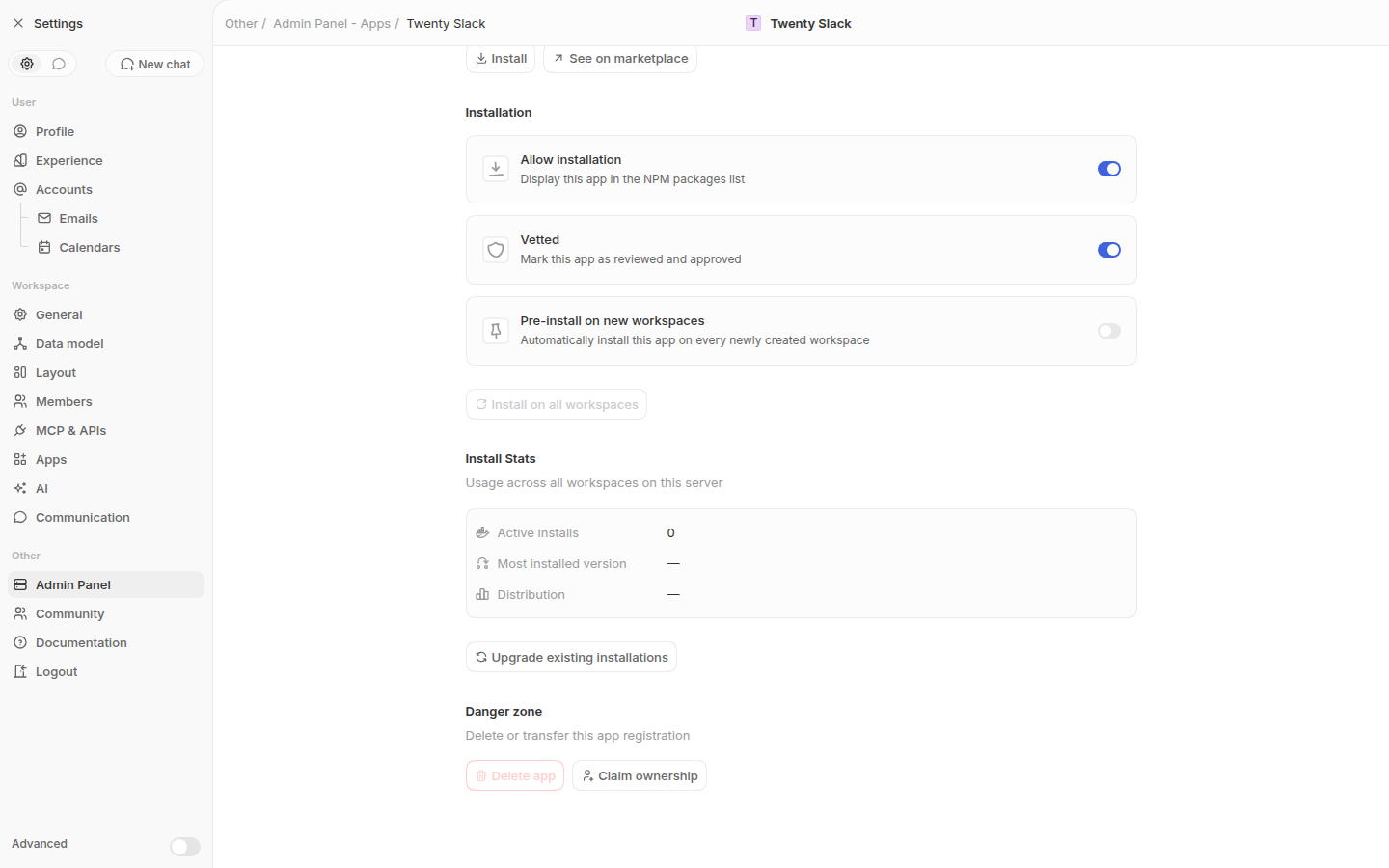 Confirmation modal with the new batch size input (defaults to 5): 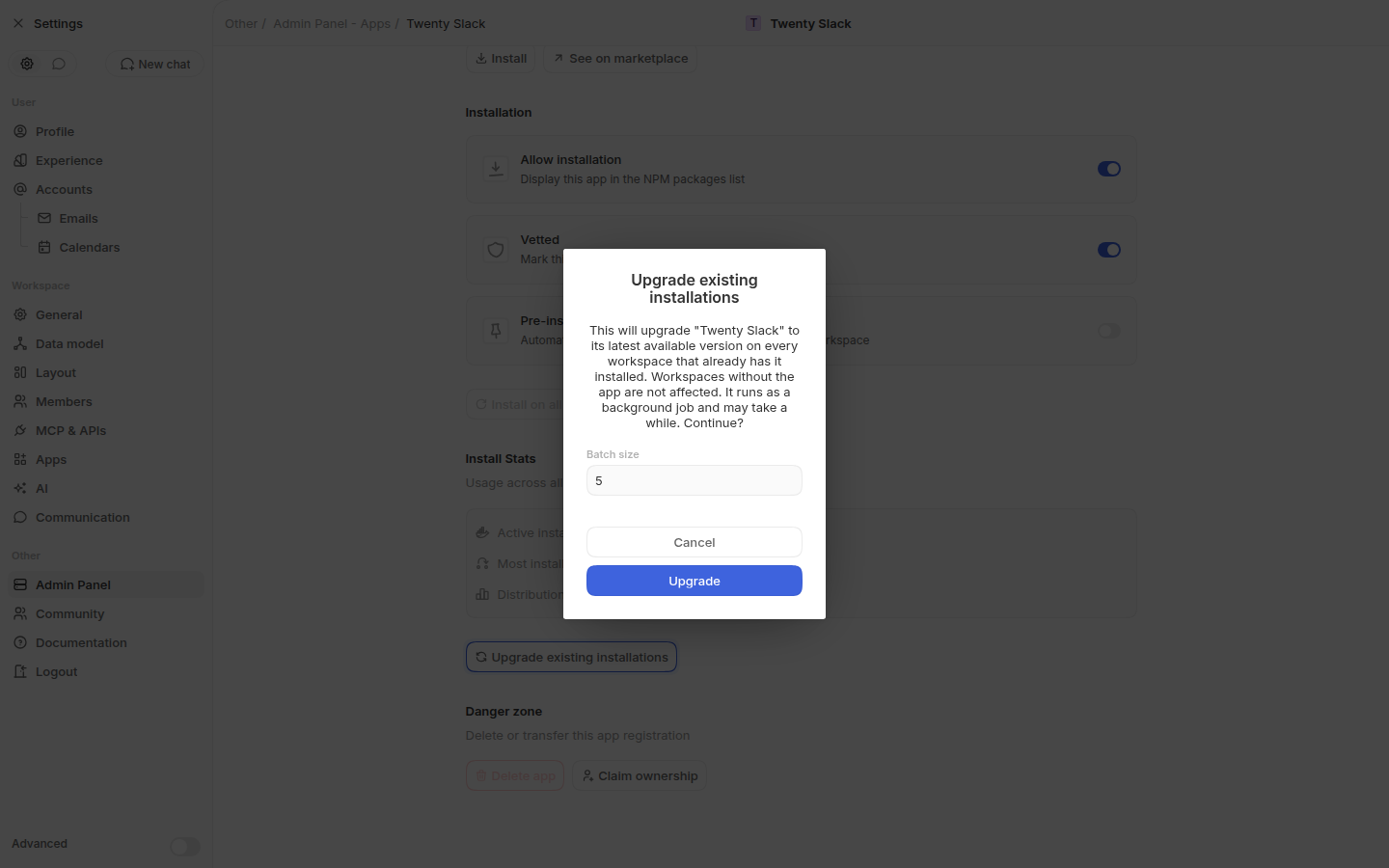 --------- Co-authored-by: Martin <martin@twenty.com> |
||
|
martmull
|
8d84a0b9f3 |
feat(app): allow non-admin developers to claim and list marketplace apps (#22621)
## Context Follow-up to #22609. Lets a non-admin developer claim ownership of a public Twenty app they published to npm, then request a marketplace listing that a server admin reviews. Marketplace state is per-instance for now. ## Claiming - Developer tab gets a **Claim an application** section: look up an unclaimed npm app by package name or universal identifier. - Ownership is proven with GitHub OAuth against the package's npm provenance (trusted publishing): the connected account must own the GitHub account or organization the package was published from. - Errors from the GitHub callback come back as a code and are shown inline with a link to the relevant documentation. - The old one-click claim stays admin-only. - A **Sync catalog** button triggers a catalog refresh instead of waiting for the hourly cron. - Gated behind the `IS_APP_CLAIMING_ENABLED` feature flag. ## Listing requests - Catalog-synced apps are created **unlisted**; a data migration unlists previously auto-listed unclaimed npm apps (owned or vetted rows are left untouched). - Owners request a listing from the Distribution tab (logo + description required); a server admin approves or rejects it from a **Listing requests** section in the Admin Panel. ## Screenshots <img width="1512" height="829" alt="image" src="https://github.com/user-attachments/assets/788d4362-97c4-4e42-810c-ef1f11517bec"/> <img width="1512" height="829" alt="image" src="https://github.com/user-attachments/assets/d6246190-c82a-4f64-87be-3bb668527645"/> <img width="1512" height="828" alt="image" src="https://github.com/user-attachments/assets/21a8dad4-610b-4d1f-8948-b9acab40d373"/> <img width="1512" height="829" alt="image" src="https://github.com/user-attachments/assets/58246130-41f7-451e-ae7f-57bd21d04bb6"/> --------- Co-authored-by: cubic-dev-ai[bot] <191113872+cubic-dev-ai[bot]@users.noreply.github.com> |
||
|
martmull
|
baa84bb2e0 |
Add auto-upgrade-in-apps (#23001)
We need to auto upgrade application, lets add this column in application entity, and add an admin button to autoupgrade all applications to latest app registrration version manually <img width="1131" height="372" alt="image" src="https://github.com/user-attachments/assets/4e755abc-38ad-4895-a2e8-d55ee1948ac2" /> <img width="906" height="533" alt="image" src="https://github.com/user-attachments/assets/ce002057-0341-4581-bf9a-66ac2bd84a9b" /> |
||
|
Charles Bochet
|
8e03921372 |
Add CREATED workspace activation status (read path + enum migration) (#22904)
## Context Since v2 onboarding (#22303), workspaces are activated **before** the billing plan step (now the last onboarding step). Users abandoning at the plan step leave ACTIVE workspaces with a Stripe customer but no subscription (~60–110/day on cloud, 935+ so far), and no cleanup mechanism ever touches them: billing webhooks never fire (no subscription), the suspended-workspaces cron only handles SUSPENDED, the onboarding cron only handles PENDING_CREATION/ONGOING_CREATION. Target lifecycle (across two PRs): `PENDING_CREATION → ONGOING_CREATION → CREATED → ACTIVE → SUSPENDED → deleted`. **`CREATED`** = the workspace schema is provisioned but onboarding is not complete — no billing subscription yet. It is **not** considered active: | Concern | CREATED behavior | |---|---| | Sign-in / invited teammates joining | allowed (invite-team step precedes the plan step) | | Member + metadata loading (app shell) | allowed (user must finish onboarding) | | Permissions | real permission checks (no PENDING-style bypass) | | Version upgrades / workspace migrations | **included** (schema must not drift) | | Messaging/calendar/workflow/etc. crons | **excluded** — no background processing until a plan is chosen | | PLAN_REQUIRED onboarding lock | unchanged (still derived from subscription existence) | ## What this PR does (read path only) The enum addition ships as a **slow** instance command, which can run after deploy — so nothing in this PR ever **writes** `CREATED`. The write path (setting it at activation, the cleanup sweep, the backfill of the existing zombie cohort) is a follow-up PR that ships once this migration has run everywhere. - **twenty-shared**: `CREATED` enum value; `PROVISIONED_WORKSPACE_ACTIVATION_STATUSES` + `isWorkspaceProvisioned` ("schema exists": CREATED | ACTIVE | SUSPENDED), replacing `isWorkspaceActiveOrSuspended` — all call sites (server member loading, access-token workspace-member lookup, front metadata-store gates) meant "has schema/members". - **Slow instance command** (2.22.0): swaps `core.workspace_activationStatus_enum` using the rename→recreate→alter-column idiom. The CHECK constraints on `core.workspace` embed casts to the enum type and would break the swap — the command captures them from `pg_constraint`, drops them, swaps the type, and restores them. - **Pre-migration-safe queries**: Postgres rejects `IN ('CREATED', ...)` when the enum value does not exist yet — even for reads, and the instance-command runner itself queries provisioned workspaces before migrating (a fresh database could never initialize). All provisioned-status filters go through a new `activationStatusIn` util comparing on `"activationStatus"::text`, valid before and after the migration. - **Upgrade path**: workspace iterator, command runner, upgrade-status and workspace-version services iterate CREATED workspaces. Since they now cover more than ACTIVE/SUSPENDED, the stale names were renamed to `ProvisionedWorkspaceCommandRunner`, `hasProvisionedWorkspaces`, `getProvisionedWorkspaceIds`, `loadProvisionedWorkspaces` (the mechanical import rename in old version-command dirs is why this PR carries the `ci:allow-previous-version-upgrade-mutation` label). - **Sign-in**: `throwIfWorkspaceIsNotReadyForSignInUp` accepts CREATED so invited members can join during onboarding (join authorization itself is unchanged — enforced upstream in `checkAccessForSignIn`); `activateWorkspace` idempotent-retry accepts CREATED as a terminal state. - **Transitions out of CREATED** (only write ACTIVE — safe to ship now, dead until the write path lands): the Stripe webhook reactivation branch also promotes CREATED, and `syncSubscriptionToDatabase` promotes synchronously; both gated on `WORKSPACE_ACTIVATING_SUBSCRIPTION_STATUSES` (Active/Trialing — extracted from `shouldReactivateWorkspace`, behavior-preserving) so an `incomplete` subscription created by the payment-intent flow before payment never promotes the workspace. - Deliberately untouched: all background crons, permission guards, JWT strategy, PLAN_REQUIRED logic, admin panel (renders the raw status string). ## Follow-up PR (after this migration has run) 1. `activateWorkspace` sets `hasWorkspaceAnySubscription ? ACTIVE : CREATED` (billing disabled → always ACTIVE, self-hosted unchanged). 2. Cleanup: suspend CREATED workspaces older than N days (config var), handing them to the existing suspended pipeline (warn → soft-delete → destroy). 3. Backfill: cloud-only slow command moving ACTIVE workspaces with no billingSubscription row (created since Jul 1) to CREATED. ## Verification - Migration exercised against a real database via the command class: up → down → up; `enum_range` and `pg_get_constraintdef` checked after each step (constraints restored against the new type, `DEFAULT 'INACTIVE'` preserved). - Pre-migration safety exercised for real: with the migration rolled back (enum without CREATED), `run-instance-commands` — the exact fresh-database CI path that failed before the `::text` fix — completes cleanly. - End-to-end with a workspace manually set to CREATED and the branch server+front running: sign-in issues tokens, `currentUser` loads workspaceMember(s), the full app loads with no console errors; GraphQL returns `activationStatus: CREATED`. - Workspace creation ran end-to-end locally in **both billing modes** on this branch: - billing disabled: signup → workspace creation → ACTIVE immediately → onboarding completes with no plan step → app loads (unchanged behavior); - billing enabled (Stripe test mode): signup creates the Stripe customer eagerly → activation ends ACTIVE → subscription-less workspace is pinned to the plan-required page → no-card trial checkout creates a `trialing` subscription via `createDirectSubscription`/`syncSubscriptionToDatabase` → app loads. - `twenty-shared` unit tests, server specs on touched services, `lint:diff-with-main` and `typecheck` for shared/server/front all green; full CI green. |
||
|
Weiko
|
25bd2897a3 |
Add weekly layout to record calendar (#22819)
## Summary - Add a week layout to record calendar views and persist the selected layout. - Render `DATE` calendars as an all-day week and `DATE_TIME` calendars as an hourly week. - Add an optional end date field across calendar configuration, metadata, persistence, and complete-view upserts. - Use configured end values for ranged and multi-day events, with a one-hour fallback when a `DATE_TIME` end is absent or invalid. - Keep calendar cards consistent with the existing compact view, including checkbox selection and whole-card record opening. - Gate the weekly layout and end-date behavior behind the public Labs `IS_CALENDAR_WEEK_VIEW_ENABLED` workspace feature flag. ## Week interactions - Show overlapping timed events side by side and cap the visible records at two per day. - Display start and end times on timed cards, enforce a readable 30-minute minimum height, and keep today’s text contrast stronger. - Drag timed events between days and times with 30-minute snapping while preserving their duration, including zero-duration events. - Show a create button when hovering a 30-minute slot; keyboard users can focus a day, move the slot with the arrow keys, and reach the same contextual action. - Initialize new records with the selected slot time and a compatible writable end value one hour later. - Show the workspace time zone and current-time indicator in timed weeks; date-only weeks keep the all-day section without an hourly grid. ## Configuration and data loading - Only allow end fields that match the start field type, and prevent selecting the same field for both boundaries. - Load records whose ranges overlap the visible period so month and week layouts display the same relevant records. - Resolve and persist calendar end fields when updating existing views through `upsert_complete_view`. - Fall back to Month and ignore the configured end field while the flag is disabled, without overwriting either persisted setting, so re-enabling restores the previous configuration. - Expose the flag in Labs and keep it default-off for workspaces without a stored value; enable it in the development seeder. <img width="1285" height="808" alt="Screenshot 2026-07-15 at 15 50 17" src="https://github.com/user-attachments/assets/b7e3f7f1-ca77-492f-8cce-cca186ebca0b" /> |
||
|
martmull
|
94192a2164 |
Resolve application registration logo and gallery image urls at query time (#22827)
## Context

Application registration logo and gallery image urls were baked into the
stored manifest and display columns at write time, with each source flow
doing it differently: npm catalog sync baked CDN urls, local dev sync
baked `public-assets` urls, and tarball uploads left raw manifest paths
that never displayed in the UI. The entity also carried a `logoUrl`
getter computed field.

This moves url generation to query time, the same way the workspace logo
works.

## What changed

**Read side**
- `ApplicationRegistrationAssetUrlService` builds display urls when
queried: stored files are served by fileId, absolute urls pass through
untouched, and not-yet-rehosted npm assets fall back to the registry CDN
from `sourcePackage@latestAvailableVersion`.
- The `logoUrl` getter on `ApplicationRegistrationEntity` is replaced by
`logoUrl` and `galleryImages` `@ResolveField`s on the metadata resolver,
the admin panel resolver, and a new resolver for
`ApplicationRegistrationSummary` (used by
`Application.applicationRegistration`).
- The marketplace detail/card DTOs and the public OAuth authorize DTO
(`findApplicationRegistrationByClientId`) go through the same url
builder.
- New public route `GET /file/application-registration/:id` streams
registration server files (these are instance-global marketplace assets,
also shown on the public OAuth authorize page).
`ServerFileStorageService.readServerFileById` now returns the mime type
alongside the stream.

**Write side**
- New `logoFileId` column on `applicationRegistration` (2.21 fast
instance command, constraint names match TypeORM naming), complementing
the fileIds already stored in the `galleryImages` jsonb.
- `ApplicationRegistrationAssetService` copies the manifest logo and
gallery images into instance-global server file storage, so all three
sources behave the same:
- **TARBALL**: from the uploaded package (previously only gallery images
were stored, never the logo).
- **LOCAL**: dev sync reads the already-uploaded public assets from
workspace storage (the CLI uploads files before syncing).
- **NPM**: catalog sync downloads the assets from the registry CDN.
Downloads are skipped when the package version is unchanged and the
files are already stored; failed or pending downloads fall back to CDN
urls at query time.
- Write-time url rewriting is removed
(`ManifestAssetUrlResolverService`, `resolveManifestAssetUrls`);
manifests now keep raw asset paths. Existing rows with baked absolute
urls keep working through the absolute-url passthrough, so no backfill
is needed.
- `updateFromManifest` and `upsertFromCatalog` preserve stored gallery
fileIds for unchanged paths, so installs and the hourly catalog sync no
longer clobber them.

## How it was verified

Against a local Postgres/Redis with the server running:
- Fresh database init runs the new instance command; column and FK/UQ
constraint names match TypeORM's generated names, and the CI
pending-migration check produces no diff.
- `findManyApplicationRegistrations { logoUrl galleryImages }` returns
fileId-served urls for a TARBALL registration (absolute urls passed
through), and null/[] for a LOCAL registration without assets.
- Ran `marketplace:catalog-sync` against the real npm registry: 14
packages synced, logos and gallery images rehosted from unpkg with
fileIds set; a second run re-downloaded nothing (version-unchanged
skip); `findMarketplaceAppDetail` for `twenty-linear` returns
fileId-served urls for the logo and all four gallery images.
- `GET /file/application-registration/:id` serves stored files with the
right content type (png and svg verified), 404s on unknown ids, and the
token-guarded generic `/file/:folder/:id` route still returns 403
without a token.
- Unit tests for the url builder and the assets-stored check; server
unit test suites for the application module pass; typecheck and lint
clean.
|
||
|
martmull
|
7381038452 |
Paginate admin panel app registrations list (#22734)
## Context The `findAllApplicationRegistrations` query on the admin panel Apps page (`/settings/admin-panel#apps`) loaded every application registration at once, with search and filtering done client-side. ## Changes **Server** - `findAllApplicationRegistrations` now takes `limit` / `offset` / `searchTerm` / `isPreInstalledOnly` args and returns a `PaginatedApplicationRegistrations` object (`registrations`, `totalCount`, `hasMore`), following the same pattern as `getQueueJobs`. - `ApplicationRegistrationService.findAll` uses `findAndCount` with `take`/`skip`, and moves the search (name, source package, universal identifier via `ILIKE`) and the pre-installed filter into the SQL query, mirroring how `getInstalledWorkspacesGlobal` filters installed workspaces. **Frontend** - `SettingsAdminApps` passes the page, the debounced search term (300ms, like the installed workspaces table), and the pre-installed toggle as query variables instead of filtering client-side. - Adds a Previous / Next pagination footer (25 per page) matching the queue jobs table, shown only when there is more than one page. - The "unconfigured first" ordering is kept within each page (`isConfigured` is a dataloader-resolved field, so it can't be sorted in SQL). ## Notes - Regenerated `generated-admin/graphql.ts` follows in a subsequent commit. --- _Generated by [Claude Code](https://claude.ai/code/session_015erumgPozkbNA3zPeKrrFW)_ <!-- This is an auto-generated description by cubic. --> <a href="https://cubic.dev/pr/twentyhq/twenty/pull/22734?utm_source=github" target="_blank" rel="noopener noreferrer" data-no-image-dialog="true"><picture><source media="(prefers-color-scheme: dark)" srcset="https://www.cubic.dev/buttons/review-in-cubic-dark.svg"><source media="(prefers-color-scheme: light)" srcset="https://www.cubic.dev/buttons/review-in-cubic-light.svg"><img alt="Review in cubic" src="https://www.cubic.dev/buttons/review-in-cubic-dark.svg"></picture></a> <!-- End of auto-generated description by cubic. --> --------- Co-authored-by: Weiko <corentin@twenty.com> |
||
|
neo773
|
3a5545c753 |
chore: remove IS_MESSAGING_CALENDAR_WEBHOOK_ENABLED flag (#22680)
Messaging/calendar webhook subscriptions are now always on; drop the feature flag gate and its enum/public-flag registration. <!-- This is an auto-generated description by cubic. --> <a href="https://cubic.dev/pr/twentyhq/twenty/pull/22680?utm_source=github" target="_blank" rel="noopener noreferrer" data-no-image-dialog="true"><picture><source media="(prefers-color-scheme: dark)" srcset="https://www.cubic.dev/buttons/review-in-cubic-dark.svg"><source media="(prefers-color-scheme: light)" srcset="https://www.cubic.dev/buttons/review-in-cubic-light.svg"><img alt="Review in cubic" src="https://www.cubic.dev/buttons/review-in-cubic-dark.svg"></picture></a> <!-- End of auto-generated description by cubic. --> |
||
|
martmull
|
0ea0c23556 |
refactor(app-marketplace): rename featured to vetted (#22674)
## What Renames the application-registration "featured" flag to "vetted" across the backend, frontend, GraphQL schema/DTOs, and the marketplace UI. "Vetted" better describes what the flag actually does today: it marks an app as reviewed and approved by the Twenty team (a trust signal), rather than "featured" which reads as spotlighting/promotion. The admin toggle description was already "Mark this app as reviewed and approved". ## How - Renamed `isFeatured` -> `isVetted` on the `ApplicationRegistration` entity, DTOs (`MarketplaceApp`, `MarketplaceAppDetail`, `UpdateApplicationRegistrationPayload`), services, GraphQL fragments, and the settings/admin UI (labels: "Featured" -> "Vetted", "Featured only" -> "Vetted only", etc.). - Renamed the `MARKETPLACE_FEATURED_APPLICATIONS` constant/file to `MARKETPLACE_VETTED_APPLICATIONS`. - Regenerated GraphQL client artifacts (`generated-metadata`, `generated-admin`, `twenty-client-sdk`). ### Database The `isFeatured` column is renamed in place to `isVetted` via a single 2.20 fast instance command (`ALTER TABLE ... RENAME COLUMN`). No new column, no data-copy backfill. - Since all 2.19 commands (including the existing `isFeatured` backfill) complete before any 2.20 command runs, the rename carries over the values that backfill set. - The entity uses `@WasRenamedInUpgrade` so the upgrade-aware layer queries the old column name until the rename step runs during an upgrade. ## Testing - `nx typecheck` and `nx lint:diff-with-main` pass for twenty-server and twenty-front. - Ran `database:reset` on a fresh dev DB: the 2.19 `isFeatured` backfill runs first, then the 2.20 rename; the column ends up as `isVetted` (and `isFeatured` no longer exists), values preserved. - Booted the server: the `@WasRenamedInUpgrade` decorator validates against the upgrade sequence, and GraphQL introspection confirms all four types expose `isVetted` and none expose `isFeatured`. - Ran the three `graphql:generate` configs and the SDK metadata client generator so the committed generated files match the generator output (field ordering included). ## Notes - The `api-breaking-changes` check flags the removal of the `isFeatured` GraphQL field — that is expected and inherent to this rename. - Translation catalogs (`locales/`) are intentionally not touched here since they are managed via Crowdin; new English strings render via Lingui's default-message fallback until translated. |
||
|
Thomas Trompette
|
48730df0d2 |
feat(workflow): scaffold core workflowVersion entity + trigger cache (phase 0) (#21674)
## What **Phase 0 (scaffold)** of migrating `workflowVersion` data to **core**. Gated by `IS_WORKFLOW_VERSION_IN_CORE_ENABLED` with **no behavior change** — nothing reads or writes the new core entity yet. ## Plan `workflowVersion` becomes a thin **workspace shell** over a core entity (the `dashboard`/`pageLayout` pattern), so navigation, the metadata relations, and the record UI keep working while the heavy data (`triggers`, `steps`) lives in core. Trigger dispatch will derive from active core versions via a per-workspace cache, letting us **eliminate** the denormalized `workflowAutomatedTrigger` object. `workflow` and `workflowRun` stay as workspace objects. Phases: **0 — scaffold (this PR)** → A — backfill + dual-write → B — switch reads to core → C — drop the workspace `trigger`/`steps` columns + the `workflowAutomatedTrigger` object. ## Included - **Core `WorkflowVersionEntity`** (`extends WorkspaceRelatedEntity`) — stores version data, with triggers as an **array** (`triggers: WorkflowTrigger[]`), a long-due shape change. Storage only: dispatch reads the primary trigger, so behavior stays single-trigger for now. - **Fast create-table instance command** for `core."workflowVersion"` (v2.19.0). - **`IS_WORKFLOW_VERSION_IN_CORE_ENABLED`** feature flag. - **Per-workspace automated-trigger cache provider** deriving CRON/DATABASE_EVENT dispatch from the active version's trigger — groundwork for removing `workflowAutomatedTrigger`. ## Notes - `WorkspaceRelatedEntity`, **not** `SyncableEntity`: this is user runtime data (like `connectedAccount`/`apiKey`/`file`), not application-manifest metadata. - No frontend behavior; the generated `FeatureFlagKey` enums are updated to include the new flag. |
||
|
martmull
|
435073e9c5 |
Display featured applications in marketplace (#22635)
## After <img width="1060" height="589" alt="image" src="https://github.com/user-attachments/assets/74dfadcf-8698-4404-81c6-b309cc4cbf79" /> <img width="732" alt="image" src="https://github.com/user-attachments/assets/0e1a3644-04bc-4208-aa77-3842d9db9cc8" /> <img width="797" alt="image" src="https://github.com/user-attachments/assets/0456ecce-607a-4705-8a89-c77029bfb6ac" /> - Remove IS_MARKETPLACE_SETTING_TAB_VISIBLE feature flag - add vetted toggle in admin app tab - added people data labs, last contact and call recorder to default vetted applications <!-- This is an auto-generated description by cubic. --> <a href="https://cubic.dev/pr/twentyhq/twenty/pull/22635?utm_source=github" target="_blank" rel="noopener noreferrer" data-no-image-dialog="true"><picture><source media="(prefers-color-scheme: dark)" srcset="https://www.cubic.dev/buttons/review-in-cubic-dark.svg"><source media="(prefers-color-scheme: light)" srcset="https://www.cubic.dev/buttons/review-in-cubic-light.svg"><img alt="Review in cubic" src="https://www.cubic.dev/buttons/review-in-cubic-dark.svg"></picture></a> <!-- End of auto-generated description by cubic. --> --------- Co-authored-by: prastoin <paul@twenty.com> |
||
|
martmull
|
25fe66565c |
feat(applications): add type and options to application variables (#22157)
## Before <img width="1452" height="709" alt="image" src="https://github.com/user-attachments/assets/cd384ffa-cbe6-49d5-a807-ca8d580f55a9" /> <img width="1074" height="452" alt="image" src="https://github.com/user-attachments/assets/720d38db-3495-4032-8831-17d24ec6a7e7" /> ## After <img width="1421" height="865" alt="image" src="https://github.com/user-attachments/assets/2275c996-c895-4800-8324-2aa2ddfddd43" /> <img width="1348" height="870" alt="image" src="https://github.com/user-attachments/assets/3e1a891d-6db0-4cbd-870a-2a5bbde4929d" /> ## Summary Adds typed application variables with optional select **options**. This is the other half of #22059, split out from the custom-settings-tab removal. ## Changes - **Shared types**: `ApplicationVariable` / `ServerVariables` gain an optional `type` (a `FieldMetadataType` subset — `TEXT`, `BOOLEAN`, `NUMBER`, `DATE`, `SELECT`, `MULTI_SELECT`, `RAW_JSON`, `RICH_TEXT`, `ARRAY`, …) and select `options`. New `serializeApplicationVariableValue` / `deserializeApplicationVariableValue` helpers convert typed values to/from the encrypted string storage. - **Server**: `type`/`options` columns on `applicationVariable` and `applicationRegistrationVariable` (entities + DTOs), a fast `2-17` instance command, manifest processing via the serialization helpers, and a `QueryDeepPartialEntity` cast where the manifest JSON column is persisted. - **Frontend**: a polymorphic `SettingsApplicationVariableInput` that renders the native `Form*` field component for each type (boolean, number, date/date-time, select, multi-select, array, raw JSON, rich text, text); fragment/query updates to fetch `type`/`options`. - **SDK**: `defineApplication` validates that `SELECT`/`MULTI_SELECT` variables declare non-empty `options` at build time (since `options` is kept structurally optional for TypeORM/SDK compatibility). Variables default to `TEXT` when no type is given, so existing manifests are unaffected. ## Notes The generated GraphQL artifacts (`type`/`options` on the variable types) are regenerated by codegen; that change accompanies this PR. https://claude.ai/code/session_013Z7UB35V2mvUozh55QHG23 --- _Generated by [Claude Code](https://claude.ai/code/session_013Z7UB35V2mvUozh55QHG23)_ <!-- This is an auto-generated description by cubic. --> <a href="https://cubic.dev/pr/twentyhq/twenty/pull/22157?utm_source=github" target="_blank" rel="noopener noreferrer" data-no-image-dialog="true"><picture><source media="(prefers-color-scheme: dark)" srcset="https://www.cubic.dev/buttons/review-in-cubic-dark.svg"><source media="(prefers-color-scheme: light)" srcset="https://www.cubic.dev/buttons/review-in-cubic-light.svg"><img alt="Review in cubic" src="https://www.cubic.dev/buttons/review-in-cubic-dark.svg"></picture></a> <!-- End of auto-generated description by cubic. --> |
||
|
martmull
|
27dea0ed0b |
Add installed workspaces view to application registration (#22359)
## After <img width="895" height="344" alt="image" src="https://github.com/user-attachments/assets/33591753-f248-45ce-b32d-cc1112f50579" /> <img width="889" height="425" alt="image" src="https://github.com/user-attachments/assets/469ee228-9abb-486f-b2ec-9efb490bb2c8" /> <img width="766" height="343" alt="image" src="https://github.com/user-attachments/assets/2d88444a-6d98-4f97-8e5d-109197cfad27" /> ## Summary Add a new "Installed workspaces" section to the application registration settings page that displays all workspaces that have installed a given application, with pagination support. ## Key Changes - **Backend Service**: Added `getInstalledWorkspaces()` method to `ApplicationRegistrationService` that queries installed applications across workspaces with pagination support - **Backend DTO**: Created `ApplicationRegistrationInstalledWorkspacesDTO` and `InstalledWorkspaceDTO` to structure the response with workspace details (id, displayName, logo, version), total count, and hasMore flag - **GraphQL Resolver**: Added `findApplicationRegistrationInstalledWorkspaces` query resolver with pagination (page parameter, default page size of 10) and proper authorization guards - **Frontend Component**: Created `SettingsApplicationRegistrationInstalledWorkspaces` component that: - Displays installed workspaces in a table with workspace logo, name, and version - Shows initial 3 workspaces with "Show all" button to expand - Implements pagination with "Show more" button to load additional pages - Handles empty state (returns null if no workspaces installed) - **GraphQL Query**: Added `FindApplicationRegistrationInstalledWorkspaces` query document for frontend data fetching - **Integration**: Integrated the new component into `SettingsApplicationRegistrationGeneralTab` ## Implementation Details - Pagination uses offset-based approach with configurable page size (10 workspaces per page) - Query results are ordered by workspace displayName and id for consistent ordering - Soft-deleted applications and workspaces are excluded from the list and counts - Apollo Client's `fetchMore` with `updateQuery` merges paginated results into the cache - Component respects existing authorization (API_KEYS_AND_WEBHOOKS permission required) - Uses existing UI components (Table, Card, Avatar, Button) from twenty-ui library - Supports internationalization with Lingui ## Screenshots The new "Installed workspaces" section on the app registration General tab (admin app detail page), captured against a local instance with a demo app installed in 14 workspaces. The three PNGs are committed under `.github/assets/screenshots/installed-workspaces/` and render inline in the **Files changed** tab of this PR: - `1-first-3-show-all.png` — Collapsed: the first 3 installed workspaces (avatar + name + installed version) with a "Show all" button. - `2-expanded-show-more.png` — "Show all": the first page of 10 workspaces, with a "Show more" button (more remain). - `3-all-paginated.png` — "Show more": all 14 workspaces loaded, button gone. Review in cubic: https://cubic.dev/pr/twentyhq/twenty/pull/22359?utm_source=github https://claude.ai/code/session_012nWtviSBdfFeHEASTtwvJ7 |
||
|
martmull
|
d1854bc7e9 |
Add marketplace catalog synchronization to admin panel (#22260)
## After <img width="1476" height="658" alt="image" src="https://github.com/user-attachments/assets/25a042dd-eabf-4b71-9872-d3b627104634" /> ## Summary This PR adds the ability for admins to manually synchronize the marketplace application catalog from the admin panel. It introduces a new mutation endpoint and UI controls to trigger catalog synchronization with user feedback via snackbar notifications. ## Key Changes - **Frontend (SettingsAdminApps component)**: - Added `useSnackBar` hook for user feedback on sync success/failure - Imported `useMutation` from Apollo Client to handle the sync operation - Added `IconRefresh` and `Button` imports for the sync UI control - Created `handleSyncCatalog` function that triggers the mutation, refetches app registrations, and displays appropriate snackbar messages - Added a new "General" section with a "Synchronize catalog" button above the existing app registrations table - Button shows loading state and is disabled while sync is in progress - **Backend (AdminPanelResolver)**: - Added `syncMarketplaceCatalog` mutation that queues a `MarketplaceCatalogSyncCronJob` via the message queue - Uses `@InjectMessageQueue` decorator to inject the cron queue service - Includes job deduplication via `id: 'marketplace-catalog-sync'` to prevent multiple pending sync jobs - Protected with `@UseGuards(AdminPanelGuard)` for admin-only access - **GraphQL Schema**: - Added `SyncMarketplaceCatalog` mutation type definition - Generated corresponding TypeScript types and mutation document - **New Files**: - Created `syncMarketplaceCatalog.ts` GraphQL mutation document <!-- This is an auto-generated description by cubic. --> <a href="https://cubic.dev/pr/twentyhq/twenty/pull/22260?utm_source=github" target="_blank" rel="noopener noreferrer" data-no-image-dialog="true"><picture><source media="(prefers-color-scheme: dark)" srcset="https://www.cubic.dev/buttons/review-in-cubic-dark.svg"><source media="(prefers-color-scheme: light)" srcset="https://www.cubic.dev/buttons/review-in-cubic-light.svg"><img alt="Review in cubic" src="https://www.cubic.dev/buttons/review-in-cubic-dark.svg"></picture></a> <!-- End of auto-generated description by cubic. --> |
||
|
martmull
|
e747bc3e42 |
Add backfill installation feature for pre-installed apps (#22199)
## After <img width="1070" height="514" alt="image" src="https://github.com/user-attachments/assets/9cbd2ff5-1678-4c2f-84da-074568f37c51" /> ## Summary Adds the ability to backfill application installations across all existing workspaces. This allows admins to retroactively install a pre-registered application on every active and suspended workspace through a background job, making the feature idempotent and non-blocking. ## Key Changes - **Backend Service**: Added `backfillApplicationOnAllWorkspaces()` method to `PreInstalledAppsService` that: - Validates the application registration exists - Iterates through all workspaces using `WorkspaceIteratorService` - Installs the app on each workspace - Swallows `APP_ALREADY_INSTALLED` errors for idempotency - Logs success/failure counts - **Background Job**: Created `BackfillApplicationInstallationJob` to process backfill requests asynchronously via the message queue - **GraphQL Mutation**: Added `backfillApplicationInstallation` mutation to `AdminPanelResolver` that: - Validates the application registration exists - Enqueues the background job - Returns immediately without blocking the request - **UI Components**: Enhanced `SettingsAdminApplicationRegistrationGeneralToggles` with: - New "Pre-install on new workspaces" toggle for the `isPreInstalled` flag - "Backfill on all workspaces" button with confirmation modal - Loading state and success/error snack bar feedback - **Data Model**: Added `isPreInstalled` field to `UpdateApplicationRegistrationPayload` input type - **Tests**: Added comprehensive unit tests for `PreInstalledAppsService.backfillApplicationOnAllWorkspaces()` covering: - Missing registration validation - Successful multi-workspace installation - Idempotent handling of already-installed errors - Proper error propagation for unexpected failures ## Implementation Details The backfill operation is designed to be: - **Idempotent**: Already-installed apps are skipped without error - **Non-blocking**: Runs as a background job via message queue - **Resilient**: Per-workspace failures don't block other installations - **Observable**: Logs aggregated success/failure counts for monitoring <!-- This is an auto-generated description by cubic. --> <a href="https://cubic.dev/pr/twentyhq/twenty/pull/22199?utm_source=github" target="_blank" rel="noopener noreferrer" data-no-image-dialog="true"><picture><source media="(prefers-color-scheme: dark)" srcset="https://www.cubic.dev/buttons/review-in-cubic-dark.svg"><source media="(prefers-color-scheme: light)" srcset="https://www.cubic.dev/buttons/review-in-cubic-light.svg"><img alt="Review in cubic" src="https://www.cubic.dev/buttons/review-in-cubic-dark.svg"></picture></a> <!-- End of auto-generated description by cubic. --> --------- Co-authored-by: cubic-dev-ai[bot] <191113872+cubic-dev-ai[bot]@users.noreply.github.com> |
||
|
nitin
|
f86bf637d1 |
[BREAKING CHANGE] remove call recording feature flag and backfill upgrade command for existing command menu items navigation command (#22176)
<!-- This is an auto-generated description by cubic. --> <a href="https://cubic.dev/pr/twentyhq/twenty/pull/22176?utm_source=github" target="_blank" rel="noopener noreferrer" data-no-image-dialog="true"><picture><source media="(prefers-color-scheme: dark)" srcset="https://www.cubic.dev/buttons/review-in-cubic-dark.svg"><source media="(prefers-color-scheme: light)" srcset="https://www.cubic.dev/buttons/review-in-cubic-light.svg"><img alt="Review in cubic" src="https://www.cubic.dev/buttons/review-in-cubic-dark.svg"></picture></a> <!-- End of auto-generated description by cubic. --> |
||
|
Félix Malfait
|
614bc7b7e6 |
feat: serve HTTP logic functions on isolated *.withtwenty.com domain (#22045)
## Summary Implements [core-team-issues#2473](https://github.com/twentyhq/core-team-issues/issues/2473): serve HTTP-triggered logic functions from a dedicated, **cookieless** public domain (`{workspaceSubdomain}.withtwenty.com`) instead of the same-site `/s/` route, so functions can safely return **arbitrary headers** — custom headers, `Permissions-Policy` (camera/mic/geolocation), `Cross-Origin-Opener-Policy: same-origin`, `Cross-Origin-Embedder-Policy: require-corp`, `Set-Cookie`, etc. The `/s/` route stays the strict, same-site path it is today. **Self-hosting is unchanged** — everything new is gated on `PUBLIC_DOMAIN_URL` being set. ### Why Today user-authored function responses are served same-site with the Twenty app, so the response-header allow-list is restricted to 5 safe headers and request headers are limited to a per-function allow-list. Serving from an origin that shares nothing with `*.twenty.com` removes that constraint safely — the same "user content domain" pattern as GitHub (`*.githubusercontent.com`) and CodeSandbox (`*.csb.app`). ## What's in here **Routing** - The **root-path → `/s` rewrite happens at the nginx ingress**, not in app code. The existing `api-ingress.yaml` already rewrites root paths onto `/s` (host-agnostically) when the edge sets `X-Twenty-Public-Domain: true`, so `*.withtwenty.com` and registered custom public domains are handled by the same mechanism. (An earlier in-app middleware was removed as a redundant, wrong-layer duplicate.) - `WorkspaceDomainsService.resolveWorkspaceAndPublicDomain` recognizes `*.` subdomains, resolves the workspace by subdomain, and returns `isIsolatedOrigin`. Explicitly registered public-domain rows still take precedence and keep their application scoping. The ingress preserves the `Host` header, so this resolution still fires. **Headers (server)** - Isolated origin → all response headers pass through and all request headers are forwarded. Same-site `/s/` keeps the strict allow-lists. (Global CORS already handles preflight/ACAO.) **`/s/` deprecation for new routes (cloud only)** - New `LOGIC_FUNCTION_LEGACY_ROUTE_CUTOFF` config var (ISO date, optional). When `PUBLIC_DOMAIN_URL` is set, functions created on/after the cutoff return **410 Gone** on `/s/` with the new URL. Existing routes and self-hosted instances are untouched. **Frontend education** - `publicFunctionDomain` added to `ClientConfig` (from `PUBLIC_DOMAIN_URL`). - The logic-function **Live URL** now resolves to `https://{workspaceSubdomain}.{publicFunctionDomain}{path}` on cloud, falling back to `/s/` for self-hosting. - Front components call their functions through the SDK (`RestApiClient`), which now targets the isolated domain via the injected `TWENTY_FUNCTIONS_URL`. - New **"Public URL"** section on the application **Settings** tab explaining the isolated domain (shown when the app exposes HTTP-triggered functions). **Docs**: note the `withtwenty.com` domain for external callers in the apps guide. ## Infra prerequisites (not code — needs dashboard work) - Wildcard DNS `*.withtwenty.com` (proxied) + wildcard TLS in the public-domain Cloudflare zone. - Edge (Cloudflare) sets `X-Twenty-Public-Domain: true` for `*.withtwenty.com` requests, so the existing nginx ingress rewrites them onto `/s` (same header the custom-domain flow already relies on). - Set `PUBLIC_DOMAIN_URL=https://withtwenty.com` on cloud. - Submit `withtwenty.com` to the **Public Suffix List** (required for cross-tenant cookie isolation before relying on `Set-Cookie`). ## Test plan - [x] `nx typecheck twenty-server`, `nx typecheck twenty-front` - [x] `lint:diff-with-main` + oxfmt clean (server + front) - [x] `npx jest route-trigger public-function-domain domain-server-config workspace-domains build-logic-function-event client-config` → server unit tests passing (resolution tiers, header passthrough vs allow-list, `/s/` cutoff 410) - [x] `npx jest getLogicFunctionHttpUrl` (front) and `nx test twenty-client-sdk` (RestApiClient routing) passing - [x] CI green (server, front, sdk, renderer, ui, zapier, example apps) - [ ] Manual: hit `{subdomain}.withtwenty.com/` end-to-end once infra is provisioned <a href="https://cubic.dev/pr/twentyhq/twenty/pull/22045?utm_source=github" rel="nofollow noreferrer noopener" target="_blank">``<img alt="Review in cubic" src="https://www.cubic.dev/buttons/review-in-cubic-dark.svg">``</a> |
||
|
neo773
|
9e31ffdf68 |
feat(messaging): webhook push sync for Gmail, Calendar and Microsoft (#21970)
<!-- This is an auto-generated description by cubic. --> <a href="https://cubic.dev/pr/twentyhq/twenty/pull/21970?utm_source=github" target="_blank" rel="noopener noreferrer" data-no-image-dialog="true"><picture><source media="(prefers-color-scheme: dark)" srcset="https://www.cubic.dev/buttons/review-in-cubic-dark.svg"><source media="(prefers-color-scheme: light)" srcset="https://www.cubic.dev/buttons/review-in-cubic-light.svg"><img alt="Review in cubic" src="https://www.cubic.dev/buttons/review-in-cubic-dark.svg"></picture></a> <!-- End of auto-generated description by cubic. --> |
||
|
Etienne
|
16a92f52a4 |
feat(admin-panel) - add billing/usage section (#21672)
Add billing/usage section <img width="740" height="763" alt="Screenshot 2026-06-16 at 14 39 51" src="https://github.com/user-attachments/assets/42db4fe4-3158-4ab8-aee5-28121ea530cd" /> <!-- This is an auto-generated description by cubic. --> <a href="https://cubic.dev/pr/twentyhq/twenty/pull/21672?utm_source=github" target="_blank" rel="noopener noreferrer" data-no-image-dialog="true"><picture><source media="(prefers-color-scheme: dark)" srcset="https://www.cubic.dev/buttons/review-in-cubic-dark.svg"><source media="(prefers-color-scheme: light)" srcset="https://www.cubic.dev/buttons/review-in-cubic-light.svg"><img alt="Review in cubic" src="https://www.cubic.dev/buttons/review-in-cubic-dark.svg"></picture></a> <!-- End of auto-generated description by cubic. --> |
||
|
Charles Bochet
|
217e1f5ab3 |
security: clear immutable High alert via @graphql-codegen typescript plugins v4 (#21380)
## What Clears the High `immutable` alert (GHSA-wf6x-7x77-mvgw) via a parent bump — **no resolution**. `immutable@3.7.6` was pulled by `@ardatan/relay-compiler@12.0.0` (→ `immutable ~3.7.6`), reached through `@graphql-tools/relay-operation-optimizer` inside the `@graphql-codegen` visitor plugins. The fix lives in `relay-operation-optimizer@7.1.4` → `relay-compiler@13.0.1` → `immutable@^5.1.5` — but the old codegen typescript plugins (v3) pinned a 6.x optimizer stuck on relay-compiler 12. **Fix chain:** - `@graphql-codegen/typescript` `^3.0.4` → `^4.1.6` - `@graphql-codegen/typescript-operations` `^3.0.4` → `^4.6.1` - refresh `@graphql-tools/relay-operation-optimizer` (within its existing `^7.0.0` range) → 7.1.4 → `relay-compiler@13.0.1` → `immutable@5.1.6` ## Heads-up: this is effectively a codegen v4 plugin upgrade The codegen typescript plugins v4 change the generated **scalar shape** (`Scalars['X']` → `Scalars['X']['input'|'output']`), so the committed `generated*/graphql.ts` are regenerated (~7.8k lines). The diff is **purely type-level** — no runtime/enum/document changes — and was regenerated against the current schema (verified: **no schema-content drift**). ## Verification - `immutable@3.7.6` gone (now 5.1.6); `relay-compiler@13.0.1` - `nx typecheck twenty-front` passes against the regenerated types (0 errors) - `yarn install --immutable` clean - Generated files regenerated against a clean origin/main schema (no drift markers) |
||
|
Félix Malfait
|
ce2d77be2a |
feat(server): in-app server-level admin management (#19785) (#21321)
## Closes #19785 In-app management of **server-level admin rights** (`canAccessFullAdminPanel`, `canImpersonate`) so self-hosters no longer need raw SQL + a Redis flush + restart to grant access. > **Draft** — feature complete; `/code-review` + `/security-review` run and addressed. ### Background `AdminPanelGuard` / `ServerLevelImpersonateGuard` read `request.user.{canAccessFullAdminPanel,canImpersonate}`, hydrated each request from `CoreEntityCacheService.get('user', …)` (local 30-min + Redis no-TTL). The cache was only invalidated on soft-delete, so a raw `UPDATE core."user"` never took effect. The **first** signup auto-gets both flags; every subsequent admin previously needed raw SQL. ### UX - **Admin Panel → General → Administrators**: a read-only overview of every user with server-level access; each row links to that user's admin page. - **Find anyone** via the user search (Recent Users) — available to full admins and impersonators — then open their **admin user page**. - On the user page, an **"Administrator access"** card (gated on `canAccessFullAdminPanel`) has two toggles — *Full admin panel access* and *Impersonation* — that work for **any** user (a user with no access shows both off). Mirrors how **Impersonate** already works (find user → user page → act). Each change opens a confirm dialog with a **2FA code** field; the last full admin's toggle is disabled. ### Backend / security - **Cache fix** — invalidate the user entity cache on committed user updates (not just soft-delete) so privilege changes propagate (~100 ms, cluster-wide) with no restart. - `getServerAdmins` query + `updateServerAdminAccess` mutation (any `targetUserId`), gated on `canAccessFullAdminPanel`. - `NoImpersonationGuard` on both — an impersonated full-admin session can't be used to escalate an impersonator. - Fresh **2FA TOTP step-up** (enrolled+verified method **and** a fresh code; genuine 2FA errors surface; dev-skip on trusted `NODE_ENV`). - **Last-admin lockout** in a transaction with a pessimistic row lock (no TOCTOU). - **Email-to-all-admins + affected user** (rendered once per locale), structured log, audit event-log emit. - **Authorization**: the read-only `userLookupAdminPanel` + `adminPanelRecentUsers` lookups now accept `canAccessFullAdminPanel OR canImpersonate` (new `AdminPanelOrImpersonateGuard`), so a full admin without impersonate can still find users to manage. Workspace/impersonation queries stay impersonate-gated. ### Reviews - `/code-review` (max effort): 3 security findings (impersonation-escalation sink, lockout TOCTOU, step-up accepting PENDING 2FA) — **all fixed**. `/simplify`: applied. `/security-review`: **no high/medium vulnerabilities**. ### Follow-ups (not in this PR) - Unit tests for `AdminPanelServerAdminService` + a frontend test. - Point the self-host troubleshooting docs at the new UI. - OTP retry UX: `ConfirmationModal` closes on confirm, so a wrong code needs a reopen (kept to reuse the existing modal; no new pattern). ### Notes for reviewers - `generated-admin/graphql.ts` entries were hand-added to match codegen output (admin codegen needs a running server); re-run `nx graphql:generate twenty-front --configuration=admin` to confirm parity. - First-admin bootstrap (first signup) is unchanged. --------- Co-authored-by: claude[bot] <41898282+claude[bot]@users.noreply.github.com> |
||
|
Marie
|
2151a414f5 | Remove IS_WORKFLOW_RUN_STEP_LOGS_ENABLED feature flag (#21323) | ||
|
nitin
|
e485b679ea |
[Call Recording] Add standard object (#21158)
Adds **Call Recording** as a first-class standard object (Twenty's
flat-metadata
standard-object system), with a hidden junction to calendar events and a
backfill
command for existing workspaces. Everything is gated behind the
`IS_CALL_RECORDING_ENABLED` feature flag.

### What's included
- **`CallRecording`**: audio/video files, transcript, status, recording
policy,
timing, external bot/recording ids. Label identifier is
`meetingOccurrenceKey`.
- **`CallRecordingCalendarEventAssociation`**: hidden junction linking a
recording
to a calendar event (dedupes one bot to many subscribers of the same
meeting).
- Full metadata graph via the flat-metadata builders: fields, indexes,
views,
  view fields/groups, record page layout, and navigation items.
- **Metadata-only reverse relation** on `CalendarEvent`: present in
standard
metadata, omitted from the TS entity class to avoid expanding recursive
  nested-insert types.
- **Upgrade command (2.9.0)** backfilling active/suspended workspaces:
  - Creates the full graph; idempotent (skips when it already exists).
- Moves a colliding custom `callRecording` object aside to
`callRecordingOld`
    (numeric suffix if that name is also taken).
- Navigation items (commands) are flag-gated by `universalIdentifier`,
so a custom object
    reusing the name is never gated.

### QA
Run locally against existing workspaces (with and without a name
collision) and a
freshly created workspace:
- [x] Backfill, collision: custom `callRecording` renamed to
`callRecordingOld`;
  standard graph created.
- [x] Backfill, no collision: standard graph created; unrelated custom
object untouched.
- [x] Idempotent: re-run is a no-op, with no duplicate metadata and
counts unchanged.
- [x] New workspace via `init()` produces an identical graph to the
backfill
  (`universalIdentifier` set-diff = 0).
- [x] Label identifier (`meetingOccurrenceKey`) holds position 0 in
non-widget views.
- [x] Nav items gated behind the feature flag; collision-renamed
object's nav
  expression re-pointed to its new name.
- [x] Unit tests cover collision name resolution and nav-gating logic.
|
||
|
Marie
|
4b15b949f3 |
Provide additional logsobservability to workflow runs (per node) (#21142)
Surfaces per-step "Logs" tabs in the workflow run side panel so users can see what each step actually did (model + tokens + tool calls for AI, console output for serverless functions, request/response for HTTP, recipients/body for Email). <img width="546" height="501" alt="ai_agent_without_websearch" src="https://github.com/user-attachments/assets/c6ca3518-9489-4484-a570-3d0569ff3b03" /> ## Storage - New `stepLogs` JSONB column on the `workflowRun` workspace entity, typed as `Record<string, WorkflowRunStepLog>` (keyed by step id). - Schema lives in `twenty-shared`: `workflowRunStepLogSchema` with a discriminated `details.type` union for `AI_AGENT | CODE | HTTP_REQUEST | EMAIL` — frontends and backends consume the same Zod-inferred type. - Field is added to existing workspaces via a workspace upgrade command (`2-9 add-workflow-run-step-logs-field`); the standard-object metadata declares it for new workspaces. - Writes happen atomically per step in `WorkflowRunStepLogWorkspaceService.setStepLog` using `jsonb_set`. That lets concurrent steps in the same run write their own keys without contending with the existing lock around `workflowRun.state`. - Per-step payload is hard-capped at 256 KB; anything larger is dropped with a `logger.warn`, so a pathological tool call can never bloat a row. See below for more information. ## How logs are produced **Aalmost everything was already being collected; this PR mostly persists and renders it.** - **AI agent** — `AgentAsyncExecutorService` already tracked token usage, model id, native web-search count, and the AI SDK's `steps[]`. We map those into the log via `mapAiStepsToToolCallLogs` (`searchVector` stripped from record outputs, per-call input/output capped at 32/64 KB, max 200 tool calls per step). The only new measurement is a wall-clock `durationMs` taken around `executeAgent`, and we now fold native web-search cost into the displayed `totalCostInDollars` (it was already billed, just not shown). - **Code / serverless function** — reuses the `console.log` output the function runner already returns (`logsByLevel`); `build-code-step-log.util` only repackages it. - **HTTP request** — built from the action's existing input/output via `build-http-request-step-log.util`. No new signals collected. - **Email (send / draft)** — added `sanitizedHtmlBody` + `plainTextBody` to the existing tool outputs (a small additive change), then `build-email-step-log.util` consumes them. No additional AI inference or external calls are made for logging — the cost is a small CPU overhead per step plus the JSONB write. ## Security The log surface intentionally shows whatever the workflow touched, which made redaction and sanitization the main design concern. - **HTTP — secrets in headers**: existing `SENSITIVE_HEADER_NAMES` set (Authorization, Cookie, …) replaced with `[redacted]` in both request and response. - **HTTP — secrets in URLs**: `SENSITIVE_URL_PARAM_NAMES` (e.g. `api_key`, `token`, `access_token`) replaced in the query string via `URL`-based parsing. - **HTTP — secrets in bodies**: `SENSITIVE_BODY_KEY_REGEX` deep-walks JSON request/response bodies (object input or stringified JSON) and redacts matching keys. Applied to the `error` field too, since transport-layer errors sometimes embed structured payloads. - **Email — XSS risk in body preview**: tool outputs now expose a server-side `sanitizedHtmlBody`; the log builder prefers it over the raw user-authored `input.body`, with `plainTextBody` as a second fallback. The original raw body is only used if sanitization didn't happen (e.g. tool failed before composing). - **AI — internal/noisy data**: `searchVector` (Postgres tsvector strings) is stripped from record outputs returned by Twenty tools to avoid leaking internal full-text-search payloads. - **DB bloat / runaway agents**: 256 KB per-step cap + 32 KB / 64 KB per-tool-call input/output cap + 200 tool calls per step. <img width="547" height="307" alt="logic_function" src="https://github.com/user-attachments/assets/dd4a3d16-67f2-434b-95b3-bdcaf9ed053d" /> ## More details on Log size & truncation Logs are stored in `workflowRun.stepLogs` (JSONB), keyed by `stepId`. ### Per-step cap Each step's log is hard-capped at **256 KB** (`MAX_STEP_LOG_BYTES` in `WorkflowRunStepLogWorkspaceService.setStepLog`). For ~99% of workflows this is roomy — typical real-world sizes: - Code / serverless function: 1–20 KB - HTTP request: 5–70 KB - Email: 5–30 KB - AI agent (a handful of tool calls): 5–50 KB ### Two layers of bounding 1. **Per-field truncation** in each builder (before writing): - **Code**: ≤ 500 entries, ≤ 4 KB per message, ≤ 8 KB stack trace - **HTTP**: ≤ 32 KB per body (request + response), UTF-8 byte-aware - **Email**: ≤ 8 KB body preview, UTF-8 byte-aware - **AI agent**: ≤ 32 KB tool input, ≤ 64 KB tool output, ≤ 200 tool calls/step 2. **Global per-step safety net** at write time: if the assembled `stepLog` still exceeds 256 KB, the write is **dropped entirely** with a `logger.warn`. The workflow itself keeps running unaffected. ### What this means in practice - **Safe**: workflow execution, step results, downstream steps — never blocked by log size. - **Safe**: iterators (each iteration overwrites the previous log for that `stepId`, so they can't accumulate). - **Safe**: step retries (same `stepId` is overwritten, not appended). - **Possible**: an AI agent step with many large tool outputs (e.g., 50+ heavy `web_search` calls) can exceed 256 KB → the **entire** step's log is dropped, side panel shows "No logs were recorded for this step". The user has no explicit signal that the log was dropped due to size (only server-side warn). - **Possible** (theoretical): a workflow with hundreds of distinct steps could push the row toward Postgres's internal ~256 MB jsonb limit. Beyond that, individual `jsonb_set` writes would error and be swallowed by the action's try/catch — workflow still completes. ### Possible future hardening (not in this PR) - Replace "drop entire log" with a stub that preserves the summary card (cost, duration, status) and marks `truncated.reason = 'size_cap'`. - Surface size-drops in the UI (similar to the existing `<StyledTruncatedNotice>`). - Emit a metric so dropped logs are observable in dashboards. |
||
|
Charles Bochet
|
58907b733c |
feat(logic-function): add LIVE / PREBUILT execution modes (#20873)
## Summary

### Why

1. Sending the code to the lambda (~1Mb usually) is heavy on network and
results to a constant traffic of ~30Mb/s on AWS which results into TB of
network data every month
2. eval(1MB of code) is not that fast, it's heavy on memory and CPU on
lambda side

### High level

Adds two execution modes for logic functions, gated behind the new
`IS_LOGIC_FUNCTION_PREBUILT_MODE_ENABLED` workspace feature flag (off
everywhere by default):

- **LIVE** (current behavior, preserved bit-for-bit): the compiled
bundle is read from object storage and shipped in every Lambda invoke
payload. Used for fast iteration in the workflow editor / Settings test
runs.
- **PREBUILT** (new): the bundle is installed onto the per-function
Lambda alongside the unified executor, and invocations carry only `{
params, env, handlerName }` — saving JSON payload egress and warm-start
`import()` cost on every call.

### Key design choices

- **Unified Lambda handler** (`constants/executor/index.mjs`) dispatches
at runtime: `event.code` present ? LIVE (write to `/tmp`, dynamic
import) : `import('./prebuilt-logic-function.mjs')`. Both code paths
always coexist on the deployment package, so the same Lambda can serve
either mode without redeploying.
- **Install runs inside the `validateBuildAndRun` migration pipeline**,
not at execute time. `Create/UpdateLogicFunctionActionHandlerService`
calls `driver.installPrebuiltBundle` when `executionMode` flips
LIVE?PREBUILT or `checksum` changes while PREBUILT, gated on
`isBuildUpToDate=true` and a fresh checksum.
- **Strict execute, no reconciliation**:
`LogicFunctionExecutorService.execute` resolves `effectiveExecutionMode`
(caller override > feature flag > entity column). For PREBUILT it asks
the driver `getInstalledBundleChecksum` (Lambda `twenty:bundle-checksum`
tag for AWS, sidecar file locally) and throws
`LOGIC_FUNCTION_PREBUILT_BUNDLE_NOT_INSTALLED` on mismatch.
- **Feature flag gates every side effect**: with the flag off the
executor forces LIVE, the action-handler install hooks bail before AWS,
and workflow activation does not flip the mode. Rollback is just turning
the flag off.

### Lifecycle

- New workflow CODE step ? `LIVE`, no install.
- Workflow activated ? build + activation flips `executionMode=PREBUILT`
? action-handler installs the bundle + sets the Lambda tag.
- Draft from active version ? duplicated logic function reset to `LIVE`.
- App install ? manifest converter sets `PREBUILT`, create-action
handler installs.
- Test runs (`executeOneFromSource`, workflow editor) pass
`executionMode=LIVE` explicitly.

### Observability

`[lambda-timing]` log lines now include `effectiveExecutionMode` and
`payloadBytes`; the action handler logs `install_duration_ms` for each
install.

## Test plan

- [x] `npx nx typecheck twenty-server` ? passes
- [x] `npx oxlint --type-aware` on all changed files ? 0 warnings, 0
errors
- [x] `npx nx test twenty-server` ? 588 suites / 5009 tests pass (no
regressions vs main)
- [x] New unit suite `flat-logic-function-validator.service.spec.ts` ?
9/9
- [x] Existing
`workflow-version-step-operations.workspace-service.spec.ts` ? 8/8
(verified the new token-based DI avoids a circular-import regression)
- [x] Snapshot for
`ALL_UNIVERSAL_FLAT_ENTITY_PROPERTIES_TO_COMPARE_AND_STRINGIFY` updated
to include `executionMode`
- [x] Integration suite `logic-function-execution.integration-spec.ts`
extended to assert `executionMode=LIVE` on newly-created functions and
continues to exercise the LIVE happy path
- [ ] Manual staging rollout: flip
`IS_LOGIC_FUNCTION_PREBUILT_MODE_ENABLED` per workspace, observe
`[lambda-timing]` `payloadBytes` drop + `install_duration_ms`, then ramp
in prod.
|
||
|
Félix Malfait
|
75df1f3997 |
chore(settings): address review comments from PR 21072 (#21121)
## Summary Round through bosiraphael's 31 review threads on the merged PR #21072 (discovery hero + ephemeral playground token). The user asked to apply each suggestion only where it adds value, so this PR is split into three buckets. ### Comments (~17 threads) - Tightened security-rationale / CSS-gotcha / API-doc comments to one or two factual lines - Kept (shortened) the comments above `RequireAccessTokenGuard` call sites — without them a future reader could remove the guard and silently reopen the escalation hole - Kept (shortened) the in-memory-only rationale on `playgroundApiKeyState` for the same reason - Kept `flex: 1 + min-height: 0` CSS gotcha on `SubMenuTopBarContainer` — non-obvious and easy to break ### Structure / extraction - Move `WEBHOOK_TABLE_ROW_GRID_TEMPLATE_COLUMNS` to its own constants file (one-export-per-file) - Split `SettingsAgentToolsTab` and `SettingsAgentToolsTable` across queries/, hooks/, types/, utils/: - `graphql/queries/findManyApplicationsForToolTable.ts` - `graphql/queries/findManyMarketplaceAppsForToolTable.ts` - `hooks/useSettingsAgentToolsTable.ts` (data loading + index merging) - `types/SettingsAgentToolItem|Application|MarketplaceApp` - `utils/getToolApplicationId|getToolLink` - Extract `SettingsAiModelsTab` optimistic mutations into `hooks/useSettingsAiModelsActions` (handleModelFieldChange, handleUseRecommendedToggle, handleModelToggle, handleToggleAllVisibleModels) - Extract `SettingsAI.handleCreateTool` into `hooks/useCreateTool` - Drop unnecessary `useMemo` wrappers on `heroTabs` arrays (SettingsObjects, SettingsLayout) - Simplify `MenuItemToggle` handler in SettingsAgentSkillsTab: `onToggleChange={setShowDeactivated}` (no longer wrapping with arrow + read of stale `!showDeactivated`) ### Hero assets - Replace placeholder `customize-illustration` with per-page exports - Rename `layout/customize-illustration-{light,dark}.png` → `layout/cover-{light,dark}.png` - Add `cover-{light,dark}.png` for **applications** and **members** (they were both pointing at the layout placeholder as a TODO) - Overwrite `data-model/cover-*.png`, `playground/cover-*.png`, `ai/ai-tools-cover-*.png` with the new exports ## Test plan - [ ] `npx nx typecheck twenty-front` ✅ - [ ] `npx nx typecheck twenty-server` ✅ - [ ] `npx nx lint twenty-front` ✅ (oxlint + oxfmt, 0 warnings/errors) - [ ] `/settings/layout`, `/settings/data-model`, `/settings/applications`, `/settings/ai`, `/settings/api-webhooks`, `/settings/members` each render the new hero illustration (light + dark) - [ ] AI tab: tool list still loads, search + Custom/Managed/Standard filters still work, "New Tool" still navigates to detail - [ ] AI tab: Models tab — smart/fast model select, "Use best models only" toggle, per-model checkboxes, toggle-all all still optimistic+revert on error - [ ] Skills tab: "Deactivated" toggle still flips show/hide - [ ] Webhooks table still uses the 1fr 28px grid |
||
|
martmull
|
c2df39405c |
Fix admin pannel server variable config tab (#21017)
## Before <img width="1046" height="490" alt="image" src="https://github.com/user-attachments/assets/450557de-fcf5-4b51-afdb-36c0c36e43d8" /> ## After <img width="1040" height="414" alt="image" src="https://github.com/user-attachments/assets/4a5fe2ab-85d6-4431-9397-6f81ae24055d" /> |
||
|
neo773
|
c5606212f2 |
Ses outbound followup (#20610)
This pull request unifies outbound with inbound under the new feature and the new email groups feature. These are workspace level shared inboxes that are shared between all workspace members. outbound sending with SES works, we only listen for tenant status events, rest is managed by AWS PR refactors old code and webhook to be split for outbound and inbound for proper separation | Area | Change | |---|---| | AWS SES driver | Split into `AwsSesRegisterDomainService` (tenant + identity + DKIM + MAIL FROM + configuration-set + EventBridge dest + contact list) and `AwsSesSendEmailService` (SendEmail). | | Reputation webhook | New `/webhooks/messaging/ses/outbound` route. SES → EventBridge (`Sending Status Enabled/Disabled` on default bus) → SNS → router → `SesOutboundSendingStateHandlerService` updates `emailing_domain.tenantStatus`. | | Inbound webhook | Refactored into `SesInboundWebhookRouterService` + `SesInboundMailHandlerService`. Shared `SnsSignatureVerifierService` + `SnsSubscriptionConfirmerService` across both routes. | | Global uniqueness | New migration + instance command: `emailing_domain.domain` is now globally unique (one tenant per domain across workspaces). | | Tenant status | New `emailing_domain.tenantStatus` column (`ACTIVE` / `PAUSED`) + `EmailingDomainTenantStatusService`. | | Send-email mutation | New `sendEmailViaDomain` GraphQL mutation + DTOs. | | Cleanup | `EmailingDomainWorkspaceCleanupJob` wired into `WorkspaceService.deleteWorkspace` — tears down SES tenant association + identity on workspace delete. | | Settings UI | Rewritten around reusable `SettingsTableListSection`. "Email Group" → "Email Handle" rename. New cells for status/source/forwarding. Outbound domains surfaced on workspace settings page. | ### Env vars (new) All in `config-variables.ts`, group `AWS_SES_SETTINGS`, all optional: - `AWS_SES_REGION` — `@IsAWSRegion`, consumed by `AwsSesClientProvider` + driver factory - `AWS_SES_ACCOUNT_ID` — used for ARN construction in driver factory - `SES_SNS_TOPIC_ARN_ALLOWLIST` — **shared** by inbound + outbound webhook routers, comma-separated list of accepted SNS topic ARNs (verified via `sns-payload-validator`) ### Migrations - `1778862608620-add-emailing-domain-tenant-status` (fast) — adds `tenantStatus` column. - `1778865501791-unique-emailing-domain-globally` (slow, idempotent) — enforces global uniqueness on `domain`. - Instance commands bumped to `2.5`. ### Infra dependency Two coupled twenty-infra PRs: - `ses-inbound-email` — receipt-rule + inbound SNS topic + S3 bucket policy + KMS grant + `email_group_*` outputs. - `ses-outbound-tf` — EventBridge rule + outbound SNS topic + SES IAM policy + outbound `webhook_url` subscription. **Based on `ses-inbound-email`.** Merge order: inbound first, then outbound. Outbound PR's chart edit owns the comma-joined `SES_SNS_TOPIC_ARN_ALLOWLIST` value (both ARNs). Features lives under `/settings/general` <img width="1496" height="845" alt="SCR-20260519-ofhi-2" src="https://github.com/user-attachments/assets/a025485a-09f7-4131-91cd-0067690ff18d" /> --------- Co-authored-by: Félix Malfait <felix.malfait@gmail.com> Co-authored-by: claude[bot] <41898282+claude[bot]@users.noreply.github.com> Co-authored-by: Félix Malfait <FelixMalfait@users.noreply.github.com> |
||
|
martmull
|
a9ff1a9d3c |
Fix server variable not shown (#20799)
## Before <img width="1502" height="675" alt="image" src="https://github.com/user-attachments/assets/b64b24b4-11a5-4f6b-a3aa-c77108f22e9d" /> ## After <img width="1262" height="593" alt="image" src="https://github.com/user-attachments/assets/42d662b4-2ec6-4ad4-9d19-58f25f52475c" /> --------- Co-authored-by: ehconitin <nitinkoche03@gmail.com> |
||
|
Charles Bochet
|
75b9b2fe5d |
feat(admin-panel): signing keys management tab with usage tracking (#20586)
## Summary - Adds a new admin-only **Security** tab to the Admin Panel (alongside General/Apps/AI/Config/Health) containing a **Signing Keys** section. The tab is intentionally introduced now so the upcoming **Encryption rotation** work can land as a sibling section. - Lists every JWT signing key with key id, `createdAt`, `revokedAt`, current/active/revoked status, and a **7-day verification count** read from Redis. A trailing row aggregates **legacy HS256** verifications so it is clear when the deprecated path is still in use. - Lets an admin **revoke** a public key. Revoking the current key drops `isCurrent`, sets `revokedAt`, nulls the encrypted `privateKey` and clears the in-process cached current key; the existing lazy path in `JwtKeyManagerService.getCurrentSigningKey()` then mints a fresh current key on the next sign. ## Backend - `SigningKeyVerifyCounterService` — bucketed Redis counter under the existing `EngineMetrics` namespace. 1-day UTC-aligned buckets, 8-day TTL refreshed on every increment, batched read via `mget`. Failures are swallowed and logged at `warn` so a Redis hiccup cannot break auth. - `JwtWrapperService.verifyJwtToken` records verifies **after success** for both ES256 (`kid` as identifier) and HS256 (the literal `legacy` identifier). - `JwtKeyManagerService.listSigningKeys()` and `revokeSigningKey(id)`: list ordered by `isCurrent DESC, createdAt DESC`; revoke is idempotent, validates the UUID, invalidates the public-key cache, and resets the cached current-key promise. - `AdminPanelResolver.getSigningKeys` (query) and `revokeSigningKey` (mutation) are both decorated with `@UseGuards(AdminPanelGuard)` so they are admin-only, like the 35 existing admin-only methods on this resolver. `privateKey` is never returned over GraphQL. ## Frontend - New `SECURITY` tab id wired into `SettingsAdminContent` and `SettingsAdminTabContent` (gated by `canAccessFullAdminPanel`). - `SettingsAdminSecurity` / `SettingsAdminSigningKeysTable` strictly reuse existing admin-panel components: `Section`, `H2Title`, `Table`/`TableRow`/`TableCell`/`TableHeader` from `@/ui/layout/table`, `Tag`/`Button` from `twenty-ui`, and `ConfirmationModal` mirroring the queue retry/delete modals. Only one minimal styled helper for the monospaced UUID rendering. - `useRevokeSigningKey` uses `useApolloAdminClient`, refetches `GetSigningKeys`, shows success/error snackbars (same pattern as `useRetryJobs`/`useDeleteJobs`). <img width="1293" height="881" alt="image" src="https://github.com/user-attachments/assets/7cf98664-950b-4451-af85-27781a8e9a9c" /> |
||
|
Charles Bochet
|
04eb913551 |
chore(page-layout): remove IS_RECORD_PAGE_LAYOUT_* feature flags (#20556)
## Summary

- Both \`IS_RECORD_PAGE_LAYOUT_EDITING_ENABLED\` and
\`IS_RECORD_PAGE_LAYOUT_GLOBAL_EDITION_ENABLED\` are force-enabled on
every existing workspace by the 1.23.0 upgrade command
\`BackfillRecordPageLayoutsCommand\` and seeded enabled for new
workspaces via \`DEFAULT_FEATURE_FLAGS\` +
\`seed-feature-flags.util.ts\`. They are no longer load-bearing.
- Unwrap all \`if (flag) { … }\` conditionals to their enabled branch on
both server and front.
- Delete legacy fallback files that only the disabled branch reached:
\`PageLayoutRelationWidgetsSyncEffect\`,
\`usePageLayoutWithRelationWidgets\`,
\`reInjectDynamicRelationWidgetsFromDraft\`,
\`injectRelationWidgetsIntoLayout\`, \`isDynamicRelationWidget\` (and
their tests).
- Strip the two \`enableFeatureFlags\` calls from the 1.23 upgrade
command — the page-layout backfill data logic itself is kept intact
since old workspaces upgrading from < 1.23 still need it.
- No DB cleanup migration: stale \`featureFlag\` rows are left in place,
matching the precedent set by #20531 and #20460.

Net diff: 37 files, +106 / -1727.

## Test plan

- [x] \`npx nx typecheck twenty-shared twenty-server twenty-front\` —
all pass
- [x] \`npx nx lint:diff-with-main twenty-server twenty-front\` — all
pass
- [x] \`cd packages/twenty-front && npx jest page-layout\` — 1240 tests,
all pass
- [x] \`cd packages/twenty-server && npx jest
workspace-entity-manager.spec\` — pass
- [ ] Manual smoke: open a record page, verify tabs render and \"Edit
Layout\" command-menu action is available
- [ ] Manual smoke: Settings → Data model → object → Layout tab is
visible (and hidden for remote / Dashboard objects)
- [ ] Manual smoke: edit a tab title, save, reload — confirm persistence
|
||
|
Charles Bochet
|
6dd1e8a471 |
feat(upgrade): expose twenty_upgrade_workspaces_up_to_date_total (#20555)
## Summary Adds a fourth gauge alongside the existing `twenty_upgrade_workspaces_behind_total` / `twenty_upgrade_workspaces_failed_total` so dashboards can show how many workspaces are currently healthy, not just the ones that need attention. - New gauge: `twenty_upgrade_workspaces_up_to_date_total` - New count is computed during `UpgradeStatusService.refreshInstanceAndAllWorkspacesStatus` (cheap — we already iterate over every workspace), persisted in the existing `UpgradeStatusCacheService` so the cache-hit path stays a single round trip, and surfaced via `InstanceAndAllWorkspacesUpgradeStatusDTO` for the admin panel. ## Files - `packages/twenty-server/src/engine/core-modules/upgrade/upgrade-gauge.service.ts` — register the new ObservableGauge - `packages/twenty-server/src/engine/core-modules/upgrade/services/upgrade-status.service.ts` — count UP_TO_DATE workspaces during refresh, propagate through cached path - `packages/twenty-server/src/engine/core-modules/upgrade/services/upgrade-status-cache.service.ts` — persist `upToDateWorkspaceCount` next to behind/failed sets - `packages/twenty-server/src/engine/core-modules/upgrade/dtos/instance-and-all-workspaces-upgrade-status.dto.ts` — `Int` field on the admin DTO - Tests: extended `upgrade-status.service.spec.ts` (14/14 green) — cached and refresh paths both assert on `upToDateWorkspaceCount` ## Follow-up A companion `twenty-infra` PR adds the new tile + line on the upgrade-status Grafana dashboard. |
||
|
Etienne
|
fcd2d586ee |
chore(billing) - remove feature flag (#20531)
- remove feature flag - remove old enforce cap usage logic |
||
|
Weiko
|
27fd124c2e |
Dedicated REST controllers for object & field metadata (#20364)
## Summary
- Replace the dynamic `RestApiMetadataController` (which parsed
`/rest/metadata/*path` and proxied to internal GraphQL) with two
dedicated controllers: `ObjectMetadataController` and
  `FieldMetadataController`.
- Drop the GraphQL hop: reads hit Postgres directly via TypeORM
repositories; writes call the existing
`{create,update,delete}One{Object,Field}` service methods.
- Introduce a new clean response shape behind a workspace feature flag
(`IS_REST_METADATA_API_NEW_FORMAT_DIRECT`) — see grace period below.
- Update the OpenAPI spec so the REST playground reflects the (default)
legacy shape during the grace period.

  ## Why
The legacy metadata controller was over-complex: it routed every method
through a path parser, a set of GraphQL query-builder factories, an
internal GraphQL call, and a
`cleanGraphQLResponse` post-processor. Operation names from GraphQL
(`createOneObject`, `updateOneField`, …) leaked straight into REST
responses. The internal-GraphQL hop also gave us
nothing on metadata reads — pagination, filtering, and serialization all
happen against the same Postgres tables either way.

  ## Feature flag & grace period
  `IS_REST_METADATA_API_NEW_FORMAT_DIRECT` (workspace-scoped):
- **Existing workspaces:** flag absent → resolves to `false` → **legacy
response shape** (no behavior change).
- **Newly created workspaces:** flag seeded to `true` via
`DEFAULT_FEATURE_FLAGS` → **new response shape** from day one.
- **Toggle:** support-assisted (no frontend); customers contact us to
opt into the new shape early.
- **Removal:** the flag, the legacy adapter utils
(`to-legacy-{object,field}-metadata-response.util.ts`), and the
parametrized test wrapper get deleted after the grace window. New shape
becomes the only shape; OpenAPI flips to new shape; POST loses the
conditional and reverts to a declarative response.

  ## Response shapes

| Operation | Legacy (flag OFF, default for existing) | New (flag ON) |
|-----------|-----------------------------------------|---------------|
| `GET /rest/metadata/objects` | `{ data: { objects: [...] }, pageInfo,
totalCount }` | `{ data: [...], pageInfo, totalCount }` |
| `GET /rest/metadata/objects/:id` | `{ data: { object: {...} } }` | `{
... }` |
| `POST /rest/metadata/objects` | `201 { data: { createOneObject: {...}
} }` | `201 { ... }` |
| `PATCH/PUT /rest/metadata/objects/:id` | `{ data: { updateOneObject:
{...} } }` | `{ ... }` |
| `DELETE /rest/metadata/objects/:id` | `{ data: { deleteOneObject: {
... } } }` | `{ ... }` |

Same matrix for `/rest/metadata/fields`. Cursor params
(`starting_after`, `ending_before`, `limit`) and `totalCount` are
preserved across both shapes. POST returns `201` in both (old
  controller already did — the doc on main saying `200` was wrong).

  ## Implementation notes
- Reads go straight to Postgres with TypeORM cursor pagination
(`paginateByIdCursor` util, mutually-exclusive `starting_after` /
`ending_before`). No cache on this path — caching +
  filterable pagination didn't combine cleanly.
- Object endpoints inline `fields[]` via a single follow-up `WHERE
objectMetadataId IN (...)` query.
- Controllers read the flag via `FeatureFlagService.isFeatureEnabled`
and conditionally pass the result through a legacy-shape adapter util
before returning.
- Per-domain REST exception filters
(`{Object,Field}MetadataRestApiExceptionFilter`); the `exceptionCode →
httpStatus` switch is extracted to a util so it can be merged with the
  existing GraphQL handler later.
- New controllers live inside the metadata domain modules
(`metadata-modules/{object,field}-metadata/controllers/`) to match
existing precedent (view-field, view, page-layout, …).
- Removes: `RestApiMetadataController`, `RestApiMetadataService`,
`metadata/query-builder/`, `clean-graphql-response.utils.ts`.
- Integration tests are parametrized over both flag values via
`describe.each` — both shapes are asserted in CI.
- OpenAPI fixes inherited from the migration (kept as-is): documents
flat `fields: [...]` rather than the obsolete `{edges:{node:[...]}}`
wrapping; always emits `totalCount`; POST
status `201`. These match what customers actually receive on both
shapes.

Note: Next goal is to implement something similar for graphql and remove
nestjs-query dependency for those 2 entities, then generalise it.
Note2: We have the same issue with Core Rest API such as
```json
{
  "data": {
    "createCompany": {
      "id": "123e4567-e89b-12d3-a456-426614174000",
      "createdAt": "2026-05-07T12:14:52.769Z",
      "updatedAt": "2026-05-07T12:14:52.769Z",
      "deletedAt": "2026-05-07T12:14:52.769Z",
   ...
```
with "createCompany" here which is odd compared to REST standards (FYI
@etiennejouan @charlesBochet)

## Before (Without feature flag)
<img width="1346" height="712" alt="Screenshot 2026-05-12 at 20 50 38"
src="https://github.com/user-attachments/assets/316ce225-1045-4aac-97a9-60fd537eb1ec"
/>
<img width="1378" height="729" alt="Screenshot 2026-05-12 at 20 52 24"
src="https://github.com/user-attachments/assets/a621ab6f-e4f8-44d5-817c-1efd25d33c30"
/>

## After (With feature flag)
<img width="1376" height="728" alt="Screenshot 2026-05-12 at 20 50 46"
src="https://github.com/user-attachments/assets/2424d9c5-e4ed-497c-8e5c-6b54d78675e4"
/>
<img width="1375" height="727" alt="Screenshot 2026-05-12 at 20 51 47"
src="https://github.com/user-attachments/assets/101d957f-38ed-45d9-ab7b-f4f4eb983397"
/>

---------

Co-authored-by: prastoin <paul@twenty.com>
|
||
|
Charles Bochet
|
5003fcbbf2 |
chore: remove dead feature flags (#20460)
## Summary Two related cleanups, following the same pattern as #19916 and #19074. ### Dead feature flags Drops four feature flags whose only references are the enum entry and the generated GraphQL/SDK files: - `IS_COMMAND_MENU_ITEM_ENABLED` — never read anywhere. - `IS_DATASOURCE_MIGRATED` — already commented `@deprecated`. Zero non-generated consumers. - `IS_RICH_TEXT_V1_MIGRATED` — the 1-19 migration that gated it was removed in #19074; the flag became dead at that point. - `IS_CONNECTED_ACCOUNT_MIGRATED` — only read by the 1-21 `migrate-messaging-infrastructure-to-metadata` command as an early-return guard, but the flag was never written anywhere in the codebase, so the guard never fired (and that workspace command is now removed entirely — see below). Generated GraphQL/SDK schemas and the `workspace-entity-manager` test mock are trimmed to match. ### 1-21 workspace commands Same pattern as #19074 (which removed workspace commands ≤ 1.18). Twenty is now on 2-5; the 1-21 workspace commands have long since run on every active workspace and are dead code. Removes: - All 14 workspace commands under `upgrade-version-command/1-21/` (compose-email menu item, key-value-pair index, datasource backfill, message-thread backfill, dedup engine commands, select-all fixes, AI response format migration, edit-layout label, drop messaging FKs, folder parent-id migration, messaging-infra-to-metadata, navigation refactor, message-thread label fix, search-menu-item label). - The `1-21-upgrade-version-command.module.ts` registration and the `V1_21_UpgradeVersionCommandModule` import from `WorkspaceCommandProviderModule`. **Kept** (intentionally): the 3 `1-21-instance-command-fast-*` files. Unlike workspace commands (which mutate data), instance commands carry **schema deltas** still required by current entity definitions (`AddViewFieldGroupIdIndex`, `MigrateMessagingCalendarToCore`, `AddEmailThreadWidgetType`). They remain registered in `INSTANCE_COMMANDS` and `'1.21.0'` stays in `TWENTY_PREVIOUS_VERSIONS`. They will fold away naturally on a future version bump when a `CoreMigrationCheck`-style snapshot picks them up. ## Test plan - [x] `npx nx typecheck twenty-shared` - [x] `npx nx typecheck twenty-server` - [x] `npx nx typecheck twenty-front` - [x] `npx prettier --check` on the changed files - [x] `npx oxlint` on the changed server files - [x] `npx jest feature-flag` (4 suites, 20 tests pass) - [x] `npx jest workspace-entity-manager` (1 suite, 5 tests pass) |
||
|
Félix Malfait
|
4da8878697 |
feat: add email forwarding message channel (#19535)
## Summary - Add email forwarding as a new message channel type, allowing users to forward emails from addresses like `support@mycompany.com` into Twenty - Inbound emails arrive via S3 (SES → S3 bucket), are polled by a cron job, parsed, routed to the correct workspace/channel, and persisted as messages - Dedicated settings page at `/settings/accounts/new-email-forwarding` where users provide their source email handle and receive a unique forwarding address - Forwarding channels bypass the IMAP/mailbox sync state machine — they skip cron-driven sync, relaunch, and message-list-fetch lifecycle stages - Forwarding address section shown at the top of the Emails settings page so users can find/copy their addresses after initial setup - Tab names for forwarding channels display the user-provided handle (e.g. `support@mycompany.com`) instead of the internal routing address - Shared utilities extracted from IMAP driver: `extractThreadId`, `extractParticipants`, `extractAddresses` to avoid code duplication - Uses the existing S3 bucket (STORAGE_S3_*) with `inbound-email/` prefix — no separate bucket needed - Feature gated behind `isEmailForwardingEnabled` client config (requires `INBOUND_EMAIL_DOMAIN` + S3 storage) ## New backend modules - `InboundEmailS3ClientProvider` — lazy-initialized S3 client using existing storage config - `InboundEmailStorageService` — S3 operations (get, move to processed/unmatched/failed) - `InboundEmailParserService` — RFC 822 parsing via `postal-mime`, builds `MessageWithParticipants` - `InboundEmailImportService` — orchestrates download → parse → route → persist → archive - `MessagingInboundEmailPollCronJob` — polls S3 `incoming/` prefix, enqueues import jobs - `CreateEmailForwardingChannelInput` DTO — accepts user-provided `handle` ## New frontend components - `SettingsAccountsNewEmailForwardingChannel` — dedicated page with handle input form + forwarding address result - `SettingsAccountsEmailForwardingSection` — forwarding address list on the Emails settings page - `useConnectedAccountHandleMap` — shared hook for account ID → handle lookup - `useCreateEmailForwardingChannel` — mutation hook accepting handle parameter ## Test plan - [x] 17 unit tests for inbound email import service (all outcomes: imported, unmatched, loop_dropped, unconfigured, parse_failed, persist_failed) - [x] 16 tests for `computeSyncStatus` including EMAIL_FORWARDING cases - [x] 11 tests for `extractEnvelopeRecipient` utility - [x] TypeScript typechecks pass for both twenty-server and twenty-front - [x] Lint passes for both packages - [ ] Manual: create forwarding channel, verify forwarding address generated - [ ] Manual: send email to forwarding address, verify it appears in Twenty https://claude.ai/code/session_01KpyF6p4cUEnuaT4h8DP5Pm --------- Co-authored-by: Claude <noreply@anthropic.com> Co-authored-by: Copilot Autofix powered by AI <223894421+github-code-quality[bot]@users.noreply.github.com> Co-authored-by: claude[bot] <41898282+claude[bot]@users.noreply.github.com> Co-authored-by: neo773 <62795688+neo773@users.noreply.github.com> Co-authored-by: neo773 <neo773@protonmail.com> |
||
|
Etienne
|
9fc5be1c4c |
Billing - Migrate from Stripe metering (#20298)
**Overall strategy** **1. Introduce “Billing V2” behind a workspace flag** Gate the new model with FeatureFlagKey.IS_BILLING_V2_ENABLED so existing workspaces stay on the old behavior until they’re migrated or explicitly on V2. **2. Replace workflow metered SKUs with a resource-credit product** Conceptually, billable “workflow execution” usage is not the primary subscription line item anymore. Add a RESOURCE_CREDIT product (and keep WORKFLOW_NODE_EXECUTION as deprecated for the transition). Usage and limits are expressed through credit buckets (e.g. price metadata like credit_amount), so one product can represent pooled credits instead of a narrow workflow-only meter. **3. Migrate subscriptions in two layers** Schema/catalog: persist extra price metadata (instance upgrade) so the server knows credit amounts and can match Stripe prices to the new model. Per workspace: the registered workspace command upgrade:2-2:migrate-to-billing-v2 finds subscriptions that still have WORKFLOW_NODE_EXECUTION, swaps those items to the right RESOURCE_CREDIT prices (using existing Stripe schedule + BillingSubscriptionUpdateService stack), then treats the workspace as V2 (flag). Workspaces without that legacy item or without a subscription are skipped. **4. Unify subscription lifecycle + usage on the server** **5. Refresh the product surface in Settings** Test : - [x] Subscribe v1 + Update subscribe + Migrate - [x] Subscribe v2 + Update subscribe |
||
|
martmull
|
948ed964bb |
Add isConfigured to application registration in App admin panel (#20326)
## After Added "Configured" column in admin panel apps tab <img width="1171" height="611" alt="image" src="https://github.com/user-attachments/assets/e6850b39-5789-4ad2-b3df-192a28cb03e2" /> Add a banner to ask to configure the application <img width="1218" height="483" alt="image" src="https://github.com/user-attachments/assets/1491363c-3479-41ca-97b7-c7dc9e07ff16" /> |
||
|
Marie
|
4852ac401a |
Add server upgrade status on admin panel (#20107)
## Summary Adds an admin upgrade-status panel that surfaces per-instance and per-workspace migration health, backed by a Redis-cached aggregate to keep the page snappy on large fleets. <img width="827" height="880" alt="Screenshot 2026-04-28 at 10 21 03" src="https://github.com/user-attachments/assets/8f88baa9-7268-4eff-bf6a-906a7f06ca91" /> <img width="804" height="892" alt="Screenshot 2026-04-28 at 10 21 11" src="https://github.com/user-attachments/assets/1e6decf8-766a-4d0e-96b1-03a9962bba3c" /> ## Computed metrics **Instance** (`InstanceUpgradeStatus`) - `inferredVersion` — version derived from the latest non-initial instance command name - `health` — `upToDate` | `behind` | `failed`, derived from the latest attempt vs. the last expected instance step in the upgrade sequence - `latestCommand` — `{ name, status, executedByVersion, errorMessage, createdAt }` from the most recent attempt **Per-workspace** (`WorkspaceUpgradeStatus`) - `workspaceId`, `displayName` - `inferredVersion`, `health`, `latestCommand` (same shape as instance), computed against the latest expected step in the sequence **Aggregate** (`AllWorkspacesUpgradeStatus`, only across `ACTIVE` / `SUSPENDED` workspaces) - `instanceUpgradeStatus` - `totalCount`, `upToDateCount`, `behindCount`, `failedCount` - `workspacesBehindIds[]`, `workspacesFailedIds[]` - `computedAt` ## Fetching strategy All reads go through `UpgradeStatusCacheService` (cache namespace: `EngineHealth`). - **Aggregate read** (`getAllWorkspacesStatus` → `getAllWorkspacesUpgradeStatus` query): reads summary + behind-ids + failed-ids in parallel; if any of the three keys is missing, full recompute (`recomputeAllWorkspaces`) is triggered, which also primes per-workspace entries. - **Per-workspace read** (`getWorkspacesStatus(ids)` → `getUpgradeStatus(ids)` query): `mget` on workspace keys; misses are recomputed individually (`recomputeWorkspace`), and aggregates are reconciled in place (count + id list deltas) without a full recompute. - **Recompute on demand**: `refreshUpgradeStatus` mutation calls `recomputeAllWorkspaces` to bypass cache and rewrite all keys. - **Auto-invalidation**: `InstanceCommandRunnerService` (fast + slow paths) and `WorkspaceCommandRunnerService` invalidate after every run via `safeInvalidateUpgradeStatusCache()` (`flushByPattern('upgrade-status:*')`). Failures in cache invalidation are swallowed and logged so they never break the migration runner. - **TTL**: `60 * 60 * 1000` ms (1 hour) on every key — protects against stale data even if a runner crashes before invalidating. ## Introduced cache keys All under the `EngineHealth` cache-storage namespace: | Key | Type | Purpose | | --- | --- | --- | | `upgrade-status:all-workspaces:summary` | `CachedAllWorkspacesStatusSummary` | Counts + instance status + `computedAt` | | `upgrade-status:all-workspaces:behind-ids` | `string[]` | Workspace ids in `behind` state | | `upgrade-status:all-workspaces:failed-ids` | `string[]` | Workspace ids in `failed` state | | `upgrade-status:workspace:<workspaceId>` | `CachedWorkspaceUpgradeStatus` | Per-workspace status (one key per workspace) | Full invalidation uses the pattern `upgrade-status:*`. ## Index added on `upgradeMigration` (already added on prod) Migration `2-2-instance-command-fast-1777308014234-addUpgradeMigrationWorkspaceIdIndex.ts`: ```sql CREATE INDEX "IDX_upgradeMigration_workspaceId_name_attempt" ON "core"."upgradeMigration" ("workspaceId", "name", "attempt") WHERE "workspaceId" IS NOT NULL; |
||
|
Thomas des Francs
|
fb8b9cb86c |
Add admin avatars and app logos (#20001)
## Summary - Add user avatars and workspace logos to the admin general table and workspace member detail view - Show app icons in the admin app registrations table and reuse the shared application display component - Expose the needed avatar and logo fields through admin GraphQL queries and backend lookup/statistics services - Keep workspace fallback behavior consistent when no logo is set and clean up a few local table styling duplicates ## Testing - `./node_modules/.bin/tsc -p packages/twenty-front/tsconfig.json --noEmit --pretty false` - Manual UI verification of the admin general, workspace detail, and apps tables --------- Co-authored-by: Charles Bochet <charles@twenty.com> |
||
|
Félix Malfait
|
085c0b9b7f |
feat(admin-panel): add read-only Billing tab and workspace logos (#20012)
## Summary - Adds a **Billing** tab on the admin-panel workspace detail page that surfaces Stripe customer + active subscription details (status, plan, interval, current period, trial, cancellation, line items, credit balance). Tab is gated on `IS_BILLING_ENABLED` both in the backend service and in the frontend tab list — completely hidden on instances where billing is disabled. - Renders a **workspace avatar next to the name** in the admin Top Workspaces list by plumbing the workspace `logo` field through the admin DTO, statistics SQL query, and generated admin GraphQL types. - **Read-only** by design: no Stripe API calls, no mutations — data comes from the existing \`BillingCustomerEntity\` / \`BillingSubscriptionEntity\` / \`BillingPriceEntity\` tables via \`BillingSubscriptionService.getCurrentBillingSubscription\`. ### What the tab shows - **Customer** container — Stripe customer ID (with link to the Stripe dashboard, monospaced), credit balance (formatted, from \`creditBalanceMicro\`). - **Subscription** container — status tag (color-coded), plan tag, billing interval, current period range, trial range (if trialing), \`cancelAtPeriodEnd\` / \`cancelAt\` / \`canceledAt\` (only when set), Stripe subscription ID (external link). - **Line items** — one card per subscription item with product name, product key tag, seats (if quantity), credits per period (for metered), unit price (formatted with currency). ### Design choices - Styling matches the user-facing billing page (\`SubscriptionInfoContainer\` + \`Tag\` + \`H2Title\` + \`Section\`) — no new UI primitives. - Currency is rendered inline with amounts via \`Intl.NumberFormat\` (e.g. \`\$19.00\`) instead of as a separate row. - Uses the generated admin GraphQL types (\`WorkspaceBillingAdminPanelQuery\`, \`SubscriptionStatus\`, \`SubscriptionInterval\`) — no hand-typed response shapes. ## Test plan - [x] \`npx nx typecheck twenty-server\` — passes - [x] \`npx nx typecheck twenty-front\` — passes - [x] oxlint + prettier on all touched files — clean - [x] \`graphql:generate --configuration=admin\` — regenerated; new \`workspaceBillingAdminPanel\` query + \`logo\` field on \`AdminPanelTopWorkspace\` appear in \`generated-admin/graphql.ts\` - [x] Backend GraphQL schema introspection shows \`workspaceBillingAdminPanel\` query on \`/admin-panel\` - [x] Direct GraphQL call with seeded \`BillingCustomer\` + \`BillingSubscription\` + \`BillingPrice\` rows returns the expected shape (\`status: "Trialing"\`, plan \`PRO\`, items with quantity/unitAmount/includedCredits, trial period dates) - [x] With \`IS_BILLING_ENABLED=false\` (default) the Billing tab is hidden — verified in the admin panel UI - [x] Top Workspaces list renders workspace avatars next to names — verified in the admin panel UI - [ ] Smoke test the Billing tab render in a real instance that has \`IS_BILLING_ENABLED=true\` + live Stripe data (skipped locally due to dev-env auth friction after toggling billing/multi-workspace; recommend a reviewer check) 🤖 Generated with [Claude Code](https://claude.com/claude-code) --------- Co-authored-by: Claude Opus 4.7 (1M context) <noreply@anthropic.com> |
||
|
Félix Malfait
|
4f938aa097 |
feat(app): infrastructure for pre-installed apps (#19973)
**PR 1 of 2.** Follow-up PR ships the Exa app, sets it as a default
pre-installed app, and removes the current `WebSearchTool` /
`WebSearchService` / `ExaDriver`. This PR adds the plumbing; no
user-visible change yet.

## Summary

- Server admins can declare a list of npm app packages to auto-install
on every new workspace and backfill onto existing workspaces via CLI.
- Server-level secrets (like Exa's API key) live on the
`ApplicationRegistration` (one row per server, encrypted) and are
injected into logic function execution env at runtime. No more
per-workspace storage of global secrets.
- A generic `POST /app/billing/charge` endpoint lets app logic functions
emit workspace usage events for metered features. Exa uses it in PR 2;
future apps (call recorder, etc.) reuse it.
- `LogicFunctionToolProvider` tool name prefix changes `logic_function_`
→ `app_`. Shorter, accurate (they come from installed apps).

## What's in this PR

**Logic function executor — server-level variables**
- `LogicFunctionExecutorService.getExecutionEnvVariables` now resolves
env vars in the order: hardcoded defaults →
`ApplicationRegistrationVariable[]` (server-level) →
`ApplicationVariable[]` (workspace-level override). The manifest
`serverVariables` schema has existed; this closes the loop.

**Config**
- `PRE_INSTALLED_APPS` — comma-separated list of npm packages. Default:
empty.

**\`PreInstalledAppsService\`** (new module)
- \`onApplicationBootstrap()\` — fetches each package's manifest from
the app registry CDN, upserts an \`ApplicationRegistration\`, and seeds
declared \`serverVariables\` from matching env vars (e.g.
\`EXA_API_KEY\` env → encrypted registration variable).
- \`installOnWorkspace(workspaceId)\` — installs all pre-installed apps
on a single workspace. Tolerates per-app failures.

**Auto-install on new workspace activation**
- \`WorkspaceService.prefillCreatedWorkspaceRecords\` invokes
\`installOnWorkspace\` after prefilling standard records. Non-blocking
on failure.

**Backfill CLI command**
- \`install-pre-installed-apps\` — iterates active and suspended
workspaces, installs pre-installed apps that aren't yet installed.
Idempotent. Run after changing \`PRE_INSTALLED_APPS\`.

**App billing endpoint**
- \`POST /app/billing/charge\`. Authenticated via \`APPLICATION_ACCESS\`
token (already injected into logic function execution env as
\`DEFAULT_APP_ACCESS_TOKEN\`). Body: \`{ creditsUsedMicro, quantity,
unit, operationType, resourceContext? }\`. Emits \`USAGE_RECORDED\` with
\`applicationId\` as \`resourceId\`. Generic — reusable by any app.

**Tool name prefix**
- \`LogicFunctionToolProvider.buildLogicFunctionToolName\` now produces
\`app_<name>\` instead of \`logic_function_<name>\`. Only affects tools
sourced from logic functions; other tool providers unchanged.

## Stats

- 16 files, +501 / −2
- 7 new files (1 command, 1 service × 2, 1 controller, 1 DTO, 2 modules)
- Typecheck: 7 pre-existing errors, zero new
- Prettier clean

## Behavior deltas

- **\`PRE_INSTALLED_APPS\` default = empty**: existing servers see no
change on merge.
- **\`ApplicationRegistrationVariable\` is now read by the executor**:
apps that were using manifest \`serverVariables\` but expecting them to
be ignored by the executor will now see them injected. No apps ship with
\`isTool: true\` logic functions today, so this is latent — first
consumer is Exa in PR 2.
- **Tool prefix**: currently no logic-function tools are named
\`logic_function_*\` in any production flow. The prefix change affects
only future tools emitted by \`LogicFunctionToolProvider\`.

## Risks

- **CDN unavailability at startup**: if the app registry CDN is down,
\`ensureRegistrationsExist\` logs warnings but doesn't block server
start. Installation on new workspaces during this window will find no
registrations and log a non-blocking error. Backfill command can retry
after CDN recovers.
- **Cold-start overhead**: \`ensureRegistrationsExist\` is called once
per process on bootstrap. Current configurable default is empty, so zero
overhead. When an admin sets \`PRE_INSTALLED_APPS\`, they accept one
HTTP call per package at boot.
- **Server-level variables flow**:
\`ApplicationRegistrationVariable.encryptedValue\` is shared by all
workspaces of a server. Appropriate for a single-tenant Exa key. Not
appropriate for per-tenant keys — those go in workspace-level
\`ApplicationVariable\` and override.

## Test plan

- [ ] \`npx nx typecheck twenty-server\` passes (verified: 7
pre-existing unrelated errors, zero new)
- [ ] Set \`PRE_INSTALLED_APPS=@twenty-apps/hello-world\` (or any real
npm-published app), \`HELLO_WORLD_API_KEY=xxx\`, restart server:
\`ApplicationRegistration\` row is upserted,
\`ApplicationRegistrationVariable\` for HELLO_WORLD_API_KEY is populated
(encrypted).
- [ ] Create a new workspace: the app is auto-installed,
\`ApplicationEntity\` row created, \`LogicFunctionEntity\` rows created.
- [ ] Existing workspace: run \`yarn nx run twenty-server:command
install-pre-installed-apps\`: apps install across all workspaces,
idempotent on re-run.
- [ ] Trigger a logic function that reads
\`process.env.HELLO_WORLD_API_KEY\`: value resolves from the
server-level \`ApplicationRegistrationVariable\`.
- [ ] Log a charge from the handler: \`POST /app/billing/charge\` with
\`Authorization: Bearer \$DEFAULT_APP_ACCESS_TOKEN\` body
\`{creditsUsedMicro: 1000, quantity: 1, unit: "INVOCATION",
operationType: "WEB_SEARCH"}\` → returns \`{success: true}\`,
\`USAGE_RECORDED\` event emitted with correct
\`resourceId=applicationId\`.
- [ ] Tool name generated by \`LogicFunctionToolProvider\` starts with
\`app_\`.

## What's NOT in this PR (PR 2 scope)

- The Exa app itself (\`packages/twenty-apps/...\` directory)
- Removing \`WebSearchTool\`, \`WebSearchService\`, \`ExaDriver\`,
\`web-search\` module
- Removing \`WEB_SEARCH_DRIVER\` config var
- Removing the current \`exa_web_search\` entry in
\`ActionToolProvider\`
- Chat preload list updated to \`app_exa_web_search\`
- Frontend \`getToolDisplayMessage\` branch for \`app_exa_web_search\`
- Setting \`PRE_INSTALLED_APPS\` default to include \`@twenty-apps/exa\`

---------

Co-authored-by: Claude Opus 4.7 (1M context) <noreply@anthropic.com>
|
||
|
Félix Malfait
|
30b8663a74 |
chore: remove IS_AI_ENABLED feature flag (#19916)
## Summary - AI is now GA, so the public/lab `IS_AI_ENABLED` flag is removed from `FeatureFlagKey`, the public flag catalog, and the dev seeder. - Drops every backend `@RequireFeatureFlag(IS_AI_ENABLED)` guard (agent, agent chat, chat subscription, role-to-agent assignment, workflow AI step creation) and the now-unused `FeatureFlagModule`/`FeatureFlagGuard` wiring in the AI and workflow modules. - Removes frontend gating from settings nav, role permissions/assignment/applicability, command menu hotkeys, side panel, mobile/drawer nav, and the agent chat provider so AI UI is always on. Tests and generated GraphQL/SDK schemas updated accordingly. ## Test plan - [x] `npx nx typecheck twenty-shared` - [x] `npx nx typecheck twenty-server` - [x] `npx nx typecheck twenty-front` - [x] `npx nx lint:diff-with-main twenty-server` - [x] `npx nx lint:diff-with-main twenty-front` - [x] `npx jest --config=packages/twenty-server/jest.config.mjs feature-flag` - [x] `npx jest --config=packages/twenty-server/jest.config.mjs workspace-entity-manager` - [ ] Manual smoke test: AI features still accessible without any flag row in `featureFlag` 🤖 Generated with [Claude Code](https://claude.com/claude-code) --------- Co-authored-by: Claude Opus 4.7 (1M context) <noreply@anthropic.com> |
||
|
Félix Malfait
|
75848ff8ea |
feat: move admin panel to dedicated /admin-panel GraphQL endpoint (#19852)
## Summary Splits admin-panel resolvers off the shared `/metadata` GraphQL endpoint onto a dedicated `/admin-panel` endpoint. The backend plumbing mirrors the existing `metadata` / `core` pattern (new scope, decorator, module, factory), and admin types now live in their own `generated-admin/graphql.ts` on the frontend — dropping 877 lines of admin noise from `generated-metadata`. ## Why - **Smaller attack surface on `/metadata`** — every authenticated user hits that endpoint; admin ops don't belong there. - **Independent complexity limits and monitoring** per endpoint. - **Cleaner module boundaries** — admin is a cross-cutting concern that doesn't match the "shared-schema configuration" meaning of `/metadata`. - **Deploy / blast-radius isolation** — a broken admin query can't affect `/metadata`. Runtime behavior, auth, and authorization are unchanged — this is a relocation, not a re-permissioning. All existing guards (`WorkspaceAuthGuard`, `UserAuthGuard`, `SettingsPermissionGuard(SECURITY)` at class level; `AdminPanelGuard` / `ServerLevelImpersonateGuard` at method level) remain on `AdminPanelResolver`. ## What changed ### Backend - `@AdminResolver()` decorator with scope `'admin'`, naming parallels `CoreResolver` / `MetadataResolver`. - `AdminPanelGraphQLApiModule` + `adminPanelModuleFactory` registered at `/admin-panel`, same Yoga hook set as the metadata factory (Sentry tracing, error handler, introspection-disabling in prod, complexity validation). - Middleware chain on `/admin-panel` is identical to `/metadata`. - `@nestjs/graphql` patch extended: `resolverSchemaScope?: 'core' | 'metadata' | 'admin'`. - `AdminPanelResolver` class decorator swapped from `@MetadataResolver()` to `@AdminResolver()` — no other changes. ### Frontend - `codegen-admin.cjs` → `src/generated-admin/graphql.ts` (982 lines). - `codegen-metadata.cjs` excludes admin paths; metadata file shrinks by 877 lines. - `ApolloAdminProvider` / `useApolloAdminClient` follow the existing `ApolloCoreProvider` / `useApolloCoreClient` pattern, wired inside `AppRouterProviders` alongside the core provider. - 37 admin consumer files migrated: imports switched to `~/generated-admin/graphql` and `client: useApolloAdminClient()` is passed to `useQuery` / `useMutation`. - Three files intentionally kept on `generated-metadata` because they consume non-admin Documents: `useHandleImpersonate.ts`, `SettingsAdminApplicationRegistrationDangerZone.tsx`, `SettingsAdminApplicationRegistrationGeneralToggles.tsx`. ### CI - `ci-server.yaml` runs all three `graphql:generate` configurations and diff-checks all three generated dirs. ## Authorization (unchanged, but audited while reviewing) Every one of the 38 methods on `AdminPanelResolver` has a method-level guard: - `AdminPanelGuard` (32 methods) — requires `canAccessFullAdminPanel === true` - `ServerLevelImpersonateGuard` (6 methods: user/workspace lookup + chat thread views) — requires `canImpersonate === true` On top of the class-level guards above. No resolver method is accessible without these flags + `SECURITY` permission in the workspace. ## Test plan - [ ] Dev server boots; `/graphql`, `/metadata`, `/admin-panel` all mapped as separate GraphQL routes (confirmed locally during development). - [ ] `nx typecheck twenty-server` passes. - [ ] `nx typecheck twenty-front` passes. - [ ] `nx lint:diff-with-main twenty-server` and `twenty-front` both clean. - [ ] Manual smoke test: log in with a user who has `canAccessFullAdminPanel=true`, open the admin panel at `/settings/admin-panel`, verify each tab loads (General, Health, Config variables, AI, Apps, Workspace details, User details, chat threads). - [ ] Manual smoke test: log in with a user who has `canImpersonate=false` and `canAccessFullAdminPanel=false`, hit `/admin-panel` directly with a raw GraphQL request, confirm permission error on every operation. - [ ] Production deploy note: reverse proxy / ingress must route the new `/admin-panel` path to the Nest server. If the proxy has an explicit allowlist, infra change required before cutover. ## Follow-ups (out of scope here) - Consider cutting over the three `SettingsAdminApplicationRegistration*` components to admin-scope versions of the app-registration operations so the admin page is fully on the admin endpoint. - The `renderGraphiQL` double-assignment in `admin-panel.module-factory.ts` is copied from `metadata.module-factory.ts` — worth cleaning up in both. |



