7d3cd5ed006efca7545e929b9ef606c5ea49a67b
1013 Commits
| Author | SHA1 | Message | Date | |
|---|---|---|---|---|
 Félix Malfait Félix Malfait
|
7d3cd5ed00 |
feat(front): add search to the language picker (#22095)
## What Adds a search bar to the **Settings → Experience → Language** picker, and makes languages searchable across languages. Each option is matched against: - its displayed label (the name in the current UI language) - its name **in English** — typing `chinese` finds "Chinois — Simplifié" - its **native name** — typing `中文` finds the same option Matching is also accent-insensitive (`francais` finds "Français"). ## How - The shared `Select` already supports search via `withSearchInput` (used by the currency/country pickers) — the picker just opts in. - Cross-language matching uses the platform `Intl.DisplayNames` API to derive each language's English and native names — no hardcoded translation tables, no extra requests. - A generic optional `searchKeywords` field on `SelectOption` lets the `Select` filter match synonyms on top of the label; the filter now runs through the existing `normalizeSearchText`, hence the accent-insensitivity. Behavior is unchanged for every existing `Select` (strict superset for ASCII labels). ## Test - `nx typecheck` / `nx lint` pass for `twenty-front` and `twenty-ui`. - Open the Language dropdown and try `chinese`, `中文`, or `francais`. <!-- This is an auto-generated description by cubic. --> <a href="https://cubic.dev/pr/twentyhq/twenty/pull/22095?utm_source=github" target="_blank" rel="noopener noreferrer" data-no-image-dialog="true"><picture><source media="(prefers-color-scheme: dark)" srcset="https://www.cubic.dev/buttons/review-in-cubic-dark.svg"><source media="(prefers-color-scheme: light)" srcset="https://www.cubic.dev/buttons/review-in-cubic-light.svg"><img alt="Review in cubic" src="https://www.cubic.dev/buttons/review-in-cubic-dark.svg"></picture></a> <!-- End of auto-generated description by cubic. --> |
||
|
Félix Malfait
|
614bc7b7e6 |
feat: serve HTTP logic functions on isolated *.withtwenty.com domain (#22045)
## Summary Implements [core-team-issues#2473](https://github.com/twentyhq/core-team-issues/issues/2473): serve HTTP-triggered logic functions from a dedicated, **cookieless** public domain (`{workspaceSubdomain}.withtwenty.com`) instead of the same-site `/s/` route, so functions can safely return **arbitrary headers** — custom headers, `Permissions-Policy` (camera/mic/geolocation), `Cross-Origin-Opener-Policy: same-origin`, `Cross-Origin-Embedder-Policy: require-corp`, `Set-Cookie`, etc. The `/s/` route stays the strict, same-site path it is today. **Self-hosting is unchanged** — everything new is gated on `PUBLIC_DOMAIN_URL` being set. ### Why Today user-authored function responses are served same-site with the Twenty app, so the response-header allow-list is restricted to 5 safe headers and request headers are limited to a per-function allow-list. Serving from an origin that shares nothing with `*.twenty.com` removes that constraint safely — the same "user content domain" pattern as GitHub (`*.githubusercontent.com`) and CodeSandbox (`*.csb.app`). ## What's in here **Routing** - The **root-path → `/s` rewrite happens at the nginx ingress**, not in app code. The existing `api-ingress.yaml` already rewrites root paths onto `/s` (host-agnostically) when the edge sets `X-Twenty-Public-Domain: true`, so `*.withtwenty.com` and registered custom public domains are handled by the same mechanism. (An earlier in-app middleware was removed as a redundant, wrong-layer duplicate.) - `WorkspaceDomainsService.resolveWorkspaceAndPublicDomain` recognizes `*.` subdomains, resolves the workspace by subdomain, and returns `isIsolatedOrigin`. Explicitly registered public-domain rows still take precedence and keep their application scoping. The ingress preserves the `Host` header, so this resolution still fires. **Headers (server)** - Isolated origin → all response headers pass through and all request headers are forwarded. Same-site `/s/` keeps the strict allow-lists. (Global CORS already handles preflight/ACAO.) **`/s/` deprecation for new routes (cloud only)** - New `LOGIC_FUNCTION_LEGACY_ROUTE_CUTOFF` config var (ISO date, optional). When `PUBLIC_DOMAIN_URL` is set, functions created on/after the cutoff return **410 Gone** on `/s/` with the new URL. Existing routes and self-hosted instances are untouched. **Frontend education** - `publicFunctionDomain` added to `ClientConfig` (from `PUBLIC_DOMAIN_URL`). - The logic-function **Live URL** now resolves to `https://{workspaceSubdomain}.{publicFunctionDomain}{path}` on cloud, falling back to `/s/` for self-hosting. - Front components call their functions through the SDK (`RestApiClient`), which now targets the isolated domain via the injected `TWENTY_FUNCTIONS_URL`. - New **"Public URL"** section on the application **Settings** tab explaining the isolated domain (shown when the app exposes HTTP-triggered functions). **Docs**: note the `withtwenty.com` domain for external callers in the apps guide. ## Infra prerequisites (not code — needs dashboard work) - Wildcard DNS `*.withtwenty.com` (proxied) + wildcard TLS in the public-domain Cloudflare zone. - Edge (Cloudflare) sets `X-Twenty-Public-Domain: true` for `*.withtwenty.com` requests, so the existing nginx ingress rewrites them onto `/s` (same header the custom-domain flow already relies on). - Set `PUBLIC_DOMAIN_URL=https://withtwenty.com` on cloud. - Submit `withtwenty.com` to the **Public Suffix List** (required for cross-tenant cookie isolation before relying on `Set-Cookie`). ## Test plan - [x] `nx typecheck twenty-server`, `nx typecheck twenty-front` - [x] `lint:diff-with-main` + oxfmt clean (server + front) - [x] `npx jest route-trigger public-function-domain domain-server-config workspace-domains build-logic-function-event client-config` → server unit tests passing (resolution tiers, header passthrough vs allow-list, `/s/` cutoff 410) - [x] `npx jest getLogicFunctionHttpUrl` (front) and `nx test twenty-client-sdk` (RestApiClient routing) passing - [x] CI green (server, front, sdk, renderer, ui, zapier, example apps) - [ ] Manual: hit `{subdomain}.withtwenty.com/` end-to-end once infra is provisioned <a href="https://cubic.dev/pr/twentyhq/twenty/pull/22045?utm_source=github" rel="nofollow noreferrer noopener" target="_blank">``<img alt="Review in cubic" src="https://www.cubic.dev/buttons/review-in-cubic-dark.svg">``</a> |
||
|
Thomas des Francs
|
9e57ec3153 |
Update data model object settings labels (#22070)
## Summary - Update Data Model object list copy: rename the section to **Objects** and the count column to **Records**. - Improve relation rows by showing the related object name with the field name as a secondary label, including morph relation-specific labels/icons. - Hide relations to system objects unless Advanced mode is enabled, and default the System objects filter to on while Advanced mode is on. - Reuse a shared secondary-label component for the light subtitle/deactivated text treatment. ## Screenshots ### Before Mix of field name & object name. Not all relations are navigable <img width="1642" height="950" alt="image" src="https://github.com/user-attachments/assets/e04fb710-e333-4dd7-a29f-82c226202e77" /> ### After <img width="1690" height="1112" alt="image" src="https://github.com/user-attachments/assets/f7d75974-a5cc-401b-bbd2-ab82a2006cf9" /> |
||
|
Raphaël Bosi
|
558e2e4107 |
Add new onboarding login screen at /welcome-v2 (#22027)
Stands up the new onboarding login screen at a new route `/welcome-v2`, as the foundation for the new onboarding flow (future PRs build the post-login steps on top of it). There is no feature flag: feature flags are per-workspace and read from `currentWorkspaceState`, which is null on the pre-auth welcome screen, so they can't cleanly gate it. A dedicated route is used instead. `/welcome` is untouched and stays the default for logged-out users; `/welcome-v2` is reachable only by navigating to it directly (nothing links or redirects to it yet), so this is fully non-breaking. The new page reuses all existing auth logic and behavior components (`useSignInUp`, `useSignInUpForm`, step state, the Google/Microsoft/credentials forms, `Logo`, `Title`, `ModalContent`) and mirrors `SignInUp.tsx` almost exactly. The only intentional design delta from today's screen is the footer wording, per Figma: "Data Processing Agreement" (linking to `/legal/dpa`) instead of "Privacy Policy". Notable: - Added an optional `to` prop to the shared `Logo` (defaults to `AppPath.SignInUp`, backward-compatible) so the logo on `/welcome-v2` doesn't bounce users back to `/welcome`. - The remaining changes are single-line additions to the pre-auth allowlists next to the existing `AppPath.SignInUp` entries (router, redirect guard, auth modal, metadata gater, captcha, page title, focus). https://github.com/user-attachments/assets/abfc96ec-a87d-4608-b92a-87e2322e4874 <!-- This is an auto-generated description by cubic. --> <a href="https://cubic.dev/pr/twentyhq/twenty/pull/22027?utm_source=github" target="_blank" rel="noopener noreferrer" data-no-image-dialog="true"><picture><source media="(prefers-color-scheme: dark)" srcset="https://www.cubic.dev/buttons/review-in-cubic-dark.svg"><source media="(prefers-color-scheme: light)" srcset="https://www.cubic.dev/buttons/review-in-cubic-light.svg"><img alt="Review in cubic" src="https://www.cubic.dev/buttons/review-in-cubic-dark.svg"></picture></a> <!-- End of auto-generated description by cubic. --> |
||
|
Thomas des Francs
|
1589b9b912 |
Add search to new sidebar item picker (#22041)
## Summary - Add search to the custom layout “New menu item” side panel. - Group search results by Objects, Views, and Records. - Reuse the existing record search behavior through a shared hook and preserve add-to-navigation drag/select flows. ## Video - Recording: https://gist.githubusercontent.com/Bonapara/c78107650efd94b580e38426b9fc2dbd/raw/755c87fab253281a9c68e5a24cbfdff6c9248af1/search-nav-item-custom-layout.webm ## Verification - Browser plugin: opened layout customization, clicked `Add menu item`, searched `o`, and verified `Objects`, `Views`, and `Records` result groups with object/view/record results. - `npx oxlint --type-aware -c packages/twenty-front/.oxlintrc.json packages/twenty-front/src/modules/navigation-menu-item/edit/side-panel/components/SidePanelNewSidebarItemPage.tsx packages/twenty-front/src/modules/navigation-menu-item/edit/side-panel/components/SidePanelNewSidebarItemRecordSubPage.tsx packages/twenty-front/src/modules/navigation-menu-item/edit/side-panel/components/SidePanelNewSidebarItemSearchResults.tsx packages/twenty-front/src/modules/navigation-menu-item/edit/side-panel/hooks/useAvailableNavigationMenuItemSearchRecords.ts` - `npx nx typecheck twenty-front` - `npx nx lint twenty-front` <!-- This is an auto-generated description by cubic. --> <a href="https://cubic.dev/pr/twentyhq/twenty/pull/22041?utm_source=github" target="_blank" rel="noopener noreferrer" data-no-image-dialog="true"><picture><source media="(prefers-color-scheme: dark)" srcset="https://www.cubic.dev/buttons/review-in-cubic-dark.svg"><source media="(prefers-color-scheme: light)" srcset="https://www.cubic.dev/buttons/review-in-cubic-light.svg"><img alt="Review in cubic" src="https://www.cubic.dev/buttons/review-in-cubic-dark.svg"></picture></a> <!-- End of auto-generated description by cubic. --> |
||
|
Etienne
|
5ca41d55fb |
feat(ai): humanize tool-call (#21976)
# Humanize tool-call labels cc: https://github.com/twentyhq/twenty/pull/21462 ## Preview <img width="459" height="156" alt="Screenshot 2026-06-22 at 19 13 11" src="https://github.com/user-attachments/assets/e7a2f5f5-cd09-4ec6-920b-5eb16b98285c" /> <img width="461" height="156" alt="Screenshot 2026-06-22 at 19 14 54" src="https://github.com/user-attachments/assets/c2114d2e-2aa8-499a-9801-68e3bb7c45f8" /> <img width="461" height="505" alt="Screenshot 2026-06-22 at 19 15 01" src="https://github.com/user-attachments/assets/ee9ca5d0-8e79-4c63-a2ff-ed5e359a9a9c" /> ## Why In the AI chat, tool steps were displayed using raw tool identifiers (`find_many_companies`, `create_one_task`, `send_email`...) and labels were partially reconstructed/humanized on the frontend. This was hard to localize and inconsistent across tool categories. This PR makes the **backend the single source of truth for human-readable, localized tool labels**, exposes them through `getToolIndex`, and reduces the frontend to a thin resolver that picks the right label for the current status (in-progress / completed). ## What changed ### Backend - `ToolIndexEntry` (and the `getToolIndex` GraphQL DTO) now carry `label`, `inProgressLabel?`, `completedLabel?`. - New `getCrudToolLabels(operation, objectLabel, i18nService, locale)` builds CRUD labels from a verb table (Search / Find / Group / Create / Update / Upsert / Delete × imperative / in-progress / completed) + the (translated, lowercased) object label. - New `translate-tool-label.util.ts` translates a source label via `I18nService` (`generateMessageId` → fallback to source when no translation exists). - Action tools: labels extracted to the `ACTION_TOOL_LABELS` constant (`msg` + `i18nLabel`) and translated in `ActionToolProvider.buildDescriptor`. - Logic-function tools use the function name as label; `toolSetToDescriptors` (workflow / view / metadata / dashboard) accepts an optional `labels` map and falls back to a humanized tool name. - Labels are localized server-side using the request locale (`@RequestLocale` → `buildToolIndex` → `context.locale`, threaded through `ToolContext` / `ToolProviderContext`). - `code_interpreter` schema now asks the model for `loadingMessage` (present tense) and `completedMessage` (past tense), so its status text is model-generated. - Removed the old generic `loadingMessage` injection mechanism (`wrap-tool-for-execution.util.ts` deleted; `wrapJsonSchemaForExecution` / `stripLoadingMessage` no longer wrap every tool). ### Frontend - New `useToolLabelMap()` hook builds a `Map<name, { label, inProgressLabel, completedLabel }>` from `getToolIndex`. - `getToolDisplayMessage` → `resolveToolDisplayMessage({ input, toolName, isFinished, labelMap, output })`: a small resolver registry keyed by tool name (`execute_tool`, `web_search`, `learn_tools`, `load_skills`, `code_interpreter`, default). - Default resolver prefers backend `completedLabel` / `inProgressLabel`, falling back to `Ran X` / `Running X`. - `learn_tools` / `load_skills` resolve their inner tool/skill names to labels (label map → tool output labels via `getToolOutputLabelEntries` → raw name). - `code_interpreter` step is now expandable to show the code even while running. ## How tool labelling flows (BE → FE) ```text BACKEND ┌───────────────────────────────────────────────────────────────────────────┐ │ Tool providers (per category) → ToolIndexEntry │ │ │ │ DatabaseToolProvider │ │ getCrudToolLabels(operation, object.labelPlural/Singular, i18n, locale) │ │ verb table (Search/Create/Update/Delete…) + translateToolLabel(object) │ │ → { label, inProgressLabel, completedLabel } │ │ │ │ ActionToolProvider │ │ ACTION_TOOL_LABELS[toolId] (msg) → translateToolLabel(…, locale) │ │ → { label, inProgressLabel?, completedLabel? } │ │ │ │ LogicFunctionToolProvider → label = logicFunction.name │ │ toolSetToDescriptors → label = labels[name] ?? humanize(name) │ │ (workflow / view / metadata / dashboard) │ └───────────────────────────────────────────────────────────────────────────┘ │ ▼ ┌───────────────────────────────────────────────────────────────────────────┐ │ GraphQL Query getToolIndex : [ToolIndexEntry] │ │ { name, label, inProgressLabel, completedLabel, description, │ │ category, objectName, icon } │ └───────────────────────────────────────────────────────────────────────────┘ │ ▼ FRONTEND ─ resolve the right label for the current status ┌───────────────────────────────────────────────────────────────────────────┐ │ useGetToolIndex() → useToolLabelMap() │ │ Map<name, { label, inProgressLabel?, completedLabel? }> │ └───────────────────────────────────────────────────────────────────────────┘ │ ▼ ┌───────────────────────────────────────────────────────────────────────────┐ │ resolveToolDisplayMessage({ input, toolName, isFinished, labelMap, output })│ │ │ │ TOOL_LABEL_RESOLVERS[toolName] ?? defaultResolver │ │ ├─ execute_tool → unwrap { toolName, arguments } then re-resolve │ │ ├─ web_search → "Searching/Searched the web for <query>" │ │ ├─ learn_tools → "Learning/Learned <labels>" │ │ ├─ load_skills → "Loading/Loaded <labels>" │ │ │ inner names resolved via: labelMap → output labels → raw name │ │ ├─ code_interpreter → model's loadingMessage / completedMessage │ │ └─ default → isFinished │ │ ? completedLabel ?? "Ran <label>" │ │ : inProgressLabel ?? "Running <label>" │ └───────────────────────────────────────────────────────────────────────────┘ │ ▼ Rendered by ThinkingStepsDisplay / ToolStepRenderer ``` ## Localization notes - Standard object labels and action/CRUD verbs are translated server-side via `I18nService` using the requester's locale. - Custom object labels are not translated unless a workspace custom translation exists (matched by `generateMessageId`); otherwise the source label is used as-is. ## Tests - **FE:** `resolveToolDisplayMessage` / `getToolOutputLabelEntries` (status selection, inner-name resolution, `code_interpreter` model labels, fallbacks). - **BE:** `toolSetToDescriptors` (label map + humanized fallback) and `database-tool.provider` label generation. <!-- This is an auto-generated description by cubic. --> <a href="https://cubic.dev/pr/twentyhq/twenty/pull/21976?utm_source=github" target="_blank" rel="noopener noreferrer" data-no-image-dialog="true"><picture><source media="(prefers-color-scheme: dark)" srcset="https://www.cubic.dev/buttons/review-in-cubic-dark.svg"><source media="(prefers-color-scheme: light)" srcset="https://www.cubic.dev/buttons/review-in-cubic-light.svg"><img alt="Review in cubic" src="https://www.cubic.dev/buttons/review-in-cubic-dark.svg"></picture></a> <!-- End of auto-generated description by cubic. --> |
||
|
Raphaël Bosi
|
5f22908588 |
Decouple twenty-ui Avatar from app server-URL config (#21968)
Makes `twenty-ui`'s `Avatar` render the `avatarUrl` it receives instead of building it from `window._env_`/`window.location` at module load, so the library no longer depends on the app environment. URL resolution moves to `twenty-front` via a `getAbsoluteImageUrl` helper applied at the call sites. Part of making twenty-ui a standalone library. |
||
|
Félix Malfait
|
adf6eb572b |
feat(billing): embed Stripe Payment Element in onboarding (#21759)
## What & why Replaces the hosted Stripe Checkout redirect on the onboarding "Choose your plan" step (credit-card trial) with an inline Stripe **Payment Element**, so users never leave the app to enter card details. ## How it works - **Frontend:** a deferred `<Elements mode="setup">` renders the Payment Element, themed via the Appearance API. On Continue: `elements.submit()` → `checkoutSession` mutation creates the trialing subscription server-side and returns its pending SetupIntent `clientSecret` → `stripe.confirmSetup()` confirms the card (handling 3DS) → redirect to the existing `/plan-required/payment-success`. - **Backend:** new `BILLING_STRIPE_PUBLISHABLE_KEY` config var exposed via `/client-config`; the card path creates the subscription with `payment_behavior: default_incomplete` + a free trial (so Stripe attaches a `pending_setup_intent`) and returns its client secret. The hosted-Checkout code path is removed. - The **no-credit-card** trial path is unchanged. - Billing address collection is **disabled** in the Payment Element to reduce friction; `automatic_tax` is correspondingly disabled (tax needs an address — collect it later, e.g. at conversion / via the billing portal). ## Required before this works 1. Set `BILLING_STRIPE_PUBLISHABLE_KEY` (`pk_…`) on the server (infra change pending). 2. Run `nx run twenty-front:graphql:generate --configuration=metadata` against a server exposing the updated schema (see inline note on the hand-authored document). 3. Verify in Stripe test mode: happy path, 3DS (`4000 0025 0000 3155`), a decline. ## Verified typecheck (front + server), oxlint + oxfmt clean, `client-config.service.spec` passing. Not run here: the app end-to-end / Stripe test mode and `graphql:generate` (no server/DB in the dev container). I've left self-review comments inline flagging cleanup opportunities plus a couple of architectural/tech-debt items. 🤖 Generated with [Claude Code](https://claude.com/claude-code) https://claude.ai/code/session_01TxCfinXq7abSrbF7aTw2cA --- _Generated by [Claude Code](https://claude.ai/code/session_01TxCfinXq7abSrbF7aTw2cA)_ <!-- This is an auto-generated description by cubic. --> <a href="https://cubic.dev/pr/twentyhq/twenty/pull/21759?utm_source=github" target="_blank" rel="noopener noreferrer" data-no-image-dialog="true"><picture><source media="(prefers-color-scheme: dark)" srcset="https://www.cubic.dev/buttons/review-in-cubic-dark.svg"><source media="(prefers-color-scheme: light)" srcset="https://www.cubic.dev/buttons/review-in-cubic-light.svg"><img alt="Review in cubic" src="https://www.cubic.dev/buttons/review-in-cubic-dark.svg"></picture></a> <!-- End of auto-generated description by cubic. --> --------- Co-authored-by: Claude <noreply@anthropic.com> |
||
|
Charles Bochet
|
d88eb6c16b |
fix(front): unwrap react-qr-code default export to fix 2FA crash on prod (#21804)
## Problem 2FA is broken on prod (critical, reported on Discord and in #21649): instead of the 2FA setup screen, users hit the app-wide error page — both at login-time provisioning and on **Settings > Profile > Two-Factor Authentication**. The 2FA screen flashes briefly (loader) and then the error page replaces it. Fixes #21649. ## Root cause The crash is a React render error — *"Element type is invalid: got object"* — at the exact moment the QR code renders (when `qrCode` flips from `null` to a value). `react-qr-code` is a CommonJS package (`__esModule: true`, `exports.default = QRCode`). The recent **Vite 8 / rolldown** bundler migration changed how its CommonJS default export is resolved into an ESM import: `import QRCode from 'react-qr-code'` now resolves to the **module namespace object** `{ default, QRCode }` instead of the component itself. Rendering that object as a React element throws and trips the error boundary. The import code never changed — only the bundler's module resolution did, which is why this regressed without any 2FA code change. Reproduced the resolution with an esbuild/rolldown-style bundle: the default import comes back as `{ default, QRCode }`, with the real `forwardRef` component sitting on `.default`. ## Fix Add a small `resolveCjsModuleDefaultExport` helper that returns the default export when a CommonJS import is handed back as a namespace object, and a no-op otherwise. Use it in the two 2FA QR render paths: - `SignInUpTwoFactorAuthenticationProvision.tsx` (login-time provisioning) - `SettingsTwoFactorAuthenticationMethod.tsx` (profile settings) ## Verification - `npx nx lint:diff-with-main twenty-front` ✅ (lint + format) - `npx nx typecheck twenty-front` ✅ (CI) |
||
|
Weiko
|
9f30915f6f |
fix(metadata): remove deprecated isCustom from Objects and Fields (#21799)
## Context Follow-up to #21228, which deprecated `isCustom` on object/field metadata but kept it exposed because the frontend still relied on it. This removes it from the GraphQL API and the frontend entirely. ## Implementation ### Server - Remove `isCustom` `@Field` from the `Object`, `Field`, and `MinimalObjectMetadata` GraphQL types - Remove the `isCustom` `@ResolveField` resolvers and the `isCustomLoader` dataloader (+ payload/interface) - Remove `isCustom` as an internal `@HideField()` on the Object/Field DTOs used by the i18n standard-override gate > Use an explicit isStandard instead (which is the correct gating) ### Frontend - Add `getIsMetadataItemCustom` helper + `useGetIsMetadataItemCustom` hook: an item is custom when `applicationId === currentWorkspace.workspaceCustomApplication.id` - Migrate all consumers off `objectMetadataItem.isCustom` / `fieldMetadataItem.isCustom`; `isRecordFieldReadOnly` now takes a precomputed `isFieldCustom` - Drop `isCustom` from the metadata fragment/mutations/minimal query, FE types, zod schemas, and mock generators; regenerate GraphQL types ## Notes - Breaking change on the (already-deprecated) `Object.isCustom` / `Field.isCustom` GraphQL fields and the `isCustom` filter - FE semantic is "belongs to the workspace custom app" (third-party-app objects/fields are treated as non-custom) - `isCustom` on IndexMetadata / View / Skill / Agent is a separate column and is untouched - Breaking changes on REST metadata API |
||
|
Félix Malfait
|
6a1b28bc12 |
feat(auth): collect the workspace logo on the sign-up creation step (#21723)
## What & why A single, consistent **workspace-creation step** for both multi-workspace and single-workspace self-host — collecting **name + logo** (and the **subdomain** in multi-workspace) — which **removes the duplicate name/logo prompt** that previously reappeared on the workspace subdomain (reported after #21641). ## Changes **One creation form for both modes** - With 0 workspaces, both multi-workspace and single-workspace route to the shared `SignInUpWorkspaceCreationForm`; `SignInUp` renders it for the `WorkspaceCreation` step regardless of domain/scope. - The subdomain field shows only in multi-workspace; single-workspace keeps its fixed address. **Logo on the creation step** - New scoped `uploadNewWorkspaceLogo(workspaceId, file)` mutation: the creator sets a logo on their just-created `PENDING_CREATION` workspace via the workspace-agnostic token (membership enforced — only the creator is a member at that point), reusing `uploadWorkspacePicture`. Upload size is capped via `settings.storage.maxFileSize` (also applied to the existing logo / profile-picture uploads). - The picked file is held locally (object-URL preview, revoked on unmount) and uploaded right after creation (non-fatal on failure). **Onboarding step → pure activation loader** - The old "Create your workspace" form (name + logo) is removed. The onboarding step now activates the pending workspace on mount and shows the loader, with a **Retry** action on failure. ## Testing - typecheck (front + server) ✅; oxlint + oxfmt clean on changed files ✅ - Unit tests: `auth.resolver.spec`, `useWorkspaceSubdomainField`, `SignInUpWorkspaceCreationForm` (multi + single-workspace), `useAuth` ✅ - Metadata GraphQL + `twenty-client-sdk` schema regenerated. Follow-up to #21641. 🤖 Generated with [Claude Code](https://claude.com/claude-code) https://claude.ai/code/session_01Xw37hR5seiCyWnppG9z4op --------- Co-authored-by: Claude Opus 4.8 (1M context) <noreply@anthropic.com> |
||
|
Raphaël Bosi
|
8034c7725f |
Reorganize twenty-ui into best-practice component domains and per-component folders (#21745)
Reorganizes `twenty-ui`'s component organization to follow how the best
UI libraries (MUI, Mantine, Base UI, Polaris) structure their source,
now that the package has stabilized.

**Taxonomy** — dissolves the meaningless `components/` junk-drawer and
the 107-file `display/` mega-category. New domains/subpaths:
`data-display`, `typography`, `icon`, `surfaces`; `feedback` and
`layout` absorb the rest (banners/callout/info + placeholders →
feedback; modal/card → surfaces; motion + separators → layout).

**Per-component layout** — every component is now
`<domain>/<ComponentName>/<ComponentName>.tsx` with colocated
styles/stories/types, `internal/` for private helpers and `parts/` for
re-exported compound sub-parts. The redundant inner `/components/` is
gone. `icon` and `json-visualizer` are kept as cohesive subsystems.

**Also:** adds a tree-shakeable root barrel (`import { Button } from
'twenty-ui'`), the generator now owns `individual-entry.ts`, and a real
barrel-leak bug is fixed (private `internals/` parts were leaking into
the public API).

Consumer imports (~1.2k files) and the `twenty-sdk` UI aggregator were
updated by codemod. The change is **export-neutral** except 16
intentionally-removed private internals symbols (all verified
unconsumed). Gates green: typecheck, lint, build, size-limit, storybook.


<!-- This is an auto-generated description by cubic. -->
<a
href="https://cubic.dev/pr/twentyhq/twenty/pull/21745?utm_source=github"
target="_blank" rel="noopener noreferrer"
data-no-image-dialog="true"><picture><source
media="(prefers-color-scheme: dark)"
srcset="https://www.cubic.dev/buttons/review-in-cubic-dark.svg"><source
media="(prefers-color-scheme: light)"
srcset="https://www.cubic.dev/buttons/review-in-cubic-light.svg"><img
alt="Review in cubic"
src="https://www.cubic.dev/buttons/review-in-cubic-dark.svg"></picture></a>
<!-- End of auto-generated description by cubic. -->
|
||
|
Félix Malfait
|
ecd90b78b9 |
fix(front): stop impersonation from corrupting the impersonator's profile name (#21757)
## Problem A customer reported that after impersonating another user, **their own account's first/last name had been permanently changed to the impersonated user's name** (persisted in the DB, surviving logout), and their actions showed up under the wrong "Updated by". The "Updated by = impersonated user" part is expected (while impersonating you genuinely act as that user). The real bug is the **durable overwrite of the impersonator's profile name**. ## Root cause About a week ago `currentUserState` became localStorage-backed with `getOnInit: true` (`currentWorkspaceMemberState` already was). Impersonation swaps the auth token and does a full reload, but — unlike sign-out — it never cleared those cached identity keys. So after the reload: 1. The atoms hydrate **synchronously from localStorage with the previous identity** (e.g. the impersonated user, on stop), and because `currentUser` is now non-null the authenticated UI renders immediately with that stale identity. 2. The network `loadCurrentUser` then corrects `currentUser` / `currentWorkspaceMember` **in place**. If **Settings → Profile** was mounted across that in-place identity flip, `NameFields` — which seeds local `useState` from `currentWorkspaceMember` once and auto-saves on change — read the stale name as a pending edit and debounce-saved it onto the **now-current** workspace member, persisting one user's name onto another. Read-only caches (object metadata, permissions) tolerate the same staleness because nothing writes them back — they're only ever overwritten by the network. `NameFields` is the one consumer that *persists* a cached identity value, which is what turns a transient stale read into a durable write. ## Fix Two small, complementary layers: - **`useImpersonationSession`** — clear the cached session identity (`clearSessionLocalStorageKeys()`) on both `startImpersonating` and `stopImpersonating`, before the reload. The reload then re-bootstraps from a clean slate for the correct user (and the brief stale-**permissions** flash goes away too). The admin's token stash lives in `sessionStorage` and is untouched; `tokenPairState` has its own key and is not in the cleared set. - **`NameFields`** — re-seed the inputs when the workspace-member **identity** changes, so an identity swap is never mistaken for a user edit. This closes the underlying footgun regardless of how the identity changes. ## Testing - Added `NameFields.test.tsx`: swapping `currentWorkspaceMemberState` to a different member must **not** trigger `updateWorkspaceMemberSettings`, while a genuine user edit still saves. Verified the test **fails without** the `NameFields` fix (it writes the previous member's name onto the new member) and **passes with** it. - `nx typecheck twenty-front`, `oxlint --type-aware`, and `oxfmt --check` all pass on the changed files; full `twenty-front` Jest suite green. 🤖 Generated with [Claude Code](https://claude.com/claude-code) https://claude.ai/code/session_015MVW3gg7CVq5oR572ctisx --- _Generated by [Claude Code](https://claude.ai/code/session_015MVW3gg7CVq5oR572ctisx)_ <!-- This is an auto-generated description by cubic. --> <a href="https://cubic.dev/pr/twentyhq/twenty/pull/21757?utm_source=github" target="_blank" rel="noopener noreferrer" data-no-image-dialog="true"><picture><source media="(prefers-color-scheme: dark)" srcset="https://www.cubic.dev/buttons/review-in-cubic-dark.svg"><source media="(prefers-color-scheme: light)" srcset="https://www.cubic.dev/buttons/review-in-cubic-light.svg"><img alt="Review in cubic" src="https://www.cubic.dev/buttons/review-in-cubic-dark.svg"></picture></a> <!-- End of auto-generated description by cubic. --> --------- Co-authored-by: Claude <noreply@anthropic.com> |
||
|
Raphaël Bosi
|
9c9c34fccf |
Remove twenty-ui-deprecated and migrate frontend to twenty-ui (#21596)
Migrates `twenty-front`, `twenty-sdk`, and `twenty-front-component-renderer` from `twenty-ui-deprecated` to `twenty-ui` (mechanical import swap — the packages have API parity) and deletes the deprecated package along with its workspace/CI/config wiring. Also adds `@linaria/react`/`@linaria/core` as direct deps of `twenty-front` (it used them transitively via the deprecated package). Note: move the required status check from `ci-ui-status-check` to `ci-new-ui-status-check`. Argos: the Storybook box-model/button-reset baseline shift (the bulk of the visual diffs) is isolated in #21665 — Storybook now loads twenty-ui's global `reset.scss`, which the production app already ships. Once #21665 merges and this branch is rebased, the remaining Argos diffs are component-level visual-parity items only. |
||
|
Félix Malfait
|
eeed998c9e |
Let users pick their workspace subdomain during sign-up (#21641)
## What & why

During onboarding the workspace subdomain was auto-generated at sign-up
and only editable later in Settings. This adds a subdomain picker to the
workspace-creation flow, with **live availability checking** and
**name-driven auto-fill**.

The subdomain is chosen **on the central sign-up domain, before the
redirect onto the workspace subdomain** — so there's no mid-onboarding
domain switch (which would otherwise force a re-auth, like the Settings
"this logs everyone out" flow). It works uniformly for credentials and
SSO, since workspace creation is a post-auth mutation.

## Flow

Authenticate → **Create a workspace** → new step (workspace name +
address with live availability + auto-fill, seeded from the work email)
→ workspace is created with the chosen subdomain → the single redirect
lands on the final subdomain → onboarding modal (name pre-filled).

## Changes

**twenty-shared**
- `getSubdomainSlugFromDisplayName` — friendly slug from a display name,
built on the existing `transliteration` package (also transliterates
non-Latin names, e.g. 日本語 → `ri-ben-yu`).

**twenty-server**
- `checkWorkspaceSubdomainAvailability(subdomain)` query
(workspace-agnostic, `UserAuthGuard`) → `{ isValid, available,
suggestedSubdomain }`.
- `SubdomainManagerService`: availability + suggestion logic with
friendly numbered suffixes (`acme`, `acme-2`, …) instead of random hex;
`generateSubdomain` reuses it.
- `signUpInNewWorkspace` accepts an optional `{ displayName, subdomain
}` input (validated; falls back to auto-generation when omitted —
backward compatible, so existing callers are unaffected). Concurrent
same-subdomain sign-ups return a clear "already taken" error instead of
a generic DB error.

**twenty-front**
- New `SignInUpStep.WorkspaceCreation` step +
`useWorkspaceSubdomainField` hook (debounced, stale-response-safe;
auto-fills from the name until the user edits it, with a one-click "use
suggested" when taken; ignores Enter during IME composition; surfaces a
clear error if the availability check fails).
- Onboarding modal name pre-filled from the chosen name.

## Testing

- Unit tests: shared slug util, the `useWorkspaceSubdomainField` hook
(real auto-fill/availability flows via `MockedProvider`), and the
workspace-creation component; existing sign-up tests still pass.
- Typecheck, lint, and format green across twenty-shared / twenty-server
/ twenty-front.

## Notes / out of scope

- No DB migration — the `subdomain` column already existed.
- Self-hosted single-workspace sign-up is unchanged; the step is gated
to multi-workspace (global scope).
- Low-priority follow-ups: length bounds on the subdomain / displayName
inputs, and an integration test for the availability query.

---------

Co-authored-by: Claude Opus 4.8 (1M context) <noreply@anthropic.com>
|
||
|
Félix Malfait
|
35c2a24afb |
perf(onboarding): compute invite suggestions on-demand (#21696)
## Summary Follow-up to #21640. In production, invite suggestions took ~1 minute to appear because `FetchOnboardingInviteSuggestionsJob` ran on the shared `calendarQueue` behind heavy calendar-sync jobs. - **Drop the background job entirely.** `getInviteSuggestions` now resolves the connected account from the authenticated `@AuthUserWorkspaceId()` and computes suggestions on demand: cache-first, with a bounded calendar fetch + cache write on a miss. Removes the Google/Microsoft enqueues, the `shouldComputeInviteSuggestions` threading through the auth controllers, and the now-unused `shouldComputeInviteSuggestionsOnConnect` / `isOnboardingConnectAccountPending` helpers. - **Prefetch one step earlier.** New `usePrefetchInviteSuggestions` hook fires the query from `CreateProfile` so the server cache is warm by the time the invite step renders. `InviteTeam` switches from `network-only` → `cache-first`. If the profile step is skipped, the invite step still computes on-demand (~1–3s, no queue) — no more minute-long waits. No GraphQL schema change. ## Test plan - [ ] Connect Google calendar in onboarding → invite step renders prefilled teammates with no perceivable wait - [ ] Connect Microsoft calendar in onboarding → same - [ ] Onboard with workspace name already set so profile step is skipped → invite step still prefills (just with a brief on-demand fetch instead of 1 min) - [ ] Connect a non-work-email account → invite step renders empty form (no suggestions) - [ ] `npx nx typecheck twenty-server` ✅ - [ ] `npx nx lint:diff-with-main twenty-server` ✅ - [ ] `npx nx lint:diff-with-main twenty-front` ✅ (changed files clean) - [ ] `google-apis.service.spec.ts` + `microsoft-apis.service.spec.ts` pass https://claude.ai/code/session_019MyY3bfAEij4AwSXMCLtWY --- _Generated by [Claude Code](https://claude.ai/code/session_019MyY3bfAEij4AwSXMCLtWY)_ <!-- This is an auto-generated description by cubic. --> <a href="https://cubic.dev/pr/twentyhq/twenty/pull/21696?utm_source=github" target="_blank" rel="noopener noreferrer" data-no-image-dialog="true"><picture><source media="(prefers-color-scheme: dark)" srcset="https://www.cubic.dev/buttons/review-in-cubic-dark.svg"><source media="(prefers-color-scheme: light)" srcset="https://www.cubic.dev/buttons/review-in-cubic-light.svg"><img alt="Review in cubic" src="https://www.cubic.dev/buttons/review-in-cubic-dark.svg"></picture></a> <!-- End of auto-generated description by cubic. --> Co-authored-by: Claude <noreply@anthropic.com> |
||
|
Félix Malfait
|
61309c45e6 |
feat(onboarding): prefill the invite step with teammates from the connected calendar (#21640)
## What & why Implements core-team-issues#1414: move the calendar/email connection earlier in onboarding and use the freshly connected calendar to prefill the **Invite your team** step with likely teammates, so users don't start from an empty form. ## Approach Everything is behind the feature flag `IS_ONBOARDING_INVITE_SUGGESTIONS_ENABLED` (off by default). **Reorder** — onboarding becomes `Workspace activation → Connect account → Create profile → Invite team`. Connecting before profile gives the calendar sync a head start; connecting *before* the workspace exists isn't possible (a connected account requires an activated workspace + workspace member + OAuth transient token). Gated in both `OnboardingService.getOnboardingStatus` (backend) and `useSetNextOnboardingStatus` (frontend) so the two agree. **Fast teammate lookup** — on Google/Microsoft connect *during onboarding*, a background job (`FetchOnboardingInviteSuggestionsJob`) runs a single bounded calendar fetch (recent events, attendees inline), keeps same-work-email-domain colleagues (excludes self + aliases; personal mailboxes yield nothing), ranks by meeting frequency, and caches the top 5. The invite step reads the cache via a new `getInviteSuggestions` query and prefills the form — polling briefly while the cache warms, and never overwriting input the user has already typed. Providers: **Google** (Calendar `events.list`) and **Microsoft** (Graph `calendarView`), routed by a `CalendarAttendeesService` dispatcher (mirrors the existing `CalendarGetCalendarEventsService`). Any fetch failure (missing scope, API error) degrades to today's empty form via the orchestrator's best-effort catch. ## How to enable Turn on `IS_ONBOARDING_INVITE_SUGGESTIONS_ENABLED` for a workspace (admin panel). ## Notes - New-workspace creators only (invitees never see the connect/invite steps). Skipping the connect step, or signing up with a personal email, falls back to the current empty form. - The "We found teammates from your calendar" subtitle only shows once suggestions are actually prefilled. - i18n: the new `<Trans>` strings are extracted on merge to `main` by the existing Crowdin workflow. ## Testing - Frontend unit tests for the reorder state machine (both flag states). - `npx nx typecheck` and `npx nx lint:diff-with-main` green for `twenty-front` and `twenty-server`. - Server boots with the new DI wiring (no circular dependency); `getInviteSuggestions` / `InviteSuggestion` present in the live metadata schema. - Not exercised in CI: live Google/Microsoft OAuth end-to-end (requires real accounts + calendar data). https://claude.ai/code/session_019MyY3bfAEij4AwSXMCLtWY --- _Generated by [Claude Code](https://claude.ai/code/session_019MyY3bfAEij4AwSXMCLtWY)_ <!-- This is an auto-generated description by cubic. --> <a href="https://cubic.dev/pr/twentyhq/twenty/pull/21640?utm_source=github" target="_blank" rel="noopener noreferrer" data-no-image-dialog="true"><picture><source media="(prefers-color-scheme: dark)" srcset="https://www.cubic.dev/buttons/review-in-cubic-dark.svg"><source media="(prefers-color-scheme: light)" srcset="https://www.cubic.dev/buttons/review-in-cubic-light.svg"><img alt="Review in cubic" src="https://www.cubic.dev/buttons/review-in-cubic-dark.svg"></picture></a> <!-- End of auto-generated description by cubic. --> --------- Co-authored-by: neo773 <62795688+neo773@users.noreply.github.com> Co-authored-by: neo773 <neo773@protonmail.com> Co-authored-by: claude[bot] <41898282+claude[bot]@users.noreply.github.com> |
||
|
martmull
|
306a1454aa |
Update Connection provider path (#21678)
## Before After connecting to oAuth linear app connection: <img width="1512" height="851" alt="image" src="https://github.com/user-attachments/assets/39b94aaf-648f-46a6-8f4d-deb1cb7e22c5" /> ## After Redirects to Linear <!-- This is an auto-generated description by cubic. --> <a href="https://cubic.dev/pr/twentyhq/twenty/pull/21678?utm_source=github" target="_blank" rel="noopener noreferrer" data-no-image-dialog="true"><picture><source media="(prefers-color-scheme: dark)" srcset="https://www.cubic.dev/buttons/review-in-cubic-dark.svg"><source media="(prefers-color-scheme: light)" srcset="https://www.cubic.dev/buttons/review-in-cubic-light.svg"><img alt="Review in cubic" src="https://www.cubic.dev/buttons/review-in-cubic-dark.svg"></picture></a> <!-- End of auto-generated description by cubic. --> |
||
|
Charles Bochet
|
7c0136b97b |
feat(deps): migrate frontend to React 19 (#21531)
## What Migrates the frontend stack from **React 18.3 → 19.2**. The website, sdk, companion and emails packages were already on React 19; this brings the remaining holdouts (`twenty-front`, `twenty-ui`, `twenty-ui-deprecated`, `twenty-front-component-renderer`) and `twenty-server`'s email rendering onto 19, and pins a single React version repo-wide. ## Why React 18.x is now the legacy line. Staying current keeps us on the patched/maintained branch and unblocks downstream library majors (react-router 7, mantine 9, etc.) that require React 19 peers. ## Dependency bumps (required by React 19 peers / removed APIs) | Package | From | To | Reason | |---|---|---|---| | react / react-dom | 18.3.1 | 19.2.3 | core | | @hello-pangea/dnd | 16 | 18 | peer `^18 \|\| ^19` | | react-datepicker | 6 | 9 | v<7 used removed `findDOMNode`; drops `@types/react-datepicker` | | react-data-grid | beta.13 | beta.59 | peer `^19.2`; new render API | | graphiql (+ @graphiql/react, plugin-explorer) | 3 / 0.23 / 1 | 5 / 0.37 / 5.1 | peer `^18 \|\| ^19` | | react-helmet-async | 1.3 | **@dr.pogodin/react-helmet** 3.2 | upstream caps peer at `^18`; drop-in React 19 fork | A `resolutions` pin enforces a single React (19.2.3) + `@types/react` (19.2.14) across the monorepo to avoid duplicate copies / type-identity splits. Versions are the aged lockfile patches (clears the `npmMinimalAgeGate`). ## Code changes - **Global `JSX` shim** (`react-jsx-global.d.ts` per package): React 19 moved the `JSX` namespace under `React.JSX`; several deps' published types (notably `@linaria/react`'s `styled.d.ts`, which types every `styled.x` via `keyof JSX.IntrinsicElements`) still reference the global namespace. Without the shim, every styled component degrades to `any` props. - **Ref nullability**: `useRef<T>(null)` now returns `RefObject<T | null>`; widened consumer prop/hook ref types accordingly (incl. the shared `useListenClickOutside`). - **react-datepicker v9**: `onChange`/`onSelect` accept `Date | null`, `calendarStartDay` typing, `ReactDatePickerProps`→`DatePickerProps`, relaxed the dynamic `selectsMultiple` discriminated union. - **react-data-grid beta.59**: `formatter`→`renderCell`, `editor`→`renderEditCell`, `headerRenderer`→`renderHeaderCell`, `components`→`renderers`, `onRowClick`→`onCellClick`, object-shaped `useRowSelection`, Set-based selection. - **dnd style cast**: `@radix-ui/react-popper` augments `CSSProperties` with a `--radix-*` index signature that dnd's closed `DraggingStyle` doesn't satisfy → cast at the spread. ## Status / testing - ✅ `typecheck` green: twenty-front, twenty-ui, twenty-ui-deprecated, twenty-front-component-renderer, twenty-server - ⏳ build / lint / unit tests / storybook+argos / runtime smoke-test in progress Draft until local + CI verification completes. Notable behavior to QA manually: spreadsheet import (data-grid), date pickers, drag-and-drop boards/lists, GraphQL playground, page titles/favicon. <!-- This is an auto-generated description by cubic. --> <a href="https://cubic.dev/pr/twentyhq/twenty/pull/21531?utm_source=github" target="_blank" rel="noopener noreferrer" data-no-image-dialog="true"><picture><source media="(prefers-color-scheme: dark)" srcset="https://www.cubic.dev/buttons/review-in-cubic-dark.svg"><source media="(prefers-color-scheme: light)" srcset="https://www.cubic.dev/buttons/review-in-cubic-light.svg"><img alt="Review in cubic" src="https://www.cubic.dev/buttons/review-in-cubic-dark.svg"></picture></a> <!-- End of auto-generated description by cubic. --> |
||
|
Thomas des Francs
|
d06e687b77 |
Fix settings UI polish pass 2 (#21540)
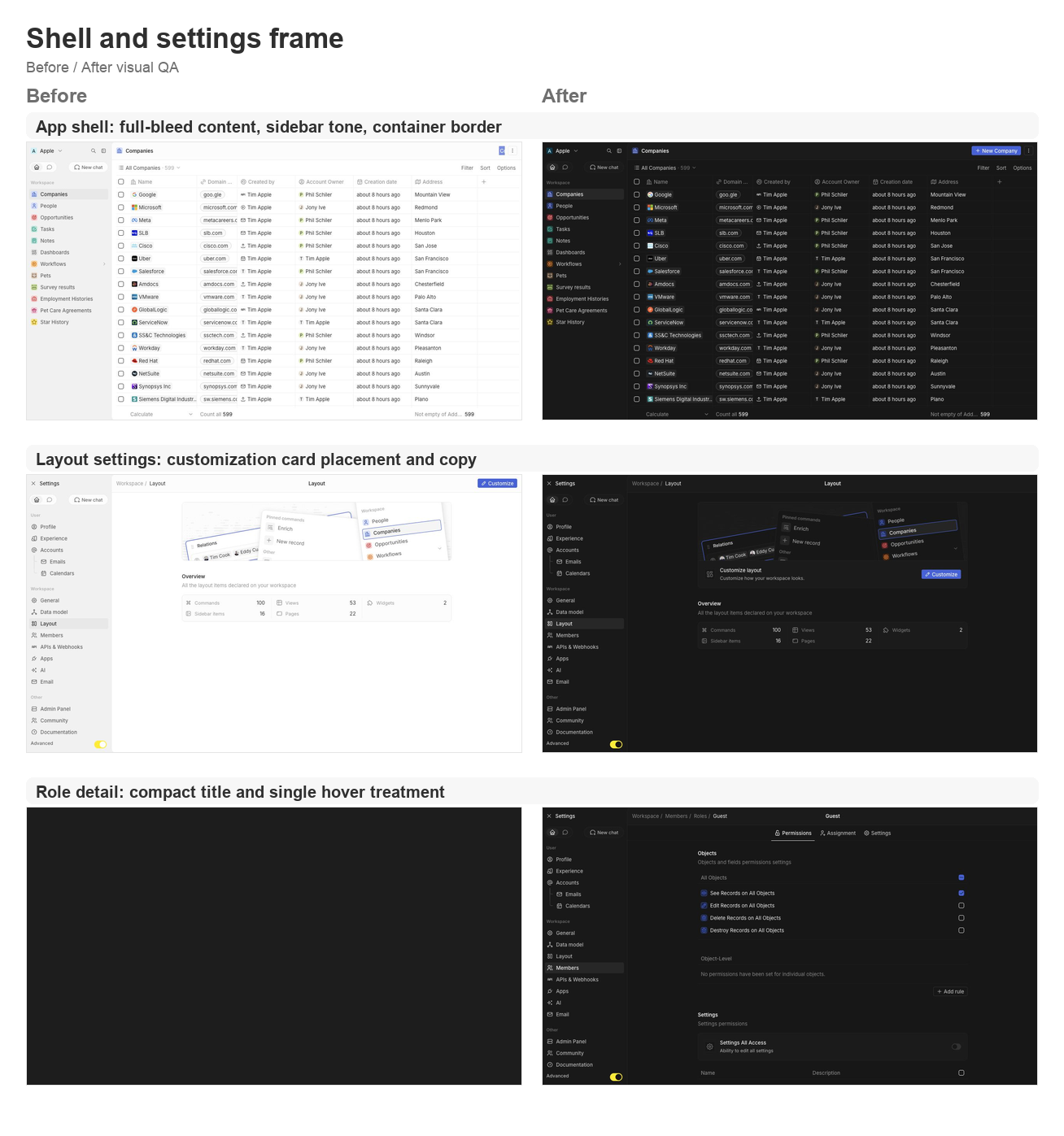
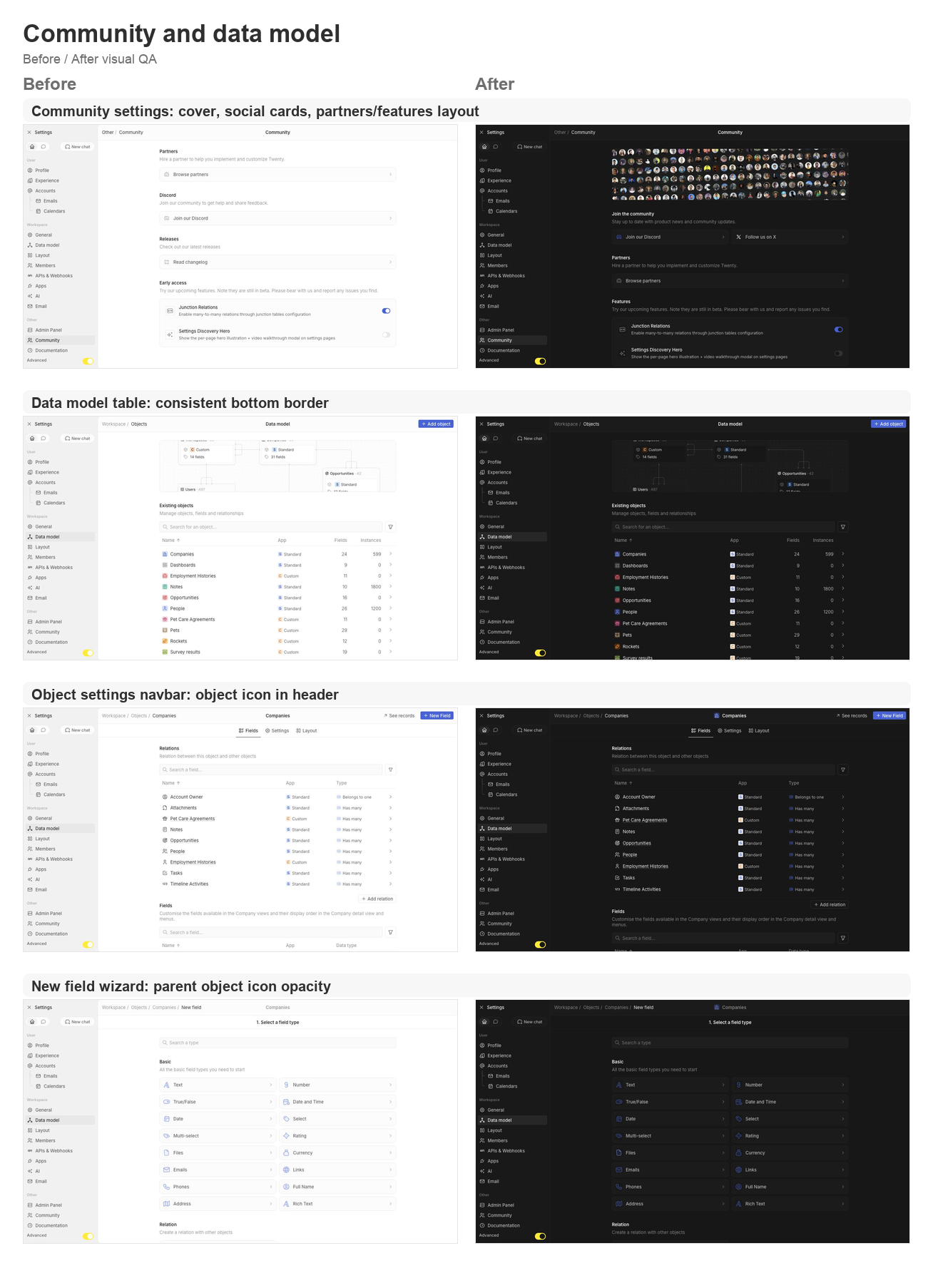
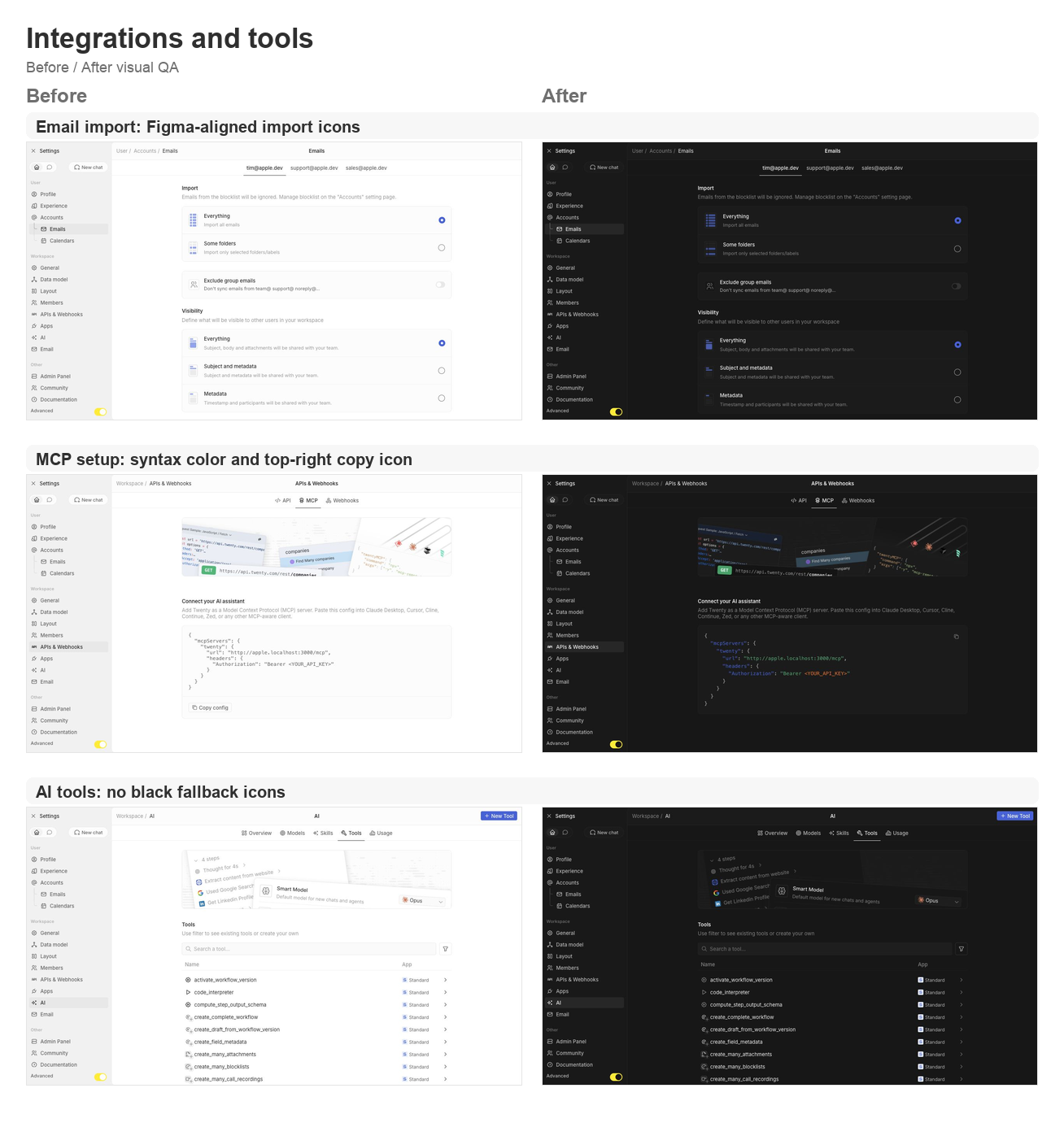
## Summary This PR groups the requested second UI polish pass across the app shell, settings pages, data model, community, AI tools, and developer setup surfaces. ### Shell and navigation polish - Lets the app content card fill the available viewport and removes the bottom-left radius on the main container. - Uses an outside-looking container border treatment so the rounded top-left edge matches the Figma frame without a double border. - Restores the separator between the AI chat side panel and the record container. - Updates navigation drawer background/skeleton tones to use gray/3 consistently. - Simplifies the full-screen backend error fallback so the white screen fills the viewport. ### Settings page polish - Moves the layout customization action from the settings navbar into a settings card under the hero. - Tightens layout page copy now that the customization surfaces are not directly manageable yet. - Aligns role detail title sizing and hover treatment with other settings headers. - Supports settings card brand icon colors, then restores Discord and X brand logos on the Community page. - Adds the Community discovery cover, moves community/social content to the top, and reorganizes Partners and Features. - Keeps setting card subtitle and separator behavior available for the updated settings cards. ### Data model and object settings polish - Adds a shared data-model table body wrapper so object, field, and relation tables all keep the expected bottom border. - Displays the object icon in the object settings navbar. - Shares the new-field wizard parent object icon wrapper and keeps the object icon at 64% opacity in wizard headers. - Updates the new-field type selector icon treatment to match the wizard header opacity behavior. ### Integrations, tools, and API polish - Reworks the MCP setup config card with light syntax coloring and a top-right copy icon button instead of the bottom copy section. - Fixes email import icons to match the Figma asset shape. - Ensures AI tool table icons and chevrons never fall back to black. ## Validation - `npx nx lint:diff-with-main twenty-front` - `npx tsc -p packages/twenty-front/tsconfig.json --noEmit` - `git diff --check` - Manual local visual pass on `apple.localhost:3001` for companies, settings/community, data model, object settings, new-field wizard, layout settings, account import, MCP setup, AI tools, and role detail pages. ## Visual QA ### Shell and settings frame <img width="1308" height="1397" alt="Shell and settings frame before/after board" src="https://raw.githubusercontent.com/twentyhq/twenty/pr-assets/ui-fixes-2/visual-qa/ui-fixes-2/shell-settings-frame.png" /> ### Community and data model <img width="1308" height="1806" alt="Community and data model before/after board" src="https://raw.githubusercontent.com/twentyhq/twenty/pr-assets/ui-fixes-2/visual-qa/ui-fixes-2/community-data-model.png" /> ### Integrations and tools <img width="1308" height="1397" alt="Integrations and tools before/after board" src="https://raw.githubusercontent.com/twentyhq/twenty/pr-assets/ui-fixes-2/visual-qa/ui-fixes-2/integrations-tools.png" /> <!-- This is an auto-generated description by cubic. --> <a href="https://cubic.dev/pr/twentyhq/twenty/pull/21540?utm_source=github" target="_blank" rel="noopener noreferrer" data-no-image-dialog="true"><picture><source media="(prefers-color-scheme: dark)" srcset="https://www.cubic.dev/buttons/review-in-cubic-dark.svg"><source media="(prefers-color-scheme: light)" srcset="https://www.cubic.dev/buttons/review-in-cubic-light.svg"><img alt="Review in cubic" src="https://www.cubic.dev/buttons/review-in-cubic-dark.svg"></picture></a> <!-- End of auto-generated description by cubic. --> |
||
|
neo773
|
5d892bdfd0 |
[WIP] Feat/marketing emails (#21173)
Marketing/campaign emails on top of the emailing-domain (SES) feature:
send a broadcast to a hand-picked list, with per-customer-domain
unsubscribe links and opt-out-only **unsubscribe topics**.

## Model

Standard objects (workspace schema, flat-metadata):
- `messageCampaign` — a campaign send (subject, body template, from
address, status, list, optional unsubscribe topic).
- `messageList` + `messageListMember` — the hand-picked audience (person
↔ list join). A campaign's recipients are its list's members; everyone
is sendable unless suppressed.

Core entities (`core` schema, workspace-scoped — readable by the public
unsubscribe flow without a workspace context):
- `unsubscribeTopic` — an opt-out-only category (name, description,
visibility). There is no opt-in subscription state.
- `messageSuppression` — the single consent store: a row with
`unsubscribeTopicId` NULL is a global block; a row with an
`unsubscribeTopicId` and reason `UNSUBSCRIBE` is a per-topic opt-out.
Two partial unique indexes dedupe global vs per-topic rows (Postgres
treats NULLs as distinct).
- `emailingDomain` — the workspace's SES sending domain,
auto-provisioned when an email channel is added (and cleaned up when its
last channel is removed), with verification status + DNS records.

Campaign messages reuse the existing `message` / `messageThread` /
`messageParticipant` model — one outbound `message` per recipient with a
`deliveryStatus` state machine.

## Sending

- `sendMessageCampaign` resolves the audience **under the caller's
permissions**, creates the campaign, and enqueues a single fan-out job
(the request never materializes per-recipient rows or jobs).
- The fan-out job materializes one QUEUED message per recipient
(deterministic ids → idempotent re-runs, reconciles crash-orphaned rows)
and fans out per-recipient send jobs carrying **only ids**.
- Each send job renders per-recipient `{{variable}}` merge fields and
sends via `EmailingDomainSenderService`, which applies suppression
(global + per-topic) and the unsubscribe footer/headers. Suppressed
recipients are recorded `SKIPPED`.
- The campaign finalizes `SENT`, or `SENT_WITH_ERRORS` if any recipient
terminally failed.
- `previewMessageCampaignAudience` returns a pre-send breakdown (total /
without-email / duplicate / globally-unsubscribed / topic-unsubscribed /
sendable), shown as a hint under the composer pickers.

## Unsubscribe

- Encrypted (AES-256-GCM) token carrying workspaceId, address, optional
`unsubscribeTopicId`, `issuedAt`, and a `preview` flag.
- One-click POST (RFC 8058) + `mailto:` — topic-scoped when the token
carries a topic, global otherwise.
- Preferences page: a checkbox per visible topic (checked = still
receiving); submitting creates per-topic opt-outs for unchecked topics
and lifts re-checked ones (UNSUBSCRIBE only — never
`BOUNCE`/`COMPLAINT`, never a global block).
- A **Preview** action in settings opens the live page via a
preview-claim token; opt-out POSTs are no-ops for preview tokens, so
previewing never mutates state.
- SES webhooks: inbound unsubscribe + outbound bounce/complaint →
suppression (race-safe against at-least-once delivery, with reason
escalation that never downgrades).
- Per-customer unsubscribe hostname (Cloudflare DNS); sends are gated on
it being active, except in LOG/demo mode.

## Architecture

Campaign orchestration, suppression, the sender, the unsubscribe
controller, and the SES webhook handlers live in `src/modules/emailing`
+ `src/modules/messaging-webhooks` (the workspace-feature layer).
`core-modules/emailing-domain` keeps the SES driver, domain
provisioning, the `unsubscribeTopic` / `messageSuppression` core
entities, and the unsubscribe token/hostname plumbing. Domain creation
is validated (`CreateEmailingDomainInput` — domain-format regex,
lowercased) before any value reaches SES or the unsubscribe hostname.

## Frontend

- Campaign composer side panel (from / list / unsubscribe topic /
subject / body) with a live audience-preview hint.
- Email settings: email channels each showing their auto-provisioned
sending domain in a single section (status + DNS records + a "Check
verification" action), plus an **Unsubscribe Topics** section to
create/manage topics and preview the recipient page. A demo-mode banner
is shown when the LOG driver is active.

---------

Co-authored-by: Félix Malfait <felix@twenty.com>
Co-authored-by: Félix Malfait <felix.malfait@gmail.com>
|
||
|
Félix Malfait
|
76f69efb43 |
Keep synced messages and events when removing a workspace member (#21443)
## Context Removing a workspace member deletes their connected accounts, which cascades into deleting every message and calendar event those accounts synced. For a CRM, losing the email history of departed teammates is a big deal. ## What this does Connected accounts are now kept and reassigned instead of deleted when a member is removed: - Ownership moves to the acting user (whoever removed the member). When members remove themselves (leave workspace, account deletion), it falls back to the oldest admin. - OAuth tokens are revoked, credentials wiped, message/calendar channels get `isSyncEnabled = false`, and the account is stamped with a new `archivedAt` column (fast instance command included). - Synced messages, threads and calendar events stay in the workspace. Channel visibility settings keep applying as before, since channels and associations survive. - The reassigned account appears in the new owner's Settings → Accounts, where it can still be deleted (with its data) like any other account. The transfer happens synchronously during removal, while the member's userWorkspace row still exists. This also removes `DeleteWorkspaceMemberConnectedAccountsCleanupJob` and its listener: the async job had to reconstruct the account-owner link from rows the removal flow had just deleted, which was race-prone (see 2181fb541e). Archived accounts are excluded from the workflow send-email default account resolution, and both removal confirmation modals now mention what happens to synced data. --------- Co-authored-by: claude[bot] <41898282+claude[bot]@users.noreply.github.com> |
||
|
Thomas des Francs
|
b14195428a |
Fix navigation and settings UI polish (#21523)
## Summary This PR groups the requested UI polish pass across navigation, settings, AI settings, data model, community/lab, and dashboard chips. ### Navigation and drawer polish - Smooths app/settings route switching with a 300ms content transition. - Smooths app menu/settings menu drawer swaps with a fade transition while preserving the existing drawer dimensions. - Keeps navigation and AI chat history panes mounted to avoid flicker when switching tabs. - Aligns the first app/settings section with the AI chat history section title. - Removes the main app navigation "Other" section. - Aligns the settings exit header with the workspace switcher header. - Sets the settings exit icon gap to 8px, uses the small icon stroke token, and keeps the icon color on text-secondary. - Makes the workspace switcher button 28px high inside its 32px container, moves the dropdown up so the workspace name does not jump, and keeps a 2px gap between header icon buttons. - Moves Settings below Support in the workspace switcher menu. - Pins the Advanced toggle to the bottom of the settings drawer and aligns its right padding with nav items. ### Settings surface polish - Fixes vertically cropped dropdown menu headers. - Makes wizard parent titles tertiary when a nested wizard title is visible. - Places danger-zone buttons side by side. - Uses a 32px Visualize button. - Restores 8px top/bottom padding on settings tables. - Separates AI overview counts into three columns like layout overview. - Adds separators inside setting cards, including the Smart Model / Fast Model card. - Groups lab/early-access toggles into one card with separators and full-width row backgrounds. - Replaces deprecated Enterprise adornment tags with the Organization adornment on gated AI/security/settings surfaces. - Uses the Discord brand icon in Community while keeping the standard icon component rendering pattern. - Tightens Skills/Tools search-to-table spacing so switching tabs does not shake the table top. - Fixes the small gap in nested navigation breadcrumbs between Emails and Calendars. ### Dashboard/data table polish - Fixes vertically cropped "Not shared" chips on dashboards. - Keeps table row/header spacing stable after the settings table padding restoration. ## Validation - `npx nx lint:diff-with-main twenty-front` - `npx tsc -p packages/twenty-front/tsconfig.json --noEmit` - Manual Chrome pass on `apple.localhost:3001` for profile, app navigation, workspace switcher, AI overview/models/skills/tools/usage, community/lab, data model, new-field wizard, and dashboards. ## Visual QA ### Settings surface fixes <img width="1324" height="2668" alt="Settings surface fixes before/after board" src="https://github.com/user-attachments/assets/312131fa-3922-4724-9460-46fd373754d1" /> ### Navigation drawer fixes <img width="1324" height="1816" alt="Navigation drawer fixes before/after board" src="https://github.com/user-attachments/assets/ca0b29e5-e393-46c0-81f7-e6bed2557b59" /> ### Tables, wizards, gates and chips <img width="1324" height="2242" alt="Tables, wizards, gates and chips before/after board" src="https://github.com/user-attachments/assets/5f358240-c31c-4c15-8ca8-04ed761fbf85" /> |
||
|
Félix Malfait
|
1efa3567ef |
Rename isUIReadOnly to isUIEditable, add isUICreatable, expose both to app developers (#21504)
<!-- CURSOR_AGENT_PR_BODY_BEGIN -->
# UI capability flags: `isUIEditable` + `isUICreatable`
## Per-verb capability model
This PR replaces the negative `isUIReadOnly` metadata flag with
positive, per-verb capability flags (à la Salesforce
`createable`/`updateable`):
- **`isUIEditable: boolean`, default `true`** — rename of `isUIReadOnly`
with inverted polarity, on **both** `objectMetadata` and
`fieldMetadata`. It is one concept ("can the user edit this through the
generic UI?") at two altitudes, so it carries one name at both levels.
- **`isUICreatable: boolean`, default `true`** — new, **object-level
only** (fields have no create verb). When `false`, no generic UI
affordance to create a record of this object appears anywhere (table "+"
buttons, board column add, calendar add, relation-section "Add new",
record picker "Add new", command-menu create action and its keyboard
shortcut).
Both flags are **UI-affordance flags only**: the server does not block
create/edit mutations based on them, so the system, API, and workflows
continue to mutate these records freely. They are orthogonal statements
about the object's nature with no implication rule in the data model.
Because today's inline creation UX creates a blank record the user must
then edit, the frontend create predicate currently requires both
`isUICreatable` and effective editability.
There is no CREATE permission in `ObjectPermissions`; the frontend keeps
gating creation on `canUpdateObjectRecords` as a proxy, ANDed with the
new flags.
## Unified create predicate
All generic creation entry points now flow through one predicate,
`canCreateRecordsForObjectMetadataItem` (`isUICreatable` && not
`isSystem` && not effectively read-only, where effective read-only
covers `isUIEditable`, `isRemote`, and the `canUpdateObjectRecords`
proxy via `isObjectMetadataReadOnly`). This deletes the previously
hardcoded suppression lists:
- `isRecordTableCreateDisabled.ts` and its hardcoded
`WorkflowRun`/`WorkflowVersion` list — deleted; those objects (plus
`workspaceMember`) now declare `isUICreatable: false` in the standard
application instead.
- The hardcoded `workspaceMember` guard inside
`useAddNewRecordAndOpenSidePanel.ts` — deleted.
- The `CREATE_NEW_RECORD` command menu item's availability expression
now checks `objectMetadataItem.isUICreatable`, `isUIEditable`,
`isSystem`, and `isRemote`; a workspace upgrade command re-syncs the
expression in existing workspaces.
Component-local conditions (soft-delete filter active, layout
customization mode) stay in their components.
## GraphQL compatibility and removal plan
The schema delta versus main is **purely additive plus deprecations —
zero breaking changes**:
- `isUIReadOnly` remains on both the ObjectMetadata and FieldMetadata
GraphQL output types for **one release** as a deprecated field computed
as `!isUIEditable` (`deprecationReason: 'Use isUIEditable'`). The Twenty
frontend no longer queries it.
- `isUIReadOnly` also remains on the **input side** for one release
(`CreateFieldInput`, `UpdateFieldInput`, `FieldFilter`, `ObjectFilter`),
keeping the schema shape identical to main for those members. On create
it acts as a legacy alias mapped to `!isUIReadOnly` (`isUIEditable` wins
when both are provided); on update it is ignored, exactly as on main (it
was never an editable property). Filtering on the deprecated member
keeps working until the column is dropped at upgrade time; after that it
is a deprecated no-op surface kept only for schema compatibility.
**Removal plan for next release: drop `isUIReadOnly` from the output
DTOs (and resolvers' `@ResolveField`s), from the input/filter types,
from the create-input mapping, and the `@WasRemovedInUpgrade`-retained
entity columns and decorators.**
## ⚠️ Webhook / database-event payload shape change
The `database-event-payload` type in `twenty-shared` got a clean rename
(no alias): metadata snapshots in webhook and database-event payloads
now carry `isUIEditable` (and `isUICreatable` at object level) **instead
of** `isUIReadOnly`, with inverted polarity. Consumers of these payloads
that read `isUIReadOnly` must switch to `isUIEditable`.
## New manifest properties (app-developer DX)
Application developers can now set these flags in their app manifests
(purely additive — existing manifests and older `twenty-sdk` versions
are unaffected, defaults apply when omitted):
- `objects[].isUICreatable?: boolean` (default `true`)
- `objects[].isUIEditable?: boolean` (default `true`)
- `fields[].isUIEditable?: boolean` (default `true`)
The manifest converters previously hardcoded `isUIReadOnly: false`; they
now read the manifest values with `?? true` defaults. The types are
re-exported through `twenty-sdk` from `twenty-shared`.
## Migration & backfill
- One fast instance command: adds `isUIEditable` (NOT NULL default
`true`) on `core."objectMetadata"` and `core."fieldMetadata"`, backfills
`isUIEditable = false` exactly where `isUIReadOnly = true`, drops
`isUIReadOnly`, and adds `isUICreatable` (default `true`) on
`objectMetadata`. The `down` is the exact inverse. Uses `ADD/DROP COLUMN
IF (NOT) EXISTS`, matching the 2-12 drop-`isCustom` precedent. Verified
up and down in separate transactions against a dev database with exact
backfill counts.
- **Cross-version upgrade safety (multi-version self-hosted jumps):**
the upgrade sequence interleaves per version (instance → workspace
commands), so pre-2.13 workspace commands run **before** the 2.13 rename
when an old instance jumps several versions. Following the `isCustom`
precedent: `isUIEditable`/`isUICreatable` are marked
`@WasIntroducedInUpgrade` and `isUIReadOnly` stays on both entities as
`@WasRemovedInUpgrade`, so the upgrade-aware entity metadata adapter
hides the not-yet-existing columns (and keeps the legacy column live) at
pre-2.13 cursors. **No committed upgrade command outside the 2-13
directory is modified**: the old 1-21/2-8/2-9 commands keep their
original `isUIReadOnly: true` inputs, which still compile (entity
property retained, deprecated create-input alias mapped) and still
produce the correct legacy column writes pre-rename.
- A 2-13 workspace command (`sync-standard-ui-capability-flags`)
re-syncs `isUICreatable` **and** `isUIEditable` on standard objects and
`isUIEditable` on standard fields from the standard-application
definitions. This backfills `isUICreatable: false` on
`workflowRun`/`workflowVersion`/`workspaceMember` and heals fields
created mid-cross-upgrade by pre-2.13 commands (whose hidden
`isUIEditable` value cannot reach the insert). Both 2-13 sync commands
pass `isSystemBuild: true` — the flat metadata validator otherwise
rejects direct updates to system objects (verified against a
deliberately drifted dev database; the run is idempotent).
- A second 2-13 workspace command re-syncs the create-record command
availability expression.
## Testing
- Unit tests for `canCreateRecordsForObjectMetadataItem`
(flag/permission/system combinations) and for the manifest converters
(flags set / omitted → defaults).
- Full `upgrade --dry-run` boots the sequence (107 steps) and validates
the upgrade-aware decorator references; both 2-13 sync commands verified
end to end against real drift and re-run idempotently.
- Schema verified by live introspection after the input-alias restore:
all four input/filter members match main, output deprecations intact;
frontend metadata types and `twenty-client-sdk` schema regenerated from
the running server.
- Read-only-related and touched jest suites pass on both packages;
typecheck and lint pass on `twenty-server` and `twenty-front`.
<!-- CURSOR_AGENT_PR_BODY_END -->
<div><a
href="https://cursor.com/agents/bc-0f3e04cb-b04a-40be-8330-5609c4538e8a"><picture><source
media="(prefers-color-scheme: dark)"
srcset="https://cursor.com/assets/images/open-in-web-dark.png"><source
media="(prefers-color-scheme: light)"
srcset="https://cursor.com/assets/images/open-in-web-light.png"><img
alt="Open in Web" width="114" height="28"
src="https://cursor.com/assets/images/open-in-web-dark.png"></picture></a> <a
href="https://cursor.com/background-agent?bcId=bc-0f3e04cb-b04a-40be-8330-5609c4538e8a"><picture><source
media="(prefers-color-scheme: dark)"
srcset="https://cursor.com/assets/images/open-in-cursor-dark.png"><source
media="(prefers-color-scheme: light)"
srcset="https://cursor.com/assets/images/open-in-cursor-light.png"><img
alt="Open in Cursor" width="131" height="28"
src="https://cursor.com/assets/images/open-in-cursor-dark.png"></picture></a> </div>
<!-- This is an auto-generated description by cubic. -->
<a
href="https://cubic.dev/pr/twentyhq/twenty/pull/21504?utm_source=github"
target="_blank" rel="noopener noreferrer"
data-no-image-dialog="true"><picture><source
media="(prefers-color-scheme: dark)"
srcset="https://www.cubic.dev/buttons/review-in-cubic-dark.svg"><source
media="(prefers-color-scheme: light)"
srcset="https://www.cubic.dev/buttons/review-in-cubic-light.svg"><img
alt="Review in cubic"
src="https://www.cubic.dev/buttons/review-in-cubic-dark.svg"></picture></a>
<!-- End of auto-generated description by cubic. -->
---------
Co-authored-by: Cursor Agent <cursoragent@cursor.com>
|
||
|
martmull
|
84a8504473 |
Add Enter HotKey to aAuth authroize screen (#21512)
as title <img width="1263" height="834" alt="image" src="https://github.com/user-attachments/assets/73dbfca2-8c7f-469d-8273-6adec5472abd" /> <!-- This is an auto-generated description by cubic. --> <a href="https://cubic.dev/pr/twentyhq/twenty/pull/21512?utm_source=github" target="_blank" rel="noopener noreferrer" data-no-image-dialog="true"><picture><source media="(prefers-color-scheme: dark)" srcset="https://www.cubic.dev/buttons/review-in-cubic-dark.svg"><source media="(prefers-color-scheme: light)" srcset="https://www.cubic.dev/buttons/review-in-cubic-light.svg"><img alt="Review in cubic" src="https://www.cubic.dev/buttons/review-in-cubic-dark.svg"></picture></a> <!-- End of auto-generated description by cubic. --> |
||
|
Raphaël Bosi
|
c4453923f0 |
Update CI: Argos visual regression for twenty-front storybook (#21454)
## What Adds Argos visual regression for `twenty-front`, reusing the storybook CI already builds and the existing sharded test matrix. Stories in the `modules` and `pages` scopes are captured as PNGs during `front-sb-test`, merged into one artifact, and pixel-diffed against `main` on the self-hosted Argos with results posted as a PR comment — same pipeline as `twenty-ui` (#21210 / #21262). ## How - **Capture**: `@argos-ci/storybook` vitest plugin, same setup as `twenty-ui`. Skipped for `performance` stories (nondeterministic profiling reports). Freezes framer-motion to avoid flaky diffs (#21412). - **Sharding**: each modules/pages shard uploads a partial artifact; a new `front-sb-screenshots` job merges them into `argos-screenshots-twenty-front` (`overwrite: true` so re-runs work). - **Baselines**: `CI Front` now runs on `push: main` — Argos resolves base builds by exact merge-base commit, so every main commit needs a build (#21217/#21222 pattern). Main pushes get a per-SHA concurrency group so back-to-back merges can't cancel queued runs and leave baseline gaps; the `performance` scope is dropped on push. - **Dispatch**: `visual-regression-dispatch.yaml` watches `CI Front` → `project=twenty-front`. ## Rollout - ✅ Prod Argos project `twenty-front` created (id 68) + `ARGOS_TOKEN_FRONT` secret set - ⬜ Merge the twentyhq/ci-privileged companion PR **before** this one - First PR builds show as *orphan* until the first main push creates a baseline (expected, same as the twenty-ui rollout) |
||
|
Charles Bochet
|
184c4948d6 |
security: strip Node dev headers from images + lingui 5.9.5 (drops vulnerable esbuild) (#21448)
## Context

AWS Inspector flags the `prod-twenty` image (built from current main)
with 16 findings, and Dependabot alert 174 flags esbuild. This PR fixes
the OpenSSL scanner findings and the esbuild CVE. The typeorm bump
(CVE-2025-60542) was **pulled out of this PR** — see "typeorm status"
below.

## Changes

### Strip `/usr/local/include/node` from runtime stages
(`twenty-server`, `twenty-app-dev`)
15 OpenSSL CVEs (June 9 advisory, incl. CRITICAL CVE-2026-34182) are all
detected via **Node's bundled OpenSSL dev headers**: 3 GENERIC
`openssl/openssl` 3.5.6 detections per CVE at
`/usr/local/include/node/openssl/archs/linux-x86_64/{asm,asm_avx2,no-asm}/include/openssl/opensslv.h`.
The headers are only needed by node-gyp and native addons are compiled
in the build stages — nothing compiles at runtime. Dropping them clears
all 45 detection instances and permanently ends this class of finding
(third occurrence: 3.5.5 → 3.5.6 → 3.5.7). None of these CVEs are
reachable through Node (no CMS/PKCS#7 API, `pfx` is operator-supplied,
Node's QUIC uses ngtcp2, ASN.1 issues need ~2GB inputs).

**Follow-up (~June 17, 2026):** the `node` binary itself still
statically links OpenSSL 3.5.6 — invisible to the scanner after this PR
and unreachable in practice, but the real fix is bumping the pinned
`node:24-alpine` digest once the [announced June 17 Node.js security
releases](https://nodejs.org/en/blog/vulnerability/june-2026-security-releases)
ship a 24.x linking OpenSSL ≥ 3.5.7 (verify via
`deps/openssl/openssl/VERSION.dat` on the release tag — 24.16.0 is still
on 3.5.6). A dated TODO sits next to the cleanup in the Dockerfile.

### esbuild dev-server CORS CVE (Dependabot alert 174,
GHSA-67mh-4wv8-2f99)
`@lingui/cli@5.1.2` (pins `esbuild ^0.21.5`) was the last parent
resolving a vulnerable esbuild (≤ 0.24.2 lets any website send requests
to the dev server and read responses). Instead of a resolution override,
this bumps the lockstepped **lingui suite 5.1.2 → 5.9.5** (within-major;
lingui adopted `esbuild ^0.25.1` in 5.4.1), which:

- removes `esbuild@0.21.5` and all its platform packages from the
lockfile with no forced ranges;
- drops the `@lingui/core` lockstep resolution (its comment marked it
droppable on the next coordinated lingui bump — the tree now resolves a
single `@lingui/core@5.9.5`);
- `@lingui/swc-plugin` stays at `^5.11.0` (peers on `@lingui/core: 5`;
its 6.x line targets lingui 6).

**lingui 5.9.5 behavioral fallout handled here:**
- Translation functions now **throw without an active locale** (5.1.2
fell back silently). The global `i18n` singleton that backs server-side
`` t`…` `` calls only had a messages compiler set, never an activated
locale → activate the source locale in `I18nService.loadTranslations()`,
mirrored in the server jest setup (unit tests bypass Nest bootstrap).
- `msg`/`t` placeholders are now strictly typed (reject
`null`/`undefined`/`unknown`) → one server call site and 16 twenty-front
files adapted with minimal nullish-coalescing fixes that preserve
rendering.
- `.po`/compiled-catalog churn from the new extractor/compiler
(reference reordering, sorted keys — verified content-identical on
unchanged `.po` inputs) is intentionally not committed: the scheduled
i18n workflows regenerate those.

## typeorm status (pulled out)

typeorm 0.3.20 → 0.3.26 was originally in this PR but **made workspace
metadata sync intermittently lossy**: `example-app-postcard` failed
twice with a *different* field missing from the synced PostCard object
each run, and one integration shard's `DataSeedWorkspaceCommand` died
with "Could not find flat entity with universal identifier …" — versus
zero such failures on recent main. Local runs (db reset + seed, group-by
integration suite 19/19) pass, so it is a nondeterministic
CI-load-sensitive regression that needs dedicated debugging (typeorm
changed LIMIT/OFFSET 0 semantics, lazy count for `getManyAndCount`,
upsert WHERE construction, and topological-sort internals in that
range). The resolutions comment documents this as the blocker;
CVE-2025-60542 is MySQL-driver-only (`sqlstring`), so Postgres-only
Twenty is not exposed in the meantime.

## Verification

- `npx nx typecheck twenty-server` / `twenty-front` — clean (no cache)
- `npx nx test twenty-server` — full suite green
- `lingui:extract` + `lingui:compile` — clean for twenty-server /
twenty-emails / twenty-front
- `oxfmt --check` — clean for both packages
- Lockfile diff: lingui 5.9.5 entries, `esbuild@0.21.5` +
`@esbuild/*@0.21.5` platform packages removed, no typeorm changes
|
||
|
Félix Malfait
|
adba66caea |
fix(twenty-front): new layout fast-follows — settings drawer, loading & command menu (#21389)
Second batch of new-layout fast-follows (master: twentyhq/core-team-issues#2478). All changes verified live against a running workspace. ## Settings drawer & header - **twentyhq/core-team-issues#2489** — sidebar icons render as plain 16px icons, no background tiles. - **twentyhq/core-team-issues#2488** — Advanced toggle spans the full drawer width; yellow dot removed. - **twentyhq/core-team-issues#2497** — page title stays centered in the settings header (breadcrumb stays left). - **twentyhq/core-team-issues#2490** — Exit Settings control aligned to the workspace switcher (24px, matching padding/gap). - **twentyhq/core-team-issues#2499** — 2px vertical gap restored between collapsible drawer section items. - **twentyhq/core-team-issues#2491** — settings drawer rhythm now matches the main app (28px items, 2px gaps, 28px section headers). - **twentyhq/core-team-issues#2492** — Home/Chat tab switch no longer flickers: both tab subtrees stay mounted (a shared `NavigationDrawerTabbedContent` toggles visibility instead of remounting + flashing the chat skeleton). ## Loading states - **twentyhq/core-team-issues#2486** — metadata loading shows an empty body (no dense skeleton rows). - **twentyhq/core-team-issues#2487** — settings table keeps its layout while loading, with the shimmer localized to the first row's first cell. ## Command menu & navigation - **twentyhq/core-team-issues#2501** — navigation section header height matches the nav item rhythm (28px). - **twentyhq/core-team-issues#2502 (part 1)** — the page side-panel toggle stays as the dots glyph while the command menu is open, instead of morphing into a second close control. ## New-field flow - **twentyhq/core-team-issues#2494** — the new-field stepper moved from a breadcrumb dropdown into a centered secondary wizard bar (back chevron + Save on the configure step); breadcrumb stays clean and the object label is the centered title. ## Descoped (substantive bugs already fixed) - **twentyhq/core-team-issues#2500** — command-menu highlight right gutter: the menu-item base measures full-width, so it's likely a scrollbar gutter on the list, not the shared component. Left for a focused follow-up. - **twentyhq/core-team-issues#2502 part 2** — moving the command-menu close from left to right is cosmetic (the duplicate-control bug is fixed by part 1) and would touch the shared `SidePanelTopBar` used by search/AI panels. ## Verification typecheck (tsgo) + oxlint + oxfmt green for all changed files; each change DOM-measured / screenshotted in the running app. |
||
|
Félix Malfait
|
ce2d77be2a |
feat(server): in-app server-level admin management (#19785) (#21321)
## Closes #19785 In-app management of **server-level admin rights** (`canAccessFullAdminPanel`, `canImpersonate`) so self-hosters no longer need raw SQL + a Redis flush + restart to grant access. > **Draft** — feature complete; `/code-review` + `/security-review` run and addressed. ### Background `AdminPanelGuard` / `ServerLevelImpersonateGuard` read `request.user.{canAccessFullAdminPanel,canImpersonate}`, hydrated each request from `CoreEntityCacheService.get('user', …)` (local 30-min + Redis no-TTL). The cache was only invalidated on soft-delete, so a raw `UPDATE core."user"` never took effect. The **first** signup auto-gets both flags; every subsequent admin previously needed raw SQL. ### UX - **Admin Panel → General → Administrators**: a read-only overview of every user with server-level access; each row links to that user's admin page. - **Find anyone** via the user search (Recent Users) — available to full admins and impersonators — then open their **admin user page**. - On the user page, an **"Administrator access"** card (gated on `canAccessFullAdminPanel`) has two toggles — *Full admin panel access* and *Impersonation* — that work for **any** user (a user with no access shows both off). Mirrors how **Impersonate** already works (find user → user page → act). Each change opens a confirm dialog with a **2FA code** field; the last full admin's toggle is disabled. ### Backend / security - **Cache fix** — invalidate the user entity cache on committed user updates (not just soft-delete) so privilege changes propagate (~100 ms, cluster-wide) with no restart. - `getServerAdmins` query + `updateServerAdminAccess` mutation (any `targetUserId`), gated on `canAccessFullAdminPanel`. - `NoImpersonationGuard` on both — an impersonated full-admin session can't be used to escalate an impersonator. - Fresh **2FA TOTP step-up** (enrolled+verified method **and** a fresh code; genuine 2FA errors surface; dev-skip on trusted `NODE_ENV`). - **Last-admin lockout** in a transaction with a pessimistic row lock (no TOCTOU). - **Email-to-all-admins + affected user** (rendered once per locale), structured log, audit event-log emit. - **Authorization**: the read-only `userLookupAdminPanel` + `adminPanelRecentUsers` lookups now accept `canAccessFullAdminPanel OR canImpersonate` (new `AdminPanelOrImpersonateGuard`), so a full admin without impersonate can still find users to manage. Workspace/impersonation queries stay impersonate-gated. ### Reviews - `/code-review` (max effort): 3 security findings (impersonation-escalation sink, lockout TOCTOU, step-up accepting PENDING 2FA) — **all fixed**. `/simplify`: applied. `/security-review`: **no high/medium vulnerabilities**. ### Follow-ups (not in this PR) - Unit tests for `AdminPanelServerAdminService` + a frontend test. - Point the self-host troubleshooting docs at the new UI. - OTP retry UX: `ConfirmationModal` closes on confirm, so a wrong code needs a reopen (kept to reuse the existing modal; no new pattern). ### Notes for reviewers - `generated-admin/graphql.ts` entries were hand-added to match codegen output (admin codegen needs a running server); re-run `nx graphql:generate twenty-front --configuration=admin` to confirm parity. - First-admin bootstrap (first signup) is unchanged. --------- Co-authored-by: claude[bot] <41898282+claude[bot]@users.noreply.github.com> |
||
|
Félix Malfait
|
bfefcd3755 |
feat(twenty-front): generalize the page primary/secondary bars (flat redesign) (#21308)
Replaces #21279 and #21282 with one clean PR from `main`. Generalizes the settings primary-bar / secondary-bar card chrome to the record index, record show and standalone pages via a shared `PageCardLayout` + `PageCardHeader` (the side panel sits as a sibling of the content card), and applies the new flat design direction: square corners on the card, side panel and loading skeletons. Iterating toward the new design (Figma node 102282-221623); the confirmed direction and the explicit "remove rounded corners" change are in, remaining designer specifics to follow. |
||
|
Raphaël Bosi
|
c596a5e342 |
Rename twenty-ui to twenty-ui-deprecated and twenty-new-ui to twenty-ui to prepare package release (#21315)
## Description Promotes the next-gen UI library (formerly `twenty-new-ui`) to the name **`twenty-ui`** (v0.1.0, publishable) and renames the old package to **`twenty-ui-deprecated`**. Rewrites ~1,730 `twenty-ui` imports → `twenty-ui-deprecated`, updates all configs/CI/Docker/deps, and migrates twenty-front's `Toggle` to the new package (first consumer) as a drop-in. ## Next steps - Wire the `ui/v*` publish dispatch (`cd-deploy-tag.yaml` + `.yarnrc.yml`), then tag `ui/v0.1.0` to publish. - Continue migrating components from `twenty-ui-deprecated` → `twenty-ui`. |
||
|
Félix Malfait
|
dfb3da1f8d |
feat(emailing-domain): add LOG driver for local development (#21286)
## What Adds a `LOG` driver to the emailing-domain feature, selected via a new `EMAILING_DOMAIN_DRIVER` config variable (defaults to `AWS_SES`, so production behavior is unchanged). The LOG driver: - resolves domains to `VERIFIED` instantly (no DNS / SES setup) - logs each `sendEmail` and returns a synthetic `messageId` instead of calling SES It also dev-seeds a pre-verified domain per workspace (`<workspaceId>.dev.twenty.local`) so the feature works out of the box. ## Why The emailing-domain feature currently ships only the AWS SES driver, so the verify → send flow can't be exercised locally (or in CI) without real AWS credentials. This unblocks local development and review of anything built on emailing domains. ## Usage ``` EMAILING_DOMAIN_DRIVER=LOG ``` The seeded `*.dev.twenty.local` domain is already verified; sends are logged (`[log-driver] sendEmail ...`). --------- Co-authored-by: claude[bot] <41898282+claude[bot]@users.noreply.github.com> |
||
|
Félix Malfait
|
a2fa941ce3 |
chore(twenty-front): remove dead SettingsAiMCP component and covers (#21281)
## What

`SettingsAiMCP` is dead code — nothing imports or renders it. The
redesign moved MCP setup to the **APIs & Webhooks** page
(`SettingsMcpSetup`, on the MCP tab), and the AI settings page now
**deep-links** there (`ApiWebhooks#mcp`) instead of rendering this
component.

Removes the orphaned component and its two cover SVGs:
- `src/pages/settings/ai/components/SettingsAiMCP.tsx`
- `public/images/ai/ai-mcp-cover-{light,dark}.svg`

## Notes

- Verified nothing references the component or the SVGs in source (only
stale `.po` source-reference comments remain, which `lingui` extraction
reconciles separately — not hand-edited here).
- The hero on the APIs & Webhooks page (incl. its MCP tab) is
unaffected; that's the `playground/cover` image.
|
||
|
Félix Malfait
|
4658d44d8b |
fix(settings): ship borderless hero cover images (#21277)
## What The settings discovery hero images (AI, Applications, Page Layouts, Members, Data Model, APIs & Webhooks) baked the rounded border into the pixels — transparent rounded corners plus a 1px edge stroke. Rendered inside `Card rounded` — which already draws a 1px border + border-radius and clips children with `overflow: hidden` — this produced a doubled, slightly misaligned border. This replaces all 12 files (light + dark per section) with clean full-bleed exports (opaque square corners), so the border and rounding come entirely from CSS. ## Notes - Pure asset swap, no component changes. - The MCP section's `.svg` cover is untouched (no new export provided). Billing's unused cover is left as-is. ## Verification - Each new image confirmed 1388×300, opaque square corners (no baked border), correct light/dark variant. - `Card` (twenty-ui) provides `border` + `border-radius` + `overflow: hidden`, so the square images are clipped to the rounded card. |
||
|
Félix Malfait
|
91f2f08995 |
feat(server): unify workspace-event ingestion behind one EventSink pipeline (#21197)
## Why The five event-log streams (`workspaceEvent`, `pageview`, `objectEvent`, `usageEvent`, `applicationLog`) each wrote to ClickHouse through their own fire-and-forget writer (`AuditService`, `UsageEventWriterService`, and the `application-logs` driver), with the per-type knowledge (table names, normalization, access rules) spread across several modules. Three of them reimplemented the same ClickHouse insert, and the read side, the live stream, and the producers lived in different modules under two different names. This consolidates them into one `core-modules/event-logs/` subsystem (emit, write, live, read), with the per-type config in a single registry so adding an event type is roughly one file. The base Logs settings tab and free application logs shipped separately in #21180 (merged). This PR adds the unified backend, the registry, and the viewer's live mode and entitlement gating. ## Pipeline ```mermaid flowchart TB subgraph PROD["Producers"] A["auth, billing, impersonation,<br/>webhook, custom-domain"] U["usage listener"] F["logic-function executor (app logs)"] R["record CRUD (entity events)"] end EM["EventLogEmitterService<br/>createContext().insert* / dispatch()"] EQ(["entityEventsToDbQueue<br/>(existing, shared with timeline)"]) CIE["CreateEventLogFromInternalEvent"] SINK["WorkspaceEventSinkService.ingest()"] C1["ClickHouseEventSink"] C2["ConsoleEventSink"] LIVE["EventLogLiveService.publishWatched()<br/>(presence-gated)"] CH[("ClickHouse, 5 tables, async_insert")] CHAN(["WORKSPACE_EVENTS_CHANNEL"]) RS["EventLogsService (registry-driven read)"] LR["EventLogsLiveResolver"] UI["Settings > Logs"] A --> EM U --> EM F --> EM EM -->|direct| SINK R --> EQ --> CIE -->|ingest| SINK SINK --> C1 --> CH SINK --> C2 SINK --> LIVE -.->|if a viewer is watching| CHAN --> LR --> UI CH --> RS --> UI ``` ## What it does - Producers call `EventLogEmitterService.createContext().insert*()`, which builds a typed `WorkspaceEventEnvelope` and writes it through `WorkspaceEventSinkService` to the configured sinks (ClickHouse, Console) plus a presence-gated live fan-out. Record/CRUD events reach the same sink through the existing `entityEventsToDbQueue`. There is no dedicated queue; ClickHouse `async_insert` batches server-side. Writes are best-effort, as on main today. - `EVENT_LOG_TYPES[table]` is the per-type source of truth: the ClickHouse table, the required entitlement, the free-text filter column, and the row-to-GraphQL mapping. Read row shapes derive from the write rows. - Four modules along their dependency boundaries: `EventLogEmitterModule` (producer API), `EventLogIngestionModule` (sink layer), `EventLogLiveModule` (fan-out), and `EventLogsViewerModule` (the entitlement-gated GraphQL read, which is where billing/enterprise/permissions stay so producers stay light). - Logs viewer: per-table columns, filters (text, date, record), live mode, and an upgrade card that points to Billing on Cloud or the Admin Panel on self-hosted. Application logs are free on every plan; the other four require the `AUDIT_LOGS` entitlement (with a `NO_ENTITLEMENT` fallback to the upgrade card). - Renames `AuditService` to `EventLogEmitterService`, and the generic `Monitoring` event to a typed `Impersonation` event (`level` + `action`). - Removes `UsageEventWriterService`, the `application-logs` driver/module, and `AuditService`'s direct inserts. ## Durability Writes are best-effort, the same as main today (the old writers were fire-and-forget). A dedicated queue was tried mid-PR and removed: `async_insert` already batches server-side, so the queue only added durability, which isn't a requirement right now. The `EventSink` seam keeps a durable transport (e.g. a Redis-Streams buffer) easy to add later without touching producers. ## Out of scope S3 peer sink (seam only), Postgres or any second read path, `ReplicatedMergeTree`, ClickHouse table-schema changes, and the record-data `EVENT_STREAM_CHANNEL` (unchanged, separate concern). ## Testing Unit tests cover the registry definitions and row normalization, the entitlement gating, the envelope builders, and the producers. Integration tests cover the write paths (record create produces an `objectEvent`; the track mutation produces a `workspaceEvent`) and the read/query path across all five tables. Verified with typecheck, lint, a server boot, and GraphQL/SDK codegen. |
||
|
Félix Malfait
|
c3dd6b25a6 |
fix: use canonical oxlint rule id in lint-disable directives (#21253)
## What Many `oxlint-disable` / `eslint-disable` directives across the repo carry a corrupted rule id — `@typescripttypescript/<rule>` — most likely a find-and-replace accident that mangled the eslint-era `@typescript-eslint/` prefix. oxlint matches disable directives **loosely by rule name**, so these still suppress in practice (not a silent no-op), but the id is malformed and misleading. ## Change Replace them with the **canonical oxlint id** `typescript/<rule>` — matching the plugin name and rule keys declared in `.oxlintrc.json` — **127 files, 262 directives**: | rule | count | | --- | ----- | | `typescript/no-explicit-any` | 250 | | `typescript/ban-ts-comment` | 6 | | `typescript/no-misused-promises` | 4 | | `typescript/no-empty-object-type` | 2 | - `twenty-server`: 122 files - `twenty-front`: 5 files Comment-only — no code or runtime changes. ## Verification `oxlint --type-aware -c .oxlintrc.json` reports **0 warnings / 0 errors** for both `twenty-server` and `twenty-front`. Every changed line is exactly the id correction inside a disable directive (262 insertions / 262 deletions, no collateral edits). > Addresses the cubic review, which flagged that the canonical oxlint id is `typescript/...` (no `@`). Worth noting the original `@typescripttypescript/` was not actually a silent no-op — oxlint matches these directives loosely by rule name — but `typescript/` is the correct, config-aligned id. |
||
|
Félix Malfait
|
a3a44c8315 |
fix(front): settings skeleton, app-detail header & empty favorites (#21209)
Three small post-redesign UI fixes. Each is an independent commit, so they can be split into separate PRs if preferred. ## 1. Settings loading skeleton — match the rounded-card layout The redesign (#21131) moved settings chrome into a rounded card (`SettingsPageLayout`: bordered header with breadcrumb + centered title, optional secondary bar, 760px body), but `SettingsSkeletonLoader` still rendered the old flat `PageHeader` + `PageBody` — so pages painted as a full-width flat bar then snapped into the card. - `SettingsSkeletonLoader` now reproduces the card and **reuses the real `SettingsPageHeader` + `SettingsPageContainer`**, so the frame aligns by construction; the card CSS is replicated (not `SettingsPageLayout`) to avoid the layout's side effects (hotkeys, side panel, info banner). - It's **composed with `SettingsSectionSkeletonLoader`** so the loading body is identical whether or not chrome is present. Rule: no chrome on screen yet → full-page skeleton; chrome already on screen → body-only `SettingsSectionSkeletonLoader` (the admin Enterprise tab now uses it, matching its sibling tabs). A short comment on each component documents this. ## 2. Application detail header — pass a plain title `SettingsApplicationDetails` / `SettingsAvailableApplicationDetails` passed a custom `SettingsApplicationDetailTitle` (avatar + name + multi-line description, fixed width) into `SettingsPageLayout`'s **centered single-line title slot**, which broke the header. They now pass the app's display name like every other page. The available-app "unlisted" notice moves into the body as a reusable `InlineBanner`; the now-unused `SettingsApplicationDetailTitle` is removed. ## 3. Navigation — hide Favorites when empty Always rendering the Favorites section (#21087) left a stray "Favorites" title above Workspace for users with no favorites. It now renders only when at least one favorite exists (redundant per-child guards dropped). Note: the "+ add favorite" entry point therefore appears once you have ≥1 favorite; the first favorite is created from a record/view as before. ## Verification - `nx typecheck twenty-front` ✅ · `oxlint` + `oxfmt --check` on changed files ✅ - i18n catalogs intentionally untouched — handled by the repo's separate i18n pipeline. |
||
|
Félix Malfait
|
2ac515894b |
feat(settings): add Logs as a dedicated tab in General settings (#21180)
## What & why The audit-log viewer lived as a full-screen page reachable only via a "View Logs" button buried in the **Security** tab. This surfaces it as the **third tab in General settings** (`General | Security | Logs`), consistent with the other tabs. ## Changes - **Relocated** the event-logs module `pages/settings/security/event-logs/` → `modules/settings/event-logs/` and render it as tab content instead of a `FullScreenContainer` page. Dropped `SettingsPath.EventLogs`, its route, and the fullscreen handling in favor of the `general#logs` hash tab. - **Security tab:** removed the "View Logs" entry; kept the log-retention setting there. - **In-tab gating** (shown to users with the Security permission): Enterprise upgrade card when not entitled, a clear "ClickHouse not configured" placeholder otherwise (derived from client config), and the query is skipped when disabled. Replaces a bespoke error component that string-matched error messages with the shared `SettingsEmptyPlaceholder` / `SettingsEnterpriseFeatureGateCard`. - **Layout:** boxed content column with the table selector + filters grouped in a `Card` and the results table below, matching settings conventions. Kept the existing fixed filters (page/event name, member, period) rather than recreating the record-view filter chips (those are tightly coupled to record/view context). Frontend + `twenty-shared` only — no changes to the log query or data. ## Test plan - [x] `npx nx typecheck twenty-front` and `npx nx lint twenty-front` pass - [x] Settings → General shows three tabs; Logs is the third; breadcrumb stays "Workspace / General" - [x] With Enterprise + ClickHouse: table selector, filters, refresh, and the paginated table work - [x] Non-Enterprise: Enterprise upgrade card shown; no failing query fires - [ ] Enterprise without ClickHouse: shows the "ClickHouse not configured" placeholder - [ ] Security tab still shows the log-retention setting and the "View Logs" button is gone - [ ] A user without the Security permission sees neither the Security nor Logs tab |
||
|
Parship Chowdhury
|
120793f69f |
fix: block self-impersonation in admin panel (#21130)
## Issue - From Settings -> Admin Panel -> Workspace -> Members, impersonating the currently logged-in user still issued an impersonation login token. Token exchange produced invalid impersonation JWTs (`impersonatorUserWorkspaceId === impersonatedUserWorkspaceId`). JWT validation then failed with `User cannot impersonate themselves`, leaving the app in an endless loading state until cookies were cleared. - Closes #21086 ## Approach I was first thinking of to only hide the impersonate button for the logged-in user in the admin, since they can not click what isn’t shown (as I thought it was just a frontend issue). But that was not enough: - The `impersonate` mutation can still be called directly (GraphQL client, scripts, devtools). - Before this fix, the mutation could succeed and only fail later at JWT validation, which led to invalid tokens and a broken session. So the PR does both: - Frontend: hide/disable self-impersonation in the UI and avoid reloading on failed token exchange (UX). - Backend: reject self-impersonation in `ImpersonationService` and at token exchange (enforcement, fail fast before bad tokens). Hiding the button is the right product behavior; the backend change is what makes the rule real and safe. ## How to test Manual: - Log in as a user with admin impersonation. - Go to Settings -> Admin panel -> Workspace -> open your workspace -> members. - Confirm your row has no Impersonate button; other members still do. - Open Admin Panel -> User for yourself -> confirm no impersonate button. - Open Settings -> Members -> your own member profile -> confirm no Impersonate action. - Impersonate another member -> should work as before Automated: `npx jest impersonation.service.spec` ### Before: <img width="830" height="413" alt="Screenshot 2026-06-02 122224" src="https://github.com/user-attachments/assets/46f38a74-8bd6-4ffa-b749-500ce18314f1" /> ### After: <img width="795" height="369" alt="Screenshot 2026-06-02 122333" src="https://github.com/user-attachments/assets/62ece4a8-d38b-4f91-817f-792ff49b146b" /> --------- Signed-off-by: Parship Chowdhury <parshipchowdhury@gmail.com> Co-authored-by: Etienne <45695613+etiennejouan@users.noreply.github.com> |
||
|
Félix Malfait
|
431f6ae98f |
feat(settings): move settings chrome into a single rounded card (#21131)
## What Replaces `SubMenuTopBarContainer` with a settings-specific `SettingsPageLayout` that puts the whole page chrome — breadcrumb, centered title, actions, an optional secondary bar (tabs or wizard step), and the 760px body — inside **one rounded card**, with `SidePanelForDesktop` as a sibling. Title, tabs and body content share one centered vertical axis at every card width. Supersedes #21122. One PR, no feature flag. ## New components (`@/settings/components/layout/`) - **SettingsPageLayout** — owns the rounded card + side-panel sibling, `useCommandMenuHotKeys`, mobile command menu - **SettingsPageHeader** — breadcrumb · centered title · actions in a symmetric `1fr auto 1fr` grid (symmetric padding throughout) - **SettingsSecondaryBar** — the secondary row, bracketed by top + bottom borders - **SettingsTabBar** — centered tabs reusing `activeTabIdComponentState` + `TabListFromUrlOptionalEffect` for URL-hash sync (does not touch the shared `TabList`) - **SettingsWizardStepBar** — back arrow · "N. Label" · optional trailing slot ## Migrations - Bulk rename across ~80 call sites (`SubMenuTopBarContainer` → `SettingsPageLayout`); old component deleted. - 5 tab pages (AI, APIs & Webhooks, Applications, Members, Role) + the Data Model object-detail page render their tabs in `secondaryBar` (object-detail keeps "See records" / "New Field" in the header actions). - The 2 role object-level steps render the wizard step bar with working back navigation. - Accounts consolidated into **General / Emails / Calendars** tabs; standalone `SettingsAccountsEmails` / `SettingsAccountsCalendars` pages + routes + stories removed. `SettingsPath.AccountsEmails` / `AccountsCalendars` now resolve to `accounts#emails` / `accounts#calendars`, so existing `getSettingsPath()` links deep-link to the right tab via the existing hash sync — no call-site changes. ## Verification - `nx typecheck twenty-front` and `nx lint twenty-front` both clean. - Browser (logged-in workspace): title / tab / body / card centers align on a single axis at multiple widths — width-invariant, so alignment holds when the AI side panel (a sibling) shrinks the card. Rounded card with even gaps on all four sides; tab row bracketed by two 1px lines; no-tab pages render header → body with no lines; wizard back navigation works; `…/accounts#emails` opens the Emails tab. The shared `PageHeader` and `TabList` are untouched. The settings side panel itself isn't wired to open yet — that's a follow-up PR. |
||
|
Félix Malfait
|
75df1f3997 |
chore(settings): address review comments from PR 21072 (#21121)
## Summary Round through bosiraphael's 31 review threads on the merged PR #21072 (discovery hero + ephemeral playground token). The user asked to apply each suggestion only where it adds value, so this PR is split into three buckets. ### Comments (~17 threads) - Tightened security-rationale / CSS-gotcha / API-doc comments to one or two factual lines - Kept (shortened) the comments above `RequireAccessTokenGuard` call sites — without them a future reader could remove the guard and silently reopen the escalation hole - Kept (shortened) the in-memory-only rationale on `playgroundApiKeyState` for the same reason - Kept `flex: 1 + min-height: 0` CSS gotcha on `SubMenuTopBarContainer` — non-obvious and easy to break ### Structure / extraction - Move `WEBHOOK_TABLE_ROW_GRID_TEMPLATE_COLUMNS` to its own constants file (one-export-per-file) - Split `SettingsAgentToolsTab` and `SettingsAgentToolsTable` across queries/, hooks/, types/, utils/: - `graphql/queries/findManyApplicationsForToolTable.ts` - `graphql/queries/findManyMarketplaceAppsForToolTable.ts` - `hooks/useSettingsAgentToolsTable.ts` (data loading + index merging) - `types/SettingsAgentToolItem|Application|MarketplaceApp` - `utils/getToolApplicationId|getToolLink` - Extract `SettingsAiModelsTab` optimistic mutations into `hooks/useSettingsAiModelsActions` (handleModelFieldChange, handleUseRecommendedToggle, handleModelToggle, handleToggleAllVisibleModels) - Extract `SettingsAI.handleCreateTool` into `hooks/useCreateTool` - Drop unnecessary `useMemo` wrappers on `heroTabs` arrays (SettingsObjects, SettingsLayout) - Simplify `MenuItemToggle` handler in SettingsAgentSkillsTab: `onToggleChange={setShowDeactivated}` (no longer wrapping with arrow + read of stale `!showDeactivated`) ### Hero assets - Replace placeholder `customize-illustration` with per-page exports - Rename `layout/customize-illustration-{light,dark}.png` → `layout/cover-{light,dark}.png` - Add `cover-{light,dark}.png` for **applications** and **members** (they were both pointing at the layout placeholder as a TODO) - Overwrite `data-model/cover-*.png`, `playground/cover-*.png`, `ai/ai-tools-cover-*.png` with the new exports ## Test plan - [ ] `npx nx typecheck twenty-front` ✅ - [ ] `npx nx typecheck twenty-server` ✅ - [ ] `npx nx lint twenty-front` ✅ (oxlint + oxfmt, 0 warnings/errors) - [ ] `/settings/layout`, `/settings/data-model`, `/settings/applications`, `/settings/ai`, `/settings/api-webhooks`, `/settings/members` each render the new hero illustration (light + dark) - [ ] AI tab: tool list still loads, search + Custom/Managed/Standard filters still work, "New Tool" still navigates to detail - [ ] AI tab: Models tab — smart/fast model select, "Use best models only" toggle, per-model checkboxes, toggle-all all still optimistic+revert on error - [ ] Skills tab: "Deactivated" toggle still flips show/hide - [ ] Webhooks table still uses the 1fr 28px grid |
||
|
Félix Malfait
|
b338a7a1d2 |
feat(settings): discovery hero rollout + ephemeral playground token (#21072)
## Summary

Two intertwined streams of work:

### UI — discovery hero pattern, settings shell, AI/API redesign
- **Generalize `SettingsDiscoveryHeroCard`** and use it on Layout, Data
Model, Apps, AI, API/Webhooks, Members. Drops 4 per-page wrapper files
(`SettingsObjectCoverImage`, `SettingsLayoutCoverImage`,
`SettingsLayoutCustomizeVideoModal`,
`SettingsDataModelVisualizeVideoModal`). Each page now supplies cover
src, modal id, and tab list.
- **Modal**: swap `<video>` placeholder for the Vimeo iframe pattern
from `twenty-docs`, per-tab `vimeoId`. Drop the parallel border-bottom
on the header (TabList draws its own baseline) and the grey background
behind the video. Note: Vimeo's embed allowlist applies — the iframes
load with the correct URL on `localhost` but the player itself requires
the video owner to allow the dev/staging domains in Vimeo settings.
- **AI page** rebuilt into a Cockpit pattern (Overview / Models / Skills
/ Tools / Usage). New `SettingsAiOverviewTab` with default Smart/Fast
pickers, at-a-glance stats, and an MCP signpost that deep-links to
`/settings/api-webhooks#mcp`. System Prompt link moved under Models.
Advanced tab removed.
- **API & Webhooks** now has 4 tabs (Playground / MCP / API Keys /
Webhooks). Hero card above tabs. Playground tab inverted to "Core API" /
"Metadata API" sections, each containing REST + GraphQL cards — schema
is the meaningful axis, protocol is secondary. Hash deep-link sync
delegated to the shared `TabListFromUrlOptionalEffect`.
- **Settings shell**: unified drawer outer padding (kill `isSettings`
branch), extract `CollapsibleNavigationDrawerSection`, add `iconColor`
on settings nav items, fix Exit Settings button alignment, 880px content
cap.

### Backend — strategy C: ephemeral playground token
The legacy paste-your-API-key flow is replaced by an on-demand
short-lived token scoped to the calling user's permissions. No shared
"Playground" API key to manage or revoke.

- New `JwtTokenTypeEnum.PLAYGROUND`. `PlaygroundTokenJwtPayload =
Omit<AccessTokenJwtPayload, 'type' | impersonation fields>` so any
future ACCESS claim flows through automatically.
- `AccessTokenService.generatePlaygroundToken` signs an access-shaped
JWT with `type: PLAYGROUND` and a configurable short TTL. A shared
private `resolveTokenSubject` helper parallelizes the user / workspace /
userWorkspace lookups for both generators.
- `JwtAuthStrategy.validateAccessToken` widened to accept
`AccessTokenJwtPayload | PlaygroundTokenJwtPayload`; impersonation gated
on `payload.type === ACCESS` so the union narrows without `as unknown
as` casts. The two branches in `validate()` collapse into one.
- New `PLAYGROUND_TOKEN_EXPIRES_IN` config var (default `2h`).
- New `generatePlaygroundToken` mutation (`WorkspaceAuthGuard`, no args,
returns `AuthToken`).
- Frontend `useOpenPlayground` hook centralizes mint → atom write →
navigate, with Apollo `onError` snackbar and a "use cached PLAYGROUND
token if still fresh" short-circuit (decodes via `jwt-decode`, checks
both `type` AND `exp`). Old API_KEY tokens left in localStorage from the
prior paste-form flow are rejected on `type` alone and force a re-mint —
this is what was causing the "This API Key is revoked" symptom on stale
browsers.

### Drive-by cleanups
- `PlaygroundToken` DTO removed (identical shape to `AuthToken` already
in use).
- 5 `customize-sidebar.webm` imports and the dead placeholder pipeline
removed.

## Test plan

### Discovery hero
- [ ] `/settings/layout`, `/settings/data-model`,
`/settings/applications`, `/settings/ai`, `/settings/api-webhooks`,
`/settings/members` each render the discovery hero card with its
illustration + play button + tabbed modal
- [ ] Modal tabs show the correct Vimeo embed URL per tab; aspect ratio
stays at 1440/900; no parallel border-bottom jog at the tab baseline
- [ ] AI Overview tab shows Smart/Fast model pickers + stats grid + MCP
signpost card; the MCP card lands on `/settings/api-webhooks#mcp` with
the MCP tab active

### API playground (ephemeral token)
- [ ] With an empty `playgroundApiKeyState` in localStorage, clicking
REST or GraphQL playground card opens the playground and the cached
token has `type: "PLAYGROUND"` with ~2h exp
- [ ] Clicking the card again within the freshness window does **not**
re-mint (`iat` / fingerprint stable across visits)
- [ ] Planting a fake API_KEY-shaped JWT in localStorage and clicking
the card forces a fresh mint (old token rejected on `type`)
- [ ] `GET /rest/companies?limit=1` with the cached token returns 200 +
real data
- [ ] `POST /graphql { __typename }` returns 200

### Settings shell
- [ ] Settings nav matches main app drawer padding; sections collapse;
Exit Settings button aligns with the workspace links above
- [ ] Active nav items have a right-gap (cleaner active state)
- [ ] Content area capped at 880px

### Verify
- [ ] `npx nx typecheck twenty-front` passes
- [ ] `npx nx typecheck twenty-server` passes
- [ ] `npx nx lint:diff-with-main twenty-front` passes
- [ ] `npx nx lint:diff-with-main twenty-server` passes
|
||
|
Nicolas Besnard
|
71c377484e |
fix(front): keep app variable cache in sync after update (#20861)
Updating an application variable in Workspace / Applications / <App> / Settings persisted server-side but the Apollo cache kept the old value. Switching tabs unmounted the settings tab, and remounting reseeded the input from the stale cache — only a full refresh showed the new value. Mutation now writes the new value into the ApplicationVariable entity via cache.modify, so FindOneApplication reflects the change immediately. Hook + table updated to pass the variable id through. Adds a hook test that pre-seeds the cache and asserts the cached value after the mutation. NOTE: saving the plain value in Apollo's cache might not be the best approach here --------- Co-authored-by: martmull <martmull@hotmail.fr> |
||
|
martmull
|
c2df39405c |
Fix admin pannel server variable config tab (#21017)
## Before <img width="1046" height="490" alt="image" src="https://github.com/user-attachments/assets/450557de-fcf5-4b51-afdb-36c0c36e43d8" /> ## After <img width="1040" height="414" alt="image" src="https://github.com/user-attachments/assets/4a5fe2ab-85d6-4431-9397-6f81ae24055d" /> |
||
|
martmull
|
6fb6ef4e7a |
Add darkmode for oAuth screen (#21005)
## after <img width="1512" height="828" alt="image" src="https://github.com/user-attachments/assets/71664eab-c921-45da-ac67-7a660c976d5c" /> |
||
|
Félix Malfait
|
7d9f9605a2 |
feat(settings): move email handles and emailing domains to dedicated Email page (#21008)
## Summary Both **Email Handles** and **Emailing Domains** were rendered on the General workspace settings page, but they're workspace-level *email infrastructure* (inbound shared addresses + outbound sender authentication) and don't belong with the workspace name, picture, and domain config. - New `SettingsWorkspaceEmail` page at `/settings/email` - Nav item under **Workspace**, hidden when `IS_EMAIL_GROUP_ENABLED` is off (and gated by `WORKSPACE` permission) - Related sub-routes (`email-group/:messageChannelId`, `emailing-domain/:domainId`, etc.) moved from `general/` to `email/` so the URL space stays consistent with the page - General page now only contains name, picture, workspace domain, and the delete-workspace section No behavior changes to the underlying section components — they're imported as-is into the new page. ## Test plan - [ ] With `IS_EMAIL_GROUP_ENABLED` enabled: **Email** appears in the Workspace nav and the page renders both sections - [ ] With the flag disabled: **Email** is hidden from nav; navigating to `/settings/email` directly renders nothing - [ ] General page no longer shows Email Handles / Emailing Domains - [ ] Clicking a shared inbox row navigates to `/settings/email/email-group/:id` (was `general/...`) - [ ] "Add emailing domain" navigates to `/settings/email/emailing-domain/new` ## Notes - Pre-existing `twenty-front` typecheck error in `FrontComponentRendererProvider.tsx` (React types mismatch between sibling packages) reproduces on `main` and is unrelated to this PR. |
||
|
Félix Malfait
|
7065441972 |
fix: refresh admin panel feature flags after toggling (#21007)
## Summary

- Add `refetchQueries` to the `updateWorkspaceFeatureFlag` mutation in
the admin workspace detail page so the toggle reflects the new value
after toggling.
- Rename `useFeatureFlagState` → `useAdminUpdateFeatureFlag` since the
hook lives under `admin-panel` and is only consumed by the admin
workspace detail page.

## Bug

In the admin panel, toggling a feature flag for a workspace other than
the admin's own workspace sent the backend mutation successfully, but
the toggle in the UI remained unchanged.

The displayed value is derived from:
```tsx
const currentWorkspaceValue =
  currentWorkspace?.id === workspaceId
    ? currentWorkspace?.featureFlags?.find((f) => f.key === flag.key)?.value
    : undefined;
const displayedValue = currentWorkspaceValue ?? flag.value;
```

When viewing a different workspace, `currentWorkspaceValue` is
`undefined` so the toggle reads `flag.value` from the
`WORKSPACE_LOOKUP_ADMIN_PANEL` query. That query was never refetched
after the mutation, so the displayed value stayed stale.

The existing optimistic Jotai update on `currentWorkspaceState` still
runs — it is needed so the rest of the app (anything consuming
`useIsFeatureEnabled`) reacts immediately when an admin toggles a flag
on their own workspace.

## Test plan

- [ ] Open the admin panel → pick a workspace that is not your own →
Feature Flags tab → toggle a flag → toggle visually flips after the
mutation completes.
- [ ] Same flow on your own workspace → toggle flips, and any UI gated
on that flag also reacts.
- [ ] If the mutation fails, the toggle reverts (existing `onError`
rollback path).
|
||
|
neo773
|
c5606212f2 |
Ses outbound followup (#20610)
This pull request unifies outbound with inbound under the new feature and the new email groups feature. These are workspace level shared inboxes that are shared between all workspace members. outbound sending with SES works, we only listen for tenant status events, rest is managed by AWS PR refactors old code and webhook to be split for outbound and inbound for proper separation | Area | Change | |---|---| | AWS SES driver | Split into `AwsSesRegisterDomainService` (tenant + identity + DKIM + MAIL FROM + configuration-set + EventBridge dest + contact list) and `AwsSesSendEmailService` (SendEmail). | | Reputation webhook | New `/webhooks/messaging/ses/outbound` route. SES → EventBridge (`Sending Status Enabled/Disabled` on default bus) → SNS → router → `SesOutboundSendingStateHandlerService` updates `emailing_domain.tenantStatus`. | | Inbound webhook | Refactored into `SesInboundWebhookRouterService` + `SesInboundMailHandlerService`. Shared `SnsSignatureVerifierService` + `SnsSubscriptionConfirmerService` across both routes. | | Global uniqueness | New migration + instance command: `emailing_domain.domain` is now globally unique (one tenant per domain across workspaces). | | Tenant status | New `emailing_domain.tenantStatus` column (`ACTIVE` / `PAUSED`) + `EmailingDomainTenantStatusService`. | | Send-email mutation | New `sendEmailViaDomain` GraphQL mutation + DTOs. | | Cleanup | `EmailingDomainWorkspaceCleanupJob` wired into `WorkspaceService.deleteWorkspace` — tears down SES tenant association + identity on workspace delete. | | Settings UI | Rewritten around reusable `SettingsTableListSection`. "Email Group" → "Email Handle" rename. New cells for status/source/forwarding. Outbound domains surfaced on workspace settings page. | ### Env vars (new) All in `config-variables.ts`, group `AWS_SES_SETTINGS`, all optional: - `AWS_SES_REGION` — `@IsAWSRegion`, consumed by `AwsSesClientProvider` + driver factory - `AWS_SES_ACCOUNT_ID` — used for ARN construction in driver factory - `SES_SNS_TOPIC_ARN_ALLOWLIST` — **shared** by inbound + outbound webhook routers, comma-separated list of accepted SNS topic ARNs (verified via `sns-payload-validator`) ### Migrations - `1778862608620-add-emailing-domain-tenant-status` (fast) — adds `tenantStatus` column. - `1778865501791-unique-emailing-domain-globally` (slow, idempotent) — enforces global uniqueness on `domain`. - Instance commands bumped to `2.5`. ### Infra dependency Two coupled twenty-infra PRs: - `ses-inbound-email` — receipt-rule + inbound SNS topic + S3 bucket policy + KMS grant + `email_group_*` outputs. - `ses-outbound-tf` — EventBridge rule + outbound SNS topic + SES IAM policy + outbound `webhook_url` subscription. **Based on `ses-inbound-email`.** Merge order: inbound first, then outbound. Outbound PR's chart edit owns the comma-joined `SES_SNS_TOPIC_ARN_ALLOWLIST` value (both ARNs). Features lives under `/settings/general` <img width="1496" height="845" alt="SCR-20260519-ofhi-2" src="https://github.com/user-attachments/assets/a025485a-09f7-4131-91cd-0067690ff18d" /> --------- Co-authored-by: Félix Malfait <felix.malfait@gmail.com> Co-authored-by: claude[bot] <41898282+claude[bot]@users.noreply.github.com> Co-authored-by: Félix Malfait <FelixMalfait@users.noreply.github.com> |
||
|
fujiwara
|
951ead5a1e |
fix(front): ignore IME composition Enter in input hotkeys (#20958)
## What Pressing Enter to confirm an IME (CJK) composition no longer submits the input. The Enter / Escape / Tab handlers now ignore key events fired while a composition is in progress (`isComposing`, or the legacy `keyCode === 229`). Fixes #20954 ## Why `isComposing` was not checked anywhere in `twenty-front`, so the Enter that confirms a Japanese / Chinese / Korean conversion was also consumed as a submit / escape / tab hotkey — making it very hard to type CJK text into any input that submits on Enter. ## Changes - `useHotkeysOnFocusedElement` — central guard; covers every input wired through `useRegisterInputEvents` (~13 components) and all hotkeys routed through this hook. - Direct `onKeyDown` Enter handlers: `CreateWorkspace`, `SettingsDevelopersApiKeysNew`, `SettingsAccountsBlocklistInput`. ## Notes - No effect on non-IME (Latin) typing — `isComposing` is only true during an active composition. It also improves accented / dead-key input on Latin layouts. - `react-hotkeys-hook@4` does not handle IME composition on its own, so the guard is explicit. ## Testing Manually verified with a Japanese IME on Chrome (macOS) against the v2.8.3 self-hosted image: romaji + Enter now only confirms the conversion; a second Enter on committed text submits as expected. The GIF in #20954 shows the original buggy behavior. Co-authored-by: Claude Opus 4.7 <noreply@anthropic.com> |
||
|
Marie
|
986b9dcb3d |
Deprecate dummy enterprise key 1/2 (#20890)
Remove usage of hasValidEnterpriseKey in FE (replaced by hasValidSignedEnterpriseKey) To avoid breaking change at deploy time, we will wait until after this has been deployed in prod, to remove hasValidEnterpriseKey in the BE. |