7c0136b97b7d1d1a6f4f40e7c4343e618563cd67
492 Commits
| Author | SHA1 | Message | Date | |
|---|---|---|---|---|
 Charles Bochet Charles Bochet
|
7c0136b97b |
feat(deps): migrate frontend to React 19 (#21531)
## What Migrates the frontend stack from **React 18.3 → 19.2**. The website, sdk, companion and emails packages were already on React 19; this brings the remaining holdouts (`twenty-front`, `twenty-ui`, `twenty-ui-deprecated`, `twenty-front-component-renderer`) and `twenty-server`'s email rendering onto 19, and pins a single React version repo-wide. ## Why React 18.x is now the legacy line. Staying current keeps us on the patched/maintained branch and unblocks downstream library majors (react-router 7, mantine 9, etc.) that require React 19 peers. ## Dependency bumps (required by React 19 peers / removed APIs) | Package | From | To | Reason | |---|---|---|---| | react / react-dom | 18.3.1 | 19.2.3 | core | | @hello-pangea/dnd | 16 | 18 | peer `^18 \|\| ^19` | | react-datepicker | 6 | 9 | v<7 used removed `findDOMNode`; drops `@types/react-datepicker` | | react-data-grid | beta.13 | beta.59 | peer `^19.2`; new render API | | graphiql (+ @graphiql/react, plugin-explorer) | 3 / 0.23 / 1 | 5 / 0.37 / 5.1 | peer `^18 \|\| ^19` | | react-helmet-async | 1.3 | **@dr.pogodin/react-helmet** 3.2 | upstream caps peer at `^18`; drop-in React 19 fork | A `resolutions` pin enforces a single React (19.2.3) + `@types/react` (19.2.14) across the monorepo to avoid duplicate copies / type-identity splits. Versions are the aged lockfile patches (clears the `npmMinimalAgeGate`). ## Code changes - **Global `JSX` shim** (`react-jsx-global.d.ts` per package): React 19 moved the `JSX` namespace under `React.JSX`; several deps' published types (notably `@linaria/react`'s `styled.d.ts`, which types every `styled.x` via `keyof JSX.IntrinsicElements`) still reference the global namespace. Without the shim, every styled component degrades to `any` props. - **Ref nullability**: `useRef<T>(null)` now returns `RefObject<T | null>`; widened consumer prop/hook ref types accordingly (incl. the shared `useListenClickOutside`). - **react-datepicker v9**: `onChange`/`onSelect` accept `Date | null`, `calendarStartDay` typing, `ReactDatePickerProps`→`DatePickerProps`, relaxed the dynamic `selectsMultiple` discriminated union. - **react-data-grid beta.59**: `formatter`→`renderCell`, `editor`→`renderEditCell`, `headerRenderer`→`renderHeaderCell`, `components`→`renderers`, `onRowClick`→`onCellClick`, object-shaped `useRowSelection`, Set-based selection. - **dnd style cast**: `@radix-ui/react-popper` augments `CSSProperties` with a `--radix-*` index signature that dnd's closed `DraggingStyle` doesn't satisfy → cast at the spread. ## Status / testing - ✅ `typecheck` green: twenty-front, twenty-ui, twenty-ui-deprecated, twenty-front-component-renderer, twenty-server - ⏳ build / lint / unit tests / storybook+argos / runtime smoke-test in progress Draft until local + CI verification completes. Notable behavior to QA manually: spreadsheet import (data-grid), date pickers, drag-and-drop boards/lists, GraphQL playground, page titles/favicon. <!-- This is an auto-generated description by cubic. --> <a href="https://cubic.dev/pr/twentyhq/twenty/pull/21531?utm_source=github" target="_blank" rel="noopener noreferrer" data-no-image-dialog="true"><picture><source media="(prefers-color-scheme: dark)" srcset="https://www.cubic.dev/buttons/review-in-cubic-dark.svg"><source media="(prefers-color-scheme: light)" srcset="https://www.cubic.dev/buttons/review-in-cubic-light.svg"><img alt="Review in cubic" src="https://www.cubic.dev/buttons/review-in-cubic-dark.svg"></picture></a> <!-- End of auto-generated description by cubic. --> |
||
|
neo773
|
5d892bdfd0 |
[WIP] Feat/marketing emails (#21173)
Marketing/campaign emails on top of the emailing-domain (SES) feature:
send a broadcast to a hand-picked list, with per-customer-domain
unsubscribe links and opt-out-only **unsubscribe topics**.

## Model

Standard objects (workspace schema, flat-metadata):
- `messageCampaign` — a campaign send (subject, body template, from
address, status, list, optional unsubscribe topic).
- `messageList` + `messageListMember` — the hand-picked audience (person
↔ list join). A campaign's recipients are its list's members; everyone
is sendable unless suppressed.

Core entities (`core` schema, workspace-scoped — readable by the public
unsubscribe flow without a workspace context):
- `unsubscribeTopic` — an opt-out-only category (name, description,
visibility). There is no opt-in subscription state.
- `messageSuppression` — the single consent store: a row with
`unsubscribeTopicId` NULL is a global block; a row with an
`unsubscribeTopicId` and reason `UNSUBSCRIBE` is a per-topic opt-out.
Two partial unique indexes dedupe global vs per-topic rows (Postgres
treats NULLs as distinct).
- `emailingDomain` — the workspace's SES sending domain,
auto-provisioned when an email channel is added (and cleaned up when its
last channel is removed), with verification status + DNS records.

Campaign messages reuse the existing `message` / `messageThread` /
`messageParticipant` model — one outbound `message` per recipient with a
`deliveryStatus` state machine.

## Sending

- `sendMessageCampaign` resolves the audience **under the caller's
permissions**, creates the campaign, and enqueues a single fan-out job
(the request never materializes per-recipient rows or jobs).
- The fan-out job materializes one QUEUED message per recipient
(deterministic ids → idempotent re-runs, reconciles crash-orphaned rows)
and fans out per-recipient send jobs carrying **only ids**.
- Each send job renders per-recipient `{{variable}}` merge fields and
sends via `EmailingDomainSenderService`, which applies suppression
(global + per-topic) and the unsubscribe footer/headers. Suppressed
recipients are recorded `SKIPPED`.
- The campaign finalizes `SENT`, or `SENT_WITH_ERRORS` if any recipient
terminally failed.
- `previewMessageCampaignAudience` returns a pre-send breakdown (total /
without-email / duplicate / globally-unsubscribed / topic-unsubscribed /
sendable), shown as a hint under the composer pickers.

## Unsubscribe

- Encrypted (AES-256-GCM) token carrying workspaceId, address, optional
`unsubscribeTopicId`, `issuedAt`, and a `preview` flag.
- One-click POST (RFC 8058) + `mailto:` — topic-scoped when the token
carries a topic, global otherwise.
- Preferences page: a checkbox per visible topic (checked = still
receiving); submitting creates per-topic opt-outs for unchecked topics
and lifts re-checked ones (UNSUBSCRIBE only — never
`BOUNCE`/`COMPLAINT`, never a global block).
- A **Preview** action in settings opens the live page via a
preview-claim token; opt-out POSTs are no-ops for preview tokens, so
previewing never mutates state.
- SES webhooks: inbound unsubscribe + outbound bounce/complaint →
suppression (race-safe against at-least-once delivery, with reason
escalation that never downgrades).
- Per-customer unsubscribe hostname (Cloudflare DNS); sends are gated on
it being active, except in LOG/demo mode.

## Architecture

Campaign orchestration, suppression, the sender, the unsubscribe
controller, and the SES webhook handlers live in `src/modules/emailing`
+ `src/modules/messaging-webhooks` (the workspace-feature layer).
`core-modules/emailing-domain` keeps the SES driver, domain
provisioning, the `unsubscribeTopic` / `messageSuppression` core
entities, and the unsubscribe token/hostname plumbing. Domain creation
is validated (`CreateEmailingDomainInput` — domain-format regex,
lowercased) before any value reaches SES or the unsubscribe hostname.

## Frontend

- Campaign composer side panel (from / list / unsubscribe topic /
subject / body) with a live audience-preview hint.
- Email settings: email channels each showing their auto-provisioned
sending domain in a single section (status + DNS records + a "Check
verification" action), plus an **Unsubscribe Topics** section to
create/manage topics and preview the recipient page. A demo-mode banner
is shown when the LOG driver is active.

---------

Co-authored-by: Félix Malfait <felix@twenty.com>
Co-authored-by: Félix Malfait <felix.malfait@gmail.com>
|
||
|
Weiko
|
f63f053444 |
CommandMenuItem overridable entity (#21486)
## Context Second PR of the overridable-entities track (after #21436 for views): command menu items become overridable so that edits on non-owned items are stored as overrides instead of mutating the row, and deletion/deactivation becomes reversible. ## What this does - `CommandMenuItemEntity` now extends `OverridableEntity<CommandMenuItemOverrides>` (adds `isActive` + `overrides`). All editable properties are overridable for now (to discuss). - **Update**: mutations on a command item not owned by the caller (standard items) are written into `overrides`; reads merge them in the DTO. The command palette edit mode (pin, reorder, shortLabel) now preserves standard values, "Reset label to default" gains true post-save semantics. - **Delete**: protected items are deactivated (`isActive = false`) instead of deleted; custom items still hard-delete. - **Object deactivate/enable toggle**: now flips `isActive` on the command item (merged into the main migration call) instead of delete/recreate; a create-if-missing fallback covers legacy deactivated objects. - **Front**: inactive command items are filtered out of the palette selector. <!-- This is an auto-generated description by cubic. --> <a href="https://cubic.dev/pr/twentyhq/twenty/pull/21486?utm_source=github" target="_blank" rel="noopener noreferrer" data-no-image-dialog="true"><picture><source media="(prefers-color-scheme: dark)" srcset="https://www.cubic.dev/buttons/review-in-cubic-dark.svg"><source media="(prefers-color-scheme: light)" srcset="https://www.cubic.dev/buttons/review-in-cubic-light.svg"><img alt="Review in cubic" src="https://www.cubic.dev/buttons/review-in-cubic-dark.svg"></picture></a> <!-- End of auto-generated description by cubic. --> --------- Co-authored-by: Charles Bochet <charles@twenty.com> |
||
|
Félix Malfait
|
1efa3567ef |
Rename isUIReadOnly to isUIEditable, add isUICreatable, expose both to app developers (#21504)
<!-- CURSOR_AGENT_PR_BODY_BEGIN -->
# UI capability flags: `isUIEditable` + `isUICreatable`
## Per-verb capability model
This PR replaces the negative `isUIReadOnly` metadata flag with
positive, per-verb capability flags (à la Salesforce
`createable`/`updateable`):
- **`isUIEditable: boolean`, default `true`** — rename of `isUIReadOnly`
with inverted polarity, on **both** `objectMetadata` and
`fieldMetadata`. It is one concept ("can the user edit this through the
generic UI?") at two altitudes, so it carries one name at both levels.
- **`isUICreatable: boolean`, default `true`** — new, **object-level
only** (fields have no create verb). When `false`, no generic UI
affordance to create a record of this object appears anywhere (table "+"
buttons, board column add, calendar add, relation-section "Add new",
record picker "Add new", command-menu create action and its keyboard
shortcut).
Both flags are **UI-affordance flags only**: the server does not block
create/edit mutations based on them, so the system, API, and workflows
continue to mutate these records freely. They are orthogonal statements
about the object's nature with no implication rule in the data model.
Because today's inline creation UX creates a blank record the user must
then edit, the frontend create predicate currently requires both
`isUICreatable` and effective editability.
There is no CREATE permission in `ObjectPermissions`; the frontend keeps
gating creation on `canUpdateObjectRecords` as a proxy, ANDed with the
new flags.
## Unified create predicate
All generic creation entry points now flow through one predicate,
`canCreateRecordsForObjectMetadataItem` (`isUICreatable` && not
`isSystem` && not effectively read-only, where effective read-only
covers `isUIEditable`, `isRemote`, and the `canUpdateObjectRecords`
proxy via `isObjectMetadataReadOnly`). This deletes the previously
hardcoded suppression lists:
- `isRecordTableCreateDisabled.ts` and its hardcoded
`WorkflowRun`/`WorkflowVersion` list — deleted; those objects (plus
`workspaceMember`) now declare `isUICreatable: false` in the standard
application instead.
- The hardcoded `workspaceMember` guard inside
`useAddNewRecordAndOpenSidePanel.ts` — deleted.
- The `CREATE_NEW_RECORD` command menu item's availability expression
now checks `objectMetadataItem.isUICreatable`, `isUIEditable`,
`isSystem`, and `isRemote`; a workspace upgrade command re-syncs the
expression in existing workspaces.
Component-local conditions (soft-delete filter active, layout
customization mode) stay in their components.
## GraphQL compatibility and removal plan
The schema delta versus main is **purely additive plus deprecations —
zero breaking changes**:
- `isUIReadOnly` remains on both the ObjectMetadata and FieldMetadata
GraphQL output types for **one release** as a deprecated field computed
as `!isUIEditable` (`deprecationReason: 'Use isUIEditable'`). The Twenty
frontend no longer queries it.
- `isUIReadOnly` also remains on the **input side** for one release
(`CreateFieldInput`, `UpdateFieldInput`, `FieldFilter`, `ObjectFilter`),
keeping the schema shape identical to main for those members. On create
it acts as a legacy alias mapped to `!isUIReadOnly` (`isUIEditable` wins
when both are provided); on update it is ignored, exactly as on main (it
was never an editable property). Filtering on the deprecated member
keeps working until the column is dropped at upgrade time; after that it
is a deprecated no-op surface kept only for schema compatibility.
**Removal plan for next release: drop `isUIReadOnly` from the output
DTOs (and resolvers' `@ResolveField`s), from the input/filter types,
from the create-input mapping, and the `@WasRemovedInUpgrade`-retained
entity columns and decorators.**
## ⚠️ Webhook / database-event payload shape change
The `database-event-payload` type in `twenty-shared` got a clean rename
(no alias): metadata snapshots in webhook and database-event payloads
now carry `isUIEditable` (and `isUICreatable` at object level) **instead
of** `isUIReadOnly`, with inverted polarity. Consumers of these payloads
that read `isUIReadOnly` must switch to `isUIEditable`.
## New manifest properties (app-developer DX)
Application developers can now set these flags in their app manifests
(purely additive — existing manifests and older `twenty-sdk` versions
are unaffected, defaults apply when omitted):
- `objects[].isUICreatable?: boolean` (default `true`)
- `objects[].isUIEditable?: boolean` (default `true`)
- `fields[].isUIEditable?: boolean` (default `true`)
The manifest converters previously hardcoded `isUIReadOnly: false`; they
now read the manifest values with `?? true` defaults. The types are
re-exported through `twenty-sdk` from `twenty-shared`.
## Migration & backfill
- One fast instance command: adds `isUIEditable` (NOT NULL default
`true`) on `core."objectMetadata"` and `core."fieldMetadata"`, backfills
`isUIEditable = false` exactly where `isUIReadOnly = true`, drops
`isUIReadOnly`, and adds `isUICreatable` (default `true`) on
`objectMetadata`. The `down` is the exact inverse. Uses `ADD/DROP COLUMN
IF (NOT) EXISTS`, matching the 2-12 drop-`isCustom` precedent. Verified
up and down in separate transactions against a dev database with exact
backfill counts.
- **Cross-version upgrade safety (multi-version self-hosted jumps):**
the upgrade sequence interleaves per version (instance → workspace
commands), so pre-2.13 workspace commands run **before** the 2.13 rename
when an old instance jumps several versions. Following the `isCustom`
precedent: `isUIEditable`/`isUICreatable` are marked
`@WasIntroducedInUpgrade` and `isUIReadOnly` stays on both entities as
`@WasRemovedInUpgrade`, so the upgrade-aware entity metadata adapter
hides the not-yet-existing columns (and keeps the legacy column live) at
pre-2.13 cursors. **No committed upgrade command outside the 2-13
directory is modified**: the old 1-21/2-8/2-9 commands keep their
original `isUIReadOnly: true` inputs, which still compile (entity
property retained, deprecated create-input alias mapped) and still
produce the correct legacy column writes pre-rename.
- A 2-13 workspace command (`sync-standard-ui-capability-flags`)
re-syncs `isUICreatable` **and** `isUIEditable` on standard objects and
`isUIEditable` on standard fields from the standard-application
definitions. This backfills `isUICreatable: false` on
`workflowRun`/`workflowVersion`/`workspaceMember` and heals fields
created mid-cross-upgrade by pre-2.13 commands (whose hidden
`isUIEditable` value cannot reach the insert). Both 2-13 sync commands
pass `isSystemBuild: true` — the flat metadata validator otherwise
rejects direct updates to system objects (verified against a
deliberately drifted dev database; the run is idempotent).
- A second 2-13 workspace command re-syncs the create-record command
availability expression.
## Testing
- Unit tests for `canCreateRecordsForObjectMetadataItem`
(flag/permission/system combinations) and for the manifest converters
(flags set / omitted → defaults).
- Full `upgrade --dry-run` boots the sequence (107 steps) and validates
the upgrade-aware decorator references; both 2-13 sync commands verified
end to end against real drift and re-run idempotently.
- Schema verified by live introspection after the input-alias restore:
all four input/filter members match main, output deprecations intact;
frontend metadata types and `twenty-client-sdk` schema regenerated from
the running server.
- Read-only-related and touched jest suites pass on both packages;
typecheck and lint pass on `twenty-server` and `twenty-front`.
<!-- CURSOR_AGENT_PR_BODY_END -->
<div><a
href="https://cursor.com/agents/bc-0f3e04cb-b04a-40be-8330-5609c4538e8a"><picture><source
media="(prefers-color-scheme: dark)"
srcset="https://cursor.com/assets/images/open-in-web-dark.png"><source
media="(prefers-color-scheme: light)"
srcset="https://cursor.com/assets/images/open-in-web-light.png"><img
alt="Open in Web" width="114" height="28"
src="https://cursor.com/assets/images/open-in-web-dark.png"></picture></a> <a
href="https://cursor.com/background-agent?bcId=bc-0f3e04cb-b04a-40be-8330-5609c4538e8a"><picture><source
media="(prefers-color-scheme: dark)"
srcset="https://cursor.com/assets/images/open-in-cursor-dark.png"><source
media="(prefers-color-scheme: light)"
srcset="https://cursor.com/assets/images/open-in-cursor-light.png"><img
alt="Open in Cursor" width="131" height="28"
src="https://cursor.com/assets/images/open-in-cursor-dark.png"></picture></a> </div>
<!-- This is an auto-generated description by cubic. -->
<a
href="https://cubic.dev/pr/twentyhq/twenty/pull/21504?utm_source=github"
target="_blank" rel="noopener noreferrer"
data-no-image-dialog="true"><picture><source
media="(prefers-color-scheme: dark)"
srcset="https://www.cubic.dev/buttons/review-in-cubic-dark.svg"><source
media="(prefers-color-scheme: light)"
srcset="https://www.cubic.dev/buttons/review-in-cubic-light.svg"><img
alt="Review in cubic"
src="https://www.cubic.dev/buttons/review-in-cubic-dark.svg"></picture></a>
<!-- End of auto-generated description by cubic. -->
---------
Co-authored-by: Cursor Agent <cursoragent@cursor.com>
|
||
|
Raphaël Bosi
|
c4453923f0 |
Update CI: Argos visual regression for twenty-front storybook (#21454)
## What Adds Argos visual regression for `twenty-front`, reusing the storybook CI already builds and the existing sharded test matrix. Stories in the `modules` and `pages` scopes are captured as PNGs during `front-sb-test`, merged into one artifact, and pixel-diffed against `main` on the self-hosted Argos with results posted as a PR comment — same pipeline as `twenty-ui` (#21210 / #21262). ## How - **Capture**: `@argos-ci/storybook` vitest plugin, same setup as `twenty-ui`. Skipped for `performance` stories (nondeterministic profiling reports). Freezes framer-motion to avoid flaky diffs (#21412). - **Sharding**: each modules/pages shard uploads a partial artifact; a new `front-sb-screenshots` job merges them into `argos-screenshots-twenty-front` (`overwrite: true` so re-runs work). - **Baselines**: `CI Front` now runs on `push: main` — Argos resolves base builds by exact merge-base commit, so every main commit needs a build (#21217/#21222 pattern). Main pushes get a per-SHA concurrency group so back-to-back merges can't cancel queued runs and leave baseline gaps; the `performance` scope is dropped on push. - **Dispatch**: `visual-regression-dispatch.yaml` watches `CI Front` → `project=twenty-front`. ## Rollout - ✅ Prod Argos project `twenty-front` created (id 68) + `ARGOS_TOKEN_FRONT` secret set - ⬜ Merge the twentyhq/ci-privileged companion PR **before** this one - First PR builds show as *orphan* until the first main push creates a baseline (expected, same as the twenty-ui rollout) |
||
|
Weiko
|
cfb9772179 |
feat(server): convert view to overridable entity (#21436)
## Context Every entity created as a side effect of object creation must support the overridable pattern (`isActive` + `overrides` + override routing) before we can re-own side effects to their true application. Starting with View. viewField, viewFieldGroup, pageLayoutTab and pageLayoutWidget already extend `OverridableEntity`. This PR brings `view` to the same pattern. ## What this does - `ViewEntity` now extends `OverridableEntity<ViewOverrides>` (adds `isActive` boolean + `overrides` jsonb). All editable view properties are overridable; the 3 fieldMetadata foreign keys are converted to/from universal identifiers like viewField's `viewFieldGroupId`. - **Update**: mutations on a view not owned by the caller (e.g. standard views like "All Companies") are written into `overrides` instead of mutating the row. Reads merge overrides in the DTO. - **Delete/destroy**: views not owned by the caller are deactivated (`isActive = false`) instead of deleted. ~~- **INDEX invariant**: `key = INDEX` views can only be created via object-creation side effect. The API now rejects creating, deleting or destroying INDEX views (object-deletion cascade is unaffected). This was not really needed for this migration but was flagged during implementation.~~ - **Front**: views with `isActive = false` are filtered out of the views selector. - Fast instance command adds the two columns (`2-12-instance-command-fast-...-view-overridable-entity.ts`). ## Notes - Custom (caller-owned) views behave exactly as before: direct updates, soft delete. - View-group side effects (kanban groups) are computed on the override-merged view so overridden `mainGroupByFieldMetadataId` works. |
||
|
Marie
|
137fe45cf6 |
Deprecate dummy enterprise key 2/2 (#21328)
Following [1/2](https://github.com/twentyhq/twenty/pull/20890) Now that all usages of hasValidEnterpriseKey has been removed in prod and deployed, we can safely remove it altogether. --------- Co-authored-by: Copilot Autofix powered by AI <175728472+Copilot@users.noreply.github.com> |
||
|
Raphaël Bosi
|
c596a5e342 |
Rename twenty-ui to twenty-ui-deprecated and twenty-new-ui to twenty-ui to prepare package release (#21315)
## Description Promotes the next-gen UI library (formerly `twenty-new-ui`) to the name **`twenty-ui`** (v0.1.0, publishable) and renames the old package to **`twenty-ui-deprecated`**. Rewrites ~1,730 `twenty-ui` imports → `twenty-ui-deprecated`, updates all configs/CI/Docker/deps, and migrates twenty-front's `Toggle` to the new package (first consumer) as a drop-in. ## Next steps - Wire the `ui/v*` publish dispatch (`cd-deploy-tag.yaml` + `.yarnrc.yml`), then tag `ui/v0.1.0` to publish. - Continue migrating components from `twenty-ui-deprecated` → `twenty-ui`. |
||
|
Félix Malfait
|
c3dd6b25a6 |
fix: use canonical oxlint rule id in lint-disable directives (#21253)
## What Many `oxlint-disable` / `eslint-disable` directives across the repo carry a corrupted rule id — `@typescripttypescript/<rule>` — most likely a find-and-replace accident that mangled the eslint-era `@typescript-eslint/` prefix. oxlint matches disable directives **loosely by rule name**, so these still suppress in practice (not a silent no-op), but the id is malformed and misleading. ## Change Replace them with the **canonical oxlint id** `typescript/<rule>` — matching the plugin name and rule keys declared in `.oxlintrc.json` — **127 files, 262 directives**: | rule | count | | --- | ----- | | `typescript/no-explicit-any` | 250 | | `typescript/ban-ts-comment` | 6 | | `typescript/no-misused-promises` | 4 | | `typescript/no-empty-object-type` | 2 | - `twenty-server`: 122 files - `twenty-front`: 5 files Comment-only — no code or runtime changes. ## Verification `oxlint --type-aware -c .oxlintrc.json` reports **0 warnings / 0 errors** for both `twenty-server` and `twenty-front`. Every changed line is exactly the id correction inside a disable directive (262 insertions / 262 deletions, no collateral edits). > Addresses the cubic review, which flagged that the canonical oxlint id is `typescript/...` (no `@`). Worth noting the original `@typescripttypescript/` was not actually a silent no-op — oxlint matches these directives loosely by rule name — but `typescript/` is the correct, config-aligned id. |
||
|
nitin
|
13f09d8946 |
[Dashboards] Remove gauge chart types and code (#20410)
Follow-up cleanup to #20172. |
||
|
Marie
|
986b9dcb3d |
Deprecate dummy enterprise key 1/2 (#20890)
Remove usage of hasValidEnterpriseKey in FE (replaced by hasValidSignedEnterpriseKey) To avoid breaking change at deploy time, we will wait until after this has been deployed in prod, to remove hasValidEnterpriseKey in the BE. |
||
|
Paul Rastoin
|
76e144e85a |
Deprecate messageChannel messageFolder calendarChannel standard objects (#20836)
# Introduction Removing old standard objects `messageChannel` and `messageFolder` and `calendarChannel` --------- Co-authored-by: Cursor <cursoragent@cursor.com> |
||
|
neo773
|
323e66433e |
lint: migrate prettier to oxfmt (#20783)
Most changes are `implements` being unwrapped this is not a oxfmt regression Prettier in 3.7 (we're on 3.1) changed this behaviour prettier blog [post](https://prettier.io/blog/2025/11/27/3.7.0#change-18094) This unifies our linting tooling --------- Co-authored-by: github-actions <github-actions@twenty.com> Co-authored-by: Charles Bochet <charles@twenty.com> |
||
|
Paul Rastoin
|
9b9c97a049 |
Deprecate and backfill delete ConnectedAccount twenty standard object (#20752)
# Introduction Following connected account permissions refactor and encryption Removing the old workspace schema twenty standard application connectedAccount objects and related standard fields and index - a lot of deadcode - instance command backfill cleaning the connected account object from workspaces |
||
|
Thomas des Francs
|
8dd0aa46e3 |
Update OAuth consent modal design (#20540)
## Summary Updates the OAuth consent screen to match the provided modal treatment, including the header artwork, app-to-Twenty logo layout, scope icons, and a content-hugging title that stays on one line until its max width. Also preserves `returnToPath` through Google and Microsoft social SSO so users who sign in from `/authorize` return to the OAuth consent flow with the original OAuth query parameters intact. ## Reference 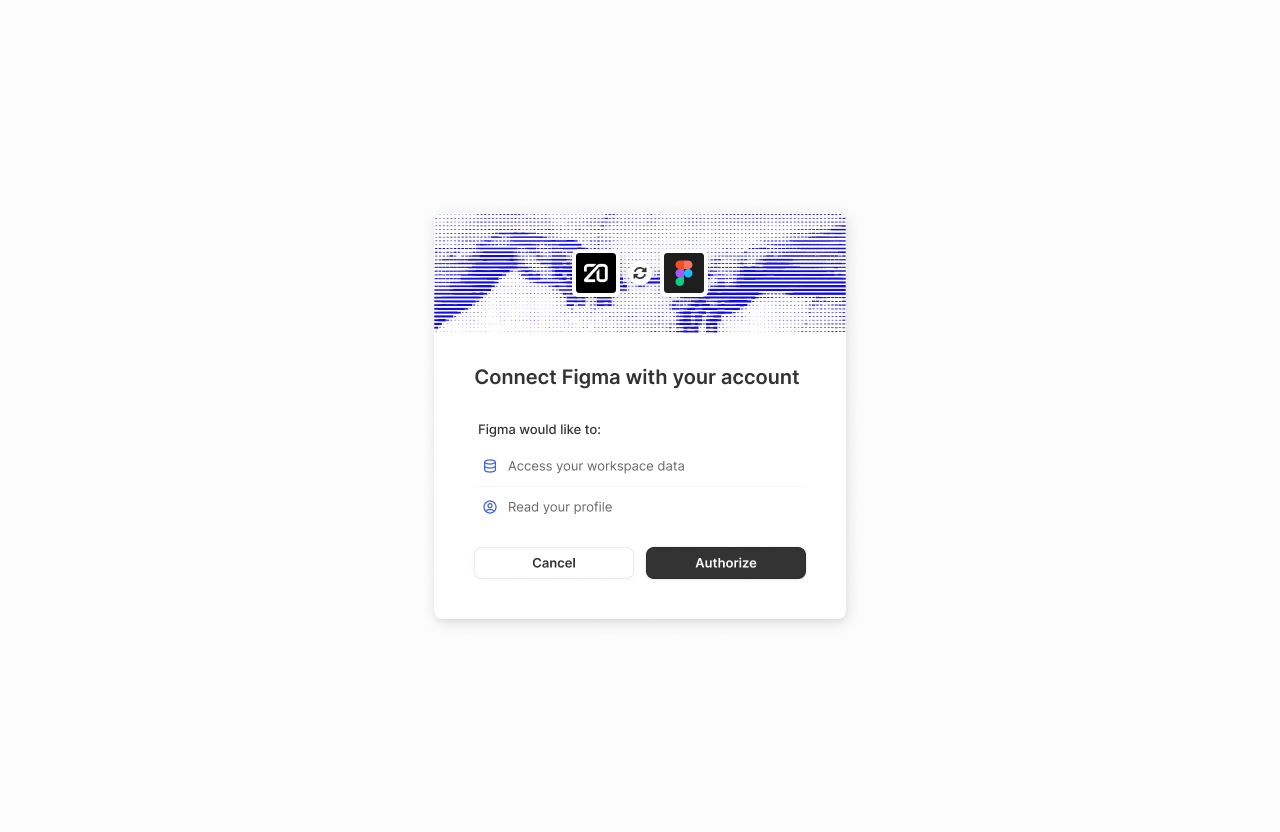 ## Validation - `yarn nx test twenty-front --testFile=src/modules/auth/hooks/__tests__/useAuth.test.tsx --coverage=false` - `yarn nx test twenty-server --testFile=src/engine/core-modules/auth/services/auth.service.spec.ts --coverage=false` - `yarn nx typecheck twenty-front` - `yarn nx typecheck twenty-server` - `git diff --check` ## Notes The reference screenshot is linked from a separate branch-hosted image commit so it renders in the PR body without adding that screenshot to the product diff. Co-authored-by: Charles Bochet <charles@twenty.com> |
||
|
Etienne
|
fcd2d586ee |
chore(billing) - remove feature flag (#20531)
- remove feature flag - remove old enforce cap usage logic |
||
|
neo773
|
b03f044d0f |
feat(messaging): add workspace toggle to sync internal emails (#20457)
Co-authored-by: cubic-dev-ai[bot] <191113872+cubic-dev-ai[bot]@users.noreply.github.com> |
||
|
Félix Malfait
|
4da8878697 |
feat: add email forwarding message channel (#19535)
## Summary - Add email forwarding as a new message channel type, allowing users to forward emails from addresses like `support@mycompany.com` into Twenty - Inbound emails arrive via S3 (SES → S3 bucket), are polled by a cron job, parsed, routed to the correct workspace/channel, and persisted as messages - Dedicated settings page at `/settings/accounts/new-email-forwarding` where users provide their source email handle and receive a unique forwarding address - Forwarding channels bypass the IMAP/mailbox sync state machine — they skip cron-driven sync, relaunch, and message-list-fetch lifecycle stages - Forwarding address section shown at the top of the Emails settings page so users can find/copy their addresses after initial setup - Tab names for forwarding channels display the user-provided handle (e.g. `support@mycompany.com`) instead of the internal routing address - Shared utilities extracted from IMAP driver: `extractThreadId`, `extractParticipants`, `extractAddresses` to avoid code duplication - Uses the existing S3 bucket (STORAGE_S3_*) with `inbound-email/` prefix — no separate bucket needed - Feature gated behind `isEmailForwardingEnabled` client config (requires `INBOUND_EMAIL_DOMAIN` + S3 storage) ## New backend modules - `InboundEmailS3ClientProvider` — lazy-initialized S3 client using existing storage config - `InboundEmailStorageService` — S3 operations (get, move to processed/unmatched/failed) - `InboundEmailParserService` — RFC 822 parsing via `postal-mime`, builds `MessageWithParticipants` - `InboundEmailImportService` — orchestrates download → parse → route → persist → archive - `MessagingInboundEmailPollCronJob` — polls S3 `incoming/` prefix, enqueues import jobs - `CreateEmailForwardingChannelInput` DTO — accepts user-provided `handle` ## New frontend components - `SettingsAccountsNewEmailForwardingChannel` — dedicated page with handle input form + forwarding address result - `SettingsAccountsEmailForwardingSection` — forwarding address list on the Emails settings page - `useConnectedAccountHandleMap` — shared hook for account ID → handle lookup - `useCreateEmailForwardingChannel` — mutation hook accepting handle parameter ## Test plan - [x] 17 unit tests for inbound email import service (all outcomes: imported, unmatched, loop_dropped, unconfigured, parse_failed, persist_failed) - [x] 16 tests for `computeSyncStatus` including EMAIL_FORWARDING cases - [x] 11 tests for `extractEnvelopeRecipient` utility - [x] TypeScript typechecks pass for both twenty-server and twenty-front - [x] Lint passes for both packages - [ ] Manual: create forwarding channel, verify forwarding address generated - [ ] Manual: send email to forwarding address, verify it appears in Twenty https://claude.ai/code/session_01KpyF6p4cUEnuaT4h8DP5Pm --------- Co-authored-by: Claude <noreply@anthropic.com> Co-authored-by: Copilot Autofix powered by AI <223894421+github-code-quality[bot]@users.noreply.github.com> Co-authored-by: claude[bot] <41898282+claude[bot]@users.noreply.github.com> Co-authored-by: neo773 <62795688+neo773@users.noreply.github.com> Co-authored-by: neo773 <neo773@protonmail.com> |
||
|
Etienne
|
9fc5be1c4c |
Billing - Migrate from Stripe metering (#20298)
**Overall strategy** **1. Introduce “Billing V2” behind a workspace flag** Gate the new model with FeatureFlagKey.IS_BILLING_V2_ENABLED so existing workspaces stay on the old behavior until they’re migrated or explicitly on V2. **2. Replace workflow metered SKUs with a resource-credit product** Conceptually, billable “workflow execution” usage is not the primary subscription line item anymore. Add a RESOURCE_CREDIT product (and keep WORKFLOW_NODE_EXECUTION as deprecated for the transition). Usage and limits are expressed through credit buckets (e.g. price metadata like credit_amount), so one product can represent pooled credits instead of a narrow workflow-only meter. **3. Migrate subscriptions in two layers** Schema/catalog: persist extra price metadata (instance upgrade) so the server knows credit amounts and can match Stripe prices to the new model. Per workspace: the registered workspace command upgrade:2-2:migrate-to-billing-v2 finds subscriptions that still have WORKFLOW_NODE_EXECUTION, swaps those items to the right RESOURCE_CREDIT prices (using existing Stripe schedule + BillingSubscriptionUpdateService stack), then treats the workspace as V2 (flag). Workspaces without that legacy item or without a subscription are skipped. **4. Unify subscription lifecycle + usage on the server** **5. Refresh the product surface in Settings** Test : - [x] Subscribe v1 + Update subscribe + Migrate - [x] Subscribe v2 + Update subscribe |
||
|
Charles Bochet
|
027331c893 |
chore(front): move mocked-metadata helpers under src/testing (#20341)
## Summary Follow-up to #20308. After that PR, production code no longer loads mocked metadata when the user is unauthenticated. The remaining mocked-metadata helpers (`useLoadMockedMetadata`, `preloadMockedMetadata`) are now only consumed by Storybook decorators, so move them next to the other testing-only utilities to make their scope explicit and prevent accidental re-introduction of a runtime dependency on mocks. - `src/modules/metadata-store/hooks/useLoadMockedMetadata.ts` → `src/testing/hooks/useLoadMockedMetadata.ts` - `src/modules/metadata-store/utils/preloadMockedMetadata.ts` → `src/testing/utils/preloadMockedMetadata.ts` The three Storybook decorator imports (`MockedMetadataLoadEffect`, `ObjectMetadataItemsDecorator`, `WorkflowStepDecorator`) are updated to the new `~/testing/...` paths. No runtime behavior change. ## Test plan - [x] `npx oxlint --type-aware -c .oxlintrc.json` on touched files — clean - [x] `npx prettier --check` on touched files — clean - [ ] CI: storybook, unit tests, e2e tests |
||
|
Charles Bochet
|
ee6c0ef904 |
Replace sign-in mocked metadata with hardcoded BackgroundMock (#20308)
## Summary When the user is logged out, we render the auth modal on top of a sample table to make the empty page feel alive. So far this was achieved by **loading a full set of mocked object / field / view / navigation-menu metadata into the runtime metadata store** and then mounting the real `RecordTable` and `AppNavigationDrawer` behind the modal. This had a few downsides: - Significant bundle weight pulled in for unauthenticated users (mocked GraphQL fixtures + the real `RecordTable` virtualization stack). - Plenty of code paths that had to know about the "showAuthModal" case (`useRecordIndexTableQuery`, `useTriggerInitialRecordTableDataLoad`, `MainContextStoreProvider`, `IsMinimalMetadataReadyEffect`...). - Any change to metadata-store internals or to the record-table runtime risked breaking the logged-out background. This PR replaces the entire flow with a small, self-contained `BackgroundMock` component tree that **does not consume any metadata** and **does not load any mocked metadata at runtime**. ### What changed - New module under `sign-in-background-mock`: - `BackgroundMockPage` + `BackgroundMockViewBar` + `BackgroundMockTable` + `BackgroundMockTableRow` render a hardcoded "Companies" table that visually mirrors the real one. - `BackgroundMockNavigationDrawer` renders a hardcoded sidebar with People / Companies / Opportunities / Tasks / Notes (with their standard colors). - Hardcoded constants in `BackgroundMockCompanies.ts`, `BackgroundMockColumns.ts`, `BackgroundMockNavigationItems.ts`. - `MinimalMetadataLoadEffect` no longer calls `loadMockedMetadataAtomic` for unauthenticated users — it just doesn't load anything. - `IsMinimalMetadataReadyEffect` now reports ready immediately when there is no access token pair, so the skeleton loader doesn't hang waiting for metadata that will never come. - `MainContextStoreProvider`, `useRecordIndexTableQuery`, and `useTriggerInitialRecordTableDataLoad` drop their `showAuthModal` branches — the real `RecordTable` is no longer mounted behind the modal. - `DefaultLayout` and `NotFound` now lazily load `BackgroundMockPage` / `BackgroundMockNavigationDrawer` instead of the deleted `SignInBackgroundMockPage` / `SignInAppNavigationDrawerMock`. - Removed: `SignInBackgroundMockPage`, `SignInBackgroundMockContainer`, `SignInBackgroundMockContainerEffect`, `SignInAppNavigationDrawerMock`, `SignInBackgroundMockColumnDefinitions`, `SignInBackgroundMockCompanies`, `SignInBackgroundMockViewFields`. `useLoadMockedMetadata` and `preloadMockedMetadata` are kept on purpose: Storybook decorators (`ObjectMetadataItemsDecorator`, `WorkflowStepDecorator`) still rely on the mocked metadata fixtures, but **production** unauthenticated runtime no longer touches them. ### Visual parity Side-by-side at 1440×900 on `/sign-in`: **Before** (loads mocked metadata + real RecordTable):  **After** (purely hardcoded BackgroundMock):  ## Test plan - [ ] `npx nx typecheck twenty-front` ✅ (passes locally) - [ ] `npx nx lint:diff-with-main twenty-front` ✅ (oxlint + prettier clean) - [ ] `npx jest useRecordIndexTableQuery` ✅ - [ ] Manually verify `/sign-in` renders the table + nav drawer behind the modal - [ ] Manually verify `/not-found` still renders the background - [ ] Verify CI: storybook, unit tests, e2e tests |
||
|
neo773
|
d040756fcf |
remove direction from messages (#20026)
This was a leftover column removed in https://github.com/twentyhq/twenty/pull/6743 but was accidentally added again when we migrated to `buildMessageStandardFlatFieldMetadatas` from workspace decorator /closes #20011 |
||
|
Paul Rastoin
|
596ce32bd6 |
Fix front unit test on main (#20233)
Jest mocks runs before the const is defined |
||
|
Paul Rastoin
|
89ad87aa64 |
Make twenty-front build env agnostic (#20055)
## Introduction
In aim to reduce and optimize the number of twenty-front build we do
during our cd process and allow twenty-front build promotion

### Build time

**Nothing is baked.** The `build/` directory is a clean, env-agnostic
artifact. `index.html` contains the empty placeholder:

```html
<script id="twenty-env-config">
  window._env_ = {
    // This will be overwritten
  };
</script>
```

The JS bundles contain no hardcoded server URL.

---

### Deploy mode 1: Frontend served by the backend (Docker / NestJS)

1. Container starts, NestJS boots in `main.ts`
2. `generateFrontConfig()` runs, reads `process.env.SERVER_URL`
3. Rewrites `dist/front/index.html`, replacing the placeholder with:
   ```html
   <script id="twenty-env-config">
     window._env_ = {
       REACT_APP_SERVER_BASE_URL: "https://api.example.com"
     };
   </script>
   ```
4. NestJS serves the static `dist/front/` directory
5. Browser loads `index.html`, `window._env_` is set before the app JS
executes
6. `src/config/index.ts` reads `window._env_.REACT_APP_SERVER_BASE_URL`
and uses it

---

### Deploy mode 2: Frontend served standalone (CDN / nginx / static
server)

1. Take the `build/` artifact as-is
2. Before serving, run at deploy time:
   ```bash
REACT_APP_SERVER_BASE_URL=https://api.example.com sh
./scripts/inject-runtime-env.sh
   ```
3. This does the same `sed` replacement on `build/index.html`
4. Serve the `build/` directory with your static server of choice
5. Same resolution in the browser:
`window._env_.REACT_APP_SERVER_BASE_URL` is picked up by
`src/config/index.ts`

---

### Fallback: no injection at all

If neither mechanism runs (e.g. local dev with `vite dev`),
`window._env_.REACT_APP_SERVER_BASE_URL` is `undefined`, and
`getDefaultUrl()` kicks in:
- **Localhost**: returns `http://localhost:3000`
- **Non-localhost**: returns same-origin (`window.location.origin`)
|
||
|
Charles Bochet
|
96fc98e710 |
Fix Apps UI: replace 'Managed' label with actual app name and unify app icons (#19897)
## Summary

- The Data Model table was labeling core Twenty objects (e.g. Person,
Company) as **Managed** even though they are part of the standard
application. This PR teaches the frontend to resolve an `applicationId`
back to its real application name (`Standard`, `Custom`, or any
installed app), and removes the misleading **Managed** label entirely.
- Introduces a single, consistent way to render an "app badge" across
the settings UI:
- new `Avatar` variant `type="app"` (rounded 4px corners + 1px
deterministic border derived from `placeholderColorSeed`)
- new `AppChip` component (icon + name) backed by a new
`useApplicationChipData` hook
- new `useApplicationsByIdMap` hook + `CurrentApplicationContext` so the
chip can render **This app** when shown inside the matching app's detail
page
- Reuses these primitives on:
- the application detail page header (`SettingsApplicationDetailTitle`)
  - the Installed / My apps tables (`SettingsApplicationTableRow`)
  - the NPM packages list (`SettingsApplicationsDeveloperTab`)
- Backend: exposes a minimal `installedApplications { id name
universalIdentifier }` field on `Workspace` (resolved from the workspace
cache, soft-deleted entries filtered out) so the frontend can resolve
`applicationId` -> name without N+1 fetches.
- Cleanup: deletes `getItemTagInfo` and inlines its tiny
responsibilities into the components that need them, matching the
`RecordChip` pattern.
|
||
|
Weiko
|
df9c4e26b5 |
Disable reset to default when custom tab or widget (#19814)
## Context "Reset to default" action is rejected by the backend for custom entities because there is no "default" concept for them ## Implementation Grey out the Reset to default action on record page-layout tabs and widgets when the entity either has no applicationId yet (unsaved draft — previously slipped through the existing check), or belongs to the workspace custom application. <img width="926" height="370" alt="Screenshot 2026-04-17 at 18 50 31" src="https://github.com/user-attachments/assets/c7c163f4-17a6-4b69-a66d-90f9085d27a2" /> |
||
|
Etienne
|
94b8e34362 |
Object view widget - Introduce new TABLE_WIDGET view type (#19545)
closes https://discord.com/channels/1130383047699738754/1491549365263667230/1491804729397743666 |
||
|
Raphaël Bosi
|
a88d1f4442 |
Introduce standalone page (#19675)
Add support for standalone pages: a new `PageLayout` type (`STANDALONE_PAGE`) that can be rendered independently at `/page/:pageLayoutId`, not tied to any record or object context. - New `STANDALONE_PAGE` page layout type - New `PAGE_LAYOUT` navigation menu item type: adds a `pageLayoutId` foreign key to `NavigationMenuItemEntity`, allowing sidebar items to link directly to standalone pages - New `GLOBAL_OBJECT_CONTEXT` command menu availability type: separates object-context-dependent commands (Create Record, Import, Export, See Deleted, Create View, Hide Deleted) from truly global ones, so standalone pages only show relevant commands - Frontend routing & rendering: adds a `/page/:pageLayoutId` route with its own page component, header, and command menu - Widget rendering refactor - Instance commands: two fast 1.22 migrations: `pageLayoutId` column + `STANDALONE_PAGE` enum, and `GLOBAL_OBJECT_CONTEXT` availability type enum - Workspace command: backfills existing command menu items from `GLOBAL` to `GLOBAL_OBJECT_CONTEXT` where appropriate - Dev seeds: adds a sample "Star History" standalone page with an iframe widget for local development |
||
|
Weiko
|
47bdcb11d8 |
Move is active to fe (#19649)
## Context Moving isActive filtering to the frontend for page layout tabs and widgets, hiding inactive entities from the UI while keeping them in state for future reactivation Next we will implement deactivated standard tab re-activation during tab creation (cc @Devessier) <img width="234" height="303" alt="📋 Menu (Slots)" src="https://github.com/user-attachments/assets/17a25ac6-55e2-4778-b7f0-e7554ed69704" /> |
||
|
Charles Bochet
|
b284c8323c |
Remove Favorite and FavoriteFolder from workspace schema (#19536)
## Summary - Removes all workspace schema definitions for `Favorite` and `FavoriteFolder` entities, which have been fully migrated to `NavigationMenuItems` - Deletes 26 standalone files including workspace entities, NestJS modules, services, listeners, jobs, standard application builders (field metadata, views, view fields, view field groups, indexes, page layouts), mocks, and integration tests - Cleans up ~40 modified files: removes `favorites` relation from 10 workspace entities and their field metadata utils, removes entries from all builder maps, shared constants (`STANDARD_OBJECTS`, `CoreObjectNameSingular`, `DEFAULT_RELATIONS_OBJECTS_STANDARD_IDS`), SDK default relations, AI tool filtering, and standard object icons |
||
|
Weiko
|
238018dc7b |
Reset Tab Page Layout (#19453)
## Context - Add "Reset to default" for page layout tabs and widgets — backend mutation resets overrides, reactivates deactivated children, and deletes custom children - Fix override write bug where mutating an overridable property (e.g. widget title) on a standard-app entity incorrectly overwrote the base column instead of writing to the overrides JSONB — PageLayoutUpdateService now uses resolveFlatEntityOverridableProperties for accurate diffing and routes properties through sanitizeOverridableEntityInput - Deprecate isOverridden - We need more time to think about this feature. Currently this adds too much complexity for a very small benefit https://github.com/user-attachments/assets/a84546c8-1e15-4d9e-a489-0825cf8b8ed2 |
||
|
Charles Bochet
|
81f10c586f |
Add workspace DDL lock env var and maintenance mode UI (#19130)
## Summary - Add `WORKSPACE_SCHEMA_DDL_LOCKED` env-only boolean config variable that blocks all workspace schema DDL changes when set to `true`. This is intended for hot upgrades where logical replication cannot handle DDL changes. Enforced at two chokepoints: - `WorkspaceMigrationRunnerService.run` — blocks all metadata-driven DDL (object/field/index CRUD, app sync/uninstall, standard app sync, upgrade commands) - `WorkspaceDataSourceService.createWorkspaceDBSchema` / `deleteWorkspaceDBSchema` — blocks workspace creation (sign-up) and hard deletion. Uses a dedicated `WorkspaceDataSourceException` (not ForbiddenException) - Add maintenance mode feature with Admin Panel UI and user-facing banner: - **Backend**: `MaintenanceModeService` stores maintenance window (startAt, endAt, optional link) in `core.keyValuePair` as `CONFIG_VARIABLE`. Validates endAt > startAt. Uses `GraphQLISODateTime` scalar for date fields. Exposed via `clientConfig` REST endpoint and admin GraphQL mutations (`setMaintenanceMode`, `clearMaintenanceMode`) - **Admin Panel**: New "Maintenance Mode" section in Health tab with UTC datetime pickers and activate/deactivate controls - **Banner**: `InformationBannerMaintenance` displayed at the top of `DefaultLayout` for all users, using Temporal API for timezone-aware formatting with an optional "Learn more" link These two features are **independent** — the DDL lock is controlled via env var for operational use, while maintenance mode is a UI notification mechanism controlled from the admin panel. |
||
|
Raphaël Bosi
|
9f95c4763c |
[COMMAND MENU ITEMS] Remove deprecated code (#19199)
This PR is the first one of a cleanup after upgrading command menu items to V2. |
||
|
Etienne
|
887e0283c5 |
Direct execution - Follow up (#19177)
Feedbacks from https://github.com/twentyhq/twenty/pull/18972 |
||
|
Charles Bochet
|
81fc960712 |
Deprecate dataSource table with dual-write to workspace.databaseSchema (#19059)
## Summary - Starts deprecation of the `core.dataSource` table by introducing a dual-write system: `DataSourceService.createDataSourceMetadata` now writes to both `core.dataSource` and `core.workspace.databaseSchema` - Migrates read sites (`WorkspaceDataSourceService.checkSchemaExists`, `WorkspaceSchemaFactory`, `MiddlewareService`, `WorkspacesMigrationCommandRunner`) to read from `workspace.databaseSchema` instead of querying the `dataSource` table - Removes the unused `databaseUrl` field from `WorkspaceEntity` and drops the column via migration - Adds a 1.20 upgrade command to backfill `workspace.databaseSchema` from `dataSource.schema` for existing workspaces |
||
|
nitin
|
578d990b9c |
[AI] Match ai chat composer to figma (#18874)
https://www.figma.com/design/xt8O9mFeLl46C5InWwoMrN/Twenty?node-id=93653-368288&t=obTG32NRidXid4lN-0 closes https://discord.com/channels/1130383047699738754/1480990726442582086 --------- Co-authored-by: Félix Malfait <felix.malfait@gmail.com> Co-authored-by: Félix Malfait <felix@twenty.com> |
||
|
Charles Bochet
|
611947e031 |
fix: metadata store lifecycle during sign-in, sign-out, and locale change (#18901)
## Summary Fixes metadata lifecycle bugs during sign-in, sign-out, and locale change: - **Cross-tab sign-out**: Broadcasts sign-out via `BroadcastChannel` so other tabs clear their session gracefully instead of hitting stale-token errors - **SSE teardown on sign-out**: Handles `UNAUTHENTICATED`/`FORBIDDEN` errors in the SSE event stream effect instead of throwing unhandled errors - **Locale switch resilience**: `invalidateAndReload` now invalidates collection hashes instead of clearing the store to empty, so components never see 0 metadata items during the reload transition - **Sign-in background mock**: Uses non-throwing `objectMetadataItemFamilySelector` instead of hooks that throw on missing metadata - **View name placeholders**: Guards against `undefined` `viewName` during metadata transitions (the minimal metadata query doesn't include `name`) - **Session cleanup**: Selective `localStorage` clearing (`clearSessionLocalStorageKeys`) preserves metadata keys; `clearAllSessionLocalStorageKeys` for full clears - **Metadata reload API**: New `useMetadataStoreActions` hook as the high-level API for metadata lifecycle operations (`applyMockedMetadata`, `invalidateAndReload`, `loadMockedMetadataAtomic`) ## Test plan - [ ] Sign out on Tab A → Tab A shows sign-in page with no console errors - [ ] Tab B (logged in) receives cross-tab broadcast and redirects to sign-in - [ ] No "Forbidden resource" SSE errors in console during sign-out - [ ] Change language in Settings > Experience → no crash, metadata refreshes in background - [ ] Sign back in after sign-out → metadata loads correctly, app is functional - [ ] Re-sign-in after locale change → correct locale is preserved |
||
|
Félix Malfait
|
77d4bd9158 |
Add billing usage analytics dashboard with ClickHouse integration (#18592)
## Summary This PR adds a comprehensive billing usage analytics feature that provides detailed breakdowns of credit consumption across execution types, users, resources, and time periods. The implementation includes a new ClickHouse-backed analytics service, GraphQL API endpoint, and a frontend dashboard component. ## Key Changes ### Backend - **New BillingAnalyticsService**: Queries ClickHouse for usage breakdowns by user, resource, execution type, and time series data - **BillingEventWriterService**: Writes billing events to ClickHouse for analytics while maintaining best-effort semantics (never blocks Stripe billing) - **ClickHouse Schema**: Added `billingEvent` table with 3-year TTL for storing detailed billing event data - **GraphQL Resolver**: New `getBillingAnalytics` query that aggregates usage data for the current billing period, protected by feature flag and billing permissions - **Enhanced BillingUsageEvent**: Added `userWorkspaceId` field to track per-user credit consumption - **AI Billing Integration**: Updated AI billing service to pass `userWorkspaceId` when recording usage events ### Frontend - **SettingsBillingAnalyticsSection**: New component displaying: - Usage breakdown by execution type with progress bars - Daily usage time series chart (28-day view) - Per-user credit consumption breakdown - Per-resource (agent/workflow) credit consumption breakdown - **SettingsUsage Page**: Dedicated page for viewing usage analytics - **GraphQL Query**: `GetBillingAnalytics` query with generated hooks - **Navigation**: Added Usage menu item in settings (feature-flagged) - **Mock Data**: Included screenshot mock data for preview/testing ### Feature Flag - Added `IS_USAGE_ANALYTICS_ENABLED` feature flag to control visibility and access to analytics features ## Implementation Details - Analytics data is queried in parallel for performance - ClickHouse writes are non-blocking to ensure billing operations never fail - Progress bars use dynamic coloring from a predefined palette - Time series visualization normalizes bar heights relative to max value - Empty state handling when no analytics data is available - Responsive UI with proper text truncation for long names https://claude.ai/code/session_01Y1EqrX6PFq3EJxJq89h7DF --------- Co-authored-by: Claude <noreply@anthropic.com> |
||
|
Raphaël Bosi
|
c107d804d2 |
Create command menu items for workflows with manual trigger (#18746)
- Automatically create and sync command menu items for all workflows with a manual trigger - Refactor `useCommandMenuItemsFromBackend` - Prefill a _Quick Lead_ workflow command menu item during workspace setup and dev seeding - Add a ready prop to `HeadlessEngineCommandWrapperEffect` to prevent premature execution when async data hasn't loaded yet --------- Co-authored-by: Charles Bochet <charles@twenty.com> |
||
|
Charles Bochet
|
d5a7dec117 |
refactor: rename ObjectMetadataItem to EnrichedObjectMetadataItem and clean up metadata flows (#18830)
## Summary - Renames `ObjectMetadataItem` to `EnrichedObjectMetadataItem` across the entire frontend (~440 files) to clarify that this type includes derived fields (`readableFields`, `updatableFields`, nested `fields[]`, `indexMetadatas[]`) computed at read time from the metadata store - Creates `splitObjectMetadataGqlResponse` that goes directly from a GraphQL `ObjectMetadataItemsQuery` response to flat store items (combining the old `mapPaginatedObjectMetadataItemsToObjectMetadataItems` + `splitObjectMetadataItemWithRelated` two-step flow into one call) - Removes `ObjectMetadataItemWithRelated` type and all "WithRelated" naming - Renames `generatedMockObjectMetadataItems` to `generateTestEnrichedObjectMetadataItemsMock` to make it clear this is test-only enriched data - Deletes `useLoadMockedObjectMetadataItems` hook (consolidated into `useLoadMockedMinimalMetadata`) - Ensures nothing destined for the metadata store computes `readableFields`/`updatableFields` (preventing the localStorage bloat from #18809) ## Type hierarchy (before → after) **Before:** ``` ObjectMetadataItemsQuery → mapPaginated → ObjectMetadataItemWithRelated → enrich → ObjectMetadataItem → split → FlatObjectMetadataItem (store) ``` **After:** ``` ObjectMetadataItemsQuery → splitObjectMetadataGqlResponse → FlatObjectMetadataItem (store) → mapPaginated + enrich (tests only) → EnrichedObjectMetadataItem ``` ## Test plan - [x] `npx nx typecheck twenty-front` passes - [x] `npx nx test twenty-front` passes (767 suites, 4505 tests) - [x] `npx nx lint twenty-front` passes - [ ] CI checks pass Made with [Cursor](https://cursor.com) |
||
|
Félix Malfait
|
96c5728ed0 |
fix: prevent localStorage bloat from derived fields on mock metadata (#18809)
## Summary - On unauthenticated pages (login), mocked object metadata was being hydrated into the store with `readableFields` and `updatableFields` attached. These derived arrays duplicate every field per object, inflating `objectMetadataItems` in localStorage from ~70 KB to ~2 MB. Combined with other metadata keys, this exceeded Safari's 5 MB quota and caused `QuotaExceededError`, preventing real data from replacing mock data on login. - Extracted flat mock data into a dedicated file (`generatedMockObjectMetadataItemsWithRelated.ts`) and use it for store hydration, keeping the enriched version (`generatedMockObjectMetadataItems`) only for tests. - Completed `splitObjectMetadataItemWithRelated`'s contract by stripping `readableFields` and `updatableFields` at runtime (not just via TypeScript's `Omit`), matching the `FlatObjectMetadataItem` return type that omits all four relational properties. ## Root cause 1. `MinimalMetadataLoadEffect` loads mocked metadata on unauthenticated pages. 2. `generatedMockObjectMetadataItems` was produced by `enrichObjectMetadataItemsWithPermissions`, which attaches `readableFields` and `updatableFields` (full copies of the `fields` array). 3. `splitObjectMetadataItemWithRelated` only destructured `fields` and `indexMetadatas` — `readableFields`/`updatableFields` leaked into `...objectProperties` at runtime because `Omit` is a compile-time-only guard. 4. These bloated objects were written to localStorage, consuming ~2 MB instead of ~70 KB. 5. On login, the intermediate state (old composite mock `current` + new flat real `draft`) exceeded the 5 MB quota, causing a `QuotaExceededError` deadlock. ## Test plan - [ ] Open the app in a fresh Safari private window (empty localStorage) - [ ] Verify the login page loads without errors - [ ] Log in and verify metadata loads correctly - [ ] Check `localStorage` size — `metadataStoreState__objectMetadataItems` should be ~70 KB, not ~2 MB - [ ] Run existing tests: `npx nx test twenty-front` — no regressions from the mock data split Made with [Cursor](https://cursor.com) --------- Co-authored-by: Charles Bochet <charles@twenty.com> |
||
|
Félix Malfait
|
908aefe7c1 |
feat: replace hardcoded AI model constants with JSON seed catalog (#18818)
## Summary - Replaces per-provider TypeScript constant files (`openai-models.const.ts`, `anthropic-models.const.ts`, etc.) with a single `ai-providers.json` catalog as the source of truth - Adds runtime model discovery via AI SDK for self-hosted providers, with `models.dev` enrichment for pricing/capabilities - Introduces composite model IDs (`provider/modelId`) for canonical, conflict-free identification - Simplifies provider configuration: API keys are injected from environment variables (e.g., `OPENAI_API_KEY`) - Adds admin panel UI for provider management (add/remove/test), model discovery, recommended model configuration, and default fast/smart model selection per workspace - Removes deprecated config variables (`AI_DISABLED_MODEL_IDS`, `AUTO_ENABLE_NEW_AI_MODELS`, etc.) - Adds database migration for composite model ID format ## Test plan - [ ] Server typecheck passes - [ ] Frontend typecheck passes - [ ] Server unit tests pass - [ ] Frontend unit tests pass - [ ] CI pipeline green - [ ] Admin panel AI tab loads correctly - [ ] Provider discovery works for configured providers - [ ] Model recommendation toggles persist - [ ] Default fast/smart model selection works Made with [Cursor](https://cursor.com) |
||
|
Félix Malfait
|
c6f11d8adb |
fix: migrate driver modules to DriverFactoryBase lazy-loading pattern (#18731)
## Summary - Migrates `LogicFunctionModule`, `CodeInterpreterModule`, and `CaptchaModule` from the `forRootAsync` + injection token pattern to the `DriverFactoryBase` lazy-loading pattern (matching `EmailModule` and `FileStorageModule`) - Fixes #18724 where `LOGIC_FUNCTION_TYPE` was not respected in worker processes because the driver was created at module boot time before the DB config cache was loaded - Removes `isEnvOnly` from `LOGIC_FUNCTION_TYPE`, `CODE_INTERPRETER_TYPE`, `CAPTCHA_DRIVER`, `IS_MULTIWORKSPACE_ENABLED`, and `FRONTEND_URL` — these can now be safely configured via the database at runtime ## How it works Each migrated module now uses a `DriverFactory` (extending `DriverFactoryBase`) instead of a module-level async factory + Symbol injection token: 1. **Lazy creation**: `getCurrentDriver()` creates the driver on first call, after `DatabaseConfigDriver.onModuleInit()` has loaded the DB cache 2. **Auto-recreation**: If config changes in the DB, the next `getCurrentDriver()` call detects the key mismatch and creates a new driver instance 3. **Unified config**: Both server and worker read from the same database — driver config only needs to be set once ### Files deleted (old pattern) - `logic-function-module.factory.ts`, `logic-function-drivers.module.ts`, `logic-function-driver.constants.ts` - `code-interpreter-module.factory.ts` - `captcha.module-factory.ts`, `captcha-driver.constants.ts` ### Files created (new pattern) - `logic-function-driver.factory.ts` - `code-interpreter-driver.factory.ts` - `captcha-driver.factory.ts` Net: **-150 lines** ## Test plan - [x] `npx nx typecheck twenty-server` passes - [x] `npx nx lint:diff-with-main twenty-server` passes - [ ] Integration tests pass (`npx nx run twenty-server:test:integration:with-db-reset`) - [ ] Verify logic functions execute in workflow runs (the original bug) - [ ] Verify code interpreter works in workflow code steps - [ ] Verify captcha validation works on sign-up (when captcha is configured) Made with [Cursor](https://cursor.com) |
||
|
Thomas Trompette
|
994215e0dc |
Update store on data model mutation (#18684)
- enrich SSE events with relations - remove queries from sse metadata events - on sse event, manage store - on object/field metadata changes, manage store TODO left: - fix other metadata items --------- Co-authored-by: github-actions[bot] <41898282+github-actions[bot]@users.noreply.github.com> Co-authored-by: github-actions <github-actions@twenty.com> Co-authored-by: Charles Bochet <charles@twenty.com> |
||
|
Charles Bochet
|
1be87eb97b |
chore: frontend dead code removal and naming cleanup (#18690)
## Summary - **Delete 10 unused files**: 7 hooks (`useWorkflowRunUnsafe`, `useGetViewById`, `useCreateViewFieldGroup`, `useDeleteViewFieldGroup`, `useUpdateViewFieldGroup`, `useCreateManyViewFieldGroups`, `useMoveViewColumns` + test), 1 component (`SettingsSummaryCard`), 1 utility (`createEventContext`) - **Rename `objectMetadataItemsState` → `objectMetadataItemsSelector`** across ~85 files to accurately reflect it is a derived selector (via `createAtomSelector`), not a base Jotai atom ## Details ### Dead code removed | Type | Name | Reason | |------|------|--------| | Hook | `useWorkflowRunUnsafe` | Never imported — duplicate of `useWorkflowRun` without schema validation | | Hook | `useGetViewById` | Never imported — `useViewById` is used instead | | Hook | `useCreateViewFieldGroup` | Never imported — CRUD done via `usePerformViewFieldGroupAPIPersist` | | Hook | `useDeleteViewFieldGroup` | Same as above | | Hook | `useUpdateViewFieldGroup` | Same as above | | Hook | `useCreateManyViewFieldGroups` | Same as above | | Hook | `useMoveViewColumns` | Only imported by its own test — no production usage | | Component | `SettingsSummaryCard` | Never imported anywhere | | Utility | `createEventContext` | Never imported anywhere | ### Rename `objectMetadataItemsState` is created via `createAtomSelector` (it derives from `objectMetadataItemsWithFieldsSelector`), so naming it `*State` is misleading. Renamed to `objectMetadataItemsSelector` for consistency with sibling selectors like `objectMetadataItemsByNamePluralMapSelector`. |
||
|
Charles Bochet
|
5c745059ad |
refactor: remove "core" naming from views and eliminate converter layer (#18667)
## Summary

- **Remove all "core" prefixes** from the views system — the
metadata-based storage migration is complete, so `CoreView`,
`coreViewsSelector`, `getCoreViews`, etc. are now just `View`,
`viewsSelector`, `getViews`
- **Eliminate the entire converter layer** (15 files, ~850 lines
deleted) — `convertCoreViewToView` and all sub-converters were either
no-ops or trivially adding `__typename` / mapping identical enum values.
Local enums now re-export from generated GraphQL types directly (single
source of truth)
- **Unify `View` and `ViewWithRelations`** into one type —
`ViewWithRelations` is now a type alias for `View`, selectors return
data directly without conversion

### Backend
- Rename `@ObjectType('CoreView')` → `@ObjectType('View')` (and all
sub-entities)
- Rename resolver methods: `getCoreViews` → `getViews`, `createCoreView`
→ `createView`, etc.
- Rename `FIND_ALL_CORE_VIEWS_GRAPHQL_OPERATION` →
`FIND_ALL_VIEWS_GRAPHQL_OPERATION`

### Frontend
- Delete 15 converter files (`convertGqlView*ToView*`,
`convertView*ToGql`, `convertViewWithRelationsToView`)
- Re-export `ViewType`, `ViewKey`, `ViewFilterGroupLogicalOperator` from
generated enums (no more duplicate enum definitions with different
casing)
- Replace `ViewOpenRecordInType` with `ViewOpenRecordIn` from generated
- Remove `__typename` from all local view sub-types
- Remove unused `variant` from `ViewFilter`, make `displayValue` and
`definition` optional
- Rename ~45 GraphQL query/mutation files and all selectors to drop
"core" prefix
- Delete unused `viewsWithRelationsSelector`
|
||
|
Charles Bochet
|
ba9aa41bba |
refactor: metadata store cleanup, SSE unification, mock metadata loading & login redirect fix (#18651)
## Summary - **SSE unification**: Replaced 11 individual SSE effect components with a single generic `MetadataStoreSSEEffect` - **Metadata store cleanup**: Merged `metadataCollectionHashesState` into `metadataStoreState` (currentCollectionHash / draftCollectionHash per entity), moved `objectMetadataItemsSelector` to `object-metadata` domain, converted `navigationMenuItemsState` to a derived selector - **Naming clarity**: Renamed `isAppMetadataReadyState` → `isMinimalMetadataReadyState`, `MetadataGater` → `MinimalMetadataGater`, `useIsLogged` → `useHasAccessTokenPair`, `patchMetadataStoreFromSSEEvent` now takes named object params - **Mock metadata loading**: Added `generate-navigation-menu-items.ts` script, rewrote `useLoadMockedMinimalMetadata` to load full objects/fields/indexes/views/navItems from generated mock data, enabling proper sign-in background rendering (table columns, view picker, navigation) - **Login/logout transitions**: `MinimalMetadataLoadEffect` manages mocked↔real metadata transitions based on auth state, `MainContextStoreProvider` computes context on auth pages for view picker support - **Login redirect fix**: `handleLoadWorkspaceAfterAuthentication` now re-enables `isAppEffectRedirectEnabled` after `loadCurrentUser()` completes, fixing the blocked post-login navigation - **Dead code removal**: Deleted `useRefreshPageLayouts`, `useApplyPageLayouts`, `useStaleMetadataEntities`, `metadataCollectionHashesState`, and all individual SSE effects ## Test plan - [x] Login from welcome page redirects to companies page - [x] Logout transitions cleanly to mocked metadata on welcome page - [x] Sign-in background shows table columns, view picker, and navigation items - [x] SSE events still update metadata store entries correctly - [x] Navigation menu items persist across page refreshes - [ ] CI: lint, typecheck, tests pass |
||
|
Charles Bochet
|
7a3540788a |
feat: uniformize metadata store with flat types, SSE alignment, presentation endpoint & localStorage (#18647)
## Summary

Uniformizes the metadata store to support **all** backend flat metadata
types, introduces a **minimal metadata endpoint** for fast initial
renders, replaces custom localStorage persistence with **Jotai's
built-in `atomWithStorage`**, and wires up a
**MinimalMetadataLoadEffect** for stale-while-revalidate loading.

### Key changes

- **All flat metadata types**: Added `FlatCommandMenuItem`,
`FlatFrontComponent`, `FlatWebhook`, `FlatRole`, `FlatRoleTarget`,
`FlatAgent`, `FlatSkill`, `FlatRowLevelPermissionPredicate`,
`FlatRowLevelPermissionPredicateGroup` — every entity in the backend
`MetadataEntityTypeMap` now has a corresponding frontend flat type
registered in `ALL_METADATA_ENTITY_KEYS` and `MetadataEntityTypeMap`.

- **Minimal metadata endpoint** (`minimalMetadata` GraphQL query): New
backend module (`MinimalMetadataModule`) returns lightweight object
metadata (names, icons, labels, flags) and basic views (id, type, key,
objectMetadataId) plus a `metadataVersion`. This enables fast first
paint before full metadata loads.

- **Jotai `atomWithStorage` for persistence**: Replaced the custom
`MetadataLocalStorageEffect` with Jotai's built-in `atomWithStorage` on
both `metadataStoreState` (family) and `metadataVersionState`. Added
`localStorageOptions` support to `createAtomFamilyState` for `{
getOnInit: true }` synchronous hydration. Each entity atom auto-persists
under keys like `metadataStoreState__objectMetadataItems`.

- **MinimalMetadataLoadEffect**: New effect mounted before
`MetadataProviderInitialEffects` that checks if the store already has
data (from Jotai localStorage hydration). If empty, it fetches minimal
metadata from the new endpoint. The full metadata load continues in
parallel, eventually enriching the store with complete data.

- **SSE effects alignment**: All metadata entity types now have
corresponding SSE effects that directly patch the metadata store via
`patchMetadataStoreFromSSEEvent`.

- **Existing selectors and joining logic**:
`objectMetadataItemsWithFieldsSelector`, `viewsWithRelationsSelector`,
`pageLayoutsWithRelationsSelector` reconstruct nested data from flat
entities for components that need it.

### Loading flow

```
App mount
  → Jotai atomWithStorage hydrates store from localStorage (sync, getOnInit)
  → MinimalMetadataLoadEffect
      → Store has data? → skip (app renders immediately)
      → Store empty? → fetch minimalMetadata endpoint → populate objects + views
  → MetadataProviderInitialEffects (full metadata load, runs in parallel)
  → LazyMetadataLoadEffect (page layouts, logic functions, nav menu, etc.)
  → IsAppMetadataReadyEffect (sets isAppMetadataReady)
```

## Test plan

- [ ] Verify app loads with empty localStorage (should fetch minimal
metadata, then full)
- [ ] Verify app loads with populated localStorage (should skip minimal
fetch, render immediately)
- [ ] Verify SSE events correctly update metadata store for all entity
types
- [ ] Verify logout clears metadata store (atom reset propagates to
localStorage)
- [ ] Verify all metadata selectors return correct joined data
- [ ] CI: lint, typecheck, tests pass
|
||
|
Charles Bochet
|
40ff109179 |
feat: migrate objectMetadata reads to granular metadata store (#18643)
## Summary

Consolidates `objectMetadataItems` onto the metadata store as the
**single source of truth**, replacing the previous dual-store approach
(separate `objectMetadataItemsState` atom + untyped
`metadataStoreState`).

### Architecture: three-layer design

```
┌─────────────────────────────────────────────────────────┐
│ Store Layer (granular, typed)                           │
│  objectMetadataItems → FlatObjectMetadataItem[]         │
│  fieldMetadataItems  → FlatFieldMetadataItem[]          │
│  indexMetadataItems  → FlatIndexMetadataItem[]           │
└────────────────┬────────────────────────────────────────┘
                 │ .current (never draft)
┌────────────────▼────────────────────────────────────────┐
│ Selectors (typed read-only)                             │
│  objectMetadataItemsSelector                            │
│  fieldMetadataItemsSelector                             │
│  indexMetadataItemsSelector                             │
│  metadataStoreStatusFamilySelector                      │
│  isSystemObjectByNameSingularFamilySelector (narrow)    │
│  activeObjectNameSingularsSelector (narrow)             │
└────────────────┬────────────────────────────────────────┘
                 │ joins objects + fields + indexes + permissions
┌────────────────▼────────────────────────────────────────┐
│ Joining Selector                                        │
│  objectMetadataItemsWithFieldsSelector                  │
│  → produces full ObjectMetadataItem[] with              │
│    readableFields / updatableFields from permissions    │
│  → 12 existing selectors repointed here                 │
└─────────────────────────────────────────────────────────┘
```

### Key changes

- **Granular flat types** (`FlatObjectMetadataItem`,
`FlatFieldMetadataItem`, `FlatIndexMetadataItem`) — objects stored
without embedded fields/indexes, matching backend "Flat" naming
convention
- **Typed write API** — `updateDraft` is now generic via
`MetadataEntityTypeMap`, giving compile-time safety on what data shape
goes to each key
- **Write path refactored** — fetch → split into flat entities via
`splitObjectMetadataItemWithRelated` → write to metadata store directly.
No more dual-write through `objectMetadataItemsState`. Permissions
enrichment moved from write path into the joining selector.
- **SSE effects write directly** — `ObjectMetadataItemSSEEffect` and
`FieldMetadataSSEEffect` now patch the store from the SSE event payload
(create/update/delete) instead of triggering a full re-fetch
- **`objectMetadataItemsState` bridge** — converted from writable
`createAtomState` to read-only `createAtomSelector` that delegates to
the joining selector. All 100+ existing consumers continue to work
without code changes.
- **All selectors use Twenty state API** — `createAtomSelector` /
`createAtomFamilySelector` throughout, no raw `atom()`
- **Narrow selectors** for hot paths —
`isSystemObjectByNameSingularFamilySelector` and
`activeObjectNameSingularsSelector` read from flat objects only,
avoiding re-renders when fields/indexes/permissions change. Placed in
`object-metadata/states/` as higher-level business selectors.
- **Test helper** — `setTestObjectMetadataItemsInMetadataStore` for
tests that need to set up composite object metadata through the store
(clearly named as a testing utility)

### Naming conventions

- `ObjectMetadataItemWithRelated` — type for objects with embedded
fields/indexes (input to split utility)
- `FlatObjectMetadataItem` / `FlatFieldMetadataItem` /
`FlatIndexMetadataItem` — granular store types
- Selector names don't expose "Current" — that's an internal detail of
the metadata store API

### Future work

- Optimistic update API (`updateCurrentOptimistically` with rollback)
- Migrate remaining entities (views, pageLayouts, etc.) to the same
pattern
- Gradually remove `objectMetadataItemsState` bridge once all direct
imports are replaced

## Test plan

- [x] `npx nx typecheck twenty-front` passes
- [x] `npx nx lint:diff-with-main twenty-front` passes
- [ ] Verify app loads correctly with metadata from the store
- [ ] Verify SSE updates (object/field changes) propagate correctly
- [ ] Run existing test suites to confirm no regressions
|
||
|
Charles Bochet
|
6b48f197d4 |
feat: deprecate WorkspaceFavorite in favor of NavigationMenuItem (#18624)
## Summary - **Removes the entire `modules/favorites/` directory** (~66 files, ~5000 lines deleted) — components, hooks, states, types, utils, tests, and the favorite-folder-picker sub-module - **Eliminates the dual-write pattern** where creating a favorite also created a NavigationMenuItem — all consumers now use `useCreateNavigationMenuItem` directly - **Removes `IS_NAVIGATION_MENU_ITEM_EDITING_ENABLED` feature flag checks** from ~12 files, always taking the NavigationMenuItem code path - **Cleans up backend dual-writes** in `object-metadata.service.ts` and `twenty-standard-application.service.ts` that were creating Favorite records alongside NavigationMenuItems - **Updates prefetch system** to only load NavigationMenuItems (removes favorites prefetch effects and states) - **Cleans up test infrastructure** — updates Storybook decorators, mock data, and graphql mocks to remove favorites references ### What was intentionally kept - **Backend entity definitions** (`FavoriteWorkspaceEntity`, `FavoriteFolderWorkspaceEntity`) — these define the database schema and need a proper database migration to remove - **Cascade deletion listeners** — still needed to clean up existing Favorite data in workspaces that haven't been fully migrated - **v1.18 migration commands** — needed for workspaces upgrading from older versions --------- Co-authored-by: Claude Opus 4.6 <noreply@anthropic.com> |