5ec98d3d84cf02b662e70b2f2502115b3a6a64fd
440 Commits
| Author | SHA1 | Message | Date | |
|---|---|---|---|---|
 Raphaël Bosi Raphaël Bosi
|
766d90af7e |
Remove framer-motion from twenty-ui (#22021)
## What Removes the `framer-motion` dependency from `twenty-ui` and replaces every usage with pure CSS animations, reaching for Base UI primitives where one fits: - **Collapse/expand** (`AnimatedEaseInOut`, `AnimatedExpandableContainer`): rebuilt on Base UI `Collapsible` (CSS-animated `--collapsible-panel-height/width` + transition states). Public props unchanged, so the ~28 call sites are untouched. - **ProgressBar**: rebuilt on Base UI `Progress` (proper `role`/`aria-valuenow`). The snackbar auto-dismiss countdown now uses a CSS keyframe + `animation-play-state` (pause on hover), removing a per-frame React re-render; `useProgressAnimation` is deleted. - The remaining `Animated*` components, the circular spinner, checkmark, and the placeholder pointer parallax move to plain CSS (SCSS modules + the `duration()` helper + theme tokens). - Deletes 3 unused components (`AnimatedTranslation`, `AnimatedTextWord`, `AnimatedFadeOut`). ## Why `twenty-ui` is a publicly published library with a size budget, so dropping framer-motion shrinks what consumers ship. `twenty-front` keeps its own framer-motion; that is out of scope here. ## Notes for reviewers - A few `twenty-ui` components received framer props from `twenty-front` call sites; those were migrated (e.g. `AnimatedLightIconButton` gained a CSS `rotate` prop, and the `EMPTY_PLACEHOLDER_TRANSITION_PROPS` spreads were removed). - Behavior change: Base UI `Collapsible` animates only on open/close transitions, so the old "animate in on first mount while already open" case no longer plays (the `initial` prop is kept for API compatibility). <!-- This is an auto-generated description by cubic. --> <a href="https://cubic.dev/pr/twentyhq/twenty/pull/22021?utm_source=github" target="_blank" rel="noopener noreferrer" data-no-image-dialog="true"><picture><source media="(prefers-color-scheme: dark)" srcset="https://www.cubic.dev/buttons/review-in-cubic-dark.svg"><source media="(prefers-color-scheme: light)" srcset="https://www.cubic.dev/buttons/review-in-cubic-light.svg"><img alt="Review in cubic" src="https://www.cubic.dev/buttons/review-in-cubic-dark.svg"></picture></a> <!-- End of auto-generated description by cubic. --> |
||
|
neo773
|
242b989c0e |
fix(emails): stop reply composer infinite re-render (#21935)
<!-- This is an auto-generated description by cubic. --> <a href="https://cubic.dev/pr/twentyhq/twenty/pull/21935?utm_source=github" target="_blank" rel="noopener noreferrer" data-no-image-dialog="true"><picture><source media="(prefers-color-scheme: dark)" srcset="https://www.cubic.dev/buttons/review-in-cubic-dark.svg"><source media="(prefers-color-scheme: light)" srcset="https://www.cubic.dev/buttons/review-in-cubic-light.svg"><img alt="Review in cubic" src="https://www.cubic.dev/buttons/review-in-cubic-dark.svg"></picture></a> <!-- End of auto-generated description by cubic. --> |
||
|
Marie
|
96a2987610 |
Fix/sanitize chart filters on save (#21958)
# Fix: sanitize chart filters referencing deactivated/deleted fields ## Summary When a field used in a chart (graph) widget filter was later **deactivated or deleted**, saving the page layout failed with a backend error such as: > Chart "...": One of the chart filters uses "...", but it was deleted. Please remove or replace this filter rule. This happened even after the user tried to remove the offending filter rule, because the invalid filter could still end up in the saved configuration. This PR makes invalid chart filters get cleaned up reliably — both as the user edits filters and, as a safety net, at save time. ## Root causes - **Edit-time persistence kept invalid filters.** `handleFiltersUpdate` persisted the current filter state to the page layout draft without sanitizing it against the object's active fields. An invalid filter (referencing a deactivated/deleted field) was re-saved on every update, blocking the configuration from being accepted. - **Save never enforced the cleanup.** `useSavePageLayout` serialized the draft as-is. The "filters referencing deactivated/deleted fields will be automatically removed on save" promise shown in the warning banner was only honored reactively (when the filter panel was actively edited), never at the actual save boundary. A chart whose filter panel wasn't touched kept its stale invalid filter in the payload. - **Query time treated inactive fields as valid.** `useGraphWidgetQueryCommon` considered all fields (including inactive ones) valid, so deactivated-field filters were never dropped when running the chart query. ## Changes ### Edit-time (keeps draft and UI in sync as you edit) - `ChartFiltersSettings` — sanitize filters in `handleFiltersUpdate` before writing to the draft, dropping any filter whose `fieldMetadataId` is not in the active-fields set. - `dropChartRecordFiltersWithDeletedFields` — enhanced to also clean up filter groups left orphaned once invalid filters are removed (iteratively removing empty groups and re-parenting checks). - `useGraphWidgetQueryCommon` — restrict valid field IDs to `isActive` fields so deactivated-field filters are silently dropped at query execution. - `ChartFiltersDeletedFieldsWarning` — updated copy to mention both deactivated and deleted fields. ### Save-time safety net (guarantees no invalid filter is ever persisted) - New `sanitizeChartFiltersInPageLayoutDraft` util — walks every chart widget in the draft and drops record filters (and now-orphaned groups) whose `fieldMetadataId` is not in the widget object's set of active fields. It leaves non-chart widgets untouched and leaves filters intact when the object metadata can't be resolved (avoids wiping valid filters during metadata loading). - `useSavePageLayout` — builds a `Map<objectMetadataId, Set<activeFieldId>>` from `useObjectMetadataItems()` and sanitizes the draft before converting it to the update input. This layer only ever removes filters whose field is genuinely deactivated/deleted — the exact set the backend rejects — and never removes filters pointing at valid fields. ## Tests - `dropChartRecordFiltersWithDeletedFields.test.ts` — extended coverage for orphaned filter-group cleanup. - `sanitizeChartFiltersInPageLayoutDraft.test.ts` — new: drops deactivated/deleted-field filters on save, keeps valid filters, cleans up orphaned groups, leaves non-chart widgets alone, and leaves filters untouched when object metadata is unresolved. <!-- This is an auto-generated description by cubic. --> <a href="https://cubic.dev/pr/twentyhq/twenty/pull/21958?utm_source=github" target="_blank" rel="noopener noreferrer" data-no-image-dialog="true"><picture><source media="(prefers-color-scheme: dark)" srcset="https://www.cubic.dev/buttons/review-in-cubic-dark.svg"><source media="(prefers-color-scheme: light)" srcset="https://www.cubic.dev/buttons/review-in-cubic-light.svg"><img alt="Review in cubic" src="https://www.cubic.dev/buttons/review-in-cubic-dark.svg"></picture></a> <!-- End of auto-generated description by cubic. --> --------- Co-authored-by: Charles Bochet <charles@twenty.com> |
||
|
Thomas des Francs
|
6ce7d04f9d |
Fix field widget textarea focus reset (#21959)
Short description: Keeps the field widget textarea on a local draft value while focused so record-store rewrites do not reset the active caret. # Before Typing in an editor-mode text field can lose caret position when the global record store is rewritten by an external record update/refetch. https://github.com/user-attachments/assets/1ee7a819-2c27-4d09-aae5-814c2cf27181 # After The focused textarea should preserve the in-progress draft and caret while still updating sibling previews optimistically and flushing the final value on blur. https://github.com/user-attachments/assets/41832493-021f-46e8-bc75-722bbb1cd7b7 <!-- This is an auto-generated description by cubic. --> <a href="https://cubic.dev/pr/twentyhq/twenty/pull/21959?utm_source=github" target="_blank" rel="noopener noreferrer" data-no-image-dialog="true"><picture><source media="(prefers-color-scheme: dark)" srcset="https://www.cubic.dev/buttons/review-in-cubic-dark.svg"><source media="(prefers-color-scheme: light)" srcset="https://www.cubic.dev/buttons/review-in-cubic-light.svg"><img alt="Review in cubic" src="https://www.cubic.dev/buttons/review-in-cubic-dark.svg"></picture></a> <!-- End of auto-generated description by cubic. --> |
||
|
Charles Bochet
|
b1ada79d72 |
fix(front): scope relation table widget via currentRecordId (#21965)
## Context Follow-up to #21293 (merged). That PR added a bespoke `relationTableFilter` to keep a relation field rendered as a record-table widget scoped to the host record. It turns out to be redundant. ## Why it's redundant The relation table widget's view already carries an `isCurrentRecordSelected` relation filter on the inverse field — it's baked in by `useAddDraftViewForFieldRelationTableWidget` when the widget is configured. That filter is resolved through the `currentRecordId` that `FieldWidgetRelationTable` provides via `RecordFilterValueDependenciesContext`, and `turnRecordFilterIntoGqlOperationFilter` turns it into exactly `{ `${inverseField}Id`: { in: [recordId] } }`. So the hand-built `relationTableFilter` duplicated a filter the existing mechanism already produces from `currentRecordId`. ## Changes - Remove `relationTableFilter` from `RecordFilterValueDependenciesContext` - Stop reading/applying it in `useFindManyRecordIndexTableParams` and `useAggregateRecordsForRecordTableColumnFooter` - Delete the `getRelationTableFilter` util and its test - `FieldWidgetRelationTable` provides `currentRecordId` only Net −263 lines; relies on the existing `isCurrentRecordSelected` + `currentRecordId` scoping path. <!-- This is an auto-generated description by cubic. --> <a href="https://cubic.dev/pr/twentyhq/twenty/pull/21965?utm_source=github" target="_blank" rel="noopener noreferrer" data-no-image-dialog="true"><picture><source media="(prefers-color-scheme: dark)" srcset="https://www.cubic.dev/buttons/review-in-cubic-dark.svg"><source media="(prefers-color-scheme: light)" srcset="https://www.cubic.dev/buttons/review-in-cubic-light.svg"><img alt="Review in cubic" src="https://www.cubic.dev/buttons/review-in-cubic-dark.svg"></picture></a> <!-- End of auto-generated description by cubic. --> |
||
|
rcshetty3
|
068a8d4efe |
fix(front): keep relation field record tables scoped to the host record (#21293)
## Problem

When a relation field is added to a record page as a record **table**
widget
(Page Layouts → a `FIELD` widget with `fieldDisplayMode: TABLE` and a
`viewId`),
the table renders the **global** list of the related object instead of
only the
records related to the current record.

Steps to reproduce:
1. On a Company record page layout, add a to-many relation field (e.g.
`Opportunities`) as a widget and set its display mode to **Table** with
a view
   (so it shows columns).
2. Open a Company record.
3. The Opportunities table lists *all* opportunities in the workspace,
not just
   the ones linked to that company.

Note: when the same relation widget has **no** `viewId`, it is correctly
scoped
to the record — but then it can't render custom columns. So custom
columns and
relation-scoping were effectively mutually exclusive.

## Root cause

`FieldWidgetRelationTable` renders the related records through
`RecordTableWidgetRendererContent` using the widget's `viewId`. That
path loads
the view's filters and fetches the related object's records, but **never
applies
the relation filter** that constrains the table to the host record. With
a
`viewId` present, the table therefore shows the whole object.

The relation filter itself already exists elsewhere —
`RecordDetailRelationSection` builds
``{ `${inverseRelationFieldName}Id`: { in: [recordId] } }`` for its
aggregate.
It just isn't applied on the table path.

## Fix

- Add a pure helper `getRelationTableFilter()` that builds the
host-relation
  filter for a to-many relation field (morph-aware, mirroring
  `RecordDetailRelationSection`).
- `FieldWidgetRelationTable` computes this filter and passes it down via
the
  existing `RecordFilterValueDependenciesContext` (new optional
  `relationTableFilter`).
- `useFindManyRecordIndexTableParams` (rows) and
`useAggregateRecordsForRecordTableColumnFooter` (footer aggregates) AND
this
  filter into their queries.

The filter is scoped to the relation-table instance through the context
and
defaults to `undefined`, so **every other table (record index, kanban,
dashboards, …) is unaffected** — `combineFilters` / object spread treat
the
absent filter as a no-op. No backend changes.

## Tests

- New unit tests for `getRelationTableFilter` (to-many → foreign-key
filter;
to-one → none; unresolved relation type / field → none; morph relation;
  missing morph target names → none).
- `nx typecheck twenty-front`, `nx lint twenty-front`, and the new
  `nx test twenty-front` suite pass locally.

## Screenshots

Same record (a "Centre" with 0 related theory allocations and 34 related
orders), same page-layout (relation fields shown as Table widgets with a
view).

**Before** — with a `viewId`, the relation tables show the *global*
lists: the
Theory Allocations table is full of allocations belonging to *other*
records,
and Collateral Orders shows 60 (the whole object's first page) instead
of 34.

<!-- drag the BEFORE screenshot here -->

**After** — the same tables are scoped to the record: Theory Allocations
is
empty (this record has none) and Collateral Orders shows exactly its 34
orders,
with the view's columns (Status / Total Value / Date).

<!-- drag the AFTER screenshot here -->

## Verification

Verified on a self-hosted instance running the equivalent change (the
four
touched files are byte-identical on `main` and the latest release tag):
a
relation table widget with a `viewId` now shows only the host record's
related
rows **with** the view's columns, the footer aggregates match the
visible rows,
and the global record index is unchanged. Confirmed across records with
different related-record counts (e.g. a record with 34 related orders
shows 34;
a record with 1 shows 1; records with 0 show an empty table).

---------

Co-authored-by: Charles Bochet <charles@twenty.com>
|
||
|
nitin
|
eeca9cd42e |
fix(front): isolate record table dashboard widget filters on duplicate (#21936)
closes https://discord.com/channels/1130383047699738754/1518291134382608394 https://github.com/user-attachments/assets/931e4e88-44e8-4634-a7f9-e0564bd80fff <!-- This is an auto-generated description by cubic. --> <a href="https://cubic.dev/pr/twentyhq/twenty/pull/21936?utm_source=github" target="_blank" rel="noopener noreferrer" data-no-image-dialog="true"><picture><source media="(prefers-color-scheme: dark)" srcset="https://www.cubic.dev/buttons/review-in-cubic-dark.svg"><source media="(prefers-color-scheme: light)" srcset="https://www.cubic.dev/buttons/review-in-cubic-light.svg"><img alt="Review in cubic" src="https://www.cubic.dev/buttons/review-in-cubic-dark.svg"></picture></a> <!-- End of auto-generated description by cubic. --> |
||
|
nitin
|
6237598a30 |
Fix meeting bot CalendarEvent field visibility and editability (#21883)
- Add the meeting bot preference field to the CalendarEvent record page fields view. - Use a Standard-app ownership gate for record field read-only logic. - Allow app-owned and workspace-custom fields on system objects to follow isUIEditable and permissions. <!-- This is an auto-generated description by cubic. --> <a href="https://cubic.dev/pr/twentyhq/twenty/pull/21883?utm_source=github" target="_blank" rel="noopener noreferrer" data-no-image-dialog="true"><picture><source media="(prefers-color-scheme: dark)" srcset="https://www.cubic.dev/buttons/review-in-cubic-dark.svg"><source media="(prefers-color-scheme: light)" srcset="https://www.cubic.dev/buttons/review-in-cubic-light.svg"><img alt="Review in cubic" src="https://www.cubic.dev/buttons/review-in-cubic-dark.svg"></picture></a> <!-- End of auto-generated description by cubic. --> |
||
|
Félix Malfait
|
b8ea742a88 |
fix(front): respect user number format for counts and aggregates (#21894)
## Problem

Several user-facing numbers were rendered raw (e.g. `153909`) instead of
honoring the workspace member's **Number format** preference (e.g. `153
909` with `Spaces and comma`). The formatting utilities already existed
(`formatNumber` / `useNumberFormat`) but were not applied on these
surfaces.

## Root cause

`transformAggregateRawValueIntoAggregateDisplayValue` — the shared
helper behind every table/board/chart aggregate — returned the `COUNT`
branch as a raw string and never threaded the user's locale format into
`formatNumber` for the other branches (so they silently fell back to
`COMMAS_AND_DOT`).

Its existing `numberFormat` param actually held the chart `SHORT`/`FULL`
abbreviation setting, so it is renamed to `chartNumberFormat`, and a new
`numberFormat: NumberFormat` now carries the locale separators.

## Surfaces fixed

- Record table footer aggregates, including the raw **"Count all"**
total
- Record board column / group-section aggregates
- Aggregate chart and pie-chart center metric (including their raw
`COUNT` early-returns)
- View picker `<view> · <count>` total
- Record show breadcrumb pagination `(x/y)`
- Record index header and side panel `N selected` counts

The board-column header needs no change — it now receives an
already-formatted string from the transform.

## Out of scope (intentionally left raw)

The editable `SettingsCounter` input (formatting would break parsing),
the advanced-filter pill, the `+N` overflow badge, and the AI routing
debug display.

## Testing

- New + existing unit tests pass
(`transformAggregateRawValueIntoAggregateDisplayValue`, `formatNumber`,
`useNumberFormat`), with added locale-aware coverage (`SPACES_AND_COMMA`
→ `153 909`, `DOTS_AND_COMMA` → `153.909`).
- `nx typecheck twenty-front`, oxlint and oxfmt on the diff all pass.

> Note: two i18n strings change placeholder shape (`{count} selected` →
`{0} selected`); a `lingui:extract` will refresh the catalogs (runtime
falls back to source text meanwhile).

https://claude.ai/code/session_013XNL2Xa11Bw7fsnPFQgsGX

---
_Generated by [Claude
Code](https://claude.ai/code/session_013XNL2Xa11Bw7fsnPFQgsGX)_

<!-- This is an auto-generated description by cubic. -->
<a
href="https://cubic.dev/pr/twentyhq/twenty/pull/21894?utm_source=github"
target="_blank" rel="noopener noreferrer"
data-no-image-dialog="true"><picture><source
media="(prefers-color-scheme: dark)"
srcset="https://www.cubic.dev/buttons/review-in-cubic-dark.svg"><source
media="(prefers-color-scheme: light)"
srcset="https://www.cubic.dev/buttons/review-in-cubic-light.svg"><img
alt="Review in cubic"
src="https://www.cubic.dev/buttons/review-in-cubic-dark.svg"></picture></a>
<!-- End of auto-generated description by cubic. -->
|
||
|
nitin
|
973b35989e |
Add standard record page layout for calendar events (#21857)
Moves calendar event details from the bespoke side-panel page to the standard record page layout system. - Adds standard calendar event record page metadata, fields view, widgets, tests, snapshots, and upgrade command for existing workspaces. - Opens calendar events through the generic ViewRecord side-panel path. - Adds participants and call recordings as standard field widgets. - Removes the old custom calendar event side-panel page and related side-panel enum/config entry. <!-- This is an auto-generated description by cubic. --> <a href="https://cubic.dev/pr/twentyhq/twenty/pull/21857?utm_source=github" target="_blank" rel="noopener noreferrer" data-no-image-dialog="true"><picture><source media="(prefers-color-scheme: dark)" srcset="https://www.cubic.dev/buttons/review-in-cubic-dark.svg"><source media="(prefers-color-scheme: light)" srcset="https://www.cubic.dev/buttons/review-in-cubic-light.svg"><img alt="Review in cubic" src="https://www.cubic.dev/buttons/review-in-cubic-dark.svg"></picture></a> <!-- End of auto-generated description by cubic. --> https://github.com/user-attachments/assets/c1f88cac-1615-478c-a3dd-87d0c61ab9a8 <img width="3024" height="1658" alt="CleanShot 2026-06-19 at 19 01 27@2x" src="https://github.com/user-attachments/assets/c3df5705-ff08-446e-ac3c-6ccb11cf21ec" /> <img width="3024" height="1658" alt="CleanShot 2026-06-19 at 19 01 19@2x" src="https://github.com/user-attachments/assets/633525db-310c-4462-8458-a72068cc1432" /> |
||
|
Weiko
|
9f30915f6f |
fix(metadata): remove deprecated isCustom from Objects and Fields (#21799)
## Context Follow-up to #21228, which deprecated `isCustom` on object/field metadata but kept it exposed because the frontend still relied on it. This removes it from the GraphQL API and the frontend entirely. ## Implementation ### Server - Remove `isCustom` `@Field` from the `Object`, `Field`, and `MinimalObjectMetadata` GraphQL types - Remove the `isCustom` `@ResolveField` resolvers and the `isCustomLoader` dataloader (+ payload/interface) - Remove `isCustom` as an internal `@HideField()` on the Object/Field DTOs used by the i18n standard-override gate > Use an explicit isStandard instead (which is the correct gating) ### Frontend - Add `getIsMetadataItemCustom` helper + `useGetIsMetadataItemCustom` hook: an item is custom when `applicationId === currentWorkspace.workspaceCustomApplication.id` - Migrate all consumers off `objectMetadataItem.isCustom` / `fieldMetadataItem.isCustom`; `isRecordFieldReadOnly` now takes a precomputed `isFieldCustom` - Drop `isCustom` from the metadata fragment/mutations/minimal query, FE types, zod schemas, and mock generators; regenerate GraphQL types ## Notes - Breaking change on the (already-deprecated) `Object.isCustom` / `Field.isCustom` GraphQL fields and the `isCustom` filter - FE semantic is "belongs to the workspace custom app" (third-party-app objects/fields are treated as non-custom) - `isCustom` on IndexMetadata / View / Skill / Agent is a separate column and is untouched - Breaking changes on REST metadata API |
||
|
Raphaël Bosi
|
8034c7725f |
Reorganize twenty-ui into best-practice component domains and per-component folders (#21745)
Reorganizes `twenty-ui`'s component organization to follow how the best
UI libraries (MUI, Mantine, Base UI, Polaris) structure their source,
now that the package has stabilized.

**Taxonomy** — dissolves the meaningless `components/` junk-drawer and
the 107-file `display/` mega-category. New domains/subpaths:
`data-display`, `typography`, `icon`, `surfaces`; `feedback` and
`layout` absorb the rest (banners/callout/info + placeholders →
feedback; modal/card → surfaces; motion + separators → layout).

**Per-component layout** — every component is now
`<domain>/<ComponentName>/<ComponentName>.tsx` with colocated
styles/stories/types, `internal/` for private helpers and `parts/` for
re-exported compound sub-parts. The redundant inner `/components/` is
gone. `icon` and `json-visualizer` are kept as cohesive subsystems.

**Also:** adds a tree-shakeable root barrel (`import { Button } from
'twenty-ui'`), the generator now owns `individual-entry.ts`, and a real
barrel-leak bug is fixed (private `internals/` parts were leaking into
the public API).

Consumer imports (~1.2k files) and the `twenty-sdk` UI aggregator were
updated by codemod. The change is **export-neutral** except 16
intentionally-removed private internals symbols (all verified
unconsumed). Gates green: typecheck, lint, build, size-limit, storybook.


<!-- This is an auto-generated description by cubic. -->
<a
href="https://cubic.dev/pr/twentyhq/twenty/pull/21745?utm_source=github"
target="_blank" rel="noopener noreferrer"
data-no-image-dialog="true"><picture><source
media="(prefers-color-scheme: dark)"
srcset="https://www.cubic.dev/buttons/review-in-cubic-dark.svg"><source
media="(prefers-color-scheme: light)"
srcset="https://www.cubic.dev/buttons/review-in-cubic-light.svg"><img
alt="Review in cubic"
src="https://www.cubic.dev/buttons/review-in-cubic-dark.svg"></picture></a>
<!-- End of auto-generated description by cubic. -->
|
||
|
nitin
|
177afde866 |
[BREAKING CHANGE] fix chart cache collisions with key-based data plumbing (#21743)
closes https://discord.com/channels/1130383047699738754/1514946035317997709 This fixes Apollo cache collisions for pie slices and line series by keeping chart bucket identity as key end-to-end, matching how bar chart already works. What changed -- - Renamed pie/line chart response identity from id to key in the chart data path. - Kept key through frontend chart hooks, types, stories, and tooltip/drilldown logic. - Only adapt key to id at actual external boundaries like Nivo and GraphWidgetLegend. - Added/updated tests covering cache normalization and chart data behavior. before - <img width="2600" height="844" alt="CleanShot 2026-06-17 at 20 17 14@2x" src="https://github.com/user-attachments/assets/b9ee83e9-db4b-423e-8668-a7beb4c4c62e" /> after - <img width="2614" height="800" alt="CleanShot 2026-06-17 at 20 16 17@2x" src="https://github.com/user-attachments/assets/674a5417-ffc2-441d-9484-e1126438254c" /> <!-- This is an auto-generated description by cubic. --> <a href="https://cubic.dev/pr/twentyhq/twenty/pull/21743?utm_source=github" target="_blank" rel="noopener noreferrer" data-no-image-dialog="true"><picture><source media="(prefers-color-scheme: dark)" srcset="https://www.cubic.dev/buttons/review-in-cubic-dark.svg"><source media="(prefers-color-scheme: light)" srcset="https://www.cubic.dev/buttons/review-in-cubic-light.svg"><img alt="Review in cubic" src="https://www.cubic.dev/buttons/review-in-cubic-dark.svg"></picture></a> <!-- End of auto-generated description by cubic. --> |
||
|
martmull
|
102c530d0f |
Add limit on view widget (#21718)
<img width="1345" height="463" alt="image" src="https://github.com/user-attachments/assets/a5d9ac2f-6375-4956-895d-3675aa9bebc1" /> <!-- This is an auto-generated description by cubic. --> <a href="https://cubic.dev/pr/twentyhq/twenty/pull/21718?utm_source=github" target="_blank" rel="noopener noreferrer" data-no-image-dialog="true"><picture><source media="(prefers-color-scheme: dark)" srcset="https://www.cubic.dev/buttons/review-in-cubic-dark.svg"><source media="(prefers-color-scheme: light)" srcset="https://www.cubic.dev/buttons/review-in-cubic-light.svg"><img alt="Review in cubic" src="https://www.cubic.dev/buttons/review-in-cubic-dark.svg"></picture></a> <!-- End of auto-generated description by cubic. --> --------- Co-authored-by: cubic-dev-ai[bot] <191113872+cubic-dev-ai[bot]@users.noreply.github.com> |
||
|
Raphaël Bosi
|
9c9c34fccf |
Remove twenty-ui-deprecated and migrate frontend to twenty-ui (#21596)
Migrates `twenty-front`, `twenty-sdk`, and `twenty-front-component-renderer` from `twenty-ui-deprecated` to `twenty-ui` (mechanical import swap — the packages have API parity) and deletes the deprecated package along with its workspace/CI/config wiring. Also adds `@linaria/react`/`@linaria/core` as direct deps of `twenty-front` (it used them transitively via the deprecated package). Note: move the required status check from `ci-ui-status-check` to `ci-new-ui-status-check`. Argos: the Storybook box-model/button-reset baseline shift (the bulk of the visual diffs) is isolated in #21665 — Storybook now loads twenty-ui's global `reset.scss`, which the production app already ships. Once #21665 merges and this branch is rebased, the remaining Argos diffs are component-level visual-parity items only. |
||
|
Raphaël Bosi
|
ecc7b38b75 |
Remove randomness from flaky twenty-front Storybook stories (#21594)
Several twenty-front Storybook stories were flagged flaky by Argos because they render different pixels across runs. This removes the non-determinism behind them. **What changed** - **Images** — replaced random `picsum.photos` URLs in the Logo and TabList stories with the existing `AVATAR_URL_MOCK`, and added global MSW handlers in `.storybook/preview.tsx` that serve a deterministic image for every remote host (picsum, twenty-icons.com, twentyhq.github.io, etc.) so no story depends on a network image load. - **Numbers** — the line-chart story built its data with `Math.random()`; now uses a deterministic formula. - **Dates** — the terminal "long output" story stamped its lines with `new Date()`; now uses a fixed base timestamp. The calendar-channel date/time format previews and example event used render-time `Date.now()`/`new Date()` in shared components; they now use a fixed reference date (`DateTimeSettingsPreviewDate`). - **Lazy-load timing** — the date-picker story now waits for the lazily-loaded calendar before the snapshot. <!-- This is an auto-generated description by cubic. --> <a href="https://cubic.dev/pr/twentyhq/twenty/pull/21594?utm_source=github" target="_blank" rel="noopener noreferrer" data-no-image-dialog="true"><picture><source media="(prefers-color-scheme: dark)" srcset="https://www.cubic.dev/buttons/review-in-cubic-dark.svg"><source media="(prefers-color-scheme: light)" srcset="https://www.cubic.dev/buttons/review-in-cubic-light.svg"><img alt="Review in cubic" src="https://www.cubic.dev/buttons/review-in-cubic-dark.svg"></picture></a> <!-- End of auto-generated description by cubic. --> |
||
|
martmull
|
c848ac34fd |
Fix default view widget visibility (#21590)
Tim logged on the left, Phil on the right, Tim created view widget ## Before <img width="1512" height="938" alt="image" src="https://github.com/user-attachments/assets/7f993f41-a244-42db-b56a-b17c15fb3409" /> ## After Fix Tim created a second view widget, Phil can see it <img width="1512" height="982" alt="image" src="https://github.com/user-attachments/assets/3908a70d-538b-4adf-95df-7373a2f6e269" /> ## After slow migration Phil can see first widget <img width="1512" height="982" alt="image" src="https://github.com/user-attachments/assets/6b30429e-1acf-4119-ba32-26db3155975e" /> <!-- This is an auto-generated description by cubic. --> <a href="https://cubic.dev/pr/twentyhq/twenty/pull/21590?utm_source=github" target="_blank" rel="noopener noreferrer" data-no-image-dialog="true"><picture><source media="(prefers-color-scheme: dark)" srcset="https://www.cubic.dev/buttons/review-in-cubic-dark.svg"><source media="(prefers-color-scheme: light)" srcset="https://www.cubic.dev/buttons/review-in-cubic-light.svg"><img alt="Review in cubic" src="https://www.cubic.dev/buttons/review-in-cubic-dark.svg"></picture></a> <!-- End of auto-generated description by cubic. --> --------- Co-authored-by: Weiko <corentin@twenty.com> |
||
|
Arun
|
f45c54679c |
[Fix] : fix: Allow label identifier system fields in view creation and fix resulting duplicate header columns (#19009)
fixes #18994 After : <img width="767" height="230" alt="Screenshot 2026-03-26 at 7 11 04 PM" src="https://github.com/user-attachments/assets/73de0154-7da1-48fa-92fc-d51a3ef5b06e" /> Before : <img width="905" height="314" alt="Screenshot 2026-03-26 at 6 56 38 PM" src="https://github.com/user-attachments/assets/89b1249b-8889-4034-a6c8-d41330154c1a" /> --------- Co-authored-by: Arun kumar <arunkumar@Aruns-MacBook-Air.local> Co-authored-by: Charles Bochet <charles@twenty.com> |
||
|
Charles Bochet
|
7c0136b97b |
feat(deps): migrate frontend to React 19 (#21531)
## What Migrates the frontend stack from **React 18.3 → 19.2**. The website, sdk, companion and emails packages were already on React 19; this brings the remaining holdouts (`twenty-front`, `twenty-ui`, `twenty-ui-deprecated`, `twenty-front-component-renderer`) and `twenty-server`'s email rendering onto 19, and pins a single React version repo-wide. ## Why React 18.x is now the legacy line. Staying current keeps us on the patched/maintained branch and unblocks downstream library majors (react-router 7, mantine 9, etc.) that require React 19 peers. ## Dependency bumps (required by React 19 peers / removed APIs) | Package | From | To | Reason | |---|---|---|---| | react / react-dom | 18.3.1 | 19.2.3 | core | | @hello-pangea/dnd | 16 | 18 | peer `^18 \|\| ^19` | | react-datepicker | 6 | 9 | v<7 used removed `findDOMNode`; drops `@types/react-datepicker` | | react-data-grid | beta.13 | beta.59 | peer `^19.2`; new render API | | graphiql (+ @graphiql/react, plugin-explorer) | 3 / 0.23 / 1 | 5 / 0.37 / 5.1 | peer `^18 \|\| ^19` | | react-helmet-async | 1.3 | **@dr.pogodin/react-helmet** 3.2 | upstream caps peer at `^18`; drop-in React 19 fork | A `resolutions` pin enforces a single React (19.2.3) + `@types/react` (19.2.14) across the monorepo to avoid duplicate copies / type-identity splits. Versions are the aged lockfile patches (clears the `npmMinimalAgeGate`). ## Code changes - **Global `JSX` shim** (`react-jsx-global.d.ts` per package): React 19 moved the `JSX` namespace under `React.JSX`; several deps' published types (notably `@linaria/react`'s `styled.d.ts`, which types every `styled.x` via `keyof JSX.IntrinsicElements`) still reference the global namespace. Without the shim, every styled component degrades to `any` props. - **Ref nullability**: `useRef<T>(null)` now returns `RefObject<T | null>`; widened consumer prop/hook ref types accordingly (incl. the shared `useListenClickOutside`). - **react-datepicker v9**: `onChange`/`onSelect` accept `Date | null`, `calendarStartDay` typing, `ReactDatePickerProps`→`DatePickerProps`, relaxed the dynamic `selectsMultiple` discriminated union. - **react-data-grid beta.59**: `formatter`→`renderCell`, `editor`→`renderEditCell`, `headerRenderer`→`renderHeaderCell`, `components`→`renderers`, `onRowClick`→`onCellClick`, object-shaped `useRowSelection`, Set-based selection. - **dnd style cast**: `@radix-ui/react-popper` augments `CSSProperties` with a `--radix-*` index signature that dnd's closed `DraggingStyle` doesn't satisfy → cast at the spread. ## Status / testing - ✅ `typecheck` green: twenty-front, twenty-ui, twenty-ui-deprecated, twenty-front-component-renderer, twenty-server - ⏳ build / lint / unit tests / storybook+argos / runtime smoke-test in progress Draft until local + CI verification completes. Notable behavior to QA manually: spreadsheet import (data-grid), date pickers, drag-and-drop boards/lists, GraphQL playground, page titles/favicon. <!-- This is an auto-generated description by cubic. --> <a href="https://cubic.dev/pr/twentyhq/twenty/pull/21531?utm_source=github" target="_blank" rel="noopener noreferrer" data-no-image-dialog="true"><picture><source media="(prefers-color-scheme: dark)" srcset="https://www.cubic.dev/buttons/review-in-cubic-dark.svg"><source media="(prefers-color-scheme: light)" srcset="https://www.cubic.dev/buttons/review-in-cubic-light.svg"><img alt="Review in cubic" src="https://www.cubic.dev/buttons/review-in-cubic-dark.svg"></picture></a> <!-- End of auto-generated description by cubic. --> |
||
|
Alexandre Ribeiro
|
fefb6cdb94 |
feat(page-layout): add number format option to aggregate chart widget (#21521)
## Context Closes #21522 Large values in the dashboard **Number** widget are always abbreviated (e.g. `1300090` → `1.3m`) with no way to display the full number. Following a discussion with the core team who were interested in this feature (https://discordapp.com/channels/1130383047699738754/1509604545381142649) , this adds a **Format** option in the **Style** section of the Number (aggregate chart) widget, letting users choose between **Short** (abbreviated, current behavior) and **Full** (complete number with thousand separators). Only the displayed value of the Number widget is affected — axes, labels and tooltips of other chart types are intentionally left untouched. ## What's inside **Server** - New `ChartNumberFormat` GraphQL enum (`SHORT` / `FULL`), following the `AxisNameDisplay` pattern - The existing — and previously unused — `format` field on `AggregateChartConfigurationDTO` is now typed with this enum and validated with `@IsEnum` - The dashboard AI tool schema (`widget.schema.ts`) accepts the new `format` option - Regenerated GraphQL types and the `twenty-client-sdk` metadata client to reflect the enum **Front** - New **Format** setting in the Style section of the Number widget settings, with a Short/Full selection dropdown (same pattern as the Axis name setting) - `transformAggregateRawValueIntoAggregateDisplayValue` takes an optional `numberFormat`: - `FULL` → full number via `formatNumber` (currency values keep up to 2 decimals) - `SHORT` → abbreviated via `formatToShortNumber` - not set → behavior unchanged (currency short, number full), so existing widgets and the record table/board footers render exactly as before ## Screenshots | Full UI Look | <img width="1917" height="955" alt="Twenty_Showcas_FullShort" src="https://github.com/user-attachments/assets/05d05779-395d-4e1a-8ff0-964f6fbef182" /> | Menu UI Look | <img width="291" height="308" alt="Screenshot_2" src="https://github.com/user-attachments/assets/82b5a1de-32fe-46ec-a9b8-add11ab4c6cd" /> ## Tests - Extended `transformAggregateRawValueIntoAggregateDisplayValue` unit tests with SHORT/FULL cases for currency and number fields - Updated the page-layout-widget creation/update integration tests and snapshots to use `ChartNumberFormat.SHORT` <!-- This is an auto-generated description by cubic. --> <a href="https://cubic.dev/pr/twentyhq/twenty/pull/21521?utm_source=github" target="_blank" rel="noopener noreferrer" data-no-image-dialog="true"><picture><source media="(prefers-color-scheme: dark)" srcset="https://www.cubic.dev/buttons/review-in-cubic-dark.svg"><source media="(prefers-color-scheme: light)" srcset="https://www.cubic.dev/buttons/review-in-cubic-light.svg"><img alt="Review in cubic" src="https://www.cubic.dev/buttons/review-in-cubic-dark.svg"></picture></a> <!-- End of auto-generated description by cubic. --> --------- Co-authored-by: Charles Bochet <charles@twenty.com> |
||
|
Félix Malfait
|
1efa3567ef |
Rename isUIReadOnly to isUIEditable, add isUICreatable, expose both to app developers (#21504)
<!-- CURSOR_AGENT_PR_BODY_BEGIN -->
# UI capability flags: `isUIEditable` + `isUICreatable`
## Per-verb capability model
This PR replaces the negative `isUIReadOnly` metadata flag with
positive, per-verb capability flags (à la Salesforce
`createable`/`updateable`):
- **`isUIEditable: boolean`, default `true`** — rename of `isUIReadOnly`
with inverted polarity, on **both** `objectMetadata` and
`fieldMetadata`. It is one concept ("can the user edit this through the
generic UI?") at two altitudes, so it carries one name at both levels.
- **`isUICreatable: boolean`, default `true`** — new, **object-level
only** (fields have no create verb). When `false`, no generic UI
affordance to create a record of this object appears anywhere (table "+"
buttons, board column add, calendar add, relation-section "Add new",
record picker "Add new", command-menu create action and its keyboard
shortcut).
Both flags are **UI-affordance flags only**: the server does not block
create/edit mutations based on them, so the system, API, and workflows
continue to mutate these records freely. They are orthogonal statements
about the object's nature with no implication rule in the data model.
Because today's inline creation UX creates a blank record the user must
then edit, the frontend create predicate currently requires both
`isUICreatable` and effective editability.
There is no CREATE permission in `ObjectPermissions`; the frontend keeps
gating creation on `canUpdateObjectRecords` as a proxy, ANDed with the
new flags.
## Unified create predicate
All generic creation entry points now flow through one predicate,
`canCreateRecordsForObjectMetadataItem` (`isUICreatable` && not
`isSystem` && not effectively read-only, where effective read-only
covers `isUIEditable`, `isRemote`, and the `canUpdateObjectRecords`
proxy via `isObjectMetadataReadOnly`). This deletes the previously
hardcoded suppression lists:
- `isRecordTableCreateDisabled.ts` and its hardcoded
`WorkflowRun`/`WorkflowVersion` list — deleted; those objects (plus
`workspaceMember`) now declare `isUICreatable: false` in the standard
application instead.
- The hardcoded `workspaceMember` guard inside
`useAddNewRecordAndOpenSidePanel.ts` — deleted.
- The `CREATE_NEW_RECORD` command menu item's availability expression
now checks `objectMetadataItem.isUICreatable`, `isUIEditable`,
`isSystem`, and `isRemote`; a workspace upgrade command re-syncs the
expression in existing workspaces.
Component-local conditions (soft-delete filter active, layout
customization mode) stay in their components.
## GraphQL compatibility and removal plan
The schema delta versus main is **purely additive plus deprecations —
zero breaking changes**:
- `isUIReadOnly` remains on both the ObjectMetadata and FieldMetadata
GraphQL output types for **one release** as a deprecated field computed
as `!isUIEditable` (`deprecationReason: 'Use isUIEditable'`). The Twenty
frontend no longer queries it.
- `isUIReadOnly` also remains on the **input side** for one release
(`CreateFieldInput`, `UpdateFieldInput`, `FieldFilter`, `ObjectFilter`),
keeping the schema shape identical to main for those members. On create
it acts as a legacy alias mapped to `!isUIReadOnly` (`isUIEditable` wins
when both are provided); on update it is ignored, exactly as on main (it
was never an editable property). Filtering on the deprecated member
keeps working until the column is dropped at upgrade time; after that it
is a deprecated no-op surface kept only for schema compatibility.
**Removal plan for next release: drop `isUIReadOnly` from the output
DTOs (and resolvers' `@ResolveField`s), from the input/filter types,
from the create-input mapping, and the `@WasRemovedInUpgrade`-retained
entity columns and decorators.**
## ⚠️ Webhook / database-event payload shape change
The `database-event-payload` type in `twenty-shared` got a clean rename
(no alias): metadata snapshots in webhook and database-event payloads
now carry `isUIEditable` (and `isUICreatable` at object level) **instead
of** `isUIReadOnly`, with inverted polarity. Consumers of these payloads
that read `isUIReadOnly` must switch to `isUIEditable`.
## New manifest properties (app-developer DX)
Application developers can now set these flags in their app manifests
(purely additive — existing manifests and older `twenty-sdk` versions
are unaffected, defaults apply when omitted):
- `objects[].isUICreatable?: boolean` (default `true`)
- `objects[].isUIEditable?: boolean` (default `true`)
- `fields[].isUIEditable?: boolean` (default `true`)
The manifest converters previously hardcoded `isUIReadOnly: false`; they
now read the manifest values with `?? true` defaults. The types are
re-exported through `twenty-sdk` from `twenty-shared`.
## Migration & backfill
- One fast instance command: adds `isUIEditable` (NOT NULL default
`true`) on `core."objectMetadata"` and `core."fieldMetadata"`, backfills
`isUIEditable = false` exactly where `isUIReadOnly = true`, drops
`isUIReadOnly`, and adds `isUICreatable` (default `true`) on
`objectMetadata`. The `down` is the exact inverse. Uses `ADD/DROP COLUMN
IF (NOT) EXISTS`, matching the 2-12 drop-`isCustom` precedent. Verified
up and down in separate transactions against a dev database with exact
backfill counts.
- **Cross-version upgrade safety (multi-version self-hosted jumps):**
the upgrade sequence interleaves per version (instance → workspace
commands), so pre-2.13 workspace commands run **before** the 2.13 rename
when an old instance jumps several versions. Following the `isCustom`
precedent: `isUIEditable`/`isUICreatable` are marked
`@WasIntroducedInUpgrade` and `isUIReadOnly` stays on both entities as
`@WasRemovedInUpgrade`, so the upgrade-aware entity metadata adapter
hides the not-yet-existing columns (and keeps the legacy column live) at
pre-2.13 cursors. **No committed upgrade command outside the 2-13
directory is modified**: the old 1-21/2-8/2-9 commands keep their
original `isUIReadOnly: true` inputs, which still compile (entity
property retained, deprecated create-input alias mapped) and still
produce the correct legacy column writes pre-rename.
- A 2-13 workspace command (`sync-standard-ui-capability-flags`)
re-syncs `isUICreatable` **and** `isUIEditable` on standard objects and
`isUIEditable` on standard fields from the standard-application
definitions. This backfills `isUICreatable: false` on
`workflowRun`/`workflowVersion`/`workspaceMember` and heals fields
created mid-cross-upgrade by pre-2.13 commands (whose hidden
`isUIEditable` value cannot reach the insert). Both 2-13 sync commands
pass `isSystemBuild: true` — the flat metadata validator otherwise
rejects direct updates to system objects (verified against a
deliberately drifted dev database; the run is idempotent).
- A second 2-13 workspace command re-syncs the create-record command
availability expression.
## Testing
- Unit tests for `canCreateRecordsForObjectMetadataItem`
(flag/permission/system combinations) and for the manifest converters
(flags set / omitted → defaults).
- Full `upgrade --dry-run` boots the sequence (107 steps) and validates
the upgrade-aware decorator references; both 2-13 sync commands verified
end to end against real drift and re-run idempotently.
- Schema verified by live introspection after the input-alias restore:
all four input/filter members match main, output deprecations intact;
frontend metadata types and `twenty-client-sdk` schema regenerated from
the running server.
- Read-only-related and touched jest suites pass on both packages;
typecheck and lint pass on `twenty-server` and `twenty-front`.
<!-- CURSOR_AGENT_PR_BODY_END -->
<div><a
href="https://cursor.com/agents/bc-0f3e04cb-b04a-40be-8330-5609c4538e8a"><picture><source
media="(prefers-color-scheme: dark)"
srcset="https://cursor.com/assets/images/open-in-web-dark.png"><source
media="(prefers-color-scheme: light)"
srcset="https://cursor.com/assets/images/open-in-web-light.png"><img
alt="Open in Web" width="114" height="28"
src="https://cursor.com/assets/images/open-in-web-dark.png"></picture></a> <a
href="https://cursor.com/background-agent?bcId=bc-0f3e04cb-b04a-40be-8330-5609c4538e8a"><picture><source
media="(prefers-color-scheme: dark)"
srcset="https://cursor.com/assets/images/open-in-cursor-dark.png"><source
media="(prefers-color-scheme: light)"
srcset="https://cursor.com/assets/images/open-in-cursor-light.png"><img
alt="Open in Cursor" width="131" height="28"
src="https://cursor.com/assets/images/open-in-cursor-dark.png"></picture></a> </div>
<!-- This is an auto-generated description by cubic. -->
<a
href="https://cubic.dev/pr/twentyhq/twenty/pull/21504?utm_source=github"
target="_blank" rel="noopener noreferrer"
data-no-image-dialog="true"><picture><source
media="(prefers-color-scheme: dark)"
srcset="https://www.cubic.dev/buttons/review-in-cubic-dark.svg"><source
media="(prefers-color-scheme: light)"
srcset="https://www.cubic.dev/buttons/review-in-cubic-light.svg"><img
alt="Review in cubic"
src="https://www.cubic.dev/buttons/review-in-cubic-dark.svg"></picture></a>
<!-- End of auto-generated description by cubic. -->
---------
Co-authored-by: Cursor Agent <cursoragent@cursor.com>
|
||
|
Weiko
|
cfb9772179 |
feat(server): convert view to overridable entity (#21436)
## Context Every entity created as a side effect of object creation must support the overridable pattern (`isActive` + `overrides` + override routing) before we can re-own side effects to their true application. Starting with View. viewField, viewFieldGroup, pageLayoutTab and pageLayoutWidget already extend `OverridableEntity`. This PR brings `view` to the same pattern. ## What this does - `ViewEntity` now extends `OverridableEntity<ViewOverrides>` (adds `isActive` boolean + `overrides` jsonb). All editable view properties are overridable; the 3 fieldMetadata foreign keys are converted to/from universal identifiers like viewField's `viewFieldGroupId`. - **Update**: mutations on a view not owned by the caller (e.g. standard views like "All Companies") are written into `overrides` instead of mutating the row. Reads merge overrides in the DTO. - **Delete/destroy**: views not owned by the caller are deactivated (`isActive = false`) instead of deleted. ~~- **INDEX invariant**: `key = INDEX` views can only be created via object-creation side effect. The API now rejects creating, deleting or destroying INDEX views (object-deletion cascade is unaffected). This was not really needed for this migration but was flagged during implementation.~~ - **Front**: views with `isActive = false` are filtered out of the views selector. - Fast instance command adds the two columns (`2-12-instance-command-fast-...-view-overridable-entity.ts`). ## Notes - Custom (caller-owned) views behave exactly as before: direct updates, soft delete. - View-group side effects (kanban groups) are computed on the override-merged view so overridden `mainGroupByFieldMetadataId` works. |
||
|
Gami
|
61b76b681e |
fix: i18n missing hardcoded strings in settings (#21424)
## What Two user-visible strings in the Settings area were never wrapped with Lingui, so they were excluded from i18n extraction and shipped untranslated regardless of the selected language: - **"Remote"** — the type chip shown for remote objects in **Settings → Data Model** (`SettingsItemTypeTag`) - **"Done"** — the confirm button of the fields configuration group rename input (`FieldsConfigurationGroupRenameInput`) ## Changes - Wrap the `Chip` `label` with the `t` macro in `SettingsItemTypeTag.tsx` (the `placeholder` / `placeholderColorSeed` props are intentionally left as-is — they drive the avatar initial and color hash, not display text). - Wrap the `Button` `title` with the existing `t` from `useLingui()` in `FieldsConfigurationGroupRenameInput.tsx`. - Add the corresponding source entries to `en.po` so Crowdin can propagate the translations to all supported locales. Both follow i18n patterns already used throughout the codebase — these two were simply missed. ## Screenshots Both components rendered via Storybook (source `en` locale) after the change — the strings now resolve through Lingui's `t` macro without breaking rendering: 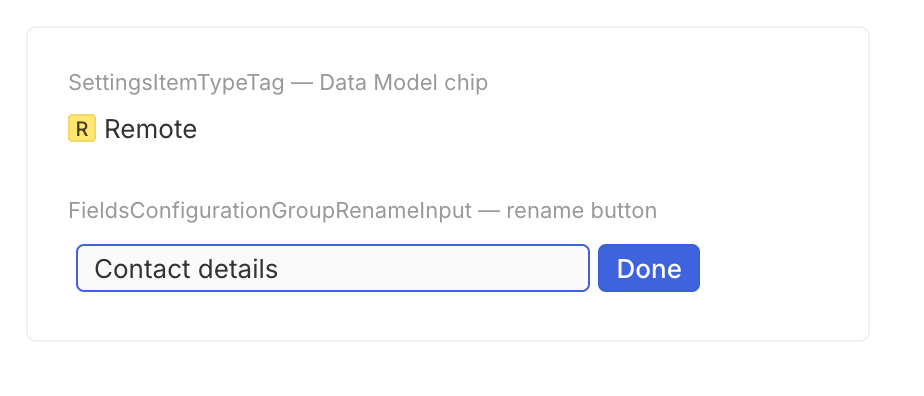 ## How to test 1. Switch the workspace language to a non-English locale. 2. Go to **Settings → Data Model** with a remote object present → the type chip reads "Remote" translated. 3. Rename a fields configuration group → the confirm button reads "Done" translated. Co-authored-by: Claude Opus 4.8 (1M context) <noreply@anthropic.com> |
||
|
Clive F
|
5f7638cdaf |
fix(front): surface widget render errors via ErrorBoundary onError (#21009)
## Summary

The page-layout widget `ErrorBoundary` in `WidgetCardShell` renders a
generic
"Invalid Configuration" fallback whenever a widget renderer throws.
Because
there is no `onError` handler, the underlying error is swallowed —
unrelated
widget types (fields, notes, front-component, etc.) all surface the same
chip
with no telemetry, which makes render failures hard to triage.

This adds an `onError` handler that forwards the caught error to
`console.error`
and to Sentry (when available) with the widget's `id`, `type`, and
`configurationType` as extra context. It reuses the same dynamic-import
Sentry
pattern already used by `AppErrorBoundary` and
`CommandMenuItemErrorBoundary`,
so it degrades gracefully to a console log when Sentry is not
configured. The
fallback UI is unchanged.

## Test plan

- [ ] `npx nx typecheck twenty-front` passes
- [ ] `npx nx lint:diff-with-main twenty-front` passes
- [ ] When a widget renderer throws, the "Invalid Configuration" chip
still
      renders and the error now appears in the browser console / Sentry

---------

Co-authored-by: Claude Opus 4.7 (1M context) <noreply@anthropic.com>
Co-authored-by: Charles Bochet <charles@twenty.com>
|
||
|
Marie
|
c27c8c88b0 |
Fix various graphs bugs (#21311)
Some bugs fixed in this PR
1. From UI any field could be chosen to group the query by it, while for
instance, RAW_JSON type (eg workflowRun.state) is not supported by
PostgreSQL to group a query by. Fix: removed it from the "group by"
fields options in FE + in BE -->
2. The BE check existed (isFlatFieldMetadataSupportedInGroupBy) but the
signature was malformed: it expected`{ fieldMetadataType,
fieldMetadataName, fieldMetadataIsSystem }` while every caller passes a
flat field metadata object with type/name/isSystem. So the check is
mis-wired — at runtime the destructured props are undefined, making it
always return true (validation bypassed). Fixed this.
3. Group by does not work with Morph relations if their direction is
ONE_TO_MANY. Added that constraint.
4. Group by with morph relations were broken even for MANY_TO_ONE,
because a morph is stored as one field per target
(polymorphicOwnerRocket, polymorphicOwnerSurveyResult…), each with its
own join column, but the frontend collapsed them into a single
polymorphicOwner field — so the backend tried to resolve a non-existent
polymorphicOwnerId. Fix: Frontend: added a target picker so you choose
the specific morph target (then its sub-field), storing the real
per-target field id. Backend: fixed validate-relation-subfield to use
the per-target field's own relationTargetObjectMetadataId instead of the
multi-target resolver that returned null.
5. (improvement) When an error occured in the query, the graph showed
"No data". Updated it to "error". (screenshot 1)
6. When a field used as a filter on a graph is deleted, it is not
deleted as a graph filter (which is ok because it would involve parsing
all the graph's configuration json to find whether a field is
referenced; there is no foreign key), which prevented from further
modifying the graph's filters. Fixed this + add an indicator that the
filter is can/should be removed (see screenshot 2)
7. "Ambiguous column name" PG error occurs when ordering by "creation
date" of a related field, because both objects have createdAt field.
Fixed it by adding table alias as prefix.
8. (improvement) While working on #5 I did not understand why we could
directly do `"objectMetadataNameSingular"."columnName" `while I expected
that for custom objects it would have to be
`_objectMetadataNameSingular`. that's simply because we use an alias
from the beginning. To add clarity, within groupBy code I replaced
`objectMetadataNameSingular` with `objectAlias` everywhere it is indeed
inherited from us using objectAlias.

<img width="685" height="391" alt="Screenshot 2026-06-08 at 12 01 45"
src="https://github.com/user-attachments/assets/f2b15ca5-da39-4114-8188-69f58f3c4cbf"
/>

<img width="598" height="341" alt="Screenshot 2026-06-08 at 11 53 55"
src="https://github.com/user-attachments/assets/66372811-4a37-40d9-b43a-4af51f89b6e6"
/>
|
||
|
Félix Malfait
|
8a3e6e645a |
fix(ui): restore content-box sizing for components broken by the global border-box reset (#21349)
## Problem Since the `twenty-ui` → `twenty-ui-deprecated` / `twenty-new-ui` → `twenty-ui` rename (#21315), many deprecated components render with **compacted height** — e.g. dropdown menu items collapse from 32px to 16px, and chips from ~24px to 16px. ## Root cause The new `twenty-ui` (formerly `twenty-new-ui`) ships a global reset in `packages/twenty-ui/src/styles/base/reset.scss`: ```css *, *::before, *::after { box-sizing: border-box; } ``` This is bundled into `twenty-ui/style.css`, which the app imports in `index.tsx`. #21315 did not change the `import 'twenty-ui/style.css'` line, but it changed what `twenty-ui` resolves to (old → new), so this **global `border-box` reset now applies app-wide**. Several deprecated components were authored against the **content box**, e.g. `StyledMenuItemBase`: ```css height: calc(32px - 2 * var(--vertical-padding)); padding: var(--vertical-padding) var(--horizontal-padding); ``` With `content-box` the padding sits *outside* the declared height → 32px total. Under the new `border-box` reset the padding is folded *inside* → 16px total. (`Chip` uses `height: spacing[4]` + outside padding — same failure mode.) Verified in the running app: the collapsed menu item computes `box-sizing: border-box`, matched by the rule `*, ::before, ::after { box-sizing: border-box }`; `height` resolves to `calc(32px - 2 * 8px) = 16px`. ## Fix Add `box-sizing: content-box` to the affected deprecated components. A class selector outranks the universal `*` reset, so this restores their intended sizing **without touching the global reset** (which the new `twenty-ui` components rely on). Affected: `StyledMenuItemBase` (and its hoverable variant), `MenuItemSelect`, `MenuItemSuggestion`, `Chip`. |
||
|
Raphaël Bosi
|
c596a5e342 |
Rename twenty-ui to twenty-ui-deprecated and twenty-new-ui to twenty-ui to prepare package release (#21315)
## Description Promotes the next-gen UI library (formerly `twenty-new-ui`) to the name **`twenty-ui`** (v0.1.0, publishable) and renames the old package to **`twenty-ui-deprecated`**. Rewrites ~1,730 `twenty-ui` imports → `twenty-ui-deprecated`, updates all configs/CI/Docker/deps, and migrates twenty-front's `Toggle` to the new package (first consumer) as a drop-in. ## Next steps - Wire the `ui/v*` publish dispatch (`cd-deploy-tag.yaml` + `.yarnrc.yml`), then tag `ui/v0.1.0` to publish. - Continue migrating components from `twenty-ui-deprecated` → `twenty-ui`. |
||
|
Weiko
|
cc76b7bc50 |
Fix fields widget new field visibility (#21111)
Fixes https://github.com/twentyhq/twenty/issues/21043 ## Context Newly created fields were never added to FIELDS widgets, regardless of the "Set fields created in the future as visible" toggle. The widget's newFieldDefaultVisibility was null on widgets that never explicitly set it (it was never populated at creation), so the backend skipped them and no view field was created. ## Implementation Keep newFieldDefaultVisibility nullable with false (not visible) as the behavior when not provided. The FE now reflects that properly and shows "un-toggled" when it's null (iso with BE behavior). The fix also ensures the value is explicitly set to true wherever it should be: - Set newFieldDefaultVisibility: true at every FIELDS widget creation path (backend default record-page layout, frontend createDefaultFieldsWidget + useTemporaryFieldsConfiguration); - Added a 2-9 workspace upgrade command that backfills true onto existing standard FIELDS widgets where the value is null. |
||
|
nitin
|
13f09d8946 |
[Dashboards] Remove gauge chart types and code (#20410)
Follow-up cleanup to #20172. |
||
|
Félix Malfait
|
3afdabb93e |
fix(dashboards): isolate pie chart slice labels per widget (#21034)
## Summary Fixes [#21014](https://github.com/twentyhq/twenty/issues/21014). When two pie chart widgets shared the same group-by field (and therefore the same slice ids) but used different aggregation operators (e.g. `count` vs `sum`), the arc-link labels would mirror between the two charts — both ending up showing either the count or the sum values, depending on render order. Center metrics stayed correct. **Root cause.** Nivo's `ArcLinkLabelsLayer` and `ArcsLayer` (from `@nivo/arcs`) wire `react-spring`'s `useTransition` with `keys: e => e.id`. When two `<ResponsivePie>` instances render with overlapping ids, the transitioned data bleeds across charts. The center metric is unaffected because it's computed by a separate hook (`usePieChartCenterMetricData`). **Fix.** Namespace the Nivo-computed slice id per widget by passing an `id` accessor to `<ResponsivePie>`: ```tsx id={(datum) => `${id}:${String(datum.id)}`} ``` Lookups inside the widget switch to `datum.data.id` (the original, un-namespaced id stored on the raw datum), so value/percentage formatting, the custom tooltip, and the legend hover-dim behavior all keep working. Touched files: - `GraphWidgetPieChart.tsx` — add `id` accessor - `CustomArcsLayer.tsx` — compare legend highlight against `datum.data.id` - `getPieChartFormattedValue.ts`, `getPieChartTooltipData.ts` — match on `datum.data.id` - Tests for both utils get a regression case covering the namespaced computed id ## Test plan - [ ] `npx jest getPieChartFormattedValue` ✅ - [ ] `npx jest getPieChartTooltipData` ✅ - [ ] `npx tsc --noEmit` ✅ - [ ] Manual: dashboard with two pies on the same group-by field, one `count` and one `sum`, "Display data label" on for both — confirm each chart shows its own metric on the slices, and the central total is unchanged. - [ ] Manual: hover a legend item — the matching slice in that chart stays solid while the others dim, and the sibling chart is not affected. - [ ] Manual: clicking a slice still drills into the correctly filtered view. |
||
|
Weiko
|
2f358a1775 |
Add a Table display mode to relation field widgets (#20929)
## Context Adds a new Table layout to the FIELD widget for to-many relation fields. On a record page, a relation can now be displayed as a full record table (the same component used for record indexes and dashboard table widgets) scoped to the records related to the current record. https://github.com/user-attachments/assets/320b24dc-f019-4d0e-bc71-3e64d032d75a https://github.com/user-attachments/assets/2f6d4f8e-de26-4fc1-ae12-c9b9c19654dc https://github.com/user-attachments/assets/3fb6d512-f83c-4818-823e-46ad2644fbc2 |
||
|
nitin
|
0b38b4ffc4 |
fix(page-layout): respect tab layoutMode on standalone pages (#20856)
Standalone-page tabs with `layoutMode: CANVAS` were silently rendering as GRID (border, padding, scroll). Now they render full-bleed, matching the CANVAS contract elsewhere. Three layered fixes: - `getTabLayoutMode`: respect `tab.layoutMode` for `STANDALONE_PAGE` (was hardcoded to GRID for any non-`RECORD_PAGE`) - `getWidgetCardVariant`: CANVAS now wins regardless of page type — refactored to early-return + exhaustive switch on `pageLayoutType` - `FrontComponentWidgetRenderer`: removed hardcoded `overflow: auto` (workflow/tasks/timeline widgets don't have it either) New `getTabLayoutMode.test.ts`. Variant tests refactored to declarative + parameterized. QA: <img width="3024" height="1654" alt="CleanShot 2026-05-22 at 20 46 50@2x" src="https://github.com/user-attachments/assets/cc61d459-6bc6-48de-ac79-d63a2ccd8957" /> https://github.com/user-attachments/assets/a3374e18-ad1b-4888-ab2b-d07730edccac |
||
|
neo773
|
323e66433e |
lint: migrate prettier to oxfmt (#20783)
Most changes are `implements` being unwrapped this is not a oxfmt regression Prettier in 3.7 (we're on 3.1) changed this behaviour prettier blog [post](https://prettier.io/blog/2025/11/27/3.7.0#change-18094) This unifies our linting tooling --------- Co-authored-by: github-actions <github-actions@twenty.com> Co-authored-by: Charles Bochet <charles@twenty.com> |
||
|
Thomas des Francs
|
c721fa8502 |
Add editor mode for text field widgets (#20779)
## Summary Tested ↓ <img width="3456" height="1990" alt="CleanShot 2026-05-20 at 21 14 04@2x" src="https://github.com/user-attachments/assets/b4e0d3d3-715f-4ad7-bd03-e8e1922b3c6c" /> - Enable `FieldDisplayMode.EDITOR` for plain `TEXT` field widgets while keeping `FIELD` as the default display mode. - Add a plain multiline text editor renderer for `TEXT + EDITOR` field widgets with optimistic record-store/cache updates and debounced persistence. - Reuse the shared `TextArea` component through a transparent, uncapped variant so the editor has no input chrome and lets the widget grow. - Add unit coverage for text display-mode config and a Storybook scenario for a text field widget in editor mode. ## useEffect cleanup note `FieldWidgetTextEditor` flushes the debounced persist callback in a `useEffect` cleanup: ```ts useEffect(() => () => persistTextDebounced.flush(), [persistTextDebounced]); ``` This follows the existing debounced autosave cleanup pattern already used in `WorkflowEditActionHttpRequest`. It ensures pending text changes are persisted when the widget unmounts, while `onBlur` still flushes immediately for normal editor exits. ## Validation - `npx nx test twenty-front --testPathPattern=page-layout` - `npx nx typecheck twenty-front` - `npx nx lint twenty-front` - Browser check on `http://apple.localhost:3001/object/company/20202020-a305-41e7-8c72-ba44072a4c58` for transparent textarea, no internal max-height/scroll, equal padding, and widget growth. Note: lint passes with two unrelated existing warnings in `NavigationDrawerItem.tsx` and `ConfigVariableEdit.tsx`. --------- Co-authored-by: Charles Bochet <charles@twenty.com> |
||
|
Weiko
|
224376233b |
fix(front): focus new Field widget and open side panel on add (#20777)
## Context In the record-page edit mode, the "Add widget" section has three menu items: `Fields group`, `Field`, and `More widgets`. `Fields group` creates the widget, focuses it, and opens its settings side panel. `Field` only added the widget to the draft — no focus, no panel — which left the user without visible confirmation or a way to immediately edit the new widget. ## Change Updated `useCreateRecordPageFieldWidget` to mirror `useCreateRecordPageFieldsWidget`: After appending the new widget to the draft, it now sets `pageLayoutEditingWidgetIdComponentState` to the new widget's id and navigates the side panel to `SidePanelPages.RecordPageFieldSettings` (with `focusTitleInput: true`, `resetNavigationStack: true`). This matches the behavior of clicking an existing field widget in `useOpenWidgetSettingsInSidePanel` (`WidgetType.FIELD` branch). |
||
|
martmull
|
7ab6f5719f |
Update default widget gridPosition (#20740)
move DEFAULT_WIDGET_SIZE to twenty-shared and use it in sync application manifest |
||
|
Charles Bochet
|
1a9f786e42 |
refactor(filters): pass fieldMetadataItems array to dispatcher (#20737)
## Summary Alternative to #20717. Same goal (clean up the filter dispatcher API after #20670) but smaller and follows the codebase's "pass data, not behavior" style. The dispatcher takes a `fieldMetadataItems: FieldShared[]` array directly instead of a `findFieldMetadataItemById: (id) => FieldShared | undefined` callback. The util builds the id lookup internally — once per call, used for both source-field and relation-target-field lookups. No new types, no separate hydration step. ## What changes **`twenty-shared`** - `computeRecordGqlOperationFilter` / `turnRecordFilterIntoRecordGqlOperationFilter` / `turnRecordFilterGroupsIntoGqlOperationFilter`: replace `findFieldMetadataItemById` param with `fieldMetadataItems` / `fieldMetadataItemById` (internal Map). - Remove the exported `FindFieldMetadataItemById` type. - `turnAnyFieldFilterIntoRecordGqlFilter`: rename its internal `fieldById` Map for consistency. - Tests updated to pass arrays. **Frontend (15 call sites)** - Switch from `fieldMetadataItemByIdMapSelector` to `flattenedFieldMetadataItemsSelector`. - Pass `fieldMetadataItems: flattenedFieldMetadataItems` to the dispatcher. - `useFindManyRecordsSelectedInContextStore` keeps the Map selector because it still does a per-filter lookup for the soft-delete check. **Server (5 call sites)** - Pass `Object.values(flatFieldMetadataMaps.byUniversalIdentifier).filter(isDefined)`. ## Why this over #20717 #20717 moves resolution into a separate hydration step + introduces a `HydratedRecordFilter` type. The bug that #20717 originally surfaced was Sentry catching 4 critical runtime errors during review (`fieldMetadataItemByIdMap` declared but not passed). The added type and the explicit hydration boundary are extra surface area for not much benefit — the existing API was a callback wrapping a Map at every call site, and the natural simplification is to just pass the Map (or its array) directly. Net diff: **196 insertions, 203 deletions** (~7 lines net removed). 32 files. ## Test plan - [x] Shared filter unit tests pass (461 tests) - [x] Frontend filter/context-store tests pass (13 tests) - [x] Frontend typecheck passes - [x] Server typecheck passes - [x] Lint passes (frontend + server) - [ ] Integration tests on #20670 still pass — workflow find-records + chart-data with relation-traversal filter still work end-to-end through the new array param |
||
|
martmull
|
d5ff9eb515 |
Create twenty app improvements (#20688)
create-twenty-app updates: - remove --example option - sync --once when scaffolding an applicaiton - rename --api-url option to --workspace-url - create a standalone page when scaffolding an app <img width="1494" height="765" alt="image" src="https://github.com/user-attachments/assets/0e35ed0c-b0aa-466c-9f56-7939294fd2cf" /> --------- Co-authored-by: cubic-dev-ai[bot] <191113872+cubic-dev-ai[bot]@users.noreply.github.com> Co-authored-by: Copilot Autofix powered by AI <62310815+github-advanced-security[bot]@users.noreply.github.com> |
||
|
Félix Malfait
|
291ce5ccdb |
fix(filters): make filter dispatcher own relation-target resolution (#20670)
## Summary Two relation-traversal bugs surfaced post-merge of #20533, both rooted in the same architectural smell: the GraphQL filter dispatcher took a flat `fields: FieldShared[]` array and silently dropped any filter whose `relationTargetFieldMetadataId` wasn't in that array. Callers had to remember to pre-augment the list with relation targets — and 16+ call sites did not all know this. This PR fixes both bugs and removes the smell. ### Bug 1 — Save as new view loses the relation target `useCreateViewFromCurrentView` built the create-filter input without `relationTargetFieldMetadataId`. The saved view's filter persisted without the traversal — on reload the chip showed "Company contains 'air'" instead of "Company → Name contains 'air'". Discarded at save time, not at read time. Fix: include `relationTargetFieldMetadataId` in the create input. (Commit 1.) ### Bug 2 — Workflow Search Records drops one-hop traversals `FindRecordsWorkflowAction` built its fields list from `flatObjectMetadata.fieldIds` only (source object's fields). The shared dispatcher then couldn't resolve the relation target field on the related object and silently dropped the filter — a configured "People where Company → Name Contains 'Airbnb'" came through as `{ and: [] }`. This was the same shape as bugs already fixed in 5 other call sites (chart filters, view filters, record table, etc.). The pattern was: caller forgets to augment fields → dispatcher silently drops the filter. Fix (commit 2): change the dispatcher to take a `findFieldMetadataItemById: (id) => FieldShared | undefined` resolver callback. Both source-field and relation-target-field lookups go through the same resolver, so callers no longer need to know about the augmentation requirement. Frontend callers pass a workspace-wide resolver built from `flattenedFieldMetadataItemsSelector`; server callers wrap `findFlatEntityByIdInFlatEntityMaps` on `flatFieldMetadataMaps`. In both cases relation-target lookups just work, because the resolver can see fields on related objects. ## Why this matters Before: "if you call the dispatcher, pre-augment your fields list with relation targets, or filters get silently dropped." An invariant only enforceable by code review, broken often enough to ship two user-visible bugs in one week. After: the dispatcher resolves field ids itself. There's no list to forget to augment. The failure mode (filter silently dropped) becomes structurally impossible at the dispatcher boundary. Net diff: 240 insertions, 319 deletions. Removed `augmentFieldsWithRelationTargets` (frontend) and the workflow whack-a-mole code (server). ## Test plan - [ ] Save view: create an advanced filter using a one-hop relation traversal, click "Save as new view", reload, confirm the chip still reads "Source → Target operator value" - [ ] Workflow: configure a Search Records action with a relation-traversal filter, run the workflow, confirm the filter is actually applied - [ ] Dashboard chart: configure a chart with a relation-traversal filter, confirm the chart data respects it - [ ] Record table, group-by, calendar, total count, footer aggregates: all continue to work with both plain and relation-traversal filters |
||
|
Charles Bochet
|
e6b7f31fea |
fix(front): prevent standalone page layout crash from useTargetRecord (#20698)
## Context

Reported in production on `engineering.twenty.com` — standalone page
layouts (e.g. "Release overview") crash with the React error boundary
fallback ("Sorry, something went wrong"). The console shows:

```
Error: useTargetRecord must be used within a record page context (targetRecordIdentifier is required)
```

The minified stack trace points at `SidePanelToggleButto…`, but that's
just the bundle chunk name — the actual call site is
`PageLayoutTabsRenderer`.

## Root cause

#19296 added an unconditional `useTargetRecord()` call inside
`PageLayoutTabsRenderer` so it could read the target object's metadata
and hide tabs whose widgets reference deactivated relations:

```ts
const targetRecord = useTargetRecord();

const { objectMetadataItem } = useObjectMetadataItem({
  objectNameSingular: targetRecord.targetObjectNameSingular,
});
```

But `PageLayoutTabsRenderer` runs on **both** record pages and
standalone pages. On standalone pages, `StandalonePageLayoutPage`
intentionally sets `targetRecordIdentifier: undefined` in
`LayoutRenderingProvider`, which makes `useTargetRecord()` throw — and
the follow-up `useObjectMetadataItem()` would also throw on miss.
|
||
|
Lakshay Manchanda
|
7c252ff233 |
Fix 19026 deactivated relation unassignable (#19296)
PR to fix the bug #19026 This PR will ensure that if an object has some relation deactivated, the relation will not be visible in the side panel tab and will not be assignable in the deactivated relation. ## Notes deactivated in People <img width="1068" height="1106" alt="image" src="https://github.com/user-attachments/assets/e8c2dbf3-5391-4dbc-8e40-79fcc44e8158" /> ## Notes not visible in the side panel of people <img width="2390" height="892" alt="image" src="https://github.com/user-attachments/assets/308a78aa-2c6d-4d3d-b67c-b49795839aae" /> --------- Co-authored-by: Thomas Trompette <thomas.trompette@sfr.fr> |
||
|
Félix Malfait
|
c938fbf4d6 |
feat(twenty-front): relation traversal in filter dropdown (stacked) (#20533)
**Stacked on #20527** https://github.com/user-attachments/assets/48995655-401a-4c35-8094-e88da8408bdd ## Summary Surfaces the one-hop relation traversal added in #20527 through the existing **composite sub-field dropdown pattern**. Clicking a MANY_TO_ONE relation field in the "+ Filter" picker now opens the same second-level dropdown that composite fields (FULL_NAME, ADDRESS, CURRENCY, etc.) already use — populated with the target object's filterable fields. Picking one (e.g. `Company → Name`) builds a filter that serializes to the nested GraphQL filter the backend now accepts: `{ company: { name: { ilike: "%X%" } } }`. No new components. The whole feature reuses `AdvancedFilterSubFieldSelectMenu` + the existing `subFieldNameUsedInDropdownComponentState` + the existing `MenuItem hasSubMenu` indicator. Only the conditions that gate the sub-menu (and the sub-menu's content for relations) were broadened. ## What landed | File | Change | |---|---| | `ObjectFilterDropdownFilterSelectMenuItem` | Sub-menu chevron now shows on MANY_TO_ONE relations (`isManyToOneRelationField` util). | | `AdvancedFilterFieldSelectMenu` | Relation clicks open the sub-menu alongside composite clicks. | | `AdvancedFilterSubFieldSelectMenu` | New branch: when the sub-menu type is `'RELATION'`, render the target object's filterable fields via `useFilterableFieldMetadataItems(targetObjectMetadataId)`. Composite logic untouched. | | `objectFilterDropdownSubMenuFieldType` state | Widened to accept a `'RELATION'` sentinel. Role-permissions sub-field menu narrows it back out (it doesn't traverse relations). | | `useSelectFieldUsedInAdvancedFilterDropdown` | New optional `targetFieldMetadataItem` arg. When present, the stored RecordFilter's `type` is the target field's type so the operand picker and value input render the target's operands (`'TEXT'` operators when filtering `company.name`, etc.). | | `turnRecordFilterIntoGqlOperationFilter` (shared) | When the filter targets a `RELATION` field with a `subFieldName`, synthesize a field-metadata for the target, recurse to build the inner filter, then wrap it under the relation field's name → `{ relationName: { targetFieldName: { ...operator } } }`. | `RecordFilter.subFieldName` stays narrowly typed as `CompositeFieldSubFieldName` so the wide downstream consumers (`shouldShowFilterTextInput`, composite handlers in the serializer, etc.) don't change. The relation target field's name is stored through a narrowly-scoped cast at the dropdown's storage point — the serializer checks `filter.type === 'RELATION'` before interpreting it as a target field name, so the cast can't be mis-read by composite-only code paths. ## Test plan - [ ] Open a table view on People, click "+ Filter", click "Company" → sub-menu opens with Company's filterable fields - [ ] Pick "Name" → operand picker shows TEXT operators (Contains, Equals, …) - [ ] Type "Airbnb" → filter applies, table shows people whose company name contains "Airbnb" - [ ] Verify network tab: the GraphQL filter variable is `{ company: { name: { ilike: "%Airbnb%" } } }` - [ ] Same flow with a composite target field (e.g. `Company → annualRecurringRevenue → amountMicros`) — should work end-to-end (backend supports composite-within-relation; #20527 has an integration test covering this) - [ ] Composite fields (FULL_NAME, ADDRESS) still open their normal sub-menu and filter correctly — no regression - [ ] Role-permissions field-select sub-field menu is unaffected (it bails out early on the RELATION sentinel) ## Out of scope - ONE_TO_MANY traversal (no backend support yet) - Aggregates (`people.count > 5`) - Persisting relation-traversal filters into a saved view (ViewFilter has no `relationPath` column yet; that's a separate slice) - REST API DSL changes - AI Tools 🤖 Generated with [Claude Code](https://claude.com/claude-code) --------- Co-authored-by: Claude Opus 4.7 <noreply@anthropic.com> |
||
|
Charles Bochet
|
04eb913551 |
chore(page-layout): remove IS_RECORD_PAGE_LAYOUT_* feature flags (#20556)
## Summary

- Both \`IS_RECORD_PAGE_LAYOUT_EDITING_ENABLED\` and
\`IS_RECORD_PAGE_LAYOUT_GLOBAL_EDITION_ENABLED\` are force-enabled on
every existing workspace by the 1.23.0 upgrade command
\`BackfillRecordPageLayoutsCommand\` and seeded enabled for new
workspaces via \`DEFAULT_FEATURE_FLAGS\` +
\`seed-feature-flags.util.ts\`. They are no longer load-bearing.
- Unwrap all \`if (flag) { … }\` conditionals to their enabled branch on
both server and front.
- Delete legacy fallback files that only the disabled branch reached:
\`PageLayoutRelationWidgetsSyncEffect\`,
\`usePageLayoutWithRelationWidgets\`,
\`reInjectDynamicRelationWidgetsFromDraft\`,
\`injectRelationWidgetsIntoLayout\`, \`isDynamicRelationWidget\` (and
their tests).
- Strip the two \`enableFeatureFlags\` calls from the 1.23 upgrade
command — the page-layout backfill data logic itself is kept intact
since old workspaces upgrading from < 1.23 still need it.
- No DB cleanup migration: stale \`featureFlag\` rows are left in place,
matching the precedent set by #20531 and #20460.

Net diff: 37 files, +106 / -1727.

## Test plan

- [x] \`npx nx typecheck twenty-shared twenty-server twenty-front\` —
all pass
- [x] \`npx nx lint:diff-with-main twenty-server twenty-front\` — all
pass
- [x] \`cd packages/twenty-front && npx jest page-layout\` — 1240 tests,
all pass
- [x] \`cd packages/twenty-server && npx jest
workspace-entity-manager.spec\` — pass
- [ ] Manual smoke: open a record page, verify tabs render and \"Edit
Layout\" command-menu action is available
- [ ] Manual smoke: Settings → Data model → object → Layout tab is
visible (and hidden for remote / Dashboard objects)
- [ ] Manual smoke: edit a tab title, save, reload — confirm persistence
|
||
|
Raj Bhaskar
|
2b4fa9d8cf |
fix: workspace member "me" filters now work in dashboard widgets (#20266)
## Summary Fixes #20225 Dashboard graph widgets only passed `timeZone` in `filterValueDependencies` when computing the GraphQL operation filter. As a result, `isCurrentWorkspaceMemberSelected` ("me") filters were silently ignored — the current workspace member ID was `undefined`. Regular view filters already use `useFilterValueDependencies` which provides both `timeZone` and `currentWorkspaceMemberId`. This PR replaces the manual `{ timeZone: userTimezone }` object in `useGraphWidgetQueryCommon` with `useFilterValueDependencies()`, giving dashboard widgets full feature parity with view filters. **Changed file:** `packages/twenty-front/src/modules/page-layout/widgets/graph/hooks/useGraphWidgetQueryCommon.ts` --------- Co-authored-by: martmull <martmull@hotmail.fr> Co-authored-by: Claude Opus 4.6 (1M context) <noreply@anthropic.com> |
||
|
nitin
|
bbd9720ab3 |
[Dashboards] [Warning] Remove gauge chart support and delete existing widgets (#20172)
## Summary Removes gauge chart from the chart-type picker and deletes existing gauge widgets via a workspace migration. The gauge was rendering a hardcoded `0.7 / "Progress"` stub regardless of configuration -- never wired to real data. The contract stays in place. We keep `WidgetConfigurationType.GAUGE_CHART`, the DTO, the GraphQL union member, and the gauge folder -- so stored gauge JSON still resolves through the schema. The render path falls through to `default: return null`, so any un-migrated gauge widget renders as an empty cell, not a crash. This PR just removes existing gauge widgets if there are any (via `upgrade:2-3:delete-gauge-widgets`). The deliberate cleanup -- deleting the type definitions, the gauge folder, the DTO -- comes in a follow-up PR after the migration has run. --------- Co-authored-by: Charles Bochet <charles@twenty.com> |
||
|
Paul Rastoin
|
820f97f53d |
[Headless Front component] Support multiple selected record (#20268)
# Introduction Support multiple selected record ids for headless front components ### Changes **Added:** - `recordIds: string[]` field to `FrontComponentExecutionContext` - `useRecordIds()` hook to get all selected record IDs **Deprecated:** - `recordId` field - use `recordIds` instead - `useRecordId()` hook - use `useRecordIds()` instead Backward compatibility is preserved |
||
|
Weiko
|
0bb345b75f |
Fix empty record page on system objects for non-English workspace members (#20235)
## Context Since #19890 (Translate standard page layouts), the server's `PageLayoutTab.title` resolver translates standard tab titles at query time. A workspace member in French viewing a `messageChannel` (or any system object with a standard page layout) receives `tab.title = "Accueil"` / `"Chronologie"` instead of `"Home"` / `"Timeline"`. The `SYSTEM_OBJECT_TABS` guard in `PageLayoutTabsRenderer` was comparing against an English-only literal allow-list, so every tab was dropped, `sortedTabs` became empty, and `<PageLayoutMainContent />` never mounted — the record page rendered blank (no fields, timeline, email thread, etc.). ## Fix Only run the allow-list filter when the resolved layout is the synthetic `DEFAULT_RECORD_PAGE_LAYOUT` (the client-side fallback for the few system objects with no server-side standard page layout config, e.g. `workspaceMember`, `attachment`, `message`). That layout ships hardcoded English tabs, so the English allow-list still works in every locale. System objects that do have a server-side standard page layout (`messageChannel`, `connectedAccount`, `workflowRun`, …) are no longer filtered at all, the server only ever persists Home/Timeline/Flow tabs for them, so no filter is needed. ## Before <img width="1262" height="722" alt="Screenshot 2026-05-04 at 15 15 54" src="https://github.com/user-attachments/assets/348c9e9d-0ae1-4046-8ead-470ed8263cb5" /> ## After <img width="1281" height="658" alt="Screenshot 2026-05-04 at 15 15 36" src="https://github.com/user-attachments/assets/7a9953b1-7320-4f1a-8c02-1688d3eda3ae" /> ## Note Next step should be to backfill those system objects with real record page layouts so we can remove this filter logic |
||
|
Abdul Rahman
|
fa8304d323 |
Fix record table dashboard save (#20202)
## Summary Fixes `METADATA_VALIDATION_FAILED` / “view field already exists” when saving dashboard **record table** widgets after the first persist (e.g. several table widgets on one dashboard). ## Problem Draft view columns used **client-generated** `viewField` ids. After save, the API stored **different** ids. The next upsert still sent the old draft ids as `viewFieldId`. The server only matched on that id, missed every row, and tried to **create** columns that already existed for the same `fieldMetadataId` + view. |
||
|
Abdul Rahman
|
19ee9444ed | add UpsertViewWidget resolver (#20053) | ||
|
Abdul Rahman
|
a710c105cf | Fix orphan views by deferring record table widget view creation to dashboard save (#20006) |