48252d35e91be5af4d3e42cf5d527646d62c8d87
507 Commits
| Author | SHA1 | Message | Date | |
|---|---|---|---|---|
 Raphaël Bosi Raphaël Bosi
|
566c3b6629 |
Remove v1 onboarding and rely only on v2 (#22398)
https://github.com/user-attachments/assets/a6bfaac3-6c79-4fd5-999a-e6a70cff8ac8 Removes the old (v1) signup and onboarding flow now that v2 is the only path, and drops the `isOnboardingV2` flag entirely. The surviving (formerly-v2) pages reclaim the canonical `AppPath` members and clean URLs (`/welcome`, `/verify`, `/workspace-activation`, `/create/profile`, `/sync/emails`, `/install-apps`, `/invite-team`, `/plan-required`). - Deletes the v1 pages, the v1 workspace-creation form, the `isOnboardingV2State` flag + `onboardingV2` URL-param plumbing, and `InstallAppsAutoSkipEffect`. - Collapses the router and page-change navigation matrix to a single set of paths, and renames the v2 components/stories to drop the `V2` suffix. Follow-up fixes so the single flow behaves correctly on every deployment: - Restore the captcha-token, query-param and pageview effects on the default (root) domain, and serve `/authorize` there so OAuth login keeps working. - Gate the invite-team → `/plan-required` interception on billing so billing-disabled instances aren't trapped on the upgrade page. - On a cold boot to an auth/onboarding path, show the onboarding loader instead of the CRM skeleton, and add `/verify-email` and `/plan-required/payment-success` to that loader path list. - Add a retry to PaymentSuccess after the confirmation timeout, fix the InstallApps icon crossfade, restyle the book-call pages for the full-page layout, and delete code orphaned by the v1 removal. - Extract the pageview/captcha/query-param logic out of `PageChangeEffect` into standalone Effect components shared by the root and workspace app trees. <!-- This is an auto-generated description by cubic. --> <a href="https://cubic.dev/pr/twentyhq/twenty/pull/22398?utm_source=github" target="_blank" rel="noopener noreferrer" data-no-image-dialog="true"><picture><source media="(prefers-color-scheme: dark)" srcset="https://www.cubic.dev/buttons/review-in-cubic-dark.svg"><source media="(prefers-color-scheme: light)" srcset="https://www.cubic.dev/buttons/review-in-cubic-light.svg"><img alt="Review in cubic" src="https://www.cubic.dev/buttons/review-in-cubic-dark.svg"></picture></a> <!-- End of auto-generated description by cubic. --> --------- Co-authored-by: Félix Malfait <felix.malfait@gmail.com> |
||
|
Félix Malfait
|
a28887bba6 |
feat(server): workspace opt-out of root-domain directory listing (#22423)
## What Lets a workspace opt out of being surfaced in the multi-workspace root-domain (app.twenty.com) picker via **email-domain discovery**. Adds `isDirectoryListingEnabled` (default `true`) on the workspace. When `false`, the workspace is filtered out of the approved-access-domain branch of `findAvailableWorkspacesByEmail`, so a user whose email domain matches an approved access domain no longer sees the workspace in the sign-up picker. ## Scope of the opt-out (deliberately narrow) The filter is applied **only** to the approved-access-domain discovery source: - **Members** (`availableWorkspacesForSignIn`) — never filtered; they keep access. - **Explicit invitations** — never filtered; the intent is one-to-one. - **Approved-access-domain discovery** — the only "listing" source, gated by the flag. A hidden workspace stays fully reachable by members and invited users via the direct workspace subdomain; it just isn't advertised in the global picker. > Open question for review: do we also want a stronger mode that hides the workspace from the root-domain picker even for existing members (forcing them to use the subdomain directly)? That would additionally filter the member/invitation sources and is a larger behavior change — not included here. ## Changes **Backend** - `workspace.entity.ts` — new `isDirectoryListingEnabled` column (`@Field`, default `true`). - `user-workspace.service.ts` — filter the approved-access-domain branch on the flag. - `update-workspace-input.ts` — expose the field on `updateWorkspace`. - `workspace.service.ts` — `PermissionFlagType.SECURITY` (same as the other discovery/security toggles). - Fast instance command adding the column (default `true`, so no existing workspace is hidden). **Frontend** - Settings > Security: a **"List in workspace directory"** toggle (shown only in multi-workspace mode) that flips the flag via `updateWorkspace`, mirroring the existing `isInternalMessagesImportEnabled` toggle. - Threaded the field through the current-user fragment, `CurrentWorkspace` type, and mock data. - Regenerated the metadata + client-sdk GraphQL types (`generated-metadata`, `twenty-client-sdk/.../generated`) — generated against a server booted from this branch. ## Verification - `tsgo` typecheck: 0 errors. `oxlint`: 0/0. `oxfmt`: clean. - Codegen diff verified to contain **only** the new field (no unrelated drift). - Tests not run locally; CI covers unit/integration + the codegen/migration freshness checks. --------- Co-authored-by: claude[bot] <41898282+claude[bot]@users.noreply.github.com> |
||
|
Raphaël Bosi
|
2e6077383b |
Add install your first apps onboarding V2 step (#22347)
https://github.com/user-attachments/assets/5326d48f-1842-4db1-bc7c-94852145c035 <img width="838" height="754" alt="CleanShot 2026-06-30 at 16 25 05@2x" src="https://github.com/user-attachments/assets/5c7d53d7-4d65-4e35-aed1-edf0c104e140" /> Adds an "Install your first apps" step to the V2 onboarding, shown right after import-contacts. It lets users opt into installing marketplace apps (Call recorder and People Data Labs for now) during onboarding. - New backend `OnboardingStatus.APPS_INSTALLATION` (between SYNC_EMAIL and PROFILE_CREATION); V1 auto-skips it. - The primary button sends the selected app ids to the server via `triggerInstallAppsOnboardingStep`, which enqueues a dedicated job that installs them asynchronously so onboarding isn't blocked. Skip continues without installing. - The workspace is credited per app on successful installation. Credits are env-driven via `ONBOARDING_INSTALL_APPS_CREDITS_REWARD_PER_APP`, shown as "Earn +N free credits (1 per tool)". <!-- This is an auto-generated description by cubic. --> <a href="https://cubic.dev/pr/twentyhq/twenty/pull/22347?utm_source=github" target="_blank" rel="noopener noreferrer" data-no-image-dialog="true"><picture><source media="(prefers-color-scheme: dark)" srcset="https://www.cubic.dev/buttons/review-in-cubic-dark.svg"><source media="(prefers-color-scheme: light)" srcset="https://www.cubic.dev/buttons/review-in-cubic-light.svg"><img alt="Review in cubic" src="https://www.cubic.dev/buttons/review-in-cubic-dark.svg"></picture></a> <!-- End of auto-generated description by cubic. --> |
||
|
Paul Rastoin
|
9d361c8bb0 |
[FIX_TYPECHECK_ON_MAIN] Add missing inviteTeamMaxCreditsReward to OnboardingConfig type (#22370)
## Context The `twenty-front` typecheck is broken on `main`: ``` src/modules/onboarding/hooks/useInviteTeam.ts:154:27 - error TS2551: Property 'inviteTeamMaxCreditsReward' does not exist on type 'OnboardingConfig'. ``` This is a merge race: one PR started consuming `onboardingConfig.inviteTeamMaxCreditsReward` in `useInviteTeam.ts`, while the frontend `OnboardingConfig` type only declared `inviteTeamCreditsRewardPerUser`. The backend already returns both fields (`client-config.entity.ts` declares `inviteTeamMaxCreditsReward` and the service populates it), so this is purely a missing frontend type field. ## Changes - Add `inviteTeamMaxCreditsReward: number` to the frontend `OnboardingConfig` type. - Add the field to the config mock so `mock-data/config.ts` satisfies the type. ## Test `npx nx typecheck twenty-front` passes. <!-- This is an auto-generated description by cubic. --> <a href="https://cubic.dev/pr/twentyhq/twenty/pull/22370?utm_source=github" target="_blank" rel="noopener noreferrer" data-no-image-dialog="true"><picture><source media="(prefers-color-scheme: dark)" srcset="https://www.cubic.dev/buttons/review-in-cubic-dark.svg"><source media="(prefers-color-scheme: light)" srcset="https://www.cubic.dev/buttons/review-in-cubic-light.svg"><img alt="Review in cubic" src="https://www.cubic.dev/buttons/review-in-cubic-dark.svg"></picture></a> <!-- End of auto-generated description by cubic. --> |
||
|
Raphaël Bosi
|
aea6c3832a |
Credit workspaces for onboarding invite-team signups (#22309)
https://github.com/user-attachments/assets/6591cbb0-2b60-4f25-8b03-26b0da73f0d8 After the invite has been accepted: <img width="1606" height="286" alt="CleanShot 2026-06-30 at 11 24 47@2x" src="https://github.com/user-attachments/assets/7becf8a5-04dc-4512-ac7f-951a77e4c0ac" /> Adds a dedicated `ONBOARDING_INVITATION_TOKEN` app-token type so invitations sent during the onboarding invite-team step are distinguished from regular invites. When an invited person actually signs up, the inviting workspace is credited 0.5 credits. Reward eligibility is derived entirely server-side, with no public API parameter: an invitation is reward-eligible only while the workspace is in the onboarding invite-team step (`ONBOARDING_INVITE_TEAM_PENDING`), a flag set once at workspace creation that no public mutation can re-arm. Both token types stay valid invitations everywhere via a shared `INVITATION_APP_TOKEN_TYPES`, so invitees still join normally and appear in invite lists. Crediting is a best-effort direct call to `BillingCreditService.creditWorkspaceBalance` from the sign-in-up flow: it no-ops when billing is disabled and never blocks signup, and is bounded by a 10-invite-per-workspace cap. No DB migration needed: `appToken.type` is a text column. <!-- This is an auto-generated description by cubic. --> <a href="https://cubic.dev/pr/twentyhq/twenty/pull/22309?utm_source=github" target="_blank" rel="noopener noreferrer" data-no-image-dialog="true"><picture><source media="(prefers-color-scheme: dark)" srcset="https://www.cubic.dev/buttons/review-in-cubic-dark.svg"><source media="(prefers-color-scheme: light)" srcset="https://www.cubic.dev/buttons/review-in-cubic-light.svg"><img alt="Review in cubic" src="https://www.cubic.dev/buttons/review-in-cubic-dark.svg"></picture></a> <!-- End of auto-generated description by cubic. --> |
||
|
Paul Rastoin
|
b0d7516951 |
Deprecate asExpression from field metadata search_vector (#22287)
## Summary Fully deprecates the cached `asExpression` / `generatedType` settings on `TS_VECTOR` (searchVector) fields. Previously the generated-column expression was stored in `FieldMetadataSettings` and kept in sync via imperative recompute side-effects. It is now **derived at DDL time** from the `searchFieldMetadata` rows that describe which fields feed the search vector, making `searchFieldMetadata` the single source of truth and removing a whole class of cache-drift bugs. This is delivered across the milestones tracked in #2587 and coordinates with the frontend migration (#1428). ## Why - The searchVector expression lived in two places (stored `settings.asExpression` + the actual generated column), kept consistent by bespoke side-effects (`recompute-search-vector-on-field-rename`, label-identifier recompute, etc.). - The frontend reconstructed the searchable-fields list by **regex-parsing** the stored `asExpression`. - Both are brittle. Deriving the expression from `searchFieldMetadata` rows at build/run time removes the cache and the parsing. ## What changed ### Server - data model & derivation - Introduce the `tsVectorFieldMetadata` relation on `searchFieldMetadata` (`tsVectorFieldMetadataId` / universal identifier) linking each searchable-field row to its target `TS_VECTOR` field. - New runtime derivation `deriveSearchVectorAsExpressionForTsVectorField` (`flat-search-field-metadata/utils/...`) used by the create-object and update-field handlers to generate the column expression from `searchFieldMetadata` rows. - Remove `asExpression` / `generatedType` from stored settings: `FieldMetadataSettings.TS_VECTOR` is now `null`; the column builder (`generate-column-definitions.util.ts`) hardcodes `generatedType: 'STORED'` and requires the derived expression. - Delete the imperative recompute side-effects and the `compute-search-vector-universal-settings-from-object-manifest` path; drop the `settings` block from all 28 standard `compute-*-standard-flat-field-metadata` utils. ### Server - migration runner - New `rebuildSearchVector` marker on `update-field` actions: the orchestrator synthesizes targeted column rebuilds (`compute-search-vector-rebuild-target-universal-identifiers.util.ts` + the deprioritize aggregator) only when a searchFieldMetadata change or indexed-field rename actually requires it - instead of rebuilding on every settings touch. - Deferrable FKs + in-flight ID resolution so a `searchFieldMetadata` row and its `TS_VECTOR` field can be created in the same transaction (deterministic UUIDs). ### Frontend (contract change, #1428) - New `SearchFieldMetadataDTO` + dataloader exposing `searchFieldMetadataList` on object metadata. - `SettingsObjectSearchSection` now reads `objectMetadataItem.searchFieldMetadatas` instead of parsing `asExpression`; new `SearchFieldMetadataItem` type, fragment, and mapping updates. ### Upgrade commands (2.18) - `2-18-instance-command-fast-...-add-ts-vector-field-metadata-id-to-search-field-metadata` - `2-18-instance-command-fast-...-make-search-field-metadata-fks-deferrable` - `2-18-instance-command-slow-...-backfill-ts-vector-field-metadata-id-on-search-field-metadata` (These were relocated from 2.16 to 2.18 and re-timestamped into an ordered block - add column -> make FK deferrable -> backfill data - since 2.16/2.17 are released.) ### Tests - Updated search-vector side-effect integration specs to assert behavior (search works) rather than the now-removed `asExpression`; removed the obsolete expression-validation specs; refreshed the application-sync snapshot (`universalSettings: null`). ## Upgrade / compatibility notes - Existing workspaces keep their stored `settings` until a later cleanup; nothing reads it anymore. The new derivation drives all DDL going forward. - Schema changes are gated behind the 2.18 instance commands above. ## Known follow-up (separate PR) https://github.com/twentyhq/core-team-issues/issues/2620 - The column rebuild (`DROP`/`ADD` of the `searchVector` STORED column) cascade-drops its GIN index and does not recreate it - a pre-existing regression on `main` inherited here. A follow-up PR will fix the rebuild handler to recreate the GIN index and add a 2.18 workspace command to recompute every search vector + strip the deprecated settings. (Planned.) ## Test plan - [ ] `npx nx typecheck twenty-server` / `twenty-front` - [ ] `npx nx lint:diff-with-main twenty-server` / `twenty-front` - [ ] Server integration: create/update/delete field, rename indexed field, update object - search returns expected records - [ ] Run the 2.18 instance commands on a seeded DB; verify `tsVectorFieldMetadataId` backfilled and FKs deferrable - [ ] Frontend: object Search settings tab lists the correct searchable fields (no `asExpression` parsing) close https://github.com/twentyhq/core-team-issues/issues/2587 <!-- This is an auto-generated description by cubic. --> <a href="https://cubic.dev/pr/twentyhq/twenty/pull/22287?utm_source=github" target="_blank" rel="noopener noreferrer" data-no-image-dialog="true"><picture><source media="(prefers-color-scheme: dark)" srcset="https://www.cubic.dev/buttons/review-in-cubic-dark.svg"><source media="(prefers-color-scheme: light)" srcset="https://www.cubic.dev/buttons/review-in-cubic-light.svg"><img alt="Review in cubic" src="https://www.cubic.dev/buttons/review-in-cubic-dark.svg"></picture></a> <!-- End of auto-generated description by cubic. --> |
||
|
Raphaël Bosi
|
facdbb5ba8 |
v2 onboarding: dedicated verify step and upgrade-free-trial as the last step (#22303)
https://github.com/user-attachments/assets/b1ee4f77-c6d7-4638-b9f1-dd801d1cc0db Completes the onboarding-v2 flow: a dedicated verify step, the reordering that makes the plan step come last, and the upgrade-free-trial page itself. ## Verify step (`/verify-v2`) After the cross-domain token exchange, v2 sign-ups land on a clean `BlankLayout` "Verifying your email" screen (fading Twenty logo) instead of the v1 `AuthModal` flashing over the background mock. The redirect target is chosen from `isOnboardingV2` (read from the Jotai store at redirect time). The pulsing logo is extracted into a shared `OnboardingPulsingLogo`, reused by the workspace-activation loader. `/verify-v2` joins the same exempt lists as `/verify` (ongoing-creation guard, metadata gater, apollo unauthenticated handler, captcha, page title) — intentionally not `useShowAuthModal`, which is what drops the modal. ## Plan step is now last `getOnboardingStatus` checks `PLAN_REQUIRED` after invite-team instead of first, so onboarding runs workspace activation → email → profile → invite → plan. This is what lets the upgrade step be reached as the final step instead of gating right after sign-up. Applies to both v1 and v2 (same order). ## Upgrade free trial page (`PlanRequiredV2` → `ChooseYourPlanV2` / `UpgradeFreeTrial`) The final step, full-screen under `BlankLayout` via `OnboardingV2Layout`, matching the Figma (billing card with the Stripe form, the "Basic / without credit card" option, trial + credits pills). Reuses the v1 `ChooseYourPlanContent` billing logic (`SubscriptionPaymentForm`, `useHandleCheckoutSession`). The "+N free credits" reward comes from `clientConfig.onboarding.upgradeCreditsReward` (sourced from `BILLING_FREE_WORKFLOW_CREDITS_FOR_TRIAL_PERIOD_WITH_CREDIT_CARD`). ## Also Fixes a latent staleness in the Apollo `onUnauthenticatedError` handler — it captured `location` from the memoized client, now read via a ref — so auth-path exemptions are correct after navigation. Note: the onboarding step order change affects v1 too (plan becomes its last step as well). |
||
|
Raphaël Bosi
|
db7d8172f7 |
Add v2 onboarding invite team page (#22229)
<img width="3024" height="1500" alt="CleanShot 2026-06-26 at 18 09 47@2x" src="https://github.com/user-attachments/assets/e91f30a5-2763-42a0-9abf-d9fa8400870c" /> Adds the v2 onboarding **Invite team** page (`INVITE_TEAM`), shown right after the create-profile step for the onboarding-v2 cohort. It renders full-screen under `BlankLayout` via the shared `OnboardingV2Layout`, matching the Figma (340px column, email inputs with inline remove, dark Invite, Skip). Reuses all v1 invite-team logic via a new `useInviteTeam` hook (v1 `InviteTeam` now consumes it too; its UI is unchanged). Routing mirrors `SyncEmailsV2`/`CreateProfileV2`: new `AppPath.InviteTeamV2`, lazy route, and an `isOnboardingV2`-gated branch in `usePageChangeEffectNavigateLocation` (+ tests and a Storybook story). No backend changes. <!-- This is an auto-generated description by cubic. --> <a href="https://cubic.dev/pr/twentyhq/twenty/pull/22229?utm_source=github" target="_blank" rel="noopener noreferrer" data-no-image-dialog="true"><picture><source media="(prefers-color-scheme: dark)" srcset="https://www.cubic.dev/buttons/review-in-cubic-dark.svg"><source media="(prefers-color-scheme: light)" srcset="https://www.cubic.dev/buttons/review-in-cubic-light.svg"><img alt="Review in cubic" src="https://www.cubic.dev/buttons/review-in-cubic-dark.svg"></picture></a> <!-- End of auto-generated description by cubic. --> |
||
|
Félix Malfait
|
538b180824 |
feat(dpa): self-serve Data Processing Agreement generator (#22243)
## What

A single, region-aware DPA that serves all customers, generated
automatically from the customer's deployment. Two layers:

1. **Click-through DPA** — recorded at signup (acceptance = execution),
resolving merge fields from the deployment region. Cloud only.
2. **In-app signed-PDF generator** — Settings → Legal → Generate DPA:
preview the agreement, enter legal entity + authorized signatory,
download a PDF pre-signed by Twenty, and store the executed copy against
the workspace with its template version + timestamp. Deep-linkable at
`/dpa` (login-gated) for `twenty.com/dpa`.

## How it resolves

A typed variable matrix (`dpa-region-config.constant.ts`) maps the
deployment region to the contracting Processor entity and terms:

- **EU (default)** → Twenty.com SAS, hosting EU/Frankfurt, governing law
France, SCC section dormant.
- **US (custom)** → Twenty, Inc., hosting US, SCC section active.

Region is a deployment-wide setting (`DPA_DEPLOYMENT_REGION`, default
EU) behind a `DpaRegionService` seam so it can later become
per-workspace without touching callers. The legal text is verbatim from
the template (generated into `dpa-template.constant.ts` directly from
the source `.docx`); only the 6 merge fields are filled and the SCC
sections (7.2–7.5) stay in the document for every region per the spec —
only field values branch. Sub-processors are deferred to
trust.twenty.com (not enumerated). Billing stays decoupled (Twenty, Inc.
remains merchant of record regardless of Processor).

## UI

Standard list + create-page pattern (mirrors API keys / webhooks): a
list of executed copies (with re-download) — or the agreement preview
when none exists — and a top-right blue **Generate DPA** CTA opening a
standard create page. The "Legal" item is intentionally **not** in the
settings menu; the page is reached via the `/dpa` deep link.

## Notable implementation details

- **PDF** is rendered server-side with `@react-pdf/renderer`. The
built-in standard-14 fonts only encode ASCII and crash on the template's
curly quotes / em–en dashes / accented Latin, so Liberation Sans (OFL)
is **subset to a Latin glyph set and embedded as base64 data: URLs** —
no font files to ship or resolve at runtime (works in dev, prod-Docker
and CI).
- New `core.dpaAgreement` table via a fast instance command (FK hash
reproduced to match TypeORM).
- Self-hosted deployments (billing disabled) skip click-through
recording and stamp a prominent "not a valid agreement" banner on the
preview and PDF.

## Tests

- Unit: resolver (per-region entity/law/SCC state, EU default, no
unresolved `{{ }}`, SCC sections present in both regions, self-hosted
notice) and HTML renderer.
- Integration (`test/integration/graphql/suites/dpa`): preview has no
unresolved fields; `generateSignedDpa` renders + persists + returns a
downloadable PDF (asserted with accented input to guard the font
regression); list re-download.

## ⚠ Needs legal input before go-live (marked `TODO_CONFIRM` in
`dpa-region-config.constant.ts`)

- Registered-office addresses for Twenty.com SAS and Twenty, Inc.
- US deployment governing law (the template only specifies France).
- DPO name and the Twenty pre-signed authorized signatory name/title.

## Out of scope (flagged per spec)

Intra-group legal agreement and any Stripe/billing-entity changes. A
future e-sign provider would plug in at `DpaService.generateSignedDpa` +
the signatory input.

> Draft until the integration test passes in CI and the legal
`TODO_CONFIRM` values are supplied.

https://claude.ai/code/session_01Ahjydxx6J1souz1s1NeA9a

---
_Generated by [Claude
Code](https://claude.ai/code/session_01Ahjydxx6J1souz1s1NeA9a)_

<!-- This is an auto-generated description by cubic. -->
<a
href="https://cubic.dev/pr/twentyhq/twenty/pull/22243?utm_source=github"
target="_blank" rel="noopener noreferrer"
data-no-image-dialog="true"><picture><source
media="(prefers-color-scheme: dark)"
srcset="https://www.cubic.dev/buttons/review-in-cubic-dark.svg"><source
media="(prefers-color-scheme: light)"
srcset="https://www.cubic.dev/buttons/review-in-cubic-light.svg"><img
alt="Review in cubic"
src="https://www.cubic.dev/buttons/review-in-cubic-dark.svg"></picture></a>
<!-- End of auto-generated description by cubic. -->
|
||
|
Raphaël Bosi
|
c891258f34 |
Add v2 onboarding create profile page (#22221)
<img width="3024" height="1498" alt="CleanShot 2026-06-26 at 15 30 23@2x" src="https://github.com/user-attachments/assets/8b4863a9-66ed-4da1-851b-473cedf71511" /> <img width="3022" height="1500" alt="CleanShot 2026-06-26 at 15 29 43@2x" src="https://github.com/user-attachments/assets/22fc0e94-f670-4638-975c-f06b2b2e25e8" /> Adds the v2 onboarding **Create profile** page, shown right after the import-contacts step (`PROFILE_CREATION`) for the onboarding-v2 cohort. It renders full-screen under `BlankLayout` via the shared `OnboardingV2Layout`, matching the Figma (340px column, inline round avatar uploader + First/Last row, Job Title, dark Continue). The v1 modal flow is untouched and still used for non-v2 users. Job Title is wired end-to-end: it adds a real `jobTitle` field to the `WorkspaceMember` standard object (shared metadata constant + flat field metadata + entity property) and a `2-17` workspace upgrade command to backfill the field on existing workspaces. Continue persists name + jobTitle through the existing `updateWorkspaceMemberSettings` mutation, whose allow-list picks up the new standard field automatically. Routing mirrors `SyncEmailsV2`: new `AppPath.CreateProfileV2`, lazy route, and an `isOnboardingV2`-gated branch in `usePageChangeEffectNavigateLocation` (+ tests and a Storybook story). Reviewer notes: - `jobTitle` is **write-only** for now (no read-back path: core DTO/transpiler/fragment unchanged), and the field is `isSystem`/non-UI-editable to match its siblings. Easy to surface later if wanted. - New `OnboardingProfilePictureUploader` is a compact round avatar uploader reusing the same upload mutation flow as `WorkspaceMemberPictureUploader`. <!-- This is an auto-generated description by cubic. --> <a href="https://cubic.dev/pr/twentyhq/twenty/pull/22221?utm_source=github" target="_blank" rel="noopener noreferrer" data-no-image-dialog="true"><picture><source media="(prefers-color-scheme: dark)" srcset="https://www.cubic.dev/buttons/review-in-cubic-dark.svg"><source media="(prefers-color-scheme: light)" srcset="https://www.cubic.dev/buttons/review-in-cubic-light.svg"><img alt="Review in cubic" src="https://www.cubic.dev/buttons/review-in-cubic-dark.svg"></picture></a> <!-- End of auto-generated description by cubic. --> |
||
|
Raphaël Bosi
|
8f7d6c24dd |
Add v2 onboarding import contacts page and unify the onboarding v2 shell (#22212)
<img width="3024" height="1668" alt="CleanShot 2026-06-26 at 13 29 28@2x" src="https://github.com/user-attachments/assets/9bdd0029-45eb-4ddb-859f-eaab9bb61406" /> Adds the new v2 onboarding **Import contacts** step (email + calendar import), shown right after workspace creation in the v2 flow. The presentational page was designed in a previous PR; this wires it in and unifies the shell. **What changed** - Reuses and unifies the existing v2 onboarding shell: extracts `OnboardingV2Layout` + `OnboardingV2Header` (the back + logo header, now with the free-credits pill), and the `SignInUpV2` workspace-creation step renders through it (old `SignInUpV2Header` removed). - New `SyncEmailsV2` route (`/sync/emails-v2`) under `BlankLayout`, wired to the same OAuth/skip hooks as v1 `SyncEmails`. - The `SYNC_EMAIL` step routes to the new page only when `isOnboardingV2` is set (mirrors the existing `WorkspaceActivation` → `WorkspaceActivationV2` branch); the v1 modal is unchanged for the non-v2 flow. - No backend changes — reuses the `SYNC_EMAIL` status and `skipSyncEmailOnboardingStep` mutation. **Reviewer notes** - Connect defaults to `METADATA` (private) visibility to match the "Only you will be able to see your emails and events" note (v1 had a selector defaulting to `SHARE_EVERYTHING`). - The header free-credits pill shows `0` for now (no current-workspace credits source on the frontend yet). - The back button is hidden on the import page (no meaningful "back" after workspace creation); unchanged on the workspace-creation step. |
||
|
Raphaël Bosi
|
cb49a7a053 |
Add v2 onboarding loading screen while creating workspace (#22152)
https://github.com/user-attachments/assets/cc7b1d10-7495-4f21-9311-4c22c0f14771 Adds the full-screen loading screen shown while a new workspace is being created in the v2 sign-up flow (`SignInUpV2`), building on the v2 "Create your workspace" step. How it works: - Submitting the v2 create-workspace form marks the flow as v2 (`isOnboardingV2State`) and creates the workspace. The flag is carried across the cross-subdomain redirect with an `onboardingV2=true` URL param, so v2 users land on a new `/workspace-activation-v2` route instead of v1's `/workspace-activation`. - `WorkspaceActivationV2` runs the real `activateWorkspace` mutation on mount and renders the loader: a pulsing Twenty logomark above a stack of status messages that shift up one at a time, cycling once per second. There is no faked/minimum duration; it advances to the next onboarding step as soon as the workspace is activated. - On activation failure it shows a "Workspace creation failed" screen with a Retry button. v1 onboarding is unchanged. Storybook: `Modules/Auth/SignInUpWorkspaceActivationV2`. Note: The flashes will be fixed in later PRs <!-- This is an auto-generated description by cubic. --> <a href="https://cubic.dev/pr/twentyhq/twenty/pull/22152?utm_source=github" target="_blank" rel="noopener noreferrer" data-no-image-dialog="true"><picture><source media="(prefers-color-scheme: dark)" srcset="https://www.cubic.dev/buttons/review-in-cubic-dark.svg"><source media="(prefers-color-scheme: light)" srcset="https://www.cubic.dev/buttons/review-in-cubic-light.svg"><img alt="Review in cubic" src="https://www.cubic.dev/buttons/review-in-cubic-dark.svg"></picture></a> <!-- End of auto-generated description by cubic. --> |
||
|
Weiko
|
9f30915f6f |
fix(metadata): remove deprecated isCustom from Objects and Fields (#21799)
## Context Follow-up to #21228, which deprecated `isCustom` on object/field metadata but kept it exposed because the frontend still relied on it. This removes it from the GraphQL API and the frontend entirely. ## Implementation ### Server - Remove `isCustom` `@Field` from the `Object`, `Field`, and `MinimalObjectMetadata` GraphQL types - Remove the `isCustom` `@ResolveField` resolvers and the `isCustomLoader` dataloader (+ payload/interface) - Remove `isCustom` as an internal `@HideField()` on the Object/Field DTOs used by the i18n standard-override gate > Use an explicit isStandard instead (which is the correct gating) ### Frontend - Add `getIsMetadataItemCustom` helper + `useGetIsMetadataItemCustom` hook: an item is custom when `applicationId === currentWorkspace.workspaceCustomApplication.id` - Migrate all consumers off `objectMetadataItem.isCustom` / `fieldMetadataItem.isCustom`; `isRecordFieldReadOnly` now takes a precomputed `isFieldCustom` - Drop `isCustom` from the metadata fragment/mutations/minimal query, FE types, zod schemas, and mock generators; regenerate GraphQL types ## Notes - Breaking change on the (already-deprecated) `Object.isCustom` / `Field.isCustom` GraphQL fields and the `isCustom` filter - FE semantic is "belongs to the workspace custom app" (third-party-app objects/fields are treated as non-custom) - `isCustom` on IndexMetadata / View / Skill / Agent is a separate column and is untouched - Breaking changes on REST metadata API |
||
|
Raphaël Bosi
|
8034c7725f |
Reorganize twenty-ui into best-practice component domains and per-component folders (#21745)
Reorganizes `twenty-ui`'s component organization to follow how the best
UI libraries (MUI, Mantine, Base UI, Polaris) structure their source,
now that the package has stabilized.

**Taxonomy** — dissolves the meaningless `components/` junk-drawer and
the 107-file `display/` mega-category. New domains/subpaths:
`data-display`, `typography`, `icon`, `surfaces`; `feedback` and
`layout` absorb the rest (banners/callout/info + placeholders →
feedback; modal/card → surfaces; motion + separators → layout).

**Per-component layout** — every component is now
`<domain>/<ComponentName>/<ComponentName>.tsx` with colocated
styles/stories/types, `internal/` for private helpers and `parts/` for
re-exported compound sub-parts. The redundant inner `/components/` is
gone. `icon` and `json-visualizer` are kept as cohesive subsystems.

**Also:** adds a tree-shakeable root barrel (`import { Button } from
'twenty-ui'`), the generator now owns `individual-entry.ts`, and a real
barrel-leak bug is fixed (private `internals/` parts were leaking into
the public API).

Consumer imports (~1.2k files) and the `twenty-sdk` UI aggregator were
updated by codemod. The change is **export-neutral** except 16
intentionally-removed private internals symbols (all verified
unconsumed). Gates green: typecheck, lint, build, size-limit, storybook.


<!-- This is an auto-generated description by cubic. -->
<a
href="https://cubic.dev/pr/twentyhq/twenty/pull/21745?utm_source=github"
target="_blank" rel="noopener noreferrer"
data-no-image-dialog="true"><picture><source
media="(prefers-color-scheme: dark)"
srcset="https://www.cubic.dev/buttons/review-in-cubic-dark.svg"><source
media="(prefers-color-scheme: light)"
srcset="https://www.cubic.dev/buttons/review-in-cubic-light.svg"><img
alt="Review in cubic"
src="https://www.cubic.dev/buttons/review-in-cubic-dark.svg"></picture></a>
<!-- End of auto-generated description by cubic. -->
|
||
|
Raphaël Bosi
|
9c9c34fccf |
Remove twenty-ui-deprecated and migrate frontend to twenty-ui (#21596)
Migrates `twenty-front`, `twenty-sdk`, and `twenty-front-component-renderer` from `twenty-ui-deprecated` to `twenty-ui` (mechanical import swap — the packages have API parity) and deletes the deprecated package along with its workspace/CI/config wiring. Also adds `@linaria/react`/`@linaria/core` as direct deps of `twenty-front` (it used them transitively via the deprecated package). Note: move the required status check from `ci-ui-status-check` to `ci-new-ui-status-check`. Argos: the Storybook box-model/button-reset baseline shift (the bulk of the visual diffs) is isolated in #21665 — Storybook now loads twenty-ui's global `reset.scss`, which the production app already ships. Once #21665 merges and this branch is rebased, the remaining Argos diffs are component-level visual-parity items only. |
||
|
Charles Bochet
|
7c0136b97b |
feat(deps): migrate frontend to React 19 (#21531)
## What Migrates the frontend stack from **React 18.3 → 19.2**. The website, sdk, companion and emails packages were already on React 19; this brings the remaining holdouts (`twenty-front`, `twenty-ui`, `twenty-ui-deprecated`, `twenty-front-component-renderer`) and `twenty-server`'s email rendering onto 19, and pins a single React version repo-wide. ## Why React 18.x is now the legacy line. Staying current keeps us on the patched/maintained branch and unblocks downstream library majors (react-router 7, mantine 9, etc.) that require React 19 peers. ## Dependency bumps (required by React 19 peers / removed APIs) | Package | From | To | Reason | |---|---|---|---| | react / react-dom | 18.3.1 | 19.2.3 | core | | @hello-pangea/dnd | 16 | 18 | peer `^18 \|\| ^19` | | react-datepicker | 6 | 9 | v<7 used removed `findDOMNode`; drops `@types/react-datepicker` | | react-data-grid | beta.13 | beta.59 | peer `^19.2`; new render API | | graphiql (+ @graphiql/react, plugin-explorer) | 3 / 0.23 / 1 | 5 / 0.37 / 5.1 | peer `^18 \|\| ^19` | | react-helmet-async | 1.3 | **@dr.pogodin/react-helmet** 3.2 | upstream caps peer at `^18`; drop-in React 19 fork | A `resolutions` pin enforces a single React (19.2.3) + `@types/react` (19.2.14) across the monorepo to avoid duplicate copies / type-identity splits. Versions are the aged lockfile patches (clears the `npmMinimalAgeGate`). ## Code changes - **Global `JSX` shim** (`react-jsx-global.d.ts` per package): React 19 moved the `JSX` namespace under `React.JSX`; several deps' published types (notably `@linaria/react`'s `styled.d.ts`, which types every `styled.x` via `keyof JSX.IntrinsicElements`) still reference the global namespace. Without the shim, every styled component degrades to `any` props. - **Ref nullability**: `useRef<T>(null)` now returns `RefObject<T | null>`; widened consumer prop/hook ref types accordingly (incl. the shared `useListenClickOutside`). - **react-datepicker v9**: `onChange`/`onSelect` accept `Date | null`, `calendarStartDay` typing, `ReactDatePickerProps`→`DatePickerProps`, relaxed the dynamic `selectsMultiple` discriminated union. - **react-data-grid beta.59**: `formatter`→`renderCell`, `editor`→`renderEditCell`, `headerRenderer`→`renderHeaderCell`, `components`→`renderers`, `onRowClick`→`onCellClick`, object-shaped `useRowSelection`, Set-based selection. - **dnd style cast**: `@radix-ui/react-popper` augments `CSSProperties` with a `--radix-*` index signature that dnd's closed `DraggingStyle` doesn't satisfy → cast at the spread. ## Status / testing - ✅ `typecheck` green: twenty-front, twenty-ui, twenty-ui-deprecated, twenty-front-component-renderer, twenty-server - ⏳ build / lint / unit tests / storybook+argos / runtime smoke-test in progress Draft until local + CI verification completes. Notable behavior to QA manually: spreadsheet import (data-grid), date pickers, drag-and-drop boards/lists, GraphQL playground, page titles/favicon. <!-- This is an auto-generated description by cubic. --> <a href="https://cubic.dev/pr/twentyhq/twenty/pull/21531?utm_source=github" target="_blank" rel="noopener noreferrer" data-no-image-dialog="true"><picture><source media="(prefers-color-scheme: dark)" srcset="https://www.cubic.dev/buttons/review-in-cubic-dark.svg"><source media="(prefers-color-scheme: light)" srcset="https://www.cubic.dev/buttons/review-in-cubic-light.svg"><img alt="Review in cubic" src="https://www.cubic.dev/buttons/review-in-cubic-dark.svg"></picture></a> <!-- End of auto-generated description by cubic. --> |
||
|
neo773
|
5d892bdfd0 |
[WIP] Feat/marketing emails (#21173)
Marketing/campaign emails on top of the emailing-domain (SES) feature:
send a broadcast to a hand-picked list, with per-customer-domain
unsubscribe links and opt-out-only **unsubscribe topics**.

## Model

Standard objects (workspace schema, flat-metadata):
- `messageCampaign` — a campaign send (subject, body template, from
address, status, list, optional unsubscribe topic).
- `messageList` + `messageListMember` — the hand-picked audience (person
↔ list join). A campaign's recipients are its list's members; everyone
is sendable unless suppressed.

Core entities (`core` schema, workspace-scoped — readable by the public
unsubscribe flow without a workspace context):
- `unsubscribeTopic` — an opt-out-only category (name, description,
visibility). There is no opt-in subscription state.
- `messageSuppression` — the single consent store: a row with
`unsubscribeTopicId` NULL is a global block; a row with an
`unsubscribeTopicId` and reason `UNSUBSCRIBE` is a per-topic opt-out.
Two partial unique indexes dedupe global vs per-topic rows (Postgres
treats NULLs as distinct).
- `emailingDomain` — the workspace's SES sending domain,
auto-provisioned when an email channel is added (and cleaned up when its
last channel is removed), with verification status + DNS records.

Campaign messages reuse the existing `message` / `messageThread` /
`messageParticipant` model — one outbound `message` per recipient with a
`deliveryStatus` state machine.

## Sending

- `sendMessageCampaign` resolves the audience **under the caller's
permissions**, creates the campaign, and enqueues a single fan-out job
(the request never materializes per-recipient rows or jobs).
- The fan-out job materializes one QUEUED message per recipient
(deterministic ids → idempotent re-runs, reconciles crash-orphaned rows)
and fans out per-recipient send jobs carrying **only ids**.
- Each send job renders per-recipient `{{variable}}` merge fields and
sends via `EmailingDomainSenderService`, which applies suppression
(global + per-topic) and the unsubscribe footer/headers. Suppressed
recipients are recorded `SKIPPED`.
- The campaign finalizes `SENT`, or `SENT_WITH_ERRORS` if any recipient
terminally failed.
- `previewMessageCampaignAudience` returns a pre-send breakdown (total /
without-email / duplicate / globally-unsubscribed / topic-unsubscribed /
sendable), shown as a hint under the composer pickers.

## Unsubscribe

- Encrypted (AES-256-GCM) token carrying workspaceId, address, optional
`unsubscribeTopicId`, `issuedAt`, and a `preview` flag.
- One-click POST (RFC 8058) + `mailto:` — topic-scoped when the token
carries a topic, global otherwise.
- Preferences page: a checkbox per visible topic (checked = still
receiving); submitting creates per-topic opt-outs for unchecked topics
and lifts re-checked ones (UNSUBSCRIBE only — never
`BOUNCE`/`COMPLAINT`, never a global block).
- A **Preview** action in settings opens the live page via a
preview-claim token; opt-out POSTs are no-ops for preview tokens, so
previewing never mutates state.
- SES webhooks: inbound unsubscribe + outbound bounce/complaint →
suppression (race-safe against at-least-once delivery, with reason
escalation that never downgrades).
- Per-customer unsubscribe hostname (Cloudflare DNS); sends are gated on
it being active, except in LOG/demo mode.

## Architecture

Campaign orchestration, suppression, the sender, the unsubscribe
controller, and the SES webhook handlers live in `src/modules/emailing`
+ `src/modules/messaging-webhooks` (the workspace-feature layer).
`core-modules/emailing-domain` keeps the SES driver, domain
provisioning, the `unsubscribeTopic` / `messageSuppression` core
entities, and the unsubscribe token/hostname plumbing. Domain creation
is validated (`CreateEmailingDomainInput` — domain-format regex,
lowercased) before any value reaches SES or the unsubscribe hostname.

## Frontend

- Campaign composer side panel (from / list / unsubscribe topic /
subject / body) with a live audience-preview hint.
- Email settings: email channels each showing their auto-provisioned
sending domain in a single section (status + DNS records + a "Check
verification" action), plus an **Unsubscribe Topics** section to
create/manage topics and preview the recipient page. A demo-mode banner
is shown when the LOG driver is active.

---------

Co-authored-by: Félix Malfait <felix@twenty.com>
Co-authored-by: Félix Malfait <felix.malfait@gmail.com>
|
||
|
Weiko
|
f63f053444 |
CommandMenuItem overridable entity (#21486)
## Context Second PR of the overridable-entities track (after #21436 for views): command menu items become overridable so that edits on non-owned items are stored as overrides instead of mutating the row, and deletion/deactivation becomes reversible. ## What this does - `CommandMenuItemEntity` now extends `OverridableEntity<CommandMenuItemOverrides>` (adds `isActive` + `overrides`). All editable properties are overridable for now (to discuss). - **Update**: mutations on a command item not owned by the caller (standard items) are written into `overrides`; reads merge them in the DTO. The command palette edit mode (pin, reorder, shortLabel) now preserves standard values, "Reset label to default" gains true post-save semantics. - **Delete**: protected items are deactivated (`isActive = false`) instead of deleted; custom items still hard-delete. - **Object deactivate/enable toggle**: now flips `isActive` on the command item (merged into the main migration call) instead of delete/recreate; a create-if-missing fallback covers legacy deactivated objects. - **Front**: inactive command items are filtered out of the palette selector. <!-- This is an auto-generated description by cubic. --> <a href="https://cubic.dev/pr/twentyhq/twenty/pull/21486?utm_source=github" target="_blank" rel="noopener noreferrer" data-no-image-dialog="true"><picture><source media="(prefers-color-scheme: dark)" srcset="https://www.cubic.dev/buttons/review-in-cubic-dark.svg"><source media="(prefers-color-scheme: light)" srcset="https://www.cubic.dev/buttons/review-in-cubic-light.svg"><img alt="Review in cubic" src="https://www.cubic.dev/buttons/review-in-cubic-dark.svg"></picture></a> <!-- End of auto-generated description by cubic. --> --------- Co-authored-by: Charles Bochet <charles@twenty.com> |
||
|
Félix Malfait
|
1efa3567ef |
Rename isUIReadOnly to isUIEditable, add isUICreatable, expose both to app developers (#21504)
<!-- CURSOR_AGENT_PR_BODY_BEGIN -->
# UI capability flags: `isUIEditable` + `isUICreatable`
## Per-verb capability model
This PR replaces the negative `isUIReadOnly` metadata flag with
positive, per-verb capability flags (à la Salesforce
`createable`/`updateable`):
- **`isUIEditable: boolean`, default `true`** — rename of `isUIReadOnly`
with inverted polarity, on **both** `objectMetadata` and
`fieldMetadata`. It is one concept ("can the user edit this through the
generic UI?") at two altitudes, so it carries one name at both levels.
- **`isUICreatable: boolean`, default `true`** — new, **object-level
only** (fields have no create verb). When `false`, no generic UI
affordance to create a record of this object appears anywhere (table "+"
buttons, board column add, calendar add, relation-section "Add new",
record picker "Add new", command-menu create action and its keyboard
shortcut).
Both flags are **UI-affordance flags only**: the server does not block
create/edit mutations based on them, so the system, API, and workflows
continue to mutate these records freely. They are orthogonal statements
about the object's nature with no implication rule in the data model.
Because today's inline creation UX creates a blank record the user must
then edit, the frontend create predicate currently requires both
`isUICreatable` and effective editability.
There is no CREATE permission in `ObjectPermissions`; the frontend keeps
gating creation on `canUpdateObjectRecords` as a proxy, ANDed with the
new flags.
## Unified create predicate
All generic creation entry points now flow through one predicate,
`canCreateRecordsForObjectMetadataItem` (`isUICreatable` && not
`isSystem` && not effectively read-only, where effective read-only
covers `isUIEditable`, `isRemote`, and the `canUpdateObjectRecords`
proxy via `isObjectMetadataReadOnly`). This deletes the previously
hardcoded suppression lists:
- `isRecordTableCreateDisabled.ts` and its hardcoded
`WorkflowRun`/`WorkflowVersion` list — deleted; those objects (plus
`workspaceMember`) now declare `isUICreatable: false` in the standard
application instead.
- The hardcoded `workspaceMember` guard inside
`useAddNewRecordAndOpenSidePanel.ts` — deleted.
- The `CREATE_NEW_RECORD` command menu item's availability expression
now checks `objectMetadataItem.isUICreatable`, `isUIEditable`,
`isSystem`, and `isRemote`; a workspace upgrade command re-syncs the
expression in existing workspaces.
Component-local conditions (soft-delete filter active, layout
customization mode) stay in their components.
## GraphQL compatibility and removal plan
The schema delta versus main is **purely additive plus deprecations —
zero breaking changes**:
- `isUIReadOnly` remains on both the ObjectMetadata and FieldMetadata
GraphQL output types for **one release** as a deprecated field computed
as `!isUIEditable` (`deprecationReason: 'Use isUIEditable'`). The Twenty
frontend no longer queries it.
- `isUIReadOnly` also remains on the **input side** for one release
(`CreateFieldInput`, `UpdateFieldInput`, `FieldFilter`, `ObjectFilter`),
keeping the schema shape identical to main for those members. On create
it acts as a legacy alias mapped to `!isUIReadOnly` (`isUIEditable` wins
when both are provided); on update it is ignored, exactly as on main (it
was never an editable property). Filtering on the deprecated member
keeps working until the column is dropped at upgrade time; after that it
is a deprecated no-op surface kept only for schema compatibility.
**Removal plan for next release: drop `isUIReadOnly` from the output
DTOs (and resolvers' `@ResolveField`s), from the input/filter types,
from the create-input mapping, and the `@WasRemovedInUpgrade`-retained
entity columns and decorators.**
## ⚠️ Webhook / database-event payload shape change
The `database-event-payload` type in `twenty-shared` got a clean rename
(no alias): metadata snapshots in webhook and database-event payloads
now carry `isUIEditable` (and `isUICreatable` at object level) **instead
of** `isUIReadOnly`, with inverted polarity. Consumers of these payloads
that read `isUIReadOnly` must switch to `isUIEditable`.
## New manifest properties (app-developer DX)
Application developers can now set these flags in their app manifests
(purely additive — existing manifests and older `twenty-sdk` versions
are unaffected, defaults apply when omitted):
- `objects[].isUICreatable?: boolean` (default `true`)
- `objects[].isUIEditable?: boolean` (default `true`)
- `fields[].isUIEditable?: boolean` (default `true`)
The manifest converters previously hardcoded `isUIReadOnly: false`; they
now read the manifest values with `?? true` defaults. The types are
re-exported through `twenty-sdk` from `twenty-shared`.
## Migration & backfill
- One fast instance command: adds `isUIEditable` (NOT NULL default
`true`) on `core."objectMetadata"` and `core."fieldMetadata"`, backfills
`isUIEditable = false` exactly where `isUIReadOnly = true`, drops
`isUIReadOnly`, and adds `isUICreatable` (default `true`) on
`objectMetadata`. The `down` is the exact inverse. Uses `ADD/DROP COLUMN
IF (NOT) EXISTS`, matching the 2-12 drop-`isCustom` precedent. Verified
up and down in separate transactions against a dev database with exact
backfill counts.
- **Cross-version upgrade safety (multi-version self-hosted jumps):**
the upgrade sequence interleaves per version (instance → workspace
commands), so pre-2.13 workspace commands run **before** the 2.13 rename
when an old instance jumps several versions. Following the `isCustom`
precedent: `isUIEditable`/`isUICreatable` are marked
`@WasIntroducedInUpgrade` and `isUIReadOnly` stays on both entities as
`@WasRemovedInUpgrade`, so the upgrade-aware entity metadata adapter
hides the not-yet-existing columns (and keeps the legacy column live) at
pre-2.13 cursors. **No committed upgrade command outside the 2-13
directory is modified**: the old 1-21/2-8/2-9 commands keep their
original `isUIReadOnly: true` inputs, which still compile (entity
property retained, deprecated create-input alias mapped) and still
produce the correct legacy column writes pre-rename.
- A 2-13 workspace command (`sync-standard-ui-capability-flags`)
re-syncs `isUICreatable` **and** `isUIEditable` on standard objects and
`isUIEditable` on standard fields from the standard-application
definitions. This backfills `isUICreatable: false` on
`workflowRun`/`workflowVersion`/`workspaceMember` and heals fields
created mid-cross-upgrade by pre-2.13 commands (whose hidden
`isUIEditable` value cannot reach the insert). Both 2-13 sync commands
pass `isSystemBuild: true` — the flat metadata validator otherwise
rejects direct updates to system objects (verified against a
deliberately drifted dev database; the run is idempotent).
- A second 2-13 workspace command re-syncs the create-record command
availability expression.
## Testing
- Unit tests for `canCreateRecordsForObjectMetadataItem`
(flag/permission/system combinations) and for the manifest converters
(flags set / omitted → defaults).
- Full `upgrade --dry-run` boots the sequence (107 steps) and validates
the upgrade-aware decorator references; both 2-13 sync commands verified
end to end against real drift and re-run idempotently.
- Schema verified by live introspection after the input-alias restore:
all four input/filter members match main, output deprecations intact;
frontend metadata types and `twenty-client-sdk` schema regenerated from
the running server.
- Read-only-related and touched jest suites pass on both packages;
typecheck and lint pass on `twenty-server` and `twenty-front`.
<!-- CURSOR_AGENT_PR_BODY_END -->
<div><a
href="https://cursor.com/agents/bc-0f3e04cb-b04a-40be-8330-5609c4538e8a"><picture><source
media="(prefers-color-scheme: dark)"
srcset="https://cursor.com/assets/images/open-in-web-dark.png"><source
media="(prefers-color-scheme: light)"
srcset="https://cursor.com/assets/images/open-in-web-light.png"><img
alt="Open in Web" width="114" height="28"
src="https://cursor.com/assets/images/open-in-web-dark.png"></picture></a> <a
href="https://cursor.com/background-agent?bcId=bc-0f3e04cb-b04a-40be-8330-5609c4538e8a"><picture><source
media="(prefers-color-scheme: dark)"
srcset="https://cursor.com/assets/images/open-in-cursor-dark.png"><source
media="(prefers-color-scheme: light)"
srcset="https://cursor.com/assets/images/open-in-cursor-light.png"><img
alt="Open in Cursor" width="131" height="28"
src="https://cursor.com/assets/images/open-in-cursor-dark.png"></picture></a> </div>
<!-- This is an auto-generated description by cubic. -->
<a
href="https://cubic.dev/pr/twentyhq/twenty/pull/21504?utm_source=github"
target="_blank" rel="noopener noreferrer"
data-no-image-dialog="true"><picture><source
media="(prefers-color-scheme: dark)"
srcset="https://www.cubic.dev/buttons/review-in-cubic-dark.svg"><source
media="(prefers-color-scheme: light)"
srcset="https://www.cubic.dev/buttons/review-in-cubic-light.svg"><img
alt="Review in cubic"
src="https://www.cubic.dev/buttons/review-in-cubic-dark.svg"></picture></a>
<!-- End of auto-generated description by cubic. -->
---------
Co-authored-by: Cursor Agent <cursoragent@cursor.com>
|
||
|
Raphaël Bosi
|
c4453923f0 |
Update CI: Argos visual regression for twenty-front storybook (#21454)
## What Adds Argos visual regression for `twenty-front`, reusing the storybook CI already builds and the existing sharded test matrix. Stories in the `modules` and `pages` scopes are captured as PNGs during `front-sb-test`, merged into one artifact, and pixel-diffed against `main` on the self-hosted Argos with results posted as a PR comment — same pipeline as `twenty-ui` (#21210 / #21262). ## How - **Capture**: `@argos-ci/storybook` vitest plugin, same setup as `twenty-ui`. Skipped for `performance` stories (nondeterministic profiling reports). Freezes framer-motion to avoid flaky diffs (#21412). - **Sharding**: each modules/pages shard uploads a partial artifact; a new `front-sb-screenshots` job merges them into `argos-screenshots-twenty-front` (`overwrite: true` so re-runs work). - **Baselines**: `CI Front` now runs on `push: main` — Argos resolves base builds by exact merge-base commit, so every main commit needs a build (#21217/#21222 pattern). Main pushes get a per-SHA concurrency group so back-to-back merges can't cancel queued runs and leave baseline gaps; the `performance` scope is dropped on push. - **Dispatch**: `visual-regression-dispatch.yaml` watches `CI Front` → `project=twenty-front`. ## Rollout - ✅ Prod Argos project `twenty-front` created (id 68) + `ARGOS_TOKEN_FRONT` secret set - ⬜ Merge the twentyhq/ci-privileged companion PR **before** this one - First PR builds show as *orphan* until the first main push creates a baseline (expected, same as the twenty-ui rollout) |
||
|
Weiko
|
cfb9772179 |
feat(server): convert view to overridable entity (#21436)
## Context Every entity created as a side effect of object creation must support the overridable pattern (`isActive` + `overrides` + override routing) before we can re-own side effects to their true application. Starting with View. viewField, viewFieldGroup, pageLayoutTab and pageLayoutWidget already extend `OverridableEntity`. This PR brings `view` to the same pattern. ## What this does - `ViewEntity` now extends `OverridableEntity<ViewOverrides>` (adds `isActive` boolean + `overrides` jsonb). All editable view properties are overridable; the 3 fieldMetadata foreign keys are converted to/from universal identifiers like viewField's `viewFieldGroupId`. - **Update**: mutations on a view not owned by the caller (e.g. standard views like "All Companies") are written into `overrides` instead of mutating the row. Reads merge overrides in the DTO. - **Delete/destroy**: views not owned by the caller are deactivated (`isActive = false`) instead of deleted. ~~- **INDEX invariant**: `key = INDEX` views can only be created via object-creation side effect. The API now rejects creating, deleting or destroying INDEX views (object-deletion cascade is unaffected). This was not really needed for this migration but was flagged during implementation.~~ - **Front**: views with `isActive = false` are filtered out of the views selector. - Fast instance command adds the two columns (`2-12-instance-command-fast-...-view-overridable-entity.ts`). ## Notes - Custom (caller-owned) views behave exactly as before: direct updates, soft delete. - View-group side effects (kanban groups) are computed on the override-merged view so overridden `mainGroupByFieldMetadataId` works. |
||
|
Marie
|
137fe45cf6 |
Deprecate dummy enterprise key 2/2 (#21328)
Following [1/2](https://github.com/twentyhq/twenty/pull/20890) Now that all usages of hasValidEnterpriseKey has been removed in prod and deployed, we can safely remove it altogether. --------- Co-authored-by: Copilot Autofix powered by AI <175728472+Copilot@users.noreply.github.com> |
||
|
Raphaël Bosi
|
c596a5e342 |
Rename twenty-ui to twenty-ui-deprecated and twenty-new-ui to twenty-ui to prepare package release (#21315)
## Description Promotes the next-gen UI library (formerly `twenty-new-ui`) to the name **`twenty-ui`** (v0.1.0, publishable) and renames the old package to **`twenty-ui-deprecated`**. Rewrites ~1,730 `twenty-ui` imports → `twenty-ui-deprecated`, updates all configs/CI/Docker/deps, and migrates twenty-front's `Toggle` to the new package (first consumer) as a drop-in. ## Next steps - Wire the `ui/v*` publish dispatch (`cd-deploy-tag.yaml` + `.yarnrc.yml`), then tag `ui/v0.1.0` to publish. - Continue migrating components from `twenty-ui-deprecated` → `twenty-ui`. |
||
|
Félix Malfait
|
c3dd6b25a6 |
fix: use canonical oxlint rule id in lint-disable directives (#21253)
## What Many `oxlint-disable` / `eslint-disable` directives across the repo carry a corrupted rule id — `@typescripttypescript/<rule>` — most likely a find-and-replace accident that mangled the eslint-era `@typescript-eslint/` prefix. oxlint matches disable directives **loosely by rule name**, so these still suppress in practice (not a silent no-op), but the id is malformed and misleading. ## Change Replace them with the **canonical oxlint id** `typescript/<rule>` — matching the plugin name and rule keys declared in `.oxlintrc.json` — **127 files, 262 directives**: | rule | count | | --- | ----- | | `typescript/no-explicit-any` | 250 | | `typescript/ban-ts-comment` | 6 | | `typescript/no-misused-promises` | 4 | | `typescript/no-empty-object-type` | 2 | - `twenty-server`: 122 files - `twenty-front`: 5 files Comment-only — no code or runtime changes. ## Verification `oxlint --type-aware -c .oxlintrc.json` reports **0 warnings / 0 errors** for both `twenty-server` and `twenty-front`. Every changed line is exactly the id correction inside a disable directive (262 insertions / 262 deletions, no collateral edits). > Addresses the cubic review, which flagged that the canonical oxlint id is `typescript/...` (no `@`). Worth noting the original `@typescripttypescript/` was not actually a silent no-op — oxlint matches these directives loosely by rule name — but `typescript/` is the correct, config-aligned id. |
||
|
nitin
|
13f09d8946 |
[Dashboards] Remove gauge chart types and code (#20410)
Follow-up cleanup to #20172. |
||
|
Marie
|
986b9dcb3d |
Deprecate dummy enterprise key 1/2 (#20890)
Remove usage of hasValidEnterpriseKey in FE (replaced by hasValidSignedEnterpriseKey) To avoid breaking change at deploy time, we will wait until after this has been deployed in prod, to remove hasValidEnterpriseKey in the BE. |
||
|
Paul Rastoin
|
76e144e85a |
Deprecate messageChannel messageFolder calendarChannel standard objects (#20836)
# Introduction Removing old standard objects `messageChannel` and `messageFolder` and `calendarChannel` --------- Co-authored-by: Cursor <cursoragent@cursor.com> |
||
|
neo773
|
323e66433e |
lint: migrate prettier to oxfmt (#20783)
Most changes are `implements` being unwrapped this is not a oxfmt regression Prettier in 3.7 (we're on 3.1) changed this behaviour prettier blog [post](https://prettier.io/blog/2025/11/27/3.7.0#change-18094) This unifies our linting tooling --------- Co-authored-by: github-actions <github-actions@twenty.com> Co-authored-by: Charles Bochet <charles@twenty.com> |
||
|
Paul Rastoin
|
9b9c97a049 |
Deprecate and backfill delete ConnectedAccount twenty standard object (#20752)
# Introduction Following connected account permissions refactor and encryption Removing the old workspace schema twenty standard application connectedAccount objects and related standard fields and index - a lot of deadcode - instance command backfill cleaning the connected account object from workspaces |
||
|
Thomas des Francs
|
8dd0aa46e3 |
Update OAuth consent modal design (#20540)
## Summary Updates the OAuth consent screen to match the provided modal treatment, including the header artwork, app-to-Twenty logo layout, scope icons, and a content-hugging title that stays on one line until its max width. Also preserves `returnToPath` through Google and Microsoft social SSO so users who sign in from `/authorize` return to the OAuth consent flow with the original OAuth query parameters intact. ## Reference 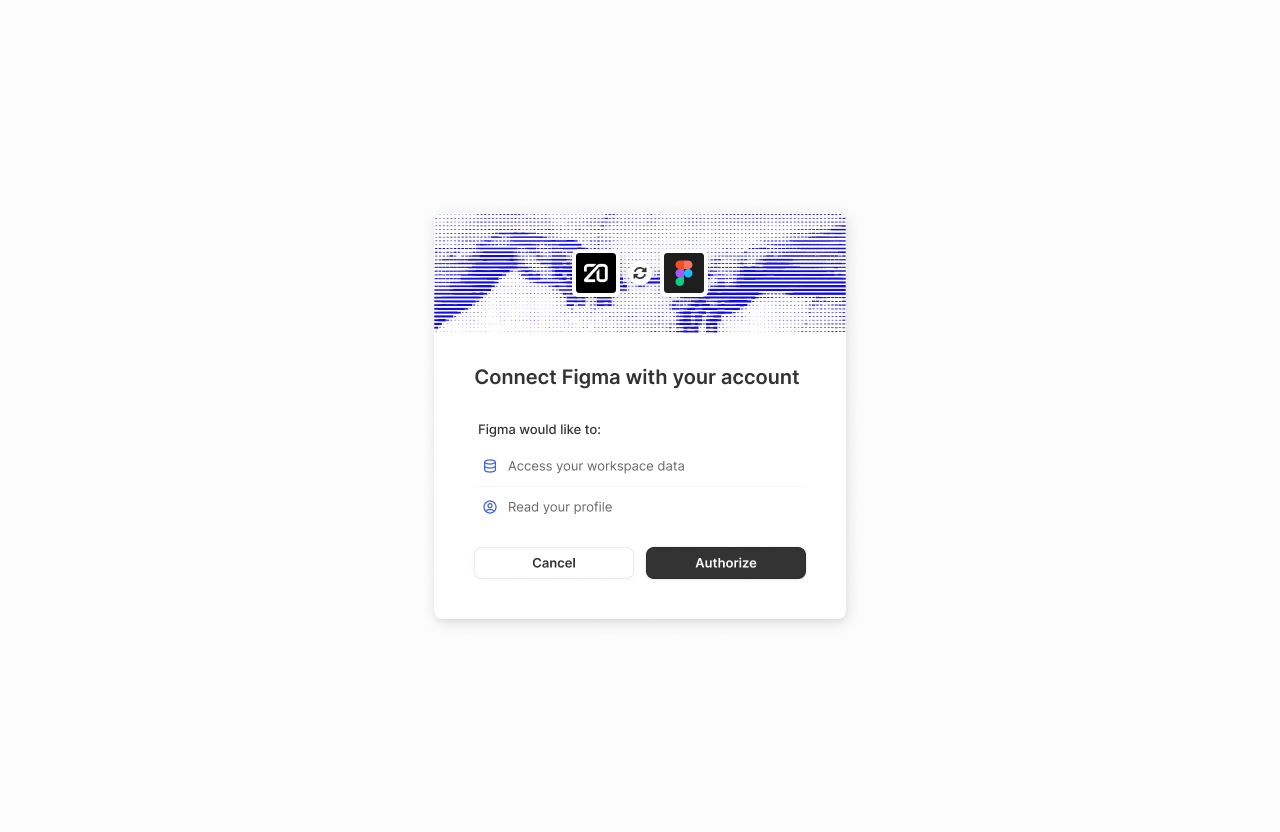 ## Validation - `yarn nx test twenty-front --testFile=src/modules/auth/hooks/__tests__/useAuth.test.tsx --coverage=false` - `yarn nx test twenty-server --testFile=src/engine/core-modules/auth/services/auth.service.spec.ts --coverage=false` - `yarn nx typecheck twenty-front` - `yarn nx typecheck twenty-server` - `git diff --check` ## Notes The reference screenshot is linked from a separate branch-hosted image commit so it renders in the PR body without adding that screenshot to the product diff. Co-authored-by: Charles Bochet <charles@twenty.com> |
||
|
Etienne
|
fcd2d586ee |
chore(billing) - remove feature flag (#20531)
- remove feature flag - remove old enforce cap usage logic |
||
|
neo773
|
b03f044d0f |
feat(messaging): add workspace toggle to sync internal emails (#20457)
Co-authored-by: cubic-dev-ai[bot] <191113872+cubic-dev-ai[bot]@users.noreply.github.com> |
||
|
Félix Malfait
|
4da8878697 |
feat: add email forwarding message channel (#19535)
## Summary - Add email forwarding as a new message channel type, allowing users to forward emails from addresses like `support@mycompany.com` into Twenty - Inbound emails arrive via S3 (SES → S3 bucket), are polled by a cron job, parsed, routed to the correct workspace/channel, and persisted as messages - Dedicated settings page at `/settings/accounts/new-email-forwarding` where users provide their source email handle and receive a unique forwarding address - Forwarding channels bypass the IMAP/mailbox sync state machine — they skip cron-driven sync, relaunch, and message-list-fetch lifecycle stages - Forwarding address section shown at the top of the Emails settings page so users can find/copy their addresses after initial setup - Tab names for forwarding channels display the user-provided handle (e.g. `support@mycompany.com`) instead of the internal routing address - Shared utilities extracted from IMAP driver: `extractThreadId`, `extractParticipants`, `extractAddresses` to avoid code duplication - Uses the existing S3 bucket (STORAGE_S3_*) with `inbound-email/` prefix — no separate bucket needed - Feature gated behind `isEmailForwardingEnabled` client config (requires `INBOUND_EMAIL_DOMAIN` + S3 storage) ## New backend modules - `InboundEmailS3ClientProvider` — lazy-initialized S3 client using existing storage config - `InboundEmailStorageService` — S3 operations (get, move to processed/unmatched/failed) - `InboundEmailParserService` — RFC 822 parsing via `postal-mime`, builds `MessageWithParticipants` - `InboundEmailImportService` — orchestrates download → parse → route → persist → archive - `MessagingInboundEmailPollCronJob` — polls S3 `incoming/` prefix, enqueues import jobs - `CreateEmailForwardingChannelInput` DTO — accepts user-provided `handle` ## New frontend components - `SettingsAccountsNewEmailForwardingChannel` — dedicated page with handle input form + forwarding address result - `SettingsAccountsEmailForwardingSection` — forwarding address list on the Emails settings page - `useConnectedAccountHandleMap` — shared hook for account ID → handle lookup - `useCreateEmailForwardingChannel` — mutation hook accepting handle parameter ## Test plan - [x] 17 unit tests for inbound email import service (all outcomes: imported, unmatched, loop_dropped, unconfigured, parse_failed, persist_failed) - [x] 16 tests for `computeSyncStatus` including EMAIL_FORWARDING cases - [x] 11 tests for `extractEnvelopeRecipient` utility - [x] TypeScript typechecks pass for both twenty-server and twenty-front - [x] Lint passes for both packages - [ ] Manual: create forwarding channel, verify forwarding address generated - [ ] Manual: send email to forwarding address, verify it appears in Twenty https://claude.ai/code/session_01KpyF6p4cUEnuaT4h8DP5Pm --------- Co-authored-by: Claude <noreply@anthropic.com> Co-authored-by: Copilot Autofix powered by AI <223894421+github-code-quality[bot]@users.noreply.github.com> Co-authored-by: claude[bot] <41898282+claude[bot]@users.noreply.github.com> Co-authored-by: neo773 <62795688+neo773@users.noreply.github.com> Co-authored-by: neo773 <neo773@protonmail.com> |
||
|
Etienne
|
9fc5be1c4c |
Billing - Migrate from Stripe metering (#20298)
**Overall strategy** **1. Introduce “Billing V2” behind a workspace flag** Gate the new model with FeatureFlagKey.IS_BILLING_V2_ENABLED so existing workspaces stay on the old behavior until they’re migrated or explicitly on V2. **2. Replace workflow metered SKUs with a resource-credit product** Conceptually, billable “workflow execution” usage is not the primary subscription line item anymore. Add a RESOURCE_CREDIT product (and keep WORKFLOW_NODE_EXECUTION as deprecated for the transition). Usage and limits are expressed through credit buckets (e.g. price metadata like credit_amount), so one product can represent pooled credits instead of a narrow workflow-only meter. **3. Migrate subscriptions in two layers** Schema/catalog: persist extra price metadata (instance upgrade) so the server knows credit amounts and can match Stripe prices to the new model. Per workspace: the registered workspace command upgrade:2-2:migrate-to-billing-v2 finds subscriptions that still have WORKFLOW_NODE_EXECUTION, swaps those items to the right RESOURCE_CREDIT prices (using existing Stripe schedule + BillingSubscriptionUpdateService stack), then treats the workspace as V2 (flag). Workspaces without that legacy item or without a subscription are skipped. **4. Unify subscription lifecycle + usage on the server** **5. Refresh the product surface in Settings** Test : - [x] Subscribe v1 + Update subscribe + Migrate - [x] Subscribe v2 + Update subscribe |
||
|
Charles Bochet
|
027331c893 |
chore(front): move mocked-metadata helpers under src/testing (#20341)
## Summary Follow-up to #20308. After that PR, production code no longer loads mocked metadata when the user is unauthenticated. The remaining mocked-metadata helpers (`useLoadMockedMetadata`, `preloadMockedMetadata`) are now only consumed by Storybook decorators, so move them next to the other testing-only utilities to make their scope explicit and prevent accidental re-introduction of a runtime dependency on mocks. - `src/modules/metadata-store/hooks/useLoadMockedMetadata.ts` → `src/testing/hooks/useLoadMockedMetadata.ts` - `src/modules/metadata-store/utils/preloadMockedMetadata.ts` → `src/testing/utils/preloadMockedMetadata.ts` The three Storybook decorator imports (`MockedMetadataLoadEffect`, `ObjectMetadataItemsDecorator`, `WorkflowStepDecorator`) are updated to the new `~/testing/...` paths. No runtime behavior change. ## Test plan - [x] `npx oxlint --type-aware -c .oxlintrc.json` on touched files — clean - [x] `npx prettier --check` on touched files — clean - [ ] CI: storybook, unit tests, e2e tests |
||
|
Charles Bochet
|
ee6c0ef904 |
Replace sign-in mocked metadata with hardcoded BackgroundMock (#20308)
## Summary When the user is logged out, we render the auth modal on top of a sample table to make the empty page feel alive. So far this was achieved by **loading a full set of mocked object / field / view / navigation-menu metadata into the runtime metadata store** and then mounting the real `RecordTable` and `AppNavigationDrawer` behind the modal. This had a few downsides: - Significant bundle weight pulled in for unauthenticated users (mocked GraphQL fixtures + the real `RecordTable` virtualization stack). - Plenty of code paths that had to know about the "showAuthModal" case (`useRecordIndexTableQuery`, `useTriggerInitialRecordTableDataLoad`, `MainContextStoreProvider`, `IsMinimalMetadataReadyEffect`...). - Any change to metadata-store internals or to the record-table runtime risked breaking the logged-out background. This PR replaces the entire flow with a small, self-contained `BackgroundMock` component tree that **does not consume any metadata** and **does not load any mocked metadata at runtime**. ### What changed - New module under `sign-in-background-mock`: - `BackgroundMockPage` + `BackgroundMockViewBar` + `BackgroundMockTable` + `BackgroundMockTableRow` render a hardcoded "Companies" table that visually mirrors the real one. - `BackgroundMockNavigationDrawer` renders a hardcoded sidebar with People / Companies / Opportunities / Tasks / Notes (with their standard colors). - Hardcoded constants in `BackgroundMockCompanies.ts`, `BackgroundMockColumns.ts`, `BackgroundMockNavigationItems.ts`. - `MinimalMetadataLoadEffect` no longer calls `loadMockedMetadataAtomic` for unauthenticated users — it just doesn't load anything. - `IsMinimalMetadataReadyEffect` now reports ready immediately when there is no access token pair, so the skeleton loader doesn't hang waiting for metadata that will never come. - `MainContextStoreProvider`, `useRecordIndexTableQuery`, and `useTriggerInitialRecordTableDataLoad` drop their `showAuthModal` branches — the real `RecordTable` is no longer mounted behind the modal. - `DefaultLayout` and `NotFound` now lazily load `BackgroundMockPage` / `BackgroundMockNavigationDrawer` instead of the deleted `SignInBackgroundMockPage` / `SignInAppNavigationDrawerMock`. - Removed: `SignInBackgroundMockPage`, `SignInBackgroundMockContainer`, `SignInBackgroundMockContainerEffect`, `SignInAppNavigationDrawerMock`, `SignInBackgroundMockColumnDefinitions`, `SignInBackgroundMockCompanies`, `SignInBackgroundMockViewFields`. `useLoadMockedMetadata` and `preloadMockedMetadata` are kept on purpose: Storybook decorators (`ObjectMetadataItemsDecorator`, `WorkflowStepDecorator`) still rely on the mocked metadata fixtures, but **production** unauthenticated runtime no longer touches them. ### Visual parity Side-by-side at 1440×900 on `/sign-in`: **Before** (loads mocked metadata + real RecordTable):  **After** (purely hardcoded BackgroundMock):  ## Test plan - [ ] `npx nx typecheck twenty-front` ✅ (passes locally) - [ ] `npx nx lint:diff-with-main twenty-front` ✅ (oxlint + prettier clean) - [ ] `npx jest useRecordIndexTableQuery` ✅ - [ ] Manually verify `/sign-in` renders the table + nav drawer behind the modal - [ ] Manually verify `/not-found` still renders the background - [ ] Verify CI: storybook, unit tests, e2e tests |
||
|
neo773
|
d040756fcf |
remove direction from messages (#20026)
This was a leftover column removed in https://github.com/twentyhq/twenty/pull/6743 but was accidentally added again when we migrated to `buildMessageStandardFlatFieldMetadatas` from workspace decorator /closes #20011 |
||
|
Paul Rastoin
|
596ce32bd6 |
Fix front unit test on main (#20233)
Jest mocks runs before the const is defined |
||
|
Paul Rastoin
|
89ad87aa64 |
Make twenty-front build env agnostic (#20055)
## Introduction
In aim to reduce and optimize the number of twenty-front build we do
during our cd process and allow twenty-front build promotion

### Build time

**Nothing is baked.** The `build/` directory is a clean, env-agnostic
artifact. `index.html` contains the empty placeholder:

```html
<script id="twenty-env-config">
  window._env_ = {
    // This will be overwritten
  };
</script>
```

The JS bundles contain no hardcoded server URL.

---

### Deploy mode 1: Frontend served by the backend (Docker / NestJS)

1. Container starts, NestJS boots in `main.ts`
2. `generateFrontConfig()` runs, reads `process.env.SERVER_URL`
3. Rewrites `dist/front/index.html`, replacing the placeholder with:
   ```html
   <script id="twenty-env-config">
     window._env_ = {
       REACT_APP_SERVER_BASE_URL: "https://api.example.com"
     };
   </script>
   ```
4. NestJS serves the static `dist/front/` directory
5. Browser loads `index.html`, `window._env_` is set before the app JS
executes
6. `src/config/index.ts` reads `window._env_.REACT_APP_SERVER_BASE_URL`
and uses it

---

### Deploy mode 2: Frontend served standalone (CDN / nginx / static
server)

1. Take the `build/` artifact as-is
2. Before serving, run at deploy time:
   ```bash
REACT_APP_SERVER_BASE_URL=https://api.example.com sh
./scripts/inject-runtime-env.sh
   ```
3. This does the same `sed` replacement on `build/index.html`
4. Serve the `build/` directory with your static server of choice
5. Same resolution in the browser:
`window._env_.REACT_APP_SERVER_BASE_URL` is picked up by
`src/config/index.ts`

---

### Fallback: no injection at all

If neither mechanism runs (e.g. local dev with `vite dev`),
`window._env_.REACT_APP_SERVER_BASE_URL` is `undefined`, and
`getDefaultUrl()` kicks in:
- **Localhost**: returns `http://localhost:3000`
- **Non-localhost**: returns same-origin (`window.location.origin`)
|
||
|
Charles Bochet
|
96fc98e710 |
Fix Apps UI: replace 'Managed' label with actual app name and unify app icons (#19897)
## Summary

- The Data Model table was labeling core Twenty objects (e.g. Person,
Company) as **Managed** even though they are part of the standard
application. This PR teaches the frontend to resolve an `applicationId`
back to its real application name (`Standard`, `Custom`, or any
installed app), and removes the misleading **Managed** label entirely.
- Introduces a single, consistent way to render an "app badge" across
the settings UI:
- new `Avatar` variant `type="app"` (rounded 4px corners + 1px
deterministic border derived from `placeholderColorSeed`)
- new `AppChip` component (icon + name) backed by a new
`useApplicationChipData` hook
- new `useApplicationsByIdMap` hook + `CurrentApplicationContext` so the
chip can render **This app** when shown inside the matching app's detail
page
- Reuses these primitives on:
- the application detail page header (`SettingsApplicationDetailTitle`)
  - the Installed / My apps tables (`SettingsApplicationTableRow`)
  - the NPM packages list (`SettingsApplicationsDeveloperTab`)
- Backend: exposes a minimal `installedApplications { id name
universalIdentifier }` field on `Workspace` (resolved from the workspace
cache, soft-deleted entries filtered out) so the frontend can resolve
`applicationId` -> name without N+1 fetches.
- Cleanup: deletes `getItemTagInfo` and inlines its tiny
responsibilities into the components that need them, matching the
`RecordChip` pattern.
|
||
|
Weiko
|
df9c4e26b5 |
Disable reset to default when custom tab or widget (#19814)
## Context "Reset to default" action is rejected by the backend for custom entities because there is no "default" concept for them ## Implementation Grey out the Reset to default action on record page-layout tabs and widgets when the entity either has no applicationId yet (unsaved draft — previously slipped through the existing check), or belongs to the workspace custom application. <img width="926" height="370" alt="Screenshot 2026-04-17 at 18 50 31" src="https://github.com/user-attachments/assets/c7c163f4-17a6-4b69-a66d-90f9085d27a2" /> |
||
|
Etienne
|
94b8e34362 |
Object view widget - Introduce new TABLE_WIDGET view type (#19545)
closes https://discord.com/channels/1130383047699738754/1491549365263667230/1491804729397743666 |
||
|
Raphaël Bosi
|
a88d1f4442 |
Introduce standalone page (#19675)
Add support for standalone pages: a new `PageLayout` type (`STANDALONE_PAGE`) that can be rendered independently at `/page/:pageLayoutId`, not tied to any record or object context. - New `STANDALONE_PAGE` page layout type - New `PAGE_LAYOUT` navigation menu item type: adds a `pageLayoutId` foreign key to `NavigationMenuItemEntity`, allowing sidebar items to link directly to standalone pages - New `GLOBAL_OBJECT_CONTEXT` command menu availability type: separates object-context-dependent commands (Create Record, Import, Export, See Deleted, Create View, Hide Deleted) from truly global ones, so standalone pages only show relevant commands - Frontend routing & rendering: adds a `/page/:pageLayoutId` route with its own page component, header, and command menu - Widget rendering refactor - Instance commands: two fast 1.22 migrations: `pageLayoutId` column + `STANDALONE_PAGE` enum, and `GLOBAL_OBJECT_CONTEXT` availability type enum - Workspace command: backfills existing command menu items from `GLOBAL` to `GLOBAL_OBJECT_CONTEXT` where appropriate - Dev seeds: adds a sample "Star History" standalone page with an iframe widget for local development |
||
|
Weiko
|
47bdcb11d8 |
Move is active to fe (#19649)
## Context Moving isActive filtering to the frontend for page layout tabs and widgets, hiding inactive entities from the UI while keeping them in state for future reactivation Next we will implement deactivated standard tab re-activation during tab creation (cc @Devessier) <img width="234" height="303" alt="📋 Menu (Slots)" src="https://github.com/user-attachments/assets/17a25ac6-55e2-4778-b7f0-e7554ed69704" /> |
||
|
Charles Bochet
|
b284c8323c |
Remove Favorite and FavoriteFolder from workspace schema (#19536)
## Summary - Removes all workspace schema definitions for `Favorite` and `FavoriteFolder` entities, which have been fully migrated to `NavigationMenuItems` - Deletes 26 standalone files including workspace entities, NestJS modules, services, listeners, jobs, standard application builders (field metadata, views, view fields, view field groups, indexes, page layouts), mocks, and integration tests - Cleans up ~40 modified files: removes `favorites` relation from 10 workspace entities and their field metadata utils, removes entries from all builder maps, shared constants (`STANDARD_OBJECTS`, `CoreObjectNameSingular`, `DEFAULT_RELATIONS_OBJECTS_STANDARD_IDS`), SDK default relations, AI tool filtering, and standard object icons |
||
|
Weiko
|
238018dc7b |
Reset Tab Page Layout (#19453)
## Context - Add "Reset to default" for page layout tabs and widgets — backend mutation resets overrides, reactivates deactivated children, and deletes custom children - Fix override write bug where mutating an overridable property (e.g. widget title) on a standard-app entity incorrectly overwrote the base column instead of writing to the overrides JSONB — PageLayoutUpdateService now uses resolveFlatEntityOverridableProperties for accurate diffing and routes properties through sanitizeOverridableEntityInput - Deprecate isOverridden - We need more time to think about this feature. Currently this adds too much complexity for a very small benefit https://github.com/user-attachments/assets/a84546c8-1e15-4d9e-a489-0825cf8b8ed2 |
||
|
Charles Bochet
|
81f10c586f |
Add workspace DDL lock env var and maintenance mode UI (#19130)
## Summary - Add `WORKSPACE_SCHEMA_DDL_LOCKED` env-only boolean config variable that blocks all workspace schema DDL changes when set to `true`. This is intended for hot upgrades where logical replication cannot handle DDL changes. Enforced at two chokepoints: - `WorkspaceMigrationRunnerService.run` — blocks all metadata-driven DDL (object/field/index CRUD, app sync/uninstall, standard app sync, upgrade commands) - `WorkspaceDataSourceService.createWorkspaceDBSchema` / `deleteWorkspaceDBSchema` — blocks workspace creation (sign-up) and hard deletion. Uses a dedicated `WorkspaceDataSourceException` (not ForbiddenException) - Add maintenance mode feature with Admin Panel UI and user-facing banner: - **Backend**: `MaintenanceModeService` stores maintenance window (startAt, endAt, optional link) in `core.keyValuePair` as `CONFIG_VARIABLE`. Validates endAt > startAt. Uses `GraphQLISODateTime` scalar for date fields. Exposed via `clientConfig` REST endpoint and admin GraphQL mutations (`setMaintenanceMode`, `clearMaintenanceMode`) - **Admin Panel**: New "Maintenance Mode" section in Health tab with UTC datetime pickers and activate/deactivate controls - **Banner**: `InformationBannerMaintenance` displayed at the top of `DefaultLayout` for all users, using Temporal API for timezone-aware formatting with an optional "Learn more" link These two features are **independent** — the DDL lock is controlled via env var for operational use, while maintenance mode is a UI notification mechanism controlled from the admin panel. |
||
|
Raphaël Bosi
|
9f95c4763c |
[COMMAND MENU ITEMS] Remove deprecated code (#19199)
This PR is the first one of a cleanup after upgrading command menu items to V2. |
||
|
Etienne
|
887e0283c5 |
Direct execution - Follow up (#19177)
Feedbacks from https://github.com/twentyhq/twenty/pull/18972 |
||
|
Charles Bochet
|
81fc960712 |
Deprecate dataSource table with dual-write to workspace.databaseSchema (#19059)
## Summary - Starts deprecation of the `core.dataSource` table by introducing a dual-write system: `DataSourceService.createDataSourceMetadata` now writes to both `core.dataSource` and `core.workspace.databaseSchema` - Migrates read sites (`WorkspaceDataSourceService.checkSchemaExists`, `WorkspaceSchemaFactory`, `MiddlewareService`, `WorkspacesMigrationCommandRunner`) to read from `workspace.databaseSchema` instead of querying the `dataSource` table - Removes the unused `databaseUrl` field from `WorkspaceEntity` and drops the column via migration - Adds a 1.20 upgrade command to backfill `workspace.databaseSchema` from `dataSource.schema` for existing workspaces |