1d755983ffe776b737676d44d993f4fc5d95c819
182 Commits
| Author | SHA1 | Message | Date | |
|---|---|---|---|---|
 Abdul Rahman Abdul Rahman
|
5effee7754 |
Fix grouping a view that can no longer be changed or removed (#23619)
Fixes #23529 https://github.com/user-attachments/assets/2dbcf5ac-9b2e-4331-b7e8-703c8c5384b5 Grouping People by Company was a one-way door: once the view was grouped, the grouping could neither be changed nor removed. Two independent bugs on the same path caused it, and both had to be fixed. ## 1. The Group by entry was disabled, so the picker was unreachable `ObjectOptionsDropdownRecordGroupsContent` disabled the `Group by` entry whenever the object had a single groupable field. People exposes exactly one (Company), so the entry was always disabled there. That entry is the only way back to the field picker once a view is grouped: `ObjectOptionsDropdownCustomView` sends `Group` to the picker while the view is ungrouped, and to the group management screen once it is grouped. With the entry disabled, the picker, and with it the `None` option, became unreachable. A table view can always drop its grouping through `None`, so the entry now stays enabled there and is only disabled for layouts that require a grouping. ## 2. The view groups created by the server were never synced back The server deletes and recreates the view groups whenever `mainGroupByFieldMetadataId` changes (`handleFlatViewUpdateSideEffect`), and returns them in the `updateView` payload. `usePerformViewAPIUpdate` only wrote the view itself back to the metadata store, so the `viewGroups` entity kept the pre-change rows. The view create path already syncs them; the update path did not. On top of that, `useHandleRecordGroupField` overwrote the groups returned by the mutation with client-generated ones whose ids matched no persisted row, and `resetRecordGroupField` bailed out on `viewGroups.length === 0`. Since a relation grouping legitimately starts with no groups, clicking `None` was a no-op even when it could be reached. - sync the view groups returned by `updateView` into the metadata store - use those groups instead of regenerating them client-side - reset the grouping based on `mainGroupByFieldMetadataId`, and reload the record index states so the table regroups and ungroups without a refresh ## 3. Drive-by: No Value missing from the widget draft preview `buildDraftViewGroupsForFieldMetadataItem` mirrors `computeFlatViewGroupsOnViewCreate` so the page layout widget preview matches what gets persisted, but it returned early for relation fields and skipped the empty group. The server keeps creating it for nullable fields, relations included, so the group appeared out of nowhere once the widget was saved. It now skips only the option groups and keeps the empty group. ## Not changed Grouping by a relation shows no groups until you add them through `New group`. That is intended, since a relation can have an unbounded number of groups, and nothing here changes it. |
||
|
Félix Malfait
|
f663cd3c68 |
Move open-record-in to object metadata and member preference (#23614)
Replaces the per-view "Open in" setting with a two-level model, following up on #23422 / #23424 and superseding the closed #23446 and #23457: - `objectMetadata.openRecordIn`: `SIDE_PANEL` | `RECORD_PAGE` | `USER_CHOICE` (default `USER_CHOICE`) - `workspaceMember.openRecordIn`: `SIDE_PANEL` | `RECORD_PAGE` (default `SIDE_PANEL`), editable in Settings > Experience The rule: records open where the member prefers, unless the object pins them, and never in a panel there is no room for (mobile always resolves to the record page). ## Why Having the setting on views, objects and members at once was heavy, and view-level resolution was fragile: a chip rendered outside a view (notes, front components, kanban cards pointing at another object) had no view to read from, which is the class of bug behind #23422. Resolution is now context-free: it needs only the object, the current member and the viewport, so chips behave identically everywhere by construction. ## Changes **Object level** - New `openRecordIn` enum column on `objectMetadata`, editable through `updateOneObject` and surfaced in Settings > Data model > Object > Layout ("Open records in": Member preference / Side Panel / Record Page) - Standard definitions pin `workflow`, `workflowVersion`, `dashboard` and `messageCampaign` to the record page (matching the previously hardcoded list) and `calendarEvent` to the side panel (it has no curated record page); everything else, including `workflowRun`, follows the member preference - Apps can set it in `defineObject()` via the object manifest **Member level** - New `openRecordIn` standard field on `workspaceMember`, persisted through the existing settings path (same as `colorScheme`) and exposed in Settings > Experience **View level (deprecated)** - `view.openRecordIn` is no longer read or written by the frontend; the "Open in" entry is gone from the view options dropdown - The column, DTO field and inputs are kept for one release for API compatibility: the output field carries a `deprecationReason`, the inputs keep accepting the value with a `Deprecated:` description (NestJS silently drops input fields that have a `deprecationReason`, which would have been a breaking change) **Upgrade (2.27)** - Fast instance command adds the `objectMetadata.openRecordIn` column defaulting to `USER_CHOICE` - Workspace command adds the `workspaceMember.openRecordIn` field - Workspace command seeds the object column from the standard definitions (any non-`USER_CHOICE` value), then lifts deliberate per-view record page choices onto objects the definitions don't pin **Debt removed** - `canOpenObjectInSidePanel` hardcoded object list and its test - `ObjectOptionsDropdownLayoutOpenInContent` and the `layoutOpenIn` dropdown wiring - `DefaultViewOpenRecordIn` - Context-store/view-based resolution in `useResolveOpenRecordIn` (now reads object metadata + member + viewport) - Front components no longer guess from the current view: an explicit side-panel call honours a pinned object and the viewport, nothing else ## Verification - Ran the three upgrade commands against a live database: column created, the pinned standard objects seeded per workspace (record page pins plus calendarEvent to side panel), member field backfilled to `SIDE_PANEL`; seed rerun is a no-op - Seed command verified on a simulated pre-upgrade workspace (index view set to record page on company): pins the standard objects plus company, idempotent on rerun - Both packages typecheck and lint clean; affected unit suites and the application sync, view creation and metadata cache integration specs pass --------- Co-authored-by: Thomas des Francs <tdesfrancs@gmail.com> |
||
|
Weiko
|
0d63906a58 |
Fix calendar field picker state handling (#23595)
## Context Changing a calendar date field already updated the record-index calendar state immediately, so the calendar moved to the new field before the `updateView` mutation completed. The options dropdown still derived its selected checkmark and field labels from `currentView`, which remains unchanged while persistence is pending. On slower environments this left the previous field name visible even though the calendar was already using the new field. Locally the same mismatch existed, but was only visible briefly because the mutation completed faster. ## What changed - Read the active start and end date field IDs from the record-index calendar component state in the calendar options dropdown. - Use that state for the main options label, the two-field submenu, and both field-picker selections. - Use the optimistic end-field state when filtering compatible start fields and deciding whether an incompatible end field must be cleared. - Keep the existing view mutation and calendar-state writes unchanged. ## Why The calendar and its configuration UI now share the same source of truth while persistence is pending. A field selection updates the calendar, checkmark, and contextual labels together instead of temporarily mixing optimistic calendar state with stale persisted view metadata. ## Safety and expected impact This is frontend state synchronization only. It does not change the metadata schema, API payloads, or persistence flow. Existing date and datetime compatibility rules remain in place. Users should see the selected field name update immediately, including when the metadata mutation is slow. ## Limitations This does not change mutation error handling or add rollback behavior. The calendar atoms were already updated optimistically before this change, this PR only makes the configuration UI reflect those same values. ## Validation - Reproduced the stale selection on qacoco and locally. - Verified locally that the checkmark moves immediately after selecting another date field, before the mutation closes the dropdown. - `npx nx typecheck twenty-front` - Focused type-aware oxlint on the four changed files, 0 warnings and 0 errors. - `npx oxfmt --check` on the four changed files. - `git diff --check` |
||
|
Weiko
|
e2e2142998 |
Add calendar date field submenu with grouped field options (#23445)
## Summary - Add a submenu for selecting calendar date fields as it was not clear enough that you could pick 2 date fields. - Group date and datetime fields with non-selectable headers ### Before <img width="240" height="252" alt="Screenshot 2026-07-29 at 11 32 54" src="https://github.com/user-attachments/assets/169bd965-676f-4ef9-8ba6-9ecac80547c6" /> ### After <img width="260" height="246" alt="Screenshot 2026-07-29 at 11 31 58" src="https://github.com/user-attachments/assets/a4471bb0-5c1f-4f5e-bddb-165a5c9da4c7" /> |
||
|
Félix Malfait
|
840c6d0129 |
Take openRecordIn from the view in scope instead of a global atom (#23422)
Stacked on #23424 (mobile chip navigation). Review that one first; the diff shown here is only the delta. ## Problem `recordIndexOpenRecordInState` was a global atom mirroring `view.openRecordIn`. It was written whenever any index view loaded and never reset, so a record chip behaved according to whichever view had been browsed last: - Companies view set to "record page". Open a Company, tap a related Opportunity chip. The Opportunities view says "side panel", but the chip reads the leftover Companies setting and opens a full page. - Visit the Opportunities index first, then the same Company page, and that same chip now opens a side panel. The setting is per view in the database, but the frontend kept it in one slot as though it were a user preference. ## Approach The value already lives on the view, so the mirror is deleted rather than scoped: - `useResolveOpenRecordIn` reads the current view of the surrounding context store. On a record index that is the view being displayed. On a record show page `MainContextStoreProvider` resolves a view for the object in the URL — the last visited view for that object, falling back to its index view — so chips there follow a view belonging to the object they sit on, rather than whatever was loaded last. - Where no context store is mounted at all (a mention inside a note, for instance) there is no view to take a setting from, so the hook falls back to `DEFAULT_VIEW_OPEN_RECORD_IN`. The instance lookup is non-throwing on purpose: `RecordChip` renders in a lot of places, and an existing test caught this crashing when the read was strict. - The options dropdown now reads and writes `currentView.openRecordIn` directly, the same way `isCompact` beside it already works, so `setAndPersistOpenRecordIn` only has to persist. - `useGetOpenRecordIn` is gone; every call site had the object name available at render, so the reactive hook covers all of them. ## Behaviour change A chip whose behaviour previously came from an unrelated view now follows the view in scope. That is the point of the change, but it does mean some chips will open somewhere different from before, always in the direction of "what this list is configured to do" rather than "what the last list was configured to do". ## Testing - New `useResolveOpenRecordIn` tests: falls back to the default with no context store, follows the context store's view when there is one. - Full frontend suite: 951 suites, 5598 tests passing. Typecheck and lint clean. - Not exercised in a running app: no database in this environment. The dropdown's optimistic behaviour in particular relies on the same view store refresh that `isCompact` already depends on, so it is worth a click-through before merge. |
||
|
Félix Malfait
|
3a8f086d15 |
Converge drag and drop on shared dnd-kit primitives, remove @hello-pangea/dnd (#23211)
Follow-ups recorded in #23023, done in one pass. ## Shared primitives - Folded `PageLayoutWidgetSortableItem` and `PageLayoutWidgetDropLine` into the shared `DragDropItemSortableCell` / new `DragDropItemDropLine` (new `data`, `dropLine`, `highlightWhileDragging`, `hasTransition` props). - Added generic `DragDropProviderDragStartEvent` (and DragMove/DragOver/DragEnd/DropTarget) helpers and deleted the 7 copied `Parameters<...>` extractions across the dnd hooks. - Replaced the `useMovePageLayoutWidgetUp/Down` implementations (~140 lines) with `moveWidgetWithinTabInDraft`. - Migrated the remaining page-layout test suites onto `pageLayoutDraftFixtures`. ## Tab reordering off Pangea - Tabs are sortable cells on the same provider as widget drags, segregated by dnd type, so widget drops on tab buttons keep working while tabs reorder. - Reordering is ID based (`reorderTabInDraft`: insert before the hovered tab), which keeps the pinned first tab in place without index arithmetic. - Preserved overflow behaviors: the dropdown stays open while a tab drag is in flight, dropping a tab on the "+N More" button appends it and opens the dropdown, and both the visible strip and the overflow list have end drop zones. ## Fields configuration editors off Pangea - Group reorder, field reorder and cross-group field moves now run on the shared cells (same drop line and end-zone patterns). ## DraggableList off Pangea - `DraggableList` / `DraggableItem` keep their consumer-facing API — the ~9 consumers now type their handlers with a local `DraggableListDropResult` instead of pangea's `DropResult` — but run on the shared sortable cells; each list's uuid group doubles as its dnd type so nested lists stay isolated from page-level providers. - Items register their index in a list-scoped registry so the end drop zone can resolve the append index at drop time (with insert-before semantics an item could otherwise never reach the last position). - Deleted three dead files that only existed for pangea plumbing (the side panel navigation placeholder, `getCssCompatibleDraggableProps`, the orphaned `recordGroupPendingDragEndReorderState`). ## Record table row drag off Pangea - Rows register through `useSortable` directly on the row element — no wrapper div, so row CSS, sticky cells and virtualization stay untouched — with the grip cell wired as the drag handle via the shared sortable handle ref context. - Both table modes (virtualized flat list and record groups) share a `DragOverlay` clone that replaces pangea's virtual-mode `renderClone`, and end drop zones per record group (and after the virtualized list) allow dropping after the last row or into an empty group. - The drop handlers keep their pangea-shaped result object, retyped as a local `RecordDragDropResult`, so the position computation logic is untouched. ## Pangea removed `@hello-pangea/dnd` is gone from `package.json` and the lockfile, along with its orphaned transitive entries (`css-box-model`, `raf-schd`, `react-redux`, `redux`). Nothing in the repo imports it anymore. ## Dashboards: cross-tab widget drag for grids react-grid-layout drags never enter dnd-kit, so the bridge hit-tests the pointer against the tab buttons' `data-page-layout-tab-drop-target-id` rects during grid drags, highlights the hovered tab through state, and on drop moves the widget to the destination grid below its existing content (`moveWidgetToGridTabInDraft`, `buildTabWidgetLayouts`). The grid's own post-drag layout commit is suppressed once so it does not overwrite the cross-tab move. ## Fixes found while testing - With `feedback: 'clone'`, the drag source is its own initial drop target and its placeholder is a DOM clone taken at drag start, so the drop line rendered into the source got baked into the placeholder and stuck there for the whole drag. The line is now hidden on the source cell, leaving a single indicator at the actual target. - Reorderable tabs collapsed to text height and sat top-aligned next to "+ New Tab" because the sortable cell wrapper defaults to `display: block; height: auto`, breaking the tab height chain — the tab list now uses the cell's `fill` mode so tabs stretch to the strip height again. ## Testing Playwright against the dev app: - Record page: widget reorder up and down in the pinned column (single blue drop line at the target), drag to another tab via its tab button (highlight + move), drag back into content at a specific position, chained cross-tab moves, tab reorder with vertical drop line, new tab creation. - Overflow (narrow viewport): drop a tab on "+N More" (appends last, dropdown opens), reorder inside the dropdown (stays open), drag a tab from the dropdown back to the visible strip. - Dashboard: grid drag within a tab, cross-tab drag onto a tab button (hover highlight, widget lands below destination content, remaining widgets keep their positions), save and reload persistence in both directions. - Fields editor: field reorder, group reorder, field move across groups, plus the Move Up / Move Down widget actions. Since the pangea-removal commits: - Typecheck, oxlint and oxfmt green over the full front source; unit suites green including the migrated `useStartRecordDrag` test (jest needed a scoped transform exemption for `@preact/signals-core` once dnd-kit reached the side-panel suites). - Storybook visual regression unchanged across ~700 stories — expected, since the migrated surfaces render identical DOM at rest (drop lines and drag overlays only exist mid-drag). - The tab strip fix reverses the exact regression mechanism: the sortable cell wrapper defaulted to `display: block; height: auto`, collapsing the tab height chain next to the full-height "+ New Tab" button; `fill` restores the stretch. --- _Generated by [Claude Code](https://claude.ai/code/session_01XKRCzzu8oGyocXZtFp7VEG)_ <a href="https://cubic.dev/pr/twentyhq/twenty/pull/23211?utm_source=github" rel="nofollow noreferrer noopener" target="_blank">``<img alt="Review in cubic" src="https://www.cubic.dev/buttons/review-in-cubic-dark.svg">``</a> |
||
|
Félix Malfait
|
3ad3e8bd1a |
feat: kanban, calendar and group-by table layouts for dashboard view widgets (#22963)
## Context Dashboard view widgets previously only rendered flat tables. This PR ships the full feature: **Table with group-by**, **Kanban**, and **Calendar** layouts for dashboard view widgets — server API + frontend, end-to-end. (Originally staged as a 4-PR stack — #22966, #22967, #22968 — consolidated here per review.) ## Server / API - **View typing.** Adds `KANBAN_WIDGET` and `CALENDAR_WIDGET` to `ViewType` (following the `TABLE_WIDGET` precedent) so widget-backing views keep their layout in `view.type` while staying excluded from record-index pickers. Shared `getViewLayoutFromViewType()` maps widget types to their base layout; `isWidgetViewType()` centralizes the exclusions that were previously hardcoded per-site. - **Migrations.** Two fast instance commands (**2.23**): `ALTER TYPE core.view_type_enum ADD VALUE` for both values, and a widened `CHK_VIEW_CALENDAR_INTEGRITY` constraint covering `CALENDAR_WIDGET` (entity `@Check` updated for fresh installs). - **Validation.** `FlatViewValidatorService` keys kanban/calendar validation on the mapped layout, so widget views get the same invariants as index views (kanban needs a groupable group-by field; calendar needs a date field + layout). Calendar widget views default to month; a non-month (DAY/WEEK) layout is rejected at the API level **unless** the `IS_CALENDAR_WEEK_VIEW_ENABLED` feature flag is enabled for the workspace — the same flag that gates day/week on index calendars. - **API.** `upsertViewWidget` (LAYOUTS permission) accepts a nested `view` settings input (`type`, `mainGroupByFieldMetadataId`, `shouldHideEmptyGroups`, kanban aggregate/column-width, calendar layout/fields). Routes through the standard update path, so `viewGroups` auto-generate from SELECT options exactly like index views. Only widget view types accepted; only `RECORD_TABLE` widgets can change view settings. - **AI tools.** `create-complete-dashboard` + `create_view` now use/allow the `*_WIDGET` types (previously they created plain `TABLE` views that leak into index pickers). ## Frontend **Settings panel.** The **Source** (object) row comes first, since which layouts are available depends on it. The **Layout** row below is a working dropdown (Table / Kanban / Calendar); layouts the source object can't support are **disabled with a hint** ("Needs a Select field" / "Needs a Date field") rather than hidden. Group-by row (select fields; searchable) with a **Hide empty groups** toggle while grouped; **Date field** row replaces Group by while Calendar is active, and — when the `IS_CALENDAR_WEEK_VIEW_ENABLED` flag is on — a **Calendar view** row (Day / Week / Month) appears beside it; **Limit** row hidden while grouped (only the flat virtualized loader enforces it). Kanban keeps its group-by locked (no `None` option). **Instant edit-mode preview.** Draft snapshots carry `viewGroups`; picking a group-by synthesizes them client-side (`buildDraftViewGroupsForFieldMetadataItem`, mirroring the server's generation), so grouped tables/boards preview immediately before dashboard save. On save, `upsertViewWidget` responses hand back the server-generated groups, which replace the client-generated ones in the persisted snapshot. **Renderers.** `RecordTableWidgetRendererContent` branches on the backing view's layout: `RecordBoardWidget` (wraps the standard `RecordBoardContainer`) and `RecordCalendarWidget` (mounts the existing `RecordCalendar`, which renders month / day / week) inside the same per-widget provider sandbox the table uses. **Read-only semantics.** Two flags with distinct scopes, each documented on its state: - `isRecordBoardViewSettingsReadOnlyComponentState` — locks the board chrome that edits view settings (add group, column reorder/resize/menu, aggregates); **card drag still updates records** under object permissions. - `isRecordCalendarReadOnlyComponentState` — widget calendars are read-only by default (no drag, no add-new, no in-calendar layout switch); cards open the side panel. The one exception, behind `IS_CALENDAR_WEEK_VIEW_ENABLED`: a **live (non edit-mode) day/week** widget calendar allows drag-to-reschedule and record creation under object permissions. Month calendars and edit-mode previews stay read-only. **Calendar state componentization.** The calendar module's three settings move from global atoms to component states keyed on `RecordCalendarComponentInstanceContext` (same pattern as record-board), so several calendar widgets and an index-page calendar can coexist without leaking state. All readers resolve the ambient instance; calendar unit tests updated. **Multi-instance fixes that also fix index pages:** record drag states were written against a different instance than every reader resolves (now use the ambient instance); the board sticky-header DOM id is namespaced per board; dragged board cards portal to `document.body` while dragging so react-grid-layout's transforms can't offset the clone from the pointer. ## Scope (v1) - Widget calendars are month-only and read-only by default. With `IS_CALENDAR_WEEK_VIEW_ENABLED` enabled, day/week layouts become selectable (UI + API) and live day/week widget calendars support drag-to-reschedule and record creation under object permissions. - Widget group-by offers SELECT fields only (server auto-generates groups from options; widgets have no per-record add-group flow). ## Tests - Integration: `upsert-view-widget-view-settings.integration-spec.ts` (9 tests — group auto-creation, invalid type/field rejections, non-month calendar widget rejected while the week/day flag is off and accepted once it's enabled, combined settings+fields call); pre-existing `upsert-view-widget` suite (20) green. - Front: new suites for draft view-group generation and snapshot clone/build utils; calendar suites componentized; full `twenty-front` jest, typecheck, oxlint green; `twenty-server` typecheck + lint green. - Browser-verified end-to-end (real dev server + seeded workspace): configure → live edit-mode preview → save → reload for all three layouts; measured drag with pointer inside the card; index-page calendar re-verified (with the week/day flag enabled). https://claude.ai/code/session_01E5N87kwwZWhDtEQaP72cMf |
||
|
Weiko
|
8cf462d5f7 |
Add day view support to record calendar (#22922)
## Summary - Add a calendar day view and wire it into the record calendar layout selection - Update the top bar, time grid, and week/day drag and drop handling to support the new view - Extend supported layout logic and public feature flags for calendar day view access - Add coverage for calendar view content, calendar container behavior, top bar behavior, day view rendering, supported layout resolution, and week event drop handling <img width="1276" height="852" alt="Screenshot 2026-07-15 at 17 48 33" src="https://github.com/user-attachments/assets/b1d9d255-2d64-4adb-82b9-3e500cb0d561" /> <!-- This is an auto-generated description by cubic. --> <a href="https://cubic.dev/pr/twentyhq/twenty/pull/22922?utm_source=github" target="_blank" rel="noopener noreferrer" data-no-image-dialog="true"><picture><source media="(prefers-color-scheme: dark)" srcset="https://www.cubic.dev/buttons/review-in-cubic-dark.svg"><source media="(prefers-color-scheme: light)" srcset="https://www.cubic.dev/buttons/review-in-cubic-light.svg"><img alt="Review in cubic" src="https://www.cubic.dev/buttons/review-in-cubic-dark.svg"></picture></a> <!-- End of auto-generated description by cubic. --> |
||
|
Weiko
|
25bd2897a3 |
Add weekly layout to record calendar (#22819)
## Summary - Add a week layout to record calendar views and persist the selected layout. - Render `DATE` calendars as an all-day week and `DATE_TIME` calendars as an hourly week. - Add an optional end date field across calendar configuration, metadata, persistence, and complete-view upserts. - Use configured end values for ranged and multi-day events, with a one-hour fallback when a `DATE_TIME` end is absent or invalid. - Keep calendar cards consistent with the existing compact view, including checkbox selection and whole-card record opening. - Gate the weekly layout and end-date behavior behind the public Labs `IS_CALENDAR_WEEK_VIEW_ENABLED` workspace feature flag. ## Week interactions - Show overlapping timed events side by side and cap the visible records at two per day. - Display start and end times on timed cards, enforce a readable 30-minute minimum height, and keep today’s text contrast stronger. - Drag timed events between days and times with 30-minute snapping while preserving their duration, including zero-duration events. - Show a create button when hovering a 30-minute slot; keyboard users can focus a day, move the slot with the arrow keys, and reach the same contextual action. - Initialize new records with the selected slot time and a compatible writable end value one hour later. - Show the workspace time zone and current-time indicator in timed weeks; date-only weeks keep the all-day section without an hourly grid. ## Configuration and data loading - Only allow end fields that match the start field type, and prevent selecting the same field for both boundaries. - Load records whose ranges overlap the visible period so month and week layouts display the same relevant records. - Resolve and persist calendar end fields when updating existing views through `upsert_complete_view`. - Fall back to Month and ignore the configured end field while the flag is disabled, without overwriting either persisted setting, so re-enabling restores the previous configuration. - Expose the flag in Labs and keep it default-off for workspaces without a stored value; enable it in the development seeder. <img width="1285" height="808" alt="Screenshot 2026-07-15 at 15 50 17" src="https://github.com/user-attachments/assets/b7e3f7f1-ca77-492f-8cce-cca186ebca0b" /> |
||
|
Abdul Rahman
|
db5338cf32 |
Feat: group records by many to one relation (#22123)
## Group records by relation (Kanban + Table)

Adds grouping by `MANY_TO_ONE` relation fields on both board and table
views, reusing the existing `ViewGroup` storage (`fieldValue = related
record id`).

- **New group** record picker to create relation-backed groups (board
column + table row)
- Relation-aware group headers (name/avatar), filtering, and drag-drop
(writes the FK join column) — all using one canonical `${name}Id` column
- Sort menu hides alphabetical options when grouping by a relation (no
comparable title)
- A group whose backing record no longer exists renders a "Deleted" chip
instead of a blank header
- **Backend:** allow `MANY_TO_ONE` relations as the Kanban
`mainGroupByField` in the flat-view validator


https://github.com/user-attachments/assets/267077a6-2667-4506-b178-eee420a16f20


<!-- This is an auto-generated description by cubic. -->
<a
href="https://cubic.dev/pr/twentyhq/twenty/pull/22123?utm_source=github"
target="_blank" rel="noopener noreferrer"
data-no-image-dialog="true"><picture><source
media="(prefers-color-scheme: dark)"
srcset="https://www.cubic.dev/buttons/review-in-cubic-dark.svg"><source
media="(prefers-color-scheme: light)"
srcset="https://www.cubic.dev/buttons/review-in-cubic-light.svg"><img
alt="Review in cubic"
src="https://www.cubic.dev/buttons/review-in-cubic-dark.svg"></picture></a>
<!-- End of auto-generated description by cubic. -->
|
||
|
Priyanshu Bartwal
|
4c966bfc32 |
[Twenty-front]: Bunch of View Picker Fixes and improvements. (#21290)
While working on #21208, I found a few related improvements and fixes that were worth including in this PR. 1. Improved View Picker UX: - Added optimistic updates when selecting a view from both the drag-and-drop view picker - Added optimistic updates when editing view. Before it used to close the whole dropdown. - Added highlighting for the currently selected view. - Before: https://github.com/user-attachments/assets/469fc60c-e65f-4452-a5a4-7df6188ab19d - After: https://github.com/user-attachments/assets/d3b151c1-0c10-45e7-a796-b5e6061c898d 2. Remove Favorites from the View Picker - Added support for removing a favorite directly from the view picker without needing to open additional menus. - Before: https://github.com/user-attachments/assets/70437fb9-d4c1-488b-aab9-0ea92d1bad99 - After: https://github.com/user-attachments/assets/442546bd-24ae-43d5-abe1-268ef3ff6475 --------- Co-authored-by: Charles Bochet <charles@twenty.com> |
||
|
Thomas des Francs
|
de9af38a67 |
Fix view type label casing (#21772)
## Summary Fix the view type label shown in the object Options menu by introducing a shared `ViewType` label map instead of formatting raw enum values at each call site. I chose to fix the root cause instead of only patching the symptom: the menu was displaying the generated enum value `TABLE`, and `capitalize()` only uppercased the first character without lowercasing the rest. The new mapping gives each view type an explicit translated UI label, so the parent Options menu, the Layout submenu, the view picker, and application content rows all use the same casing source. ## Before / After | Before | After | | --- | --- | | The Options menu showed `TABLE` in uppercase. | The Options menu now shows `Table`, and the Layout submenu still shows `Table`, `Calendar`, and `Kanban`. | | 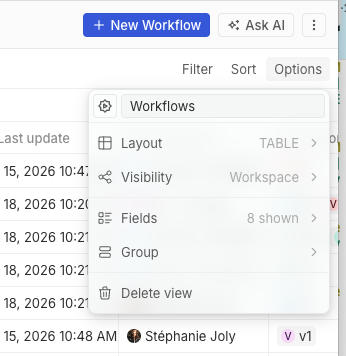 | 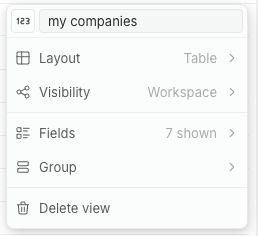 | ## Tests - `git diff --check` - Browser smoke test on `http://apple.localhost:3001/objects/companies` - default view Options menu still opens - custom view Options menu shows `Layout` contextual text as `Table`, not `TABLE` - Layout submenu still shows `Table`, `Calendar`, and `Kanban` - no browser console errors Not run: package lint/test commands, because this checkout has no `node_modules` installed. |
||
|
nitin
|
9bc0db5666 |
fix: exclude non-groupBy date fields (deletedAt) from calendar field selection (#21764)
Closes #21608 The Tasks Calendar renders an empty grid because `GroupByTasks` fails with `Field "deletedAt" is not supported in groupBy` while the header count (`AggregateTasks`) still succeeds. The calendar renders by grouping records on the selected date field. Calendar-field eligibility only checked `isFieldMetadataDateKind`, so `deletedAt` (a system DATE_TIME field) could be picked or auto-defaulted as the calendar field — and the groupBy engine correctly rejects it (only `createdAt`/`updatedAt` are groupable system date fields). Fix: gate calendar-field eligibility on `isFieldMetadataSupportedInGroupBy` (the same authority the backend groupBy validator uses), so non-groupable date fields can no longer be selected. - `useGetAvailableFieldsForCalendar` — add the groupBy-support check alongside the date-kind filter - `ObjectOptionsDropdownCalendarFieldsContent` — reuse the hook's list instead of re-filtering raw fields |
||
|
Raphaël Bosi
|
8034c7725f |
Reorganize twenty-ui into best-practice component domains and per-component folders (#21745)
Reorganizes `twenty-ui`'s component organization to follow how the best
UI libraries (MUI, Mantine, Base UI, Polaris) structure their source,
now that the package has stabilized.

**Taxonomy** — dissolves the meaningless `components/` junk-drawer and
the 107-file `display/` mega-category. New domains/subpaths:
`data-display`, `typography`, `icon`, `surfaces`; `feedback` and
`layout` absorb the rest (banners/callout/info + placeholders →
feedback; modal/card → surfaces; motion + separators → layout).

**Per-component layout** — every component is now
`<domain>/<ComponentName>/<ComponentName>.tsx` with colocated
styles/stories/types, `internal/` for private helpers and `parts/` for
re-exported compound sub-parts. The redundant inner `/components/` is
gone. `icon` and `json-visualizer` are kept as cohesive subsystems.

**Also:** adds a tree-shakeable root barrel (`import { Button } from
'twenty-ui'`), the generator now owns `individual-entry.ts`, and a real
barrel-leak bug is fixed (private `internals/` parts were leaking into
the public API).

Consumer imports (~1.2k files) and the `twenty-sdk` UI aggregator were
updated by codemod. The change is **export-neutral** except 16
intentionally-removed private internals symbols (all verified
unconsumed). Gates green: typecheck, lint, build, size-limit, storybook.


<!-- This is an auto-generated description by cubic. -->
<a
href="https://cubic.dev/pr/twentyhq/twenty/pull/21745?utm_source=github"
target="_blank" rel="noopener noreferrer"
data-no-image-dialog="true"><picture><source
media="(prefers-color-scheme: dark)"
srcset="https://www.cubic.dev/buttons/review-in-cubic-dark.svg"><source
media="(prefers-color-scheme: light)"
srcset="https://www.cubic.dev/buttons/review-in-cubic-light.svg"><img
alt="Review in cubic"
src="https://www.cubic.dev/buttons/review-in-cubic-dark.svg"></picture></a>
<!-- End of auto-generated description by cubic. -->
|
||
|
Raphaël Bosi
|
9c9c34fccf |
Remove twenty-ui-deprecated and migrate frontend to twenty-ui (#21596)
Migrates `twenty-front`, `twenty-sdk`, and `twenty-front-component-renderer` from `twenty-ui-deprecated` to `twenty-ui` (mechanical import swap — the packages have API parity) and deletes the deprecated package along with its workspace/CI/config wiring. Also adds `@linaria/react`/`@linaria/core` as direct deps of `twenty-front` (it used them transitively via the deprecated package). Note: move the required status check from `ci-ui-status-check` to `ci-new-ui-status-check`. Argos: the Storybook box-model/button-reset baseline shift (the bulk of the visual diffs) is isolated in #21665 — Storybook now loads twenty-ui's global `reset.scss`, which the production app already ships. Once #21665 merges and this branch is rebased, the remaining Argos diffs are component-level visual-parity items only. |
||
|
Raphaël Bosi
|
c596a5e342 |
Rename twenty-ui to twenty-ui-deprecated and twenty-new-ui to twenty-ui to prepare package release (#21315)
## Description Promotes the next-gen UI library (formerly `twenty-new-ui`) to the name **`twenty-ui`** (v0.1.0, publishable) and renames the old package to **`twenty-ui-deprecated`**. Rewrites ~1,730 `twenty-ui` imports → `twenty-ui-deprecated`, updates all configs/CI/Docker/deps, and migrates twenty-front's `Toggle` to the new package (first consumer) as a drop-in. ## Next steps - Wire the `ui/v*` publish dispatch (`cd-deploy-tag.yaml` + `.yarnrc.yml`), then tag `ui/v0.1.0` to publish. - Continue migrating components from `twenty-ui-deprecated` → `twenty-ui`. |
||
|
Abdul Rahman
|
270069c3e3 |
Add search to Fields dropdown (#19750)
Issue link: https://discord.com/channels/1130383047699738754/1489198502998315100 https://github.com/user-attachments/assets/7d0a859e-c33e-4f9e-bdb3-5867fc0dd80f |
||
|
Etienne
|
94b8e34362 |
Object view widget - Introduce new TABLE_WIDGET view type (#19545)
closes https://discord.com/channels/1130383047699738754/1491549365263667230/1491804729397743666 |
||
|
Charles Bochet
|
d5a7dec117 |
refactor: rename ObjectMetadataItem to EnrichedObjectMetadataItem and clean up metadata flows (#18830)
## Summary - Renames `ObjectMetadataItem` to `EnrichedObjectMetadataItem` across the entire frontend (~440 files) to clarify that this type includes derived fields (`readableFields`, `updatableFields`, nested `fields[]`, `indexMetadatas[]`) computed at read time from the metadata store - Creates `splitObjectMetadataGqlResponse` that goes directly from a GraphQL `ObjectMetadataItemsQuery` response to flat store items (combining the old `mapPaginatedObjectMetadataItemsToObjectMetadataItems` + `splitObjectMetadataItemWithRelated` two-step flow into one call) - Removes `ObjectMetadataItemWithRelated` type and all "WithRelated" naming - Renames `generatedMockObjectMetadataItems` to `generateTestEnrichedObjectMetadataItemsMock` to make it clear this is test-only enriched data - Deletes `useLoadMockedObjectMetadataItems` hook (consolidated into `useLoadMockedMinimalMetadata`) - Ensures nothing destined for the metadata store computes `readableFields`/`updatableFields` (preventing the localStorage bloat from #18809) ## Type hierarchy (before → after) **Before:** ``` ObjectMetadataItemsQuery → mapPaginated → ObjectMetadataItemWithRelated → enrich → ObjectMetadataItem → split → FlatObjectMetadataItem (store) ``` **After:** ``` ObjectMetadataItemsQuery → splitObjectMetadataGqlResponse → FlatObjectMetadataItem (store) → mapPaginated + enrich (tests only) → EnrichedObjectMetadataItem ``` ## Test plan - [x] `npx nx typecheck twenty-front` passes - [x] `npx nx test twenty-front` passes (767 suites, 4505 tests) - [x] `npx nx lint twenty-front` passes - [ ] CI checks pass Made with [Cursor](https://cursor.com) |
||
|
Charles Bochet
|
5c745059ad |
refactor: remove "core" naming from views and eliminate converter layer (#18667)
## Summary

- **Remove all "core" prefixes** from the views system — the
metadata-based storage migration is complete, so `CoreView`,
`coreViewsSelector`, `getCoreViews`, etc. are now just `View`,
`viewsSelector`, `getViews`
- **Eliminate the entire converter layer** (15 files, ~850 lines
deleted) — `convertCoreViewToView` and all sub-converters were either
no-ops or trivially adding `__typename` / mapping identical enum values.
Local enums now re-export from generated GraphQL types directly (single
source of truth)
- **Unify `View` and `ViewWithRelations`** into one type —
`ViewWithRelations` is now a type alias for `View`, selectors return
data directly without conversion

### Backend
- Rename `@ObjectType('CoreView')` → `@ObjectType('View')` (and all
sub-entities)
- Rename resolver methods: `getCoreViews` → `getViews`, `createCoreView`
→ `createView`, etc.
- Rename `FIND_ALL_CORE_VIEWS_GRAPHQL_OPERATION` →
`FIND_ALL_VIEWS_GRAPHQL_OPERATION`

### Frontend
- Delete 15 converter files (`convertGqlView*ToView*`,
`convertView*ToGql`, `convertViewWithRelationsToView`)
- Re-export `ViewType`, `ViewKey`, `ViewFilterGroupLogicalOperator` from
generated enums (no more duplicate enum definitions with different
casing)
- Replace `ViewOpenRecordInType` with `ViewOpenRecordIn` from generated
- Remove `__typename` from all local view sub-types
- Remove unused `variant` from `ViewFilter`, make `displayValue` and
`definition` optional
- Rename ~45 GraphQL query/mutation files and all selectors to drop
"core" prefix
- Delete unused `viewsWithRelationsSelector`
|
||
|
Charles Bochet
|
ba9aa41bba |
refactor: metadata store cleanup, SSE unification, mock metadata loading & login redirect fix (#18651)
## Summary - **SSE unification**: Replaced 11 individual SSE effect components with a single generic `MetadataStoreSSEEffect` - **Metadata store cleanup**: Merged `metadataCollectionHashesState` into `metadataStoreState` (currentCollectionHash / draftCollectionHash per entity), moved `objectMetadataItemsSelector` to `object-metadata` domain, converted `navigationMenuItemsState` to a derived selector - **Naming clarity**: Renamed `isAppMetadataReadyState` → `isMinimalMetadataReadyState`, `MetadataGater` → `MinimalMetadataGater`, `useIsLogged` → `useHasAccessTokenPair`, `patchMetadataStoreFromSSEEvent` now takes named object params - **Mock metadata loading**: Added `generate-navigation-menu-items.ts` script, rewrote `useLoadMockedMinimalMetadata` to load full objects/fields/indexes/views/navItems from generated mock data, enabling proper sign-in background rendering (table columns, view picker, navigation) - **Login/logout transitions**: `MinimalMetadataLoadEffect` manages mocked↔real metadata transitions based on auth state, `MainContextStoreProvider` computes context on auth pages for view picker support - **Login redirect fix**: `handleLoadWorkspaceAfterAuthentication` now re-enables `isAppEffectRedirectEnabled` after `loadCurrentUser()` completes, fixing the blocked post-login navigation - **Dead code removal**: Deleted `useRefreshPageLayouts`, `useApplyPageLayouts`, `useStaleMetadataEntities`, `metadataCollectionHashesState`, and all individual SSE effects ## Test plan - [x] Login from welcome page redirects to companies page - [x] Logout transitions cleanly to mocked metadata on welcome page - [x] Sign-in background shows table columns, view picker, and navigation items - [x] SSE events still update metadata store entries correctly - [x] Navigation menu items persist across page refreshes - [ ] CI: lint, typecheck, tests pass |
||
|
Charles Bochet
|
40ff109179 |
feat: migrate objectMetadata reads to granular metadata store (#18643)
## Summary

Consolidates `objectMetadataItems` onto the metadata store as the
**single source of truth**, replacing the previous dual-store approach
(separate `objectMetadataItemsState` atom + untyped
`metadataStoreState`).

### Architecture: three-layer design

```
┌─────────────────────────────────────────────────────────┐
│ Store Layer (granular, typed)                           │
│  objectMetadataItems → FlatObjectMetadataItem[]         │
│  fieldMetadataItems  → FlatFieldMetadataItem[]          │
│  indexMetadataItems  → FlatIndexMetadataItem[]           │
└────────────────┬────────────────────────────────────────┘
                 │ .current (never draft)
┌────────────────▼────────────────────────────────────────┐
│ Selectors (typed read-only)                             │
│  objectMetadataItemsSelector                            │
│  fieldMetadataItemsSelector                             │
│  indexMetadataItemsSelector                             │
│  metadataStoreStatusFamilySelector                      │
│  isSystemObjectByNameSingularFamilySelector (narrow)    │
│  activeObjectNameSingularsSelector (narrow)             │
└────────────────┬────────────────────────────────────────┘
                 │ joins objects + fields + indexes + permissions
┌────────────────▼────────────────────────────────────────┐
│ Joining Selector                                        │
│  objectMetadataItemsWithFieldsSelector                  │
│  → produces full ObjectMetadataItem[] with              │
│    readableFields / updatableFields from permissions    │
│  → 12 existing selectors repointed here                 │
└─────────────────────────────────────────────────────────┘
```

### Key changes

- **Granular flat types** (`FlatObjectMetadataItem`,
`FlatFieldMetadataItem`, `FlatIndexMetadataItem`) — objects stored
without embedded fields/indexes, matching backend "Flat" naming
convention
- **Typed write API** — `updateDraft` is now generic via
`MetadataEntityTypeMap`, giving compile-time safety on what data shape
goes to each key
- **Write path refactored** — fetch → split into flat entities via
`splitObjectMetadataItemWithRelated` → write to metadata store directly.
No more dual-write through `objectMetadataItemsState`. Permissions
enrichment moved from write path into the joining selector.
- **SSE effects write directly** — `ObjectMetadataItemSSEEffect` and
`FieldMetadataSSEEffect` now patch the store from the SSE event payload
(create/update/delete) instead of triggering a full re-fetch
- **`objectMetadataItemsState` bridge** — converted from writable
`createAtomState` to read-only `createAtomSelector` that delegates to
the joining selector. All 100+ existing consumers continue to work
without code changes.
- **All selectors use Twenty state API** — `createAtomSelector` /
`createAtomFamilySelector` throughout, no raw `atom()`
- **Narrow selectors** for hot paths —
`isSystemObjectByNameSingularFamilySelector` and
`activeObjectNameSingularsSelector` read from flat objects only,
avoiding re-renders when fields/indexes/permissions change. Placed in
`object-metadata/states/` as higher-level business selectors.
- **Test helper** — `setTestObjectMetadataItemsInMetadataStore` for
tests that need to set up composite object metadata through the store
(clearly named as a testing utility)

### Naming conventions

- `ObjectMetadataItemWithRelated` — type for objects with embedded
fields/indexes (input to split utility)
- `FlatObjectMetadataItem` / `FlatFieldMetadataItem` /
`FlatIndexMetadataItem` — granular store types
- Selector names don't expose "Current" — that's an internal detail of
the metadata store API

### Future work

- Optimistic update API (`updateCurrentOptimistically` with rollback)
- Migrate remaining entities (views, pageLayouts, etc.) to the same
pattern
- Gradually remove `objectMetadataItemsState` bridge once all direct
imports are replaced

## Test plan

- [x] `npx nx typecheck twenty-front` passes
- [x] `npx nx lint:diff-with-main twenty-front` passes
- [ ] Verify app loads correctly with metadata from the store
- [ ] Verify SSE updates (object/field changes) propagate correctly
- [ ] Run existing test suites to confirm no regressions
|
||
|
Weiko
|
00c3cd1051 |
Add system view fallback (#18536)
## Context The goal is to add a "See records" button in all objects that would redirect to that view (this will be done in a later PR). See screenshot below. <img width="665" height="312" alt="Screenshot 2026-03-10 at 15 54 36" src="https://github.com/user-attachments/assets/6e23a75b-cff0-4d93-bce8-b5481b05c6f6" /> ## Implementation - If a view does not exist on an object, there is a **temporary** fallback where the frontend creates the missing view as a custom view when going over the object index page - System objects are now surfaced but we don't want their records to be editable, they will be readonly (mostly, all fields will be non-editable except for their custom fields). - We can't create a new record of a system object, some actions are also hidden. - The backend now rejects if you are trying to delete the last view of an object |
||
|
Charles Bochet
|
ef499b6d47 |
Re-enable disabled lint rules and right-size CI runners (#18461)
## Summary - Re-enable one lint rule that was temporarily disabled during the ESLint-to-Oxlint migration: - **`twenty/sort-css-properties-alphabetically`** in twenty-front — 578 violations auto-fixed across 390 files - Document why **`typescript/consistent-type-imports`** cannot be auto-fixed in twenty-server: NestJS relies on `emitDecoratorMetadata` for DI, so converting constructor parameter imports to `import type` erases them at compile time and breaks dependency injection at runtime - Right-size CI runners, reducing 8-core usage from 18 jobs to 3: | Change | Jobs | Rationale | |--------|------|-----------| | **Keep 8-core** | `ci-merge-queue/e2e-test`, `ci-front/front-sb-build`, `ci-front/front-build` | Heavy builds needing max CPU + memory (10GB NODE_OPTIONS, full Storybook webpack bundling) | | **8-core → 4-core** | `ci-server` (build, lint-typecheck, validation, test, integration-test), `ci-front/front-sb-test`, `ci-zapier/server-setup`, `ci-sdk/sdk-e2e-test` | Already sharded into 10-12 parallel instances, I/O-bound (DB/Redis), or moderate single builds | | **8-core → 2-core** | `ci-emails/emails-test` | Trivially lightweight (build + curl health check) | | **Removed** | `ci-front/front-chromatic-deployment` | Dead code — permanently disabled with `if: false` | - Fix merge queue CI issues: - **Concurrency**: Use `merge_group.base_ref` instead of unique merge group ref so new queue entries cancel previous runs - **Required status checks**: Add `merge_group` trigger to all 6 required CI workflows (front, server, shared, website, docker-compose, sdk) with `changed-files-check` auto-skipped for merge_group events — status check jobs auto-pass without re-running full CI - **Build caching**: Add Nx build cache restore/save to E2E test job with fallback to `main` branch cache for faster frontend and server builds ## Test plan - [ ] CI passes on this PR (verifies lint rule auto-fix works) - [ ] Verify 4-core runner jobs complete within their 30-minute timeouts - [ ] Verify merge queue status checks auto-pass (ci-front-status-check, ci-server-status-check, etc.) - [ ] Verify merge queue E2E concurrency cancels previous runs when a new PR enters the queue |
||
|
Charles Bochet
|
9d57bc39e5 |
Migrate from ESLint to OxLint (#18443)
## Summary Fully replaces ESLint with OxLint across the entire monorepo: - **Replaced all ESLint configs** (`eslint.config.mjs`) with OxLint configs (`.oxlintrc.json`) for every package: `twenty-front`, `twenty-server`, `twenty-emails`, `twenty-ui`, `twenty-shared`, `twenty-sdk`, `twenty-zapier`, `twenty-docs`, `twenty-website`, `twenty-apps/*`, `create-twenty-app` - **Migrated custom lint rules** from ESLint plugin format to OxLint JS plugin system (`@oxlint/plugins`), including `styled-components-prefixed-with-styled`, `no-hardcoded-colors`, `sort-css-properties-alphabetically`, `graphql-resolvers-should-be-guarded`, `rest-api-methods-should-be-guarded`, `max-consts-per-file`, and Jotai-related rules - **Migrated custom rule tests** from ESLint `RuleTester` + Jest to `oxlint/plugins-dev` `RuleTester` + Vitest - **Removed all ESLint dependencies** from `package.json` files and regenerated lockfiles - **Updated Nx targets** (`lint`, `lint:diff-with-main`, `fmt`) in `nx.json` and per-project `project.json` to use `oxlint` commands with proper `dependsOn` for plugin builds - **Updated CI workflows** (`.github/workflows/ci-*.yaml`) — no more ESLint executor - **Updated IDE setup**: replaced `dbaeumer.vscode-eslint` with `oxc.oxc-vscode` extension, configured `source.fixAll.oxc` and format-on-save with Prettier - **Replaced all `eslint-disable` comments** with `oxlint-disable` equivalents across the codebase - **Updated docs** (`twenty-docs`) to reference OxLint instead of ESLint - **Renamed** `twenty-eslint-rules` package to `twenty-oxlint-rules` ### Temporarily disabled rules (tracked in `OXLINT_MIGRATION_TODO.md`) | Rule | Package | Violations | Auto-fixable | |------|---------|-----------|-------------| | `twenty/sort-css-properties-alphabetically` | twenty-front | 578 | Yes | | `typescript/consistent-type-imports` | twenty-server | 3814 | Yes | | `twenty/max-consts-per-file` | twenty-server | 94 | No | ### Dropped plugins (no OxLint equivalent) `eslint-plugin-project-structure`, `lingui/*`, `@stylistic/*`, `import/order`, `prefer-arrow/prefer-arrow-functions`, `eslint-plugin-mdx`, `@next/eslint-plugin-next`, `eslint-plugin-storybook`, `eslint-plugin-react-refresh`. Partial coverage for `jsx-a11y` and `unused-imports`. ### Additional fixes (pre-existing issues exposed by merge) - Fixed `EmailThreadPreview.tsx` broken import from main rename (`useOpenEmailThreadInSidePanel`) - Restored truthiness guard in `getActivityTargetObjectRecords.ts` - Fixed `AgentTurnResolver` return types to match entity (virtual `fileMediaType`/`fileUrl` are resolved via `@ResolveField()`) ## Test plan - [x] `npx nx lint twenty-front` passes - [x] `npx nx lint twenty-server` passes - [x] `npx nx lint twenty-docs` passes - [x] Custom oxlint rules validated with Vitest: `npx nx test twenty-oxlint-rules` - [x] `npx nx typecheck twenty-front` passes - [x] `npx nx typecheck twenty-server` passes - [x] CI workflows trigger correctly with `dependsOn: ["twenty-oxlint-rules:build"]` - [x] IDE linting works with `oxc.oxc-vscode` extension |
||
|
Charles Bochet
|
647c32ff3e |
Deprecate runtime theme objects in favor of CSS variables (#18402)
## Summary

- **Eliminate `ICON_SIZES` / `ICON_STROKES` constants**: all icon
dimensions are now resolved at runtime via
`resolveThemeVariableAsNumber(themeCssVariables.icon.size.X)`, ensuring
values always come from computed CSS variables
- **No more consumer imports from `twenty-ui/theme`**: moved
`ColorSchemeContext`, `ColorSchemeProvider`, `ThemeColor`,
`MAIN_COLOR_NAMES`, `getNextThemeColor`, `AnimationDuration` to
`twenty-ui/theme-constants`
- **Remove `ThemeContext` / `ThemeContextProvider` / `ThemeProvider` /
`ThemeType`**: replaced across ~300 files with `themeCssVariables` (for
CSS contexts) or `resolveThemeVariable` / `resolveThemeVariableAsNumber`
(for JS runtime values)
- **Simplify provider chain**: only `ColorSchemeProvider` remains — it
toggles `light`/`dark` class on `document.documentElement` and provides
`colorScheme` via React context
- **Fix pre-existing test failures**: `useIcons.test.ts`
(non-configurable ES module spy) and
`turnRecordFilterGroupIntoGqlOperationFilter.test.ts`
(`Omit<RecordFilter, 'id'>` type mismatch)

### Theme access pattern (before → after)

| Context | Before | After |
|---------|--------|-------|
| CSS (Linaria) | `${({ theme }) => theme.font.color.primary}` |
`${themeCssVariables.font.color.primary}` |
| JS runtime (icon size, animation) | `theme.icon.size.md` /
`ICON_SIZES.md` |
`resolveThemeVariableAsNumber(themeCssVariables.icon.size.md)` |
| Color scheme check | `theme.name === 'dark'` |
`useContext(ColorSchemeContext).colorScheme === 'dark'` |
|
||
|
Charles Bochet
|
7a2e397ad1 |
Complete linaria migration (#18361)
## Summary

Completes the migration of the frontend styling system from **Emotion**
(`@emotion/styled`, `@emotion/react`) to **Linaria** (`@linaria/react`,
`@linaria/core`), a zero-runtime CSS-in-JS library where styles are
extracted at build time.

This is the final step of the migration — all ~494 files across
`twenty-front`, `twenty-ui`, `twenty-website`, and `twenty-sdk` are now
fully converted.

## Changes

### Styling Migration (across ~480 component files)
- Replaced all `@emotion/styled` imports with `@linaria/react`
- Converted runtime theme access patterns (`({ theme }) => theme.x.y`)
to build-time `themeCssVariables` CSS custom properties
- Replaced `useTheme()` hook (from Emotion) with
`useContext(ThemeContext)` where runtime theme values are still needed
(e.g., passing colors to non-CSS props like icon components)
- Removed `@emotion/react` `css` helper usages in favor of Linaria
template literals

### Dependency & Configuration Changes
- **Removed**: `@emotion/react`, `@emotion/styled` from root
`package.json`
- **Added**: `@wyw-in-js/babel-preset`, `next-with-linaria` (for
twenty-website SSR support)
- Updated Nx generator defaults from `@emotion/styled` to
`@linaria/react` in `nx.json`
- Simplified `vite.config.ts` (removed Emotion-specific configuration)
- Updated `twenty-website/next.config.js` to use `next-with-linaria` for
SSR Linaria support

### Storybook & Testing
- Removed `ThemeProvider` from Emotion in Storybook previews
(`twenty-front`, `twenty-sdk`)
- Now relies solely on `ThemeContextProvider` for theme injection

### Documentation
- Removed the temporary `docs/emotion-to-linaria-migration-plan.md`
(migration complete)
- Updated `CLAUDE.md` and `README.md` to reflect Linaria as the styling
stack
- Updated frontend style guide docs across all locales

## How it works

Linaria extracts styles at build time via the `@wyw-in-js/vite` plugin.
All expressions in `styled` template literals must be **statically
evaluable** — no runtime theme objects or closures over component state.

- **Static styles** use `themeCssVariables` which map to CSS custom
properties (`var(--theme-color-x)`)
- **Runtime theme access** (for non-CSS use cases like icon `color`
props) uses `useContext(ThemeContext)` instead of Emotion's `useTheme()`
|
||
|
Charles Bochet
|
bc4ae35bc4 |
Rework atom naming (#18240)
## Summary - **Enhanced the `matching-state-variable` ESLint rule** to enforce consistent naming for `ComponentState`, `FamilyState`, and `ComponentFamilyState` hooks — previously it only covered `useAtomState` and `useAtomStateValue` - **The rule now checks 12 hooks** across three categories: value hooks (`useAtomComponentStateValue`, `useAtomFamilyStateValue`, etc.), state hooks (`useAtomComponentState`, `useAtomComponentFamilyState`), and setter hooks (`useSetAtomState`, `useSetAtomComponentState`, `useSetAtomFamilyState`, `useSetAtomComponentFamilyState`) - **Fixed all 225 resulting lint violations** across 151 files, renaming variables to match their state atom names (e.g. `currentViewId` → `contextStoreCurrentViewId`, `selectedRecord` → `recordStore`). Cases where the same state is accessed with different family keys/instance IDs are suppressed with `eslint-disable-next-line`. ## Naming convention | Hook | State argument | Valid | Invalid | |------|---------------|-------|---------| | `useAtomStateValue` | `fooState` | `const foo = ...` | `const bar = ...` | | `useAtomComponentStateValue` | `fooComponentState` | `const foo = ...` | `const bar = ...` | | `useAtomFamilyStateValue` | `fooFamilyState` | `const foo = ...` | `const bar = ...` | | `useAtomComponentFamilyStateValue` | `fooComponentFamilyState` | `const foo = ...` | `const bar = ...` | | `useAtomState` | `fooState` | `const [foo, setFoo] = ...` | `const [bar, setBar] = ...` | | `useAtomComponentState` | `fooComponentState` | `const [foo, setFoo] = ...` | `const [bar, setBar] = ...` | | `useAtomComponentFamilyState` | `fooComponentFamilyState` | `const [foo, setFoo] = ...` | `const [bar, setBar] = ...` | | `useSetAtomState` | `fooState` | `const setFoo = ...` | `const setBar = ...` | | `useSetAtomComponentState` | `fooComponentState` | `const setFoo = ...` | `const setBar = ...` | | `useSetAtomFamilyState` | `fooFamilyState` | `const setFoo = ...` | `const setBar = ...` | | `useSetAtomComponentFamilyState` | `fooComponentFamilyState` | `const setFoo = ...` | `const setBar = ...` | |
||
|
Charles Bochet
|
121788c42f |
Fully deprecate old recoil (#18210)
## Summary Removes the `recoil` dependency entirely from `package.json` and `twenty-front/package.json`, completing the migration to Jotai as the sole state management library. Removes all Recoil infrastructure: `RecoilRoot` wrapper from `App.tsx` and test decorators, `RecoilDebugObserver`, Recoil-specific ESLint rules (`use-getLoadable-and-getValue-to-get-atoms`, `useRecoilCallback-has-dependency-array`), and legacy Recoil utility hooks/types (`useRecoilComponentState`, `useRecoilComponentValue`, `createComponentState`, `createFamilyState`, `getSnapshotValue`, `cookieStorageEffect`, `localStorageEffect`, etc.). Renames all `V2`-suffixed Jotai state files and types to their canonical names (e.g., `ComponentStateV2` -> `ComponentState`, `agentChatInputStateV2` -> `agentChatInputState`, `SelectorCallbacksV2` -> `SelectorCallbacks`), and removes the now-redundant V1 counterparts. Updates ~433 files across the codebase to use the renamed Jotai imports, remove Recoil imports, and clean up test wrappers (`RecoilRootDecorator` -> `JotaiRootDecorator`). |
||
|
Charles Bochet
|
d81f006979 |
Rename Jotai state hooks and utilities to consistent Atom-based naming (#18209)
## Summary Rename all Jotai-based state management hooks and utilities to a consistent naming convention that: 1. Removes legacy Recoil naming (`useRecoilXxxV2`, `createXxxV2`) 2. Always includes `Atom` in the name to distinguish from jotai native hooks 3. Follows a consistent ordering: `Atom` → `Component` → `Family` → `Type` (`State`/`Selector`) 4. Includes the type qualifier (`State` or `Selector`) in all value-reading hooks to avoid naming conflicts with jotai's native `useAtomValue` ## Naming Convention **Hooks**: `use[Set]Atom[Component][Family][State|Selector][Value|State|CallbackState]` **Utils**: `createAtom[Component][Family][State|Selector]` ## Changes ### Hooks renamed (definition files + all usages across ~1,500 files): | Old Name (Recoil) | Intermediate (Atom) | Final Name | |---|---|---| | `useRecoilValueV2` | `useAtomValue` | **`useAtomStateValue`** | | `useRecoilStateV2` | `useAtomState` | `useAtomState` | | `useSetRecoilStateV2` | `useSetAtomState` | `useSetAtomState` | | `useFamilyRecoilValueV2` | `useFamilyAtomValue` | **`useAtomFamilyStateValue`** | | `useSetFamilyRecoilStateV2` | `useSetFamilyAtomState` | **`useSetAtomFamilyState`** | | `useFamilySelectorValueV2` | `useFamilySelectorValue` | **`useAtomFamilySelectorValue`** | | `useFamilySelectorStateV2` | `useFamilySelectorState` | **`useAtomFamilySelectorState`** | | `useRecoilComponentValueV2` | `useAtomComponentValue` | **`useAtomComponentStateValue`** | | `useRecoilComponentStateV2` | `useAtomComponentState` | `useAtomComponentState` | | `useSetRecoilComponentStateV2` | `useSetAtomComponentState` | `useSetAtomComponentState` | | `useRecoilComponentFamilyValueV2` | `useAtomComponentFamilyValue` | **`useAtomComponentFamilyStateValue`** | | `useRecoilComponentFamilyStateV2` | `useAtomComponentFamilyState` | `useAtomComponentFamilyState` | | `useSetRecoilComponentFamilyStateV2` | `useSetAtomComponentFamilyState` | `useSetAtomComponentFamilyState` | | `useRecoilComponentSelectorValueV2` | `useAtomComponentSelectorValue` | `useAtomComponentSelectorValue` | | `useRecoilComponentFamilySelectorValueV2` | `useAtomComponentFamilySelectorValue` | `useAtomComponentFamilySelectorValue` | | `useRecoilComponentStateCallbackStateV2` | `useAtomComponentStateCallbackState` | `useAtomComponentStateCallbackState` | | `useRecoilComponentSelectorCallbackStateV2` | `useAtomComponentSelectorCallbackState` | `useAtomComponentSelectorCallbackState` | | `useRecoilComponentFamilyStateCallbackStateV2` | `useAtomComponentFamilyStateCallbackState` | `useAtomComponentFamilyStateCallbackState` | | `useRecoilComponentFamilySelectorCallbackStateV2` | `useAtomComponentFamilySelectorCallbackState` | `useAtomComponentFamilySelectorCallbackState` | ### Utilities renamed: | Old Name (Recoil) | Final Name | |---|---| | `createStateV2` | **`createAtomState`** | | `createFamilyStateV2` | **`createAtomFamilyState`** | | `createSelectorV2` | **`createAtomSelector`** | | `createFamilySelectorV2` | **`createAtomFamilySelector`** | | `createWritableSelectorV2` | **`createAtomWritableSelector`** | | `createWritableFamilySelectorV2` | **`createAtomWritableFamilySelector`** | | `createComponentStateV2` | **`createAtomComponentState`** | | `createComponentFamilyStateV2` | **`createAtomComponentFamilyState`** | | `createComponentSelectorV2` | **`createAtomComponentSelector`** | | `createComponentFamilySelectorV2` | **`createAtomComponentFamilySelector`** | ## Details - All definition files renamed to match new convention - All import paths and usages updated across the entire `twenty-front` package - Jotai's native `useAtomValue` is aliased as `useJotaiAtomValue` in the wrapper hook to avoid collision - Legacy Recoil files in `state/utils/` and `component-state/utils/` left untouched (separate naming scope) - Typecheck passes cleanly |
||
|
Charles Bochet
|
eaf9fe27b2 | Improve Jotai work (#18205) | ||
|
Charles Bochet
|
0f2af6a6cb |
Jotai 13 (#18178)
## Recoil to Jotai Migration — PR 13: Workflow, Page Layout, AI, Activities, Settings, SSE & Remaining Modules ### Summary This is the 13th PR in the [14-PR migration series](packages/twenty-front/src/modules/ui/utilities/state/jotai/MIGRATION_PLAN.md) to replace Recoil with Jotai as the state management library in `twenty-front`. This PR migrates the remaining consumer code across all modules — updating ~1,076 files with ~10k insertions/deletions. ### What changed **New Jotai infrastructure (13 new files):** - `createComponentSelectorV2` and `createComponentFamilySelectorV2` — instance-scoped derived atoms, replacing Recoil's component selectors - 6 new hooks: `useRecoilComponentSelectorValueV2`, `useRecoilComponentFamilySelectorValueV2`, `useRecoilComponentSelectorCallbackStateV2`, `useRecoilComponentFamilySelectorCallbackStateV2`, `useRecoilComponentStateCallbackStateV2`, `useRecoilComponentFamilyStateCallbackStateV2` - New types: `ComponentSelectorV2`, `ComponentFamilySelectorV2`, `SelectorCallbacksV2` - Extended `buildGetHelper` to support the new selector patterns **State definition migrations:** - `createState()` → `createStateV2()` (Jotai `atom()`) - `createFamilyState()` → `createFamilyStateV2()` (Jotai `atom()` with family cache) - Recoil `selector`/`selectorFamily` → Jotai derived `atom()` via V2 utilities **Hook migrations (~2,400 removed, ~1,545 added V2 equivalents):** - `useRecoilValue` → `useRecoilValueV2` - `useRecoilState` → `useRecoilStateV2` - `useSetRecoilState` → `useSetRecoilStateV2` - `useRecoilCallback` → `useCallback` + `jotaiStore.get/set` - `useRecoilComponentValue` → `useRecoilComponentValueV2` - `useSetRecoilComponentState` → `useSetRecoilComponentStateV2` - `useRecoilComponentFamilyValue` → `useRecoilComponentFamilyValueV2` / `useFamilySelectorValueV2` - ~397 direct `import from 'recoil'` removed **Deleted files (9 files):** - `dateLocaleState.ts` — consolidated - `currentAIChatThreadTitleStateV2.ts` — renamed to replace the original - `isCommandMenuOpenedState.ts` — removed - `filesFieldUploadState.ts` — replaced by V2 - `recordStoreFamilySelector.ts`, `recordStoreFieldValueSelector.ts`, `recordStoreRecordsSelector.ts` — replaced by V2 equivalents - `settingsAllRolesSelector.ts` — replaced by `useSettingsAllRoles` hook - `settingsRoleIdsStateV2.ts` — consolidated **Modules migrated:** - Workflow (diagram, steps, variables, filters) - Page Layout (widgets, fields, graph, tabs) - AI (chat, agents, browsing context) - Activities (rich text editor, targets, timeline) - Action Menu (single/multiple record actions) - Command Menu (navigation, history, pages, workflow) - Context Store - Record Board, Record Table, Record Calendar, Record Index - Record Field, Record Filter, Record Sort, Record Group - Record Drag, Record Picker, Record Store - Views (view bar, view picker, filters, sorts) - Settings (roles, permissions, SSO, security, data model, developers, domains) - SSE (event streams, subscriptions) - Spreadsheet Import - Auth, Favorites, Front Components, Information Banner |
||
|
Charles Bochet
|
b51eb6471f |
Jotai 12 (#18160)
Co-authored-by: Cursor <cursoragent@cursor.com> |
||
|
Baptiste Devessier
|
00209f7e2c |
Wire fields widget to backend + basic edition (#17965)
Closes https://github.com/twentyhq/core-team-issues/issues/2215 Closes https://github.com/twentyhq/core-team-issues/issues/2216 Closes https://github.com/twentyhq/core-team-issues/issues/2218 ## Fields widget edition demo https://github.com/user-attachments/assets/08626d70-8fcb-4ae2-9222-10ef57e75f90 ## Dashboards still work https://github.com/user-attachments/assets/aa9a9c45-a0a2-481e-b132-bc52254778da |
||
|
Charles Bochet
|
530f74e28c |
Migrate more to Jotai (#18087)
Continue jotai migration |
||
|
Charles Bochet
|
1a13258302 |
Keep migrating to jotai (#18064)
And we continue! |
||
|
Charles Bochet
|
36c2b0e23b |
Migrate dropdown to jotai (#18063)
Here we go again |
||
|
Félix Malfait
|
c9c3b2b691 |
fix: improve clipboard copy for non-HTTPS self-hosted deployments (#17989)
Closes #8305 The Clipboard API (`navigator.clipboard`) requires a secure context (HTTPS or localhost). Self-hosted deployments on plain HTTP silently fail when copying. This PR: - Adds a `document.execCommand('copy')` fallback for insecure contexts - Shows a descriptive error message explaining HTTPS is required when the fallback also fails - Consolidates 3 components that were using `navigator.clipboard` directly (without error handling) to use the centralized `useCopyToClipboard` hook Generated with [Claude Code](https://claude.ai/code) <!-- CURSOR_SUMMARY --> --- > [!NOTE] > **Low Risk** > Scoped to frontend clipboard UX with a defensive fallback and clearer errors; minimal impact outside copy flows. > > **Overview** > Improves copy-to-clipboard behavior in non-HTTPS/self-hosted deployments by enhancing `useCopyToClipboard` to use `navigator.clipboard` only in secure contexts and otherwise fall back to `document.execCommand('copy')`. > > Updates 2FA setup screens and the view visibility dropdown to use the centralized `copyToClipboard` helper (with consistent snackbars), and shows a more descriptive error (longer duration) when copying fails due to an insecure context. > > <sup>Written by [Cursor Bugbot](https://cursor.com/dashboard?tab=bugbot) for commit 30944e63eba720c30f2cad5829aadc7361e67e4c. This will update automatically on new commits. Configure [here](https://cursor.com/dashboard?tab=bugbot).</sup> <!-- /CURSOR_SUMMARY --> --------- Co-authored-by: claude[bot] <41898282+claude[bot]@users.noreply.github.com> Co-authored-by: Charles Bochet <charlesBochet@users.noreply.github.com> |
||
|
Charles Bochet
|
d2f8352cb8 |
Start Jotai Migration (#17893)
## Recoil → Jotai progressive migration: infrastructure + ChipFieldDisplay ### Benchmark In the beginning, there was no hope: <img width="1180" height="948" alt="image" src="https://github.com/user-attachments/assets/f8635991-52e6-4958-8240-6ba7214132b2" /> Then the hope was reborn <img width="2070" height="948" alt="image" src="https://github.com/user-attachments/assets/be1182b9-1c8d-4fdc-ab4c-1484ad74449d" /> ### Approach We introduce a **V2 state management layer** backed by Jotai that mirrors the existing Recoil API, enabling component-by-component migration without a big-bang rewrite. #### V2 API (Jotai-backed, Recoil-ergonomic) - `createStateV2` / `createFamilyStateV2` — drop-in replacements for `createState` / `createFamilyState`, returning wrapper types over Jotai atoms - `useRecoilValueV2`, `useRecoilStateV2`, `useFamilyRecoilValueV2`, etc. — thin wrappers around Jotai's `useAtomValue` / `useAtom` / `useSetAtom` - A shared `jotaiStore` (via `createStore()`) passed to a `<JotaiProvider>` wrapping `<RecoilRoot>`, also accessible imperatively for dual-writes #### Dual-write bridge for progressive migration For state shared between migrated and non-migrated components, we use **dual-write**: writers update both the Recoil atom and the Jotai V2 atom (via `jotaiStore.set()`). This avoids sync components or extra subscriptions. Write sites updated: `useUpsertRecordsInStore`, `useSetRecordTableData`, `ListenRecordUpdatesEffect`, `RecordShowEffect`, `useLoadRecordIndexStates`, `useUpdateObjectViewOptions`. #### First migration: ChipFieldDisplay render path - `useChipFieldDisplay` → reads `recordStoreFamilyStateV2` via `useFamilyRecoilValueV2` (was `useRecoilValue(recordStoreFamilyState)`) - `RecordChip` → reads `recordIndexOpenRecordInStateV2` via `useRecoilValueV2` (was `useRecoilValue(recordIndexOpenRecordInState)`) - `Avatar` (twenty-ui) and event handlers (`useOpenRecordInCommandMenu`) left on Recoil — not on the render path / in a different package #### Pattern for migrating additional state 1. Create V2 atom: `createStateV2` or `createFamilyStateV2` 2. Add `jotaiStore.set(v2Atom, value)` at each write site 3. Switch readers to `useRecoilValueV2(v2Atom)` 4. Once all readers are migrated, remove the Recoil atom and dual-writes #### Why not jotai-recoil-adapter? Evaluated [jotai-recoil-adapter](https://github.com/clockelliptic/jotai-recoil-adapter) — not production-ready (21 open issues, no React 19, forces providerless mode, missing types). We built a purpose-built thin layer instead. |
||
|
Charles Bochet
|
b456f79167 |
Reduce leak between gql schema (#17878)
## Reduce type leakage between GraphQL schemas ### Why Twenty runs two separate GraphQL schemas: **core** and **metadata**. NestJS's `@nestjs/graphql` uses a global `TypeMetadataStorage` that accumulates all decorated types across all modules. When each schema is built, every registered type leaks into both schemas regardless of which module it belongs to. This means the core schema's generated TypeScript (`generated/graphql.ts`) contained ~2,700 lines of types that only belong to the metadata schema (and vice versa). This creates confusion about type ownership, inflates generated code, and makes it harder to reason about which API surface each schema actually exposes. ### How **1. Patch `@nestjs/graphql` to support schema-scoped type resolution** - **(Already done)** Added a `resolverSchemaScope` option to `GqlModuleOptions`, allowing each schema to declare a scope (e.g. `'metadata'`) - `ResolversExplorerService` now filters resolvers by a `RESOLVER_SCHEMA_SCOPE` metadata key, so each schema only sees its own resolvers - `GraphQLSchemaFactory` now performs a **reachability walk** (`computeReachableTypes`) starting from scoped resolver return types and arguments, only including types that are transitively referenced — handling unions, interfaces, and prototype chains - Type definition storage and orphaned reference registry are cleared between schema builds to prevent cross-contamination **2. Register `ClientConfig` as orphaned type in metadata schema** Since `ClientConfig` is needed in the metadata schema but not directly returned by a resolver, it's explicitly declared via `buildSchemaOptions.orphanedTypes`. **3. Regenerate frontend types and fix imports** - `generated/graphql.ts` shrank by ~2,700 lines (types moved to where they belong) - `generated-metadata/graphql.ts` gained types like `ClientConfig` that were previously missing - ~500 frontend files updated to import from the correct generated file |
||
|
Etienne
|
4fcc424e24 |
Files field - add files field display and input + filtering (#17637)
This PR introduces a new FILES field type for Twenty CRM, allowing users to attach multiple files to any record. - Files field display - Files field preview - Files field input - Files field filtering To test : 1/ need to activate feature flag `IS_FILES_FIELD_ENABLED` + create a new FILES field - display in read only, edit, inline, table - edit - filter - export closes https://github.com/twentyhq/core-team-issues/issues/2154 <img width="354" height="134" alt="Screenshot 2026-02-02 at 19 11 01" src="https://github.com/user-attachments/assets/3c3de89e-f6b6-4526-b710-e4c7ee1a6d30" /> <img width="1081" height="933" alt="Screenshot 2026-02-02 at 19 10 41" src="https://github.com/user-attachments/assets/7c9a7278-edb7-4d4a-882c-f7404689d011" /> <img width="1073" height="719" alt="Screenshot 2026-02-02 at 19 10 33" src="https://github.com/user-attachments/assets/79cc372b-56a2-4cbf-b4fe-023adc4753a8" /> |
||
|
Félix Malfait
|
c737028dd6 |
Move tools/eslint-rules to packages/twenty-eslint-rules (#17203)
## Summary Moves the custom ESLint rules from `tools/eslint-rules` to `packages/twenty-eslint-rules` for better organization within the monorepo packages structure. ## Changes - Move `eslint-rules` from `tools/` to `packages/twenty-eslint-rules` - Use `loadWorkspaceRules` from `@nx/eslint-plugin` to load custom rules - Update all ESLint configs to use the `twenty/` rule prefix instead of `@nx/workspace-` - Update `project.json`, `jest.config.mjs` with new paths - Update `package.json` workspaces and `nx.json` cache inputs - Update Dockerfile reference ## Technical Details The custom ESLint rules are now loaded using Nx's `loadWorkspaceRules` utility which: - Handles TypeScript transpilation automatically - Allows loading workspace rules from any directory - Provides a cleaner approach than the previous `@nx/workspace-` convention ## Testing - Verified all 17 custom ESLint rules load correctly from the new location - Verified linting works on dependent packages (twenty-front, twenty-server, etc.) |
||
|
Abdullah.
|
5240a1818f |
feat: upgrade Storybook to version 9 (#17077)
Upgraded from 8.6.15 to 9.1.17 in two steps: - 8.6.15 -> 9.0.0 - 9.0.0 -> 9.1.17 I had to disable `storybook-addon-cookie` since it is not supported for Storybook 9. However, I do intend to upgrade to Storybook 10 when this is merged, so we can replace the aforementioned add-on with this fork specifically created to support Storybook 10 and above: https://www.npmjs.com/package/@storybook-community/storybook-addon-cookie. Additionally, once we upgrade to Version 10 successfully, I will start looking into integrating the official Vitest add-on. |
||
|
Marie
|
f414f4799b |
Enable switching field to group records by on existing kanban view (#17015)
Fixes https://github.com/twentyhq/twenty/issues/16982 and https://github.com/twentyhq/private-issues/issues/403 Re-introducing the feature to allow to switch field to group records by on a kanban view https://github.com/user-attachments/assets/a552d3f2-7900-4771-b512-98cb99cdd8de |
||
|
BOHEUS
|
1113c20d89 |
Destroy core view (#16868)
Solution for #16526 --------- Co-authored-by: prastoin <paul@twenty.com> |
||
|
Weiko
|
e83b9c9eb6 |
Clarify non-implemented calendar layouts (#16937)
## Context Some users are confused with the dropdown showing other calendar layouts. We've decided to hide it for now since their implementation is not planned yet. Before <img width="1292" height="845" alt="Screenshot 2026-01-05 at 15 06 36" src="https://github.com/user-attachments/assets/e12e064a-1f58-454c-8933-b3ae2537378a" /> After <img width="1301" height="839" alt="Screenshot 2026-01-05 at 15 00 15" src="https://github.com/user-attachments/assets/f4a65fb1-ac2e-4068-b7da-1b7ef55b174c" /> |
||
|
Etienne
|
ecd41fc9cb |
Reduce complexity on groupBy query (#16803)
fixes https://github.com/twentyhq/core-team-issues/issues/2009 |
||
|
Bhoomaahamso
|
08527930d7 |
fix: 🐛 visible fields count updates when toggling field (#16789)
Fixes: #16734 Solution: The ObjectOptionsDropdownDefaultView was reading from recordIndexFieldDefinitionsState via useObjectOptionsForBoard, while field visibility changes update currentRecordFieldsComponentState. This caused the "X shown" count to remain stale after hiding fields. Changed to use visibleRecordFieldsComponentSelector (same state source used by ViewFieldsVisibleDropdownSection) so both components react to the same state updates. https://github.com/user-attachments/assets/62eb5c98-f15f-4ee8-bdce-1ab4e4752f66 |
||
|
Félix Malfait
|
1088f7bbab |
feat: add lingui/no-unlocalized-strings ESLint rule and fix translations (#16610)
## Summary
This PR adds the `lingui/no-unlocalized-strings` ESLint rule to detect
untranslated strings and fixes translation issues across multiple
components.

## Changes

### ESLint Configuration (`eslint.config.react.mjs`)
- Added comprehensive `ignore` patterns for non-translatable strings
(CSS values, HTML attributes, technical identifiers)
- Added `ignoreNames` for props that don't need translation (className,
data-*, aria-*, etc.)
- Added `ignoreFunctions` for console methods, URL APIs, and other
non-user-facing functions
- Disabled rule for debug files, storybook, and test files

### Components Fixed (~19 files)
- Object record components (field inputs, pickers, merge dialogs)
- Settings components (accounts, admin panel)
- Serverless function components
- Record table and title cell components

## Status
🚧 **Work in Progress** - ~124 files remaining to fix

This PR is being submitted as draft to allow progressive fixing of
remaining translation issues.

## Testing
- Run `npx eslint "src/**/*.tsx"` in `packages/twenty-front` to check
remaining issues
|
||
|
Raphaël Bosi
|
ca976afa10 |
Fix drag and drop in dropdown (#16622)
## Bug description Due to the dropdown using floating ui, there was an offset on the draggable item when the drag and drop was implemented inside a scrollable dropdown. ## Video QA ### Before https://github.com/user-attachments/assets/fe4b4c36-39ae-4d26-9e19-85d5ffd23b30 ### After https://github.com/user-attachments/assets/1f00b9b0-c231-49cb-a232-75ca42a98e8c |



