0b335d15b30d8bd981e35e20ea87395bb48a4651
1261 Commits
| Author | SHA1 | Message | Date | |
|---|---|---|---|---|
 Félix Malfait Félix Malfait
|
0b335d15b3 |
Refresh billing state after ending trial period (#23534)
Fixes #23530 After adding a credit card in the billing prompt, the credits section and subscription details stayed stale until a full page refresh. The `endSubscriptionTrialPeriod` mutation only returned `status` and `hasPaymentMethod`, and the frontend hook only patched the subscription status into the workspace state. The credits query was never refetched, so granted credits kept showing trial values, and `currentPeriodEnd` (renewal date) and `billingCustomer.hasPaymentMethod` stayed outdated. The backend already syncs everything to the database synchronously before the mutation returns, so fresh data was available, just never fetched. Changes: - `BillingEndTrialPeriodDTO` now includes nullable `currentBillingSubscription` and `billingSubscriptions`, returned by the resolver on success, mirroring the other billing update mutations (`switchSubscriptionInterval`, etc.) - `useEndSubscriptionTrialPeriod` applies the full billing update via `useApplyCurrentWorkspaceBillingUpdate` (falling back to the previous status-only patch), marks the billing customer as having a payment method, and refetches `GetResourceCreditUsage` so the credits section updates for any active observer This covers all entry points that end the trial: the billing page card modal, the trial banner, the AI chat banner, and the return from the Stripe portal. --- _Generated by [Claude Code](https://claude.ai/code/session_01W1J7cW2MhaqXGfdjvHeFoX)_ <!-- This is an auto-generated description by cubic. --> <a href="https://cubic.dev/pr/twentyhq/twenty/pull/23534?utm_source=github" target="_blank" rel="noopener noreferrer" data-no-image-dialog="true"><picture><source media="(prefers-color-scheme: dark)" srcset="https://www.cubic.dev/buttons/review-in-cubic-dark.svg"><source media="(prefers-color-scheme: light)" srcset="https://www.cubic.dev/buttons/review-in-cubic-light.svg"><img alt="Review in cubic" src="https://www.cubic.dev/buttons/review-in-cubic-dark.svg"></picture></a> <!-- End of auto-generated description by cubic. --> |
||
|
Thomas des Francs
|
030ee2c7cc |
Move settings tabs below page headers (#23519)
## Summary - Position the Admin Panel tabs directly below the settings header. - Position the Communication tabs directly below the settings header. - Reuse the shared settings tab bar while preserving permissions, disabled states, and hash navigation. - Keep the responsive tab overflow menu available on narrow settings cards. ## After <img width="3456" height="2008" alt="Admin Panel tabs positioned below the settings header" src="https://github.com/user-attachments/assets/c8ff965c-d4b2-4700-85e1-0763f9f0852d" /> |
||
|
Félix Malfait
|
b602294f1d |
Hide the command menu button while the mobile side panel is open (#23471)
On mobile the side panel covers the page, but the page header stays mounted underneath. Its command menu button (`⌘K`, the `⋮` icon) sits at the same coordinates as the panel's own close button, so the two icons render on top of each other. Measured on a 390x844 viewport with the AI chat open: - `Command Menu` button at `x=346, y=8, 32x32` - `Close side panel` button at `x=358, y=14, 24x24` `SidePanelToggleButton` already hid itself for the command menu and search pages, but the AI chat pages (`AskAI`, `ViewPreviousAiChats`) are not in `COMMAND_MENU_SIDE_PANEL_PAGES`, so the button stayed and overlapped. ## Change Hide the button on mobile whenever the side panel is open, rather than enumerating pages — the header is not reachable behind a full-screen panel either way. Layout customization mode is the exception and keeps it: `alignWithSidePanelTopBar` deliberately repositions the button into the side panel top bar there, so that path is preserved. Desktop is unaffected. ## Testing Three cases added to `SidePanelToggleButton.test.tsx` (hidden on mobile with the panel open, kept on mobile in layout customization mode, kept on desktop with the AI chat open); the `useIsMobile` mock is now switchable per test. All 10 tests pass. Verified in the browser at 390x844: with the AI chat open only `Close side panel` remains in the top bar, and the button reappears once the panel is closed. --- _Generated by [Claude Code](https://claude.ai/code/session_018gcsCQbuTMsyFWv874p25Q)_ <!-- This is an auto-generated description by cubic. --> <a href="https://cubic.dev/pr/twentyhq/twenty/pull/23471?utm_source=github" target="_blank" rel="noopener noreferrer" data-no-image-dialog="true"><picture><source media="(prefers-color-scheme: dark)" srcset="https://www.cubic.dev/buttons/review-in-cubic-dark.svg"><source media="(prefers-color-scheme: light)" srcset="https://www.cubic.dev/buttons/review-in-cubic-light.svg"><img alt="Review in cubic" src="https://www.cubic.dev/buttons/review-in-cubic-dark.svg"></picture></a> <!-- End of auto-generated description by cubic. --> |
||
|
martmull
|
00e418a039 |
Show call recorders as calendar event participants (#23380)
Closes twentyhq/core-team-issues#2729 Call recordings attached to a calendar event are now displayed next to the human participants, in the timeline event card (`EventCardCalendarEvent`). They are rendered as the source app's `AppChip`, rounded so it sits in the participant avatar group, with the recording status in tooltip https://github.com/user-attachments/assets/e0c393c8-fd65-4468-8c4f-503dd22c13d5 ## Before No call recorder chip displayed TODO: add this in the calendar views (`CalendarEventRow`) |
||
|
martmull
|
942755d0dd |
fix(applications): display the installed application icon (#23411)
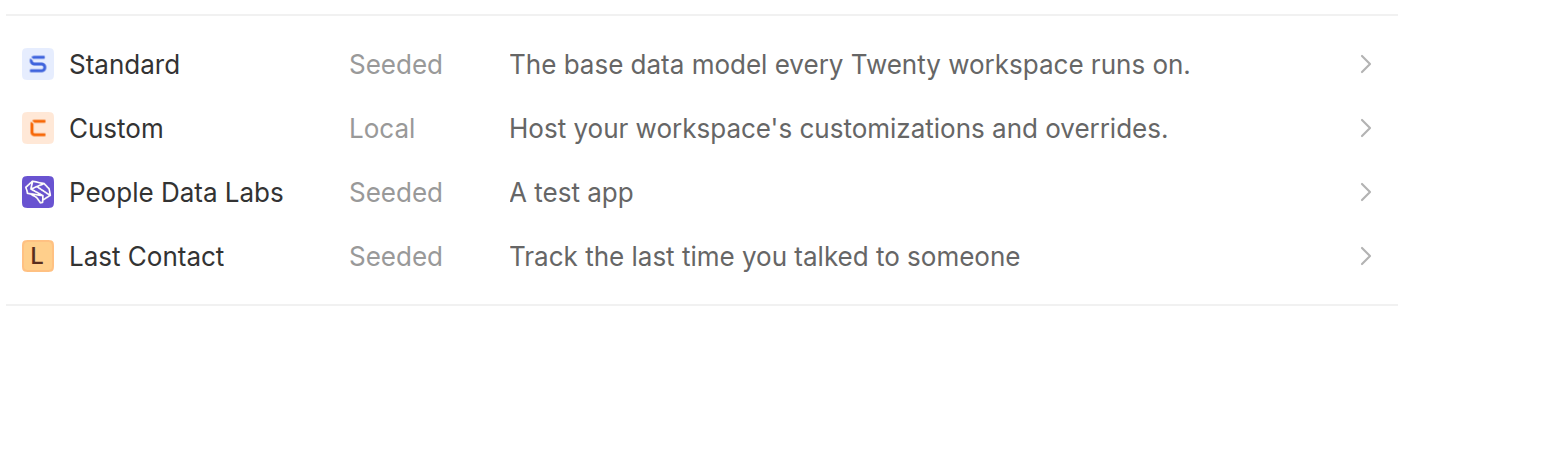
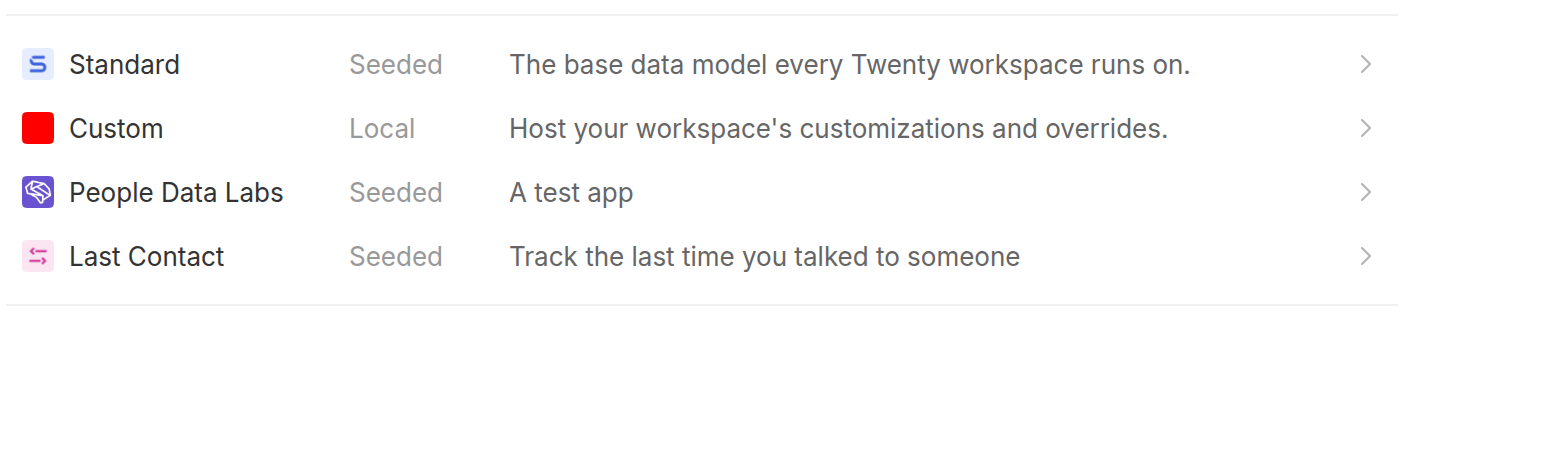
## Problem

After installing an app, its icon is missing across the UI, while
application *registration* icons render fine.

`Application.logo` holds the manifest path (`public/logo.svg`), which is
package-relative and not displayable. The server exposes a `logoUrl`
resolve field that turns it into
`/public-assets/{workspaceId}/{applicationId}/{logo}`, but on the front
end:

- `APPLICATION_FRAGMENT` and `FIND_MANY_APPLICATIONS` never selected
`Application.logoUrl`.
- So the only source of a usable logo url was
`currentWorkspace.installedApplications`, which is fetched by
`GetCurrentUser` at bootstrap. Nothing refreshed it after
`installApplication`, so a freshly installed app was absent from that
list.
- `useApplicationChipData` then fell through to
`fallbackApplicationData`, which callers populated with the raw `logo`
path. `getAbsoluteImageUrl('public/logo.svg')` yields
`{serverUrl}/public/logo.svg`, which 404s, so the avatar rendered as a
letter placeholder.

## Before / After

An app installed while the applications page is open, so the workspace
snapshot loaded at bootstrap does not know about it yet:

| Before | After |
|---|---|
| <img
src="https://raw.githubusercontent.com/twentyhq/twenty/e27a817fd95c5e44c1fbb64fd4fd68525daeee61/.pr-assets/app-icon-before.png"
width="480"> | <img
src="https://raw.githubusercontent.com/twentyhq/twenty/e27a817fd95c5e44c1fbb64fd4fd68525daeee61/.pr-assets/app-icon-after.png"
width="480"> |

## Changes

- Select `logoUrl` on `Application` in `APPLICATION_FRAGMENT` and
`FIND_MANY_APPLICATIONS`.
- Drop `logo` from `ApplicationDisplayData` and from the `AppChip` /
subtable fallback props, so a package-relative path can no longer reach
an `img` src. Call sites that already passed a url under `logo` now pass
`logoUrl`.
- `SettingsApplicationDetails` and `SettingsApplicationsTable` pass the
application's own `logoUrl`.
- On install, add the returned application to
`currentWorkspace.installedApplications` instead of reloading the
current user, so the chips that resolve by `applicationId` only (nav
menu items, object/field tables, tool rows, workflow nodes) pick it up.
- Stop exposing `logo` on the `Application` GraphQL type: nothing
selects it anymore, and having both `logo` (package-relative path) and
`logoUrl` (display url) was the source of the bug. The column is still
read server-side to build `logoUrl`.
- Regenerated `generated-metadata/graphql.ts`.

## Verification

Ran the stack locally against a seeded workspace with an installed app
whose logo lives at `public/logo.png`:

- `findManyApplications` returns a `logoUrl` under `/public-assets/...`,
and that url serves `200 image/png`.
- Reproduced the bug and the fix in the browser with the scenario shown
above (screenshots taken on the base commit and on this branch).
- `npx nx typecheck twenty-front`, `npx nx typecheck twenty-server`,
`npx nx lint:diff-with-main` on both, and the application settings jest
suites pass.

---
_Generated by [Claude
Code](https://claude.ai/code/session_01N8r4z2dZ553nAnCNe7GxMH)_

[Review in
cubic](https://cubic.dev/pr/twentyhq/twenty/pull/23411?utm_source=github)
|
||
|
neo773
|
1e58c3073c |
Feat/email composer improvements (#23188)
- Move composer to dedicated page - Add test email option - Auto saved as draft can be revisited from `objects/messageCampaigns` later - Campaign stats component https://github.com/user-attachments/assets/9e523116-e79b-496d-9c9d-3887e0c9213f <!-- This is an auto-generated description by cubic. --> <a href="https://cubic.dev/pr/twentyhq/twenty/pull/23188?utm_source=github" target="_blank" rel="noopener noreferrer" data-no-image-dialog="true"><picture><source media="(prefers-color-scheme: dark)" srcset="https://www.cubic.dev/buttons/review-in-cubic-dark.svg"><source media="(prefers-color-scheme: light)" srcset="https://www.cubic.dev/buttons/review-in-cubic-light.svg"><img alt="Review in cubic" src="https://www.cubic.dev/buttons/review-in-cubic-dark.svg"></picture></a> <!-- End of auto-generated description by cubic. --> --------- Co-authored-by: Félix Malfait <felix.malfait@gmail.com> |
||
|
Shinu Cherian
|
b81ca99162 |
fix(twenty-front): hide layout editor UI when SystemPermissionFlag.LAYOUTS is missing (#23303) (#23343)
## Description Fixes #23303. This PR ensures that the layout editor UI and customization entry points are hidden and protected when a user lacks the `SystemPermissionFlag.LAYOUTS` permission flag. ### Changes Made: 1. **`useEnterLayoutCustomizationMode.ts`**: Added `useHasPermissionFlag(PermissionFlagType.LAYOUTS)` check inside `enterLayoutCustomizationMode` to return `false` and prevent entering customization mode if the user lacks permission. 2. **`WorkspaceSection.tsx`**: Updated the sidebar `WorkspaceSection` component to render the layout edit button (`IconTool`) only when `hasLayoutsPermission` is `true`. 3. **`ObjectLayout.tsx`**: Disabled customize and reset layout controls in the Data Model Object Details settings page if the user lacks `LAYOUTS` permission. 4. **`useEnterLayoutCustomizationMode.test.tsx`**: Added unit tests to verify that `useEnterLayoutCustomizationMode` correctly guards layout customization initialization based on permission. ## Testing - Added unit tests for `useEnterLayoutCustomizationMode` permission checks. <!-- This is an auto-generated description by cubic. --> <a href="https://cubic.dev/pr/twentyhq/twenty/pull/23343?utm_source=github" target="_blank" rel="noopener noreferrer" data-no-image-dialog="true"><picture><source media="(prefers-color-scheme: dark)" srcset="https://www.cubic.dev/buttons/review-in-cubic-dark.svg"><source media="(prefers-color-scheme: light)" srcset="https://www.cubic.dev/buttons/review-in-cubic-light.svg"><img alt="Review in cubic" src="https://www.cubic.dev/buttons/review-in-cubic-dark.svg"></picture></a> <!-- End of auto-generated description by cubic. --> |
||
|
Guillaume Flambard
|
710d4da4b1 |
fix(emails): bump @react-email/render to ^2.0.6 to fix empty transactional email bodies (#23323)
## Problem Fixes #23307. Every transactional email (workspace invite, password reset, email verification, etc.) is delivered with an **empty body** — no title, text, or CTA. ## Root cause `twenty-server` pins `@react-email/render` directly at `^1.2.3`: ```jsonc // packages/twenty-server/package.json "@react-email/render": "^1.2.3", ``` In 1.2.3, `render()` reads `renderToReadableStream` **before** the email template's async Suspense boundary (i18n/locale load) has resolved. The result is the Suspense fallback marker instead of the real markup: ```html <!DOCTYPE html ...><!--$!--><template></template><!--/$--> ``` This was fixed upstream in `@react-email/render@2.0.6` (*"await stream.allReady before reading renderToReadableStream output"*). `twenty-emails` already resolves a 2.x render via `react-email@6.5.0`, so the server's direct pin was simply stale — the two were out of sync. ## Fix Bump the direct pin to `^2.0.6` (resolves to `2.1.0`) and regenerate the lockfile. The server's `render()` imports now use the fixed 2.x. > Note: a `1.2.3` entry remains in `yarn.lock` — it is an internal transitive > pin of `@react-email/components@0.5.3`, not the server render path, so it is > expected and harmless. ## Verification Rendering `SendInviteLinkEmail` through the real `render()` (Node 24) now returns full markup (5.7 kB) with no Suspense marker and the resolved invite link + workspace content, instead of the empty fallback. A jest unit test was intentionally not added: `@react-email/render` 2.x uses a dynamic import that jest's CJS runtime rejects ("A dynamic import callback was invoked without --experimental-vm-modules") — which is exactly why the existing email specs mock `render`. The fix was verified with a standalone Node script. <!-- This is an auto-generated description by cubic. --> <a href="https://cubic.dev/pr/twentyhq/twenty/pull/23323?utm_source=github" target="_blank" rel="noopener noreferrer" data-no-image-dialog="true"><picture><source media="(prefers-color-scheme: dark)" srcset="https://www.cubic.dev/buttons/review-in-cubic-dark.svg"><source media="(prefers-color-scheme: light)" srcset="https://www.cubic.dev/buttons/review-in-cubic-light.svg"><img alt="Review in cubic" src="https://www.cubic.dev/buttons/review-in-cubic-dark.svg"></picture></a> <!-- End of auto-generated description by cubic. --> --------- Co-authored-by: Félix Malfait <felix.malfait@gmail.com> |
||
|
Guillaume Flambard
|
1e5b8e6db4 |
fix(front): add accessible labels to icon-only options dropdown triggers (#23325)
## Problem Refs #23127. Icon-only `LightIconButton` "more options" triggers (`IconDotsVertical`) render without an accessible name, failing WCAG 4.1.2 (button-name) — screen readers announce nothing for them. ## Fix Add `aria-label={t`More options`}` to the affected dropdown triggers. `LightIconButton` already forwards `aria-label` and sets `aria-hidden` on the icon when a label is present, so this is purely additive — no behavioral or visual change. Scoped to a coherent set of options-menu triggers (attachments, public domains, SSO, connected accounts, field group config). Other unlabeled icon buttons can follow in separate PRs. ## Verification `oxlint --type-aware` and `oxfmt` pass on all changed files. The label is i18n-wrapped via the existing `useLingui` macro already imported in each component. <!-- This is an auto-generated description by cubic. --> <a href="https://cubic.dev/pr/twentyhq/twenty/pull/23325?utm_source=github" target="_blank" rel="noopener noreferrer" data-no-image-dialog="true"><picture><source media="(prefers-color-scheme: dark)" srcset="https://www.cubic.dev/buttons/review-in-cubic-dark.svg"><source media="(prefers-color-scheme: light)" srcset="https://www.cubic.dev/buttons/review-in-cubic-light.svg"><img alt="Review in cubic" src="https://www.cubic.dev/buttons/review-in-cubic-dark.svg"></picture></a> <!-- End of auto-generated description by cubic. --> |
||
|
neo773
|
3fb29db28a |
Feat/email settings v2 (#23180)
Settings pages changes - Add `displayName` - Unsubscribers Page <img width="1496" height="844" alt="Screenshot 2026-07-22 at 8 52 15 PM" src="https://github.com/user-attachments/assets/69bc1993-4547-4a64-83a6-b47fef1a4e40" /> <!-- This is an auto-generated description by cubic. --> <a href="https://cubic.dev/pr/twentyhq/twenty/pull/23180?utm_source=github" target="_blank" rel="noopener noreferrer" data-no-image-dialog="true"><picture><source media="(prefers-color-scheme: dark)" srcset="https://www.cubic.dev/buttons/review-in-cubic-dark.svg"><source media="(prefers-color-scheme: light)" srcset="https://www.cubic.dev/buttons/review-in-cubic-light.svg"><img alt="Review in cubic" src="https://www.cubic.dev/buttons/review-in-cubic-dark.svg"></picture></a> <!-- End of auto-generated description by cubic. --> --------- Co-authored-by: Félix Malfait <felix.malfait@gmail.com> |
||
|
martmull
|
25b0b2601f |
Replace admin app rollout buttons with upgrade-application CLI command (#23212)
## What Removes the two rollout buttons from the admin application detail page and replaces the upgrade flow with a CLI command that can be run directly from a server or worker pod. Also restructures application stop into its own module with a kill switch CLI command, and surfaces stopped apps in workspace settings. ### Removed - "Install on all workspaces" button (General tab, `SettingsAdminApplicationRegistrationGeneralToggles`), its confirmation modal and tooltip - "Upgrade existing installations" button (`SettingsApplicationRegistrationGeneralStats`), its confirmation modal and batch size input - `backfillApplicationInstallation` and `upgradeRegistrationApplications` admin GraphQL mutations and their frontend documents / generated types - `BackfillApplicationInstallationJob` (its only trigger was the removed mutation); `UpgradeApplicationsJob` is kept since the auto-upgrade flow still enqueues it Per review, the "install on all workspaces" flow is dropped without a CLI replacement for now; a dedicated command will be added when needed. ### application:upgrade command Located in `application-upgrade/commands`, registered in `ApplicationUpgradeModule`: ``` yarn command:prod application:upgrade \ --application-registration-universal-identifier <universalIdentifier> \ [--batch-size 5] \ [--workspace-id <id> --workspace-id <id2>] \ [--workspace-count-limit 10] \ [--dry-run] [--yes] ``` - `--workspace-id` (repeatable) restricts the upgrade to specific workspaces; `--workspace-count-limit` caps how many installations are upgraded (max 50, for canary rollouts) - `--batch-size` and `--workspace-count-limit` are validated as positive integers, max 50 - `--dry-run` reports how many (and which) workspaces would be upgraded, without upgrading - Without `--dry-run`, a confirmation prompt shows the app, target version and impacted workspaces; the run then executes exactly the confirmed set; `--yes` skips the prompt for non-interactive usage The upgrade plan is computed by a new `ApplicationUpgradeService.findApplicationsToUpgrade`, and batches run through a new `upgradeApplications` method — both reused by `upgradeAllApplications`, so the auto-upgrade job path is unchanged. ### Application kill switch (per review) Global mechanism only — a per-workspace stop had no demonstrated operational need and added a Redis key format, execution branching, CLI options and tests; an isolated workspace issue can be handled directly in the DB or Redis with the same effort. - `ApplicationStopService` moved to a dedicated `application-stop/` folder with its own `ApplicationStopModule` (imported and re-exported by `ApplicationModule`) - `stop` / `remove` methods that enable or clear the Redis-backed global kill switch; the logic function executor checks it before executing - `application:kill-switch` command with a positional action, confirmation prompt (shows the installation count) and `--yes` bypass: ``` # Enable the kill switch (stop is the default action) yarn command:prod application:kill-switch stop -u <universalIdentifier> [-y] yarn command:prod application:kill-switch -u <universalIdentifier> # Remove the kill switch yarn command:prod application:kill-switch remove -u <universalIdentifier> [-y] ``` ### Stopped apps surfaced in workspace settings (per review) - Dedicated `isApplicationStopped(applicationUniversalIdentifier)` query backed by the kill switch, fetched with `network-only` policy solely by the application detail page — listing applications triggers no extra Redis reads - Application detail page shows a danger banner when the app is stopped: "We are currently encountering issues with this app, its behavior may be degraded while we work on a fix." ## Test - `npx nx typecheck twenty-server` / `npx nx typecheck twenty-front` pass - `npx nx lint:diff-with-main` passes for both packages - `application-stop.service.spec.ts` covers stop, remove, caching and fail-open behavior - Verified end to end locally: ran the kill switch command on a seeded workspace and confirmed the banner renders on the app detail page (screenshot shared separately) |
||
|
Félix Malfait
|
3a8f086d15 |
Converge drag and drop on shared dnd-kit primitives, remove @hello-pangea/dnd (#23211)
Follow-ups recorded in #23023, done in one pass. ## Shared primitives - Folded `PageLayoutWidgetSortableItem` and `PageLayoutWidgetDropLine` into the shared `DragDropItemSortableCell` / new `DragDropItemDropLine` (new `data`, `dropLine`, `highlightWhileDragging`, `hasTransition` props). - Added generic `DragDropProviderDragStartEvent` (and DragMove/DragOver/DragEnd/DropTarget) helpers and deleted the 7 copied `Parameters<...>` extractions across the dnd hooks. - Replaced the `useMovePageLayoutWidgetUp/Down` implementations (~140 lines) with `moveWidgetWithinTabInDraft`. - Migrated the remaining page-layout test suites onto `pageLayoutDraftFixtures`. ## Tab reordering off Pangea - Tabs are sortable cells on the same provider as widget drags, segregated by dnd type, so widget drops on tab buttons keep working while tabs reorder. - Reordering is ID based (`reorderTabInDraft`: insert before the hovered tab), which keeps the pinned first tab in place without index arithmetic. - Preserved overflow behaviors: the dropdown stays open while a tab drag is in flight, dropping a tab on the "+N More" button appends it and opens the dropdown, and both the visible strip and the overflow list have end drop zones. ## Fields configuration editors off Pangea - Group reorder, field reorder and cross-group field moves now run on the shared cells (same drop line and end-zone patterns). ## DraggableList off Pangea - `DraggableList` / `DraggableItem` keep their consumer-facing API — the ~9 consumers now type their handlers with a local `DraggableListDropResult` instead of pangea's `DropResult` — but run on the shared sortable cells; each list's uuid group doubles as its dnd type so nested lists stay isolated from page-level providers. - Items register their index in a list-scoped registry so the end drop zone can resolve the append index at drop time (with insert-before semantics an item could otherwise never reach the last position). - Deleted three dead files that only existed for pangea plumbing (the side panel navigation placeholder, `getCssCompatibleDraggableProps`, the orphaned `recordGroupPendingDragEndReorderState`). ## Record table row drag off Pangea - Rows register through `useSortable` directly on the row element — no wrapper div, so row CSS, sticky cells and virtualization stay untouched — with the grip cell wired as the drag handle via the shared sortable handle ref context. - Both table modes (virtualized flat list and record groups) share a `DragOverlay` clone that replaces pangea's virtual-mode `renderClone`, and end drop zones per record group (and after the virtualized list) allow dropping after the last row or into an empty group. - The drop handlers keep their pangea-shaped result object, retyped as a local `RecordDragDropResult`, so the position computation logic is untouched. ## Pangea removed `@hello-pangea/dnd` is gone from `package.json` and the lockfile, along with its orphaned transitive entries (`css-box-model`, `raf-schd`, `react-redux`, `redux`). Nothing in the repo imports it anymore. ## Dashboards: cross-tab widget drag for grids react-grid-layout drags never enter dnd-kit, so the bridge hit-tests the pointer against the tab buttons' `data-page-layout-tab-drop-target-id` rects during grid drags, highlights the hovered tab through state, and on drop moves the widget to the destination grid below its existing content (`moveWidgetToGridTabInDraft`, `buildTabWidgetLayouts`). The grid's own post-drag layout commit is suppressed once so it does not overwrite the cross-tab move. ## Fixes found while testing - With `feedback: 'clone'`, the drag source is its own initial drop target and its placeholder is a DOM clone taken at drag start, so the drop line rendered into the source got baked into the placeholder and stuck there for the whole drag. The line is now hidden on the source cell, leaving a single indicator at the actual target. - Reorderable tabs collapsed to text height and sat top-aligned next to "+ New Tab" because the sortable cell wrapper defaults to `display: block; height: auto`, breaking the tab height chain — the tab list now uses the cell's `fill` mode so tabs stretch to the strip height again. ## Testing Playwright against the dev app: - Record page: widget reorder up and down in the pinned column (single blue drop line at the target), drag to another tab via its tab button (highlight + move), drag back into content at a specific position, chained cross-tab moves, tab reorder with vertical drop line, new tab creation. - Overflow (narrow viewport): drop a tab on "+N More" (appends last, dropdown opens), reorder inside the dropdown (stays open), drag a tab from the dropdown back to the visible strip. - Dashboard: grid drag within a tab, cross-tab drag onto a tab button (hover highlight, widget lands below destination content, remaining widgets keep their positions), save and reload persistence in both directions. - Fields editor: field reorder, group reorder, field move across groups, plus the Move Up / Move Down widget actions. Since the pangea-removal commits: - Typecheck, oxlint and oxfmt green over the full front source; unit suites green including the migrated `useStartRecordDrag` test (jest needed a scoped transform exemption for `@preact/signals-core` once dnd-kit reached the side-panel suites). - Storybook visual regression unchanged across ~700 stories — expected, since the migrated surfaces render identical DOM at rest (drop lines and drag overlays only exist mid-drag). - The tab strip fix reverses the exact regression mechanism: the sortable cell wrapper defaulted to `display: block; height: auto`, collapsing the tab height chain next to the full-height "+ New Tab" button; `fill` restores the stretch. --- _Generated by [Claude Code](https://claude.ai/code/session_01XKRCzzu8oGyocXZtFp7VEG)_ <a href="https://cubic.dev/pr/twentyhq/twenty/pull/23211?utm_source=github" rel="nofollow noreferrer noopener" target="_blank">``<img alt="Review in cubic" src="https://www.cubic.dev/buttons/review-in-cubic-dark.svg">``</a> |
||
|
neo773
|
59eead238d |
message list member backfill (#23176)
<!-- This is an auto-generated description by cubic. --> <a href="https://cubic.dev/pr/twentyhq/twenty/pull/23176?utm_source=github" target="_blank" rel="noopener noreferrer" data-no-image-dialog="true"><picture><source media="(prefers-color-scheme: dark)" srcset="https://www.cubic.dev/buttons/review-in-cubic-dark.svg"><source media="(prefers-color-scheme: light)" srcset="https://www.cubic.dev/buttons/review-in-cubic-light.svg"><img alt="Review in cubic" src="https://www.cubic.dev/buttons/review-in-cubic-dark.svg"></picture></a> <!-- End of auto-generated description by cubic. --> |
||
|
Raphaël Bosi
|
0c964aee10 |
Fix blank pages and add error recovery in onboarding (#23069)
Onboarding showed a blank page in two places: before the plan/payment step, and briefly after the welcome animation. `ChooseYourPlan` returned `null` while its `ListPlans` query loaded, leaving the step empty during the crossfade. It now renders the step loader, and the plans query is warmed from an earlier onboarding step so the content is usually already there. The post-completion redirect lands transiently on `/`, whose route element was `<></>`, so the welcome animation could reveal an empty page. It now renders a skeleton, and the `null` Suspense fallbacks on payment-success and book-call are replaced too. A failed `ListPlans` query was worse than a blank frame: `PLAN_REQUIRED` redirects every route back to itself, so the user was locked out of the product with no way to retry. That step and the billing settings page now show a retryable error state. One related fix found on the way: `BlankLayout` had no error boundary, so a render-time throw anywhere in sign-in or onboarding took down the whole app. `DefaultLayout` already had one. <!-- This is an auto-generated description by cubic. --> <a href="https://cubic.dev/pr/twentyhq/twenty/pull/23069?utm_source=github" target="_blank" rel="noopener noreferrer" data-no-image-dialog="true"><picture><source media="(prefers-color-scheme: dark)" srcset="https://www.cubic.dev/buttons/review-in-cubic-dark.svg"><source media="(prefers-color-scheme: light)" srcset="https://www.cubic.dev/buttons/review-in-cubic-light.svg"><img alt="Review in cubic" src="https://www.cubic.dev/buttons/review-in-cubic-dark.svg"></picture></a> <!-- End of auto-generated description by cubic. --> |
||
|
martmull
|
e14c32015f |
Make upgrade applications batch size a job parameter defaulting to 5 (#23101)
Makes the batch size used when upgrading applications a parameter instead of a hardcoded constant, defaulting to 5, and lets admins set it from the upgrade confirmation modal. Backend: - `UpgradeApplicationsJobData` gains an optional `batchSize` field, passed through by `UpgradeApplicationsJob` to the service. - `ApplicationUpgradeService.upgradeAllApplications` accepts an optional `batchSize` parameter, defaulting to `UPGRADE_APPLICATIONS_DEFAULT_BATCH_SIZE = 5` (previously a fixed batch size of 20). The value is sanitized to a positive integer to avoid an infinite batching loop. - The `upgradeRegistrationApplications` admin mutation accepts an optional `batchSize: Int` argument and forwards it to the job. Frontend (admin panel): - The "Upgrade existing installations" confirmation modal now includes a "Batch size" number input, defaulting to 5, sent with the mutation. - Updated the admin GraphQL document and generated types. ## Screenshots Upgrade section on the admin app registration page: 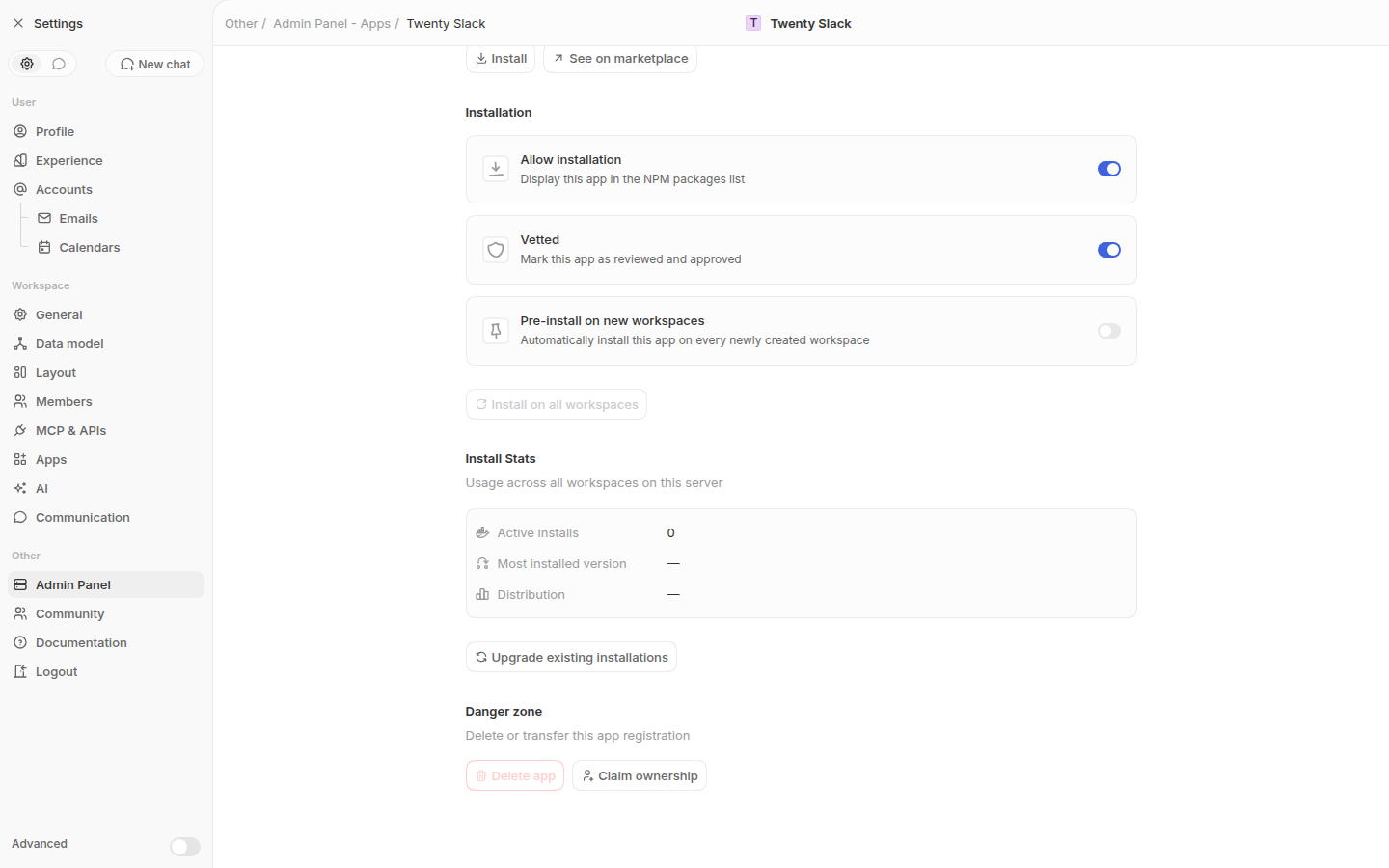 Confirmation modal with the new batch size input (defaults to 5): 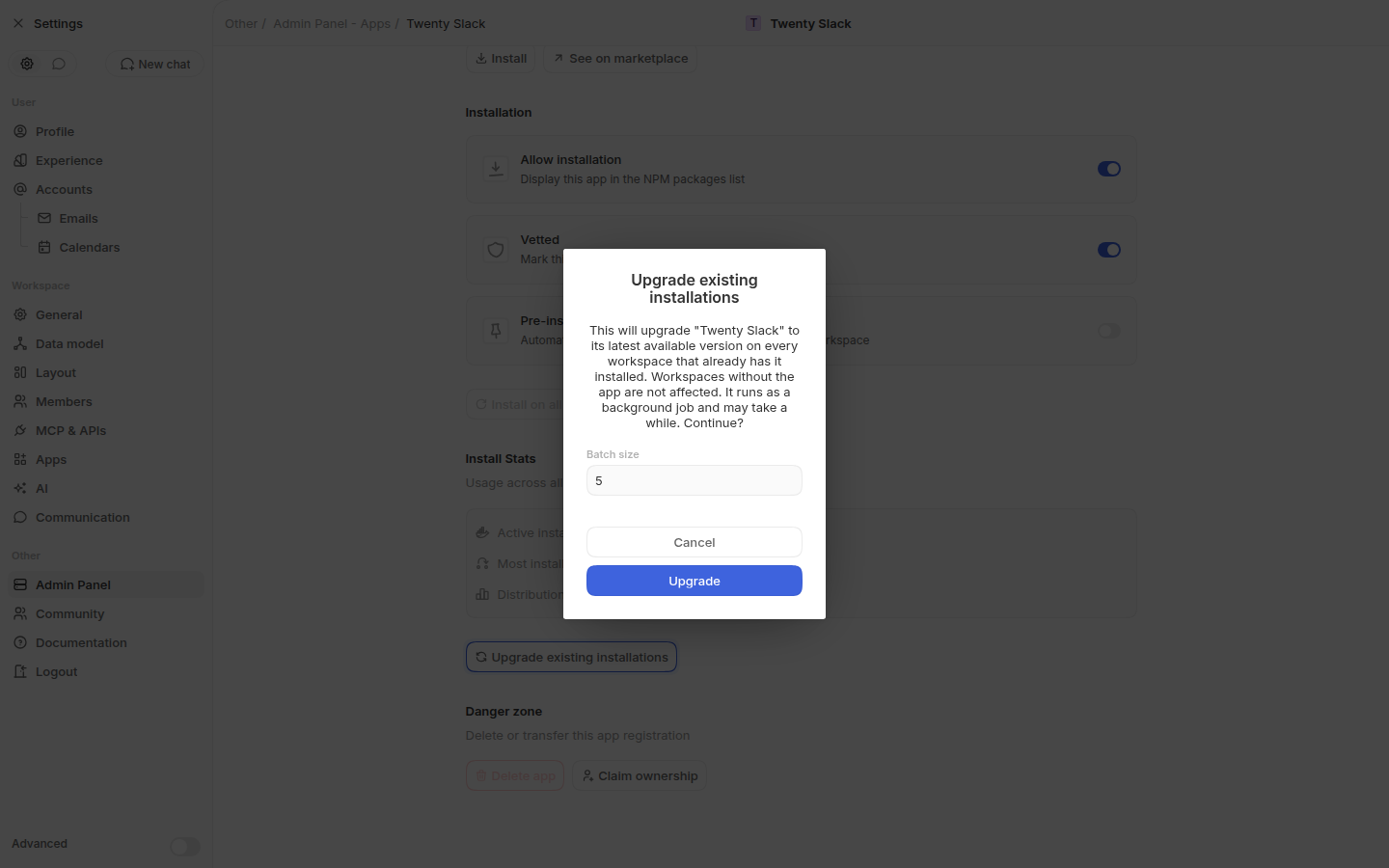 --------- Co-authored-by: Martin <martin@twenty.com> |
||
|
Marie
|
bc3112a999 |
Fix: allow API key creation without Roles permission (#23102)
## Problem A user with the **API keys & webhooks** permission but **without** the **Roles** setting permission cannot create an API key through the UI. The role selector relies on the `getRoles` query, which is guarded by the `ROLES` permission, so the roles list comes back empty, `SettingsDevelopersRoleSelector` early-returns, and no role can be selected — leaving the form unsavable. <img width="1058" height="408" alt="Screenshot 2026-07-21 at 13 38 34" src="https://github.com/user-attachments/assets/fe97ba78-e116-458d-af10-11c5969c4636" /> ## Fix Expose the assignable roles through the API-key permission scope so users can **pick** a role to assign to an API key without being able to **edit** roles. - **Backend**: add `getApiKeyRoles` query on `ApiKeyResolver` (already guarded by `API_KEYS_AND_WEBHOOKS`), backed by `ApiKeyRoleService.getApiKeyAssignableRoles` which returns roles where `canBeAssignedToApiKeys = true`. - **Frontend**: add a `GetApiKeyRoles` query and use it in the API key create and detail pages instead of `getRoles`. The role selector prop type is narrowed to the fields it actually uses. <img width="1025" height="455" alt="Screenshot 2026-07-21 at 13 45 01" src="https://github.com/user-attachments/assets/f1be8f97-5a30-4afc-9eee-c928f4607471" /> |
||
|
martmull
|
8d84a0b9f3 |
feat(app): allow non-admin developers to claim and list marketplace apps (#22621)
## Context Follow-up to #22609. Lets a non-admin developer claim ownership of a public Twenty app they published to npm, then request a marketplace listing that a server admin reviews. Marketplace state is per-instance for now. ## Claiming - Developer tab gets a **Claim an application** section: look up an unclaimed npm app by package name or universal identifier. - Ownership is proven with GitHub OAuth against the package's npm provenance (trusted publishing): the connected account must own the GitHub account or organization the package was published from. - Errors from the GitHub callback come back as a code and are shown inline with a link to the relevant documentation. - The old one-click claim stays admin-only. - A **Sync catalog** button triggers a catalog refresh instead of waiting for the hourly cron. - Gated behind the `IS_APP_CLAIMING_ENABLED` feature flag. ## Listing requests - Catalog-synced apps are created **unlisted**; a data migration unlists previously auto-listed unclaimed npm apps (owned or vetted rows are left untouched). - Owners request a listing from the Distribution tab (logo + description required); a server admin approves or rejects it from a **Listing requests** section in the Admin Panel. ## Screenshots <img width="1512" height="829" alt="image" src="https://github.com/user-attachments/assets/788d4362-97c4-4e42-810c-ef1f11517bec"/> <img width="1512" height="829" alt="image" src="https://github.com/user-attachments/assets/d6246190-c82a-4f64-87be-3bb668527645"/> <img width="1512" height="828" alt="image" src="https://github.com/user-attachments/assets/21a8dad4-610b-4d1f-8948-b9acab40d373"/> <img width="1512" height="829" alt="image" src="https://github.com/user-attachments/assets/58246130-41f7-451e-ae7f-57bd21d04bb6"/> --------- Co-authored-by: cubic-dev-ai[bot] <191113872+cubic-dev-ai[bot]@users.noreply.github.com> |
||
|
martmull
|
45b319ef2d |
Add autofocus to 2FA OTP inputs (#23067)
as title <img width="854" height="533" alt="image" src="https://github.com/user-attachments/assets/777c2d83-8318-4337-865d-67aebc9186c2" /> |
||
|
martmull
|
baa84bb2e0 |
Add auto-upgrade-in-apps (#23001)
We need to auto upgrade application, lets add this column in application entity, and add an admin button to autoupgrade all applications to latest app registrration version manually <img width="1131" height="372" alt="image" src="https://github.com/user-attachments/assets/4e755abc-38ad-4895-a2e8-d55ee1948ac2" /> <img width="906" height="533" alt="image" src="https://github.com/user-attachments/assets/ce002057-0341-4581-bf9a-66ac2bd84a9b" /> |
||
|
neo773
|
5bedd5b8cc |
feat(email-group): communications UX, per-record DNS status (#23002)
- Rename Communications label to singular, remove docs-home banner - Provision unsubscribe Cloudflare records at domain creation and surface per-record status badges; skip Cloudflare when not configured - Move sending-domain status into the section header and only show the records table when a record is unverified - Reply to the original recipients when replying to your own message - Fix DNS records table column/badge alignment; emit synthetic records in the log driver for local testing <img width="1496" height="849" alt="Screenshot 2026-07-17 at 7 47 24 PM" src="https://github.com/user-attachments/assets/a5a59adb-2df4-4154-98b2-acf87a8008da" /> |
||
|
Félix Malfait
|
5e27e04c0a |
Add mostly-empty field hints to data model settings (#22962)
## What

Fields that are empty in almost all records now show a subtle `Mostly
empty` hint next to their name in the object's Fields settings table
(same visual treatment as `Deactivated`), with a tooltip explaining the
signal and a matching **Mostly empty** toggle in the search filter
dropdown. The goal is to nudge admins to clean up and deactivate fields
nobody uses, while keeping the page untouched when the data model is
healthy.

## How

**No table scans.** Emptiness is read from Postgres planner statistics,
so the cost is a catalog lookup regardless of table size:

- `pg_class.reltuples` gates the feature on an approximate row count (≥
100 records; never-analyzed tables mean no hints). Reuses the shared
helper extracted from `ObjectRecordCountService`.
- `pg_stats.null_frac` plus the sampled frequency of the column type's
empty sentinel (`''` for text columns, `'{}'` for arrays, `'{}'`/`'[]'`
for json — matched per physical column type) gives a per-column empty
fraction. A value dominating ≥ 95% of a column is guaranteed to appear
in the most-common-values list, so the approximation is reliable exactly
at the threshold we care about.

**Decision rules** (pure util, unit-tested):

- Flag when every relevant column is ≥ 95% empty and the object has ≥
100 records.
- Skip system fields, the label identifier, relations, booleans, and
actor fields (exhaustive switch — a new `FieldMetadataType` fails to
compile until classified).
- Composite fields must have all their columns empty, with column sets
derived from `compositeTypeDefinitions`; only default-bearing code
columns (`currencyCode`, phone country/calling codes) are excluded so
stamped defaults don't mask emptiness.
- Anything unknown (missing stats, new column since last ANALYZE)
degrades to silence — no hint is ever shown on missing data.

**API:** one `mostlyEmptyFieldMetadataIds(objectMetadataId)` query on
the metadata schema, guarded by the `DATA_MODEL` settings permission,
fetched lazily when the fields page opens.

**UI:** exception-based — no new columns, no persistent controls. The
badge and the filter toggle only materialize when at least one field
qualifies, and disappear once things are cleaned up.

## Test

- Unit tests for the decision util (threshold,
system/label-identifier/inactive exclusion, missing statistics,
composite all-columns rule, links label/secondary data, currency
narrowing, excluded types).
- Catalog SQL validated against Postgres 16 with a table mimicking
Twenty's column shapes (text `''` defaults, enums, arrays, jsonb,
currency pairs), including the type-aware sentinel matching (a text
column full of literal `"{}"` strings does not count as empty).
- End-to-end on a seeded dev instance: 899 companies with a mix of
filled/empty fields — the API returned exactly the five fields predicted
by the raw statistics (`annualRevenue`, `employees`, `introVideo`,
`tagline`, `workPolicy`) and correctly excluded `address` (city 33%
filled), actor/system fields, and the label identifier.
- UI driven with Playwright: badge, tooltip copy, filter toggle, and
filtered table all verified visually.
- `lint:diff-with-main`, `typecheck` (server + front), and all three
`graphql:generate` configurations + SDK metadata client regenerated and
committed.
|
||
|
Weiko
|
25bd2897a3 |
Add weekly layout to record calendar (#22819)
## Summary - Add a week layout to record calendar views and persist the selected layout. - Render `DATE` calendars as an all-day week and `DATE_TIME` calendars as an hourly week. - Add an optional end date field across calendar configuration, metadata, persistence, and complete-view upserts. - Use configured end values for ranged and multi-day events, with a one-hour fallback when a `DATE_TIME` end is absent or invalid. - Keep calendar cards consistent with the existing compact view, including checkbox selection and whole-card record opening. - Gate the weekly layout and end-date behavior behind the public Labs `IS_CALENDAR_WEEK_VIEW_ENABLED` workspace feature flag. ## Week interactions - Show overlapping timed events side by side and cap the visible records at two per day. - Display start and end times on timed cards, enforce a readable 30-minute minimum height, and keep today’s text contrast stronger. - Drag timed events between days and times with 30-minute snapping while preserving their duration, including zero-duration events. - Show a create button when hovering a 30-minute slot; keyboard users can focus a day, move the slot with the arrow keys, and reach the same contextual action. - Initialize new records with the selected slot time and a compatible writable end value one hour later. - Show the workspace time zone and current-time indicator in timed weeks; date-only weeks keep the all-day section without an hourly grid. ## Configuration and data loading - Only allow end fields that match the start field type, and prevent selecting the same field for both boundaries. - Load records whose ranges overlap the visible period so month and week layouts display the same relevant records. - Resolve and persist calendar end fields when updating existing views through `upsert_complete_view`. - Fall back to Month and ignore the configured end field while the flag is disabled, without overwriting either persisted setting, so re-enabling restores the previous configuration. - Expose the flag in Labs and keep it default-off for workspaces without a stored value; enable it in the development seeder. <img width="1285" height="808" alt="Screenshot 2026-07-15 at 15 50 17" src="https://github.com/user-attachments/assets/b7e3f7f1-ca77-492f-8cce-cca186ebca0b" /> |
||
|
Abdul Rahman
|
f4ff234db8 |
feat: make record avatar/icon resolution data-driven via a configurable image identifier field (#22644)
## Summary Today the avatar/icon shown for a record is hardcoded per object — Company pulls a favicon from its domain link, Person uses `avatarUrl`, etc. This PR replaces that hardcoding with a generic, data-driven abstraction based on a configurable **image identifier field** on each object's metadata (mirroring the existing **label identifier** concept). An object's image identifier can point to: - a **`FILES`** field → the uploaded image is used directly (rounded avatar), or - a **`LINKS`** field → a favicon is derived from the primary URL via the Twenty icons service (squared avatar), gated by `ALLOW_REQUESTS_TO_TWENTY_ICONS`. This lets any object type (Opportunity, a custom "Listing", etc.) define its own avatar/icon without code changes, and makes the field configurable/overridable for standard objects. ## ❓ Open question: also allow `TEXT` → direct image URL? Right now the image identifier is restricted to `FILES` (uploaded file) and `LINKS` (favicon). We deliberately left out `TEXT` → **direct image URL** (e.g. an imported/synced photo URL stored in a text field). There's precedent for it — Person's avatar was originally a `TEXT` `avatarUrl`, and WorkspaceMember still is — and it's unambiguous (a `TEXT` field has no favicon-vs-image ambiguity, and selecting it as the image identifier is itself the declaration of intent). It's a small, clean extension: - add `TEXT` to the allowed image-identifier types, - add an explicit `TEXT → raw URL` case - `getAvatarType`: `TEXT → rounded`. Caveats: it relies on admin assertion that the text values are image URLs (no data-level guarantee), and external image URLs load third-party content in the browser (IP-leak/hotlinking, same as favicons — a proxy/cache would be the more robust long-term answer). ### ✅ Resolution Decision: **we will not support `TEXT` as an image identifier.** Image identifiers stay restricted to `FILES` and `LINKS`, and any other type fails closed (returns no avatar) on both the frontend and backend. Instead, the legacy items that still rely on a `TEXT` avatar — Person's deprecated `avatarUrl` and WorkspaceMember's `avatarUrl` — will be migrated to `FILE` fields in a follow-up PR. Until then, WorkspaceMember remains an exception (its `avatarUrl` still resolves through the existing CorePicture path), and legacy Person `avatarUrl` values that haven't been migrated will show initials placeholders. <!-- This is an auto-generated description by cubic. --> <a href="https://cubic.dev/pr/twentyhq/twenty/pull/22644?utm_source=github" target="_blank" rel="noopener noreferrer" data-no-image-dialog="true"><picture><source media="(prefers-color-scheme: dark)" srcset="https://www.cubic.dev/buttons/review-in-cubic-dark.svg"><source media="(prefers-color-scheme: light)" srcset="https://www.cubic.dev/buttons/review-in-cubic-light.svg"><img alt="Review in cubic" src="https://www.cubic.dev/buttons/review-in-cubic-dark.svg"></picture></a> <!-- End of auto-generated description by cubic. --> |
||
|
martmull
|
94192a2164 |
Resolve application registration logo and gallery image urls at query time (#22827)
## Context

Application registration logo and gallery image urls were baked into the
stored manifest and display columns at write time, with each source flow
doing it differently: npm catalog sync baked CDN urls, local dev sync
baked `public-assets` urls, and tarball uploads left raw manifest paths
that never displayed in the UI. The entity also carried a `logoUrl`
getter computed field.

This moves url generation to query time, the same way the workspace logo
works.

## What changed

**Read side**
- `ApplicationRegistrationAssetUrlService` builds display urls when
queried: stored files are served by fileId, absolute urls pass through
untouched, and not-yet-rehosted npm assets fall back to the registry CDN
from `sourcePackage@latestAvailableVersion`.
- The `logoUrl` getter on `ApplicationRegistrationEntity` is replaced by
`logoUrl` and `galleryImages` `@ResolveField`s on the metadata resolver,
the admin panel resolver, and a new resolver for
`ApplicationRegistrationSummary` (used by
`Application.applicationRegistration`).
- The marketplace detail/card DTOs and the public OAuth authorize DTO
(`findApplicationRegistrationByClientId`) go through the same url
builder.
- New public route `GET /file/application-registration/:id` streams
registration server files (these are instance-global marketplace assets,
also shown on the public OAuth authorize page).
`ServerFileStorageService.readServerFileById` now returns the mime type
alongside the stream.

**Write side**
- New `logoFileId` column on `applicationRegistration` (2.21 fast
instance command, constraint names match TypeORM naming), complementing
the fileIds already stored in the `galleryImages` jsonb.
- `ApplicationRegistrationAssetService` copies the manifest logo and
gallery images into instance-global server file storage, so all three
sources behave the same:
- **TARBALL**: from the uploaded package (previously only gallery images
were stored, never the logo).
- **LOCAL**: dev sync reads the already-uploaded public assets from
workspace storage (the CLI uploads files before syncing).
- **NPM**: catalog sync downloads the assets from the registry CDN.
Downloads are skipped when the package version is unchanged and the
files are already stored; failed or pending downloads fall back to CDN
urls at query time.
- Write-time url rewriting is removed
(`ManifestAssetUrlResolverService`, `resolveManifestAssetUrls`);
manifests now keep raw asset paths. Existing rows with baked absolute
urls keep working through the absolute-url passthrough, so no backfill
is needed.
- `updateFromManifest` and `upsertFromCatalog` preserve stored gallery
fileIds for unchanged paths, so installs and the hourly catalog sync no
longer clobber them.

## How it was verified

Against a local Postgres/Redis with the server running:
- Fresh database init runs the new instance command; column and FK/UQ
constraint names match TypeORM's generated names, and the CI
pending-migration check produces no diff.
- `findManyApplicationRegistrations { logoUrl galleryImages }` returns
fileId-served urls for a TARBALL registration (absolute urls passed
through), and null/[] for a LOCAL registration without assets.
- Ran `marketplace:catalog-sync` against the real npm registry: 14
packages synced, logos and gallery images rehosted from unpkg with
fileIds set; a second run re-downloaded nothing (version-unchanged
skip); `findMarketplaceAppDetail` for `twenty-linear` returns
fileId-served urls for the logo and all four gallery images.
- `GET /file/application-registration/:id` serves stored files with the
right content type (png and svg verified), 404s on unknown ids, and the
token-guarded generic `/file/:folder/:id` route still returns 403
without a token.
- Unit tests for the url builder and the assets-stored check; server
unit test suites for the application module pass; typecheck and lint
clean.
|
||
|
Félix Malfait
|
6201d06141 |
Preload Stripe.js before the onboarding payment step (#22858)
## Context On the plan-required onboarding step, the card form was slow to appear because Stripe.js is loaded lazily (`@stripe/stripe-js/pure`): the script download only started once the payment page rendered, and the PaymentElement iframe could only boot after that. ## What this does - Adds `usePreloadStripeForPlanRequiredStep`, called once from `OnboardingStepLayout` (the shared layout for the authenticated onboarding step routes), so Stripe.js is already loaded by the time the user reaches the payment step. The hook only triggers when billing is enabled, the workspace has no subscription yet, and a publishable key is configured, so self-hosted instances still never contact Stripe. - Moves the memoized loader to `settings/billing/utils/getStripePromise.ts`, shared by `useStripePromise` and the preload hook. - Stops caching failed script loads: previously a rejected `loadStripe` promise stayed in the cache forever, which would have made a failed preload permanently break the payment form. Now a later call retries (stripe-js re-injects the script tag on retry). - Extracts the plan-required predicate into `onboarding/utils/getIsPlanRequired.ts`, now shared with `useSetNextOnboardingStatus`. The in-app add-credit-card modal is intentionally left untouched: it has no preceding step to preload from. ## Tests - `getStripePromise.test.ts`: dedup per publishable key, retry after a failed load. - `usePreloadStripeForPlanRequiredStep.test.ts`: preloads when billing is enabled and no subscription exists; skips when billing is disabled, a subscription exists, or the key is missing. --- _Generated by [Claude Code](https://claude.ai/code/session_01NtUN99tHPZ6bPWwpYKMbpE)_ <!-- This is an auto-generated description by cubic. --> <a href="https://cubic.dev/pr/twentyhq/twenty/pull/22858?utm_source=github" target="_blank" rel="noopener noreferrer" data-no-image-dialog="true"><picture><source media="(prefers-color-scheme: dark)" srcset="https://www.cubic.dev/buttons/review-in-cubic-dark.svg"><source media="(prefers-color-scheme: light)" srcset="https://www.cubic.dev/buttons/review-in-cubic-light.svg"><img alt="Review in cubic" src="https://www.cubic.dev/buttons/review-in-cubic-dark.svg"></picture></a> <!-- End of auto-generated description by cubic. --> |
||
|
martmull
|
7381038452 |
Paginate admin panel app registrations list (#22734)
## Context The `findAllApplicationRegistrations` query on the admin panel Apps page (`/settings/admin-panel#apps`) loaded every application registration at once, with search and filtering done client-side. ## Changes **Server** - `findAllApplicationRegistrations` now takes `limit` / `offset` / `searchTerm` / `isPreInstalledOnly` args and returns a `PaginatedApplicationRegistrations` object (`registrations`, `totalCount`, `hasMore`), following the same pattern as `getQueueJobs`. - `ApplicationRegistrationService.findAll` uses `findAndCount` with `take`/`skip`, and moves the search (name, source package, universal identifier via `ILIKE`) and the pre-installed filter into the SQL query, mirroring how `getInstalledWorkspacesGlobal` filters installed workspaces. **Frontend** - `SettingsAdminApps` passes the page, the debounced search term (300ms, like the installed workspaces table), and the pre-installed toggle as query variables instead of filtering client-side. - Adds a Previous / Next pagination footer (25 per page) matching the queue jobs table, shown only when there is more than one page. - The "unconfigured first" ordering is kept within each page (`isConfigured` is a dataloader-resolved field, so it can't be sorted in SQL). ## Notes - Regenerated `generated-admin/graphql.ts` follows in a subsequent commit. --- _Generated by [Claude Code](https://claude.ai/code/session_015erumgPozkbNA3zPeKrrFW)_ <!-- This is an auto-generated description by cubic. --> <a href="https://cubic.dev/pr/twentyhq/twenty/pull/22734?utm_source=github" target="_blank" rel="noopener noreferrer" data-no-image-dialog="true"><picture><source media="(prefers-color-scheme: dark)" srcset="https://www.cubic.dev/buttons/review-in-cubic-dark.svg"><source media="(prefers-color-scheme: light)" srcset="https://www.cubic.dev/buttons/review-in-cubic-light.svg"><img alt="Review in cubic" src="https://www.cubic.dev/buttons/review-in-cubic-dark.svg"></picture></a> <!-- End of auto-generated description by cubic. --> --------- Co-authored-by: Weiko <corentin@twenty.com> |
||
|
neo773
|
b0dc637dbd |
Throw proper error on duplicate emailing domain (#22790)
Adding an emailing domain that already exists blew up with a raw QueryFailedError and the client just saw a generic "An error occurred". The unique index on domain is global, so the workspace-scoped existence check never caught rows owned by another workspace. Now the check is unscoped and throws an EmailingDomainException mapped to CONFLICT with a proper user-facing message, in both the createEmailingDomain mutation and the email group channel flow. Also dropped the hardcoded catch-all snackbar on the new channel page so server messages actually reach the user. <!-- This is an auto-generated description by cubic. --> <a href="https://cubic.dev/pr/twentyhq/twenty/pull/22790?utm_source=github" target="_blank" rel="noopener noreferrer" data-no-image-dialog="true"><picture><source media="(prefers-color-scheme: dark)" srcset="https://www.cubic.dev/buttons/review-in-cubic-dark.svg"><source media="(prefers-color-scheme: light)" srcset="https://www.cubic.dev/buttons/review-in-cubic-light.svg"><img alt="Review in cubic" src="https://www.cubic.dev/buttons/review-in-cubic-dark.svg"></picture></a> <!-- End of auto-generated description by cubic. --> |
||
|
Félix Malfait
|
3dd7dfde5a |
feat(billing): collect credit card in-app when starting subscription from billing page (#22706)
## Context

On the billing page, a trialing workspace without a payment method that
clicks "Increase" (credits section) or "Subscribe Now" (subscription
card) goes through the end-trial confirmation and then gets redirected
to the Stripe billing portal to add a card. We already have an in-app
card collection flow (`AddCreditCardModal`, Stripe PaymentElement on a
SetupIntent) used by the AI chat credits banner and the global end-trial
information banner. The billing page was the last surface still bouncing
users to the portal.

## What this does

Applies the same pattern as `AIChatNoMoreBillingCreditsBanner` and
`InformationBannerEndTrialPeriod` to the billing page:

- When the workspace is trialing and `billingHasPaymentMethod ===
false`, the `endTrialPeriod` modal now renders `AddCreditCardModal`
(in-app card entry) instead of the confirmation modal. Once the card is
added, the subscription starts via `endTrialPeriod({
skipPaymentMethodRedirect: true })`, and the user stays on the billing
page.
- When a payment method exists (or the flag is unknown), the existing
"Start Your Subscription" confirmation modal is unchanged, including its
portal-redirect fallback if the backend reports no card.
- Both entry points share the same modal instance
(`BILLING_MODAL_IDS.endTrialPeriod`), so the "Increase" button in the
credits section and the "Subscribe Now" header action both get the
in-app flow. Button labels are unchanged: they state the outcome, and
the modal explains the card step.
- `AddCreditCardModal` now closes only after `onPaymentMethodAdded`
resolves, so the form keeps a visible loading state until the
subscription is confirmed instead of closing instantly while activation
runs in the background. This also benefits the AI chat and information
banner flows that share the component.

## What stays the same

- No backend changes. `endSubscriptionTrialPeriod` still verifies the
payment method live against Stripe and calls
`ensureDefaultPaymentMethod` before activating, so the card added
through the SetupIntent becomes the default charged card.
- 3DS or redirect-based payment methods return to the billing page with
the `start-subscription-after-payment-method` param, which the globally
mounted `EndTrialAfterPaymentMethodGater` already handles.
- The trial banner ("Trial ends X, please add card details") keeps its
portal flow on purpose: its semantic is add a card while keeping the
trial, whereas `AddCreditCardModal` starts the subscription immediately.
Converting it would need a variant of the form that skips the auto-start
param. Same for the past-due "Update payment" path. Both are possible
follow-ups.
- All strings reuse existing Lingui msgids, no catalog changes needed.

## Testing

- `oxlint`, `oxfmt` and `nx typecheck twenty-front` pass.
- All 17 `settings/billing` jest suites pass.
- Could not drive the Stripe flow end-to-end in this environment (no
Stripe test keys); the composition is identical to the two surfaces
already shipped, and the state matrix (`hasPaymentMethod` false / true /
unknown, trialing / not trialing, permission gating) was traced through
both entry points.
|
||
|
martmull
|
0ea0c23556 |
refactor(app-marketplace): rename featured to vetted (#22674)
## What Renames the application-registration "featured" flag to "vetted" across the backend, frontend, GraphQL schema/DTOs, and the marketplace UI. "Vetted" better describes what the flag actually does today: it marks an app as reviewed and approved by the Twenty team (a trust signal), rather than "featured" which reads as spotlighting/promotion. The admin toggle description was already "Mark this app as reviewed and approved". ## How - Renamed `isFeatured` -> `isVetted` on the `ApplicationRegistration` entity, DTOs (`MarketplaceApp`, `MarketplaceAppDetail`, `UpdateApplicationRegistrationPayload`), services, GraphQL fragments, and the settings/admin UI (labels: "Featured" -> "Vetted", "Featured only" -> "Vetted only", etc.). - Renamed the `MARKETPLACE_FEATURED_APPLICATIONS` constant/file to `MARKETPLACE_VETTED_APPLICATIONS`. - Regenerated GraphQL client artifacts (`generated-metadata`, `generated-admin`, `twenty-client-sdk`). ### Database The `isFeatured` column is renamed in place to `isVetted` via a single 2.20 fast instance command (`ALTER TABLE ... RENAME COLUMN`). No new column, no data-copy backfill. - Since all 2.19 commands (including the existing `isFeatured` backfill) complete before any 2.20 command runs, the rename carries over the values that backfill set. - The entity uses `@WasRenamedInUpgrade` so the upgrade-aware layer queries the old column name until the rename step runs during an upgrade. ## Testing - `nx typecheck` and `nx lint:diff-with-main` pass for twenty-server and twenty-front. - Ran `database:reset` on a fresh dev DB: the 2.19 `isFeatured` backfill runs first, then the 2.20 rename; the column ends up as `isVetted` (and `isFeatured` no longer exists), values preserved. - Booted the server: the `@WasRenamedInUpgrade` decorator validates against the upgrade sequence, and GraphQL introspection confirms all four types expose `isVetted` and none expose `isFeatured`. - Ran the three `graphql:generate` configs and the SDK metadata client generator so the committed generated files match the generator output (field ordering included). ## Notes - The `api-breaking-changes` check flags the removal of the `isFeatured` GraphQL field — that is expected and inherent to this rename. - Translation catalogs (`locales/`) are intentionally not touched here since they are managed via Crowdin; new English strings render via Lingui's default-message fallback until translated. |
||
|
Pratik Mahajan
|
72d728ea8e |
fix(messaging): add sender name to IMAP/SMTP From headers (#22603)
Manual IMAP/SMTP outbound emails were being composed with a bare email address in the From header, so recipients did not see the sender's display name. Gmail already built a proper sender header from Google profile data, but manually configured IMAP/SMTP accounts had no equivalent path and fell back to the raw address only. Fix this by storing the optional sender display name in the IMAP/SMTP/CALDAV connection parameters, exposing it through the settings flow and metadata API, and reusing a shared From-header formatter when composing outbound messages. The formatter now builds a properly encoded sender header when a name is available and falls back to the bare email address when it is not, keeping the behavior safe for blank or missing names. Gmail keeps using its existing Google-derived display name source; this change only brings manual accounts up to the same header formatting standard and removes duplicated formatting logic between outbound drivers. After this change, manual SMTP sends and IMAP draft creation include the configured sender name in the From header, while blank names are normalized away instead of producing malformed headers. Existing manual account names are preserved when updates omit the field, and edited accounts can still explicitly clear it through the settings flow. Add focused utility coverage for the shared From-header formatter. Fixes: #22608 <!-- This is an auto-generated description by cubic. --> <a href="https://cubic.dev/pr/twentyhq/twenty/pull/22603?utm_source=github" target="_blank" rel="noopener noreferrer" data-no-image-dialog="true"><picture><source media="(prefers-color-scheme: dark)" srcset="https://www.cubic.dev/buttons/review-in-cubic-dark.svg"><source media="(prefers-color-scheme: light)" srcset="https://www.cubic.dev/buttons/review-in-cubic-light.svg"><img alt="Review in cubic" src="https://www.cubic.dev/buttons/review-in-cubic-dark.svg"></picture></a> <!-- End of auto-generated description by cubic. --> --------- Co-authored-by: neo773 <neo773@protonmail.com> |
||
|
Félix Malfait
|
b5b6e110b0 |
Merge app Public URL and Public Domains settings into one App URL section (#22666)
## Context

The app settings tab showed two sections for the same concept: a "Public
URL" block with a very technical description (Permissions-Policy, COOP,
COEP), a blue info banner about the legacy `/s/` endpoint, and a
separate "Public Domains" block. Confusing, and scary-sounding for apps
whose routes are not really "public".

## Changes

**One merged "App URL" section** (still only rendered for apps that
actually expose HTTP-triggered functions):
- Title renamed to the neutral "App URL" with a one-line description:
"This app's routes are served from this URL. Add a custom domain to use
your own."
- Read-only copyable base URL input, custom domain list card right below
it.
- Removed the info banner and all header/CORS jargon.

**Always show the real URL**: `getFunctionsBaseUrl` now takes
`serverBaseUrl` and falls back to `${serverBaseUrl}/s` instead of
returning `undefined`, so self-hosted instances (no dedicated function
domain) see their actual base URL instead of nothing. This centralizes
the fallback previously duplicated in `FrontComponentRenderer` and
`getLogicFunctionHttpUrl`.

**"Public Domain" renamed to "Custom Domain"** in all user-facing
strings (add card, footer button, detail page, snackbars). Internal
identifiers, GraphQL types and routes keep the `PublicDomain` name to
match the backend entity.

**Polish**:
- Domain rows and the add card use a world icon instead of the mail
icon.
- Row description shows "Added x days ago" instead of a raw ISO
timestamp, via a new shared `useGetAddedRelativeDateDescription` hook
also adopted by the approved access domains card that had the same
inline helper.
- `FrontComponentRenderer` consumes `functionsBaseUrl` from
`useGetLogicFunctionHttpUrl` instead of re-deriving it from the same
atoms.
- User docs updated accordingly.

## Testing

- Ran the app locally (Postgres/Redis + server + front), synced a
fixture app with an HTTP-triggered logic function, and verified the
merged section renders correctly with the copyable URL and Add Custom
Domain card, no banner, no duplicate section.
- `getLogicFunctionHttpUrl` unit tests updated and passing (7/7), `npx
nx typecheck twenty-front` and `lint:diff-with-main` green.
- Locale catalogs are untouched; Crowdin sync regenerates them from the
new source strings.

---
_Generated by [Claude
Code](https://claude.ai/code/session_01NyEWoybMBq62cSNfAFdJAT)_

<!-- This is an auto-generated description by cubic. -->
<a
href="https://cubic.dev/pr/twentyhq/twenty/pull/22666?utm_source=github"
target="_blank" rel="noopener noreferrer"
data-no-image-dialog="true"><picture><source
media="(prefers-color-scheme: dark)"
srcset="https://www.cubic.dev/buttons/review-in-cubic-dark.svg"><source
media="(prefers-color-scheme: light)"
srcset="https://www.cubic.dev/buttons/review-in-cubic-light.svg"><img
alt="Review in cubic"
src="https://www.cubic.dev/buttons/review-in-cubic-dark.svg"></picture></a>
<!-- End of auto-generated description by cubic. -->
|
||
|
martmull
|
2a495c3477 |
feat(app): allow claiming ownership of unclaimed app registrations (#22609)
## After <img width="653" height="703" alt="image" src="https://github.com/user-attachments/assets/ebe800da-b00b-4239-99a9-e157f7bfd7a0" /> <img width="634" height="711" alt="image" src="https://github.com/user-attachments/assets/00a048bf-36b1-489f-a080-1ed2d069e625" /> ## Context App registrations track their owner via `ownerWorkspaceId`. Curated / catalog / CLI apps are seeded **unclaimed** (`ownerWorkspaceId: null`). Until now there was no way to take ownership of an unclaimed app from the UI — the only ownership action was **Transfer ownership**, which requires the caller to already be the owner, so it can't act on a null-owner app. This PR adds a way to **claim** an unclaimed app registration, and makes the owner always visible on the detail page. ## Behaviour Admin panel → app registration detail → General tab: - The **Owner** row is now always shown — an **Unclaimed** tag when there's no owner workspace (previously the row was hidden). - Danger zone buttons are ownership-aware: - **Unclaimed** app → **Delete app** + **Claim ownership** (claims it for the current workspace). - **Owned** app → **Delete app** + **Transfer ownership** (unchanged). Transfer is hidden for unclaimed apps because transferring requires the caller to already own the registration. ## Changes **Backend** - New `claimOwnership` service method: looks the registration up globally, rejects it if it already has an owner, otherwise assigns `ownerWorkspaceId` to the caller's workspace. - New `claimApplicationRegistrationOwnership` mutation, guarded by `WorkspaceAuthGuard` + `SettingsPermissionGuard(APPLICATIONS)` (same guards as transfer). - New `ClaimApplicationRegistrationOwnershipInput` DTO (`applicationRegistrationId`). **Frontend** - **Claim ownership** button (shown only when the registration has no owner workspace); opens a confirmation modal and calls the new mutation. - **Transfer ownership** button now renders only for owned registrations. - The **Owner** row in the general info card is always displayed, with an `Unclaimed` tag when there is no owner. **Generated** - Regenerated the checked-in GraphQL artifacts (`twenty-front` metadata, `twenty-client-sdk` schema/types) against the live server so codegen output matches. ## Verification - `nx typecheck twenty-front` and `nx typecheck twenty-server` pass. - `oxlint` + `oxfmt` pass on all changed source files. - Codegen is idempotent — re-running the three `graphql:generate` configs + `generate-metadata-client` produces no diff. - Verified end-to-end on the running app against the seeded unclaimed `Twenty CLI` registration (Owner shows `Unclaimed`; Danger zone shows Delete + Claim ownership). https://claude.ai/code/session_01U7rbxhBSUQRWBbdP5TmAgZ |
||
|
Marie
|
8a4bcd1445 |
(Billing for self hosts) Tie enterprise key to server (#22464)
# Enterprise key: bind to a server, free dev instances, self-serve transfer, shorter license ## Summary Enterprise keys were being reused across multiple instances (e.g. one prod + one dev, or several environments), which broke seat accounting and made licensing ambiguous. This PR ties each enterprise key to a **single server**, while giving customers a legitimate, self-serve way to run a **free development instance** and to **move their key** when they replace a server. ## Product behavior ### 1. Enterprise key is bound to one server - The first server to validate an enterprise key **claims** it (claim-on-first-use). From then on, that key is bound to that one server (until unbound - see 3.). - Any other instance that presents the **same key from a different server is hard-rejected**: it does not receive a license, so enterprise features stay off there. - Each instance has a stable server identifier. If one isn't set, the instance generates and persists one automatically on first validation (in keyValuePair table), so existing customers generally don't need to do anything (unless they have disabled config variables in db then they should add it to .env). ### 2. Free development instance - Every enterprise subscription gets **one free, non-billable development instance** in addition to its production instance. - An instance registers as development by declaring its instance type as `development` (done by default when validating the enterprise key, then can be toggled from UI or by updating value in keyValuePair table). - The free dev slot is only granted while there is an **active production instance** on the same subscription (so it's a perk for paying customers, not a way to run for free). - Only **one** dev instance can be active at a time per subscription, and it is **not counted as a billable seat**. ### 3. Self-serve unbind / rebind (transfer) - Admins can **release** the binding from the enterprise settings, which frees the key so it can be **claimed by a new server**. - This is the intended path when **sunsetting an instance and standing up a new one** (migration, re-hosting, disaster recovery): release on the old/dead box, then the new box claims it on its next validation. - To prevent abuse, releases are **rate-limited (10 per rolling 30 days)**; hitting the limit shows a clear message. ### 4. Automatic release of dead servers - If a bound server stops checking in for **14 days**, its binding is considered stale and is **auto-released**, so a replacement can claim the key without any manual step. This covers the case where the old server is already gone and can't release itself. ### 5. Shorter license validity (30 → 7 days) - The license (validity token) now expires after **7 days** instead of 30. The daily background refresh keeps healthy instances licensed transparently. - This limits the value of copying a license from one instance to another, since a copied license now stops working within a week. ### 6. License issuance is rate-limited - Issuing a new license is capped at **twice per 24h, independently for production and for development**. This tolerates the normal daily refresh (including small drift between runs) while blocking bursts of license minting for cloned instances. - Hitting this limit never revokes an existing, still-valid license — the current one keeps working until it expires; the manual "refresh" button just reports that the daily limit was reached. ## What changes for existing self-hosted customers **If you run a single production instance with one enterprise key:** nothing to do. On the next validation your instance reports its server identifier, claims the binding, and keeps working. **If you reuse one key across several instances (e.g. prod + dev, or multiple environments):** only the **first** instance to validate keeps its license. The others will **lose enterprise features**. To migrate: - Keep your production instance as-is (it claims the binding). - For a secondary/testing box, mark it as a **development instance** (set the instance type to `development`) to use the free dev slot — no extra cost. - If you genuinely need multiple production instances, you'll need **separate subscriptions/keys** for each. **If you're replacing a server (decommissioning + rebuilding):** - **Release** the binding from enterprise settings on the old instance, then start the new one — it will claim the key automatically. - If the old server is already gone, just wait for the **14-day auto-release**, or contact support. **Legacy instances that can't persist a server identifier automatically:** set the server identifier explicitly in your environment configuration (the instance logs a message telling you to do so). **Offline instances:** because licenses now last 7 days, an instance that can't reach our licensing endpoint for more than a week will lose enterprise features until it can check in again. > A migration email will be sent to affected customers separately. ## Technical implementation (brief) - Binding state lives in the **subscription's billing metadata** (bound server id + last-seen timestamps for prod and dev, release timestamps, and license-issuance timestamps). No new database is introduced on the licensing side; the billing provider's subscription metadata is the source of truth. <img width="976" height="413" alt="metadata_3" src="https://github.com/user-attachments/assets/ccc64822-e177-4223-a65a-4a4602aedf0e" /> - On each validation, a pure **binding resolver** takes the reported server id + instance type + current metadata and returns `allowed` (with the metadata to persist and whether the seat is billable) or `rejected`. It handles claim-on-first-use, staleness/auto-release, the dev-requires-active-prod rule, and the single-dev-slot rule. - **Rate limits** (release + license issuance) use a shared sliding-window helper stored as pruned timestamp lists in the same metadata, so the metadata self-cleans and never grows unbounded. License issuance uses **separate windows per instance type**. - The self-hosted instance **generates and persists a server identifier** if none is configured, and sends it (plus instance type) as instance metadata on validation. - A rejected binding returns a specific error code; the instance **revokes its stored license** on that code. A license-issuance rate-limit instead **throws a typed exception that surfaces to the manual refresh** while leaving the existing license untouched; the daily refresh job swallows it. - License lifetime is a configurable duration (defaulted from 30 to **7 days**), clamped to the subscription's cancellation date when sooner. |
||
|
neo773
|
904957ea1e |
message campaign redesign (#22508)
<!-- This is an auto-generated description by cubic. --> <a href="https://cubic.dev/pr/twentyhq/twenty/pull/22508?utm_source=github" target="_blank" rel="noopener noreferrer" data-no-image-dialog="true"><picture><source media="(prefers-color-scheme: dark)" srcset="https://www.cubic.dev/buttons/review-in-cubic-dark.svg"><source media="(prefers-color-scheme: light)" srcset="https://www.cubic.dev/buttons/review-in-cubic-light.svg"><img alt="Review in cubic" src="https://www.cubic.dev/buttons/review-in-cubic-dark.svg"></picture></a> <!-- End of auto-generated description by cubic. --> |
||
|
Thomas des Francs
|
59c16ef46f |
Polish settings billing and MCP UI (#22554)
## Summary - Polish Billing credits progress rounding and secondary action styling. - Update MCP setup logos, card spacing, grouping, and badge color. ## Before/After MCP & APIs <img width="2258" height="2010" alt="MCP & APIs settings visual" src="https://github.com/user-attachments/assets/915c8b50-5b98-4ba9-8e5c-a33f36440f6e" /> Billing <img width="2240" height="1644" alt="Billing settings visual" src="https://github.com/user-attachments/assets/9e3eb332-5792-4a4a-80b0-1b984e574008" /> |
||
|
Thomas des Francs
|
1a60d4eaa3 |
Add MCP setup screen (#22468)
## Summary - Add a first-tab MCP setup experience under MCP & APIs with quick install cards, manual configuration, client logos, and HTTPS gating for Claude install links. - Rename API/Webhooks settings surfaces to MCP & APIs and update related icons, permissions, breadcrumbs, and command menu entries. - Add the Tabler sparkle-2 icon wrapper and MCP setup visual assets. ## Screenshots | Before | After | | --- | --- | |  | <img alt="image" src="https://github.com/user-attachments/assets/a6ae2ae6-322b-4370-b9b6-0a3d73ff7fa7" /> | <!-- This is an auto-generated description by cubic. --> <a href="https://cubic.dev/pr/twentyhq/twenty/pull/22468?utm_source=github" target="_blank" rel="noopener noreferrer" data-no-image-dialog="true"><picture><source media="(prefers-color-scheme: dark)" srcset="https://www.cubic.dev/buttons/review-in-cubic-dark.svg"><source media="(prefers-color-scheme: light)" srcset="https://www.cubic.dev/buttons/review-in-cubic-light.svg"><img alt="Review in cubic" src="https://www.cubic.dev/buttons/review-in-cubic-dark.svg"></picture></a> <!-- End of auto-generated description by cubic. --> --------- Co-authored-by: Charles Bochet <charles@twenty.com> |
||
|
Thomas des Francs
|
e609320666 | Squirclesssss 🟦🔵 (#22535) | ||
|
Raphaël Bosi
|
566c3b6629 |
Remove v1 onboarding and rely only on v2 (#22398)
https://github.com/user-attachments/assets/a6bfaac3-6c79-4fd5-999a-e6a70cff8ac8 Removes the old (v1) signup and onboarding flow now that v2 is the only path, and drops the `isOnboardingV2` flag entirely. The surviving (formerly-v2) pages reclaim the canonical `AppPath` members and clean URLs (`/welcome`, `/verify`, `/workspace-activation`, `/create/profile`, `/sync/emails`, `/install-apps`, `/invite-team`, `/plan-required`). - Deletes the v1 pages, the v1 workspace-creation form, the `isOnboardingV2State` flag + `onboardingV2` URL-param plumbing, and `InstallAppsAutoSkipEffect`. - Collapses the router and page-change navigation matrix to a single set of paths, and renames the v2 components/stories to drop the `V2` suffix. Follow-up fixes so the single flow behaves correctly on every deployment: - Restore the captcha-token, query-param and pageview effects on the default (root) domain, and serve `/authorize` there so OAuth login keeps working. - Gate the invite-team → `/plan-required` interception on billing so billing-disabled instances aren't trapped on the upgrade page. - On a cold boot to an auth/onboarding path, show the onboarding loader instead of the CRM skeleton, and add `/verify-email` and `/plan-required/payment-success` to that loader path list. - Add a retry to PaymentSuccess after the confirmation timeout, fix the InstallApps icon crossfade, restyle the book-call pages for the full-page layout, and delete code orphaned by the v1 removal. - Extract the pageview/captcha/query-param logic out of `PageChangeEffect` into standalone Effect components shared by the root and workspace app trees. <!-- This is an auto-generated description by cubic. --> <a href="https://cubic.dev/pr/twentyhq/twenty/pull/22398?utm_source=github" target="_blank" rel="noopener noreferrer" data-no-image-dialog="true"><picture><source media="(prefers-color-scheme: dark)" srcset="https://www.cubic.dev/buttons/review-in-cubic-dark.svg"><source media="(prefers-color-scheme: light)" srcset="https://www.cubic.dev/buttons/review-in-cubic-light.svg"><img alt="Review in cubic" src="https://www.cubic.dev/buttons/review-in-cubic-dark.svg"></picture></a> <!-- End of auto-generated description by cubic. --> --------- Co-authored-by: Félix Malfait <felix.malfait@gmail.com> |
||
|
Thomas des Francs
|
1db9b0c657 |
Fix webhook entity dropdown layout (#22497)
## Summary - Reuse the shared `SelectControl` for the webhook entity selector. - Update webhook entity menu icons and object ordering. - Fix dropdown section labels and separators so headers span full width while menu items keep the expected inset and 4px header spacing. - Keep the webhook filter row responsive and the remove-filter button at icon-button width. ## Before/After <img width="3454" height="2000" alt="image" src="https://github.com/user-attachments/assets/bfe0cc39-ad66-4cae-98be-1eddc66f12f3" />  ## Tests - `git diff --check` - `npx nx typecheck twenty-front` <!-- This is an auto-generated description by cubic. --> <a href="https://cubic.dev/pr/twentyhq/twenty/pull/22497?utm_source=github" target="_blank" rel="noopener noreferrer" data-no-image-dialog="true"><picture><source media="(prefers-color-scheme: dark)" srcset="https://www.cubic.dev/buttons/review-in-cubic-dark.svg"><source media="(prefers-color-scheme: light)" srcset="https://www.cubic.dev/buttons/review-in-cubic-light.svg"><img alt="Review in cubic" src="https://www.cubic.dev/buttons/review-in-cubic-dark.svg"></picture></a> <!-- End of auto-generated description by cubic. --> |
||
|
martmull
|
25fe66565c |
feat(applications): add type and options to application variables (#22157)
## Before <img width="1452" height="709" alt="image" src="https://github.com/user-attachments/assets/cd384ffa-cbe6-49d5-a807-ca8d580f55a9" /> <img width="1074" height="452" alt="image" src="https://github.com/user-attachments/assets/720d38db-3495-4032-8831-17d24ec6a7e7" /> ## After <img width="1421" height="865" alt="image" src="https://github.com/user-attachments/assets/2275c996-c895-4800-8324-2aa2ddfddd43" /> <img width="1348" height="870" alt="image" src="https://github.com/user-attachments/assets/3e1a891d-6db0-4cbd-870a-2a5bbde4929d" /> ## Summary Adds typed application variables with optional select **options**. This is the other half of #22059, split out from the custom-settings-tab removal. ## Changes - **Shared types**: `ApplicationVariable` / `ServerVariables` gain an optional `type` (a `FieldMetadataType` subset — `TEXT`, `BOOLEAN`, `NUMBER`, `DATE`, `SELECT`, `MULTI_SELECT`, `RAW_JSON`, `RICH_TEXT`, `ARRAY`, …) and select `options`. New `serializeApplicationVariableValue` / `deserializeApplicationVariableValue` helpers convert typed values to/from the encrypted string storage. - **Server**: `type`/`options` columns on `applicationVariable` and `applicationRegistrationVariable` (entities + DTOs), a fast `2-17` instance command, manifest processing via the serialization helpers, and a `QueryDeepPartialEntity` cast where the manifest JSON column is persisted. - **Frontend**: a polymorphic `SettingsApplicationVariableInput` that renders the native `Form*` field component for each type (boolean, number, date/date-time, select, multi-select, array, raw JSON, rich text, text); fragment/query updates to fetch `type`/`options`. - **SDK**: `defineApplication` validates that `SELECT`/`MULTI_SELECT` variables declare non-empty `options` at build time (since `options` is kept structurally optional for TypeORM/SDK compatibility). Variables default to `TEXT` when no type is given, so existing manifests are unaffected. ## Notes The generated GraphQL artifacts (`type`/`options` on the variable types) are regenerated by codegen; that change accompanies this PR. https://claude.ai/code/session_013Z7UB35V2mvUozh55QHG23 --- _Generated by [Claude Code](https://claude.ai/code/session_013Z7UB35V2mvUozh55QHG23)_ <!-- This is an auto-generated description by cubic. --> <a href="https://cubic.dev/pr/twentyhq/twenty/pull/22157?utm_source=github" target="_blank" rel="noopener noreferrer" data-no-image-dialog="true"><picture><source media="(prefers-color-scheme: dark)" srcset="https://www.cubic.dev/buttons/review-in-cubic-dark.svg"><source media="(prefers-color-scheme: light)" srcset="https://www.cubic.dev/buttons/review-in-cubic-light.svg"><img alt="Review in cubic" src="https://www.cubic.dev/buttons/review-in-cubic-dark.svg"></picture></a> <!-- End of auto-generated description by cubic. --> |
||
|
Charles Bochet
|
caa282f5da |
fix(front): gate SSO and audit logs on enterprise validity token (#22459)
## Problem The Security settings UI gates the **SSO** card and **audit logs** on `currentWorkspace.hasValidSignedEnterpriseKey`, but the backend enforces enterprise features through `EnterprisePlanService.isValid()`, which returns `hasValidEnterpriseValidityToken()`. These check different things: - **`hasValidSignedEnterpriseKey`** — the `ENTERPRISE_KEY` config var is present and is a correctly-signed JWT (signature check only, no expiry). It's the credential the operator installs. - **`hasValidEnterpriseValidityToken`** — a validity token (fetched from the licensing API, stored as an `AppToken`, refreshed by cron) that is present and not expired. This is the runtime "is enterprise active right now" check, and it's the one every backend gate uses (`EnterpriseFeaturesEnabledGuard`, SSO sign-in, event-log retention, billing, row-level permissions, signing-key rotation). As a result, a workspace with a valid unexpired validity token but no locally-signed key (e.g. the `ENTERPRISE_KEY` env var isn't set on a given replica, or an "orphaned validity token" state) shows SSO **disabled** in the UI while the server would actually authorize SSO operations. ## Change Gate the SSO card and audit-logs section on `hasValidEnterpriseValidityToken` so the UI matches backend enforcement. The Enterprise management page (`SettingsEnterprise.tsx`) deliberately keeps the key/token distinction — it needs the signed key for subscription status, the customer portal, and the orphaned-validity-token warning — so it is left unchanged. ## Files - `SettingsSSOIdentitiesProvidersListCard.tsx` — skip/disable now driven by the validity token - `SettingsSecuritySettings.tsx` — `hasEnterpriseAccess` now driven by the validity token ## Notes - The SSO `skip` condition changed from `=== false` to `!== true`, so an undefined workspace (still loading) now skips the query rather than firing it — consistent with the `disabled` checks below it. ## Test - `nx lint:diff-with-main twenty-front` passes. - Not manually verifiable in local dev without an enterprise license setup (requires a workspace in the token-valid / key-absent state). <!-- This is an auto-generated description by cubic. --> <a href="https://cubic.dev/pr/twentyhq/twenty/pull/22459?utm_source=github" target="_blank" rel="noopener noreferrer" data-no-image-dialog="true"><picture><source media="(prefers-color-scheme: dark)" srcset="https://www.cubic.dev/buttons/review-in-cubic-dark.svg"><source media="(prefers-color-scheme: light)" srcset="https://www.cubic.dev/buttons/review-in-cubic-light.svg"><img alt="Review in cubic" src="https://www.cubic.dev/buttons/review-in-cubic-dark.svg"></picture></a> <!-- End of auto-generated description by cubic. --> |
||
|
Thomas des Francs
|
416f4cf90e |
Add billing plans comparison page (#22424)
## What changed - Added a Billing > Plans tab with a Pro vs Organization comparison table. - Updated subscription card CTAs so Compare plans routes to the new Plans tab, while upgrade/downgrade actions stay inside the comparison page. - Added a reusable segmented control and used it for the billing period toggle and navigation drawer tabs. - Hid billing pages/navigation when billing is disabled, including self-hosted environments. <img width="1417" height="882" alt="file-f98283057b5a700f275cde2a38831ac3" src="https://github.com/user-attachments/assets/182a7ff4-51fa-492e-8c75-51f9dc35b59e" /> <!-- This is an auto-generated description by cubic. --> <a href="https://cubic.dev/pr/twentyhq/twenty/pull/22424?utm_source=github" target="_blank" rel="noopener noreferrer" data-no-image-dialog="true"><picture><source media="(prefers-color-scheme: dark)" srcset="https://www.cubic.dev/buttons/review-in-cubic-dark.svg"><source media="(prefers-color-scheme: light)" srcset="https://www.cubic.dev/buttons/review-in-cubic-light.svg"><img alt="Review in cubic" src="https://www.cubic.dev/buttons/review-in-cubic-dark.svg"></picture></a> <!-- End of auto-generated description by cubic. --> --------- Co-authored-by: Etienne <45695613+etiennejouan@users.noreply.github.com> |
||
|
Félix Malfait
|
86e4685781 |
fix: format numbers according to user preferences in settings views (#22501)
## Context Record and field counts in several settings views were rendered as raw numbers (e.g. `158355`), ignoring the workspace member's number format preference. This PR routes them through the existing `useNumberFormat` hook (which wraps `formatNumber` with the user's `numberFormat` preference), so they render as `158,355` / `158 355` / `158.355` / `158'355` depending on the preference. ## Changes Starting point (from the screenshot): the Settings → Data model objects table. - **`SettingsObjectItemTableRow`** — Fields and Records columns in Settings → Data model - **`SettingsAvailableStandardObjectItemTableRow`** — Fields column in Settings → Data model → New object - **`SettingsDataModelOverviewObject`** — record count next to the object name in the data model graph overview (guards against `undefined` while the count query loads) - **`SettingsLogs`** — "X of Y" record counts above the event logs table - **`SettingsAdminGeneral`** — Users column in the admin panel top workspaces table - **`SettingsAdminWorkspaceContent`** — Members value in the admin panel workspace info card - **`NoteList`** — total notes count in the record page Notes tab ## Test coverage - `npx nx lint:diff-with-main twenty-front` (oxlint + oxfmt) passes - `npx nx typecheck twenty-front` passes - No behavioral change beyond formatting; `formatNumber` defaults to 0 decimals so integer counts stay integers https://claude.ai/code/session_019pXXZSaza8TXPYK8NefQiS --- _Generated by [Claude Code](https://claude.ai/code/session_019pXXZSaza8TXPYK8NefQiS)_ <!-- This is an auto-generated description by cubic. --> <a href="https://cubic.dev/pr/twentyhq/twenty/pull/22501?utm_source=github" target="_blank" rel="noopener noreferrer" data-no-image-dialog="true"><picture><source media="(prefers-color-scheme: dark)" srcset="https://www.cubic.dev/buttons/review-in-cubic-dark.svg"><source media="(prefers-color-scheme: light)" srcset="https://www.cubic.dev/buttons/review-in-cubic-light.svg"><img alt="Review in cubic" src="https://www.cubic.dev/buttons/review-in-cubic-dark.svg"></picture></a> <!-- End of auto-generated description by cubic. --> |
||
|
Félix Malfait
|
a28887bba6 |
feat(server): workspace opt-out of root-domain directory listing (#22423)
## What Lets a workspace opt out of being surfaced in the multi-workspace root-domain (app.twenty.com) picker via **email-domain discovery**. Adds `isDirectoryListingEnabled` (default `true`) on the workspace. When `false`, the workspace is filtered out of the approved-access-domain branch of `findAvailableWorkspacesByEmail`, so a user whose email domain matches an approved access domain no longer sees the workspace in the sign-up picker. ## Scope of the opt-out (deliberately narrow) The filter is applied **only** to the approved-access-domain discovery source: - **Members** (`availableWorkspacesForSignIn`) — never filtered; they keep access. - **Explicit invitations** — never filtered; the intent is one-to-one. - **Approved-access-domain discovery** — the only "listing" source, gated by the flag. A hidden workspace stays fully reachable by members and invited users via the direct workspace subdomain; it just isn't advertised in the global picker. > Open question for review: do we also want a stronger mode that hides the workspace from the root-domain picker even for existing members (forcing them to use the subdomain directly)? That would additionally filter the member/invitation sources and is a larger behavior change — not included here. ## Changes **Backend** - `workspace.entity.ts` — new `isDirectoryListingEnabled` column (`@Field`, default `true`). - `user-workspace.service.ts` — filter the approved-access-domain branch on the flag. - `update-workspace-input.ts` — expose the field on `updateWorkspace`. - `workspace.service.ts` — `PermissionFlagType.SECURITY` (same as the other discovery/security toggles). - Fast instance command adding the column (default `true`, so no existing workspace is hidden). **Frontend** - Settings > Security: a **"List in workspace directory"** toggle (shown only in multi-workspace mode) that flips the flag via `updateWorkspace`, mirroring the existing `isInternalMessagesImportEnabled` toggle. - Threaded the field through the current-user fragment, `CurrentWorkspace` type, and mock data. - Regenerated the metadata + client-sdk GraphQL types (`generated-metadata`, `twenty-client-sdk/.../generated`) — generated against a server booted from this branch. ## Verification - `tsgo` typecheck: 0 errors. `oxlint`: 0/0. `oxfmt`: clean. - Codegen diff verified to contain **only** the new field (no unrelated drift). - Tests not run locally; CI covers unit/integration + the codegen/migration freshness checks. --------- Co-authored-by: claude[bot] <41898282+claude[bot]@users.noreply.github.com> |
||
|
martmull
|
4f44131901 |
perf(front): query only rendered fields in application settings pages (#22454)
Part of the application settings architecture work: https://github.com/twentyhq/core-team-issues/issues/2456 Application settings pages pulled far more data than they render: - **`FindOneApplicationByUniversalIdentifier`** fetched the full `ApplicationFields` fragment (all nested agents, objects, logicFunctions, frontComponents, commandMenuItems) just so `SettingsAvailableApplicationDetails` could check whether an app is installed. Slimmed to `id, universalIdentifier, name, version` (its only caller; every field usage audited). - **`FindManyApplicationRegistrations`** (developer tab list) fetched the 17-field registration fragment including `isConfigured`, which triggers a per-row DataLoader resolve. The list renders only `id, name, universalIdentifier, sourceType` — new lean `ApplicationRegistrationListItem` fragment. The detail page and admin list, which actually render `isConfigured`, keep the full fragment. - **`SidePanelEditOwnerSection`** pulled the full `FindOneApplication` payload to render a name — new `FindOneApplicationName` (`id, name`) query. Regenerated `generated-metadata/graphql.ts` (document-level changes only, zero schema drift; data/admin outputs byte-identical). Deliberately untouched: the installed-app detail page query (renders its nested collections across tabs), the sub-detail pages that share its cache entry, and the marketplace manifest usage (needs backend fields — later PR). Verified: typecheck, oxlint/oxfmt on touched files, jest (applications 19/19, navigation-menu-item 86/86). 🤖 Generated with [Claude Code](https://claude.com/claude-code) https://claude.ai/code/session_011sST4rPLU1Koi2oVGi84ei --- _Generated by [Claude Code](https://claude.ai/code/session_011sST4rPLU1Koi2oVGi84ei)_ <!-- This is an auto-generated description by cubic. --> <a href="https://cubic.dev/pr/twentyhq/twenty/pull/22454?utm_source=github" target="_blank" rel="noopener noreferrer" data-no-image-dialog="true"><picture><source media="(prefers-color-scheme: dark)" srcset="https://www.cubic.dev/buttons/review-in-cubic-dark.svg"><source media="(prefers-color-scheme: light)" srcset="https://www.cubic.dev/buttons/review-in-cubic-light.svg"><img alt="Review in cubic" src="https://www.cubic.dev/buttons/review-in-cubic-dark.svg"></picture></a> <!-- End of auto-generated description by cubic. --> |
||
|
Thomas des Francs
|
d8cc81cb91 |
Improve billing settings UI (#22377)
## Summary - Refresh the settings billing subscription and credits cards with clearer status, usage, and action states. - Add the credit-package picker flow and route past-due/cancellation actions to billing management instead of credit modals. - Clean up related billing UI helpers and formatting. ## Screens ### regular <img width="1007" height="781" alt="image" src="https://github.com/user-attachments/assets/dc9c0c59-8cda-422a-a0d3-56292421a744" /> ### downgrading <img width="1049" height="818" alt="image" src="https://github.com/user-attachments/assets/0dc3dea8-5b55-4cf2-bc92-997cf6e9bebc" /> <img width="1048" height="901" alt="image" src="https://github.com/user-attachments/assets/fba805ad-f523-444b-93a0-2011b6b43443" /> ### Trialing without card <img width="1008" height="903" alt="image" src="https://github.com/user-attachments/assets/d5dd11b6-4c92-4102-ac22-ad1ad4e9fbfb" /> with card <img width="1008" height="806" alt="image" src="https://github.com/user-attachments/assets/0dbeb00e-890e-4448-94fe-0cc0ef411e8d" /> ### Past due & Unpaid <img width="1052" height="860" alt="Past due" src="https://github.com/user-attachments/assets/25ba53ef-6e74-4b4c-bfe1-d6c74e165917" /> <img width="1138" height="860" alt="Unpaid" src="https://github.com/user-attachments/assets/bb16fe65-84e4-40a7-8951-90b01030aded" /> --------- Co-authored-by: Etienne <45695613+etiennejouan@users.noreply.github.com> |
||
|
martmull
|
27dea0ed0b |
Add installed workspaces view to application registration (#22359)
## After <img width="895" height="344" alt="image" src="https://github.com/user-attachments/assets/33591753-f248-45ce-b32d-cc1112f50579" /> <img width="889" height="425" alt="image" src="https://github.com/user-attachments/assets/469ee228-9abb-486f-b2ec-9efb490bb2c8" /> <img width="766" height="343" alt="image" src="https://github.com/user-attachments/assets/2d88444a-6d98-4f97-8e5d-109197cfad27" /> ## Summary Add a new "Installed workspaces" section to the application registration settings page that displays all workspaces that have installed a given application, with pagination support. ## Key Changes - **Backend Service**: Added `getInstalledWorkspaces()` method to `ApplicationRegistrationService` that queries installed applications across workspaces with pagination support - **Backend DTO**: Created `ApplicationRegistrationInstalledWorkspacesDTO` and `InstalledWorkspaceDTO` to structure the response with workspace details (id, displayName, logo, version), total count, and hasMore flag - **GraphQL Resolver**: Added `findApplicationRegistrationInstalledWorkspaces` query resolver with pagination (page parameter, default page size of 10) and proper authorization guards - **Frontend Component**: Created `SettingsApplicationRegistrationInstalledWorkspaces` component that: - Displays installed workspaces in a table with workspace logo, name, and version - Shows initial 3 workspaces with "Show all" button to expand - Implements pagination with "Show more" button to load additional pages - Handles empty state (returns null if no workspaces installed) - **GraphQL Query**: Added `FindApplicationRegistrationInstalledWorkspaces` query document for frontend data fetching - **Integration**: Integrated the new component into `SettingsApplicationRegistrationGeneralTab` ## Implementation Details - Pagination uses offset-based approach with configurable page size (10 workspaces per page) - Query results are ordered by workspace displayName and id for consistent ordering - Soft-deleted applications and workspaces are excluded from the list and counts - Apollo Client's `fetchMore` with `updateQuery` merges paginated results into the cache - Component respects existing authorization (API_KEYS_AND_WEBHOOKS permission required) - Uses existing UI components (Table, Card, Avatar, Button) from twenty-ui library - Supports internationalization with Lingui ## Screenshots The new "Installed workspaces" section on the app registration General tab (admin app detail page), captured against a local instance with a demo app installed in 14 workspaces. The three PNGs are committed under `.github/assets/screenshots/installed-workspaces/` and render inline in the **Files changed** tab of this PR: - `1-first-3-show-all.png` — Collapsed: the first 3 installed workspaces (avatar + name + installed version) with a "Show all" button. - `2-expanded-show-more.png` — "Show all": the first page of 10 workspaces, with a "Show more" button (more remain). - `3-all-paginated.png` — "Show more": all 14 workspaces loaded, button gone. Review in cubic: https://cubic.dev/pr/twentyhq/twenty/pull/22359?utm_source=github https://claude.ai/code/session_012nWtviSBdfFeHEASTtwvJ7 |
||
|
Paul Rastoin
|
b0d7516951 |
Deprecate asExpression from field metadata search_vector (#22287)
## Summary Fully deprecates the cached `asExpression` / `generatedType` settings on `TS_VECTOR` (searchVector) fields. Previously the generated-column expression was stored in `FieldMetadataSettings` and kept in sync via imperative recompute side-effects. It is now **derived at DDL time** from the `searchFieldMetadata` rows that describe which fields feed the search vector, making `searchFieldMetadata` the single source of truth and removing a whole class of cache-drift bugs. This is delivered across the milestones tracked in #2587 and coordinates with the frontend migration (#1428). ## Why - The searchVector expression lived in two places (stored `settings.asExpression` + the actual generated column), kept consistent by bespoke side-effects (`recompute-search-vector-on-field-rename`, label-identifier recompute, etc.). - The frontend reconstructed the searchable-fields list by **regex-parsing** the stored `asExpression`. - Both are brittle. Deriving the expression from `searchFieldMetadata` rows at build/run time removes the cache and the parsing. ## What changed ### Server - data model & derivation - Introduce the `tsVectorFieldMetadata` relation on `searchFieldMetadata` (`tsVectorFieldMetadataId` / universal identifier) linking each searchable-field row to its target `TS_VECTOR` field. - New runtime derivation `deriveSearchVectorAsExpressionForTsVectorField` (`flat-search-field-metadata/utils/...`) used by the create-object and update-field handlers to generate the column expression from `searchFieldMetadata` rows. - Remove `asExpression` / `generatedType` from stored settings: `FieldMetadataSettings.TS_VECTOR` is now `null`; the column builder (`generate-column-definitions.util.ts`) hardcodes `generatedType: 'STORED'` and requires the derived expression. - Delete the imperative recompute side-effects and the `compute-search-vector-universal-settings-from-object-manifest` path; drop the `settings` block from all 28 standard `compute-*-standard-flat-field-metadata` utils. ### Server - migration runner - New `rebuildSearchVector` marker on `update-field` actions: the orchestrator synthesizes targeted column rebuilds (`compute-search-vector-rebuild-target-universal-identifiers.util.ts` + the deprioritize aggregator) only when a searchFieldMetadata change or indexed-field rename actually requires it - instead of rebuilding on every settings touch. - Deferrable FKs + in-flight ID resolution so a `searchFieldMetadata` row and its `TS_VECTOR` field can be created in the same transaction (deterministic UUIDs). ### Frontend (contract change, #1428) - New `SearchFieldMetadataDTO` + dataloader exposing `searchFieldMetadataList` on object metadata. - `SettingsObjectSearchSection` now reads `objectMetadataItem.searchFieldMetadatas` instead of parsing `asExpression`; new `SearchFieldMetadataItem` type, fragment, and mapping updates. ### Upgrade commands (2.18) - `2-18-instance-command-fast-...-add-ts-vector-field-metadata-id-to-search-field-metadata` - `2-18-instance-command-fast-...-make-search-field-metadata-fks-deferrable` - `2-18-instance-command-slow-...-backfill-ts-vector-field-metadata-id-on-search-field-metadata` (These were relocated from 2.16 to 2.18 and re-timestamped into an ordered block - add column -> make FK deferrable -> backfill data - since 2.16/2.17 are released.) ### Tests - Updated search-vector side-effect integration specs to assert behavior (search works) rather than the now-removed `asExpression`; removed the obsolete expression-validation specs; refreshed the application-sync snapshot (`universalSettings: null`). ## Upgrade / compatibility notes - Existing workspaces keep their stored `settings` until a later cleanup; nothing reads it anymore. The new derivation drives all DDL going forward. - Schema changes are gated behind the 2.18 instance commands above. ## Known follow-up (separate PR) https://github.com/twentyhq/core-team-issues/issues/2620 - The column rebuild (`DROP`/`ADD` of the `searchVector` STORED column) cascade-drops its GIN index and does not recreate it - a pre-existing regression on `main` inherited here. A follow-up PR will fix the rebuild handler to recreate the GIN index and add a 2.18 workspace command to recompute every search vector + strip the deprecated settings. (Planned.) ## Test plan - [ ] `npx nx typecheck twenty-server` / `twenty-front` - [ ] `npx nx lint:diff-with-main twenty-server` / `twenty-front` - [ ] Server integration: create/update/delete field, rename indexed field, update object - search returns expected records - [ ] Run the 2.18 instance commands on a seeded DB; verify `tsVectorFieldMetadataId` backfilled and FKs deferrable - [ ] Frontend: object Search settings tab lists the correct searchable fields (no `asExpression` parsing) close https://github.com/twentyhq/core-team-issues/issues/2587 <!-- This is an auto-generated description by cubic. --> <a href="https://cubic.dev/pr/twentyhq/twenty/pull/22287?utm_source=github" target="_blank" rel="noopener noreferrer" data-no-image-dialog="true"><picture><source media="(prefers-color-scheme: dark)" srcset="https://www.cubic.dev/buttons/review-in-cubic-dark.svg"><source media="(prefers-color-scheme: light)" srcset="https://www.cubic.dev/buttons/review-in-cubic-light.svg"><img alt="Review in cubic" src="https://www.cubic.dev/buttons/review-in-cubic-dark.svg"></picture></a> <!-- End of auto-generated description by cubic. --> |
||
|
Raphaël Bosi
|
facdbb5ba8 |
v2 onboarding: dedicated verify step and upgrade-free-trial as the last step (#22303)
https://github.com/user-attachments/assets/b1ee4f77-c6d7-4638-b9f1-dd801d1cc0db Completes the onboarding-v2 flow: a dedicated verify step, the reordering that makes the plan step come last, and the upgrade-free-trial page itself. ## Verify step (`/verify-v2`) After the cross-domain token exchange, v2 sign-ups land on a clean `BlankLayout` "Verifying your email" screen (fading Twenty logo) instead of the v1 `AuthModal` flashing over the background mock. The redirect target is chosen from `isOnboardingV2` (read from the Jotai store at redirect time). The pulsing logo is extracted into a shared `OnboardingPulsingLogo`, reused by the workspace-activation loader. `/verify-v2` joins the same exempt lists as `/verify` (ongoing-creation guard, metadata gater, apollo unauthenticated handler, captcha, page title) — intentionally not `useShowAuthModal`, which is what drops the modal. ## Plan step is now last `getOnboardingStatus` checks `PLAN_REQUIRED` after invite-team instead of first, so onboarding runs workspace activation → email → profile → invite → plan. This is what lets the upgrade step be reached as the final step instead of gating right after sign-up. Applies to both v1 and v2 (same order). ## Upgrade free trial page (`PlanRequiredV2` → `ChooseYourPlanV2` / `UpgradeFreeTrial`) The final step, full-screen under `BlankLayout` via `OnboardingV2Layout`, matching the Figma (billing card with the Stripe form, the "Basic / without credit card" option, trial + credits pills). Reuses the v1 `ChooseYourPlanContent` billing logic (`SubscriptionPaymentForm`, `useHandleCheckoutSession`). The "+N free credits" reward comes from `clientConfig.onboarding.upgradeCreditsReward` (sourced from `BILLING_FREE_WORKFLOW_CREDITS_FOR_TRIAL_PERIOD_WITH_CREDIT_CARD`). ## Also Fixes a latent staleness in the Apollo `onUnauthenticatedError` handler — it captured `location` from the memoized client, now read via a ref — so auth-path exemptions are correct after navigation. Note: the onboarding step order change affects v1 too (plan becomes its last step as well). |
||
|
Thomas des Francs
|
2bb7fb2e9b |
Polish settings page titles and admin tables (#22305)
## Summary - Reuse the shared settings title presentation for read-only and editable settings page titles. - Polish settings AI/app icons, breadcrumb cropping, and admin detail title icons. - Align admin panel table/card typography and spacing with existing settings tables. ## Before/After <img width="1524" height="2214" alt="Settings pages before and after" src="https://github.com/user-attachments/assets/91037b25-b442-4eb2-b244-1d8280ce2cd9" /> <img width="2200" height="3268" alt="Additional settings UI before and after" src="https://github.com/user-attachments/assets/f10d7283-7031-4958-8539-649c3067cd31" /> <!-- This is an auto-generated description by cubic. --> <a href="https://cubic.dev/pr/twentyhq/twenty/pull/22305?utm_source=github" target="_blank" rel="noopener noreferrer" data-no-image-dialog="true"><picture><source media="(prefers-color-scheme: dark)" srcset="https://www.cubic.dev/buttons/review-in-cubic-dark.svg"><source media="(prefers-color-scheme: light)" srcset="https://www.cubic.dev/buttons/review-in-cubic-light.svg"><img alt="Review in cubic" src="https://www.cubic.dev/buttons/review-in-cubic-dark.svg"></picture></a> <!-- End of auto-generated description by cubic. --> |